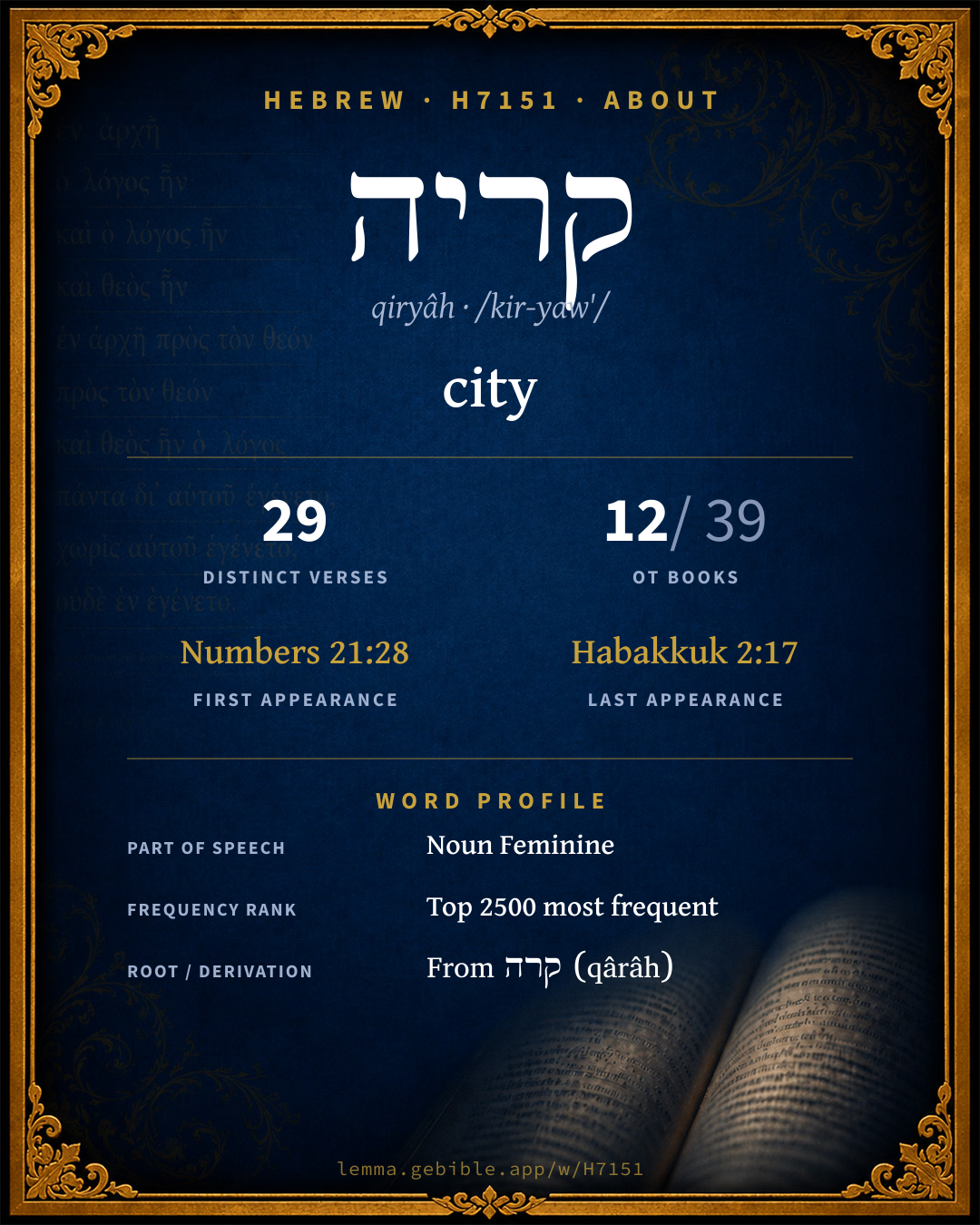
קִרְיָה
city
‘city’ is one of 5 main senses fuller range ↓
Full lexicon entry — Brown-Driver-Briggs (BDB)
From Brown-Driver-Briggs (BDB)
Where this word appears
See every Absolute-state word in the Hebrew Bible →
Grammar key — what these labels mean
Part of speech
- Noun
- A naming word — a person, place, thing, or idea.
Noun type
- Common
- A common noun — a general class of person, place, or thing (“king,” “city,” “water”), not a specific name.
State
- Absolute
- The independent form of a noun, not bound to a following word.
- Construct
- A noun bound to a following noun in a possessive / “of” relationship (the construct chain).
Gender
- Feminine
- Grammatically feminine.
Number
- Singular
- One.
Grammatical forms
- Noun, Common, Feminine, Singular, Absolute 18 times (62%)
- Noun, Common, Feminine, Singular, Construct 11 times (38%)
Parsed forms decoded from the imported morphology (morphhb / Westminster Leningrad Codex — WLC text public domain, morphhb tagging CC BY 4.0), counted across 29 parsed occurrences — not distinct verses.
Every verse where H7151 appears — 29 distinct verses across 12 books. Click any verse to open its interlinear word-by-word view. Verse text shown in the World English Bible for context — . Each verse’s Hebrew form is shown with its reference; the English is not keyword-highlighted, since the data carries no word-level English alignment. Use “Compare translations” on any verse to read it across multiple English versions. This concordance covers the Hebrew Bible; Septuagint (Greek Old Testament) occurrences are not indexed here.
Numbers 1 verse
Deuteronomy 2 verses
- Deuteronomy 2:36 קִרְיָ֔ה n c fs From Aroer, which is on the edge of the valley of the Arnon, and [from] the city that is in the valley, even to Gilead, there was not a city too high for us; Yahweh our God delivered up all before us:
- Deuteronomy 3:4 קִרְיָ֔ה n c fs We took all his cities at that time; there was not a city which we didn't take from them; sixty cities, all the region of Argob, the kingdom of Og in Bashan.
1 Kings 2 verses
- 1 Kings 1:41 הַ/קִּרְיָ֖ה ptcl def.art + n c fs Adonijah and all the guests who were with him heard it as they had made an end of eating. When Joab heard the sound of the trumpet, he said, Why is this noise of the city being in an uproar?
- 1 Kings 1:45 הַ/קִּרְיָ֑ה ptcl def.art + n c fs and Zadok the priest and Nathan the prophet have anointed him king in Gihon; and they are come up from there rejoicing, so that the city rang again. This is the noise that you have heard.
Job 1 verse
Psalms 1 verse
Proverbs 5 verses
- Proverbs 10:15 קִרְיַ֣ת n c fs cs The rich man's wealth is his strong city. The destruction of the poor is their poverty.
- Proverbs 11:10 קִרְיָ֑ה n c fs When it goes well with the righteous, the city rejoices. When the wicked perish, there is shouting.
- Proverbs 18:11 קִרְיַ֣ת n c fs cs The rich man's wealth is his strong city, Like an unscalable wall in his own imagination.
- Proverbs 18:19 מִ/קִּרְיַת prep + n c fs cs A brother offended is more difficult than a fortified city; And disputes are like the bars of a castle.
- Proverbs 29:8 קִרְיָ֑ה n c fs Mockers stir up a city, But wise men turn away anger.
Isaiah 10 verses
- Isaiah 1:21 קִרְיָ֖ה n c fs How the faithful city has become a prostitute! She was full of justice; righteousness lodged in her, But now murderers.
- Isaiah 1:26 קִרְיָ֖ה n c fs I will restore your judges as at the first, And your counselors as at the beginning. Afterward you shall be called 'The city of righteousness, A faithful town.'
- Isaiah 22:2 קִרְיָ֖ה n c fs You that are full of shouting, a tumultuous city, a joyous town; your slain are not slain with the sword, neither are they dead in battle.
- Isaiah 24:10 קִרְיַת n c fs cs The waste city is broken down; every house is shut up, that no man may come in.
- Isaiah 25:2 קִרְיָ֥ה n c fs For you have made of a city a heap, of a fortified city a ruin, a palace of strangers to be no city; it shall never be built.
- Isaiah 25:3 קִרְיַ֛ת n c fs cs Therefore shall a strong people glorify you; a city of awesome nations shall fear you.
- Isaiah 26:5 קִרְיָ֖ה n c fs For he has brought down those who dwell on high, the lofty city: he lays it low, he lays it low even to the ground; he brings it even to the dust.
- Isaiah 29:1 קִרְיַ֖ת n c fs cs Ho Ariel, Ariel, the city where David encamped! add you year to year; let the feasts come round:
- Isaiah 32:13 קִרְיָ֖ה n c fs On the land of my people shall come up thorns and briers; yes, on all the houses of joy in the joyous city.
- Isaiah 33:20 קִרְיַ֖ת n c fs cs Look on Zion, the city of our solemnities: your eyes shall see Jerusalem a quiet habitation, a tent that shall not be removed, the stakes of it shall never be plucked up, neither shall any of the cords of it be broken.
Jeremiah 1 verse
Lamentations 1 verse
Hosea 1 verse
Micah 1 verse
Habakkuk 3 verses
- Habakkuk 2:8 קִרְיָ֖ה n c fs Because you have plundered many nations, all the remnant of the peoples will plunder you, because of men's blood, and for the violence done to the land, to the city and to all who dwell in it.
- Habakkuk 2:12 קִרְיָ֖ה n c fs Woe to him who builds a town with blood, and establishes a city by iniquity!
- Habakkuk 2:17 קִרְיָ֖ה n c fs For the violence done to Lebanon will overwhelm you, and the destruction of the animals, which made them afraid; because of men's blood, and for the violence done to the land, to every city and to those who dwell in them.
About this entry
At a glance — auto-summarized from this page’s data, not written by a person. Every figure links to its source below. This summary describes the numbers; it doesn’t interpret them.
קריה (qiryâh) is a Hebrew noun most often rendered “city.” Not a single-sense word: explore its full sense range. The Hebrew Bible uses it across 29 verses — moderately common. Isaiah dominates its distribution — 10 of 29 verses. It first appears in Numbers 21:28. For the data behind this summary, explore the sense tree and the renderings breakdown below.
Gloss history
Strong's 1890 vs modern scholarship
About this word
Strong's H7151 catalogs a Hebrew word from the Hebrew Old Testament.
These counts are not copied from any lexicon or concordance. They are computed here, from the morphology-tagged Hebrew Old Testament. What Lemma adds →
- 29
- distinct verses
- The word appears in 29 distinct verses.
- 12 / 39
- OT books
- The word appears in 12 of 39 Old Testament books.
- #1,160
- by frequency
- Top 2500 most frequent Hebrew words (rank 1,160 of 8,640 Hebrew words by occurrence).
View all 29 occurrences in the concordance →
By section of the Old Testament
By traditional corpus
Conventional, traditional groupings — biblical authorship is debated, so this is a traditional corpus grouping, not an authorship claim. Each share is this word’s portion of its verses in that division of the Hebrew canon. Each figure is a share of the word’s 29 distinct verses.
- Prophets (Nevi'im) 18 verses · 62%
- Writings (Ketuvim) 8 verses · 28%
- Torah (Pentateuch) 3 verses · 10%
How translations render this word
Counts come from each version’s own published word-to-Strong’s tagging or interlinear alignment — an approximate guide to how each version renders this word, not a word-level alignment the data otherwise carries. Because each total is that version’s own tagged count, the per-version totals vary from one another and need not match the appearance or distinct-verse counts above. These counts may also differ from a printed concordance because Lemma counts each distinctly tagged rendering and does not collapse phrase taggings into a single head-word total. This is a fixed set of word-tagged versions (KJV, ASV, BSB, ULT) and does not change with the reading translation you choose elsewhere. Each version’s license is shown beside its name below (and on Sources).
BDB lists this Strong’s number as 2 distinct words (homographs). Each count above pools all of them and is not split by sense — see the Senses section below. A low-frequency rendering may belong to a different one of those words, not the primary meaning.
- King James Version†: City 27×
- American Standard Version†: City 23×, Kiriath-arba 2×, Town 2×
- Berean Standard Bible†: City 21×, Town 4×
- unfoldingWord Literal Text†: City 14×, City of 7×, The 4×
King James Version Public Domain
Renders H7151 across 31† tagged occurrences — most commonly:
Plus 4 renderings that appear only once — usually multi-word phrases or single function words the recovered tagging swept in, not distinct renderings.
American Standard Version Public Domain
Renders H7151 across 31† tagged occurrences — most commonly:
Plus 2 renderings that appear only once — usually multi-word phrases or single function words the recovered tagging swept in, not distinct renderings.
Berean Standard Bible Public Domain
Renders H7151 across 29† tagged occurrences — most commonly:
Plus 4 renderings that appear only once — usually multi-word phrases or single function words the recovered tagging swept in, not distinct renderings.
unfoldingWord Literal Text CC BY-SA 4.0
Renders H7151 across 33† tagged occurrences — most commonly:
Plus 4 renderings that appear only once — usually multi-word phrases or single function words the recovered tagging swept in, not distinct renderings.
Senses in the full BDB
What do BDB’s symbols mean?
BDB uses these scholarly abbreviations:
| Symbol | Meaning |
|---|---|
| 𝔊 | the Septuagint (the ancient Greek translation, LXX) |
| 𝔙 | the Vulgate (the Latin translation) |
| 𝔖 | the Syriac version (the Peshitta) |
| 𝔗 | the Targum (the Aramaic translation) |
| ψ | the Psalms |
| √ | root (the underlying root or stem) |
| ‖ | parallel passage (a synonymous or contrasted parallel) |
| † | the dagger: every passage where the word occurs is cited |
The 4 senses and sub-senses the full Brown-Driver-Briggs lexicon distinguishes for this word, in lexicon order (not ranked by frequency), with BDB’s own verbatim wording and sub-sense lettering. Shown in Hebrew script with BDB’s own scholarly abbreviations. The condensed entry is in the Lexicon Entry tab. See also the Forms in the corpus table below.
- 1. in gen. Dt 2:36; 3:4. e.g. Deuteronomy 2:36
- 2. of specif. towns, Ho 6:8 (גִּלְעָד, 𝔊Codd. Γαλγαλα, cf. Now); קִרְיַת סִיחֹן Nu 21:28; Damascus, ק׳ מְשׂוֹשִׂי Je 49:25 (‖ עִיר תְּהִלָּה); especially of Jerus. Mi 4:10; Is 29:1; 33:20, רְחֹבוֹת ק׳ La 2:11, ק׳ מֶלֶךְ רָ֑ב ψ 48:3, city for inhab. 1 K 1:41, 45, ק׳ נֶאֱמָנָה Is 1:21, 26 (‖ עִיר הַצֶּדֶק), ק׳ עַלִּיזָה 22:2 (‖ עִיר הוֹמִיָּה), 32:13. e.g. Hosea 6:8
- 3. in Is 24–26 coll., i.e. denoting various, representative, cities, ק׳ תֹּהוּ 24:10, ק׳ בְּצוּרָה 25:2, ק׳ גּוֹיִם עָרִיצִים v 3, ק׳ נִשְׂגָּבָה 26:5; so prob. Hb 2:8, 17. e.g. Isaiah 24:10
- 4. indef., Hb 2:12, (‖ עִיר); Pr 29:8, ק׳ עֹז 18:19 a city of strength, so ק׳ עֻזּוֹ 10:15 (in fig.) = 18:11 (id.); = inhab., 11:10, הֲמוֹן ק׳ Jb 39:7. e.g. Habakkuk 2:12
Senses from the full Brown-Driver-Briggs lexicon (Brown, Driver, Briggs; Oxford 1906 — public domain), digitized via Sefaria, supplemented by the OpenScriptures HebrewLexicon (CC BY 4.0). Full attribution on Sources.
Word origin
n.f. town, city (syn. of עִיר, chiefly poet., and in the higher style; perhaps from above √ as meeting-place of men; cf. n.pr.loc. MI13 קרית, l.10 קריתן; J.Aram. קַרְיָה);—abs. ק׳ Is 1:21 +; cstr. קִרְיַת Nu 21:28 +;—
— Brown-Driver-Briggs (Oxford 1906, public domain), digitized via Sefaria, supplemented by the OpenScriptures HebrewLexicon (CC BY 4.0). See Sources.
Derived from קרה (qârâh) (H7136) — to meet.
Jastrow Dictionary
A second Hebrew/Aramaic lexicon for comparison, covering Aramaic and post-biblical (Talmudic, Targumic, Midrashic) usage that the biblical-Hebrew BDB does not. Matched by lemma rather than by Strong’s number, so a lemma may carry more than one Jastrow headword (shown separately below), and the entries cover usage well beyond the Bible.
קִרְיָה I
- a. II) town, settlement, fort. Lam. R. introd. (R. Naḥman) (ref. to Is. XXIX, 1) ק׳ שחנה וכ׳ the town in which David put up his camp; ק׳ דלא חניא וכ׳ the place where &c., v. חַנְיָא. Ib. ק׳ שעשה וכ׳, v. קְסִרְקִיטוֹן; Yalk. Is. 302. Tanḥ. K’dosh. 9 מעשה היה בקִרְיָתֵנוּ it happened in our place; Lev. R. s. 24, beg. בקרתני (corr. acc.; Yalk. Ps. 680 בעירנו).—Pl. קִרְיוֹת. Y. Snh. I, 18ᶜ bot. מעשה … ק׳ וכ׳ it happened with (representatives of) 24 townships belonging to the house of Rabbi, that they were assembled to proclaim an intercalation at Lydda.—[Y. B. Bath. IX, 17ᵃ קריות, read קרנות, v. קָרוֹן.] e.g. Isaiah 29:1
קִרְיָה II
- (= קִרְיָאָה, v. קוּרְיָיאָה a. קִרְיָיא)townsman, villager. Gen. R. s. 18 (ref. to Gen. II, 22) טבוי לק׳ דמלכא שושביניה lucky is the townsman whose groomsman is the king (‘Rashi’ טבות לקרתא דמלכא שושבינה); Yalk. ib. 24 טובוי לקי׳. e.g. Genesis 2:22
קְרִיָּה
- , v. קְרִיאָה
A Dictionary of the Targumim, the Talmud Babli and Yerushalmi, and the Midrashic Literature (Marcus Jastrow; London, Luzac, 1903) — Public Domain. Digitized via Sefaria. Digitized via Sefaria. Full attribution on Sources.
Forms in the corpus
The 15 distinct written forms H7151 takes in the Hebrew Bible, most frequent first — each parse links to that state’s occurrences in the concordance. Hebrew forms include their vowel points and cantillation, so a single lemma takes many written forms.
Same root — word family
Other BDB entries built from the same root as H7151, grouped by Strong’s listed origin. These share a root / origin per the lexicon — not necessarily a shared meaning. Each links to that word’s own entry.
Derives from
Shares the same root
- מקרה miqreh H4745 chance
- מקרה mᵉqâreh H4746 beam work
- קרה qâreh H7137 chance
- קרי qᵉrîy H7147 opposition
- קרת qereth H7176 city
Derived from this word
Proper names from this root
People and places named from this root — a name, not an additional meaning of the word.
- קריות Qᵉrîyôwth H7152 Kerioth
- קרית ארבע Qiryath ʼArbaʻ H7153 Kirjath-arba
- קרית בעל Qiryath Baʻal H7154 Kirjath-baal
- קרית חצות Qiryath Chutsôwth H7155 Kirjath-huzoth
- קריתים Qiryâthayim H7156 Kiriathaim
- קרית יערים Qiryath Yᵉʻârîym H7157 Kirjath-jearim
- קרית סנה Qiryath Çannâh H7158 Kirjath-sepher
Compare all same-root words → Showing 4 of 15 — not the complete family. 7 of the same-root words are proper names (people or places). They share a root, not necessarily a meaning.
Septuagint verse parallels
This word appears in 28 verses that also exist in the Greek Old Testament (Septuagint), out of the 29 Hebrew verses it occurs in. You can read those verses in Greek by switching the Old Testament edition to the Septuagint.
Read these verses in the Septuagint
- Numbers 21:28
- Deuteronomy 2:36
- 1 Kings 1:41
- Job 39:7
- Psalms 48:2
- Proverbs 10:15
- Isaiah 1:21
- Lamentations 2:11
- Hosea 6:8
- Micah 4:10
- Habakkuk 2:8
This is a verse-level parallel only — the same verses exist in both the Hebrew and Greek Old Testaments. No word-level Hebrew↔Greek correspondence is claimed: the data carries no such alignment, so no Greek word is shown as this Hebrew word’s translation. Coverage is not total — the Septuagint omits the deuterocanon and renumbers the Psalms, so some Hebrew verses have no direct Greek parallel.