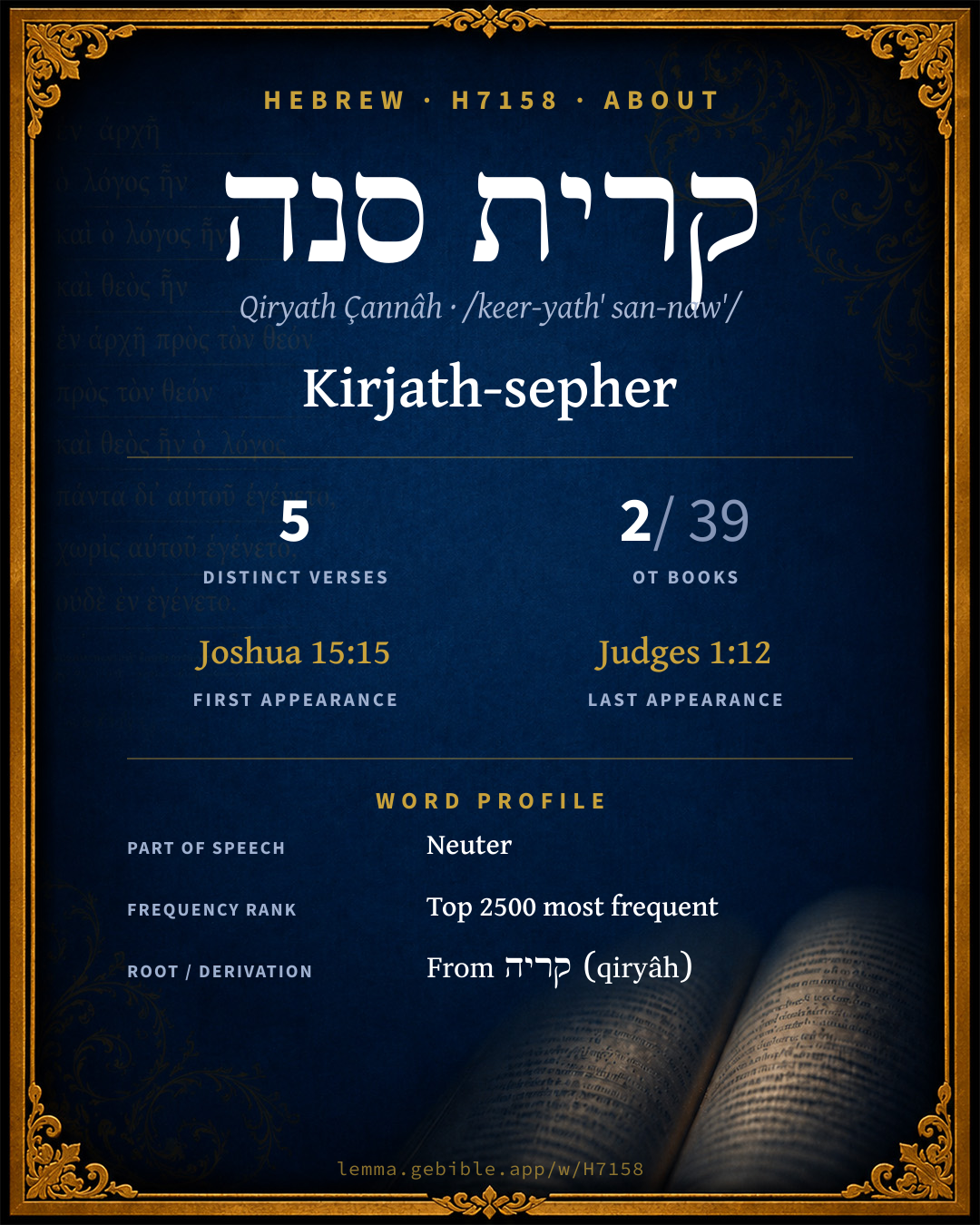
קִרְיַת־סֵ֫פֶר
Kirjath-sepher
BDB lists 2 entries for ‘Kirjath-sepher’ fuller range ↓
Full lexicon entry — Brown-Driver-Briggs (BDB)
From Brown-Driver-Briggs (BDB)
Where this word appears
Grammar key — what these labels mean
Part of speech
- Noun
- A naming word — a person, place, thing, or idea.
Noun type
- Proper
- A name of a specific person, place, or people (e.g. Abraham, Zion, Israel).
Every verse where H7158 appears — 5 distinct verses across 2 books. Click any verse to open its interlinear word-by-word view. Verse text shown in the World English Bible for context — . Each verse’s Hebrew form is shown with its reference; the English is not keyword-highlighted, since the data carries no word-level English alignment. Use “Compare translations” on any verse to read it across multiple English versions. This concordance covers the Hebrew Bible; Septuagint (Greek Old Testament) occurrences are not indexed here.
Joshua 3 verses
- Joshua 15:15 קִרְיַת סֵֽפֶר n Proper n Proper He went up there against the inhabitants of Debir: now the name of Debir before was Kiriath Sepher.
- Joshua 15:16 קִרְיַת סֵ֖פֶר n Proper n Proper Caleb said, He who strikes Kiriath Sepher, and takes it, to him will I give Achsah my daughter as wife.
- Joshua 15:49 וְ/קִרְיַת סַנָּ֖ה conj + n Proper n Proper and Dannah, and Kiriath Sannah (the same is Debir),
Judges 2 verses
About this entry
At a glance — auto-summarized from this page’s data, not written by a person. Every figure links to its source below. This summary describes the numbers; it doesn’t interpret them.
The Hebrew name קרית סנה centers on the idea of “Kirjath-sepher.” It is rare — just 5 verses in the entire Hebrew Bible. Joshua dominates its distribution — 3 of 5 verses. Its earliest occurrence is Joshua 15:15. Dig into 5-verse concordance and the renderings breakdown below.
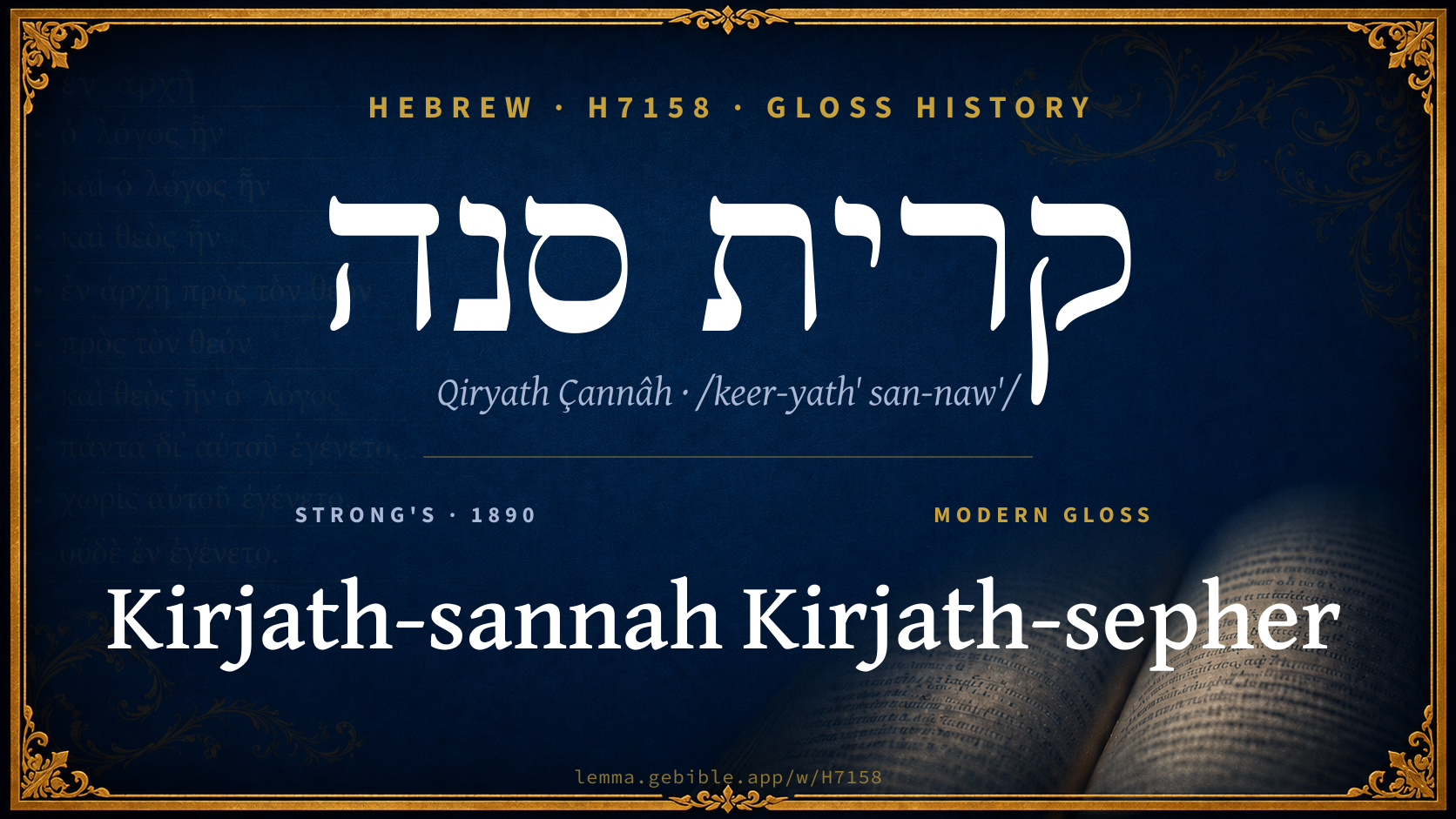
Gloss history
Strong's 1890 vs modern scholarship
About this word
Strong's H7158 catalogs a Hebrew word from the Hebrew Old Testament.
These counts are not copied from any lexicon or concordance. They are computed here, from the morphology-tagged Hebrew Old Testament. What Lemma adds →
- 5
- distinct verses
- The word appears in 5 distinct verses.
- 2 / 39
- OT books
- The word appears in 2 of 39 Old Testament books.
- #2,342
- by frequency
- Top 2500 most frequent Hebrew words (rank 2,342 of 8,640 Hebrew words by occurrence).
View all 5 occurrences in the concordance →
By traditional corpus
Conventional, traditional groupings — biblical authorship is debated, so this is a traditional corpus grouping, not an authorship claim. Each share is this word’s portion of its verses in that division of the Hebrew canon. Each figure is a share of the word’s 5 distinct verses.
- Prophets (Nevi'im) 5 verses · 100%
How translations render this word
Counts come from each version’s own published word-to-Strong’s tagging or interlinear alignment — an approximate guide to how each version renders this word, not a word-level alignment the data otherwise carries. Because each total is that version’s own tagged count, the per-version totals vary from one another and need not match the appearance or distinct-verse counts above. These counts may also differ from a printed concordance because Lemma counts each distinctly tagged rendering and does not collapse phrase taggings into a single head-word total. This is a fixed set of word-tagged versions (KJV, ASV, BSB, ULT) and does not change with the reading translation you choose elsewhere. Each version’s license is shown beside its name below (and on Sources).
BDB lists this Strong’s number as 3 distinct words (homographs). Each count above pools all of them and is not split by sense — see the Senses section below. A low-frequency rendering may belong to a different one of those words, not the primary meaning.
- King James Version†: Kirjathsepher 2×, Was kirjathsepher 2×
- American Standard Version†: Kiriath-sepher 2×, Was kiriath-sepher 2×
- Berean Standard Bible†: Kiriath-sepher 4×
- unfoldingWord Literal Text†: Kiriath 3×, Sepher 3×, Kiriath sepher 2×
King James Version Public Domain
Renders H7158 across 5† tagged occurrences — most commonly:
Plus 1 rendering that appears only once — usually multi-word phrases or single function words the recovered tagging swept in, not distinct renderings.
American Standard Version Public Domain
Renders H7158 across 5† tagged occurrences — most commonly:
Plus 1 rendering that appears only once — usually multi-word phrases or single function words the recovered tagging swept in, not distinct renderings.
Berean Standard Bible Public Domain
Renders H7158 across 5† tagged occurrences — most commonly:
Plus 1 rendering that appears only once — usually multi-word phrases or single function words the recovered tagging swept in, not distinct renderings.
unfoldingWord Literal Text CC BY-SA 4.0
Renders H7158 across 10† tagged occurrences — most commonly:
Plus 2 renderings that appear only once — usually multi-word phrases or single function words the recovered tagging swept in, not distinct renderings.
Senses in BDB
The 2 senses BDB distinguishes for this word, in lexicon order (not ranked by frequency or importance). The full entry — with sub-senses — is in the Lexicon Entry tab.
- Kirjath-sepher or Kirjath-sannah = "city of the book"
- a town in the mountains of Judah to the west of Hebron
Word origin
n.pr.loc. πόλις (τῶν) γραμμάτων, + (𝔊B Ju 1:11) Καριασσωφαρ: ancient name of דְּבִיר (v. ii. ד׳ 2 c) (perhaps ק׳־סֹפֵר scribe-town, cf. 𝔊 supr., also 𝔖 and Egyptian Bai-ti̥ṯu-pa-ï̥rḁ, house of scribe, WMMAs. u. Eur. 174 BuhlGeogr. 274, cf. GFM Ju);—Jos 15:15, 16; Ju 1:11, 12; another name is ק׳־סַנָּה Jos 15:49 (but 𝔊 πόλις γραμμάτων, hence read perhaps ק׳־ספר, so Steuern), in S. Judah; on site (prob. Dhoherîye, 5 h. SW. from Hebron) v. ii. דְּבִיר 2 c and BuhlGeogr. 164.
— Brown-Driver-Briggs (Oxford 1906, public domain), digitized via Sefaria, supplemented by the OpenScriptures HebrewLexicon (CC BY 4.0). See Sources.
Derived from קריה (qiryâh) (H7151) — city.
Jastrow Dictionary
A second Hebrew/Aramaic lexicon for comparison, covering Aramaic and post-biblical (Talmudic, Targumic, Midrashic) usage that the biblical-Hebrew BDB does not. Matched by lemma rather than by Strong’s number, so a lemma may carry more than one Jastrow headword (shown separately below), and the entries cover usage well beyond the Bible.
סְנֶה
- (b. h.) prick, thorn, thorn-bush. Ex. R. s. 2; Tanḥ. Sh’moth 14 (expl. בלבת, Ex. III, 2) משני חלקיו של ס׳ (from the heart of) from upward of two thirds of the height of the thorn-bush. Ib. הם … אף אני בס׳ וכ׳ they (the Israelites) are in anguish, I (the Lord) also appear in the thorn-bush, out of a narrow place. Ex. R. l. c. מה הסנה שפל וכ׳ as the thorn-bush is the lowest of the trees, so are the Israelites &c.; a. fr.—Pl. סְנָאִים, סְנָאִין, סְנָיִים, סְנָיִין. Kil. VIII, 5, a. e. חוּלְדַּת הס׳, v. חוּלְדָּה I. Tanḥ. Ki Thissa 2 סגיין (corr. acc.). B. Mets. 117ᵃ (expl. תקרה) קינים ס׳ וטינא Ar. (ed. קינים וס׳) he must furnish reeds, thorns and clay (for the ceiling).—Y. Meg. I, 72ᵈ top בסנאיו של יוסף, v. סַנּוֹא.] e.g. Exodus 3:2
סני
- to hate, v. שָׂנֵא.
A Dictionary of the Targumim, the Talmud Babli and Yerushalmi, and the Midrashic Literature (Marcus Jastrow; London, Luzac, 1903) — Public Domain. Digitized via Sefaria. Digitized via Sefaria. Full attribution on Sources.
Forms in the corpus
The 5 distinct written forms H7158 takes in the Hebrew Bible, most frequent first — each parse links to that state’s occurrences in the concordance. Hebrew forms include their vowel points and cantillation, so a single lemma takes many written forms.
| Form | Parsing | Example | Uses |
|---|---|---|---|
| קִרְיַת | Noun, Proper | Joshua 15:15 | 4 |
| סֵ֖פֶר | Noun, Proper | Joshua 15:16 | 2 |
| סֵֽפֶר | Noun, Proper | Joshua 15:15 | 2 |
| וְ/קִרְיַת | Noun, Proper | Joshua 15:49 | 1 |
| סַנָּ֖ה | Noun, Proper | Joshua 15:49 | 1 |
Same root — word family
Other BDB entries built from the same root as H7158, grouped by Strong’s listed origin. These share a root / origin per the lexicon — not necessarily a shared meaning. Each links to that word’s own entry.
Derives from
Shares the same root
Proper names from this root
People and places named from this root — a name, not an additional meaning of the word.
- קריות Qᵉrîyôwth H7152 Kerioth
- קרית ארבע Qiryath ʼArbaʻ H7153 Kirjath-arba
- קרית בעל Qiryath Baʻal H7154 Kirjath-baal
- קרית חצות Qiryath Chutsôwth H7155 Kirjath-huzoth
- קריתים Qiryâthayim H7156 Kiriathaim
- קרית יערים Qiryath Yᵉʻârîym H7157 Kirjath-jearim
Compare all same-root words → Showing 4 of 9 — not the complete family. 6 of the same-root words are proper names (people or places). They share a root, not necessarily a meaning.
Bible dictionary
Public-domain dictionary articles matched to this entry by name (Kirjath-sepher). A biblical name can be shared by more than one person or place, so an article may treat several.
Easton's Bible Dictionary · M. G. Easton, 1897
City of books, Josh. 15:15; same as Kirjath-sannah (q.v.), now represented by the valley of ed-Dhaberiyeh, south-west of Hebron. The name of this town is an evidence that the Canaanites were acquainted with writing and books. "The town probably contained a noted school, or was the site of an oracle and the residence of some learned priest." The "books" were probably engraved stones or bricks.
Smith's Bible Dictionary · William Smith, 1863
(city of books). (Joshua 15:15,16; Judges 1:11,12) [Debir]
Hitchcock's Bible Names Dictionary · Roswell D. Hitchcock, 1869
city of letters, or of the book
Classic public-domain reference works; full attribution on Sources.
Septuagint verse parallels
This word appears in 5 verses that also exist in the Greek Old Testament (Septuagint), out of the 5 Hebrew verses it occurs in. You can read those verses in Greek by switching the Old Testament edition to the Septuagint.
Read these verses in the Septuagint
This is a verse-level parallel only — the same verses exist in both the Hebrew and Greek Old Testaments. No word-level Hebrew↔Greek correspondence is claimed: the data carries no such alignment, so no Greek word is shown as this Hebrew word’s translation. Coverage is not total — the Septuagint omits the deuterocanon and renumbers the Psalms, so some Hebrew verses have no direct Greek parallel.