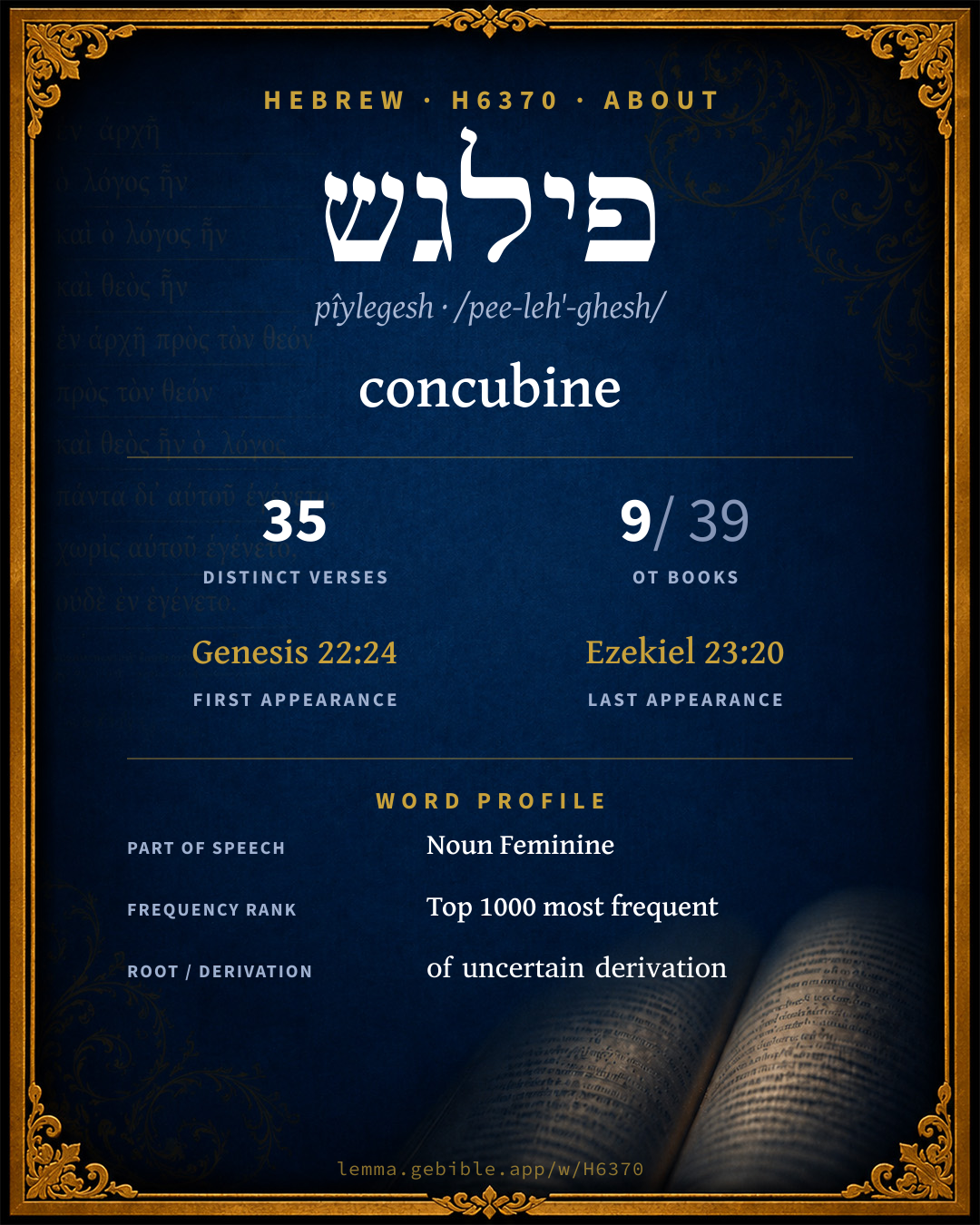
פִּלֶ֫גֶשׁ
concubine
‘concubine’ is one of 3 main senses fuller range ↓
Full lexicon entry — Brown-Driver-Briggs (BDB)
From Brown-Driver-Briggs (BDB)
Where this word appears
See every Construct-state word in the Hebrew Bible →
Grammar key — what these labels mean
Part of speech
- Noun
- A naming word — a person, place, thing, or idea.
Noun type
- Common
- A common noun — a general class of person, place, or thing (“king,” “city,” “water”), not a specific name.
State
- Construct
- A noun bound to a following noun in a possessive / “of” relationship (the construct chain).
- Absolute
- The independent form of a noun, not bound to a following word.
Gender
- Feminine
- Grammatically feminine.
Number
- Singular
- One.
- Plural
- More than one (in Hebrew, generally three or more).
24 distinct verses where H6370 appears in the Construct state, across 6 books. Filtered view — show all forms. Click any verse to open its interlinear word-by-word view. Verse text shown in the World English Bible for context — . Each verse’s Hebrew form is shown with its reference; the English is not keyword-highlighted, since the data carries no word-level English alignment. Use “Compare translations” on any verse to read it across multiple English versions. This concordance covers the Hebrew Bible; Septuagint (Greek Old Testament) occurrences are not indexed here.
Genesis 2 verses
- Genesis 22:24 וּ/פִֽילַגְשׁ֖/וֹ conj + n c fs cs + sfx pers 3ms His concubine, whose name was Reumah, also bare Tebah, Gaham, Tahash, and Maacah.
- Genesis 35:22 פִּילֶ֣גֶשׁ n c fs cs It happened, while Israel lived in that land, that Reuben went and lay with Bilhah, his father's concubine, and Israel heard of it. Now the sons of Jacob were twelve.
Judges 11 verses
- Judges 8:31 וּ/פִֽילַגְשׁ/וֹ֙ conj + n c fs cs + sfx pers 3ms His concubine who was in Shechem, she also bore him a son, and he named him Abimelech.
- Judges 19:2 פִּֽילַגְשׁ֔/וֹ n c fs cs + sfx pers 3ms His concubine played the prostitute against him, and went away from him to her father's house to Bethlehem Judah, and was there the space of four months.
- Judges 19:9 וּ/פִילַגְשׁ֖/וֹ conj + n c fs cs + sfx pers 3ms When the man rose up to depart, he, and his concubine, and his servant, his father-in-law, the young lady's father, said to him, Behold, now the day draws toward evening, please stay all night: behold, the day grows to an end, lodge here, that your heart may be merry; and tomorrow get you early on your way, that you may go home.
- Judges 19:10 וּ/פִילַגְשׁ֖/וֹ conj + n c fs cs + sfx pers 3ms But the man wouldn't stay that night, but he rose up and departed, and came over against Jebus (the same is Jerusalem): and there were with him a couple of donkeys saddled; his concubine also was with him.
- Judges 19:24 וּ/פִֽילַגְשֵׁ֗/הוּ conj + n c fs cs + sfx pers 3ms Behold, here is my daughter a virgin, and his concubine; them I will bring out now, and humble you them, and do with them what seems good to you: but to this man don't do any such folly.
- Judges 19:25 בְּ/פִ֣ילַגְשׁ֔/וֹ prep + n c fs cs + sfx pers 3ms But the men wouldn't listen to him: so the man laid hold on his concubine, and brought her forth to them; and they knew her, and abused her all the night until the morning: and when the day began to spring, they let her go.
- Judges 19:27 פִֽילַגְשׁ֗/וֹ n c fs cs + sfx pers 3ms Her lord rose up in the morning, and opened the doors of the house, and went out to go his way; and, behold, the woman his concubine was fallen down at the door of the house, with her hands on the threshold.
- Judges 19:29 בְּ/פִֽילַגְשׁ֔/וֹ prep + n c fs cs + sfx pers 3ms When he was come into his house, he took a knife, and laid hold on his concubine, and divided her, limb by limb, into twelve pieces, and sent her throughout all the borders of Israel.
- Judges 20:4 וּ/פִֽילַגְשִׁ֖/י conj + n c fs cs + sfx pers 1cs The Levite, the husband of the woman who was murdered, answered, I came into Gibeah that belongs to Benjamin, I and my concubine, to lodge.
- Judges 20:5 פִּילַגְשִׁ֥/י n c fs cs + sfx pers 1cs The men of Gibeah rose against me, and beset the house round about me by night; me they thought to have slain, and my concubine they forced, and she is dead.
- Judges 20:6 בְּ/פִֽילַגְשִׁ/י֙ prep + n c fs cs + sfx pers 1cs I took my concubine, and cut her in pieces, and sent her throughout all the country of the inheritance of Israel; for they have committed lewdness and folly in Israel.
2 Samuel 5 verses
- 2 Samuel 3:7 פִּלֶ֔גֶשׁ פִּילֶ֥גֶשׁ n c fs n c fs cs Now Saul had a concubine, whose name was Rizpah, the daughter of Aiah: and [Ish-bosheth] said to Abner, Why have you gone in to my father's concubine?
- 2 Samuel 16:21 פִּלַגְשֵׁ֣י n c fp cs Ahithophel said to Absalom, Go in to your father's concubines, that he has left to keep the house; and all Israel will hear that you are abhorred of your father: then will the hands of all who are with you be strong.
- 2 Samuel 16:22 פִּֽלַגְשֵׁ֣י n c fp cs So they spread Absalom a tent on the top of the house; and Absalom went in to his father's concubines in the sight of all Israel.
- 2 Samuel 19:5 פִּלַגְשֶֽׁי/ךָ n c fp cs + sfx pers 2ms Joab came into the house to the king, and said, You have shamed this day the faces of all your servants, who this day have saved your life, and the lives of your sons and of your daughters, and the lives of your wives, and the lives of your concubines;
- 2 Samuel 21:11 פִּלֶ֥גֶשׁ n c fs cs It was told David what Rizpah the daughter of Aiah, the concubine of Saul, had done.
1 Chronicles 4 verses
- 1 Chronicles 1:32 פִּילֶ֣גֶשׁ n c fs cs The sons of Keturah, Abraham's concubine: she bore Zimran, and Jokshan, and Medan, and Midian, and Ishbak, and Shuah. The sons of Jokshan: Sheba, and Dedan.
- 1 Chronicles 2:46 פִּילֶ֣גֶשׁ n c fs cs Ephah, Caleb's concubine, bore Haran, and Moza, and Gazez; and Haran became the father of Gazez.
- 1 Chronicles 2:48 פִּלֶ֤גֶשׁ n c fs cs Maacah, Caleb's concubine, bore Sheber and Tirhanah.
- 1 Chronicles 7:14 פִּֽילַגְשׁ/וֹ֙ n c fs cs + sfx pers 3ms The sons of Manasseh: Asriel, whom his concubine the Aramitess bore: she bore Machir the father of Gilead:
2 Chronicles 1 verse
Ezekiel 1 verse
About this entry
At a glance — auto-summarized from this page’s data, not written by a person. Every figure links to its source below. This summary describes the numbers; it doesn’t interpret them.
פילגש (pîylegesh) is a Hebrew noun most often rendered “concubine.” Debuting at Genesis 22:24, it then recurs through the corpus. With 35 verses in 9 books, it is a moderately common word in the Hebrew Bible. It concentrates in Judges, which alone accounts for 34% of its uses. It is not a single-sense word — see its full sense range. For the data behind this summary, explore the sense tree and the renderings breakdown below.
Gloss history
Strong's 1890 vs modern scholarship
About this word
Strong's H6370 catalogs a Hebrew word from the Hebrew Old Testament.
These counts are not copied from any lexicon or concordance. They are computed here, from the morphology-tagged Hebrew Old Testament. What Lemma adds →
- 35
- distinct verses
- The word appears in 35 distinct verses.
- 9 / 39
- OT books
- The word appears in 9 of 39 Old Testament books.
- #967
- by frequency
- Top 1000 most frequent Hebrew words (rank 967 of 8,640 Hebrew words by occurrence).
View all 35 occurrences in the concordance →
Most concentrated in
- Judges 12 verses 34%
- 2 Samuel 8 verses 23%
- 1 Chronicles 5 verses 14%
By section of the Old Testament
By traditional corpus
Conventional, traditional groupings — biblical authorship is debated, so this is a traditional corpus grouping, not an authorship claim. Each share is this word’s portion of its verses in that division of the Hebrew canon. Each figure is a share of the word’s 35 distinct verses.
- Prophets (Nevi'im) 22 verses · 63%
- Writings (Ketuvim) 9 verses · 26%
- Torah (Pentateuch) 4 verses · 11%
How translations render this word
Counts come from each version’s own published word-to-Strong’s tagging or interlinear alignment — an approximate guide to how each version renders this word, not a word-level alignment the data otherwise carries. Because each total is that version’s own tagged count, the per-version totals vary from one another and need not match the appearance or distinct-verse counts above. These counts may also differ from a printed concordance because Lemma counts each distinctly tagged rendering and does not collapse phrase taggings into a single head-word total. This is a fixed set of word-tagged versions (KJV, ASV, BSB, ULT) and does not change with the reading translation you choose elsewhere. Each version’s license is shown beside its name below (and on Sources).
- King James Version: Concubine 17×, Concubines 12×
- American Standard Version: Concubine 9×, Concubines 9×, 's concubine 5×
- Berean Standard Bible: Concubine 19×, Concubines 14×
- unfoldingWord Literal Text: Concubine 17×, Concubines 11×, Concubine of 6×
King James Version Public Domain
Renders H6370 across 36 tagged occurrences — most commonly:
Plus 7 renderings that appear only once — usually multi-word phrases or single function words the recovered tagging swept in, not distinct renderings. Not rendered by a distinct English word in 1 further occurrence.
American Standard Version Public Domain
Renders H6370 across 36 tagged occurrences — most commonly:
Plus 11 renderings that appear only once — usually multi-word phrases or single function words the recovered tagging swept in, not distinct renderings.
Berean Standard Bible Public Domain
Renders H6370 across 37 tagged occurrences — most commonly:
Plus 4 renderings that appear only once — usually multi-word phrases or single function words the recovered tagging swept in, not distinct renderings.
unfoldingWord Literal Text CC BY-SA 4.0
Renders H6370 across 40 tagged occurrences — most commonly:
Plus 2 renderings that appear only once — usually multi-word phrases or single function words the recovered tagging swept in, not distinct renderings.
Senses in the full BDB
What do BDB’s symbols mean?
BDB uses these scholarly abbreviations:
| Symbol | Meaning |
|---|---|
| 𝔊 | the Septuagint (the ancient Greek translation, LXX) |
| 𝔙 | the Vulgate (the Latin translation) |
| 𝔖 | the Syriac version (the Peshitta) |
| 𝔗 | the Targum (the Aramaic translation) |
| ψ | the Psalms |
| √ | root (the underlying root or stem) |
| ‖ | parallel passage (a synonymous or contrasted parallel) |
| † | the dagger: every passage where the word occurs is cited |
The 2 senses and sub-senses the full Brown-Driver-Briggs lexicon distinguishes for this word, in lexicon order (not ranked by frequency), with BDB’s own verbatim wording and sub-sense lettering. Shown in Hebrew script with BDB’s own scholarly abbreviations. The condensed entry is in the Lexicon Entry tab. See also the Forms in the corpus table below.
- 1. concubine Gn 22:24; 25:6; 35:22; 36:12; Ju 8:31; 19:1 + 10 times Ju 19, 20, 2 S 3:7(×2) + 7 times 2 S, 1 K 11:13; 1 Ch 1:32 + 6 times Ch, Est 2:14 Ct 6:8, 9. e.g. Genesis 22:24
- 2. either = paramour (perhaps contempt.; ὁ πάλλαξ = youth), or concubinage Ez 23:20 (fig. of Jerusalem doting on Babylon). e.g. Ezekiel 23:20
Senses from the full Brown-Driver-Briggs lexicon (Brown, Driver, Briggs; Oxford 1906 — public domain), digitized via Sefaria, supplemented by the OpenScriptures HebrewLexicon (CC BY 4.0). Full attribution on Sources.
Word origin
n.f. concubine (NH id.; 𝔗Jer פִּילַּקְתָּא (פַּלְקְתָא), perhaps influenced by Gk. παλλακή, παλλακίς (proposes young girl), Lat. pellex; orig. Gk. word according to StaG. i.380, cf. also LewyFremdw. 66 f.; on poss. Hittite origin v. JenZMG xlviii (1894), 468 ff.);—פִּ׳ abs. 2 S 3:7, cstr. 21:11, פִּי׳ abs. Gn 36:12; Ju 19:1, cstr. Gn 35:22 + 4 times; sf. פִּילַנְשׁוֹ 22:24 +, שֵׁהוּ- Ju 19:24; שִׁי- 20:4 + 2 times; pl. פִּלַגְשִׁים 2 S 5:13 + 2 times, פִּי׳ Gn 25:6 + 5 times; cstr. פִּלַגְשֵׁי 2 S 16:21, 22; sf. פִּילַגְשָׁיו 2 Ch 11:21, פִּלַגְשֶׁיךָ 2 S 19:6, פִּלַגְשֵׁיהֶם Ez 23:20;—
— Brown-Driver-Briggs (Oxford 1906, public domain), digitized via Sefaria, supplemented by the OpenScriptures HebrewLexicon (CC BY 4.0). See Sources.
Origin: of uncertain derivation
Jastrow Dictionary
A second Hebrew/Aramaic lexicon for comparison, covering Aramaic and post-biblical (Talmudic, Targumic, Midrashic) usage that the biblical-Hebrew BDB does not. Matched by lemma rather than by Strong’s number, so a lemma may carry more than one Jastrow headword (shown separately below), and the entries cover usage well beyond the Bible.
פִּילֶּגֶשׁ
- , v. פִּלֶּגֶשׁ
A Dictionary of the Targumim, the Talmud Babli and Yerushalmi, and the Midrashic Literature (Marcus Jastrow; London, Luzac, 1903) — Public Domain. Digitized via Sefaria. Digitized via Sefaria. Full attribution on Sources.
Forms in the corpus
The 33 distinct written forms H6370 takes in the Hebrew Bible, most frequent first — each parse links to that state’s occurrences in the concordance. Hebrew forms include their vowel points and cantillation, so a single lemma takes many written forms.
Septuagint verse parallels
This word appears in 34 verses that also exist in the Greek Old Testament (Septuagint), out of the 35 Hebrew verses it occurs in. You can read those verses in Greek by switching the Old Testament edition to the Septuagint.
Read these verses in the Septuagint
- Genesis 22:24
- Judges 8:31
- 2 Samuel 3:7
- 1 Chronicles 1:32
- 2 Chronicles 11:21
- Esther 2:14
- Song of Solomon 6:8
- Ezekiel 23:20
This is a verse-level parallel only — the same verses exist in both the Hebrew and Greek Old Testaments. No word-level Hebrew↔Greek correspondence is claimed: the data carries no such alignment, so no Greek word is shown as this Hebrew word’s translation. Coverage is not total — the Septuagint omits the deuterocanon and renumbers the Psalms, so some Hebrew verses have no direct Greek parallel.