1 Chronicles 2:46

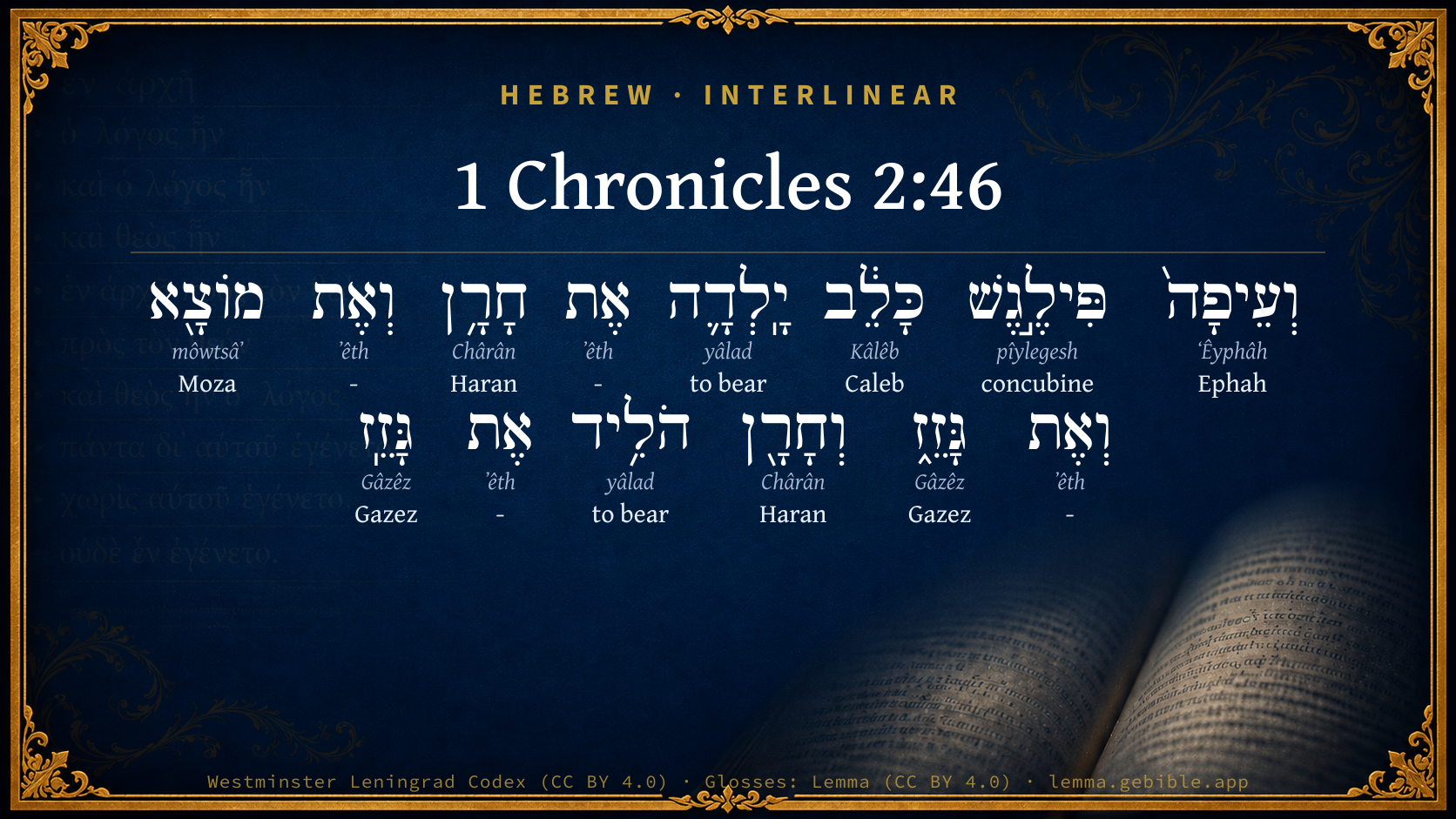
Hebrew (Westminster Leningrad Codex) 1 Chronicles 2:46 appears in the Hebrew Old Testament. The text above is from the Westminster Leningrad Codex. Each word links to its Strong’s number, a concise gloss, and parsing drawn from the Open Scriptures Hebrew Bible morphology. Click any word for its full Brown-Driver-Briggs (BDB) entry.
Download image
Cite this verse

1 Chronicles 2:46 (World English Bible). Public Domain. Lemma interlinear Bible study tool, https://lemma.gebible.app/v/1-chronicles/2/46.

Show BibTeX & RIS
BibTeX
RIS
English Translation
Ephah, Caleb's concubine, bore Haran, and Moza, and Gazez; and Haran became the father of Gazez.
World English Bible · Public Domain
Highlights
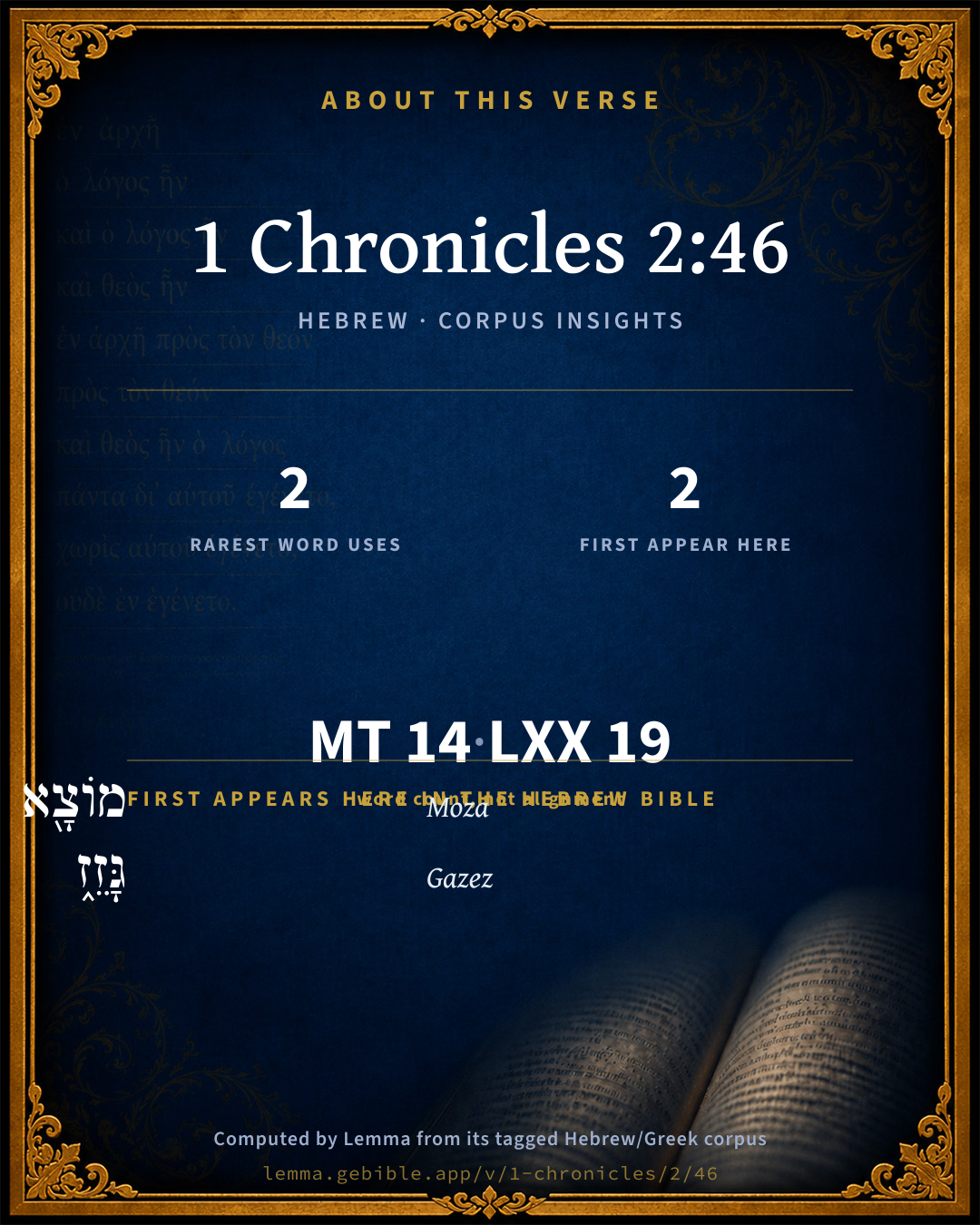
  • 2 first appearances in the Hebrew Bible
Full analysis ↓
Download a study sheet

One document with this verse’s original text, its word-by-word gloss line, the meaning frame, cross-references with their text, attributed commentary, and full source and license credits — printable, and it pastes into notes with its structure intact.

This verse Autodidact and up

Study sheet (.html) Plain text (.txt)

A passage Seminary Student

Up to 50 verses in one chapter. A passage sheet keeps up to 6 commentary sources and 12 cross-references per verse, in the order this page ranks them, and says so on the sheet whenever that leaves anything out. Ask for a single verse and you get the Autodidact verse sheet above.

Everything on this page stays free to read, with no account — the sheet is a download of what is already on screen, not access to it.

Want to remove ads? Support Godless Engineer
Compare translations 3

The same verse in 3 English versions, stacked beneath the original-language interlinear above. Click any original word for its lexicon entry.

Each is an independent rendering of the whole verse — the interlinear is not word-aligned to these translations.

Highlighted words mark where these versions differ — a whole-verse word diff, not a word-by-word alignment.

  • World English Bible Public Domain
    Ephah, Caleb's concubine, bore Haran, and Moza, and Gazez; and Haran became the father of Gazez.
  • King James Version Public Domain
    And Ephah, Caleb's concubine, bare Haran, and Moza, and Gazez: and Haran begat Gazez.
  • unfoldingWord Literal Text CC BY-SA 4.0
    And Ephah, the concubine of Caleb, bore Haran and Moza and Gazez. And Haran fathered Gazez.

unfoldingWord Literal Text — © unfoldingWord, licensed CC BY-SA 4.0. Word-aligned USFM3 via Door43 (git.door43.org/unfoldingWord/en_ult).

Versions to compare (up to 4)

3 of 4 selected

Show all 18 translations

Every available English version of this verse, each an independent rendering of the whole verse.

  • World English Bible Public Domain
    Ephah, Caleb's concubine, bore Haran, and Moza, and Gazez; and Haran became the father of Gazez.
  • Berean Standard Bible Public Domain
    Caleb’s concubine Ephah was the mother of Haran, Moza, and Gazez. Haran was the father of Gazez.
  • Majority Standard Bible Public Domain
    Caleb’s concubine Ephah was the mother of Haran, Moza, and Gazez. Haran was the father of Gazez.
  • King James Version Public Domain
    And Ephah, Caleb's concubine, bare Haran, and Moza, and Gazez: and Haran begat Gazez.
  • American Standard Version (1901) Public Domain
    And Ephah, Caleb's concubine, bare Haran, and Moza, and Gazez; and Haran begat Gazez.
  • Revised Version (1885) Public Domain
    And Ephah, Caleb’s concubine, bare Haran, and Moza, and Gazez: and Haran begat Gazez.
  • Geneva Bible (1599) Public Domain
    And Ephah a concubine of Caleb bare Haran and Moza, and Gazez: Haran also begate Gazez.
  • Douay-Rheims (1899) Public Domain
    And Epha the concubine of Caleb bore Haran, and Mesa, and Gezez. And Haran beget Gezez.
  • Young's Literal Translation Public Domain
    And Ephah concubine of Caleb bare Haran, and Moza, and Gazez; and Haran begat Gazez.
  • Literal Standard Version CC BY-SA 4.0
    And Ephah concubine of Caleb bore Haran, and Moza, and Gazez; and Haran begot Gazez.
  • Unlocked Literal Bible CC BY-SA 4.0
    Ephah, Caleb's concubine, bore Haran, Moza, and Gazez. Haran became the father of Gazez.
  • unfoldingWord Literal Text CC BY-SA 4.0
    And Ephah, the concubine of Caleb, bore Haran and Moza and Gazez. And Haran fathered Gazez.
  • Darby Bible Public Domain
    And Ephah, Caleb's concubine, bore Haran, and Moza, and Gazez; and Haran begot Gazez.
  • World Messianic Bible Public Domain
    Efah, Caleb’s concubine, bore Haran, Moza, and Gazez; and Haran became the father of Gazez.
  • Webster's Bible Public Domain
    And Ephah, Caleb's concubine, bore Haran, and Moza, and Gazez: and Haran begat Gazez.
  • Free Bible Version CC BY-SA 4.0
    Ephah, Caleb's concubine, was the mother of Haran, Moza, and Gazez. Haran was the father of Gazez.
  • Bible in Basic English Public Domain
    And Ephah, Caleb's servant-wife, had Haran and Moza and Gazez; and Haran was the father of Gazez.
  • JPS Tanakh (1917) Public Domain
    And Ephah, Caleb's concubine, bore Haran, and Moza, and Gazez; and Haran begot Gazez.

Literal Standard Version (2020), Covenant Press — licensed CC BY-SA 4.0. Text via the HelloAO Bible API (eBible.org). Unlocked Literal Bible (unfoldingWord) — licensed CC BY-SA 4.0. Text via the HelloAO Bible API (eBible.org). unfoldingWord Literal Text — © unfoldingWord, licensed CC BY-SA 4.0. Word-aligned USFM3 via Door43 (git.door43.org/unfoldingWord/en_ult). Free Bible Version, Dr. Jonathan Gallagher — licensed CC BY-SA 4.0. Text via the HelloAO Bible API (eBible.org).

Word by word

More ways to search: Search by grammar → Find every occurrence → Compare this word →

Practice this passage: Drill this verse → Learn its vocabulary →

About this verse

These counts appear in no published source. They are computed here, from the morphology-tagged text and Lemma’s own curated glosses. What Lemma adds →

14
words
8
distinct lemmas
Historical
section

Notable vocabulary

The rarest word here is גָּזֵ֑ז Gazez H1495 — appearing just 2 times in the whole Hebrew Bible.

First appearance in Scripture

These words make their first canonical appearance in the Hebrew Bible here:

  • מוֹצָ֖א Moza H4162
  • גָּזֵ֑ז Gazez H1495

Grammatical profile

  • 2 verbs
  • 8 nouns
  • 4 particles

Verb forms

  • יָֽלְדָ֛ה Qal · Perfect
  • הֹלִ֥יד Hiphil · Perfect

Repetition

Words recur within this verse — often emphatic in Hebrew:

  • יָֽלְדָ֛ה to bear H3205 ×2
  • חָרָ֥ן Haran H2771 ×2
  • גָּזֵ֑ז Gazez H1495 ×2

Hebrew & Septuagint length

In English translation the verse runs 16 words from the Hebrew and 12 from the Septuagint (LXX English) — closely comparable.

A rough comparison of the two English renderings, which tokenize alike — not a word-level alignment.

Word counts can differ between the Hebrew and the Greek without any difference in meaning — e.g. the Hebrew direct-object marker אֵת has no separate Greek word, and Greek often adds the article ὁ.

In the original languages it is 14 Hebrew tokens and 19 Greek tokens — but the two are counted differently (Hebrew bundles its prefixes and suffixes into one token; the Greek is in lemma form), so that isn’t a like-for-like length.

Cross-references

2

Topical passages linked to 1 Chronicles 2:46 in the Treasury of Scripture Knowledge — connected by theme and wording, ordered by reader-vote popularity; previews shown in the World English Bible.

  • 1 Chronicles 2:18–19 Caleb the son of Hezron became the father of [children] of Azubah [his] wife, and of Jerioth; and these were her sons: Jesher, and Shobab, and Ardon.
  • 1 Chronicles 2:48 Maacah, Caleb's concubine, bore Sheber and Tirhanah.

Cross-references courtesy of OpenBible.info (CC BY 4.0).

Hebrew and Greek witnesses Masoretic Hebrew ↔ Greek Septuagint

The same verse in the two great witnesses to the Old Testament, shown verse-for-verse.

These are two independent witnesses, not word-aligned to each other, and the Septuagint is shown in lemma (dictionary) form.

Hebrew 1 Chronicles 2:46 Masoretic · Westminster Leningrad Codex

וְעֵיפָה֙ פִּילֶ֣גֶשׁ כָּלֵ֔ב יָֽלְדָ֛ה אֶת חָרָ֥ן וְאֶת מוֹצָ֖א וְאֶת גָּזֵ֑ז וְחָרָ֖ן הֹלִ֥יד אֶת גָּזֵֽז

Ephah, Caleb's concubine, bore Haran, and Moza, and Gazez; and Haran became the father of Gazez.

World English Bible · Public Domain

Greek LXX 1 Chronicles 2:46 Septuagint · lemma form

καί γαιφα ὁ παλλακή χαλεβ γεννάω ὁ αρραν καί ὁ μωσά καί ὁ γεζουε καί αρραν γεννάω ὁ γεζουε

And Gaepha the concubine of Chaleb bore Aram, and Mosa, and Gezue.

LXX2012 (modern English Septuagint) · Public Domain

On this verse, Ellicott's Commentary for English Readers discusses the Septuagint’s reading. Read the note in Commentary ↓

Hebrew: Westminster Leningrad Codex (CC BY 4.0). Greek: Septuagint (public domain); English from LXX2012 (modern English Septuagint) (Public Domain). How the Septuagint differs from the Hebrew →

Commentary

Notes on 1 Chronicles 2:46 from classic Christian and Jewish commentators (each source and its license shown beneath its notes). The classic Christian expositions comment on the surrounding passage and are grouped to its opening verse, so a note may address several verses; the Jewish commentaries on the Tanakh (Rashi and others) are per-verse, so they appear only where the commentator wrote on this verse.

Lemma curates 59 commentaries, every one of them public domain or Creative Commons licensed, each selected and text-cleaned for this edition rather than reprinted as found. About our sources →

Ellicott's Commentary for English Readers

II.—1Ch_2:46-49 : The sons of Ephah and Maachah, two concubines of Caleb.

(46) Ephah, Caleb’s concubine . . .—These sons of concubines appear to represent mixed populations or tribal groups considered to be of less pure descent than the chief houses of Caleb. The same title of inferiority might cover a relation of dependence, something like that of the clients of the great Roman houses. The name Ephah occurred in 1Ch_1:33 as a tribe of the Midianites. It is likely, therefore, that we have before us a record of the admixture of a Midianite element with the southern Judeans.

Haran.—Abraham’s brother (Gen_11:26); a place in Mesopotamia where Abraham settled (Gen_11:31). It is the Assyrian harranu (high-road). The Midianites claimed descent from Abraham (1Ch_1:33), this name therefore might well be borne by a semi-Midianite clan.

Moza.—Occurs in Jos_18:26 as a town in Benjamin.

Haran begat Gazez.—Comp. 1Ch_2:24, Note. Gazez was probably a branch of the clan Haran. The LXX. (Vat.) omits the clause.

(47) The sons of Jahdai.—Heb., Yohdai, or Yehdai. The connection of these tribal groups with the foregoing is not clear; but from 1Ch_2:46 it appears that they were Calebites with a foreign admixture. It is curious to find the Midianite name Ephah recurring among them.

(48) Maachah, Caleb’s concubine, bare . . .—The Heb. is peculiar, “Caleb’s concubine Maachah—he bare Sheber,” &c. There is another reading, “she bare.” Maachah was a well-known Syrian state (Deu_3:14). (Comp. 2Sa_3:3; 1Ch_11:43; 1Ch_19:6-7; and 2Ki_25:23.) These Calebites, it would seem, were of partly Aramean origin. The masculine verb “he bare” is intelligible if Maachah means not a woman, but a race. (Comp. 1Ch_19:15, “Aram hath fled” = the Syrians have fled; 16, “Aram saw,” &c.)

(49) Madmannah.—A town of southern Judah, mentioned along with Ziklag in Jos_15:31. The Shaaf who settled here are different from those mentioned in 1Ch_2:47.

Machbenah, an unknown place in Judah, and Gibeah in the hill-country (Jos_15:57) were settlements of the mixed Calebites called Sheva.

The daughter of Caleb was Achsa.—In Jos_15:13-19 the father of Achsah is called Caleb son of Jephunneh. This Caleb son of Jephunneh is associated with Joshua in the Pentateuch (Num_12:6; Num_12:8), and took a prominent part in the conquest of Canaan.

As he represents Judah (Num_12:6; comp. Jdg_1:10-12), it is reasonable to see in Caleb son of Jephunneh the chief of the tribal division of Hezron-Caleb in the time of Joshua.

Already in these curious lists we have met with special memorials of remarkable members of clans (comp. 1Ch_2:6-7; 1Ch_2:20), and we may see in the brief clause “and Achsah, daughter of Caleb” a similar notice that this famous person was a Calebite.

A Bible Commentary for English Readers, edited by Charles John Ellicott (1878–1897) — public domain. Text from a community e-Sword module.

Geneva Bible (1599)

Geneva Bible translators

This difference was between the wife and the concubine, that the wife was taken with certain solemnities of marriage, and her children did inherit: the concubine had no solemnities in marriage, neither did her children inherit, but had a portion of goods or money given them.

Geneva Bible (1599) marginal notes — public domain. Text via Bolls.life.

John Gill's Exposition

And the families of Kirjathjearim,.... That dwelt there, of which Shobal was prince, and who sprung from him, are as follow:

the Ithrite, and the Puhites, and the Shumathites, and the Mishraites; who had their names from Jether, Putha, Shumath, and Mishra, descendants of Shobal:

of them came the Zareathites, and the Eshtaulites; that is, from the Mishraites sprung the inhabitants of Zeroth and Eshtaol, places in the tribe of Judah, Jos 15:33.

John Gill's Exposition of the Whole Bible (1746–1763) — public domain (CC PDM 1.0). Text via the HelloAO Bible API.

The Pulpit Commentary

Vers. 46-49 give the names the first of which appears as that of a man also, next verse and (1Ch_1:33) of two additional concubines of Caleb, and of their descendants.

The Pulpit Commentary (1880–1919), ed. H.D.M. Spence-Jones & Joseph S. Exell — public domain. Text from a community e-Sword module.

Keil & Delitzsch

C. F. Keil & F. Delitzsch

And the families of Kirjathjearim,.... That dwelt there, of which Shobal was prince, and who sprung from him, are as follow:

the Ithrite, and the Puhites, and the Shumathites, and the Mishraites; who had their names from Jether, Putha, Shumath, and Mishra, descendants of Shobal:

of them came the Zareathites, and the Eshtaulites; that is, from the Mishraites sprung the inhabitants of Zeroth and Eshtaol, places in the tribe of Judah, Jos 15:33.

Keil & Delitzsch — Biblical Commentary on the Old Testament (1861–1891) — public domain (CC PDM 1.0). Text via the HelloAO Bible API. (Old Testament only.)

Lesson kit

Teaching starters — assembled from the data on this page, not authored interpretation. Every prompt links to the verse data it draws on. Edit before teaching.

1 Chronicles, in the Historical, opens this verse with 14 words (8 distinct Hebrew lemmas). Its most distinctive word is Gâzêz (“Gazez”). A historical commentator’s framing appears above. Read the whole chapter for the surrounding context.

Discussion questions

  1. The word Gâzêz carries the sense “Gazez.” How does it shape the verse?
  2. 2 words make their first appearance in Scripture here. What does this debut establish?
  3. How does 1 Chronicles 2:18–19, which shares this passage’s theme, read alongside this verse?
  4. What does the repetition of “to bear” (2× in this one verse) do in this verse?
  5. These translations render this verse differently. What is at stake in choosing one wording over another?
  6. «יָֽלְדָ֛ה» is a Qal Perfect verb. How does that grammatical form shape the action described?
  7. Compare how Ellicott's Commentary for English Readers and Geneva Bible (1599) read this verse. Where do they agree or differ?

Things to notice

Reading settings

Reading text

Shown beneath each verse's original-language words.

Old Testament
Old Testament edition

Read the OT as the Masoretic Hebrew (MT) or the Greek Septuagint (LXX).

English shown for the Greek Septuagint (in the Hebrew ↔ Greek comparison).

Comparing translations? Open the Compare panel on any verse page to stack up to four side by side.