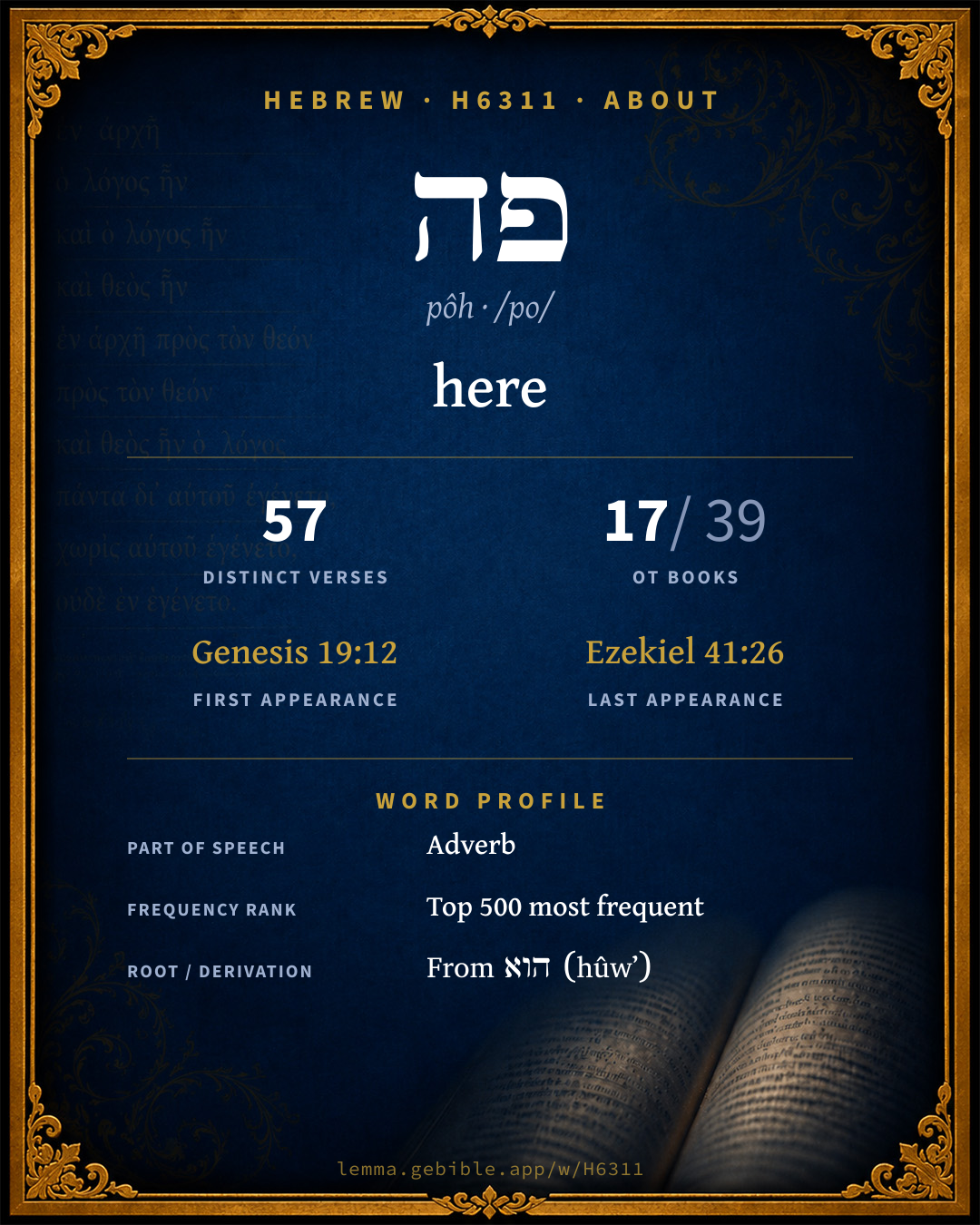
פֹּה
here
also: from here, hither fuller range ↓
Full lexicon entry — Brown-Driver-Briggs (BDB)
From Brown-Driver-Briggs (BDB)
Where this word appears
Grammar key — what these labels mean
Part of speech
- Adverb
- A word that modifies a verb, adjective, or other adverb.
Every verse where H6311 appears in the Book of Genesis — 3 distinct verses. Click any verse to open its interlinear word-by-word view. Verse text shown in the World English Bible for context — . Each verse’s Hebrew form is shown with its reference; the English is not keyword-highlighted, since the data carries no word-level English alignment. Use “Compare translations” on any verse to read it across multiple English versions. This concordance covers the Hebrew Bible; Septuagint (Greek Old Testament) occurrences are not indexed here.
Genesis
- Genesis 19:12 פֹ֔ה adv The men said to Lot, "Do you have anybody else here? Sons-in-law, your sons, your daughters, and whoever you have in the city, bring them out of the place:
- Genesis 22:5 פֹּה֙ adv Abraham said to his young men, "Stay here with the donkey. The boy and I will go yonder. We will worship, and come back to you.
- Genesis 40:15 פֹּה֙ adv For indeed, I was stolen away out of the land of the Hebrews, and here also have I done nothing that they should put me into the dungeon."
About this entry
At a glance — auto-summarized from this page’s data, not written by a person. Every figure links to its source below. This summary describes the numbers; it doesn’t interpret them.
פה (pôh) is a Hebrew verb most often rendered “here.” It first appears in Genesis 19:12. Spanning 57 verses in 17 books, it ranks among the moderately common words of the Hebrew Bible. Ezekiel dominates its distribution — 18 of 57 verses. It also covers “from here” and “hither”, alongside “here” — see its full sense range. The sections below give every sense, occurrence, and version rendering.
Gloss history
Strong's 1890 vs modern scholarship
About this word
Strong's H6311 catalogs a Hebrew word from the Hebrew Old Testament.
These counts are not copied from any lexicon or concordance. They are computed here, from the morphology-tagged Hebrew Old Testament. What Lemma adds →
- 57
- distinct verses
- The word appears in 57 distinct verses.
- 17 / 39
- OT books
- The word appears in 17 of 39 Old Testament books.
- #487
- by frequency
- Top 500 most frequent Hebrew words (rank 487 of 8,640 Hebrew words by occurrence).
View all 57 occurrences in the concordance →
Most concentrated in
- Ezekiel 18 verses 32%
- 2 Kings 7 verses 12%
- Deuteronomy 4 verses 7%
By section of the Old Testament
By traditional corpus
Conventional, traditional groupings — biblical authorship is debated, so this is a traditional corpus grouping, not an authorship claim. Each share is this word’s portion of its verses in that division of the Hebrew canon. Each figure is a share of the word’s 57 distinct verses.
- Prophets (Nevi'im) 40 verses · 70%
- Torah (Pentateuch) 10 verses · 18%
- Writings (Ketuvim) 7 verses · 12%
How translations render this word
Counts come from each version’s own published word-to-Strong’s tagging or interlinear alignment — an approximate guide to how each version renders this word, not a word-level alignment the data otherwise carries. Because each total is that version’s own tagged count, the per-version totals vary from one another and need not match the appearance or distinct-verse counts above. These counts may also differ from a printed concordance because Lemma counts each distinctly tagged rendering and does not collapse phrase taggings into a single head-word total. This is a fixed set of word-tagged versions (KJV, ASV, BSB, ULT) and does not change with the reading translation you choose elsewhere. Each version’s license is shown beside its name below (and on Sources).
- King James Version: Side 2×
- American Standard Version: Side 2×
- Berean Standard Bible: Here 37×, Each side 9×, Side 4×
- unfoldingWord Literal Text: Here 46×, Side 14×, Each side 4×
King James Version Public Domain
Renders H6311 across 7 tagged occurrences — most commonly:
Plus 5 renderings that appear only once — usually multi-word phrases or single function words the recovered tagging swept in, not distinct renderings. Not rendered by a distinct English word in 1 further occurrence.
American Standard Version Public Domain
Renders H6311 across 8 tagged occurrences — most commonly:
Plus 6 renderings that appear only once — usually multi-word phrases or single function words the recovered tagging swept in, not distinct renderings.
Berean Standard Bible Public Domain
Renders H6311 across 64 tagged occurrences — most commonly:
Plus 10 renderings that appear only once — usually multi-word phrases or single function words the recovered tagging swept in, not distinct renderings. Not rendered by a distinct English word in 17 further occurrences.
unfoldingWord Literal Text CC BY-SA 4.0
Renders H6311 across 82 tagged occurrences — most commonly:
Plus 6 renderings that appear only once — usually multi-word phrases or single function words the recovered tagging swept in, not distinct renderings.
Senses in the full BDB
What do BDB’s symbols mean?
BDB uses these scholarly abbreviations:
| Symbol | Meaning |
|---|---|
| 𝔊 | the Septuagint (the ancient Greek translation, LXX) |
| 𝔙 | the Vulgate (the Latin translation) |
| 𝔖 | the Syriac version (the Peshitta) |
| 𝔗 | the Targum (the Aramaic translation) |
| ψ | the Psalms |
| √ | root (the underlying root or stem) |
| ‖ | parallel passage (a synonymous or contrasted parallel) |
| † | the dagger: every passage where the word occurs is cited |
The 6 senses and sub-senses the full Brown-Driver-Briggs lexicon distinguishes for this word, in lexicon order (not ranked by frequency), with BDB’s own verbatim wording and sub-sense lettering. Shown in Hebrew script with BDB’s own scholarly abbreviations. The condensed entry is in the Lexicon Entry tab. See also the Forms in the corpus table below.
- 1. here:
- a. Gn 19:12 עֹד מִי־לְךָ פֹה whom hast thou still here? 22:5 שְׁבוּ לָכֶם פֹּה, 40:15; Nu 22:8; 32:16 Dt 5:28; 12:8 Ju 4:20 הֲיֵשׁ פֹּה אִישׁ, 2 K 3:11, etc.; asked in some surprise, Ju 18:3 מַה־לְּךָ פֹה = what is thy business here? simil. †1 K 19:9, 13; Is 22:16; 52:5 וְעַתָּה מַה־לִּי־פֹה. Cf. the syn. בָּזֶה, כֹּה 2. e.g. Genesis 19:12
- b. עַד־פֹּה †Jb 38:11a. e.g. Job 38:11
- c. מִפֹּה or מִפּוֹ, only Ez 40–41, and always (except 40:12a, where it must be supplied with 𝔊 𝔖) repeated, on this side … on that side (cf. מִזֶּה … מִזֶּה), Ez 40:10(×2), 12b, b, 21(×2), etc. e.g. Ezekiel 40:12
- d. with the interrog. אֵי, אֵיפֹה where? v. p. 33.
- 2. after a verb of motion, hither, 1 S 16:11 עַד־בֹּאוֹ פֹה, Ezr 4:2. e.g. 1 Samuel 16:11
Senses from the full Brown-Driver-Briggs lexicon (Brown, Driver, Briggs; Oxford 1906 — public domain), digitized via Sefaria, supplemented by the OpenScriptures HebrewLexicon (CC BY 4.0). Full attribution on Sources.
Word origin
and (Ez 40–41, 23 out of 35 times) פּוֹ, also †Jb 38:11b פֹּא, adv.loc. here, hither (prob. from the same demonst. √ found in ف so, then (often in apod.), אַף, אֵפוֹא: cf. Köii. 1, 247 f., 243, 331 f.):—
— Brown-Driver-Briggs (Oxford 1906, public domain), digitized via Sefaria, supplemented by the OpenScriptures HebrewLexicon (CC BY 4.0). See Sources.
Derived from הוא (hûwʼ) (H1931) — he.
Jastrow Dictionary
A second Hebrew/Aramaic lexicon for comparison, covering Aramaic and post-biblical (Talmudic, Targumic, Midrashic) usage that the biblical-Hebrew BDB does not. Matched by lemma rather than by Strong’s number, so a lemma may carry more than one Jastrow headword (shown separately below), and the entries cover usage well beyond the Bible.
פֶּה
- c. (b. h.) [opening,] orifice, mouth; speech. Ḥull. 142ᵃ, v. לָחַךְ. Pes. 113ᵇ המדבר אחד בפה ואחד בלב he who speaks one way with his mouth, and another way in his heart. Ex. R. s. 1 (play on בפרך, Ex. I, 13) בפה רך with soft (persuasive) speech; Sot. 11ᵇ. Tanḥ. Kor. 9 עד שהביאתו לפִי הארץ וכ׳ until it (the fire) brought him to the opening of the earth, among those that were swallowed up; Yalk. Num. 752. Sabb. 140ᵇ, sq. בהמה שפִּיהָ יפה a beast whose mouth is clean (that does not drop saliva when eating; oth. opin.: that is fastidious about its food), opp. שפיה רעה; a. v. fr.—Keth. I, 6, a. e. לא מִפּיהָ וכ׳, v. חָיָה. Shebu. IV, 1 מִפִּי עצמו (an oath) out of his own mouth (‘I swear that I know no testimony in thy case’), מפי אחרים administered by others.—בְּעַל פה or על פה by word of mouth. Gitt. 72ᵇ top אי אמר ר׳ יוסי בעל פה whether R. Yose had the same opinion in the case of a verbal condition. Ib. 60ᵇ תורה רוב בכתב ומיעוט על פה of the interpretations of the Law, the larger portion rests on the written text, the smaller on oral tradition. Ib. דברים שבכתב … על פה דברים שבעל פה וכ׳ written things (Biblical passages) must not be recited from memory, verbally transmitted words must not be recited from writing.—תורה שבעל פה (abbrev. שבע"פ) oral law. Yoma 28ᵇ, a. fr., v. כְּתָב.—לְפִי a) according to, in proportion to. B. Bath. 11ᵇ לפי בני אדם in proportion to the number of inhabitants of a house; לפי פתחים in proportion to the number of entrances (of a building); a. fr.—b) because. Snh. VII, 4 לפי שבאת לפיכך וכ׳ … because a human being has gone to ruin through it, therefore &c.; a. fr., v. לְפִיכָךְ.—Trnsf. any orifice. Ab. V, 6 פי הארץ the opening of the earth (that swallowed Korah); פי הבאר the opening for the well (Num. XXI, 16).—Nidd. 16ᵇ רוק בתוך הפה spittle in the mouth, euphem. for blood in the orifice of the matrix. Snh. 100ᵃ (play on ת̇ר̇ופ̇ה̇, Ez. XLVII, 12) להת̇יר̇ פ̇ה̇ של מטה to open the lower orifice (the womb of the childless), opp. פה של מעלה the mouth; ib. להתיר פה עקרות; Men. 98ᵃ; a. fr.—Pl. a) פִּיּוֹת. Deut. R. s. 2 (ref. to Zech. XIII, 8) הפ׳ שאומרים שתי וכ׳ those mouths that say, there are two powers (good and evil). Cant. R. to IV, 4 (play on תלפיות, ib.) ספר שאמרוהו פ׳ הרבה the book (תִּלִּים, Psalms) which many mouths have indited (the book of many authors). Ib. ת̇ל̇ שמתפללין בו כל פ׳ the mound (Temple ruins) towards which all mouths are directed in prayer; Ber. 30ᵃ. Ib. 5ᵃ (expl. פיפיות, Ps. CXLIX, 6) חרב של שתי פ׳ a two-edged sword; a. fr.—Ab. d’R. N. ch. XXVIII שתי פ׳ two faces, v. פִּינָּה.—b) פִּיפִיּוֹת. Num. R. s. 18 באותה … פ׳ הרבה at that moment many mouths of the earth were opened (Yalk. ib. 752 פיות).—c) (Chald. pl.) פּוּמִין open vessels; topmost layer in open vessels. Tosef. Ter. V, 11 אם יש [שם] מאה פ׳ וכ׳ if a hundred open vessels are there (in one of which an upper layer of T’rumah has been put) &c.; הפ׳ אסורין the upper layers are forbidden; Y. ib. IV, 43ᵃ bot. e.g. Exodus 1:13
פָּה
- pah, name of a worm in figs. Sabb. 90ᵃ פה דתאני וכ׳ the pah in figs … is dangerous. Ib. קטליה פ"ה לדין (not קטלה) the pah has killed that man.
פה
- , Y. Snh. I, 18ᶜ bot., v. פּוּחַ ch.
A Dictionary of the Targumim, the Talmud Babli and Yerushalmi, and the Midrashic Literature (Marcus Jastrow; London, Luzac, 1903) — Public Domain. Digitized via Sefaria. Digitized via Sefaria. Full attribution on Sources.
Forms in the corpus
The 40 distinct written forms H6311 takes in the Hebrew Bible, most frequent first — each parse links to that state’s occurrences in the concordance. Hebrew forms include their vowel points and cantillation, so a single lemma takes many written forms.
| Form | Parsing | Example | Uses |
|---|---|---|---|
| מִ/פּ֔וֹ | Adverb | Ezekiel 40:12 | 6 |
| פֹּ֖ה | Adverb | Deuteronomy 12:8 | 5 |
| פֹּ֥ה | Adverb | 1 Kings 22:7 | 5 |
| מִ/פּ֣וֹ | Adverb | Ezekiel 40:34 | 3 |
| מִ/פֹּ֑ה | Adverb | Ezekiel 40:12 | 3 |
| פֹ֔ה | Adverb | Genesis 19:12 | 3 |
| פֹ֖ה | Adverb | 1 Kings 19:9 | 3 |
| פֹ֗ה | Adverb | 2 Kings 2:2 | 3 |
| פֹֽה | Adverb | 1 Samuel 16:11 | 3 |
| פֹה֙ | Adverb | Isaiah 22:16 | 3 |
| פֹּֽה | Adverb | Ezekiel 8:9 | 3 |
| פֹּה֙ | Adverb | Genesis 22:5 | 3 |
| וּ/מִ/פּ֑וֹ | Adverb | Ezekiel 40:34 | 2 |
| מִ/פּ֑וֹ | Adverb | Ezekiel 41:2 | 2 |
| מִ/פּ֖וֹ | Adverb | Ezekiel 40:26 | 2 |
| מִ/פּ֛וֹ | Adverb | Ezekiel 40:26 | 2 |
| מִ/פֹּ֔ה | Adverb | Ezekiel 40:10 | 2 |
| מִ/פֹּ֖ה | Adverb | Ezekiel 40:41 | 2 |
| מִ/פּֽוֹ | Adverb | Ezekiel 40:12 | 2 |
| פֹ֑ה | Adverb | Ezekiel 8:17 | 2 |
| פֹ֛ה | Adverb | Deuteronomy 5:3 | 2 |
| פֹּ֗ה | Adverb | Deuteronomy 29:15 | 2 |
| פֹּ֤ה | Adverb | 2 Kings 3:11 | 2 |
| וּ/מִ/פּ֔וֹ | Adverb | Ezekiel 41:26 | 1 |
| וּ/מִ/פּ֖וֹ | Adverb | Ezekiel 41:15 | 1 |
| וּ/מִ/פּֽוֹ | Adverb | Ezekiel 40:10 | 1 |
| וּ/פֹ֥א | Adverb | Job 38:11 | 1 |
| וּ֠/פֹה | Adverb | Joshua 18:8 | 1 |
| מִ/פּ֥וֹ | Adverb | Ezekiel 41:15 | 1 |
| מִ/פֹּ֗ה | Adverb | Ezekiel 40:41 | 1 |
| מִ/פֹּ֥ה | Adverb | Ezekiel 40:10 | 1 |
| מִ/פֹּֽה | Adverb | Ezekiel 40:49 | 1 |
| מִ/פֹּה֙ | Adverb | Ezekiel 40:10 | 1 |
| מִ/פּוֹ֙ | Adverb | Ezekiel 40:21 | 1 |
| פֹ֣ה | Adverb | 1 Kings 2:30 | 1 |
| פֹּ֑ה | Adverb | Numbers 32:16 | 1 |
| פֹּ֔ה | Adverb | Joshua 18:6 | 1 |
| פֹּ֚ה | Adverb | 2 Kings 3:11 | 1 |
| פֹּ֣ה | Adverb | Job 38:11 | 1 |
| פֹּה֮ | Adverb | Deuteronomy 5:31 | 1 |
Same root — word family
Other BDB entries built from the same root as H6311, grouped by Strong’s listed origin. These share a root / origin per the lexicon — not necessarily a shared meaning. Each links to that word’s own entry.
Derives from
Shares the same root
Derived from this word
Compare all same-root words → Showing 4 of 7 — not the complete family. They share a root, not necessarily a meaning.
Septuagint verse parallels
This word appears in 56 verses that also exist in the Greek Old Testament (Septuagint), out of the 57 Hebrew verses it occurs in. You can read those verses in Greek by switching the Old Testament edition to the Septuagint.
Read these verses in the Septuagint
- Genesis 19:12
- Numbers 22:8
- Deuteronomy 5:3
- Joshua 18:6
- Judges 4:20
- Ruth 4:1
- 1 Samuel 16:11
- 2 Samuel 20:4
- 1 Kings 2:30
- 2 Kings 2:2
- 1 Chronicles 29:17
- 2 Chronicles 18:6
This is a verse-level parallel only — the same verses exist in both the Hebrew and Greek Old Testaments. No word-level Hebrew↔Greek correspondence is claimed: the data carries no such alignment, so no Greek word is shown as this Hebrew word’s translation. Coverage is not total — the Septuagint omits the deuterocanon and renumbers the Psalms, so some Hebrew verses have no direct Greek parallel.