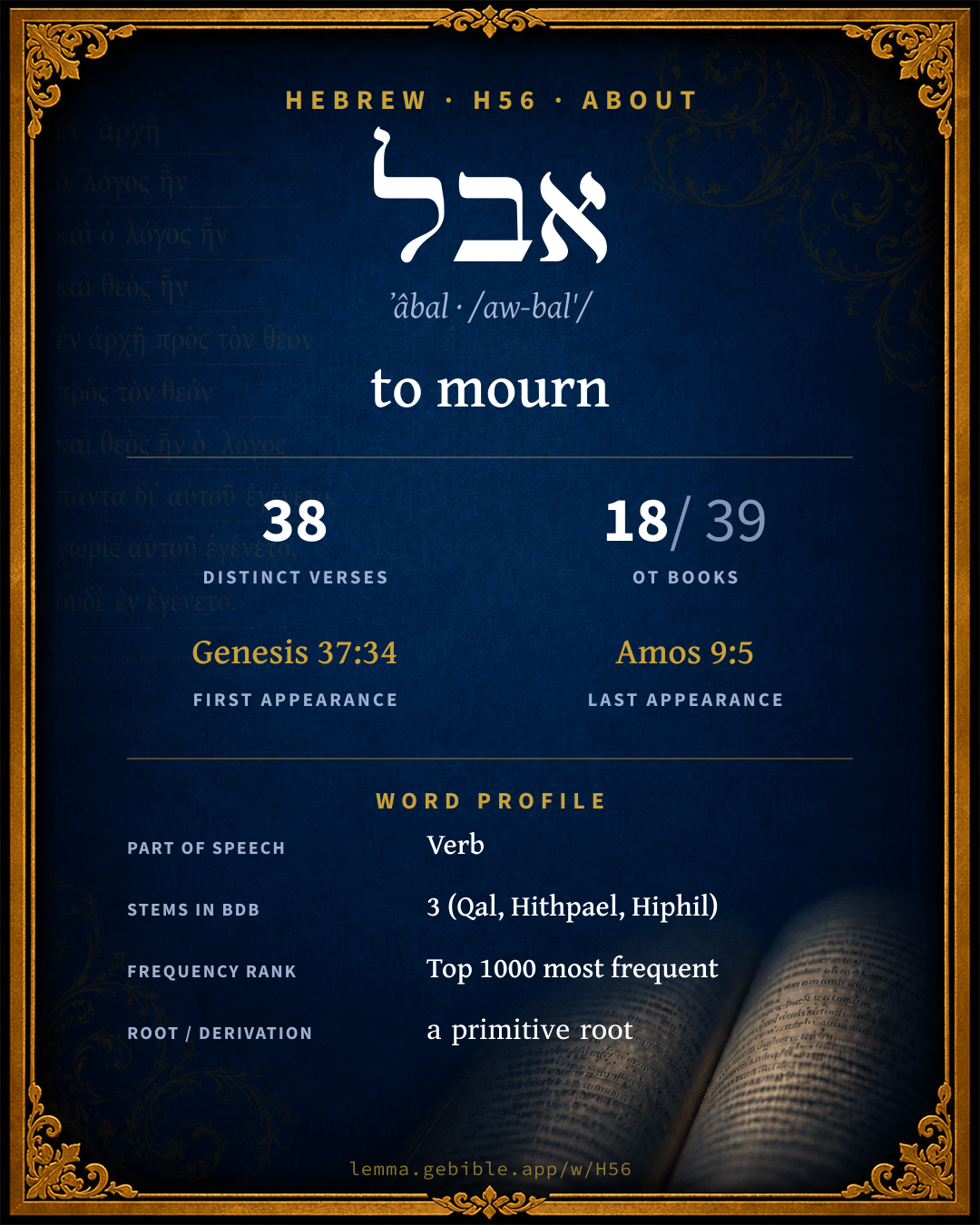
אָבַל
to mourn
‘to mourn’ is one of 2 main senses fuller range ↓
Full lexicon entry — Brown-Driver-Briggs (BDB)
From Brown-Driver-Briggs (BDB)
Where this word appears
See every Hithpael verb in the Hebrew Bible →
Grammar key — what these labels mean
Part of speech
- Verb
- An action or state-of-being word.
Stem
- Qal
- The basic, simple active stem — the plain form of the verb (“he wrote”).
- Hithpael
- The reflexive or reciprocal stem (the subject acts on itself).
- Hiphil
- The causative active stem (“he caused / brought about”).
Form
- Perfect
- A completed action or state — Hebrew marks aspect (completeness) more than strict tense (“he wrote”).
- Sequential Imperfect
- An imperfect with prefixed waw — the standard past-narrative form (waw-consecutive imperfect).
- Imperfect
- An incomplete, ongoing, or future action (“he will / would write”).
- Participle Active
- A verbal adjective expressing ongoing or characteristic action (“writing / one who writes”).
- Sequential Perfect
- A perfect with prefixed waw continuing a preceding imperfect or command (waw-consecutive perfect).
- Jussive
- A third- or second-person volitional form expressing wish or command (“let him write”).
- Imperative
- A direct command (“write!”).
State
- Absolute
- The independent form of a noun, not bound to a following word.
Person
- 3rd Person
- The one spoken about (“he / she / it / they”).
- 1st Person
- The speaker (“I / we”).
- 2nd Person
- The one addressed (“you”).
Gender
- Feminine
- Grammatically feminine.
- Masculine
- Grammatically masculine.
- Common
- Either gender — not distinguished for this form.
Number
- Singular
- One.
- Plural
- More than one (in Hebrew, generally three or more).
Grammatical forms 19 distinct
- Verb, Qal, Perfect, 3rd Person, Feminine, Singular 5 times (13%)
- Verb, Hithpael, Sequential Imperfect, 3rd Person, Masculine, Singular 4 times (10%)
- Verb, Qal, Imperfect, 3rd Person, Feminine, Singular 4 times (10%)
- Verb, Hithpael, Sequential Imperfect, 3rd Person, Masculine, Plural 3 times (8%)
- Verb, Qal, Perfect, 3rd Person, Masculine, Singular 3 times (8%)
- Verb, Hithpael, Participle Active, Masculine, Singular, Absolute 3 times (8%)
- Verb, Qal, Perfect, 3rd Person, Common, Plural 3 times (8%)
- Verb, Qal, Sequential Perfect, 3rd Person, Common, Plural 2 times (5%)
+11 more forms (12 occurrences)
Parsed forms decoded from the imported morphology (morphhb / Westminster Leningrad Codex — WLC text public domain, morphhb tagging CC BY 4.0), counted across 39 parsed occurrences — not distinct verses.
Every verse where H56 appears — 38 distinct verses across 18 books. Click any verse to open its interlinear word-by-word view. Verse text shown in the World English Bible for context — . Each verse’s Hebrew form is shown with its reference; the English is not keyword-highlighted, since the data carries no word-level English alignment. Use “Compare translations” on any verse to read it across multiple English versions. This concordance covers the Hebrew Bible; Septuagint (Greek Old Testament) occurrences are not indexed here.
Genesis 1 verse
Exodus 1 verse
Numbers 1 verse
1 Samuel 3 verses
- 1 Samuel 6:19 וַ/יִּֽתְאַבְּל֣וּ conj + Hithpael wimpf 3mp He struck of the men of Beth-shemesh, because they had looked into the ark of Yahweh, he struck of the people fifty thousand seventy men; and the people mourned, because Yahweh had struck the people with a great slaughter.
- 1 Samuel 15:35 הִתְאַבֵּ֥ל Hithpael pf 3ms Samuel came no more to see Saul until the day of his death; for Samuel mourned for Saul: and Yahweh repented that he had made Saul king over Israel.
- 1 Samuel 16:1 מִתְאַבֵּ֣ל Hithpael ptcp.act ms Yahweh said to Samuel, How long will you mourn for Saul, seeing I have rejected him from being king over Israel? fill your horn with oil, and go: I will send you to Jesse the Bethlehemite; for I have provided me a king among his sons.
2 Samuel 3 verses
- 2 Samuel 13:37 וַ/יִּתְאַבֵּ֥ל conj + Hithpael wimpf 3ms But Absalom fled, and went to Talmai the son of Ammihur, king of Geshur. [David] mourned for his son every day.
- 2 Samuel 14:2 הִֽתְאַבְּלִי מִתְאַבֶּ֖לֶת Hithpael impv 2fs Hithpael ptcp.act fs Joab sent to Tekoa, and fetched there a wise woman, and said to her, please act like a mourner, and put on mourning clothing, Please, and don't anoint yourself with oil, but be as a woman who has a long time mourned for the dead:
- 2 Samuel 19:1 וַ/יִּתְאַבֵּ֖ל conj + Hithpael wimpf 3ms It was told Joab, Behold, the king weeps and mourns for Absalom.
1 Chronicles 1 verse
2 Chronicles 1 verse
Ezra 1 verse
Nehemiah 2 verses
- Nehemiah 1:4 וָ/אֶתְאַבְּלָ֖/ה conj + Hithpael wimpf 1cs + sfx h It happened, when I heard these words, that I sat down and wept, and mourned certain days; and I fasted and prayed before the God of heaven,
- Nehemiah 8:9 תִּֽתְאַבְּל֖וּ Hithpael juss 2mp Nehemiah, who was the governor, and Ezra the priest the scribe, and the Levites who taught the people, said to all the people, This day is holy to Yahweh your God; don't mourn, nor weep. For all the people wept, when they heard the words of the law.
Job 1 verse
Isaiah 6 verses
- Isaiah 3:26 וְ/אָבְל֖וּ conj + Qal wpf 3cp Her gates shall lament and mourn; And she shall be desolate and sit on the ground.
- Isaiah 19:8 וְ/אָ֣בְל֔וּ conj + Qal wpf 3cp The fishermen shall lament, and all those who cast angle into the Nile shall mourn, and those who spread nets on the waters shall languish.
- Isaiah 24:4 אָבְלָ֤ה Qal pf 3fs The earth mourns and fades away, the world languishes and fades away, the lofty people of the earth do languish.
- Isaiah 24:7 אָבַ֥ל Qal pf 3ms The new wine mourns, the vine languishes, all the merry-hearted do sigh.
- Isaiah 33:9 אָבַ֤ל Qal pf 3ms The land mourns and languishes; Lebanon is confounded and withers away; Sharon is like a desert; and Bashan and Carmel shake off [their leaves].
- Isaiah 66:10 הַ/מִּֽתְאַבְּלִ֖ים ptcl def.art + Hithpael ptcp.act mp Rejoice you with Jerusalem, and be glad for her, all you who love her: rejoice for joy with her, all you who mourn over her;
Jeremiah 5 verses
- Jeremiah 4:28 תֶּאֱבַ֣ל Qal impf 3fs For this shall the earth mourn, and the heavens above be black; because I have spoken it, I have purposed it, and I have not repented, neither will I turn back from it.
- Jeremiah 12:4 תֶּאֱבַ֣ל Qal impf 3fs How long shall the land mourn, and the herbs of the whole country wither? for the wickedness of those who dwell therein, the animals are consumed, and the birds; because they said, He shall not see our latter end.
- Jeremiah 12:11 אָבְלָ֥ה Qal pf 3fs They have made it a desolation; it mourns to me, being desolate; the whole land is made desolate, because no man lays it to heart.
- Jeremiah 14:2 אָבְלָ֣ה Qal pf 3fs Judah mourns, and the gates of it languish, they sit in black on the ground; and the cry of Jerusalem is gone up.
- Jeremiah 23:10 אָבְלָ֣ה Qal pf 3fs For the land is full of adulterers; for because of swearing the land mourns; the pastures of the wilderness are dried up. Their course is evil, and their might is not right;
Lamentations 1 verse
Ezekiel 3 verses
- Ezekiel 7:12 יִתְאַבָּ֑ל Hithpael juss 3ms The time is come, the day draws near: don't let the buyer rejoice, nor the seller mourn; for wrath is on all the multitude of it.
- Ezekiel 7:27 יִתְאַבָּ֗ל Hithpael impf 3ms The king shall mourn, and the prince shall be clothed with desolation, and the hands of the people of the land shall be troubled: I will do to them after their way, and according to their deserts will I judge them; and they shall know that I am Yahweh.
- Ezekiel 31:15 הֶאֱבַ֜לְתִּי Hiphil pf 1cs Thus says the Lord Yahweh: In the day when he went down to Sheol I caused a mourning: I covered the deep for him, and I restrained the rivers of it; and the great waters were stayed; and I caused Lebanon to mourn for him, and all the trees of the field fainted for him.
Daniel 1 verse
Hosea 2 verses
- Hosea 4:3 תֶּאֱבַ֣ל Qal impf 3fs Therefore the land will mourn, And everyone who dwells therein will waste away. All living things in her, Even the animals of the field and the birds of the sky; Yes, the fish of the sea also die.
- Hosea 10:5 אָבַ֨ל Qal pf 3ms The inhabitants of Samaria will be in terror for the calves of Beth Aven; For its people will mourn over it, Along with its priests who rejoiced over it, For its glory, because it has departed from it.
Joel 2 verses
Amos 3 verses
- Amos 1:2 וְ/אָֽבְלוּ֙ conj + Qal pf 3cp He said: "Yahweh will roar from Zion, And utter his voice from Jerusalem; And the pastures of the shepherds will mourn, And the top of Carmel will wither."
- Amos 8:8 וְ/אָבַ֖ל conj + Qal wpf 3ms Won't the land tremble for this, And everyone mourn who dwells in it? Yes, it will rise up wholly like the River; And it will be stirred up and sink again, like the River of Egypt.
- Amos 9:5 וְ/אָבְל֖וּ conj + Qal pf 3cp For the Lord, Yahweh of Hosts, is he who touches the land and it melts, and all who dwell in it will mourn; and it will rise up wholly like the River, and will sink again, like the River of Egypt.
About this entry
At a glance — auto-summarized from this page’s data, not written by a person. Every figure links to its source below. This summary describes the numbers; it doesn’t interpret them.
The Hebrew verb אבל centers on the idea of “to mourn.” Its English rendering has broadened — “mourneth” classically, “mourns” (unfoldingWord Literal Text) in modern versions; see the renderings breakdown. Spanning 38 verses in 18 books, it ranks among the moderately common words of the Hebrew Bible. Its earliest occurrence is Genesis 37:34. Read the stem: it spans 3 stems, including Qal and Hithpael. Dig into 38-verse concordance and the renderings breakdown below.
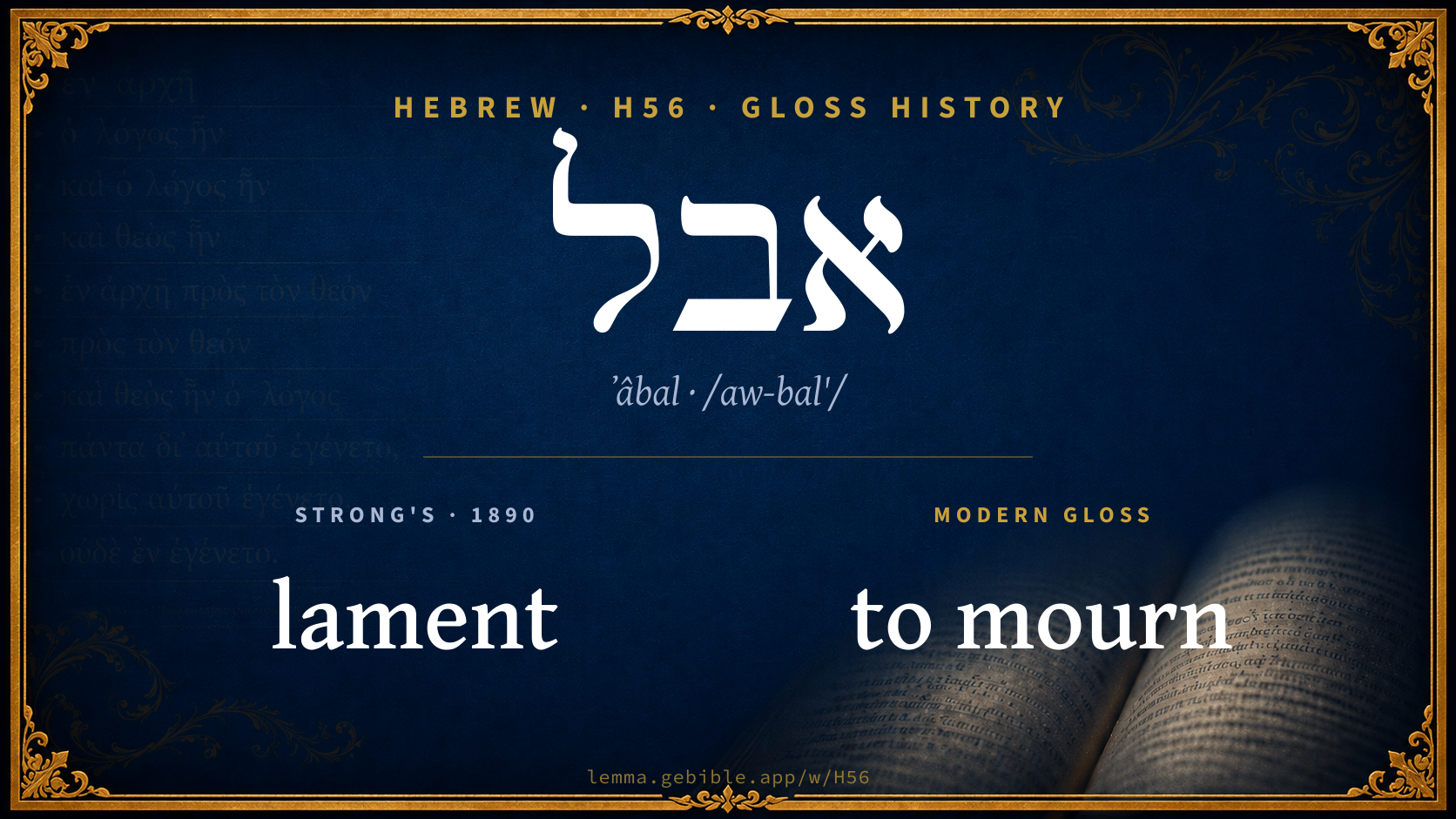
Gloss history
Strong's 1890 vs modern scholarship
About this word
Strong's H56 catalogs a Hebrew word from the Hebrew Old Testament.
These counts are not copied from any lexicon or concordance. They are computed here, from the morphology-tagged Hebrew Old Testament. What Lemma adds →
- 38
- distinct verses
- The word appears in 38 distinct verses.
- 18 / 39
- OT books
- The word appears in 18 of 39 Old Testament books.
- #922
- by frequency
- Top 1000 most frequent Hebrew words (rank 922 of 8,640 Hebrew words by occurrence).
View all 38 occurrences in the concordance →
By section of the Old Testament
By traditional corpus
Conventional, traditional groupings — biblical authorship is debated, so this is a traditional corpus grouping, not an authorship claim. Each share is this word’s portion of its verses in that division of the Hebrew canon. Each figure is a share of the word’s 38 distinct verses.
- Prophets (Nevi'im) 27 verses · 71%
- Writings (Ketuvim) 8 verses · 21%
- Torah (Pentateuch) 3 verses · 8%
How translations render this word
Counts come from each version’s own published word-to-Strong’s tagging or interlinear alignment — an approximate guide to how each version renders this word, not a word-level alignment the data otherwise carries. Because each total is that version’s own tagged count, the per-version totals vary from one another and need not match the appearance or distinct-verse counts above. These counts may also differ from a printed concordance because Lemma counts each distinctly tagged rendering and does not collapse phrase taggings into a single head-word total. This is a fixed set of word-tagged versions (KJV, ASV, BSB, ULT) and does not change with the reading translation you choose elsewhere. Each version’s license is shown beside its name below (and on Sources).
- King James Version: Mourneth 8×, Mourn 7×, Mourned 7×
- American Standard Version: Mourned 8×, Mourneth 8×, Mourn 7×
- Berean Standard Bible: Mourn 8×, Mourns 8×, Mourned 5×
- unfoldingWord Literal Text: Mourns 8×, Mourn 6×, And 5×
King James Version Public Domain
Renders H56 across 39 tagged occurrences — most commonly:
Plus 15 renderings that appear only once — usually multi-word phrases or single function words the recovered tagging swept in, not distinct renderings.
American Standard Version Public Domain
Renders H56 across 39 tagged occurrences — most commonly:
Plus 11 renderings that appear only once — usually multi-word phrases or single function words the recovered tagging swept in, not distinct renderings.
Berean Standard Bible Public Domain
Renders H56 across 39 tagged occurrences — most commonly:
Plus 13 renderings that appear only once — usually multi-word phrases or single function words the recovered tagging swept in, not distinct renderings.
unfoldingWord Literal Text CC BY-SA 4.0
Renders H56 across 47 tagged occurrences — most commonly:
Plus 15 renderings that appear only once — usually multi-word phrases or single function words the recovered tagging swept in, not distinct renderings.
Senses in the full BDB
Hebrew verbs can shift meaning by stem (binyan): Qal is the basic action, Niphal is often passive or reflexive, Piel often intensifies or makes it factitive, and Hiphil is typically causative. The senses below are grouped under the stem BDB assigns to each. This entry also uses Hithpael (reflexive or reciprocal).
What do BDB’s symbols mean?
BDB uses these scholarly abbreviations:
| Symbol | Meaning |
|---|---|
| 𝔊 | the Septuagint (the ancient Greek translation, LXX) |
| 𝔙 | the Vulgate (the Latin translation) |
| 𝔖 | the Syriac version (the Peshitta) |
| 𝔗 | the Targum (the Aramaic translation) |
| ψ | the Psalms |
| √ | root (the underlying root or stem) |
| ‖ | parallel passage (a synonymous or contrasted parallel) |
| † | the dagger: every passage where the word occurs is cited |
The 3 senses and sub-senses the full Brown-Driver-Briggs lexicon distinguishes for this word, in lexicon order (not ranked by frequency), with BDB’s own verbatim wording and sub-sense lettering. Shown in Hebrew script with BDB’s own scholarly abbreviations. The condensed entry is in the Lexicon Entry tab. See also the Forms in the corpus table below.
Qal
- Pf. אָבַל Is 24:7 + 2 times etc. Impf. 3 fs. תֶּאֱבַל Ho 4:3 + 3 times—mourn, lament (poet. & higher style); abs., human subj. Jo 1:9 Am 8:8; 9:5 Is 19:8 (‖ אנה) cf. Jb 14:22 (subj. נַפְשׁוֹ); sq. על Ho 10:5; more often fig., inanim. subj., gates Is 3:26; land 24:4; 33:9 Ho 4:3 Jo 1:10 Je 4:28 (sq. על) 12:4; 23:10 cf. 12:11 (sq. על), יְהוּדָה 14:2; pastures Am 1:2. e.g. Isaiah 24:7
Hithpael
- —Pf. הִתְאַבֵּל 1 S 15:35; Impf. יִתְאַבָּ֑ל Ez 7:12, 27; וַיִּתְאַבֵּל Gn 37:34 + 3 times etc.; Imv. fs. הִתְאַבְּלִי 2 S 14:2; Pt. מִתְאַבֵּל 1 S 16:1 + 2 times etc.;—mourn (mostly prose) especially for dead, sq. על Gn 37:34 2 S 13:37; 14:2; 19:2 (‖ בכה) 2 Ch 35:24, cf. also Is 66:10 (over Jerusalem); abs. 1 Ch 7:22; cf. 2 S 14:2 play the mourner (where indic. by dress); over unworthy Saul sq. אֶל 1 S 15:35; 16:1; over sin sq. על Ezr 10:6 cf. (abs.) Ne 8:9; judgment of י׳ Ex 33:4 abs. (indic. by dress), Nu 14:39 Ez 7:27 (del. B Co); sq. כִּי 1 S 6:19; calamity Ne 1:4 Ez 7:12 cf. Dn 10:2. e.g. 1 Samuel 15:35
Hiphil
- Pf. הֶאֱבַלְתִּי Ez 31:15; Impf. וַיַּאֲבֶל־ La 2:8;—cause to mourn; Ez 31:15 abs. MT, but A B Co obj. תהום sq. על, caused the deep to mourn over; La 2:8 obj. wall etc.; (both these fig.; cf. Qal). e.g. Ezekiel 31:15
Senses from the full Brown-Driver-Briggs lexicon (Brown, Driver, Briggs; Oxford 1906 — public domain), digitized via Sefaria, supplemented by the OpenScriptures HebrewLexicon (CC BY 4.0). Full attribution on Sources.
Word origin
vb. mourn (Assyrian [abâlu] v. DlW)—
— Brown-Driver-Briggs (Oxford 1906, public domain), digitized via Sefaria, supplemented by the OpenScriptures HebrewLexicon (CC BY 4.0). See Sources.
Origin: a primitive root
Jastrow Dictionary
A second Hebrew/Aramaic lexicon for comparison, covering Aramaic and post-biblical (Talmudic, Targumic, Midrashic) usage that the biblical-Hebrew BDB does not. Matched by lemma rather than by Strong’s number, so a lemma may carry more than one Jastrow headword (shown separately below), and the entries cover usage well beyond the Bible.
אֲבָל
- (b. h.)
- 1. indeed, yes. Tosef. Erub. V (IV), 1 אמרו לו א׳ said they to him, yes (we admit). Erub. 30ᵇ top. Nidd. 3ᵇ; a. e.—Gen. R. s. 91 לשון דרומית וכ׳ it is a South Palestine expression where ăbal means bram, v. בְּרַם.
- 2. but, however. Ber. VII, 1; a. v. fr.
אָבֵל I
- (b. h.) pr. n. pl. Abel, name of several towns; cmp. אֲבֵילִין. Erub. 87ᵃ ed. (Ms. M. בבל, corr. acc., Var. lect. v. Rabb. D. S. a. l. note).
אָבֵל II
- , v. אבב; cmp. אפל); [dark, cmp. קֹדֵר], mourner, esp. during seven days after burial. M. Kat. 14ᵇ; a. v. fr.—Pl. אֲבֵלִים, (אֲבֵילִין) אֲבֵילִים. Keth. 8ᵇ; v. בְּרָכָה. Y. Ab. Zar. I, 39ᶜ bot. אֲבֵילֵי גויים mourners among gentiles; a. fr.—Fem. אֲבֵילָה, אֲבֵלָה. Y. Ber. IV, 8ᵃ; Y. Taan. II, 65ᶜ bot.
אָבֵל III
- (foreg.) to mourn. Hithpa. הִתְאַבֵּל, Nithpa. נִתְאַבֵּל to observe mourning ceremonies, to be bound to mourn, be an אָבֵל. M. Kat. 20ᵇ כל שמִתְאַבֵּל עליו מתא׳ עמו over whom one is bound to mourn, with him he must mourn, i.e. one must share in the mourning ceremonies of a relation at whose death he would have to observe mourning; a. fr.—Tanḥ. Sh’mini, 1 נתא׳. Pesik. Sos p. 148ᵇ; a. fr.
אֲבֵל
- Targ. Lam. II, 8.
- (denom. of אֲבֵלָא) to mourn. Targ. Gen. XXXVII, 34; a. fr.—Y. Ab. Zar. I, 39ᶜ top. v. אִימִירָא. Esth. R. beg. כד ילידת הוו מִתְאַבְּלִין when the Empress gave birth, they (the Jews) mourned (it being the Ninth of Ab). B. Kam. 59ᵇ את חשיבא לאִתְאַבּוּלֵי וכ׳ ed. (Ms. R. לאַבּוּלֵי, v. infra) art thou distinguished enough to wear mourning for Jerusalem?
- . Ib. מְאַבֵּילְנָא ed. (Ms. F. מאבלנא, v. Rabb. D. S. a. l., note 6) I wear mourning.
אֵבֶל
- foreg.) mourning; cmp. אֲבֵילוּת. Y. M. Kat. III, 82ᵇ; a. fr.—Pl. אֲבֵילִים. M. Kat. 7ᵇ מי שתכפוהו אֲבֵילָיו he whom his mourning days overtook, i.e. a second case occurring before the mourning days of the first expired.—אֵבֶל רַבָּתִי Ebel Rabbathi (Great Mourning), name of a Talmudic treatise, also named euphemistically שְׂמָחוֹת Rejoicings.—[Chald. Targ. Gen. L, 11; v. אֶבְלָא.]
אֻבָל
- , v. אוּבָל
אוּבָל
- (v. יוּבָל)
- 1. river. Dan. VIII, 2; 3; 6. e.g. Daniel 8:2
- 2. as a pr. n. Ubal (The River). Gen. R. s. 16 (referring to Dan. l. c.) א׳ אוותנטין וכ׳ Ubal is the source of all the other rivers.
A Dictionary of the Targumim, the Talmud Babli and Yerushalmi, and the Midrashic Literature (Marcus Jastrow; London, Luzac, 1903) — Public Domain. Digitized via Sefaria. Digitized via Sefaria. Full attribution on Sources.
Forms in the corpus
The 34 distinct written forms H56 takes in the Hebrew Bible, most frequent first — each parse links to that stem’s occurrences in the concordance. Hebrew forms include their vowel points and cantillation, so a single lemma takes many written forms.
Same root — word family
Other BDB entries built from the same root as H56, grouped by Strong’s listed origin. These share a root / origin per the lexicon — not necessarily a shared meaning. Each links to that word’s own entry.
Derived from this word
Proper names from this root
People and places named from this root — a name, not an additional meaning of the word.
Compare all same-root words → Showing 4 of 5 — not the complete family. 1 of the same-root words is a proper name (a person or place). They share a root, not necessarily a meaning.
Septuagint verse parallels
This word appears in 36 verses that also exist in the Greek Old Testament (Septuagint), out of the 38 Hebrew verses it occurs in. You can read those verses in Greek by switching the Old Testament edition to the Septuagint.
Read these verses in the Septuagint
- Genesis 37:34
- Exodus 33:4
- Numbers 14:39
- 1 Samuel 6:19
- 2 Samuel 13:37
- 1 Chronicles 7:22
- 2 Chronicles 35:24
- Ezra 10:6
- Job 14:22
- Isaiah 3:26
- Jeremiah 4:28
- Lamentations 2:8
This is a verse-level parallel only — the same verses exist in both the Hebrew and Greek Old Testaments. No word-level Hebrew↔Greek correspondence is claimed: the data carries no such alignment, so no Greek word is shown as this Hebrew word’s translation. Coverage is not total — the Septuagint omits the deuterocanon and renumbers the Psalms, so some Hebrew verses have no direct Greek parallel.