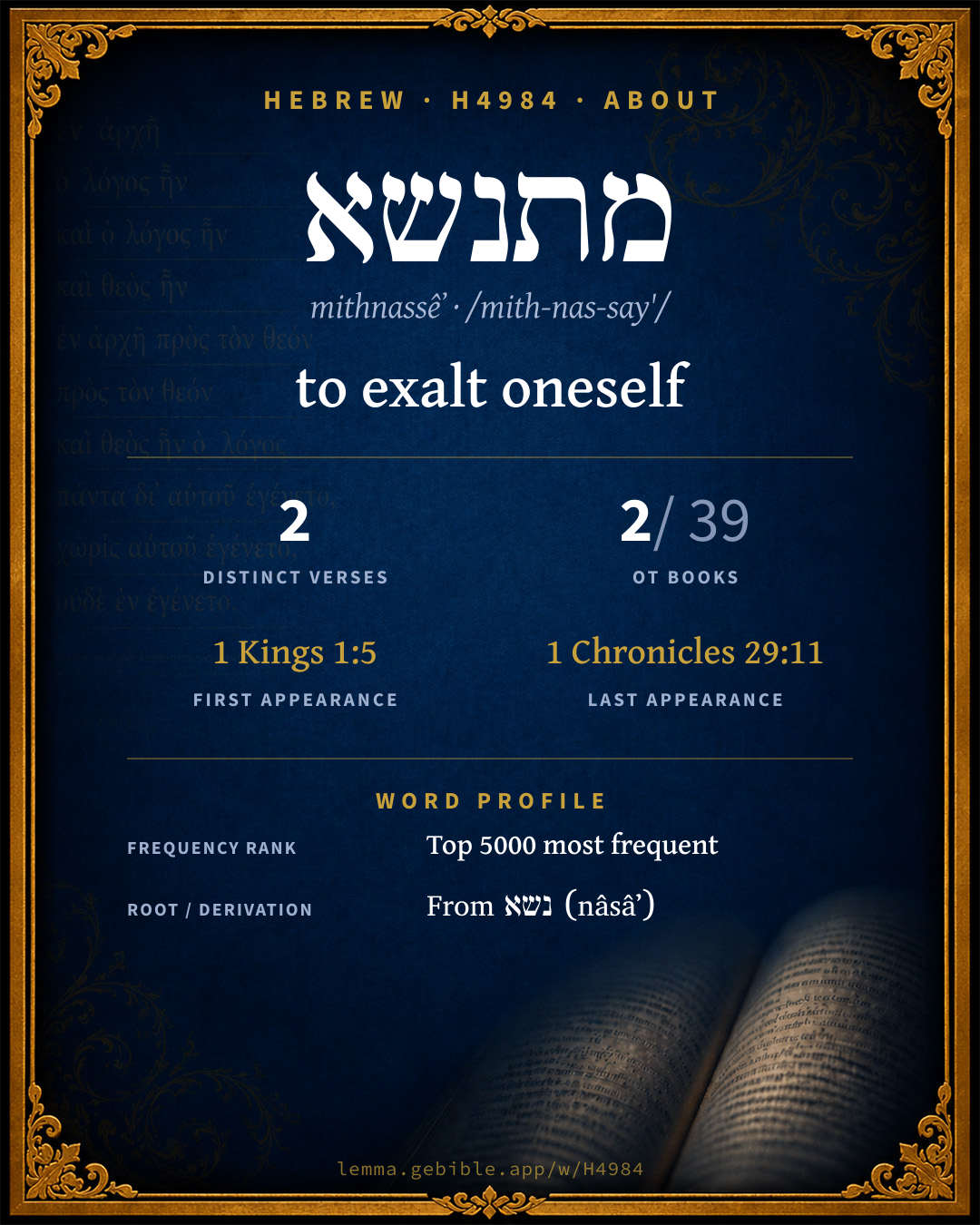
מִתְנַשֵּׂא
to exalt oneself
Full lexicon entry — Brown-Driver-Briggs (BDB)
From Brown-Driver-Briggs (BDB)
Where this word appears
Grammar key — what these labels mean
Part of speech
- Verb
- An action or state-of-being word.
Stem
- Hithpael
- The reflexive or reciprocal stem (the subject acts on itself).
Form
- Participle Active
- A verbal adjective expressing ongoing or characteristic action (“writing / one who writes”).
State
- Absolute
- The independent form of a noun, not bound to a following word.
Gender
- Masculine
- Grammatically masculine.
Number
- Singular
- One.
Every verse where H4984 appears in the Book of 1 Chronicles — 1 distinct verse. Click any verse to open its interlinear word-by-word view. Verse text shown in the World English Bible for context — . Each verse’s Hebrew form is shown with its reference; the English is not keyword-highlighted, since the data carries no word-level English alignment. Use “Compare translations” on any verse to read it across multiple English versions. This concordance covers the Hebrew Bible; Septuagint (Greek Old Testament) occurrences are not indexed here.
1 Chronicles
About this entry
At a glance — auto-summarized from this page’s data, not written by a person. Every figure links to its source below. This summary describes the numbers; it doesn’t interpret them.
At its core, מתנשא (mithnassêʼ) means “to exalt oneself.” The Hebrew Bible uses it only 2 verses. The word gravitates to 1 Kings (50%), then 1 Chronicles. First canonically at 1 Kings 1:5, it enters the text early. It shares a root with נשא, משא and משא. Each statement above links to its evidence; the full detail follows below.
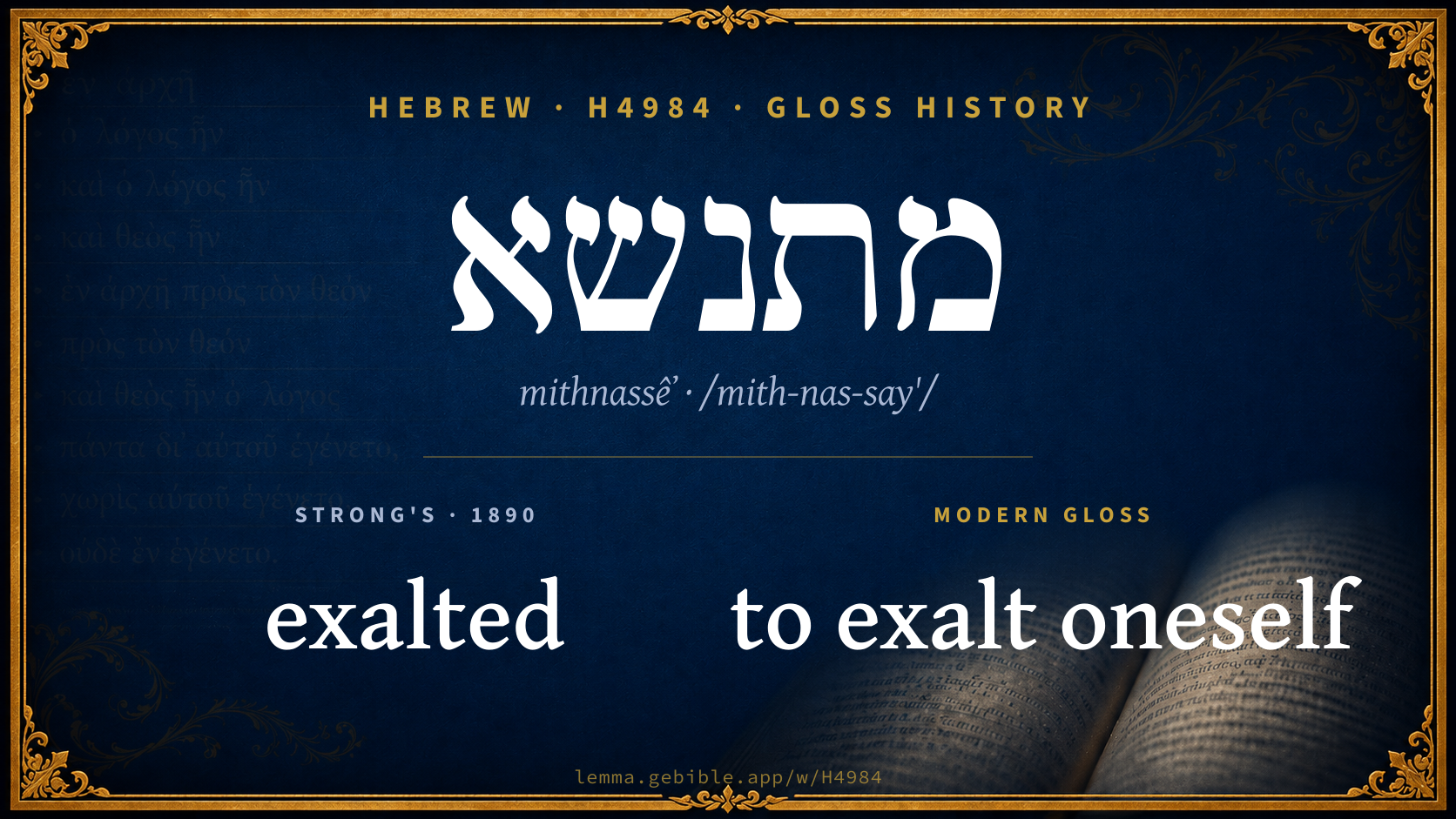
Gloss history
Strong's 1890 vs modern scholarship
About this word
Strong's H4984 catalogs a Hebrew word from the Hebrew Old Testament.
These counts are not copied from any lexicon or concordance. They are computed here, from the morphology-tagged Hebrew Old Testament. What Lemma adds →
- 2
- distinct verses
- The word appears in 2 distinct verses.
- 2 / 39
- OT books
- The word appears in 2 of 39 Old Testament books.
- #4,807
- by frequency
- Top 5000 most frequent Hebrew words (rank 4,807 of 8,640 Hebrew words by occurrence).
View all 2 occurrences in the concordance →
Most concentrated in
- 1 Kings 1 verse 50%
- 1 Chronicles 1 verse 50%
By section of the Old Testament
By traditional corpus
Conventional, traditional groupings — biblical authorship is debated, so this is a traditional corpus grouping, not an authorship claim. Each share is this word’s portion of its verses in that division of the Hebrew canon. Each figure is a share of the word’s 2 distinct verses.
- Prophets (Nevi'im) 1 verse · 50%
- Writings (Ketuvim) 1 verse · 50%
How translations render this word
Counts come from each version’s own published word-to-Strong’s tagging or interlinear alignment — an approximate guide to how each version renders this word, not a word-level alignment the data otherwise carries. Because each total is that version’s own tagged count, the per-version totals vary from one another and need not match the appearance or distinct-verse counts above. These counts may also differ from a printed concordance because Lemma counts each distinctly tagged rendering and does not collapse phrase taggings into a single head-word total. This is a fixed set of word-tagged versions (KJV, ASV, BSB, ULT) and does not change with the reading translation you choose elsewhere. Each version’s license is shown beside its name below (and on Sources).
- King James Version: Exalted 1×, Thou art exalted 1×
- American Standard Version: Exalted 1×, Thou art exalted 1×
- unfoldingWord Literal Text: Lifting yourself 1×, Was lifting himself up 1×
King James Version Public Domain
Renders H4984 across 2 tagged occurrences — most commonly:
American Standard Version Public Domain
Renders H4984 across 2 tagged occurrences — most commonly:
unfoldingWord Literal Text CC BY-SA 4.0
Renders H4984 across 2 tagged occurrences — most commonly:
35 senses and sub-senses in the full BDB
Hebrew verbs can shift meaning by stem (binyan): Qal is the basic action, Niphal is often passive or reflexive, Piel often intensifies or makes it factitive, and Hiphil is typically causative. The senses below are grouped under the stem BDB assigns to each. This entry also uses Hithpael (reflexive or reciprocal).
What do BDB’s symbols mean?
BDB uses these scholarly abbreviations:
| Symbol | Meaning |
|---|---|
| 𝔊 | the Septuagint (the ancient Greek translation, LXX) |
| 𝔙 | the Vulgate (the Latin translation) |
| 𝔖 | the Syriac version (the Peshitta) |
| 𝔗 | the Targum (the Aramaic translation) |
| ψ | the Psalms |
| √ | root (the underlying root or stem) |
| ‖ | parallel passage (a synonymous or contrasted parallel) |
| † | the dagger: every passage where the word occurs is cited |
The 35 senses and sub-senses the full Brown-Driver-Briggs lexicon distinguishes for this word, in lexicon order (not ranked by frequency), with BDB’s own verbatim wording and sub-sense lettering. Shown in Hebrew script with BDB’s own scholarly abbreviations. The condensed entry is in the Lexicon Entry tab. See also the Forms in the corpus table below.
Qal
- Pf. נ׳ Gn 13:6 +; 2 ms. נָשָׂאתָ 1 K 2:26 +, נָשָׂאתָה Nu 14:19, sf. נְשָׂאתַ֫נִי ψ 102:11; 2 fs. sf. נְשָׂאתִים Ez 16:58; 3 pl. נָֽשְׂאוּ 2 S 18:28 +, נָשׂוּא ψ 139:20, וְנָשׂוּ consec. Ez 39:26, sf. נְשָׂאוּם 2 Ch 12:11, etc.; Impf. 3 ms. יִשָּׂא Gn 32:21 +, וַיִּשָּׂא 13:10 +, sf. יִשָּׂאֵהוּ Dt 32:11 +; 3 mpl. יִשְׂאוּ Ho 4:8 +, יִשָּׂ֑אוּ Hb 2:6 +, וַיִּשְׂאוּ Ju 2:4 +; sf. יִשָּׂאֻנוּ Is 64:5; 3 fpl. תִּשֶּׂ֫נָה Je 9:17, וַתִּשֶּׂ֫אנָה Ru 1:9, וַתִּשֶּׂ֫נָה Zc 5:9; Ru 1:14; 2 fpl. תִּשֶּׂ֫אינָה Ez 23:49, etc.; Imv. ms. שָׂא Gn 13:14 +, נְשָׂא ψ 10:12, נְסָה 4:7; sf. שָׂאֵהוּ Nu 11:12; 2 K 4:19; fs. שְׂאִי Gn 21:18 +, etc.; Inf. abs. נָשׂוֹא Je 10:5, נָשׂא Ho 1:6 + 2 times; cstr. נְשׂא Is 1:14 + 2 times, שׂוֹא ψ 89:10 (read perhaps שְׁאוֹן roar Ri Bi Che, cf. Hi שׁוֹא), usually שְׂאֵת Gn 4:7 + sf. נָשְׂאִי ψ 28:2, שְׂאֵתִי Je 15:15 ψ 89:51, etc.; Aramaizing Inf. לְמַשְׂאוֹת Ez 17:9 (si vera l.; Co Berthol לְיוֹם שְׂאֵת); Pt. act. נֹשֵׁא Ex 34:7 +, f. נֹשְׁאֵת 1 K 10:22, נֹשֵׁאת Est 2:15, etc.; pass. cstr. נְשׂוּא Is 3:3 +, נְשׂוּי ψ 32:1, etc.— e.g. Genesis 13:6
- 1. lift, lift up:
- a. lit., c. acc. pers. vel rei; the flood lifts ark Gn 7:17 (J), י׳ lifts standard (נֵם) Is 5:26; 11:12 + (often sq. ל pers.), rod Is 10:26, c. עַל against v 24, נ׳ חֶרֶב אֶל־ Mi 4:3 = Is 2:4, etc.;—especially lift in order to hold, carry away, etc. Gn 21:18 (E), Ju 9:48; Am 6:10; 2 S 2:32; 4:4; 1 K 13:29; 2 K 9:25, 26 Ez 3:12, 14; 8:3; 11:24 +; lift up wings to fly Ez 10:16, 19; 11:22; †נ׳ רַגְלָיו וַיֵּלֶךְ Gn 29:1 he lifted up his feet and went; lift up, upon (על) Gn 31:17; 42:26 (both E), fig. Jb 31:36; נ׳ בְּמֹאזְנַיִם Jb 6:2 put a thing into scale; נ׳ בוֹ אָלָה put on him (require of him) an oath 1 K 8:31 = 2 Ch 6:22, so van d. H., 𝔊; correct MT נָשָׁא (Baer Ginsb), but sense hardly possible; אֶשָּׂא בְשָׂרִי בְשִׁנָּ֑י Jb 13:14 I will take up my flesh in my teeth (fig. for hazarding life). e.g. Genesis 7:17
- b. in many phr., lit. and fig., e.g.: (1) lift up hand; against (ב) 2 S 18:28; 20:21, c. לְ ψ 106:26; אֶל־ (as signal) Is 49:22; abs., in display of power ψ 10:12; freq. in oath (especially Ez P; of י׳; usually sq. inf., often + ל pers.) Ex 6:8; Nu 14:30; (both P), Ez 20:5(×2), 6, 15, 23, 28, 42; 36:7; 44:12; 47:14 Ne 9:15, + אֶל־שָׁמַיִם Dt 32:40 lift hand to heaven; in prayer (c. אֶל־) ψ 28:2 La 2:19, so (בְּשִׁמְךָ) ψ 63:5, abs. 134:2, and, remarkably, אֶל־מִצְוֹתֶיךָ 119:48; also fig. of the deep (תְּהוֹם) Hb 3:10; in blessing Lv 9:22 (P; c. אֶל). (2) lift up one’s head = shew boldness, independence Ju 8:28; Zc 2:4; Jb 10:15 ψ 83:3; of another = restore to honour Gn 40:13, 20 (E), but lift thy head from off thee (מֵעָלֶיךָ), v 19, by word-play;—+מִבֵּית כֶּלֶא 2 K 25:27 = Je 52:31; fig. of gates, lift up your heads ψ 24:7, 9. (3) lift up one’s face, countenance (פָּנִים), lit., 2 K 9:32 (אֶל־); sign of good conscience 2 S 2:22 (אֶל־), abs. Jb 11:15; of י׳, sign of favour, נ׳ פָּנָיו אֶל־ Nu 6:26 (P; form of benediction); cf. נ׳ אוֹר פָּנֶיךָ עַל־ ψ 4:7; especially lift up face of another (orig. prob. of one prosate in humility; opp. הֵשִׁיב פָּנִים repel), in various shades of meaning = grant a request Gn 19:21 (J; + לַּדָּבָר הַוֶּה), 1 S 25:35; 2 K 3:14 Jb 42:8, 9; = be gracious to, Gn 32:21 (E), Mal 1:8, 9 hence phr. נְשׂוּא פָנִים graciously received, held in honour †2 K 5:1 (of Naaman), and, as subst., honourable, eminent one Is 3:3; 9:14 (but del. as gloss), Jb 22:8†; = shew consideration for Dt 28:50 La 4:16; also in bad sense = be unduly influenced by Jb 32:21, and, specif., = shew partiality (towards) Dt 10:17 (denied of י׳), Lv 19:15 (H), Mal 2:9 (כַּתּוֹרָה), Jb 13:8, 10; 34:19; Pr 18:5 ψ 82:2 (syn. הִכִּיר פ׳); even נ׳ פְּנֵי כָל־כֹּפֶר Pr 6:35 i.e. regard any bribe. (4) lift up eyes, on high 2 K 19:22 = Is 37:23, cf. ψ 121:1 (אֶל־); לַשָּׁמַיִם Is 51:6 (‖ הִבִּיט אֶל־); sq. ה loc. Dt 3:27; 4:19 cf. Ez 8:5(×2); toward (אֶל־) idols Ez 18:6, 12, 15; 33:25, cf. 23:27; toward (אֶל־) י׳ ψ 123:1 (these with implied worship); נ׳ עֵינֶיהָ אֶל־ Gn 39:7 i.e. she gazed at him with desire; usually + vb. of seeing (35 times) Gn 13:10, 14; 18:2 + (Hex only JE), Is 40:26 (+ מָרוֹם), 49:18; 60:4 (both + סָבִיב), Je 3:2 (+ עַל־). (5) lift up voice (קוֹל), give (loud) utterance Is 52:8, of floods ψ 93:3, + and weep Gn 21:16 (E) 27:38; 29:11 (both J), Ju 2:4, + וַתָּשָּׂא וַיִּתְּנוּ אֶת־קוֹלָם וַיִּבְכּוּ Nu 14:1 (P), + 9 times; + יָרֹ֫נּוּ Is 24:14; + קָרָא Ju 9:7; קוֹל om. Is 3:7; 42:2, v 11 (‖ יָרֹ֫נּוּ); also (6) lift up (+ vb. of saying, usually אָמַר), often of formal and solemn utterance, נ׳ מָשָׁל Nu 23:7, 18; 24:3, 15, 20, 21, 23 Jb 27:1; 29:1 + עַל Mi 2:4; Hb 2:6; Is 14:4; ונשׂא־בוֹ אָלָה 1 K 8:31 and he shall lift up against him an oath = 2 Ch 6:22 (MT וְנָשָׂא v. Baer Ginsb, but sense difficult; read rather וְנָשָׂא); י׳ נ׳ עָלָיו הַמַּשָּׂא הַזֶּה 2 K 9:25; נ׳ קִונָה, + עַל־ Je 7:29 Ez 26:17; 27:2; 28:12; 32:2, + אֶל־ 19:1; 27:32; lift up word Am 5:1 (על, + קִינָה); weeping Je 9:9 (עַל־); lamentation (נְהִי) v 17 (עַל־), reproach ψ 15:3 (עַל־). (7) lift up, take up = utter: name of י׳, לַשָּׁוְא Ex 20:7(×2) = Dt 5:11(×2) (Decalogue); cf. ψ 139:20 (read prob. שְׁמֶ֑ךָ Bö Ol Che Kau); בַּל־אֶשָּׂא שְׁמוֹתָם עַל־שְׂפָתָ֑י ψ 16:4; נ׳ בְּרִיתִי עֲלֵי־פִיךָ ψ 50:16; prob. also נ׳ שֵׁמַע שָׁוְא Ex 23:1 (E). (8) lift up prayer in behalf of (בְּעַד) † 2 K 19:4 = Is 37:4, Je 7:16; 11:14. (9) lift up soul (נֶפֶשׁ), i.e. direct the desire (נֶפֶשׁ 6 a) towards (אל) a thing, Dt 24:15 Pr 10:18, אֶל־עָוֹן Ho 4:8, לַשָּׁוְא ψ 24:4 (cf. Pi. and ii. מַשָּׂא 2); אֶל־י׳ ψ 25:1; 86:4 143:8, so the heart La 3:41. (10) take up (incur) sin, iniquity, (only HP) †Ex 28:43 Nu 18:22, c. עַל for Lv 19:17; 22:9 Nu 18:32 (cf. also 2 b). (11) of heart lifting one up, (inciting), Ex 35:21, 26; 36:2 (all P); of presumption 2 K 14:10 = 2 Ch 25:19.—MT appar. requires intrans. or reflex. meaning, lift oneself up, in foll., text dub. in all: Ho 13:1 read perhaps נָשִׂיא Oort We cf. Now; Na 1:5 Now (after Bi) וַתֵּשָׁא (read וַתֵּ֫שֶׁא? √ שׁאה); ψ 89:10 read שְׁאוֹן Bi Ri Che; Hb 1:3 יִשָּׂא queried by We Gr Buhl al., cf. GunkelSchöpfung 33. e.g. 2 Samuel 18:28
- 2. Bear, carry:
- a. lit., a load or burden (usually acc.) Gn 37:25; 44:1 (both J), 45:23(×2) (E), 1 S 10:3(×3) Je 10:5; 17:21, 27 +; subj. רוּחַ Ex 10:13 1 K 18:12; obj. armour נֹשֵׂא כֵלִים 1 S 14:1 + often S; weapons 1 Ch 5:18; 12:24 2 Ch 14:7(×2); La 3:27 (נ׳ עֹל fig.), Is 1:14 (fig., cf. d infr.); a load of care, responsibility Dt 1:9, 12; share a burden with נ׳ אֶת־ Ex 18:22 (E; no acc.); with ב׳, יִשָּׂא בְשִׂיחִי מִשְׁכָּבִי Jb 7:13 my bed shall carry at (help carry) my grief, Nu 11:17; take up and carry (idolatrous images) Am 5:26 Is 46:7; bear ephod, 1 S 2:28; 14:3 + v 18 (𝔊), 22:18 (v. Dr in HastDict. Bib. 726); in triumph Is 8:4. e.g. Genesis 37:25
- b. especially bear guilt, or punishment Gn 4:13 (J, עֲוֹנִי), often Ez HP: †נ׳ עָוֹן Lv 5:1, 17; 7:18 Nu 5:31; 14:34, cf. 15:31 (all P), Lv 17:16; 19:8; 20:17, 19 (H) Ez 14:10; 44:12 (cf. Hiph. Lv 22:16); נ׳ חֵטְא Lv 20:20; 24:15 (H) Nu 9:13 (P), cf. Ez 23:49; cf. נ׳ כְּלִמָּה 16:52(×2), נ׳ עֹנֶשׁ Pr 19:19, נ׳ abs. 9:12; נ׳ עֲוֹן … = be responsible for Ex 28:38 Nu 18:1(×2) cf. v 23; incur guilt Ex 28:43; = bear guilt for others Lv 10:17; 16:22 (of goat), Nu 30:16 (all P), Ez 4:4, 5, 6, cf. נ׳ זְנוּתֵיכֶם Nu 14:33; נ׳ חֵטְא Is 53:12, cf. נ׳ חֳלָיֵנוּ v 4; also נ׳ בַּעֲוֹן … bear at (share in), Ez 18:19, 20(×2). e.g. Genesis 4:13
- c. support, sustain, on (על) wings Ex 19:4 Dt 32:11 ψ 91:12 (all fig.); land could not support them Gn 13:6 (J), 36:7 (P). e.g. Exodus 19:4
- d. endure Je 15:15; 31:19 Ez 36:6 Jb 34:31 ψ 69:8; 88:16 Pr 18:14; 30:21; suffer, bear with, permit Jb 21:3. e.g. Jeremiah 15:15
- e. bear, carry, וַיִּשָּׂא מֵאֵת פָּנָיו אֲלֵהֶם Gn 43:34 (J) and they (indef.) carried portions from his presence unto them; carry gifts as tribute 2 S 8:2, 6; later, bring an offering ψ 96:8 = 1 Ch 16:29, Ez 20:31 (𝔊 Co בראשׁית; Toy foll. MT). e.g. Genesis 43:34
- f. carry = contain, hold: bath to hold 1/10 homer Ez 45:11. e.g. Ezekiel 45:11
- g. bear fruit, of tree Hg 2:19 Jo 2:22, fig. Ez 36:8; boughs 17:23 (in fig.); produce, yield, of mountains Jb 40:20 ψ 72:3 (both c. לְ for). e.g. Haggai 2:19
- 3. Take, take away:
- a. lit. c. מִן 1 S 17:34 Nu 16:15 (unjustly). e.g. 1 Samuel 17:34
- b. take away, carry off, Ju 21:23 1 K 15:22 = 2 Ch 16:6, 1 K 18:12 La 5:13 Mi 2:2 Je 49:29 (ל pers.), Is 40:24; 41:16 +; take away head (מֵעַל pers.) Gn 40:19 (v. supr.); sweep away = destroy Jb 32:22 (cf. Niph. 4); life 2 S 14:14. e.g. Judges 21:23
- c. take away, guilt, iniquity, transgression, etc., i.e. forgive, † c. acc. Gn 50:17 (E), Ex 32:32 (E), 10:17; 34:7 (J), Nu 14:18 (JE), 1 S 15:25 Ho 14:3 Jb 7:21 (‖ הֶעֱבִיר עָוֹן), ψ 32:5; + ל pers. Mi 7:18; ל pers., acc. om., Gn 18:24, 26 (J), Nu 14:19 (JE; ‖ סלח עָוֹן), Ho 1:6 Is 2:9 (prob. gloss.), ψ 99:8; c. ל of sin Gn 50:17 Ex 23:21 Jos 24:19 (both E), 1 S 25:28 ψ 25:18 ψ 25:18; נְשֻׂא עָוֹן Is 33:24; נְשׂוּי־פֶּשַׁע ψ 32:1. [in this sense נ׳ used in E; סלח in D P; both in J; נ׳ also in early proph., S. and Jb, and in earlier and latest ψψ; not in Je K Is 2 La Chr Dn, which use סלח; v. BrHex. 155.] e.g. Genesis 50:17
- d. take as wife (usually c. לְ for), late: Ezr 9:2, 12; 10:44 Ne 13:25 2 Ch 11:21; 13:21; 24:3 Ru 1:4. e.g. Ezra 9:2
- e. take an enumeration, usually c. רֹאשׂ sum Ex 30:12 Nu 1:2, 49; 4:2, 22; 26:2; 31:26, 49 (all P); c. מִסְפָּר Nu 3:40 1 Ch 27:23. e.g. Exodus 30:12
- f. take and carry away, receive, Dt 33:3 1 K 5:23 ψ 24:5; hence, obtain favour (חֶסֶד, חֵן) Est 2:9, 17 (both + לִפְנֵי), 5:2 (+ בְּעֵינָיו).—לְמַשְׂאוֹת אוֹתָהּ מִשָּׁרָשֶׁיהָ Ez 17:9 (Co Berthol לְיוֹם שְׂאֵת וגו׳) is usually rendered plucking it up (tearing it away) by the roots, but dub.; נ׳ not elsewhere in this sense. e.g. Deuteronomy 33:3
Niphal
- Pf. נִשָּׂא Je 51:9, וְנ׳ consec. Ex 25:28 +; Impf. יִנָּשֵׂא Is 40:4; 3 mpl. יִנָּֽשְׂאוּ Ez 1:19, 20, 21, יִנָּשׂוּא Je 10:5, יִנָּשֵׂ֑אוּ Pr 30:13; 3 fpl. תִּנָּשֶׂאנָה Is 49:22, etc.; Imv. הִנָּשֵׂא ψ 7:7; 94:2, mpl. הִנָּֽשְׂאוּ ψ 24:7; Inf. הִנָּשֵׂא Ez 1:19, sf. הִנָּֽשְׂאָם Ez 1:21; Pt. נִשָּׂא Is 2:2 +, f. נִשָּׂאָה Is 30:25, נִשֵּׂאת Zc 5:7 1 Ch 14:2, etc.;—2 S 19:43 is dub., and pt. (Ol§ 192 c Köi 632 f.) inexplicable; read נִשּׂא (Inf. abs. Niph.) Dr (cf. Th), or מַשְׂאֵת portion Gr HPS; > BaNB 90 thinks נִשֵּׂאת Inf. Niph. with compensative ending;— e.g. Jeremiah 51:9
- 1. be lifted up,
- a. lit. Zc 5:7 Ez 1:19, 21 (both מֵעַל הָאָרֶץ), v 19, 20, 21 (all in vision), of valleys Is 40:4; of gates ψ 24:7 + v 9b (read Niph.); of eyelids Pr 30:13 (superciliousness); metaph. of judment on Babylon reaching up to the sky (עַד); pt. = elevated, exalted Is 6:1 (of י׳’s throne, in vision); of lofty hills Is 2:14; 30:25; 57:7, cf. Mi 4:1 = Is 2:2 (מִן, lifted from out the hills), once of trees 2:13 (text dub.); gen., Is 2:12. e.g. Zechariah 5:7
- b. fig., be exalted, of kg., 2 Ch 32:23, kingdom 1 Ch 14:2, servant of י׳ Is 52:13, י׳ himself 57:15. e.g. 2 Chronicles 32:23
- 2. refl. lift oneself up = rise up, of י׳, to display power in judgment: Is 33:10 ψ 94:2. e.g. Isaiah 33:10
- 3. be borne, carried Je 10:5 Ex 25:28 (P), Is 49:22; 66:12. e.g. Jeremiah 10:5
- 4. be taken away carried off, 2 K 20:17 (ה loc.) = Is 39:6; be swept away (of multitude) Dn 11:12 (cf. Bev Behrm, Prince, v. also Qal 3; Ew Hi as 2, v. Dr). e.g. 2 Kings 20:17
Piel
- Pf. נִשֵּׂא 2 S 5:12, נִשָּׂא (anal. of ל׳ ה) 2 S 19:43 1 K 9:11, וְנִשָּׂא consec. Am 4:2, etc.; Impf. 3 ms. sf. וַיְנַשְּׂאֵ֫הוּ Est 3:1, וַיְנַשְּׂאֵם Is 63:9; 3 mpl. sf. יְנַשְּׂאוּהוּ Ezr 1:4; Imv. ms. sf. נַשְּׂאֵם ψ 28:9; Pt. pl. מְנַשְּׂאִים Je 22:27 + 2 times;— e.g. 2 Samuel 5:12
- 1. lift up = exalt, kingdom 2 S 5:12 (‖ Niph. 1 Ch 14:2), pers. Est 5:11 (עַל), cf. 3:1; = support, aid, assist Ezr 8:36 Est 9:3; c. ב aid with trees (supply with) 1 K 9:11, so Ezr 1:4. e.g. 2 Samuel 5:12
- 2. fig. נ׳ נֶפֶשׁ = desire, long, Je 22:27; 44:14. e.g. Jeremiah 22:27
- 3. carry, bear continuously Is 63:9, ψ 28:9. e.g. Isaiah 63:9
- 4. take, take away 2 S 19:43 (ל for; but v. Niph. supr.); Am 4:2 (ב instr.; We Now וְנָֽשְׂאוּ).— e.g. 2 Samuel 19:43
Hithpael
- Impf. יִתְנַשָּׂ֑א Nu 23:24; 3 fs. תִּנַּשֵּׂא 24:7; 2 ms. תִּתְנַשֵּׂא Ez 29:15; 3 mpl. יִנַּשְּׂאוּ Dn 11:14; 2 mpl. תִּתְנַשְּׂאוּ Nu 16:3; Inf. הִתְנַשֵּׂא Ez 17:14 Pr 30:32; Pt. מִתְנַשֵּׂא 1 K 1:5 1 Ch 29:11;—lift oneself up, like a lion Nu 23:24 (JE); pt. he who exalts himself 1 Ch 29:11 (+ לְכֹל לְרֹאשׁ) as human ruler (Kau), > (sc. אַתָּה) of י׳ as ruler; Ew§ 160 e Ke Be as subst. [inf. of Aramaic form], the exaltation; of a kingdom Nu 24:7 (JE), cf. Ez 17:14; in arrogance 1 K 1:5 Nu 16:3 (P; c. עַל־), Ez 29:15 (c. עַל), Pr 30:32 Dn 11:14. e.g. Numbers 23:24
Hiphil
- Pf. 3 ms. consec.
- 1. cause one to bear iniquity (2 acc.) וְהִשִּׂ֫יאוּ Lv 22:16. e.g. Leviticus 22:16
- 2. appar. cause to bring, have brought, וְהִשִּׂיאוּ 2 S 17:13 (c. acc. rei + אֶל loc.), but very dub.; Ki Kit Bu וְיָשִׂימוּ; HPS וְהֵבִיאוּ; > We הֵשִׂימוּ. e.g. 2 Samuel 17:13
Senses from the full Brown-Driver-Briggs lexicon (Brown, Driver, Briggs; Oxford 1906 — public domain), digitized via Sefaria, supplemented by the OpenScriptures HebrewLexicon (CC BY 4.0). Full attribution on Sources.
Word origin
vb. lift, carry, take (NH = BH; Ph. נשא id. Lzb326; Assyrian našû, id. DlHWB484; Biblical Aramaic נְשָׂא (rare); Syriac in ܡܰܐܣܰܐܬܳܐ scales; Palm. נסא, נשא n.pr. Lzb326 Cook81, 83 (cp. נשׁא forget); Arabic نَشَأَ intrans. rise, be high, etc.; Sab. in n.pr., e.g. CISiv. 5. 1; also נשא vb. HalRev. Sém. iv (1896), 69 Min. נשא take, HomSüdar. Chrest. 128; Ethiopic ነሥአ suscipere, tollere Di635, so OEth., DHMEpigr. Denkm. aus Abess. (1894), 52);—
— Brown-Driver-Briggs (Oxford 1906, public domain), digitized via Sefaria, supplemented by the OpenScriptures HebrewLexicon (CC BY 4.0). See Sources.
Derived from נשא (nâsâʼ) (H5375) — to lift.
Forms in the corpus
The 2 distinct written forms H4984 takes in the Hebrew Bible, most frequent first — each parse links to that stem’s occurrences in the concordance. Hebrew forms include their vowel points and cantillation, so a single lemma takes many written forms.
| Form | Parsing | Example | Uses |
|---|---|---|---|
| וְ/הַ/מִּתְנַשֵּׂ֖א | Verb, Hithpael, Participle Active, Masculine, Singular, Absolute | 1 Chronicles 29:11 | 1 |
| מִתְנַשֵּׂ֥א | Verb, Hithpael, Participle Active, Masculine, Singular, Absolute | 1 Kings 1:5 | 1 |
Same root — word family
Other BDB entries built from the same root as H4984, grouped by Strong’s listed origin. These share a root / origin per the lexicon — not necessarily a shared meaning. Each links to that word’s own entry.
Derives from
Shares the same root
- משא massâʼ H4853 burden
- משא massôʼ H4856 partiality
- משאה massâʼâh H4858 uplifting
- משאת masʼêth H4864 burden
- נשא nᵉsâʼ H5376 to lift
- נשאת nissêʼth H5379 portion
- נשואה nᵉsûwʼâh H5385 load
- נשיא nâsîyʼ H5387 chief
- שאת sᵉʼêth H7613 exaltation
- שוא sôwʼ H7721 rising
Proper names from this root
People and places named from this root — a name, not an additional meaning of the word.
Compare all same-root words → Showing 4 of 13 — not the complete family. 1 of the same-root words is a proper name (a person or place). They share a root, not necessarily a meaning.
Septuagint verse parallels
This word appears in 2 verses that also exist in the Greek Old Testament (Septuagint), out of the 2 Hebrew verses it occurs in. You can read those verses in Greek by switching the Old Testament edition to the Septuagint.
Read these verses in the Septuagint
This is a verse-level parallel only — the same verses exist in both the Hebrew and Greek Old Testaments. No word-level Hebrew↔Greek correspondence is claimed: the data carries no such alignment, so no Greek word is shown as this Hebrew word’s translation. Coverage is not total — the Septuagint omits the deuterocanon and renumbers the Psalms, so some Hebrew verses have no direct Greek parallel.