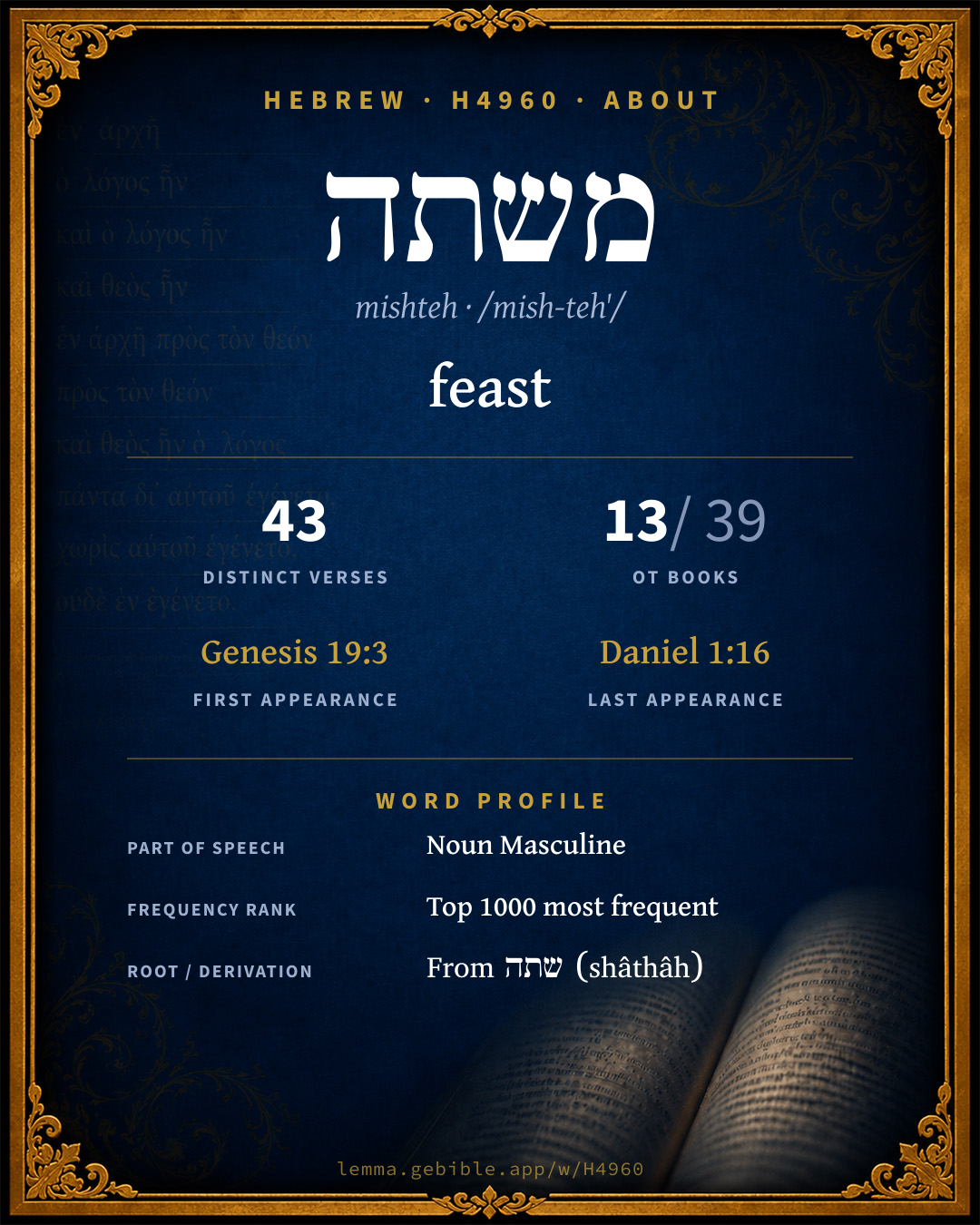
מִשְׁתֶּה
feast
also: drink, banquet fuller range ↓
Full lexicon entry — Brown-Driver-Briggs (BDB)
From Brown-Driver-Briggs (BDB)
Where this word appears
See every Absolute-state word in the Hebrew Bible →
Grammar key — what these labels mean
Part of speech
- Noun
- A naming word — a person, place, thing, or idea.
Noun type
- Common
- A common noun — a general class of person, place, or thing (“king,” “city,” “water”), not a specific name.
State
- Absolute
- The independent form of a noun, not bound to a following word.
- Construct
- A noun bound to a following noun in a possessive / “of” relationship (the construct chain).
Gender
- Masculine
- Grammatically masculine.
Number
- Singular
- One.
31 distinct verses where H4960 appears in the Absolute state, across 11 books. Filtered view — show all forms. Click any verse to open its interlinear word-by-word view. Verse text shown in the World English Bible for context — . Each verse’s Hebrew form is shown with its reference; the English is not keyword-highlighted, since the data carries no word-level English alignment. Use “Compare translations” on any verse to read it across multiple English versions. This concordance covers the Hebrew Bible; Septuagint (Greek Old Testament) occurrences are not indexed here.
Genesis 5 verses
- Genesis 19:3 מִשְׁתֶּ֔ה n c ms He urged them greatly, and they came in with him, and entered into his house. He made them a feast, and baked unleavened bread, and they ate.
- Genesis 21:8 מִשְׁתֶּ֣ה n c ms The child grew, and was weaned. Abraham made a great feast on the day that Isaac was weaned.
- Genesis 26:30 מִשְׁתֶּ֔ה n c ms He made them a feast, and they ate and drink.
- Genesis 29:22 מִשְׁתֶּֽה n c ms Laban gathered together all the men of the place, and made a feast.
- Genesis 40:20 מִשְׁתֶּ֖ה n c ms It happened the third day, which was Pharaoh's birthday, that he made a feast for all his servants, and he lifted up the head of the chief cupbearer and the head of the chief baker among his servants.
Judges 3 verses
- Judges 14:10 מִשְׁתֶּ֔ה n c ms His father went down to the woman: and Samson made there a feast; for so used the young men to do.
- Judges 14:12 הַ/מִּשְׁתֶּה֙ ptcl def.art + n c ms Samson said to them, Let me now put forth a riddle to you: if you can declare it to me within the seven days of the feast, and find it out, then I will give you thirty linen garments and thirty changes of clothing;
- Judges 14:17 הַ/מִּשְׁתֶּ֑ה ptcl def.art + n c ms She wept before him the seven days, while their feast lasted: and it happened on the seventh day, that he told her, because she pressed him sore; and she told the riddle to the children of her people.
1 Samuel 1 verse
2 Samuel 1 verse
1 Kings 1 verse
Ezra 1 verse
Esther 14 verses
- Esther 1:3 מִשְׁתֶּ֔ה n c ms in the third year of his reign, he made a feast to all his princes and his servants; the power of Persia and Media, the nobles and princes of the provinces, being before him;
- Esther 1:5 מִשְׁתֶּ֖ה n c ms When these days were fulfilled, the king made a feast to all the people who were present in Shushan the palace, both great and small, seven days, in the court of the garden of the king's palace.
- Esther 2:18 מִשְׁתֶּ֣ה מִשְׁתֵּ֣ה n c ms n c ms cs Then the king made a great feast to all his princes and his servants, even Esther's feast; and he made a release to the provinces, and gave gifts, according to the bounty of the king.
- Esther 5:4 הַ/מִּשְׁתֶּ֖ה ptcl def.art + n c ms Esther said, If it seem good to the king, let the king and Haman come this day to the banquet that I have prepared for him.
- Esther 5:5 הַ/מִּשְׁתֶּ֖ה ptcl def.art + n c ms Then the king said, Cause Haman to make haste, that it may be done as Esther has said. So the king and Haman came to the banquet that Esther had prepared.
- Esther 5:8 הַ/מִּשְׁתֶּה֙ ptcl def.art + n c ms if I have found favor in the sight of the king, and if it please the king to grant my petition, and to perform my request, let the king and Haman come to the banquet that I shall prepare for them, and I will do tomorrow as the king has said.
- Esther 5:12 הַ/מִּשְׁתֶּ֥ה ptcl def.art + n c ms Haman said moreover, Yes, Esther the queen did let no man come in with the king to the banquet that she had prepared but myself; and tomorrow also am I invited by her together with the king.
- Esther 5:14 הַ/מִּשְׁתֶּ֖ה ptcl def.art + n c ms Then said Zeresh his wife and all his friends to him, Let a gallows be made fifty cubits high, and in the morning speak you to the king that Mordecai may be hanged thereon: then go you in merrily with the king to the banquet. The thing pleased Haman; and he caused the gallows to be made.
- Esther 6:14 הַ/מִּשְׁתֶּ֖ה ptcl def.art + n c ms While they were yet talking with him, came the king's chamberlains, and hurried to bring Haman to the banquet that Esther had prepared.
- Esther 8:17 מִשְׁתֶּ֖ה n c ms In every province, and in every city, wherever the king's commandment and his decree came, the Jews had gladness and joy, a feast and a good day. Many from among the peoples of the land became Jews; for the fear of the Jews was fallen on them.
- Esther 9:17 מִשְׁתֶּ֥ה n c ms [This was done] on the thirteenth day of the month Adar; and on the fourteenth day of the same they rested, and made it a day of feasting and gladness.
- Esther 9:18 מִשְׁתֶּ֥ה n c ms But the Jews who were in Shushan assembled together on the thirteenth [day] of it, and on the fourteenth of it; and on the fifteenth [day] of the same they rested, and made it a day of feasting and gladness.
- Esther 9:19 וּ/מִשְׁתֶּ֖ה conj + n c ms Therefore do the Jews of the villages, who dwell in the unwalled towns, make the fourteenth day of the month Adar [a day of] gladness and feasting, and a good day, and of sending portions one to another.
- Esther 9:22 מִשְׁתֶּ֣ה n c ms as the days in which the Jews had rest from their enemies, and the month which was turned to them from sorrow to gladness, and from mourning into a good day; that they should make them days of feasting and gladness, and of sending portions one to another, and gifts to the needy.
Job 2 verses
- Job 1:4 מִשְׁתֶּ֔ה n c ms His sons went and held a feast in the house of each one on his birthday; and they sent and called for their three sisters to eat and to drink with them.
- Job 1:5 הַ/מִּשְׁתֶּ֜ה ptcl def.art + n c ms It was so, when the days of their feasting had run their course, that Job sent and sanctified them, and rose up early in the morning, and offered burnt offerings according to the number of them all. For Job said, "It may be that my sons have sinned, and renounced God in their hearts." Thus did Job continually.
Proverbs 1 verse
Ecclesiastes 1 verse
Jeremiah 1 verse
About this entry
At a glance — auto-summarized from this page’s data, not written by a person. Every figure links to its source below. This summary describes the numbers; it doesn’t interpret them.
“feast” is the headline sense of the Hebrew noun משתה (mishteh). First canonically at Genesis 19:3, it enters the text early. It turns up in 43 verses across 13 books, a moderately common footprint. It concentrates in Esther, which alone accounts for 44% of its uses. Not a single-sense word: its full sense range also takes in “drink” and “banquet”. See the sense tree, 43-verse concordance, and the renderings breakdown below.
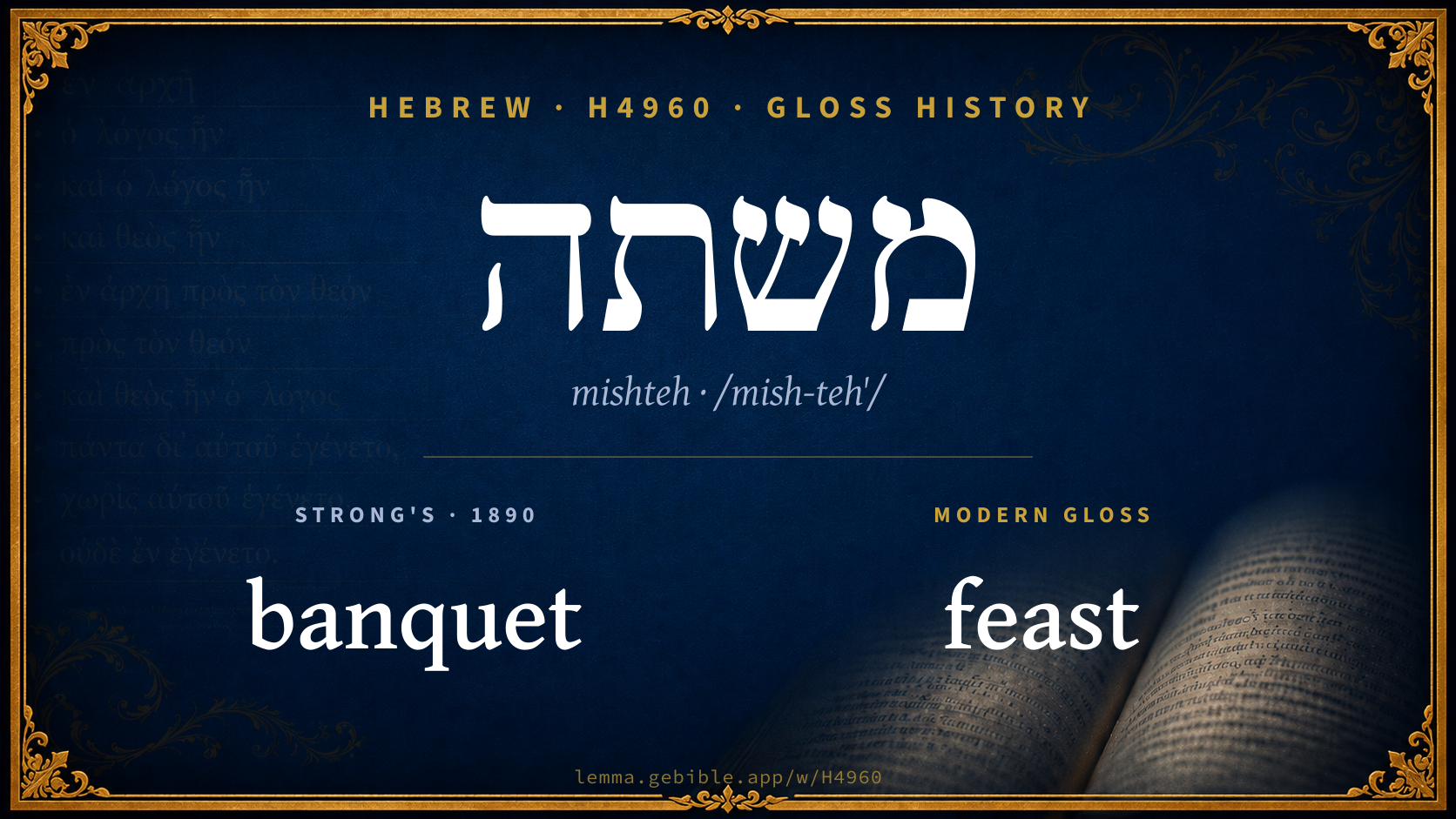
Gloss history
Strong's 1890 vs modern scholarship
About this word
Strong's H4960 catalogs a Hebrew word from the Hebrew Old Testament.
These counts are not copied from any lexicon or concordance. They are computed here, from the morphology-tagged Hebrew Old Testament. What Lemma adds →
- 43
- distinct verses
- The word appears in 43 distinct verses.
- 13 / 39
- OT books
- The word appears in 13 of 39 Old Testament books.
- #796
- by frequency
- Top 1000 most frequent Hebrew words (rank 796 of 8,640 Hebrew words by occurrence).
View all 43 occurrences in the concordance →
By section of the Old Testament
By traditional corpus
Conventional, traditional groupings — biblical authorship is debated, so this is a traditional corpus grouping, not an authorship claim. Each share is this word’s portion of its verses in that division of the Hebrew canon. Each figure is a share of the word’s 43 distinct verses.
- Writings (Ketuvim) 28 verses · 65%
- Prophets (Nevi'im) 10 verses · 23%
- Torah (Pentateuch) 5 verses · 12%
How translations render this word
Counts come from each version’s own published word-to-Strong’s tagging or interlinear alignment — an approximate guide to how each version renders this word, not a word-level alignment the data otherwise carries. Because each total is that version’s own tagged count, the per-version totals vary from one another and need not match the appearance or distinct-verse counts above. These counts may also differ from a printed concordance because Lemma counts each distinctly tagged rendering and does not collapse phrase taggings into a single head-word total. This is a fixed set of word-tagged versions (KJV, ASV, BSB, ULT) and does not change with the reading translation you choose elsewhere. Each version’s license is shown beside its name below (and on Sources).
- King James Version: Feast 18×, Banquet 10×, Feasting 7×
- American Standard Version: Feast 18×, Banquet 10×, Feasting 6×
- Berean Standard Bible: Feast 15×, Banquet 10×, Feasting 7×
- unfoldingWord Literal Text: Feast 18×, Banquet 7×, Feast of 4×
King James Version Public Domain
Renders H4960 across 46 tagged occurrences — most commonly:
Plus 7 renderings that appear only once — usually multi-word phrases or single function words the recovered tagging swept in, not distinct renderings.
American Standard Version Public Domain
Renders H4960 across 46 tagged occurrences — most commonly:
Plus 8 renderings that appear only once — usually multi-word phrases or single function words the recovered tagging swept in, not distinct renderings.
Berean Standard Bible Public Domain
Renders H4960 across 42 tagged occurrences — most commonly:
Plus 4 renderings that appear only once — usually multi-word phrases or single function words the recovered tagging swept in, not distinct renderings. Not rendered by a distinct English word in 4 further occurrences.
unfoldingWord Literal Text CC BY-SA 4.0
Renders H4960 across 48 tagged occurrences — most commonly:
Plus 6 renderings that appear only once — usually multi-word phrases or single function words the recovered tagging swept in, not distinct renderings.
Senses in the full BDB
What do BDB’s symbols mean?
BDB uses these scholarly abbreviations:
| Symbol | Meaning |
|---|---|
| 𝔊 | the Septuagint (the ancient Greek translation, LXX) |
| 𝔙 | the Vulgate (the Latin translation) |
| 𝔖 | the Syriac version (the Peshitta) |
| 𝔗 | the Targum (the Aramaic translation) |
| ψ | the Psalms |
| √ | root (the underlying root or stem) |
| ‖ | parallel passage (a synonymous or contrasted parallel) |
| † | the dagger: every passage where the word occurs is cited |
The 2 senses and sub-senses the full Brown-Driver-Briggs lexicon distinguishes for this word, in lexicon order (not ranked by frequency), with BDB’s own verbatim wording and sub-sense lettering. Shown in Hebrew script with BDB’s own scholarly abbreviations. The condensed entry is in the Lexicon Entry tab. See also the Forms in the corpus table below.
- 1. feast, banquet (occasion for drinking, drinking-bout), 1 S 25:36(×2); Is 5:12; Je 51:39 (fig.), Jb 1:5; Est 2:18; 5:14; 8:17; 9:19; lasting seven days Ju 14:12, 17 (wedding-feast, cf. Gn 29:22, and v. BenzArch. 143; Ency. Bib. 2949 NowArch. i. 163); עָשָׂה מ׳ give or make a feast (sometimes + ל pers.) Gn 19:3; 26:30 (both J), 21:8; 40:20 (both E), Ju 14:10; 2 S 3:20 1 K 3:15; Est 1:3 + 8 times Est, Jb 1:4 + 2 S 13:27(×2) 𝔊 Th We Dr and mod.; מִשְׁתֵּה הַיַּיִן Est 5:6; 7:2, 7, בֵּית מִשְׁתֶּה Je 16:8; Ec 7:2, בֵּית מִשְׁתֵּה הַיַּיִן Est 7:8; יוֹם מ׳ וְשִׂמְחָה Est 9:17, 18, cf. v 22; of י׳’s banquet for all peoples Is 25:6 (fig. of Messianic blessings); fig. also in טוֹב־לֵב מ׳ תָּמִיד Pr 15:15. e.g. 1 Samuel 25:36
- 2. drink (late): מַאֲכָל וּמ׳ וָשֶׁמֶן Ezr 3:7; sf. יֵין מִשְׁתָּיו Dn 1:5, 8; מִשְׁתֵּיהֶם v 16; מִשְׁתֵּיכֶם v 10. e.g. Ezra 3:7
Senses from the full Brown-Driver-Briggs lexicon (Brown, Driver, Briggs; Oxford 1906 — public domain), digitized via Sefaria, supplemented by the OpenScriptures HebrewLexicon (CC BY 4.0). Full attribution on Sources.
Word origin
n.m. Gn 21:8 1. feast; 2. drink;—abs. מ׳ Gn 19:3 +; cstr. מִשְׁתֵּה 1 S 25:36 +; sf. מִשְׁתָּיו Dn 1:5 + (Ges§ 93 ss), etc.;—
— Brown-Driver-Briggs (Oxford 1906, public domain), digitized via Sefaria, supplemented by the OpenScriptures HebrewLexicon (CC BY 4.0). See Sources.
Derived from שתה (shâthâh) (H8354) — to drink.
Jastrow Dictionary
A second Hebrew/Aramaic lexicon for comparison, covering Aramaic and post-biblical (Talmudic, Targumic, Midrashic) usage that the biblical-Hebrew BDB does not. Matched by lemma rather than by Strong’s number, so a lemma may carry more than one Jastrow headword (shown separately below), and the entries cover usage well beyond the Bible.
מִשְׁתֶּה
- drink. Keth. 8ᵇ כמִשְׁתֵּה ראשונים וכ׳ as those before you drank (the cup of grief) &c.—Esp. feast, wedding meal &c. Gen. R. s. 53 מ׳ גדול מִשְׁתֵּה גדולים ‘a great feast’ (Gen. XXI, 8) a festive gathering of great men. Keth. 4ᵃ, a. fr. שבעת ימי המ׳ the wedding week. Sabb. 67ᵇ עשה מ׳ לבנו gave a feast in honor of his son. Keth. 8ᵃ נערים ממ׳ נגינתם the voices of the youths singing at their banquets. Ber. I, 1, a. fr. בית המ׳ (the house of a) wedding. Deut. R. s. 1, end; a. fr.—Pl. מִשְׁתָּאוֹת, מִשְׁתָּיוֹת. B. Bath. 91ᵃ. Ruth R. to IV, 2; Y. Keth. I, 25ᵃ מכאן לבית הזה שהממנים … בבית מ׳ וכ׳ from here (Ruth l. c.) this house (of the Nasi) learned to ordain elders at its banquets. Nidd. 16ᵇ, v. רָגַל; a. fr. e.g. Genesis 21:8
A Dictionary of the Targumim, the Talmud Babli and Yerushalmi, and the Midrashic Literature (Marcus Jastrow; London, Luzac, 1903) — Public Domain. Digitized via Sefaria. Digitized via Sefaria. Full attribution on Sources.
Forms in the corpus
The 23 distinct written forms H4960 takes in the Hebrew Bible, most frequent first — each parse links to that state’s occurrences in the concordance. Hebrew forms include their vowel points and cantillation, so a single lemma takes many written forms.
Same root — word family
Other BDB entries built from the same root as H4960, grouped by Strong’s listed origin. These share a root / origin per the lexicon — not necessarily a shared meaning. Each links to that word’s own entry.
Derives from
Shares the same root
Derived from this word
Compare all same-root words → Showing 4 of 5 — not the complete family. They share a root, not necessarily a meaning.
Septuagint verse parallels
This word appears in 41 verses that also exist in the Greek Old Testament (Septuagint), out of the 43 Hebrew verses it occurs in. You can read those verses in Greek by switching the Old Testament edition to the Septuagint.
Read these verses in the Septuagint
- Genesis 19:3
- Judges 14:10
- 1 Samuel 25:36
- 2 Samuel 3:20
- 1 Kings 3:15
- Ezra 3:7
- Esther 1:3
- Job 1:4
- Proverbs 15:15
- Ecclesiastes 7:2
- Isaiah 5:12
- Jeremiah 16:8
This is a verse-level parallel only — the same verses exist in both the Hebrew and Greek Old Testaments. No word-level Hebrew↔Greek correspondence is claimed: the data carries no such alignment, so no Greek word is shown as this Hebrew word’s translation. Coverage is not total — the Septuagint omits the deuterocanon and renumbers the Psalms, so some Hebrew verses have no direct Greek parallel.