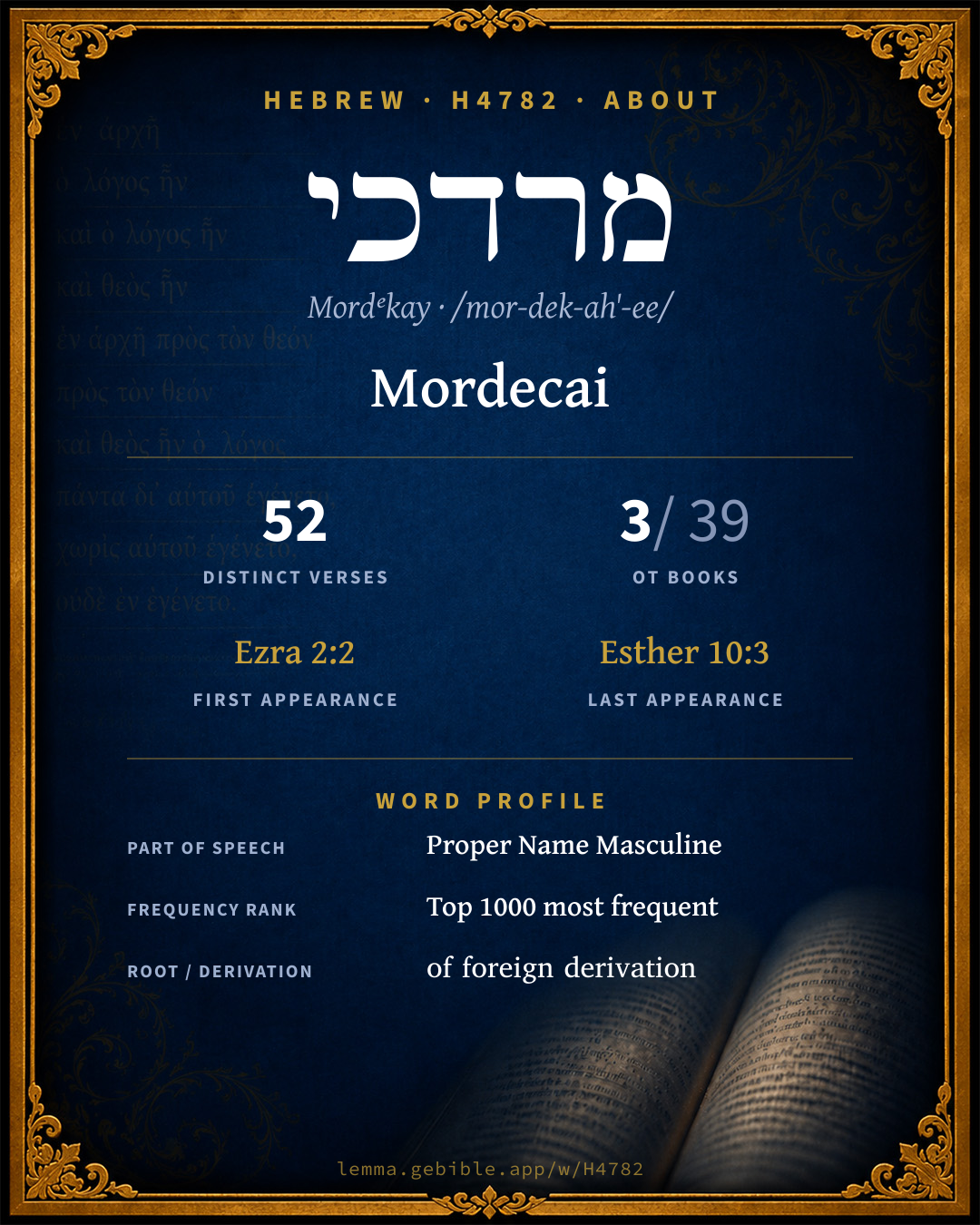
מׇרְדֳּכַי
Mordecai
BDB lists 3 entries for ‘Mordecai’ fuller range ↓
Full lexicon entry — Brown-Driver-Briggs (BDB)
From Brown-Driver-Briggs (BDB)
Where this word appears
Grammar key — what these labels mean
Part of speech
- Noun
- A naming word — a person, place, thing, or idea.
Noun type
- Proper
- A name of a specific person, place, or people (e.g. Abraham, Zion, Israel).
Every verse where H4782 appears — 52 distinct verses across 3 books. Click any verse to open its interlinear word-by-word view. Verse text shown in the World English Bible for context — . Each verse’s Hebrew form is shown with its reference; the English is not keyword-highlighted, since the data carries no word-level English alignment. Use “Compare translations” on any verse to read it across multiple English versions. This concordance covers the Hebrew Bible; Septuagint (Greek Old Testament) occurrences are not indexed here.
Ezra 1 verse
Nehemiah 1 verse
Esther 50 verses
- Esther 2:5 מָרְדֳּכַ֗י n Proper There was a certain Jew in Shushan the palace, whose name was Mordecai, the son of Jair, the son of Shimei, the son of Kish, a Benjamite,
- Esther 2:7 מָרְדֳּכַ֛י n Proper He brought up Hadassah, who is, Esther, his uncle's daughter: for she had neither father nor mother, and the maiden was fair and beautiful; and when her father and mother were dead, Mordecai took her for his own daughter.
- Esther 2:10 מָרְדֳּכַ֛י n Proper Esther had not made known her people nor her relatives; for Mordecai had charged her that she should not make it known.
- Esther 2:11 מָרְדֳּכַי֙ n Proper Mordecai walked every day before the court of the women's house, to know how Esther did, and what would become of her.
- Esther 2:15 מָרְדֳּכַ֡י n Proper Now when the turn of Esther, the daughter of Abihail the uncle of Mordecai, who had taken her for his daughter, was come to go in to the king, she required nothing but what Hegai the king's chamberlain, the keeper of the women, appointed. Esther obtained favor in the sight of all those who looked at her.
- Esther 2:19 וּ/מָרְדֳּכַ֖י conj + n Proper When the virgins were gathered together the second time, then Mordecai was sitting in the king's gate.
- Esther 2:20 מָרְדֳּכָ֑י מָרְדֳּכַי֙ n Proper n Proper Esther had not yet made known her relatives nor her people; as Mordecai had charged her: for Esther did the commandment of Mordecai, like as when she was brought up with him.
- Esther 2:21 וּ/מָרְדֳּכַ֖י conj + n Proper In those days, while Mordecai was sitting in the king's gate, two of the king's chamberlains, Bigthan and Teresh, of those who kept the threshold, were angry, and sought to lay hands on the king Ahasuerus.
- Esther 2:22 לְ/מָרְדֳּכַ֔י מָרְדֳּכָֽי prep + n Proper n Proper The thing became known to Mordecai, who shown it to Esther the queen; and Esther told the king [of it] in Mordecai's name.
- Esther 3:2 וּ/מָ֨רְדֳּכַ֔י conj + n Proper All the king's servants, who were in the king's gate, bowed down, and did reverence to Haman; for the king had so commanded concerning him. But Mordecai didn't bow down, nor did him reverence.
- Esther 3:3 לְ/מָרְדֳּכָ֑י prep + n Proper Then the king's servants, who were in the king's gate, said to Mordecai, Why disobey you the king's commandment?
- Esther 3:4 מָרְדֳּכַ֔י n Proper Now it came to pass, when they spoke daily to him, and he didn't listen to them, that they told Haman, to see whether Mordecai's matters would stand: for he had told those who he was a Jew.
- Esther 3:5 מָרְדֳּכַ֔י n Proper When Haman saw that Mordecai didn't bow down, nor did him reverence, then was Haman full of wrath.
- Esther 3:6 בְּ/מָרְדֳּכַ֣י מָרְדֳּכָ֑י מָרְדֳּכָֽי prep + n Proper n Proper n Proper But he scorned the thought of laying hands on Mordecai alone; for they had made known to him the people of Mordecai: therefore Haman sought to destroy all the Jews who were throughout the whole kingdom of Ahasuerus, even the people of Mordecai.
- Esther 4:1 וּ/מָרְדֳּכַ֗י מָרְדֳּכַי֙ conj + n Proper n Proper Now when Mordecai knew all that was done, Mordecai tore his clothes, and put on sackcloth with ashes, and went out into the midst of the city, and cried with a loud and a bitter cry;
- Esther 4:4 מָרְדֳּכַ֗י n Proper Esther's maidens and her chamberlains came and told it her; and the queen was exceedingly grieved: and she sent clothing to clothe Mordecai, and to take his sackcloth from off him; but he didn't receive it.
- Esther 4:5 מָרְדֳּכָ֑י n Proper Then called Esther for Hathach, one of the king's chamberlains, whom he had appointed to attend on her, and charged him to go to Mordecai, to know what this was, and why it was.
- Esther 4:6 מָרְדֳּכָ֑י n Proper So Hathach went forth to Mordecai to the broad place of the city, which was before the king's gate.
- Esther 4:7 מָרְדֳּכַ֔י n Proper Mordecai told him of all that had happened to him, and the exact sum of the money that Haman had promised to pay to the king's treasuries for the Jews, to destroy them.
- Esther 4:9 מָרְדֳּכָֽי n Proper Hathach came and told Esther the words of Mordecai.
- Esther 4:10 מָרְדֳּכָֽי n Proper Then Esther spoke to Hathach, and gave him a message to Mordecai [saying]:
- Esther 4:12 לְ/מָרְדֳּכָ֔י prep + n Proper They told to Mordecai Esther's words.
- Esther 4:13 מָרְדֳּכַ֖י n Proper Then Mordecai bade them return answer to Esther, Don't think to yourself that you shall escape in the king's house, more than all the Jews.
- Esther 4:15 מָרְדֳּכָֽי n Proper Then Esther bade them return answer to Mordecai,
- Esther 4:17 מָרְדֳּכָ֑י n Proper So Mordecai went his way, and did according to all that Esther had commanded him.
- Esther 5:9 מָרְדֳּכַ֜י מָרְדֳּכַ֖י n Proper n Proper Then went Haman forth that day joyful and glad of heart: but when Haman saw Mordecai in the king's gate, that he didn't stand up nor move for him, he was filled with wrath against Mordecai.
- Esther 5:13 מָרְדֳּכַ֣י n Proper Yet all this avails me nothing, so long as I see Mordecai the Jew sitting at the king's gate.
- Esther 5:14 מָרְדֳּכַי֙ n Proper Then said Zeresh his wife and all his friends to him, Let a gallows be made fifty cubits high, and in the morning speak you to the king that Mordecai may be hanged thereon: then go you in merrily with the king to the banquet. The thing pleased Haman; and he caused the gallows to be made.
- Esther 6:2 מָרְדֳּכַ֜י n Proper It was found written that Mordecai had told of Bigthana and Teresh, two of the king's chamberlains, of those who kept the threshold, who had sought to lay hands on the king Ahasuerus.
- Esther 6:3 לְ/מָרְדֳּכַ֖י prep + n Proper The king said, What honor and dignity has been bestowed on Mordecai for this? Then the king's servants who ministered to him said, "Nothing has been done for him."
- Esther 6:4 מָרְדֳּכַ֔י n Proper The king said, "Who is in the court?" Now Haman was come into the outward court of the king's house, to speak to the king to hang Mordecai on the gallows that he had prepared for him.
- Esther 6:10 לְ/מָרְדֳּכַ֣י prep + n Proper Then the king said to Haman, Make haste, and take the clothing and the horse, as you have said, and do even so to Mordecai the Jew, who sits at the king's gate: let nothing fail of all that you have spoken.
- Esther 6:11 מָרְדֳּכָ֑י n Proper Then took Haman the clothing and the horse, and arrayed Mordecai, and caused him to ride through the street of the city, and proclaimed before him, Thus shall it be done to the man whom the king delights to honor.
- Esther 6:12 מָרְדֳּכַ֖י n Proper Mordecai came again to the king's gate. But Haman hurried to his house, mourning and having his head covered.
- Esther 6:13 מָרְדֳּכַ֞י n Proper Haman recounted to Zeresh his wife and all his friends everything that had happened to him. Then his wise men and Zeresh his wife said to him, If Mordecai, before whom you have begun to fall, be of the seed of the Jews, you shall not prevail against him, but shall surely fall before him.
- Esther 7:9 לְֽ/מָרְדֳּכַ֞י prep + n Proper Then said Harbonah, one of the chamberlains who were before the king, Behold also, the gallows fifty cubits high, which Haman has made for Mordecai, who spoke good for the king, stands in the house of Haman. The king said, Hang him thereon.
- Esther 7:10 לְ/מָרְדֳּכָ֑י prep + n Proper So they hanged Haman on the gallows that he had prepared for Mordecai. Then was the king's wrath pacified.
- Esther 8:1 וּ/מָרְדֳּכַ֗י conj + n Proper On that day did the king Ahasuerus give the house of Haman the Jews' enemy to Esther the queen. Mordecai came before the king; for Esther had told what he was to her.
- Esther 8:2 לְ/מָרְדֳּכָ֑י מָרְדֳּכַ֖י prep + n Proper n Proper The king took off his ring, which he had taken from Haman, and gave it to Mordecai. Esther set Mordecai over the house of Haman.
- Esther 8:7 וּֽ/לְ/מָרְדֳּכַ֖י conj + prep + n Proper Then the king Ahasuerus said to Esther the queen and to Mordecai the Jew, See, I have given Esther the house of Haman, and him they have hanged on the gallows, because he laid his hand on the Jews.
- Esther 8:9 מָרְדֳּכַ֣י n Proper Then were the king's scribes called at that time, in the third month Sivan, on the three and twentieth [day] of it; and it was written according to all that Mordecai commanded to the Jews, and to the satraps, and the governors and princes of the provinces which are from India to Ethiopia, one hundred twenty-seven provinces, to every province according to the writing of it, and to every people after their language, and to the Jews according to their writing, and according to their language.
- Esther 8:15 וּ/מָרְדֳּכַ֞י conj + n Proper Mordecai went forth from the presence of the king in royal clothing of blue and white, and with a great crown of gold, and with a robe of fine linen and purple: and the city of Shushan shouted and was glad.
- Esther 9:3 מָרְדֳּכַ֖י n Proper All the princes of the provinces, and the satraps, and the governors, and those who did the king's business, helped the Jews; because the fear of Mordecai was fallen on them.
- Esther 9:4 מָרְדֳּכַי֙ מָרְדֳּכַ֖י n Proper n Proper For Mordecai was great in the king's house, and his fame went forth throughout all the provinces; for the man Mordecai grew greater and greater.
- Esther 9:20 מָרְדֳּכַ֔י n Proper Mordecai wrote these things, and sent letters to all the Jews who were in all the provinces of the king Ahasuerus, both near and far,
- Esther 9:23 מָרְדֳּכַ֖י n Proper The Jews undertook to do as they had begun, and as Mordecai had written to them;
- Esther 9:29 וּ/מָרְדֳּכַ֥י conj + n Proper Then Esther the queen, the daughter of Abihail, and Mordecai the Jew, wrote with all authority to confirm this second letter of Purim.
- Esther 9:31 מָרְדֳּכַ֤י n Proper to confirm these days of Purim in their appointed times, according as Mordecai the Jew and Esther the queen had enjoined them, and as they had ordained for themselves and for their seed, in the matter of the fastings and their cry.
- Esther 10:2 מָרְדֳּכַ֔י n Proper All the acts of his power and of his might, and the full account of the greatness of Mordecai, whereunto the king advanced him, aren't they written in the book of the chronicles of the kings of Media and Persia?
- Esther 10:3 מָרְדֳּכַ֣י n Proper For Mordecai the Jew was next to king Ahasuerus, and great among the Jews, and accepted of the multitude of his brothers, seeking the good of his people, and speaking peace to all his seed.
About this entry
At a glance — auto-summarized from this page’s data, not written by a person. Every figure links to its source below. This summary describes the numbers; it doesn’t interpret them.
At its core, מרדכי (Mordᵉkay) means “Mordecai.” The word gravitates to Esther (96%), then Ezra and Nehemiah. It appears 52 verses across 3 books of the Hebrew Bible, among its moderately common vocabulary. First canonically at Ezra 2:2, it enters the text early. Dig into 52-verse concordance and the renderings breakdown below.
Gloss history
Strong's 1890 vs modern scholarship
About this word
Strong's H4782 catalogs a Hebrew word from the Hebrew Old Testament.
These counts are not copied from any lexicon or concordance. They are computed here, from the morphology-tagged Hebrew Old Testament. What Lemma adds →
- 52
- distinct verses
- The word appears in 52 distinct verses.
- 3 / 39
- OT books
- The word appears in 3 of 39 Old Testament books.
- #639
- by frequency
- Top 1000 most frequent Hebrew words (rank 639 of 8,640 Hebrew words by occurrence).
View all 52 occurrences in the concordance →
By section of the Old Testament
By traditional corpus
Conventional, traditional groupings — biblical authorship is debated, so this is a traditional corpus grouping, not an authorship claim. Each share is this word’s portion of its verses in that division of the Hebrew canon. Each figure is a share of the word’s 52 distinct verses.
- Writings (Ketuvim) 52 verses · 100%
How translations render this word
Counts come from each version’s own published word-to-Strong’s tagging or interlinear alignment — an approximate guide to how each version renders this word, not a word-level alignment the data otherwise carries. Because each total is that version’s own tagged count, the per-version totals vary from one another and need not match the appearance or distinct-verse counts above. These counts may also differ from a printed concordance because Lemma counts each distinctly tagged rendering and does not collapse phrase taggings into a single head-word total. This is a fixed set of word-tagged versions (KJV, ASV, BSB, ULT) and does not change with the reading translation you choose elsewhere. Each version’s license is shown beside its name below (and on Sources).
- King James Version: Mordecai 53×
- American Standard Version: Mordecai 48×
- Berean Standard Bible: Mordecai 46×, Mordecai’s 6×, He 3×
- unfoldingWord Literal Text: Mordecai 58×, The 2×
King James Version Public Domain
Renders H4782 across 60 tagged occurrences — most commonly:
Plus 7 renderings that appear only once — usually multi-word phrases or single function words the recovered tagging swept in, not distinct renderings.
American Standard Version Public Domain
Renders H4782 across 60 tagged occurrences — most commonly:
Plus 12 renderings that appear only once — usually multi-word phrases or single function words the recovered tagging swept in, not distinct renderings.
Berean Standard Bible Public Domain
Renders H4782 across 60 tagged occurrences — most commonly:
Plus 5 renderings that appear only once — usually multi-word phrases or single function words the recovered tagging swept in, not distinct renderings.
unfoldingWord Literal Text CC BY-SA 4.0
Renders H4782 across 63 tagged occurrences — most commonly:
Plus 3 renderings that appear only once — usually multi-word phrases or single function words the recovered tagging swept in, not distinct renderings.
Senses in the full BDB
What do BDB’s symbols mean?
BDB uses these scholarly abbreviations:
| Symbol | Meaning |
|---|---|
| 𝔊 | the Septuagint (the ancient Greek translation, LXX) |
| 𝔙 | the Vulgate (the Latin translation) |
| 𝔖 | the Syriac version (the Peshitta) |
| 𝔗 | the Targum (the Aramaic translation) |
| ψ | the Psalms |
| √ | root (the underlying root or stem) |
| ‖ | parallel passage (a synonymous or contrasted parallel) |
| † | the dagger: every passage where the word occurs is cited |
The 2 senses and sub-senses the full Brown-Driver-Briggs lexicon distinguishes for this word, in lexicon order (not ranked by frequency), with BDB’s own verbatim wording and sub-sense lettering. Shown in Hebrew script with BDB’s own scholarly abbreviations. The condensed entry is in the Lexicon Entry tab. See also the Forms in the corpus table below.
- 1. companion of Zerub., according to Ezr 2:2=Ne 7:7. 𝔊 Μαραθχαιος, Μαρδοχαιος, etc. e.g. Ezra 2:2
- 2. cousin and adoptive father of Esther Est 2:5, 7, 10 + 55 times Est. 𝔊 Μαρδοχαιος. e.g. Esther 2:5
Senses from the full Brown-Driver-Briggs lexicon (Brown, Driver, Briggs; Oxford 1906 — public domain), digitized via Sefaria, supplemented by the OpenScriptures HebrewLexicon (CC BY 4.0). Full attribution on Sources.
Word origin
(van d. H. מָרְדְּכַי) n.pr.m. Mordecai (perhaps from n. div. Marduk (מְרֹדַךְ), Zim ZAW xi. 161 ff.; cf. further Wild (citing Jensen)Comm. Est. 173f.);—מ׳ Ezr 2:2 Est 2:5 +; מָרְדֳּכָ֑י Est 2:22 +;—
— Brown-Driver-Briggs (Oxford 1906, public domain), digitized via Sefaria, supplemented by the OpenScriptures HebrewLexicon (CC BY 4.0). See Sources.
Origin: of foreign derivation
Jastrow Dictionary
A second Hebrew/Aramaic lexicon for comparison, covering Aramaic and post-biblical (Talmudic, Targumic, Midrashic) usage that the biblical-Hebrew BDB does not. Matched by lemma rather than by Strong’s number, so a lemma may carry more than one Jastrow headword (shown separately below), and the entries cover usage well beyond the Bible.
מָרְדְּכַי
- (b. h.) pr. n. m. Mordecai,
- 1. the uncle of Esther. Pes. 117ᵃ מ׳ ואסתר אמרוהו M. and Esther recited (composed) those psalms of Hallel. Yeb. 24ᵇ, v. גֵּר; a. fr.
- 2. name of an Amora. Keth. 87ᵃ. Ber. 31ᵃ; a. fr.
A Dictionary of the Targumim, the Talmud Babli and Yerushalmi, and the Midrashic Literature (Marcus Jastrow; London, Luzac, 1903) — Public Domain. Digitized via Sefaria. Digitized via Sefaria. Full attribution on Sources.
Forms in the corpus
The 26 distinct written forms H4782 takes in the Hebrew Bible, most frequent first — each parse links to that state’s occurrences in the concordance. Hebrew forms include their vowel points and cantillation, so a single lemma takes many written forms.
| Form | Parsing | Example | Uses |
|---|---|---|---|
| מָרְדֳּכַ֖י | Noun, Proper | Esther 4:13 | 7 |
| מָרְדֳּכַ֔י | Noun, Proper | Esther 3:4 | 6 |
| מָרְדֳּכָ֑י | Noun, Proper | Esther 2:20 | 6 |
| מָרְדֳּכַי֙ | Noun, Proper | Esther 2:11 | 5 |
| מָרְדֳּכָֽי | Noun, Proper | Esther 2:22 | 5 |
| לְ/מָרְדֳּכָ֑י | Noun, Proper | Esther 3:3 | 3 |
| מָרְדֳּכַ֣י | Noun, Proper | Esther 5:13 | 3 |
| וּ/מָרְדֳּכַ֖י | Noun, Proper | Esther 2:19 | 2 |
| וּ/מָרְדֳּכַ֗י | Noun, Proper | Esther 4:1 | 2 |
| מָרְדֳּכַ֗י | Noun, Proper | Esther 2:5 | 2 |
| מָרְדֳּכַ֛י | Noun, Proper | Esther 2:7 | 2 |
| מָרְדֳּכַ֜י | Noun, Proper | Esther 5:9 | 2 |
| מָרְדֳּכַ֥י | Noun, Proper | Ezra 2:2 | 2 |
| בְּ/מָרְדֳּכַ֣י | Noun, Proper | Esther 3:6 | 1 |
| וּ/מָ֨רְדֳּכַ֔י | Noun, Proper | Esther 3:2 | 1 |
| וּ/מָרְדֳּכַ֞י | Noun, Proper | Esther 8:15 | 1 |
| וּ/מָרְדֳּכַ֥י | Noun, Proper | Esther 9:29 | 1 |
| וּֽ/לְ/מָרְדֳּכַ֖י | Noun, Proper | Esther 8:7 | 1 |
| לְ/מָרְדֳּכַ֔י | Noun, Proper | Esther 2:22 | 1 |
| לְ/מָרְדֳּכַ֖י | Noun, Proper | Esther 6:3 | 1 |
| לְ/מָרְדֳּכַ֣י | Noun, Proper | Esther 6:10 | 1 |
| לְ/מָרְדֳּכָ֔י | Noun, Proper | Esther 4:12 | 1 |
| לְֽ/מָרְדֳּכַ֞י | Noun, Proper | Esther 7:9 | 1 |
| מָרְדֳּכַ֞י | Noun, Proper | Esther 6:13 | 1 |
| מָרְדֳּכַ֡י | Noun, Proper | Esther 2:15 | 1 |
| מָרְדֳּכַ֤י | Noun, Proper | Esther 9:31 | 1 |
Bible dictionary
Public-domain dictionary articles matched to this entry by name (Mordecai). A biblical name can be shared by more than one person or place, so an article may treat several.
Easton's Bible Dictionary · M. G. Easton, 1897
The son of Jair, of the tribe of Benjamin. It has been alleged that he was carried into captivity with Jeconiah, and hence that he must have been at least one hundred and twenty-nine years old in the twelfth year of Ahasuerus (Xerxes). But the words of Esther do not necessarily lead to this conclusion. It was probably Kish of whom it is said (ver. 6) that he "had been carried away with the captivity."
He resided at Susa, the metropolis of Persia. He adopted his cousin Hadassah (Esther), an orphan child, whom he tenderly brought up as his own daughter. When she was brought into the king's harem and made queen in the room of the deposed queen Vashti, he was promoted to some office in the court of Ahasuerus, and was one of those who "sat in the king's gate" (Esther 2:21). While holding this office, he discovered a plot of the eunuchs to put the king to death, which, by his vigilance, was defeated. His services to the king in this matter were duly recorded in the royal chronicles.
Haman (q.v.) the Agagite had been raised to the highest position at court. Mordecai refused to bow down before him; and Haman, being stung to the quick by the conduct of Mordecai, resolved to accomplish his death in a wholesale destruction of the Jewish exiles throughout the Persian empire (Esther 3:8-15). Tidings of this cruel scheme soon reached the ears of Mordecai, who communicated with Queen Esther regarding it, and by her wise and bold intervention the scheme was frustrated. The Jews were delivered from destruction, Mordecai was raised to a high rank, and Haman was executed on the gallows he had by anticipation erected for Mordecai (6:2-7:10). In memory of the signal deliverance thus wrought for them, the Jews to this day celebrate the feast (9:26-32) of Purim (q.v.).
Smith's Bible Dictionary · William Smith, 1863
(little man, or worshipper or Mars), the deliverer, under divine Providence, of the Jews from the destruction plotted against them by Haman the chief minister of Xerxes; the institutor of the feast of Purim. The incidents of his history are too well known to need to be dwelt upon. [Esther, Book Of] Three things are predicated of Mordecai in the book of Esther: (1) That he lived in Shushan; (2) That his name was Mordecai, son of Jair, son of Shimei, son of Kish the Benjamite who was taken captive with Jehoiachin; (3) That he brought up Esther.
Hitchcock's Bible Names Dictionary · Roswell D. Hitchcock, 1869
contrition; bitter; bruising
Classic public-domain reference works; full attribution on Sources.
Septuagint verse parallels
This word appears in 48 verses that also exist in the Greek Old Testament (Septuagint), out of the 52 Hebrew verses it occurs in. You can read those verses in Greek by switching the Old Testament edition to the Septuagint.
Read these verses in the Septuagint
This is a verse-level parallel only — the same verses exist in both the Hebrew and Greek Old Testaments. No word-level Hebrew↔Greek correspondence is claimed: the data carries no such alignment, so no Greek word is shown as this Hebrew word’s translation. Coverage is not total — the Septuagint omits the deuterocanon and renumbers the Psalms, so some Hebrew verses have no direct Greek parallel.