
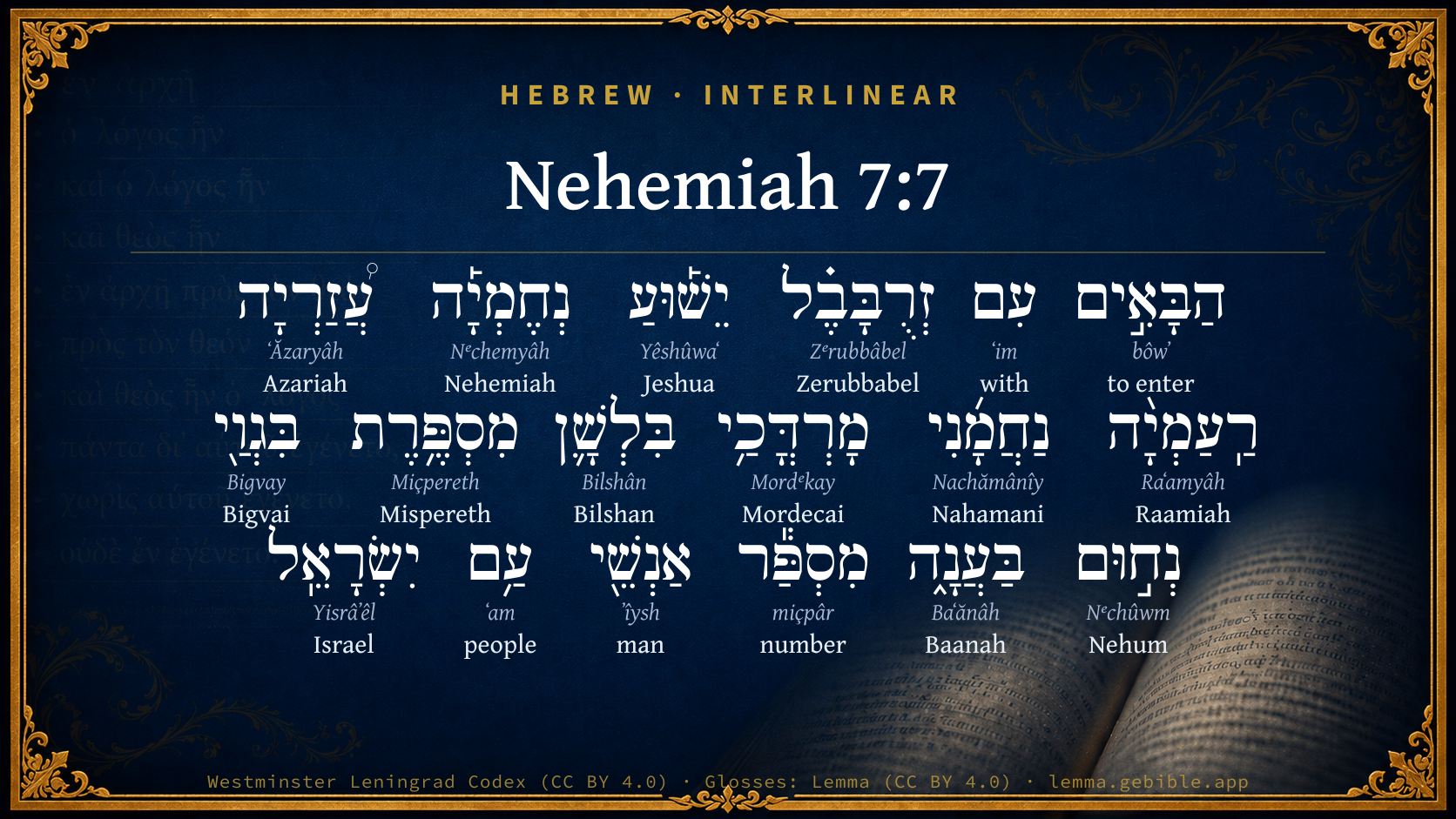
Nehemiah 7:7

Hebrew (Westminster Leningrad Codex) Nehemiah 7:7 appears in the Hebrew Old Testament. The text above is from the Westminster Leningrad Codex. Each word links to its Strong’s number, a concise gloss, and parsing drawn from the Open Scriptures Hebrew Bible morphology. Click any word for its full Brown-Driver-Briggs (BDB) entry.
Download image
Cite this verse

Nehemiah 7:7 (World English Bible). Public Domain. Lemma interlinear Bible study tool, https://lemma.gebible.app/v/nehemiah/7/7.

Show BibTeX & RIS
BibTeX
RIS
English Translation
who came with Zerubbabel, Jeshua, Nehemiah, Azariah, Raamiah, Nahamani, Mordecai, Bilshan, Mispereth, Bigvai, Nehum, Baanah. The number of the men of the people of Israel:
World English Bible · Public Domain
Highlights
  • 4 hapax legomena — only here in the Hebrew Bible
  • 4 first appearances in the Hebrew Bible
Full analysis ↓
Download a study sheet

One document with this verse’s original text, its word-by-word gloss line, the meaning frame, cross-references with their text, attributed commentary, and full source and license credits — printable, and it pastes into notes with its structure intact.

This verse Autodidact and up

Study sheet (.html) Plain text (.txt)

A passage Seminary Student

Up to 50 verses in one chapter. A passage sheet keeps up to 6 commentary sources and 12 cross-references per verse, in the order this page ranks them, and says so on the sheet whenever that leaves anything out. Ask for a single verse and you get the Autodidact verse sheet above.

Everything on this page stays free to read, with no account — the sheet is a download of what is already on screen, not access to it.

Want to remove ads? Support Godless Engineer
Compare translations 3

The same verse in 3 English versions, stacked beneath the original-language interlinear above. Click any original word for its lexicon entry.

Each is an independent rendering of the whole verse — the interlinear is not word-aligned to these translations.

Highlighted words mark where these versions differ — a whole-verse word diff, not a word-by-word alignment.

  • World English Bible Public Domain
    who came with Zerubbabel, Jeshua, Nehemiah, Azariah, Raamiah, Nahamani, Mordecai, Bilshan, Mispereth, Bigvai, Nehum, Baanah. The number of the men of the people of Israel:
  • King James Version Public Domain
    Who came with Zerubbabel, Jeshua, Nehemiah, Azariah, Raamiah, Nahamani, Mordecai, Bilshan, Mispereth, Bigvai, Nehum, Baanah. The number, I say, of the men of the people of Israel was this;
  • unfoldingWord Literal Text CC BY-SA 4.0
    the ones who came with Zerubbabel, Jeshua, Nehemiah, Azariah, Raamiah, Nahamani, Mordecai, Bilshan, Mispereth, Bigvai, Nehum, Baanah. The number of the men of the people of Israel:

unfoldingWord Literal Text — © unfoldingWord, licensed CC BY-SA 4.0. Word-aligned USFM3 via Door43 (git.door43.org/unfoldingWord/en_ult).

Versions to compare (up to 4)

3 of 4 selected

Show all 18 translations

Every available English version of this verse, each an independent rendering of the whole verse.

  • World English Bible Public Domain
    who came with Zerubbabel, Jeshua, Nehemiah, Azariah, Raamiah, Nahamani, Mordecai, Bilshan, Mispereth, Bigvai, Nehum, Baanah. The number of the men of the people of Israel:
  • Berean Standard Bible Public Domain
    accompanied by Zerubbabel, Jeshua, Nehemiah, Azariah, Raamiah, Nahamani, Mordecai, Bilshan, Mispereth, Bigvai, Nehum, and Baanah. This is the count of the men of Israel:
  • Majority Standard Bible Public Domain
    accompanied by Zerubbabel, Jeshua, Nehemiah, Azariah, Raamiah, Nahamani, Mordecai, Bilshan, Mispereth, Bigvai, Nehum, and Baanah. This is the count of the men of Israel:
  • King James Version Public Domain
    Who came with Zerubbabel, Jeshua, Nehemiah, Azariah, Raamiah, Nahamani, Mordecai, Bilshan, Mispereth, Bigvai, Nehum, Baanah. The number, I say, of the men of the people of Israel was this;
  • American Standard Version (1901) Public Domain
    who came with Zerubbabel, Jeshua, Nehemiah, Azariah, Raamiah, Nahamani, Mordecai, Bilshan, Mispereth, Bigvai, Nehum, Baanah. The number of the men of the people of Israel:
  • Revised Version (1885) Public Domain
    who came with Zerubbabel, Jeshua, Nehemiah, Azariah, Raamiah, Nahamani, Mordecai, Bilshan, Mispereth, Bigvai, Nehum, Baanah. The number of the men of the people of Israel:
  • Geneva Bible (1599) Public Domain
    They which came with Zerubbabel, Ieshua, Nehemiah, Azariah, Raamiah, Nahamani, Mordecai, Bilshan, Mispereth, Biguai, Nehum, Baanah. This is the nomber of the men of the people of Israel.
  • Douay-Rheims (1899) Public Domain
    Who came with Zorobabel, Josue, Nehemias, Azarias, Raamias, Nahamani, Mardochai, Belsam, Mespharath, Begoia, Nahum, Baana. The number of the men of the people of Israel:
  • Young's Literal Translation Public Domain
    who are coming in with Zerubbabel, Jeshua, Nehemiah, Azariah, Raamiah, Nahamani, Mordecai, Bilshan, Mispereth, Bigvai, Nehum, Baanah. Number of the men of the people of Israel:
  • Literal Standard Version CC BY-SA 4.0
    who are coming in with Zerubbabel, Jeshua, Nehemiah, Azariah, Raamiah, Nahamani, Mordecai, Bilshan, Mispereth, Bigvai, Nehum, Baanah. The number of the men of the people of Israel:
  • Unlocked Literal Bible CC BY-SA 4.0
    They came with Zerubbabel, Jeshua, Nehemiah, Azariah, Raamiah, Nahamani, Mordecai, Bilshan, Mispereth, Bigvai, Nehum, and Baanah. The number of the men of the people of Israel included the following.
  • unfoldingWord Literal Text CC BY-SA 4.0
    the ones who came with Zerubbabel, Jeshua, Nehemiah, Azariah, Raamiah, Nahamani, Mordecai, Bilshan, Mispereth, Bigvai, Nehum, Baanah. The number of the men of the people of Israel:
  • Darby Bible Public Domain
    those who came with Zerubbabel, Jeshua, Nehemiah, Azariah, Raamiah, Nahamani, Mordecai, Bilshan, Mispereth, Bigvai, Nehum, Baanah. The number of the men of the people of Israel:
  • World Messianic Bible Public Domain
    who came with Zerubbabel, Yeshua, Nehemiah, Azariah, Raamiah, Nahamani, Mordecai, Bilshan, Mispereth, Bigvai, Nehum, and Baanah. The number of the men of the people of Israel:
  • Webster's Bible Public Domain
    Who came with Zerubbabel, Jeshua, Nehemiah, Azariah, Raamiah, Nahamani, Mordecai, Bilshan, Mispereth, Bigvai, Nehum, Baanah. The number, I say, of the men of the people of Israel was this;
  • Free Bible Version CC BY-SA 4.0
    They were led by Zerubbabel, Jeshua, Nehemiah, Azariah, Raamiah, Nahamani, Mordecai, Bilshan, Mispereth, Bigvai, Nehum, and Baanah. This is the number of men of the people of Israel:
  • Bible in Basic English Public Domain
    Who came with Zerubbabel, Jeshua, Nehemiah, Azariah, Raamiah, Nahamani, Mordecai, Bilshan, Mispereth, Bigvai, Nehum, Baanah. The number of the men of the people of Israel:
  • JPS Tanakh (1917) Public Domain
    who came with Zerubbabel, Jeshua, Nehemiah, Azariah, Raamiah, Nahamani, Mordecai, Bilshan, Mispereth, Bigvai, Nehum, Baanah. The number of the men of the people of Israel:

Literal Standard Version (2020), Covenant Press — licensed CC BY-SA 4.0. Text via the HelloAO Bible API (eBible.org). Unlocked Literal Bible (unfoldingWord) — licensed CC BY-SA 4.0. Text via the HelloAO Bible API (eBible.org). unfoldingWord Literal Text — © unfoldingWord, licensed CC BY-SA 4.0. Word-aligned USFM3 via Door43 (git.door43.org/unfoldingWord/en_ult). Free Bible Version, Dr. Jonathan Gallagher — licensed CC BY-SA 4.0. Text via the HelloAO Bible API (eBible.org).

Word by word

More ways to search: Search by grammar → Find every occurrence → Compare this word →

Practice this passage: Drill this verse → Learn its vocabulary →

רַֽעַמְיָ֨ה
Raʻamyâh
H7485
“Raamiah”
Noun, Proper
Part of Speech
Noun
Type
Proper
Full BDB Definition

Origin: from H7481 and H3050

TWOT: None

Raamiah = "thunder of Jehovah" - one who returned from exile with Zerubbabel - also 'Reelaiah'
  1. הַבָּאִ֣ים bôwʼ H935 “the · entering” Particle, Definite Article + Verb, Qal, Participle Active, Masculine, Plural, Absolute
  2. עִם ʻim H5973 “with” Preposition
  3. זְרֻבָּבֶ֗ל Zᵉrubbâbel H2216 “Zerubbabel” Noun, Proper
  4. יֵשׁ֡וּעַ Yêshûwaʻ H3442 “Jeshua” Noun, Proper
  5. נְחֶמְיָ֡ה Nᵉchemyâh H5166 “Nehemiah” Noun, Proper
  6. עֲ֠זַרְיָה ʻĂzaryâh H5838 “Azariah” Noun, Proper
  7. נַחֲמָ֜נִי Nachămânîy H5167 “Nahamani” Noun, Proper
  8. מָרְדֳּכַ֥י Mordᵉkay H4782 “Mordecai” Noun, Proper
  9. בִּלְשָׁ֛ן Bilshân H1114 “Bilshan” Noun, Proper
  10. מִסְפֶּ֥רֶת Miçpereth H4559 “Mispereth” Noun, Proper
  11. בִּגְוַ֖י Bigvay H902 “Bigvai” Noun, Proper
  12. נְח֣וּם Nᵉchûwm H5149 “Nehum” Noun, Proper
  13. בַּעֲנָ֑ה Baʻănâh H1196 “Baanah” Noun, Proper
  14. מִסְפַּ֕ר miçpâr H4557 “number of” Noun, Common, Masculine, Singular, Construct
  15. אַנְשֵׁ֖י ʼîysh H376 “men of” Noun, Common, Masculine, Plural, Construct
  16. עַ֥ם ʻam H5971 “people of” Noun, Common, Masculine, Singular, Construct
  17. יִשְׂרָאֵֽל Yisrâʼêl H3478 “Israel” Noun, Proper

About this verse

These counts appear in no published source. They are computed here, from the morphology-tagged text and Lemma’s own curated glosses. What Lemma adds →

18
words
18
distinct lemmas
Historical
section

Notable vocabulary

4 hapax legomena — words that appear only here in the entire Hebrew Bible:

  • רַֽעַמְיָ֨ה Raamiah H7485
  • נַחֲמָ֜נִי Nahamani H5167
  • מִסְפֶּ֥רֶת Mispereth H4559
  • נְח֣וּם Nehum H5149

First appearance in Scripture

These words make their first canonical appearance in the Hebrew Bible here:

  • רַֽעַמְיָ֨ה Raamiah H7485
  • נַחֲמָ֜נִי Nahamani H5167
  • מִסְפֶּ֥רֶת Mispereth H4559
  • נְח֣וּם Nehum H5149

Shared distinctive vocabulary

בִּלְשָׁ֛ן Bilshan H1114 occurs in 2 verses of the Hebrew Bible. Also found in:

Grammatical profile

  • 1 verb
  • 16 nouns
  • 1 preposition

Verb forms

  • הַבָּאִ֣ים Qal · Participle Active

Cross-references

12

Topical passages linked to Nehemiah 7:7 in the Treasury of Scripture Knowledge — connected by theme and wording, ordered by reader-vote popularity; previews shown in the World English Bible.

  • Ezra 2:2 who came with Zerubbabel, Jeshua, Nehemiah, Seraiah, Reelaiah, Mordecai, Bilshan, Mispar, Bigvai, Rehum, Baanah. The number of the men of the people of Israel:
  • Haggai 1:1 In the second year of Darius the king, in the sixth month, in the first day of the month, the Word of Yahweh came by Haggai, the prophet, to Zerubbabel, the son of Shealtiel, governor of Judah, and to Joshua, the son of Jehozadak, the high priest, saying,
  • Zechariah 3:1–3 He showed me Joshua the high priest standing before the angel of Yahweh, and Satan standing at his right hand to be his adversary.
  • Ezra 3:8–9 Now in the second year of their coming to the house of God at Jerusalem, in the second month, began Zerubbabel the son of Shealtiel, and Jeshua the son of Jozadak, and the rest of their brothers the priests and the Levites, and all those who were come out of the captivity to Jerusalem, and appointed the Levites, from twenty years old and upward, to have the oversight of the work of the house of Yahweh.
  • Ezra 5:2 Then rose up Zerubbabel the son of Shealtiel, and Jeshua the son of Jozadak, and began to build the house of God which is at Jerusalem; and with them were the prophets of God, helping them.
  • Nehemiah 2:2 The king said to me, Why is your face sad, seeing you are not sick? this is nothing else but sorrow of heart. Then I was very sore afraid.
  • Nehemiah 12:1 Now these are the priests and the Levites who went up with Zerubbabel the son of Shealtiel, and Jeshua: Seraiah, Jeremiah, Ezra,
  • Nehemiah 12:3 Shecaniah, Rehum, Meremoth,
  • Nehemiah 12:7 Sallu, Amok, Hilkiah, Jedaiah. These were the chiefs of the priests and of their brothers in the days of Jeshua.
  • Nehemiah 12:10 Jeshua became the father of Joiakim, and Joiakim became the father of Eliashib, and Eliashib became the father of Joiada,
  • Ezekiel 1:11 Their faces and their wings were separate above; two [wings] of everyone were joined one to another, and two covered their bodies.
  • Matthew 1:12–13 After the exile to Babylon, Jechoniah became the father of Shealtiel. Shealtiel became the father of Zerubbabel.

Cross-references courtesy of OpenBible.info (CC BY 4.0).

Hebrew and Greek witnesses Masoretic Hebrew ↔ Greek Septuagint

The same verse in the two great witnesses to the Old Testament, shown verse-for-verse.

These are two independent witnesses, not word-aligned to each other, and the Septuagint is shown in lemma (dictionary) form.

Hebrew Nehemiah 7:7 Masoretic · Westminster Leningrad Codex

הַבָּאִ֣ים עִם זְרֻבָּבֶ֗ל יֵשׁ֡וּעַ נְחֶמְיָ֡ה עֲ֠זַרְיָה רַֽעַמְיָ֨ה נַחֲמָ֜נִי מָרְדֳּכַ֥י בִּלְשָׁ֛ן מִסְפֶּ֥רֶת בִּגְוַ֖י נְח֣וּם בַּעֲנָ֑ה מִסְפַּ֕ר אַנְשֵׁ֖י עַ֥ם יִשְׂרָאֵֽל

who came with Zerubbabel, Jeshua, Nehemiah, Azariah, Raamiah, Nahamani, Mordecai, Bilshan, Mispereth, Bigvai, Nehum, Baanah. The number of the men of the people of Israel:

World English Bible · Public Domain

Greek LXX Structure differs

The Septuagint has no separate book of Nehemiah. Its Greek text is the second half of Esdras B (2 Esdras), chapters 11–23; Ezra is the first half (1–10).

A verse-for-verse comparison isn’t shown here because the chapters and verses don’t line up. Switch to the LXX edition with the MT / LXX toggle above to read the Greek directly.

Hebrew: Westminster Leningrad Codex (CC BY 4.0). Greek: Septuagint (public domain); English from a public-domain English Septuagint. How the Septuagint differs from the Hebrew →

Commentary

Notes on Nehemiah 7:7 from classic Christian and Jewish commentators (each source and its license shown beneath its notes). The classic Christian expositions comment on the surrounding passage and are grouped to its opening verse, so a note may address several verses; the Jewish commentaries on the Tanakh (Rashi and others) are per-verse, so they appear only where the commentator wrote on this verse.

Lemma curates 59 commentaries, every one of them public domain or Creative Commons licensed, each selected and text-cleaned for this edition rather than reprinted as found. About our sources →

Tyndale Open Study Notes

Tyndale Open Resources

7:7 Their leaders: Sheshbazzar (see Ezra 1:8) is omitted here and in Ezra 2:2, suggesting that both lists were developed after the people had settled in their towns and after Sheshbazzar had died.

Tyndale Open Study Notes — © Tyndale Open Resources, licensed CC BY-SA 4.0. Text via the HelloAO Bible API.

Geneva Bible (1599)

Geneva Bible translators

Azariah in Ezra is called Seraiah, and Raamiah, Reelaiah, Ezra 2:2.

Geneva Bible (1599) marginal notes — public domain. Text via Bolls.life.

Adam Clarke's Commentary

Verse 7. Who came with Zerubbabel] The register which he found was that of the persons only who came long before Zerubbabel, Ezra, and Joshua the son of Josedek, which register could not answer in every respect to the state of the people then. Several persons and families were no doubt dead, and others had arrived since. Nehemiah probably altered it only in such parts, leaving the body of it as it was before; and this will account for the difference between it and the register that is found in Ezra, Ezr 2:1-58.

Adam Clarke's Commentary on the Bible (1810–1826) — public domain. Text from a community e-Sword/MySword module.

The Cambridge Bible for Schools and Colleges

gen. ed. J. J. S. Perowne

7. Azariah] = Seraiah in Ezra.

Raamiah] = Reelaiah in Ezra.

Nahamani] Not in Ezra.

Mispereth] = Mizpar in Ezra.

Nehum] = Rehum in Ezra.

I say, … was this] R.V. omits.

The Cambridge Bible for Schools and Colleges (gen. ed. J. J. S. Perowne; Cambridge University Press, 1878–1918) — public domain. Text from a community e-Sword module.

The Pulpit Commentary

Jeshua, Nehemiah, etc. To the eleven names given by Ezra, Nehemiah adds one, "Nahamani," the sixth. He gives the others in the same order as Ezra, but spells some of the names differentlye.g. "Azariah" for "Seraiah," "Raamiah" for "Reelaiah," "Mispereth" for "Mizpar," and "Nehum" for "Rehum."

The Pulpit Commentary (1880–1919), ed. H.D.M. Spence-Jones & Joseph S. Exell — public domain. Text from a community e-Sword module.

John Wesley's Explanatory Notes

Tirshatha - Nehemiah. So it is no wonder that the number of the monies, and other things here contributed, differ from that Ezra ii, 68, 69, because this is another collection.

John Wesley, Explanatory Notes Upon the Whole Bible (1754–1765) — public domain. Text via the GEBible commentary corpus.

Scofield Reference Notes

C. I. Scofield

Zerubbabel

Called Zorobabel, Mat 1:12; Mat 1:13.

The Scofield Reference Bible (1917 edition), notes by C. I. Scofield — public domain. Text from a community e-Sword module.

Rashi

Rabbi Shlomo Yitzchaki (Rashi)

who came with Zerubbabel who came from the captivity of the exile with Zerubbabel.

Jeshua This is Joshua the son of Jehozadak, the High Priest. These figures sometimes coincide with the above figures (Ezra 2); sometimes there are some that do not coincide. Scripture was not so exact with the figures, but the total is the same in both places, as it is stated (Ezra 2:64, Neh. 7:66): “The entire congregation together was forty-two thousand three hundred and sixty.” The writer relied on this total and was not so exact in the figures of the individual numbers. Everything is explained above (Ezra 2).

Rashi on the Tanakh — English translations: “The Judaica Press complete Tanach with Rashi, translated by A. J. Rosenberg” (CC BY 4.0); “Pentateuch with Rashi's commentary by M. Rosenbaum and A.M. Silbermann, 1929-1934” (public domain); “The Metsudah Tanach series, Lakewood, N.J” (CC BY 4.0); and “The Book of Joshua, Metsudah Publications, 1997” (CC BY 4.0). Text via Sefaria.

Lesson kit

Teaching starters — assembled from the data on this page, not authored interpretation. Every prompt links to the verse data it draws on. Edit before teaching.

Nehemiah, in the Historical, opens this verse with 18 words (18 distinct Hebrew lemmas). Its most distinctive word is Raʻamyâh (“Raamiah”). A historical commentator’s framing appears above. Read the whole chapter for the surrounding context.

Discussion questions

  1. What does “Raamiah” (Raʻamyâh) contribute to the verse as a whole?
  2. 4 words here appear nowhere else in the Hebrew Bible. Why might the author reach for such rare wording?
  3. 4 words make their first appearance in Scripture here. What does this debut establish?
  4. How does Ezra 2:2, which shares the word «Bilshan», read alongside this verse?
  5. These translations render this verse differently. What is at stake in choosing one wording over another?
  6. «הַבָּאִ֣ים» is a Qal Participle Active verb. How does that grammatical form shape the action described?
  7. Compare how Tyndale Open Study Notes and Geneva Bible (1599) read this verse. Where do they agree or differ?

Things to notice

  • 4 words in this verse appear nowhere else in the Hebrew Bible.
  • 4 words make their first canonical appearance in Scripture here.
  • These translations choose different wording for 3 words in this verse.
  • 18 distinct Hebrew lemmas span 18 words in this verse.

Reading settings

Reading text

Shown beneath each verse's original-language words.

Old Testament
Old Testament edition

Read the OT as the Masoretic Hebrew (MT) or the Greek Septuagint (LXX).

English shown for the Greek Septuagint (in the Hebrew ↔ Greek comparison).

Comparing translations? Open the Compare panel on any verse page to stack up to four side by side.