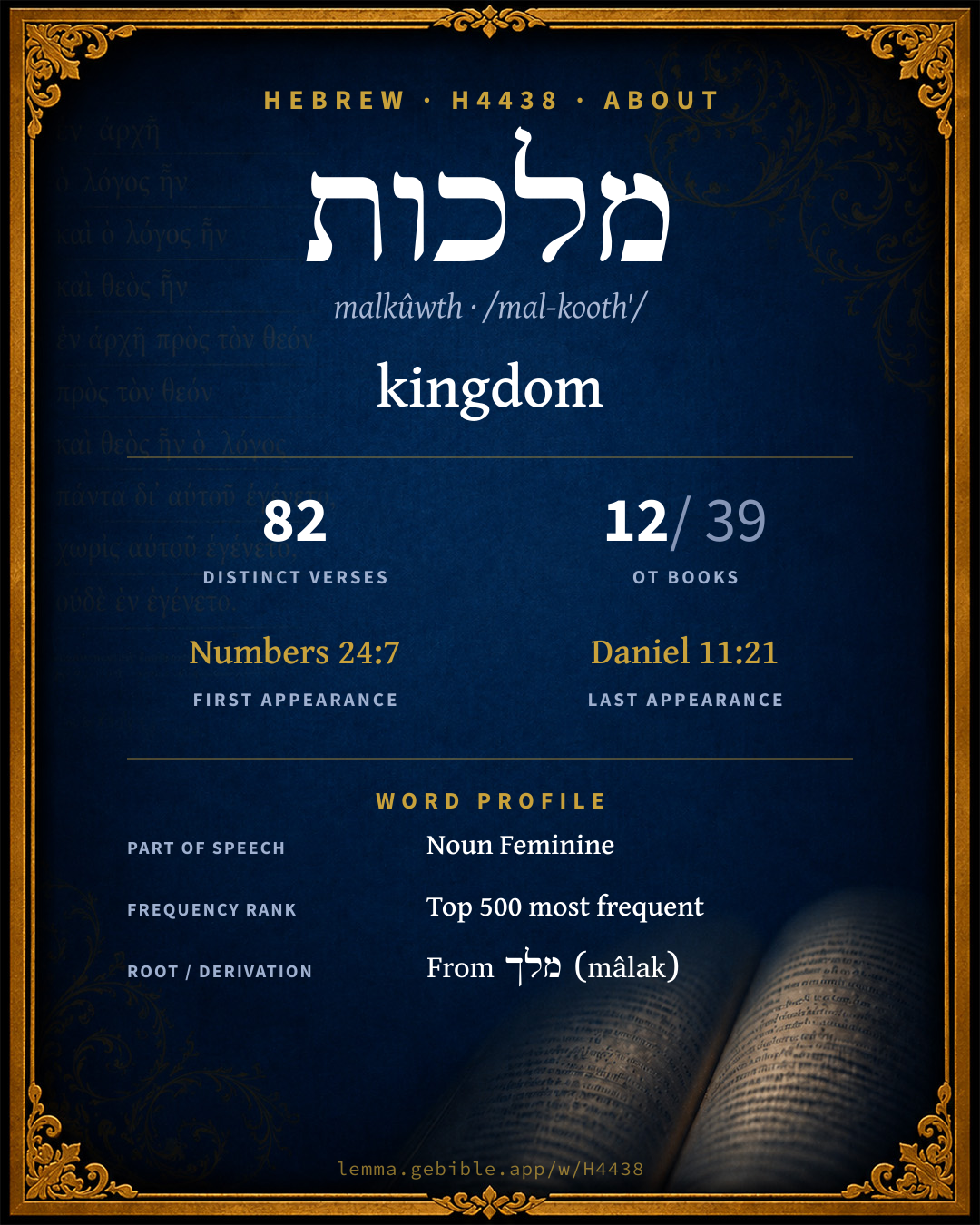
מַלְכוּת
kingdom
also: royalty, royal power, reign, sovereign power fuller range ↓
Full lexicon entry — Brown-Driver-Briggs (BDB)
From Brown-Driver-Briggs (BDB)
Where this word appears
See every Construct-state word in the Hebrew Bible →
Grammar key — what these labels mean
Part of speech
- Noun
- A naming word — a person, place, thing, or idea.
Noun type
- Common
- A common noun — a general class of person, place, or thing (“king,” “city,” “water”), not a specific name.
State
- Construct
- A noun bound to a following noun in a possessive / “of” relationship (the construct chain).
- Absolute
- The independent form of a noun, not bound to a following word.
Gender
- Feminine
- Grammatically feminine.
Number
- Singular
- One.
- Plural
- More than one (in Hebrew, generally three or more).
Every verse where H4438 appears in the Book of Daniel — 14 distinct verses. Click any verse to open its interlinear word-by-word view. Verse text shown in the World English Bible for context — . Each verse’s Hebrew form is shown with its reference; the English is not keyword-highlighted, since the data carries no word-level English alignment. Use “Compare translations” on any verse to read it across multiple English versions. This concordance covers the Hebrew Bible; Septuagint (Greek Old Testament) occurrences are not indexed here.
Daniel
- Daniel 1:1 לְ/מַלְכ֖וּת prep + n c fs cs In the third year of the reign of Jehoiakim king of Judah came Nebuchadnezzar king of Babylon to Jerusalem, and besieged it.
- Daniel 1:20 מַלְכוּתֽ/וֹ n c fs cs + sfx pers 3ms In every matter of wisdom and understanding, concerning which the king inquired of them, he found them ten times better than all the magicians and enchanters who were in all his realm.
- Daniel 2:1 לְ/מַלְכוּת֙ prep + n c fs cs In the second year of the reign of Nebuchadnezzar, Nebuchadnezzar dreamed dreams; and his spirit was troubled, and his sleep went from him.
- Daniel 8:1 לְ/מַלְכ֖וּת prep + n c fs cs In the third year of the reign of king Belshazzar a vision appeared to me, even to me, Daniel, after that which appeared to me at the first.
- Daniel 8:22 מַלְכֻי֛וֹת n c fp As for that which was broken, in the place where four stood up, four kingdoms shall stand up out of the nation, but not with his power.
- Daniel 8:23 מַלְכוּתָ֔/ם n c fs cs + sfx pers 3mp In the latter time of their kingdom, when the transgressors are come to the full, a king of fierce face, and understanding dark sentences, shall stand up.
- Daniel 9:1 מַלְכ֥וּת n c fs cs In the first year of Darius the son of Ahasuerus, of the seed of the Medes, who was made king over the realm of the Chaldeans,
- Daniel 10:13 מַלְכ֣וּת n c fs cs But the prince of the kingdom of Persia withstood me twenty-one days; but, behold, Michael, one of the chief princes, came to help me: and I remained there with the kings of Persia.
- Daniel 11:2 מַלְכ֥וּת n c fs cs Now will I show you the truth. Behold, there shall stand up yet three kings in Persia; and the fourth shall be far richer than they all: and when he has grown strong through his riches, he shall stir up all against the realm of Greece.
- Daniel 11:4 מַלְכוּת֔/וֹ מַלְכוּת֔/וֹ n c fs cs + sfx pers 3ms n c fs cs + sfx pers 3ms When he shall stand up, his kingdom shall be broken, and shall be divided toward the four winds of the sky, but not to his posterity, nor according to his dominion with which he ruled; for his kingdom shall be plucked up, even for others besides these.
- Daniel 11:9 בְּ/מַלְכוּת֙ prep + n c fs He shall come into the realm of the king of the south, but he shall return into his own land.
- Daniel 11:17 מַלְכוּת֛/וֹ n c fs cs + sfx pers 3ms He shall set his face to come with the strength of his whole kingdom, and with him equitable conditions; and he shall perform them: and he shall give him the daughter of women, to corrupt her; but she shall not stand, neither be for him.
- Daniel 11:20 מַלְכ֑וּת n c fs Then shall stand up in his place one who shall cause a tax collector to pass through the kingdom to maintain its glory; but within few days he shall be destroyed, neither in anger, nor in battle.
- Daniel 11:21 מַלְכ֑וּת מַלְכ֖וּת n c fs n c fs In his place shall stand up a contemptible person, to whom they had not given the honor of the kingdom: but he shall come in time of security, and shall obtain the kingdom by flatteries.
About this entry
At a glance — auto-summarized from this page’s data, not written by a person. Every figure links to its source below. This summary describes the numbers; it doesn’t interpret them.
The Hebrew noun מלכות centers on the idea of “kingdom.” Alongside “kingdom” the lexicon also lists “royalty”, “royal power”, and “reign” — part of its full sense range. Spanning 82 verses in 12 books, it ranks among the moderately common words of the Hebrew Bible. Esther dominates its distribution — 21 of 82 verses. Debuting at Numbers 24:7, it then recurs through the corpus. For the data behind this summary, explore the sense tree and the renderings breakdown below.
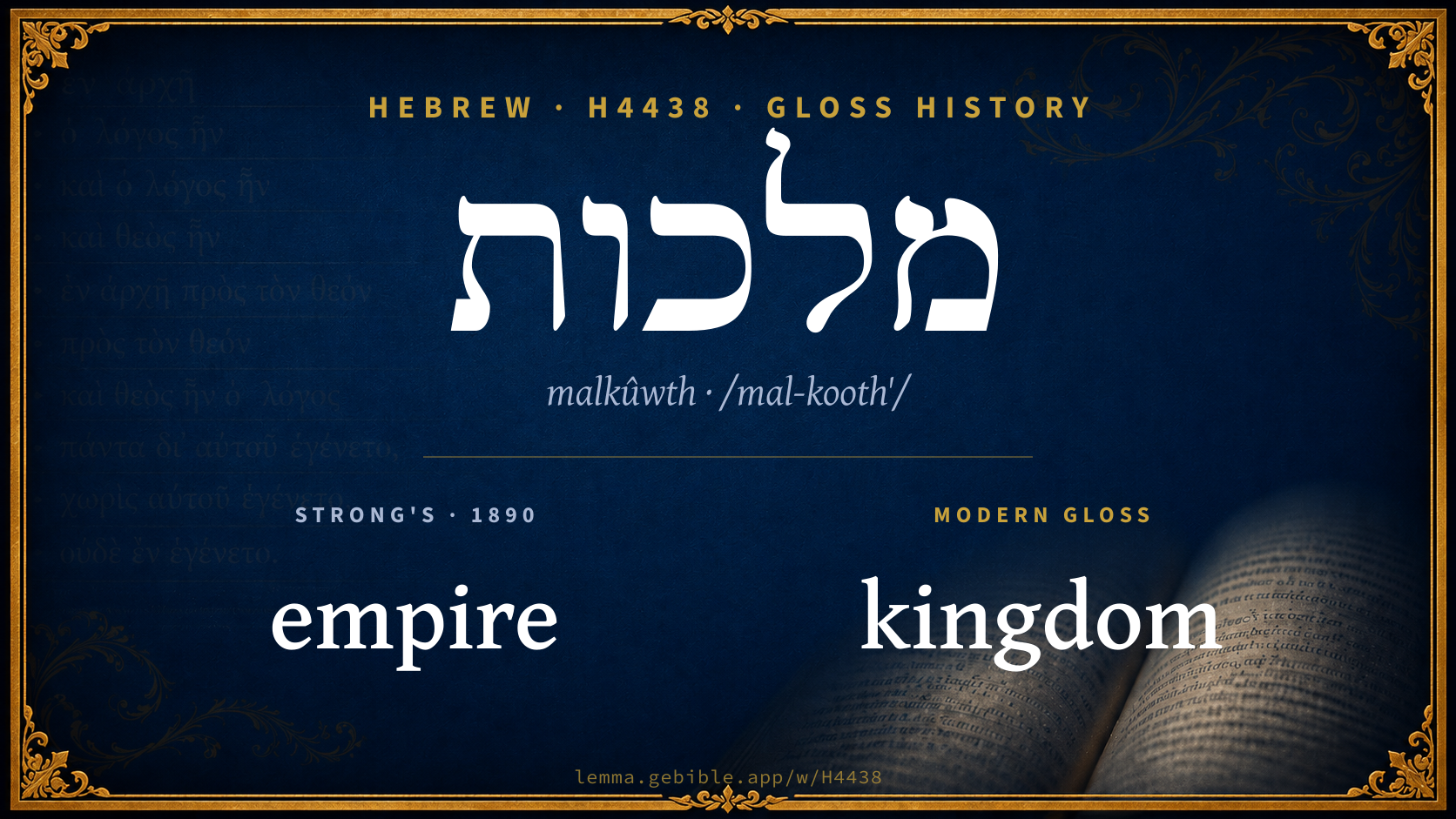
Gloss history
Strong's 1890 vs modern scholarship
About this word
Strong's H4438 catalogs a Hebrew word from the Hebrew Old Testament.
These counts are not copied from any lexicon or concordance. They are computed here, from the morphology-tagged Hebrew Old Testament. What Lemma adds →
- 82
- distinct verses
- The word appears in 82 distinct verses.
- 12 / 39
- OT books
- The word appears in 12 of 39 Old Testament books.
- #455
- by frequency
- Top 500 most frequent Hebrew words (rank 455 of 8,640 Hebrew words by occurrence).
View all 82 occurrences in the concordance →
Most concentrated in
- Esther 21 verses 26%
- 2 Chronicles 17 verses 21%
- Daniel 14 verses 17%
By section of the Old Testament
By traditional corpus
Conventional, traditional groupings — biblical authorship is debated, so this is a traditional corpus grouping, not an authorship claim. Each share is this word’s portion of its verses in that division of the Hebrew canon. Each figure is a share of the word’s 82 distinct verses.
- Writings (Ketuvim) 76 verses · 93%
- Prophets (Nevi'im) 5 verses · 6%
- Torah (Pentateuch) 1 verse · 1%
How translations render this word
Counts come from each version’s own published word-to-Strong’s tagging or interlinear alignment — an approximate guide to how each version renders this word, not a word-level alignment the data otherwise carries. Because each total is that version’s own tagged count, the per-version totals vary from one another and need not match the appearance or distinct-verse counts above. These counts may also differ from a printed concordance because Lemma counts each distinctly tagged rendering and does not collapse phrase taggings into a single head-word total. This is a fixed set of word-tagged versions (KJV, ASV, BSB, ULT) and does not change with the reading translation you choose elsewhere. Each version’s license is shown beside its name below (and on Sources).
- King James Version: Kingdom 43×, Reign 19×, Royal 12×
- American Standard Version: Kingdom 40×, Reign 18×, Royal 11×
- Berean Standard Bible: Kingdom 44×, Royal 17×, Reign 16×
- unfoldingWord Literal Text: Kingdom 38×, Royalty 14×, Reign of 13×
King James Version Public Domain
Renders H4438 across 91 tagged occurrences — most commonly:
Plus 15 renderings that appear only once — usually multi-word phrases or single function words the recovered tagging swept in, not distinct renderings.
American Standard Version Public Domain
Renders H4438 across 93 tagged occurrences — most commonly:
Plus 17 renderings that appear only once — usually multi-word phrases or single function words the recovered tagging swept in, not distinct renderings.
Berean Standard Bible Public Domain
Renders H4438 across 88 tagged occurrences — most commonly:
Plus 7 renderings that appear only once — usually multi-word phrases or single function words the recovered tagging swept in, not distinct renderings. Not rendered by a distinct English word in 3 further occurrences.
unfoldingWord Literal Text CC BY-SA 4.0
Renders H4438 across 95 tagged occurrences — most commonly:
Plus 6 renderings that appear only once — usually multi-word phrases or single function words the recovered tagging swept in, not distinct renderings.
Senses in the full BDB
What do BDB’s symbols mean?
BDB uses these scholarly abbreviations:
| Symbol | Meaning |
|---|---|
| 𝔊 | the Septuagint (the ancient Greek translation, LXX) |
| 𝔙 | the Vulgate (the Latin translation) |
| 𝔖 | the Syriac version (the Peshitta) |
| 𝔗 | the Targum (the Aramaic translation) |
| ψ | the Psalms |
| √ | root (the underlying root or stem) |
| ‖ | parallel passage (a synonymous or contrasted parallel) |
| † | the dagger: every passage where the word occurs is cited |
The 3 senses and sub-senses the full Brown-Driver-Briggs lexicon distinguishes for this word, in lexicon order (not ranked by frequency), with BDB’s own verbatim wording and sub-sense lettering. Shown in Hebrew script with BDB’s own scholarly abbreviations. The condensed entry is in the Lexicon Entry tab. See also the Forms in the corpus table below.
- 1. royal power, dominion Nu 24:7 (c. תִּנַּשֵּׂא), 1 S 20:31 (c. תִּכּוֹן), 1 K 2:12 (c. id.); cf. Je 10:7 Ec 4:14; 1 Ch 11:10; 12:23; 29:30 (‖ גְּבוּרָה), 2 Ch 33:13 Est 1:19, royal (queenly) dignity 4:14; 1 Ch 14:2 (c. נִשֵּׂאת); c. לָכַד Dn 11:21; c. הֵכִין (subj. י׳) 1 Ch 17:11; 28:7; 2 Ch 12:1 (subj. Rehob.); Isr. royalty as belonging to י׳ 1 Ch 17:14; dominion of י׳ ψ 103:19 (c. מָֽשְׁלָה), ψ 145:13(×2); כְּבוֹד מ׳ v 11; כְּבוֹד הֲדַר מ׳ v 12; שֵׁבֶט מ׳ ψ 45:7; כִּסֵּא מ׳ 1 Ch 22:10; 28:5 2 Ch 7:18; of Pers. Est 1:2; 5:1; בַּיִת לְמ׳ 2 Ch 1:18; 2:11; בֵּית מ׳ Est 1:9; 2:16; 5:1 (cf. Assyrian bit šarruti DlHWB 171); יֵין מ׳ royal wine Est 1:7; דְּבַר מ׳ royal command Est 1:19; הוֹד מ׳ royal honour, majesty 1 Ch 29:25 Dn 11:21; so perhaps also הֶדֶר מ׳ Dn 11:20 v. Bev; עשֶׁר כְּבוֹד מ׳ Est 1:4; כֶּתֶר מ׳ royal crown Est 1:11; 2:17; 6:8; לְבוּשׁ מ׳ royal apparel Est 6:8; 8:15; מ׳ (לְבוּשׁ om.) Est 5:1 (queenly attire). e.g. Numbers 24:7
- 2. reign: 40th year of reign of David 1 Ch 26:31 cf. 2 Ch 3:2; 15:10, 19; 16:1, 12; 35:19 Je 49:34 Dn 1:1; also 2 Ch 29:19; of Babyl. and Pers. kings Je 52:31 (בִּשְׁנַת מ׳ ‖ 2 K 25:27 מָלְכוֹ) Dn 2:1; 8:1 Ezr 4:5, 6(×2) 7:1; 8:1 Ne 12:22 Est 2:16; cf. עַד־מְלֹךְ מַלְכוּת פָּרָס 2 Ch 36:20. e.g. 1 Chronicles 26:31
- 3. kingdom, realm 2 Ch 1:1; 11:17; 20:30 Ne 9:35; especially realm of Babyl. and Pers. 2 Ch 36:22 = Ezr 1:1, Est 1:14, 20; 2:3; 3:6, 8; 5:3, 6; 7:2; 9:30 Dn 1:20; 8:22, 23; 9:1; 10:13; cf. 11:2, 4(×2), 9, 17; v 20 הֶדֶר מ׳ = Jerus. according to Hi, but v. 1 supr. e.g. 2 Chronicles 1:1
Senses from the full Brown-Driver-Briggs lexicon (Brown, Driver, Briggs; Oxford 1906 — public domain), digitized via Sefaria, supplemented by the OpenScriptures HebrewLexicon (CC BY 4.0). Full attribution on Sources.
Word origin
n.f. royalty, royal power, reign, kingdom (chiefly late);—מ׳ abs. Est 1:9 +; cstr. 1 Ch 12:23 +; sf. מַלְכוּתִי 1 Ch 17:14, etc.; pl. מַלְכֻיּוֹת Dn 8:22;—
— Brown-Driver-Briggs (Oxford 1906, public domain), digitized via Sefaria, supplemented by the OpenScriptures HebrewLexicon (CC BY 4.0). See Sources.
Derived from מלך (mâlak) (H4427) — to reign.
Jastrow Dictionary
A second Hebrew/Aramaic lexicon for comparison, covering Aramaic and post-biblical (Talmudic, Targumic, Midrashic) usage that the biblical-Hebrew BDB does not. Matched by lemma rather than by Strong’s number, so a lemma may carry more than one Jastrow headword (shown separately below), and the entries cover usage well beyond the Bible.
מַלְכוּת
- 1. kingdom, government; office. Ab. III, 5 עול מ׳ the yoke of (secular) government (burden of office). Ber. 13ᵇ, a. fr. עול מ׳ שמים the yoke of (submission to) divine government. Gitt. VIII, 5, v. הוּגָּן. Ber. 48ᵇ, a. e. אין מ׳ נוגעת וכ׳, v. חָבֵר. Sot. 11ᵇ (ref. to בתים, Ex. I, 21) בתי מ׳ dynasties.—מרד במ׳ to rebel against the government, to commit treason. Snh. 49ᵃ; a. fr.—מ׳ הָרִשְׁעָה the wicked government (Rome). Ber. 61ᵇ Ms. M. a. early ed. (later ed. יון); a. fr.—קרוב למ׳ connected with the court (influential). B. Kam. 83ᵃ. Gitt. 14ᵇ; a. fr.—Pl. מַלְכִיּוֹת. Gen. R. s. 44 ארבעה … גיהינם ומ׳ וכ׳ the Lord showed him (Abraham) four things: future punishment, (persecution by foreign) governments &c.; Mekh. Yithro, s. 9 ארבע מ׳ וכ׳ the four empires which were destined to subject his descendants. Ber. 34ᵇ, a. e. אין בין … אלא שעבוד מ׳ מלבד there will be no difference (in the conditions of life) between the present and the Messianic days except (the delivery from) the oppression of governments; a. fr. e.g. Exodus 1:21
- 2. (in liturgy) a benediction invoking God as king (אלהינו מלך העולם). Ib. 12ᵃ כל ברכה שאין בה מ׳ וכ׳ a benediction in which the word ‘king’ does not occur, is no benediction.—Pl. מַלְכִיּוֹת the references to the divine kingdom in the Musaf of the New Year’s Day, the section called Malkhiyoth. R. Hash. IV, 5. Ib. 6 עשרה מ׳ the recitation of ten Biblical verses referring to the divine government. Ib. (32ᵇ) זכרונות מ׳ וכ׳ Ms. M. (ed. sing.), v. זִכָּרוֹן. Y. ib. III, 58ᵈ; a. e.
A Dictionary of the Targumim, the Talmud Babli and Yerushalmi, and the Midrashic Literature (Marcus Jastrow; London, Luzac, 1903) — Public Domain. Digitized via Sefaria. Digitized via Sefaria. Full attribution on Sources.
Forms in the corpus
The 49 distinct written forms H4438 takes in the Hebrew Bible, most frequent first — each parse links to that state’s occurrences in the concordance. Hebrew forms include their vowel points and cantillation, so a single lemma takes many written forms.
Same root — word family
Other BDB entries built from the same root as H4438, grouped by Strong’s listed origin. These share a root / origin per the lexicon — not necessarily a shared meaning. Each links to that word’s own entry.
Derives from
Shares the same root
- מלוכה mᵉlûwkâh H4410 kingship
- מלך melek H4428 king
- מלך mᵉlak H4431 counsel
- מלכת mᵉleketh H4446 queen
- ממלכה mamlâkâh H4467 kingdom
Derived from this word
Proper names from this root
People and places named from this root — a name, not an additional meaning of the word.
- ימלך Yamlêk H3230 Jamlech
- מלוך Mallûwk H4409 Malluch
- מלך Môlek H4432 Molech
- מלכת Môleketh H4447 Hammoleketh
Compare all same-root words → Showing 4 of 12 — not the complete family. 4 of the same-root words are proper names (people or places). They share a root, not necessarily a meaning.
Septuagint verse parallels
This word appears in 74 verses that also exist in the Greek Old Testament (Septuagint), out of the 82 Hebrew verses it occurs in. You can read those verses in Greek by switching the Old Testament edition to the Septuagint.
Read these verses in the Septuagint
- Numbers 24:7
- 1 Samuel 20:31
- 1 Kings 2:12
- 1 Chronicles 11:10
- 2 Chronicles 1:1
- Ezra 1:1
- Esther 1:2
- Psalms 45:6
- Ecclesiastes 4:14
- Jeremiah 52:31
- Daniel 1:1
This is a verse-level parallel only — the same verses exist in both the Hebrew and Greek Old Testaments. No word-level Hebrew↔Greek correspondence is claimed: the data carries no such alignment, so no Greek word is shown as this Hebrew word’s translation. Coverage is not total — the Septuagint omits the deuterocanon and renumbers the Psalms, so some Hebrew verses have no direct Greek parallel.