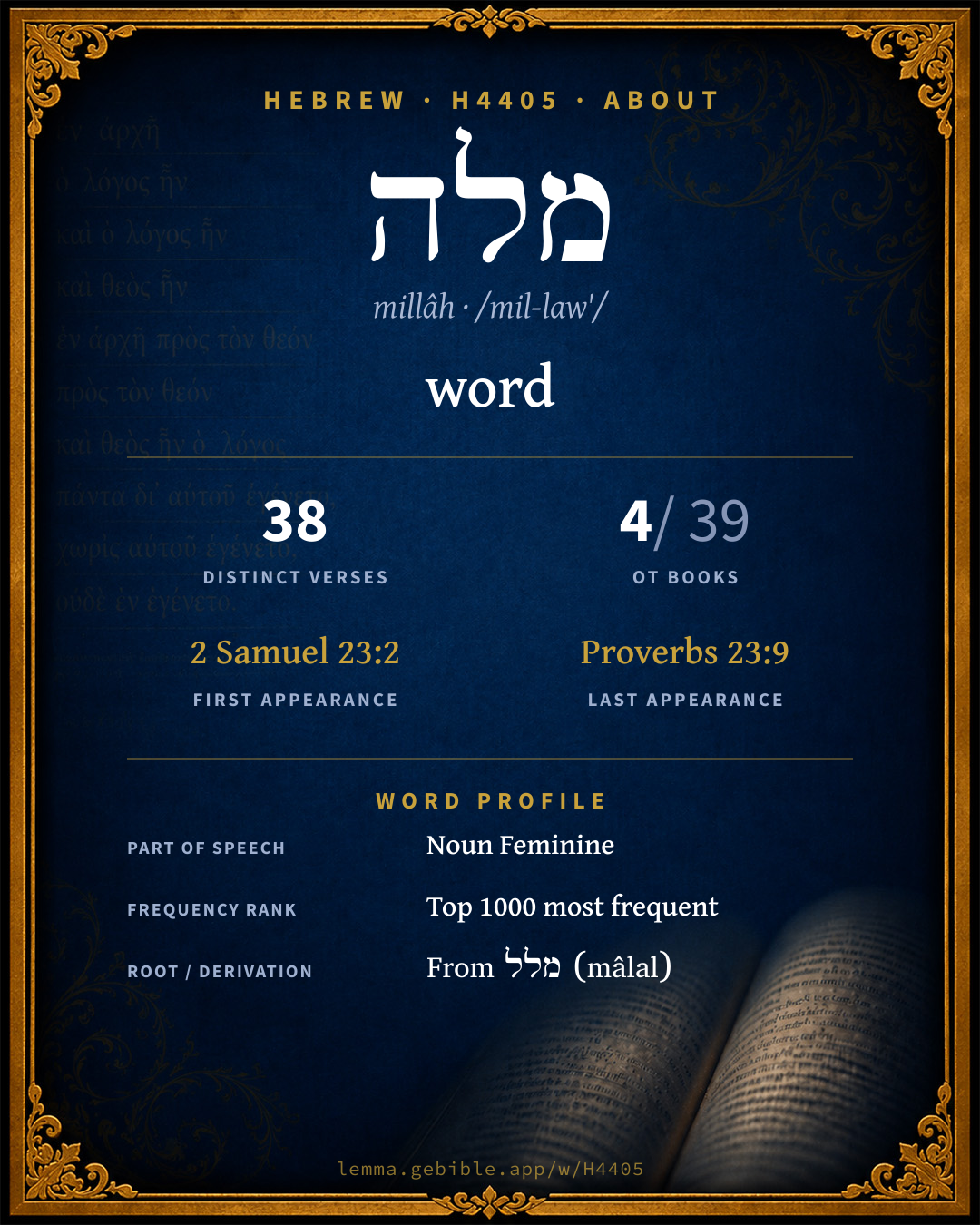
מִלָּה
word
Full lexicon entry — Brown-Driver-Briggs (BDB)
From Brown-Driver-Briggs (BDB)
Where this word appears
See every Absolute-state word in the Hebrew Bible →
Grammar key — what these labels mean
Part of speech
- Noun
- A naming word — a person, place, thing, or idea.
Noun type
- Common
- A common noun — a general class of person, place, or thing (“king,” “city,” “water”), not a specific name.
State
- Absolute
- The independent form of a noun, not bound to a following word.
- Construct
- A noun bound to a following noun in a possessive / “of” relationship (the construct chain).
Gender
- Feminine
- Grammatically feminine.
Number
- Plural
- More than one (in Hebrew, generally three or more).
- Singular
- One.
Grammatical forms
- Noun, Common, Feminine, Plural, Absolute 23 times (61%)
- Noun, Common, Feminine, Plural, Construct 8 times (21%)
- Noun, Common, Feminine, Singular, Construct 5 times (13%)
- Noun, Common, Feminine, Singular, Absolute 2 times (5%)
Parsed forms decoded from the imported morphology (morphhb / Westminster Leningrad Codex — WLC text public domain, morphhb tagging CC BY 4.0), counted across 38 parsed occurrences — not distinct verses.
Every verse where H4405 appears — 38 distinct verses across 4 books. Click any verse to open its interlinear word-by-word view. Verse text shown in the World English Bible for context — . Each verse’s Hebrew form is shown with its reference; the English is not keyword-highlighted, since the data carries no word-level English alignment. Use “Compare translations” on any verse to read it across multiple English versions. This concordance covers the Hebrew Bible; Septuagint (Greek Old Testament) occurrences are not indexed here.
2 Samuel 1 verse
Job 34 verses
- Job 4:2 בְּ֝/מִלִּ֗ין prep + n c fp "If someone ventures to talk with you, will you be grieved? But who can withhold himself from speaking?
- Job 4:4 מִלֶּ֑י/ךָ n c fp cs + sfx pers 2ms Your words have supported him who was falling, You have made firm the feeble knees.
- Job 6:26 מִלִּ֣ים n c fp Do you intend to reprove words, Seeing that the speeches of one who is desperate are as wind?
- Job 8:10 מִלִּֽים n c fp Shall they not teach you, tell you, And utter words out of their heart?
- Job 12:11 מִלִּ֣ין n c fp Doesn't the ear try words, Even as the palate tastes its food?
- Job 13:17 מִלָּתִ֑/י n c fs cs + sfx pers 1cs Hear diligently my speech. Let my declaration be in your ears.
- Job 15:3 וּ֝/מִלִּ֗ים conj + n c fp Should he reason with unprofitable talk, Or with speeches with which he can do no good?
- Job 15:13 מִלִּֽין n c fp That you turn your spirit against God, And let such words go out of your mouth?
- Job 16:4 בְּ/מִלִּ֑ים prep + n c fp I also could speak as you do. If your soul were in my soul's place, I could join words together against you, And shake my head at you.
- Job 18:2 לְ/מִלִּ֑ין prep + n c fp "How long will you hunt for words? Consider, and afterwards we will speak.
- Job 19:2 בְ/מִלִּֽים prep + n c fp "How long will you torment me, And crush me with words?
- Job 19:23 מִלָּ֑/י n c fp cs + sfx pers 1cs "Oh that my words were now written! Oh that they were inscribed in a book!
- Job 21:2 מִלָּתִ֑/י n c fs cs + sfx pers 1cs "Listen diligently to my speech. Let this be your consolation.
- Job 23:5 מִלִּ֣ים n c fp I would know the words which he would answer me, And understand what he would tell me.
- Job 24:25 מִלָּתִֽ/י n c fs cs + sfx pers 1cs If it isn't so now, who will prove me a liar, And make my speech worth nothing?"
- Job 26:4 מִלִּ֑ין n c fp To whom have you uttered words? Whose spirit came forth from you?
- Job 29:9 בְ/מִלִּ֑ים prep + n c fp The princes refrained from talking, And laid their hand on their mouth;
- Job 29:22 מִלָּתִֽ/י n c fs cs + sfx pers 1cs After my words they didn't speak again; My speech fell on them.
- Job 30:9 לְ/מִלָּֽה prep + n c fs "Now I have become their song. Yes, I am a byword to them.
- Job 32:11 מִלִּֽין n c fp "Behold, I waited for your words, And I listened for your reasoning, While you searched out what to say.
- Job 32:14 מִלִּ֑ין n c fp For he has not directed his words against me; Neither will I answer him with your speeches.
- Job 32:15 מִלִּֽים n c fp "They are amazed. They answer no more. They don't have a word to say.
- Job 32:18 מִלִּ֑ים n c fp For I am full of words. The spirit within me constrains me.
- Job 33:1 מִלָּ֑/י n c fp cs + sfx pers 1cs "However, Job, Please hear my speech, And listen to all my words.
- Job 33:8 מִלִּ֣ין n c fp "Surely you have spoken in my hearing, I have heard the voice of your words, saying,
- Job 33:32 מִלִּ֥ין n c fp If you have anything to say, answer me: Speak, for I desire to justify you.
- Job 34:2 מִלָּ֑/י n c fp cs + sfx pers 1cs "Hear my words, you wise men; Give ear to me, you who have knowledge.
- Job 34:3 מִלִּ֣ין n c fp For the ear tries words, As the palate tastes food.
- Job 34:16 מִלָּֽ/י n c fp cs + sfx pers 1cs "If now you have understanding, hear this. Listen to the voice of my words.
- Job 35:4 מִלִּ֑ין n c fp I will answer you, And your companions with you.
- Job 35:16 מִלִּ֥ין n c fp Therefore Job opens his mouth with empty talk, And he multiplies words without knowledge."
- Job 36:2 מִלִּֽים n c fp "Bear with me a little, and I will show you; For I still have something to say on God's behalf.
- Job 36:4 מִלָּ֑/י n c fp cs + sfx pers 1cs For truly my words are not false. One who is perfect in knowledge is with you.
- Job 38:2 בְ/מִלִּ֗ין prep + n c fp "Who is this who darkens counsel By words without knowledge?
Psalms 2 verses
Proverbs 1 verse
About this entry
At a glance — auto-summarized from this page’s data, not written by a person. Every figure links to its source below. This summary describes the numbers; it doesn’t interpret them.
מלה (millâh) is a Hebrew noun most often rendered “word.” It clusters heavily in Job, which alone accounts for 89% of its uses. It turns up in 38 verses across 4 books, a moderately common footprint. It first appears in 2 Samuel 23:2. From the same root come מלל, מלל and מלה. For the data behind this summary, explore the sense tree and the renderings breakdown below.
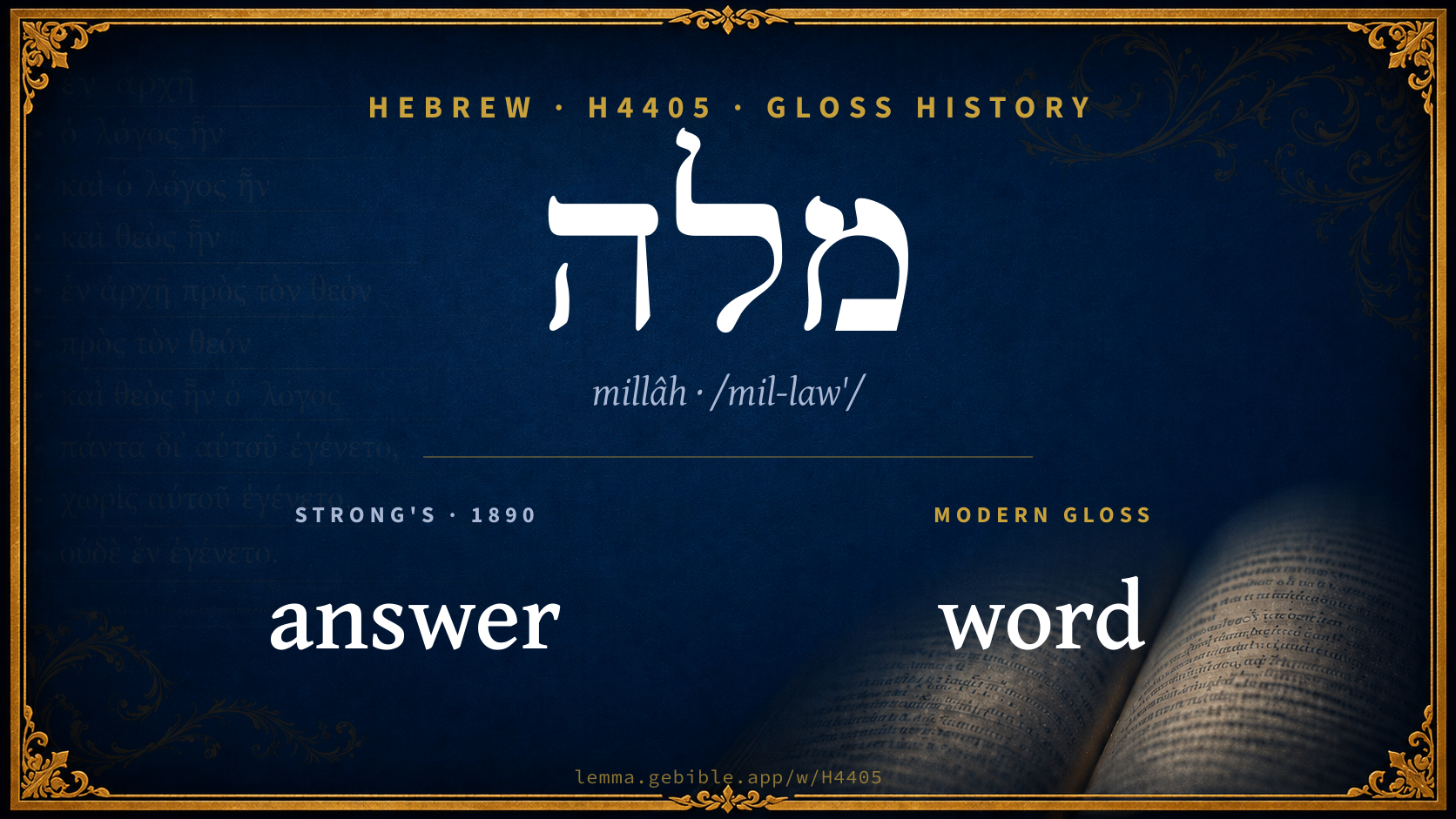
Gloss history
Strong's 1890 vs modern scholarship
About this word
Strong's H4405 catalogs a Hebrew word from the Hebrew Old Testament.
These counts are not copied from any lexicon or concordance. They are computed here, from the morphology-tagged Hebrew Old Testament. What Lemma adds →
- 38
- distinct verses
- The word appears in 38 distinct verses.
- 4 / 39
- OT books
- The word appears in 4 of 39 Old Testament books.
- #947
- by frequency
- Top 1000 most frequent Hebrew words (rank 947 of 8,640 Hebrew words by occurrence).
View all 38 occurrences in the concordance →
By section of the Old Testament
By traditional corpus
Conventional, traditional groupings — biblical authorship is debated, so this is a traditional corpus grouping, not an authorship claim. Each share is this word’s portion of its verses in that division of the Hebrew canon. Each figure is a share of the word’s 38 distinct verses.
- Writings (Ketuvim) 37 verses · 97%
- Prophets (Nevi'im) 1 verse · 3%
How translations render this word
Counts come from each version’s own published word-to-Strong’s tagging or interlinear alignment — an approximate guide to how each version renders this word, not a word-level alignment the data otherwise carries. Because each total is that version’s own tagged count, the per-version totals vary from one another and need not match the appearance or distinct-verse counts above. These counts may also differ from a printed concordance because Lemma counts each distinctly tagged rendering and does not collapse phrase taggings into a single head-word total. This is a fixed set of word-tagged versions (KJV, ASV, BSB, ULT) and does not change with the reading translation you choose elsewhere. Each version’s license is shown beside its name below (and on Sources).
- King James Version: Words 19×, Speech 4×
- American Standard Version: Words 18×, Speech 4×, Me 2×
- Berean Standard Bible: Words 22×, Speaking 2×, Speech 2×
- unfoldingWord Literal Text: Words 31×, Word 6×
King James Version Public Domain
Renders H4405 across 37 tagged occurrences — most commonly:
Plus 14 renderings that appear only once — usually multi-word phrases or single function words the recovered tagging swept in, not distinct renderings. Not rendered by a distinct English word in 1 further occurrence.
American Standard Version Public Domain
Renders H4405 across 38 tagged occurrences — most commonly:
Plus 14 renderings that appear only once — usually multi-word phrases or single function words the recovered tagging swept in, not distinct renderings.
Berean Standard Bible Public Domain
Renders H4405 across 37 tagged occurrences — most commonly:
Plus 11 renderings that appear only once — usually multi-word phrases or single function words the recovered tagging swept in, not distinct renderings. Not rendered by a distinct English word in 1 further occurrence.
unfoldingWord Literal Text CC BY-SA 4.0
Renders H4405 across 41 tagged occurrences — most commonly:
Plus 4 renderings that appear only once — usually multi-word phrases or single function words the recovered tagging swept in, not distinct renderings.
Senses in BDB
The 1 sense BDB distinguishes for this word, in lexicon order (not ranked by frequency or importance). The full entry — with sub-senses — is in the Lexicon Entry tab.
- word, speech, utterance
Word origin
n.f. word, speech, utterance (poet., especially Jb; common in Aramaic);—מ׳ ψ 139:4 Jb 30:9; sf. מִלָּתִי Jb 13:17 + 3 times; מִלָּתוֹ 2 S 23:2; pl. מִלִּים Jb 6:26 + 9 times (all Jb); מִלִּין Jb 4:2 + 12 times (all Jb); pl. sf. מִלָּ֑י Jb 19:23 + 4 times; מִלֶּיךָ Jb 4:4 Pr 23:9; מִלֵּיהֶם ψ 19:5;—word בִּלְשׁוֹנִי in (on) my tongue ψ 139:4; word (of י׳), עַל־לְשׁוֹנִי on my tongue 2 S 23:2; שֵׂכֶל מ׳ Pr 23:9; fig. ψ 19:5 (‖ קַוָּם; but read קוֹלָם v. Che crit. n.); elsewhere only Jb (34 times); sg. speech, utterance Jb 13:17; 21:2; 24:25; 29:22; also word = by-word, וָאֱהִי לָהֶם לְמִלָּה Jb 30:9; pl. words, Jb 4:4; 6:26; 8:10: 12:11; 15:3 (‖ דָּבָר), 16:4; 19:2, 23; 32:11, 14; 33:1, 8 (קוֹל מ׳), 34:2, 3, 16 (קוֹל מ׳), 36:2, 4; words of God Jb 23:5; words = speech, speaking, וַעְצֹר בְּמִלִּין מִי יוּכָ֑ל Jb 4:2, cf. 29:9; utter words, וְהֹצֵאתָ מִפִּיךָ מִלִּין 15:13; הִגַּדְתָּ מ׳ 26:4; lay snares for words תְּשִׂימוּן קִנְצֵי לְמִלִּין Jb 18:2, cf. Jb 32:15 הֶעְתִּיקוּ מֵהֶם מִלִּים; מָלֵתִי מִלִּים Jb 32:18 I am full of words, cf. אִם־יֵשׁ־מִלִּין הֲשִׁיבֵנִי 33:32; אֲשִׁיבְךָ מִלִּין Jb 35:4; בִּבְלִי־דַ֫עַת מִלִּין יַכְבִּר 35:16, cf. 38:2.
— Brown-Driver-Briggs (Oxford 1906, public domain), digitized via Sefaria, supplemented by the OpenScriptures HebrewLexicon (CC BY 4.0). See Sources.
Derived from מלל (mâlal) (H4448) — to speak.
Jastrow Dictionary
A second Hebrew/Aramaic lexicon for comparison, covering Aramaic and post-biblical (Talmudic, Targumic, Midrashic) usage that the biblical-Hebrew BDB does not. Matched by lemma rather than by Strong’s number, so a lemma may carry more than one Jastrow headword (shown separately below), and the entries cover usage well beyond the Bible.
מִלָּה
- word. Lev. R. s. 16 (prov.) מ׳ בסלע משתוקא בשנים where a word is worth a Sela, silence is worth two; Meg. 18ᵃ (v. Rabb. D. S. a. l. note 1).—Pl. מִלִּין, מִי. Cant. R. to IV, 4, v. קָצַב; a. e.—Ch. מִלָּה, v. מִילָּא.]
A Dictionary of the Targumim, the Talmud Babli and Yerushalmi, and the Midrashic Literature (Marcus Jastrow; London, Luzac, 1903) — Public Domain. Digitized via Sefaria. Digitized via Sefaria. Full attribution on Sources.
Forms in the corpus
The 24 distinct written forms H4405 takes in the Hebrew Bible, most frequent first — each parse links to that state’s occurrences in the concordance. Hebrew forms include their vowel points and cantillation, so a single lemma takes many written forms.
Same root — word family
Other BDB entries built from the same root as H4405, grouped by Strong’s listed origin. These share a root / origin per the lexicon — not necessarily a shared meaning. Each links to that word’s own entry.
Derives from
Shares the same root
Derived from this word
Proper names from this root
People and places named from this root — a name, not an additional meaning of the word.
Compare all same-root words → Showing 4 of 6 — not the complete family. 2 of the same-root words are proper names (people or places). They share a root, not necessarily a meaning.
Septuagint verse parallels
This word appears in 38 verses that also exist in the Greek Old Testament (Septuagint), out of the 38 Hebrew verses it occurs in. You can read those verses in Greek by switching the Old Testament edition to the Septuagint.
Read these verses in the Septuagint
This is a verse-level parallel only — the same verses exist in both the Hebrew and Greek Old Testaments. No word-level Hebrew↔Greek correspondence is claimed: the data carries no such alignment, so no Greek word is shown as this Hebrew word’s translation. Coverage is not total — the Septuagint omits the deuterocanon and renumbers the Psalms, so some Hebrew verses have no direct Greek parallel.