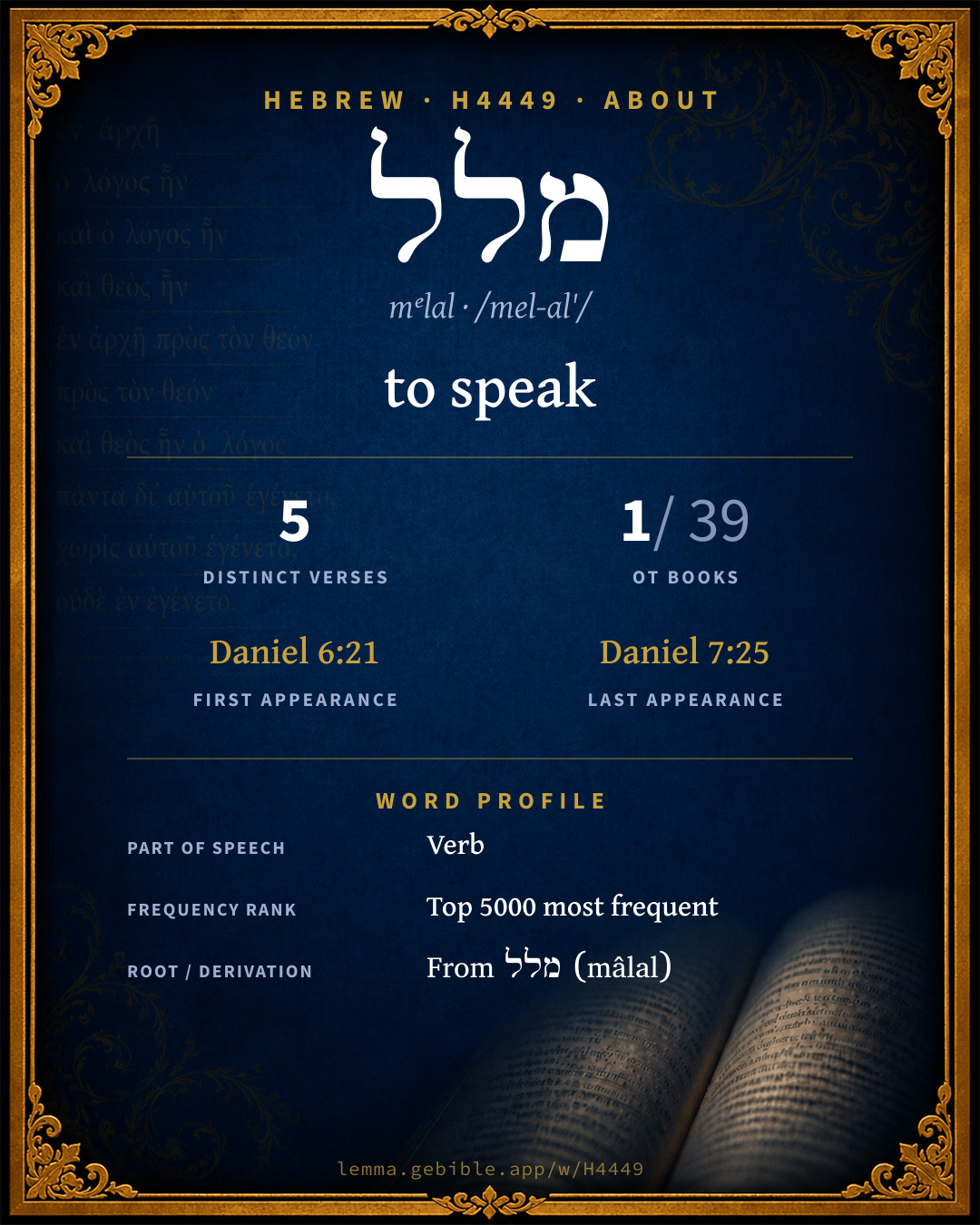
מְלַל
to speak
Full lexicon entry — Brown-Driver-Briggs (BDB)
From Brown-Driver-Briggs (BDB)
Where this word appears
Grammar key — what these labels mean
Part of speech
- Verb
- An action or state-of-being word.
Stem
- Piel
- An intensive or resultative active stem.
Form
- Participle Active
- A verbal adjective expressing ongoing or characteristic action (“writing / one who writes”).
- Imperfect
- An incomplete, ongoing, or future action (“he will / would write”).
- Perfect
- A completed action or state — Hebrew marks aspect (completeness) more than strict tense (“he wrote”).
State
- Absolute
- The independent form of a noun, not bound to a following word.
Person
- 3rd Person
- The one spoken about (“he / she / it / they”).
Gender
- Masculine
- Grammatically masculine.
- Feminine
- Grammatically feminine.
Number
- Singular
- One.
Grammatical forms
- Verb, Piel, Participle Active, Masculine, Singular, Absolute 2 times (40%)
- Verb, Piel, Imperfect, 3rd Person, Masculine, Singular 1 time (20%)
- Verb, Piel, Perfect, 3rd Person, Masculine, Singular 1 time (20%)
- Verb, Piel, Participle Active, Feminine, Singular, Absolute 1 time (20%)
Parsed forms decoded from the imported morphology (morphhb / Westminster Leningrad Codex — WLC text public domain, morphhb tagging CC BY 4.0), counted across 5 parsed occurrences — not distinct verses.
Every verse where H4449 appears — 5 distinct verses across 1 book. Click any verse to open its interlinear word-by-word view. Verse text shown in the World English Bible for context — . Each verse’s Hebrew form is shown with its reference; the English is not keyword-highlighted, since the data carries no word-level English alignment. Use “Compare translations” on any verse to read it across multiple English versions. This concordance covers the Hebrew Bible; Septuagint (Greek Old Testament) occurrences are not indexed here.
Daniel 5 verses
- Daniel 6:21 מַלִּ֑ל Piel pf 3ms Then said Daniel to the king, O king, live forever.
- Daniel 7:8 מְמַלִּ֥ל Piel ptcp.act ms I considered the horns, and, behold, there came up among them another horn, a little one, before which three of the first horns were plucked up by the roots: and, behold, in this horn were eyes like the eyes of a man, and a mouth speaking great things.
- Daniel 7:11 מְמַלֱּלָ֑ה Piel ptcp.act fs I saw at that time because of the voice of the great words which the horn spoke; I saw even until the animal was slain, and its body destroyed, and it was given to be burned with fire.
- Daniel 7:20 מְמַלִּ֣ל Piel ptcp.act ms and concerning the ten horns that were on its head, and the other [horn] which came up, and before which three fell, even that horn that had eyes, and a mouth that spoke great things, whose look was more stout than its fellows.
- Daniel 7:25 יְמַלִּ֔ל Piel impf 3ms He shall speak words against the Most High, and shall wear out the saints of the Most High; and he shall think to change the times and the law; and they shall be given into his hand until a time and times and half a time.
About this entry
At a glance — auto-summarized from this page’s data, not written by a person. Every figure links to its source below. This summary describes the numbers; it doesn’t interpret them.
מלל — transliterated mᵉlal — is a Hebrew verb carrying the sense “to speak.” It occurs a mere 5 verses across Scripture. Its uses cluster heavily in Daniel (100% of all occurrences). Debuting at Daniel 6:21, it then recurs through the corpus. Sharing its root, it stands alongside מלל, מלה and מלילה. See the sense tree, 5-verse concordance, and the renderings breakdown below.
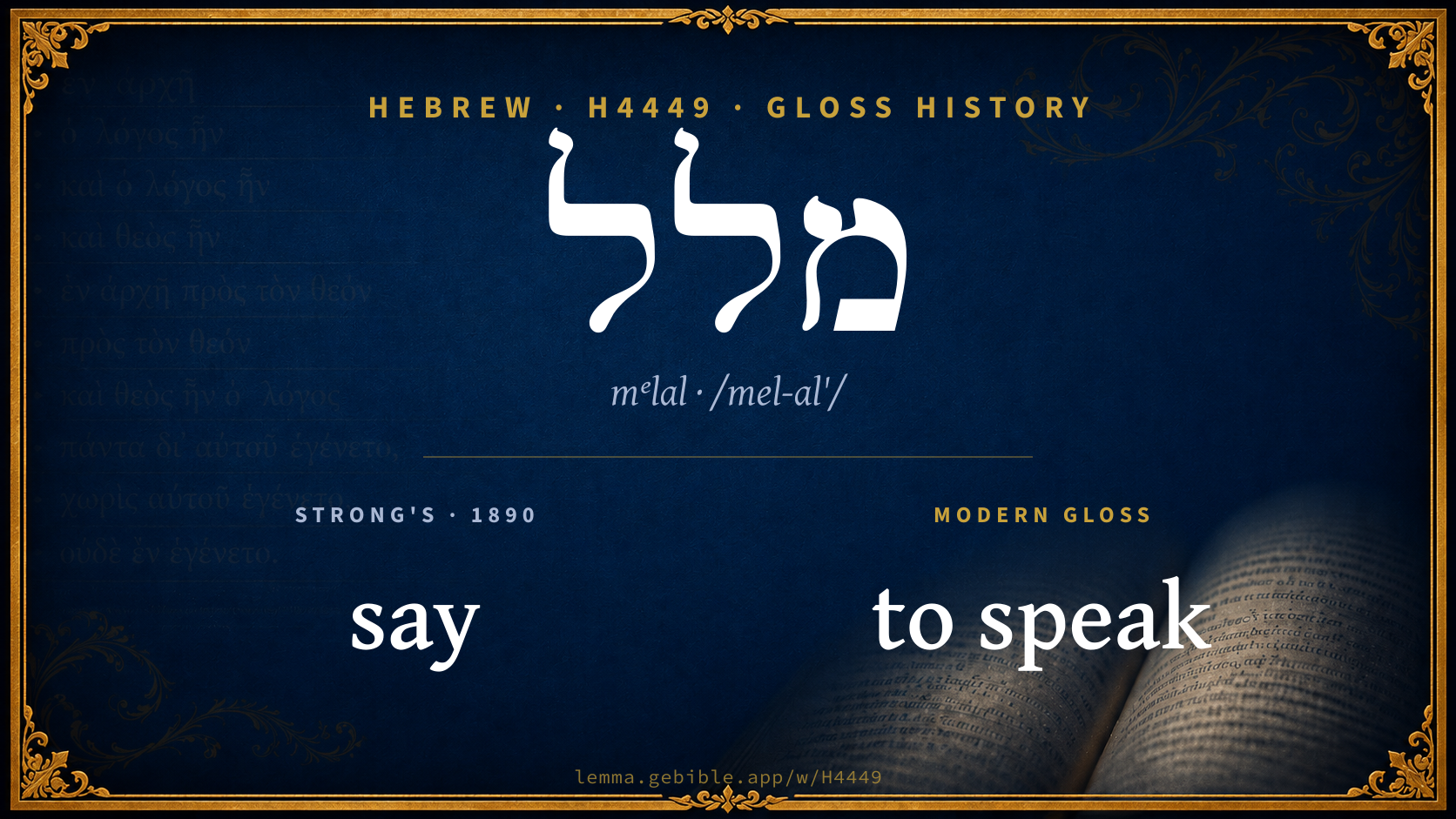
Gloss history
Strong's 1890 vs modern scholarship
About this word
Strong's H4449 catalogs a Hebrew word from the Hebrew Old Testament.
These counts are not copied from any lexicon or concordance. They are computed here, from the morphology-tagged Hebrew Old Testament. What Lemma adds →
- 5
- distinct verses
- The word appears in 5 distinct verses.
- 1 / 39
- OT books
- The word appears in 1 of 39 Old Testament books.
- #3,337
- by frequency
- Top 5000 most frequent Hebrew words (rank 3,337 of 8,640 Hebrew words by occurrence).
View all 5 occurrences in the concordance →
Most concentrated in
- Daniel 5 verses 100%
By section of the Old Testament
By traditional corpus
Conventional, traditional groupings — biblical authorship is debated, so this is a traditional corpus grouping, not an authorship claim. Each share is this word’s portion of its verses in that division of the Hebrew canon. Each figure is a share of the word’s 5 distinct verses.
- Writings (Ketuvim) 5 verses · 100%
How translations render this word
Counts come from each version’s own published word-to-Strong’s tagging or interlinear alignment — an approximate guide to how each version renders this word, not a word-level alignment the data otherwise carries. Because each total is that version’s own tagged count, the per-version totals vary from one another and need not match the appearance or distinct-verse counts above. These counts may also differ from a printed concordance because Lemma counts each distinctly tagged rendering and does not collapse phrase taggings into a single head-word total. This is a fixed set of word-tagged versions (KJV, ASV, BSB, ULT) and does not change with the reading translation you choose elsewhere. Each version’s license is shown beside its name below (and on Sources).
- King James Version: Spake 2×
- American Standard Version: Spake 2×
- Berean Standard Bible: Spoke 2×
- unfoldingWord Literal Text: Speaking 2×
King James Version Public Domain
Renders H4449 across 5 tagged occurrences — most commonly:
Plus 3 renderings that appear only once — usually multi-word phrases or single function words the recovered tagging swept in, not distinct renderings.
American Standard Version Public Domain
Renders H4449 across 5 tagged occurrences — most commonly:
Plus 3 renderings that appear only once — usually multi-word phrases or single function words the recovered tagging swept in, not distinct renderings.
Berean Standard Bible Public Domain
Renders H4449 across 5 tagged occurrences — most commonly:
Plus 3 renderings that appear only once — usually multi-word phrases or single function words the recovered tagging swept in, not distinct renderings.
unfoldingWord Literal Text CC BY-SA 4.0
Renders H4449 across 5 tagged occurrences — most commonly:
Plus 3 renderings that appear only once — usually multi-word phrases or single function words the recovered tagging swept in, not distinct renderings.
Senses in BDB
The 1 sense BDB distinguishes for this word, in lexicon order (not ranked by frequency or importance). The full entry — with sub-senses — is in the Lexicon Entry tab.
- (Pael) to speak, say
Word origin
[ מְלַל ] vb. Pa. speak, say
— Brown-Driver-Briggs (Oxford 1906, public domain), digitized via Sefaria, supplemented by the OpenScriptures HebrewLexicon (CC BY 4.0). See Sources.
Derived from מלל (mâlal) (H4448) — to speak.
Jastrow Dictionary
A second Hebrew/Aramaic lexicon for comparison, covering Aramaic and post-biblical (Talmudic, Targumic, Midrashic) usage that the biblical-Hebrew BDB does not. Matched by lemma rather than by Strong’s number, so a lemma may carry more than one Jastrow headword (shown separately below), and the entries cover usage well beyond the Bible.
מָלָל
- (denom. of מוֹל) border, hem. Kel. XXVIII, 7; Sabb. 29ᵃ שלש על … חוץ מן המ׳ the measure of three square handbreadths of which the Rabbis speak, means exclusive of the portion used for hemming. M. Kat. 26ᵇ הקורע … מתוך המ׳ he who rends his garment only as far as the hem goes; Y. ib. III, 83ᵇ top מן המ׳.—Denom.:
מָלַל I
- to hem, edge. M. Kat. 26ᵃ וכולן רשאין … למוֹלְלָן and all these rents may be mended by … hemming. Kil. IX, 9 מוֹלֵל עד וכ׳ he hems (the purple band) before he knots it.
מָלַל II
- (b. h.)
- 1. to crush, squeeze, esp. to rub ears for husking the grain. Taan. 6ᵃ דבר שמָל, v. מַלְקוֹשׁ. Maasr. IV, 5, v. מְלִילָה. Bets. 13ᵃ למוֹלְלָן במלילות with the intention of husking them when parched. Tosef. Sabb. XVI (XVII), 22; Sabb. 12ᵃ מוֹלֵל he rubs it between two fingers; a. fr.—Part. pass. מָלוּל. Tosef. ib. XIV (XV), 17 מוֹלְלִין את המ׳ you may husk that which needs husking.
- 2. to stir a mush, make a pulp. Pes. 40ᵇ אין מוֹלְלִין … והרוצה שיִמְלוֹל וכ׳ you must not stir a dish (in the usual way) on Passover, but he who desires to make a mush, must put in the flour and then add vinegar.—Part. pass. as ab. Tosef. Maasr. I, 7 מן המלול ed. (ed. Zuck. המאמל, Var. הממל) out of the olive pulp.
- to be compressible, (of webs) to be soft and downy. Gitt. 59ᵃ (ref. to מ̇ל̇ת̇ח̇ה, II Kings X, 22) דבר הנמ̇ל̇ל ונמת̇ח̇ a cloth which can be compressed (creased) and stretched (again, showing no creases when unfolded); [Rashi: a stuff the thread of which is twisted between the spinner’s fingers and stretched].—V. מַלְמֵלָה. e.g. 2 Kings 10:22
מְלַל I
- v. מוּל ch.
מֶלֶל
- ch., constr. of מַלְלָא.
מָלַל III
- , Pi. מִלֵּל, מִי׳ (b. h.; [to present, show; cmp. הִגִּיד, חִוָּה,] to proclaim, utter, speak. Hor. 13ᵇ; Meg. 18ᵃ; Macc. 10ᵃ (ref. to Ps. CVI, 2) למי נאה למַלֵּל וכ׳ whom does it become to utter the mighty deeds &c.?—Y. Keth. II, 26ᵈ bot. שמענו פלוני מְמַלֵּל על פלו׳ אשתו we heard that man speaking of (pointing out) that woman as his wife; מְמַלֶּלֶת על בניה speaking of her children; a. e.—[Lev. R. s. 27 מי מלל, read: מָל, v. מוּל, II, 2.—Lam. R. introd. (R. Hăn. 1) מְמַלְּלִים, v. לִמְלֵם.] e.g. Psalms 106:2
מְלַל II
- , Pa. מַלֵּיל, מַלֵּל ch. same, in gen. to speak (corresp. to b. h. דִּבֵּר, שִׂיחַ). Targ. Gen. XXXIV, 3 (O. ed. Berl. מַלֵּי). Ib. XVII, 22, sq.; a. v. fr.—Part. מְמַלֵּל, מְמַלְּלָא &c. (in ed. frequ. with one מ, corr. acc.). Targ. Job II, 10; a. fr.—Kidd. 50ᵃ מְמַלֵּי מילי עלוי (= מְמלְּלֵי) they speak against me.
- 1. to be spoken, said, told. Targ. Ps. LXXXVII, 3. Targ. Y. Ex. XX, 16; a. e.—Y. Shek. VI, 50, top (play on שחו, Ez. XLVII, 5) [read:] מאי מי שחו מיין דמִתְמַלְּלִין וכ׳ what is me saḥu? Waters which are spoken of in the world (v. שִׂיחַ). e.g. Ezekiel 47:5
- 2. to converse. Targ. Y. Ex. XXXIII, 9. Targ. Ez. II, 2; I, 28; a. e.
A Dictionary of the Targumim, the Talmud Babli and Yerushalmi, and the Midrashic Literature (Marcus Jastrow; London, Luzac, 1903) — Public Domain. Digitized via Sefaria. Digitized via Sefaria. Full attribution on Sources.
Forms in the corpus
The 5 distinct written forms H4449 takes in the Hebrew Bible, most frequent first — each parse links to that stem’s occurrences in the concordance. Hebrew forms include their vowel points and cantillation, so a single lemma takes many written forms.
| Form | Parsing | Example | Uses |
|---|---|---|---|
| יְמַלִּ֔ל | Verb, Piel, Imperfect, 3rd Person, Masculine, Singular | Daniel 7:25 | 1 |
| מְמַלֱּלָ֑ה | Verb, Piel, Participle Active, Feminine, Singular, Absolute | Daniel 7:11 | 1 |
| מְמַלִּ֣ל | Verb, Piel, Participle Active, Masculine, Singular, Absolute | Daniel 7:20 | 1 |
| מְמַלִּ֥ל | Verb, Piel, Participle Active, Masculine, Singular, Absolute | Daniel 7:8 | 1 |
| מַלִּ֑ל | Verb, Piel, Perfect, 3rd Person, Masculine, Singular | Daniel 6:21 | 1 |
Same root — word family
Other BDB entries built from the same root as H4449, grouped by Strong’s listed origin. These share a root / origin per the lexicon — not necessarily a shared meaning. Each links to that word’s own entry.
Derives from
Shares the same root
Derived from this word
Proper names from this root
People and places named from this root — a name, not an additional meaning of the word.
Compare all same-root words → Showing 4 of 6 — not the complete family. 2 of the same-root words are proper names (people or places). They share a root, not necessarily a meaning.
Septuagint verse parallels
This word appears in 5 verses that also exist in the Greek Old Testament (Septuagint), out of the 5 Hebrew verses it occurs in. You can read those verses in Greek by switching the Old Testament edition to the Septuagint.
Read these verses in the Septuagint
This is a verse-level parallel only — the same verses exist in both the Hebrew and Greek Old Testaments. No word-level Hebrew↔Greek correspondence is claimed: the data carries no such alignment, so no Greek word is shown as this Hebrew word’s translation. Coverage is not total — the Septuagint omits the deuterocanon and renumbers the Psalms, so some Hebrew verses have no direct Greek parallel.