
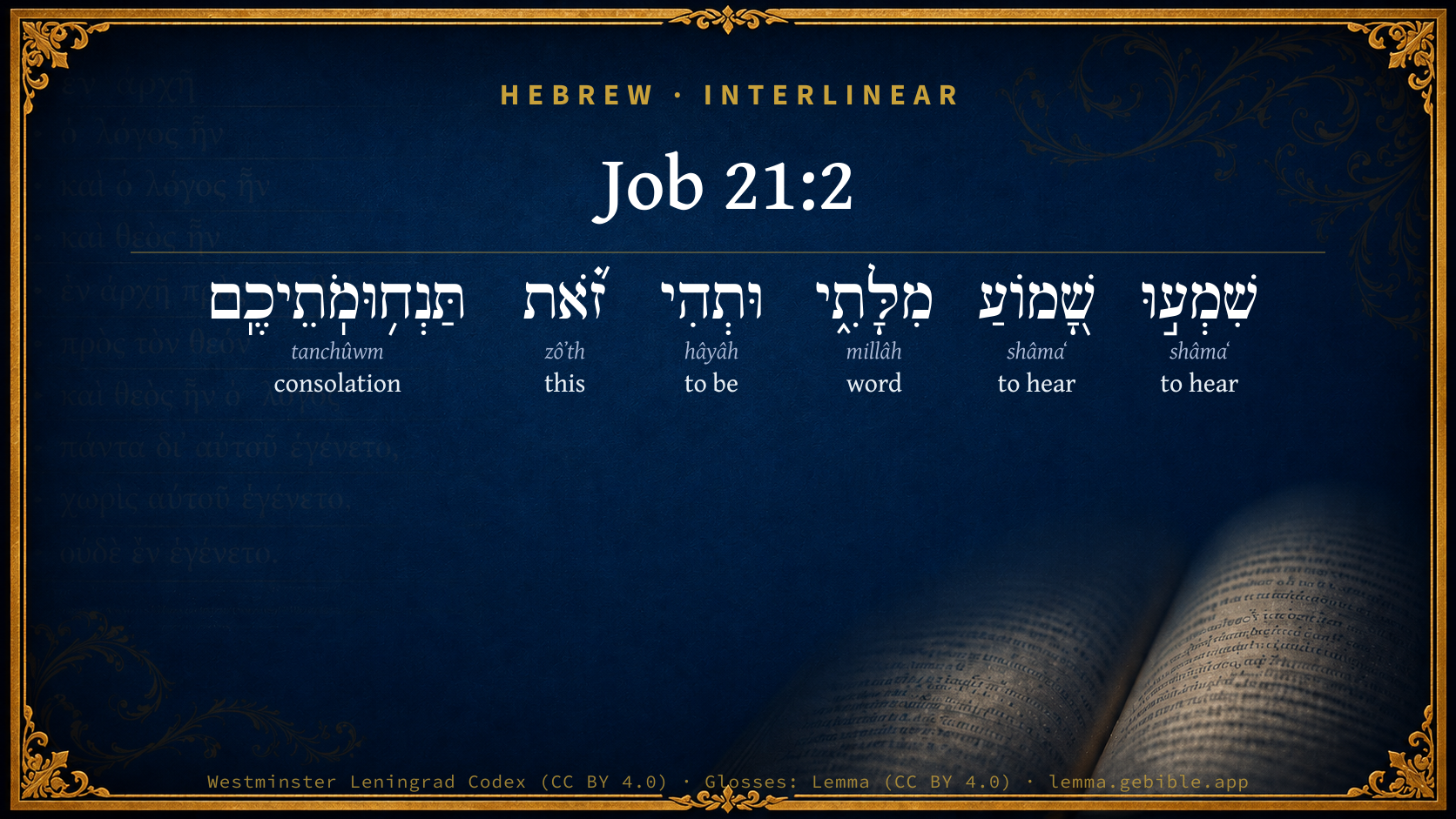
Job 21:2

Hebrew (Westminster Leningrad Codex) Job 21:2 appears in the Hebrew Old Testament. The text above is from the Westminster Leningrad Codex. Each word links to its Strong’s number, a concise gloss, and parsing drawn from the Open Scriptures Hebrew Bible morphology. Click any word for its full Brown-Driver-Briggs (BDB) entry.
Download image
Cite this verse

Job 21:2 (World English Bible). Public Domain. Lemma interlinear Bible study tool, https://lemma.gebible.app/v/job/21/2.

Show BibTeX & RIS
BibTeX
RIS
English Translation
"Listen diligently to my speech. Let this be your consolation.
World English Bible · Public Domain
Download a study sheet

One document with this verse’s original text, its word-by-word gloss line, the meaning frame, cross-references with their text, attributed commentary, and full source and license credits — printable, and it pastes into notes with its structure intact.

This verse Autodidact and up

Study sheet (.html) Plain text (.txt)

A passage Seminary Student

Up to 50 verses in one chapter. A passage sheet keeps up to 6 commentary sources and 12 cross-references per verse, in the order this page ranks them, and says so on the sheet whenever that leaves anything out. Ask for a single verse and you get the Autodidact verse sheet above.

Everything on this page stays free to read, with no account — the sheet is a download of what is already on screen, not access to it.

Want to remove ads? Support Godless Engineer
Compare translations 3

The same verse in 3 English versions, stacked beneath the original-language interlinear above. Click any original word for its lexicon entry.

Each is an independent rendering of the whole verse — the interlinear is not word-aligned to these translations.

Highlighted words mark where these versions differ — a whole-verse word diff, not a word-by-word alignment.

  • World English Bible Public Domain
    "Listen diligently to my speech. Let this be your consolation.
  • King James Version Public Domain
    Hear diligently my speech, and let this be your consolations.
  • unfoldingWord Literal Text CC BY-SA 4.0
    “Hearing, hear my words, and let this be your consolation.

unfoldingWord Literal Text — © unfoldingWord, licensed CC BY-SA 4.0. Word-aligned USFM3 via Door43 (git.door43.org/unfoldingWord/en_ult).

Versions to compare (up to 4)

3 of 4 selected

Show all 18 translations

Every available English version of this verse, each an independent rendering of the whole verse.

  • World English Bible Public Domain
    "Listen diligently to my speech. Let this be your consolation.
  • Berean Standard Bible Public Domain
    “Listen carefully to my words; let this be your consolation to me.
  • Majority Standard Bible Public Domain
    “Listen carefully to my words; let this be your consolation to me.
  • King James Version Public Domain
    Hear diligently my speech, and let this be your consolations.
  • American Standard Version (1901) Public Domain
    Hear diligently my speech; And let this be your consolations.
  • Revised Version (1885) Public Domain
    Hear diligently my speech; and let this be your consolations.
  • Geneva Bible (1599) Public Domain
    Heare diligently my wordes, and this shalbe in stead of your consolations.
  • Douay-Rheims (1899) Public Domain
    Hear, I beseech you, my words, and do penance.
  • Young's Literal Translation Public Domain
    Hear ye diligently my word, And this is your consolation.
  • Literal Standard Version CC BY-SA 4.0
    “Hear my word diligently, || And this is your consolation.
  • Unlocked Literal Bible CC BY-SA 4.0
    “Listen carefully to my words, and let this be the comfort you offer to me.
  • unfoldingWord Literal Text CC BY-SA 4.0
    “Hearing, hear my words, and let this be your consolation.
  • Darby Bible Public Domain
    Hear attentively my speech, and let this replace your consolations.
  • World Messianic Bible Public Domain
    “Listen diligently to my speech. Let this be your consolation.
  • Webster's Bible Public Domain
    Hear diligently my speech, and let this be your consolations.
  • Free Bible Version CC BY-SA 4.0
    “Please listen carefully to what I say—that would be one comfort you could give me.
  • Bible in Basic English Public Domain
    Give attention with care to my words; and let this be your comfort.
  • JPS Tanakh (1917) Public Domain
    Hear diligently my speech; and let this be your consolations.

Literal Standard Version (2020), Covenant Press — licensed CC BY-SA 4.0. Text via the HelloAO Bible API (eBible.org). Unlocked Literal Bible (unfoldingWord) — licensed CC BY-SA 4.0. Text via the HelloAO Bible API (eBible.org). unfoldingWord Literal Text — © unfoldingWord, licensed CC BY-SA 4.0. Word-aligned USFM3 via Door43 (git.door43.org/unfoldingWord/en_ult). Free Bible Version, Dr. Jonathan Gallagher — licensed CC BY-SA 4.0. Text via the HelloAO Bible API (eBible.org).

Word by word

More ways to search: Search by grammar → Find every occurrence → Compare this word →

Practice this passage: Drill this verse → Learn its vocabulary →

About this verse

These counts appear in no published source. They are computed here, from the morphology-tagged text and Lemma’s own curated glosses. What Lemma adds →

6
words
5
distinct lemmas
Wisdom
section

Notable vocabulary

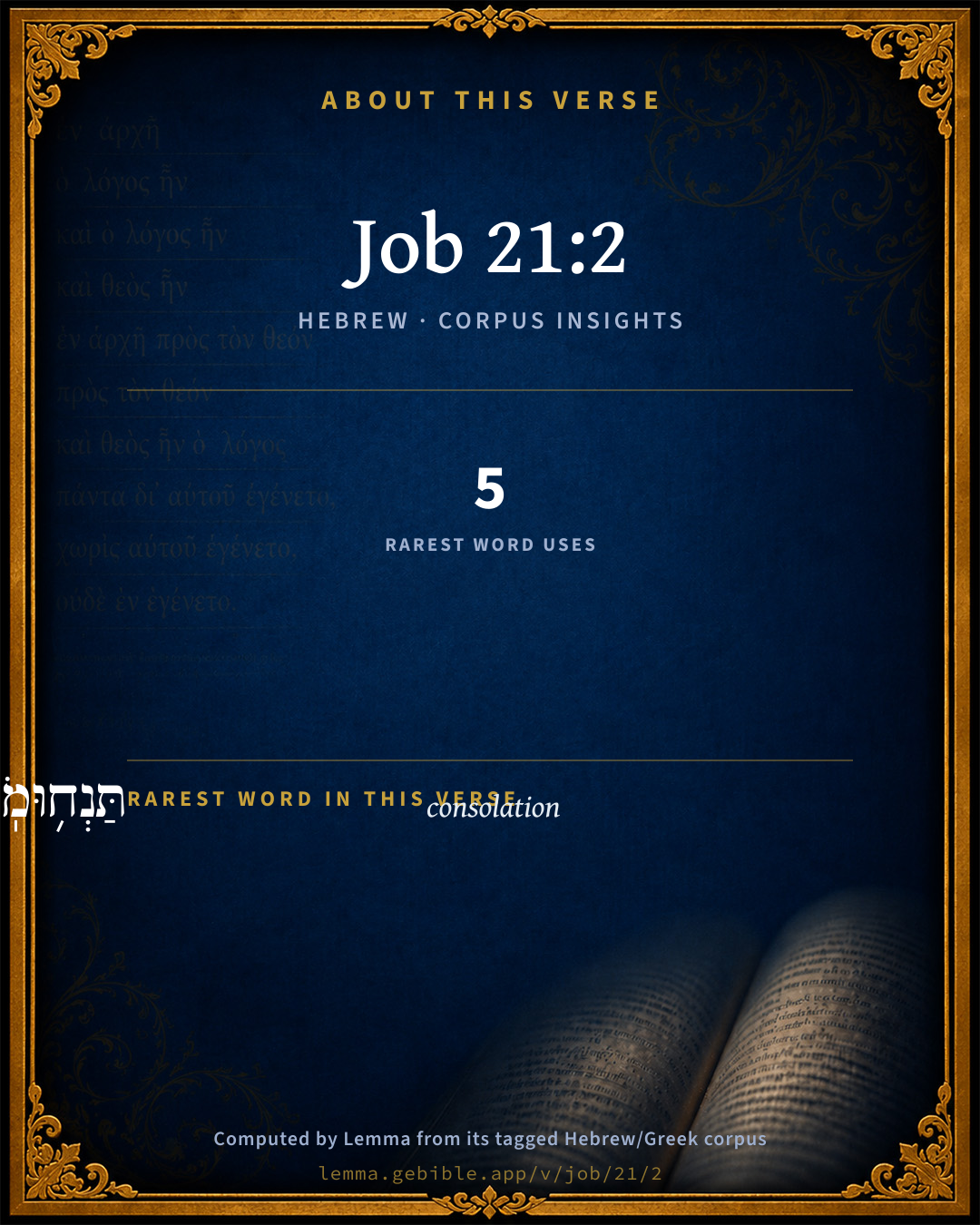
The rarest word here is תַּנְח֥וּמֹֽתֵיכֶֽם consolation H8575 — appearing just 5 times in the whole Hebrew Bible.

Shared distinctive vocabulary

תַּנְח֥וּמֹֽתֵיכֶֽם consolation H8575 occurs in 5 verses of the Hebrew Bible. Also found in:

Grammatical profile

  • 3 verbs
  • 2 nouns
  • 1 pronoun

Verb forms

  • שִׁמְע֣וּ Qal · Imperative
  • שָׁ֭מוֹעַ Qal · Infinitive Absolute
  • וּתְהִי Qal · Jussive

Repetition

A word recurs within this verse — often emphatic in Hebrew:

  • שִׁמְע֣וּ to hear H8085 ×2

Hebrew & Septuagint length

In English translation the verse runs 10 words from the Hebrew and 15 from the Septuagint (LXX English) — the Septuagint runs noticeably longer here. See the side-by-side →

A rough comparison of the two English renderings, which tokenize alike — not a word-level alignment.

Word counts can differ between the Hebrew and the Greek without any difference in meaning — e.g. the Hebrew direct-object marker אֵת has no separate Greek word, and Greek often adds the article ὁ.

Cross-references

10

Topical passages linked to Job 21:2 in the Treasury of Scripture Knowledge — connected by theme and wording, ordered by reader-vote popularity; previews shown in the World English Bible.

  • Hebrews 2:1 Therefore we ought to pay greater attention to the things that were heard, lest perhaps we drift away.
  • Judges 9:7 When they told it to Jotham, he went and stood on the top of Mount Gerizim, and lifted up his voice, and cried, and said to them, Listen to me, you men of Shechem, that God may listen to you.
  • Job 13:3–4 "Surely I would speak to the Almighty. I desire to reason with God.
  • Job 15:11 Are the consolations of God too small for you, Even the word that is gentle toward you?
  • Job 16:2 "I have heard many such things. Miserable comforters are you all!
  • Job 18:2 "How long will you hunt for words? Consider, and afterwards we will speak.
  • Job 33:1 "However, Job, Please hear my speech, And listen to all my words.
  • Job 33:31–33 Mark well, Job, and listen to me: Hold your peace, and I will speak.
  • Job 34:2 "Hear my words, you wise men; Give ear to me, you who have knowledge.
  • Isaiah 55:2 Why do you spend money for that which is not bread? and your labor for that which doesn't satisfy? listen diligently to me, and eat you that which is good, and let your soul delight itself in fatness.

Cross-references courtesy of OpenBible.info (CC BY 4.0).

Hebrew and Greek witnesses Masoretic Hebrew ↔ Greek Septuagint

The same verse in the two great witnesses to the Old Testament, shown verse-for-verse.

Here the Septuagint runs noticeably longer than the Hebrew — LXX2012 (modern English Septuagint) 15 words vs World English Bible 10. A rough length comparison of the two English translations, not a word-level alignment — read both below.

These are two independent witnesses, not word-aligned to each other, and the Septuagint is shown in lemma (dictionary) form.

Hebrew Job 21:2 Masoretic · Westminster Leningrad Codex

שִׁמְע֣וּ שָׁ֭מוֹעַ מִלָּתִ֑י וּתְהִי זֹ֝֗את תַּנְח֥וּמֹֽתֵיכֶֽם

"Listen diligently to my speech. Let this be your consolation.

World English Bible · Public Domain

Greek LXX Job 21:2 Septuagint · lemma form

ἀκούω ἀκούω ἐγώ ὁ λόγος ἵνα μή εἰμί ἐγώ παρά σύ οὗτος ὁ παράκλησις

Hear you⌃, hear you⌃ my words, that I may not have this consolation from you.

LXX2012 (modern English Septuagint) · Public Domain

On this verse, Haydock's Catholic Bible Commentary discusses the Septuagint’s reading. Read the note in Commentary ↓

Hebrew: Westminster Leningrad Codex (CC BY 4.0). Greek: Septuagint (public domain); English from LXX2012 (modern English Septuagint) (Public Domain). How the Septuagint differs from the Hebrew →

Commentary

Notes on Job 21:2 from classic Christian and Jewish commentators (each source and its license shown beneath its notes). The classic Christian expositions comment on the surrounding passage and are grouped to its opening verse, so a note may address several verses; the Jewish commentaries on the Tanakh (Rashi and others) are per-verse, so they appear only where the commentator wrote on this verse.

Lemma curates 59 commentaries, every one of them public domain or Creative Commons licensed, each selected and text-cleaned for this edition rather than reprinted as found. About our sources →

Trapp's Complete Commentary

John Trapp

Job 21:2 Hear diligently my speech, and let this be your consolations.

Ver. 2. Hear diligently my speech] Heb. In hearing hear. The Greek hath it, Hear, hear; that is, hear me out, have so much patience with me as not to interrupt me any more; yea, hear with understanding; let your ους and νους meet; draw up your inward ears to your outward, that one sound may pierce both. Lay aside passion and prejudice, suffer a word of information, for it is but one word that I have to say, &c, The Hebrew is singular, and promiseth brevity. Only this one word Job would that they should hear double; sc. by an after deliberate meditation, as David did, Psa 62:11, "God hath spoken once; twice have I heard this," &c. Gravis rationis humanae morbus est, quod plerunque soleat ea damnare quae aut non intelligat, aut non placuerint (Brent.).

And let this be your consolations] Comfort me this way at least, that you will give me the hearing. Hither you came as comforters, but by your galling speeches you have grieved and vexed me above measure. Now make me some amends, and remembering your office as friends, and your design, which was to condole with me and to comfort me, hear me intently, and this I shall take as kindly as if in tenderest compassion you had drunk to me in a bowl of nepenthes, {A drug of Egyptian origin mentioned in the Odyssey as capable of banishing grief or trouble from the mind; hence, any drug or potion having, or conceived as having, the same power; also, occas. the plant or herb supposed to yield the drug.} or had given me a cup of consolation, as Jer 16:7. The Vulgate Latin rendereth it (but not well), Hear, I pray you, my speech, and repent. The Hebrew root signifieth first to repent, and then to comfort, 1Sa 15:35 Isa 40:1, because the penitent only get sound comfort.

John Trapp, A Commentary or Exposition upon All the Books of the Old and New Testament (1647–1656) — public domain. Text from a community e-Sword module.

Joseph Benson's Commentary

Job 21:2-3. Hear diligently my speech — If you have no other comfort to administer, at least afford me this: be so kind, so just, as to give me a patient hearing: and let this be your consolations — I shall accept of it instead of those consolations which you owed to me in this my distressed condition, and which I expected from you. And it will be a consolation to yourselves in the reflection, to have dealt tenderly with your afflicted friend. Suffer me to speak — Without such interruption as you have given me. And after I have spoken, mock on — If I do not defend my cause with solid and convincing arguments, go on in your scoffs.

Joseph Benson's Commentary on the Old and New Testaments (1811–1818) — public domain. Text from a community e-Sword module.

Whedon's Commentary on the Bible

Daniel D. Whedon

Exordium — If the friends will but give him a proper hearing, Job will speak of an astounding anomaly in the moral world, the mere contemplation of which fills his soul with terror, Job_21:2-6.

2. Your consolations — The consolations you give. As you have no other solace to administer, yield me what little there is in attentive listening. The best consolation is often that of silence.

Daniel D. Whedon (gen. ed.), Commentary on the Old and New Testaments (1874–1909) — public domain. Text from a community e-Sword module.

Tyndale Open Study Notes

Tyndale Open Resources

21:2 Job’s friends insisted that they were delivering God’s own message of comfort (15:11), but Job found no comfort in their words (16:2), so he asked for the consolation of their attentive silence (see 13:5).

Tyndale Open Study Notes — © Tyndale Open Resources, licensed CC BY-SA 4.0. Text via the HelloAO Bible API.

Geneva Bible (1599)

Geneva Bible translators

Your diligent marking of my words shall be to me a great consolation.

Geneva Bible (1599) marginal notes — public domain. Text via Bolls.life.

Adam Clarke's Commentary

Verse 2. Let this be your consolations.] ותהי זאת תנחומתיכם uthehi zoth tanchumotheychem may be translated, "And let this be your retractations." Let what I am about to say induce you to retract what you have said, and to recall your false judgments.

נחם nacham signifies, not only to comfort, but to change one's mind, to repent; hence the Vulgate translates et agite paenitentiam, "and repent," which Coverdale follows in his version, and amende yourselves. Some suppose the verse to be understood ironically: I am now about to give you consolations for those you have given me. When I have done, then turn them into mockery if you please.

Adam Clarke's Commentary on the Bible (1810–1826) — public domain. Text from a community e-Sword/MySword module.

Ellicott's Commentary for English Readers

(2) Hear diligently my speech.—“Listen to my words, and let that be the consolation you give me.”

A Bible Commentary for English Readers, edited by Charles John Ellicott (1878–1897) — public domain. Text from a community e-Sword module.

The Cambridge Bible for Schools and Colleges

gen. ed. J. J. S. Perowne

2. your consolations] They believed they were offering him the consolations of God (ch. Job_15:11); the consolation he seeks from them is that they listen to him.

The Cambridge Bible for Schools and Colleges (gen. ed. J. J. S. Perowne; Cambridge University Press, 1878–1918) — public domain. Text from a community e-Sword module.

John Gill's Exposition

Suffer me that I may speak,.... To go on with his discourse, without any interruption, until he had finished it; as he before craves their attention, here he entreats their patience to hear him out, as well as to give him leave to begin; they might by their gestures seem as if they were breaking up and departing; or they raised a tumultuous clamour, to hinder his proceeding to reply; or he might fear, that if he was allowed to speak, they would break in upon him before he had done, as they had already; or "bear me", as several of the Jewish commentators explain the phrase; though what he was going to say might sit heavy upon their minds, and be very burdensome, grating, and uneasy to them; yet he entreats they would endure it patiently, until he had made an end of speaking:

and after that I have spoken, mock on; as they had already, Job 12:4; they had mocked not at his troubles and afflictions, but at his words and arguments in vindication of his innocence; and now all he entreats of them is, that they would admit him to speak once more, and to finish his discourse; and then if they thought fit, or if they could, to go on with their scoffs and derisions of him; if he could but obtain this favour, he should be easy, he should not regard their mockings, but bear them patiently; and he seems to intimate, that he thought he should be able to say such things to them, that would spoil their mocking, and prevent it for the future; so the Greek version renders it, "thou shalt not laugh"; and the words being singular have led many to think, that Zophar, who spoke last, is particularly intended, though it may respect everyone of his friends.

John Gill's Exposition of the Whole Bible (1746–1763) — public domain (CC PDM 1.0). Text via the HelloAO Bible API.

Albert Barnes' Notes on the Bible

Hear diligently - Hebrew “Hearing hear” - that is, hear attentively. What he was about to say was worthy of their solemn consideration.

And let this be your consolations - That is, “You came to me for the professed purpose of giving “me” consolation. In that you have wholly failed. You have done nothing to sustain or comfort me; but all that you have said has only tended to exasperate me, and to increase my sorrow. If you will now hear me attentively, I will take that as a consolation, and it shall be in the place of what I had a right to expect from you. It will be “some” comfort if I am permitted to express my sentiments without interruption, and I will accept it as a proof of kindness on your part.”

Albert Barnes' Notes on the Bible (1834–1885) — public domain. Text from a community e-Sword/MySword module.

Haydock's Catholic Bible Commentary

Do. "After your opinion." (Menochius) --- Symmachus, "hear." Septuagint, "may this be for your consolation," (Hebrew) which I shall receive from you, or which you may make use of, if you should be afflicted (Calmet) as I am. (Haydock) --- Job undertakes to show that the wicked are sometimes suffered to enjoy a long prosperity.

George Leo Haydock (1774–1849), Haydock's Catholic Family Bible and Commentary, 1859 edition — public domain. Excludes Psalms (Douay-Rheims chapter numbering differs from Protestant) and Deuterocanonical books (Catholic canon only).

Matthew Poole's English Annotations

Or, this shall be your consolations, i.e. I shall accept of your patient and diligent attention to me, instead of all those consolations which you owed to me in this condition, and which I expected from you.

Matthew Poole's English Annotations on the Holy Bible (1683–1685) — public domain. Text from a community e-Sword/MySword module.

John Wesley's Explanatory Notes

Hear, &c. - If you have no other comfort to administer, at least afford me this. And it will be a comfort to yourselves in the reflection, to have dealt tenderly with your afflicted friend.

John Wesley, Explanatory Notes Upon the Whole Bible (1754–1765) — public domain. Text via the GEBible commentary corpus.

Rashi

Rabbi Shlomo Yitzchaki (Rashi)

Job’s answerand this shall be your consolations The fact that you will keep your peace and listen to me this will be my consolation from you.

Rashi on the Tanakh — English translations: “The Judaica Press complete Tanach with Rashi, translated by A. J. Rosenberg” (CC BY 4.0); “Pentateuch with Rashi's commentary by M. Rosenbaum and A.M. Silbermann, 1929-1934” (public domain); “The Metsudah Tanach series, Lakewood, N.J” (CC BY 4.0); and “The Book of Joshua, Metsudah Publications, 1997” (CC BY 4.0). Text via Sefaria.

Lesson kit

Teaching starters — assembled from the data on this page, not authored interpretation. Every prompt links to the verse data it draws on. Edit before teaching.

Job, in the Wisdom, opens this verse with 6 words (5 distinct Hebrew lemmas). Its most distinctive word is tanchûwm (“consolation”). The Greek Septuagint runs longer here. A historical commentator’s framing appears above. Read the whole chapter for the surrounding context.

Discussion questions

  1. How does “consolation” (tanchûwm) shape what this verse is saying?
  2. Job 15:11 shares the word «consolation» with this verse. How do the two illuminate each other?
  3. “to hear” occurs 2× in this one verse. What is the effect of the repetition?
  4. Compared with the Hebrew, the Septuagint runs longer here. What questions does that raise?
  5. These translations render this verse differently; the difference is in the English rendering, not the original. What questions does that raise?
  6. The verb «שִׁמְע֣וּ» is Qal Imperative. How does its form color the action?
  7. Reading how Trapp's Complete Commentary and Joseph Benson's Commentary read this verse, where do the two commentators agree and where do they part?

Things to notice

  • These translations choose different wording for 8 words in this verse.
  • “to hear” occurs 2× in this single verse.
  • 5 distinct Hebrew lemmas span 6 words in this verse.

Reading settings

Reading text

Shown beneath each verse's original-language words.

Old Testament
Old Testament edition

Read the OT as the Masoretic Hebrew (MT) or the Greek Septuagint (LXX).

English shown for the Greek Septuagint (in the Hebrew ↔ Greek comparison).

Comparing translations? Open the Compare panel on any verse page to stack up to four side by side.