
Job 30:9

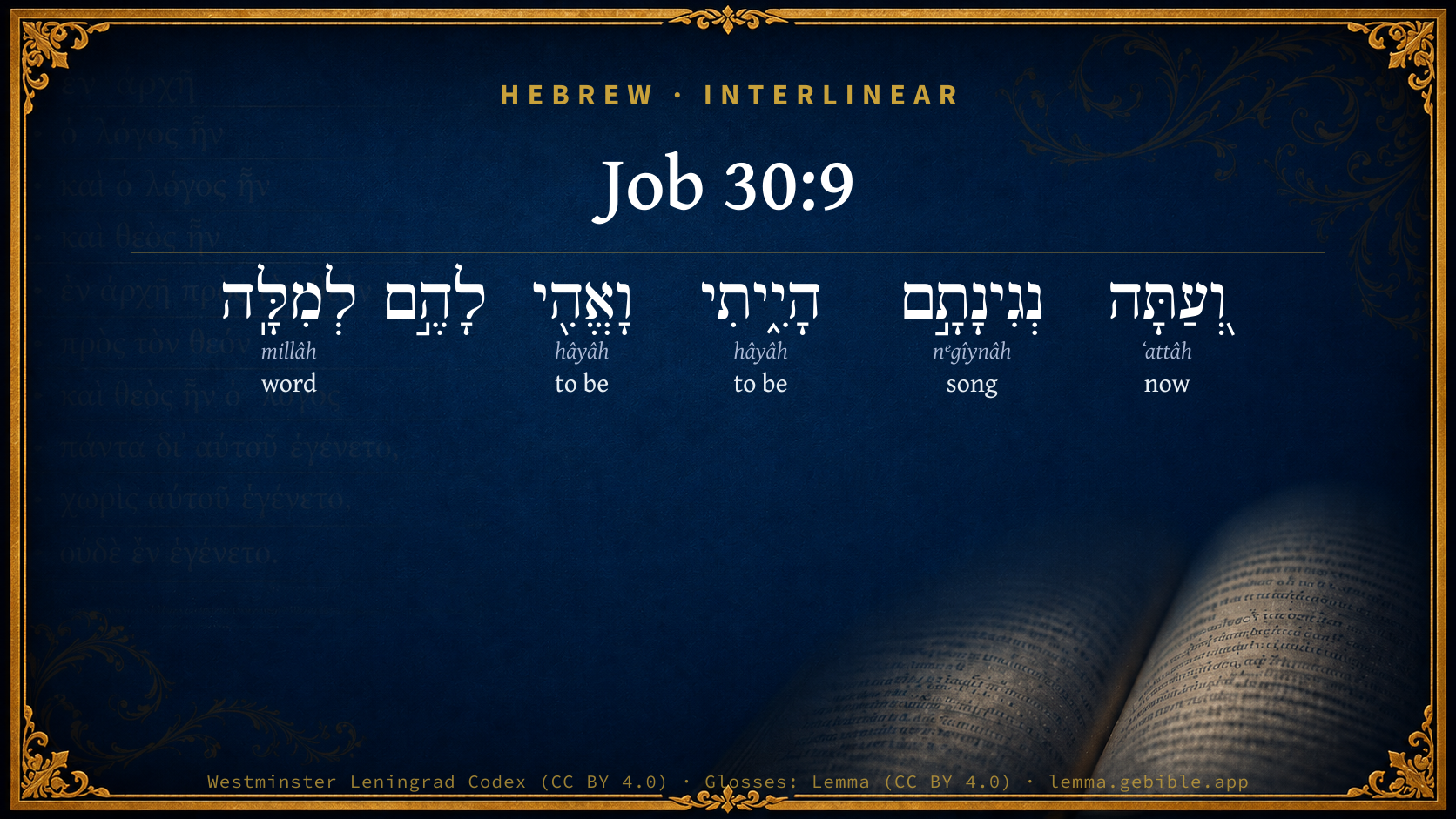
Hebrew (Westminster Leningrad Codex) Job 30:9 appears in the Hebrew Old Testament. The text above is from the Westminster Leningrad Codex. Each word links to its Strong’s number, a concise gloss, and parsing drawn from the Open Scriptures Hebrew Bible morphology. Click any word for its full Brown-Driver-Briggs (BDB) entry.
Download image
Cite this verse

Job 30:9 (World English Bible). Public Domain. Lemma interlinear Bible study tool, https://lemma.gebible.app/v/job/30/9.

Show BibTeX & RIS
BibTeX
RIS
English Translation
"Now I have become their song. Yes, I am a byword to them.
World English Bible · Public Domain
Highlights
  • 1 first appearance in the Hebrew Bible
Full analysis ↓
Download a study sheet

One document with this verse’s original text, its word-by-word gloss line, the meaning frame, cross-references with their text, attributed commentary, and full source and license credits — printable, and it pastes into notes with its structure intact.

This verse Autodidact and up

Study sheet (.html) Plain text (.txt)

A passage Seminary Student

Up to 50 verses in one chapter. A passage sheet keeps up to 6 commentary sources and 12 cross-references per verse, in the order this page ranks them, and says so on the sheet whenever that leaves anything out. Ask for a single verse and you get the Autodidact verse sheet above.

Everything on this page stays free to read, with no account — the sheet is a download of what is already on screen, not access to it.

Want to remove ads? Support Godless Engineer
Compare translations 3

The same verse in 3 English versions, stacked beneath the original-language interlinear above. Click any original word for its lexicon entry.

Each is an independent rendering of the whole verse — the interlinear is not word-aligned to these translations.

Highlighted words mark where these versions differ — a whole-verse word diff, not a word-by-word alignment.

  • World English Bible Public Domain
    "Now I have become their song. Yes, I am a byword to them.
  • King James Version Public Domain
    And now am I their song, yea, I am their byword.
  • unfoldingWord Literal Text CC BY-SA 4.0
    But now I have become their song, and I am a word for them.

unfoldingWord Literal Text — © unfoldingWord, licensed CC BY-SA 4.0. Word-aligned USFM3 via Door43 (git.door43.org/unfoldingWord/en_ult).

Versions to compare (up to 4)

3 of 4 selected

Show all 18 translations

Every available English version of this verse, each an independent rendering of the whole verse.

  • World English Bible Public Domain
    "Now I have become their song. Yes, I am a byword to them.
  • Berean Standard Bible Public Domain
    And now they mock me in song; I have become a byword among them.
  • Majority Standard Bible Public Domain
    And now they mock me in song; I have become a byword among them.
  • King James Version Public Domain
    And now am I their song, yea, I am their byword.
  • American Standard Version (1901) Public Domain
    And now I am become their song, Yea, I am a byword unto them.
  • Revised Version (1885) Public Domain
    And now I am become their song, yea, I am a byword unto them.
  • Geneva Bible (1599) Public Domain
    And now am I their song, and I am their talke.
  • Douay-Rheims (1899) Public Domain
    Now I am turned into their song, and am become their byword.
  • Young's Literal Translation Public Domain
    And now, their song I have been, And I am to them for a byword.
  • Literal Standard Version CC BY-SA 4.0
    And now, I have been their song, || And I am to them for a byword.
  • Unlocked Literal Bible CC BY-SA 4.0
    But now I have become the subject of their taunting song; I have become a byword for them.
  • unfoldingWord Literal Text CC BY-SA 4.0
    But now I have become their song, and I am a word for them.
  • Darby Bible Public Domain
    And now I am their song, yea, I am their byword.
  • World Messianic Bible Public Domain
    “Now I have become their song. Yes, I am a byword to them.
  • Webster's Bible Public Domain
    And now I am their song, yes, I am their by-word.
  • Free Bible Version CC BY-SA 4.0
    Yet now they mock me in their songs; I have become a joke to them!
  • Bible in Basic English Public Domain
    And now I have become their song, and I am a word of shame to them.
  • JPS Tanakh (1917) Public Domain
    And now I am become their song, yea, I am a byword unto them.

Literal Standard Version (2020), Covenant Press — licensed CC BY-SA 4.0. Text via the HelloAO Bible API (eBible.org). Unlocked Literal Bible (unfoldingWord) — licensed CC BY-SA 4.0. Text via the HelloAO Bible API (eBible.org). unfoldingWord Literal Text — © unfoldingWord, licensed CC BY-SA 4.0. Word-aligned USFM3 via Door43 (git.door43.org/unfoldingWord/en_ult). Free Bible Version, Dr. Jonathan Gallagher — licensed CC BY-SA 4.0. Text via the HelloAO Bible API (eBible.org).

Word by word

More ways to search: Search by grammar → Find every occurrence → Compare this word →

Practice this passage: Drill this verse → Learn its vocabulary →

About this verse

These counts appear in no published source. They are computed here, from the morphology-tagged text and Lemma’s own curated glosses. What Lemma adds →

6
words
4
distinct lemmas
Wisdom
section

Notable vocabulary

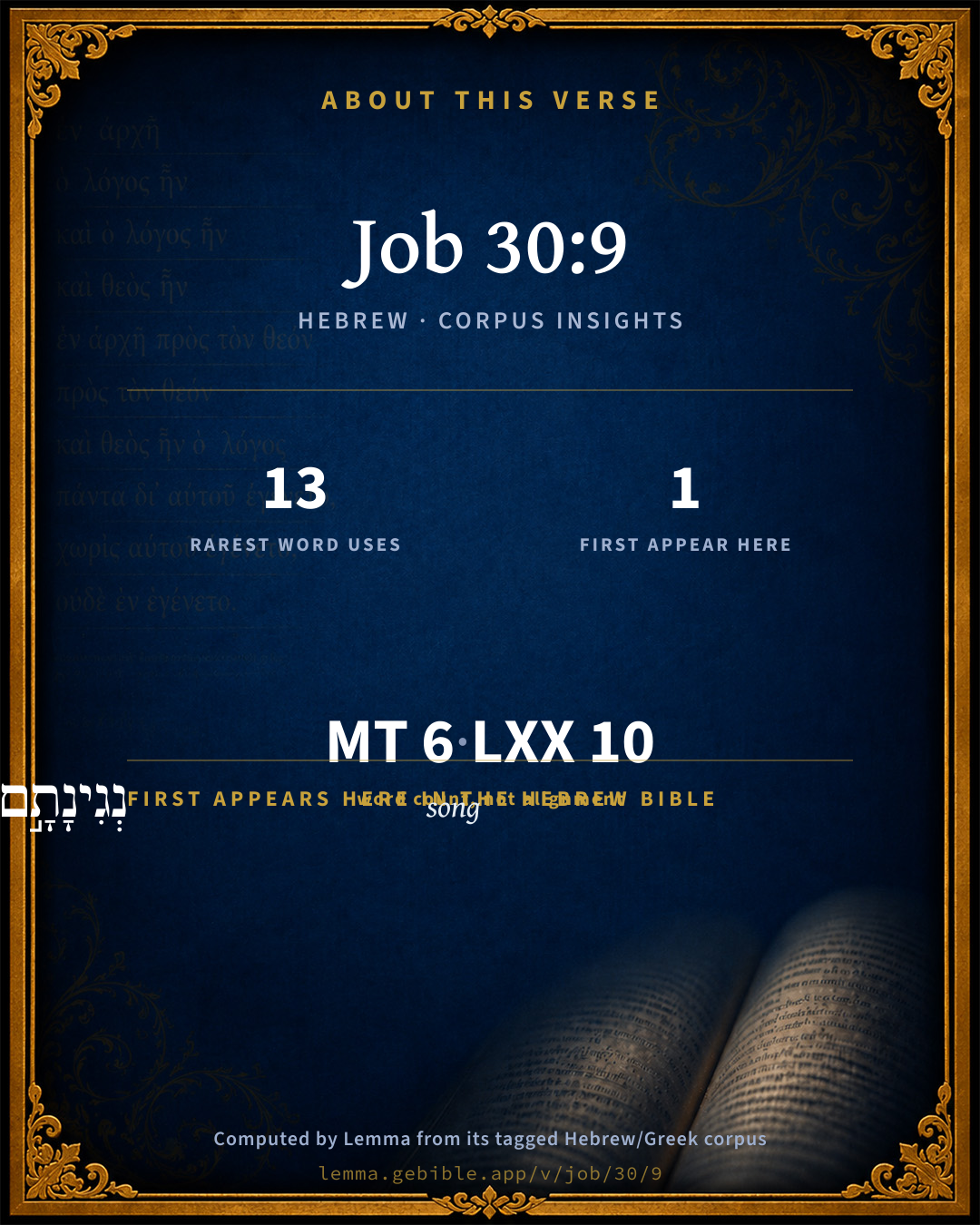
The rarest word here is נְגִינָתָ֣ם song H5058 — appearing just 13 times in the whole Hebrew Bible.

First appearance in Scripture

This word makes its first canonical appearance in the Hebrew Bible here:

  • נְגִינָתָ֣ם song H5058

Shared distinctive vocabulary

נְגִינָתָ֣ם song H5058 occurs in 13 verses of the Hebrew Bible. Also found in:

Grammatical profile

  • 2 verbs
  • 2 nouns
  • 1 preposition
  • 1 adverb

Verb forms

  • הָיִ֑יתִי Qal · Perfect
  • וָאֱהִ֖י Qal · Sequential Imperfect

Repetition

A word recurs within this verse — often emphatic in Hebrew:

  • הָיִ֑יתִי to be H1961 ×2

Hebrew & Septuagint length

In English translation the verse runs 13 words from the Hebrew and 13 from the Septuagint (LXX English) — the same length.

A rough comparison of the two English renderings, which tokenize alike — not a word-level alignment.

Word counts can differ between the Hebrew and the Greek without any difference in meaning — e.g. the Hebrew direct-object marker אֵת has no separate Greek word, and Greek often adds the article ὁ.

In the original languages it is 6 Hebrew tokens and 10 Greek tokens — but the two are counted differently (Hebrew bundles its prefixes and suffixes into one token; the Greek is in lemma form), so that isn’t a like-for-like length.

Cross-references

7

Topical passages linked to Job 30:9 in the Treasury of Scripture Knowledge — connected by theme and wording, ordered by reader-vote popularity; previews shown in the World English Bible.

  • Job 17:6 "But he has made me a byword of the people. They spit in my face.
  • Lamentations 3:63 See you their sitting down, and their rising up; I am their song.
  • Lamentations 3:14 I am become a derision to all my people, and their song all the day.
  • Job 12:4 I am like one who is a joke to his neighbor, I, who called on God, and he answered. The just, the blameless man is a joke.
  • Psalms 35:15–16 But in my adversity, they rejoiced, and gathered themselves together. The attackers gathered themselves together against me, and I didn't know it. They tore at me, and didn't cease.
  • Psalms 69:11–12 When I made sackcloth my clothing, I became a byword to them.
  • Psalms 44:14 You make us a byword among the nations, A shaking of the head among the peoples.

Cross-references courtesy of OpenBible.info (CC BY 4.0).

Hebrew and Greek witnesses Masoretic Hebrew ↔ Greek Septuagint

The same verse in the two great witnesses to the Old Testament, shown verse-for-verse.

These are two independent witnesses, not word-aligned to each other, and the Septuagint is shown in lemma (dictionary) form.

Hebrew Job 30:9 Masoretic · Westminster Leningrad Codex

וְ֭עַתָּה נְגִינָתָ֣ם הָיִ֑יתִי וָאֱהִ֖י לָהֶ֣ם לְמִלָּֽה

"Now I have become their song. Yes, I am a byword to them.

World English Bible · Public Domain

Greek LXX Job 30:9 Septuagint · lemma form

νυνί δέ κιθάρα ἐγώ εἰμί αὐτός καί ἐγώ θρύλημα ἔχω

But now I am their music, and they have me for a byword.

LXX2012 (modern English Septuagint) · Public Domain

On this verse, Keil & Delitzsch discusses the Septuagint’s reading. Read the note in Commentary ↓

Hebrew: Westminster Leningrad Codex (CC BY 4.0). Greek: Septuagint (public domain); English from LXX2012 (modern English Septuagint) (Public Domain). How the Septuagint differs from the Hebrew →

Commentary

Notes on Job 30:9 from classic Christian and Jewish commentators (each source and its license shown beneath its notes). The classic Christian expositions comment on the surrounding passage and are grouped to its opening verse, so a note may address several verses; the Jewish commentaries on the Tanakh (Rashi and others) are per-verse, so they appear only where the commentator wrote on this verse.

Lemma curates 59 commentaries, every one of them public domain or Creative Commons licensed, each selected and text-cleaned for this edition rather than reprinted as found. About our sources →

Trapp's Complete Commentary

John Trapp

Job 30:9 And now am I their song, yea, I am their byword.

Ver. 9. And now am I their song] They compose comedies out of my tragedies, and make themselves merry in my misery; they not only make ballads and sonnets of my sufferings, but also play them upon their instruments, as the Hebrew word importeth.

Yea, I am their byword] Sermonis argumentum , the matter of their discourse; I am all their talk; neither have they anything else whereof to chat and babble, but only of me; yea, to make my disgraces to pass into a proverb, they call all miserable men by my name, De me confabulantur et contemptim loquuntur (Disc.). The ale stakes served David in like sort; the drunkards upon their ale bench tossed his name as dogs do carrion, making him their ballad and their byword, Psa 69:12. The whole Church complaineth of the like contempt, Psa 79:4 Lam 3:14; Lam 3:63 Eze 33:32. Thus when the invincible Armada, as they called it, was coming for England, Don Bernardino Mendoza, the Spanish ambassador in France, solaced himself with a vain and false poem or song of England’s miseries; which, as a triumph before the victory, he absurdly printed (Cambd. Eliz.). The gunpowder traitors also did the like in their sevenfold psalmody, as they called it; that devilish ditty, which secretly the Papists passed from hand to hand with tunes set to be sung or played. The matter consisted of railing upon King Edward VI, Queen Elizabeth, King James, and others; of petition, imprecation, prophecy, and praise (Spec. Bell. Sacr.).

John Trapp, A Commentary or Exposition upon All the Books of the Old and New Testament (1647–1656) — public domain. Text from a community e-Sword module.

Whedon's Commentary on the Bible

Daniel D. Whedon

Second strophe — These human outcasts are led on to such brutal usage of Job by the treatment he had received at the hands of God, who had himself set the example, by letting loose his horde of calamities against his servant, Job_30:9-15.

9. Their song (of derision) — See Job_17:6. Nothing can give us of the West an idea of the shocking and indecent scurrilities Orientals put into their satirical, or, rather, abusive songs. (Kitto.)

Daniel D. Whedon (gen. ed.), Commentary on the Old and New Testaments (1874–1909) — public domain. Text from a community e-Sword module.

Tyndale Open Study Notes

Tyndale Open Resources

30:9 They taunt me! See also 17:6; cp. Ps 69:12; Lam 3:14, 63.

Tyndale Open Study Notes — © Tyndale Open Resources, licensed CC BY-SA 4.0. Text via the HelloAO Bible API.

Geneva Bible (1599)

Geneva Bible translators

They make songs of me, and mock at my misery.

Geneva Bible (1599) marginal notes — public domain. Text via Bolls.life.

Jamieson, Fausset & Brown

Robert Jamieson, A. R. Fausset & David Brown

(Job 17:6). Strikingly similar to the derision Jesus Christ underwent (Lam 3:14; Psa 69:12). Here Job returns to the sentiment in Job 30:1. It is to such I am become a song of "derision."

Jamieson, Fausset & Brown — Commentary Critical and Explanatory on the Whole Bible (1871) — public domain (CC PDM 1.0). Text via the HelloAO Bible API.

Adam Clarke's Commentary

Verse 9. Now am I their song] I am the subject of their mirth, and serve as a proverb or by-word. They use me with every species of indignity.

Adam Clarke's Commentary on the Bible (1810–1826) — public domain. Text from a community e-Sword/MySword module.

Ellicott's Commentary for English Readers

(9) And now am I their song.—See the references in the margin, which show that it is quite appropriate to give to the complaints of Job a Messianic interpretation.

A Bible Commentary for English Readers, edited by Charles John Ellicott (1878–1897) — public domain. Text from a community e-Sword module.

The Cambridge Bible for Schools and Colleges

gen. ed. J. J. S. Perowne

9–10. Job’s treatment now at the hands of these outcasts.

With “spit in my face” comp. ch. Job_17:6. In ch. 24. Job referred to this miserable race With compassion; they had often no doubt excited his pity, and he saw in their lot and in the injustice and cruelties which they suffered at the hands of more prosperous men a strange mystery of providence. Now he speaks of their conduct to himself with resentment; for it was no requital of any injury he had ever done them. Yet though they might mistake Job’s individual feeling to them, he was one of the class that had robbed them and that continued the robbery and oppression, and they avenged their wrongs on him with a malicious delight in the calamities that had overtaken him.

The Cambridge Bible for Schools and Colleges (gen. ed. J. J. S. Perowne; Cambridge University Press, 1878–1918) — public domain. Text from a community e-Sword module.

John Gill's Exposition

And now am I their song,.... The subject of their song, of whom they sung ballads about the streets, in public places, and at their festivals and merriments, as Christ the antitype of Job was the song of the drunkard, Psa 69:12; see Lam 3:14; or the meaning may be, they rejoiced in his afflictions and calamities, and made themselves merry with them, which was cruel and inhuman, as David's enemies did in his, and those abject, mean, base people, like those that derided Job: and so the Edomites rejoiced over the children of Judah, in the day of their destruction, and as the inhabitants of Popish countries will rejoice over the witnesses when slain, and make merry, Psa 35:15;

yea, I am their byword: all their talk was about him continually, and at every turn would use his name proverbially for an hypocrite, or a wicked man; and thus Christ, of whom Job was a type, became a proverb in the mouth of the Jews, Psa 69:11; and as the Jews themselves now are with others, Jer 24:9.

John Gill's Exposition of the Whole Bible (1746–1763) — public domain (CC PDM 1.0). Text via the HelloAO Bible API.

Albert Barnes' Notes on the Bible

And now am I their song - See Job 17:6; compare Psa 69:12, “I was the song of the drunkards;” Lam 3:14, “I was a derision to all my people, and their song all the day.” The sense is, that they made Job and his calamities the subject of low jesting, and treated him with contempt. His name and sufferings would be introduced into their scurrilous songs to give them pith and point, and to show how much they despised him now.

Yea, I am their by-word - See the notes at Job 17:6.

Albert Barnes' Notes on the Bible (1834–1885) — public domain. Text from a community e-Sword/MySword module.

Haydock's Catholic Bible Commentary

Bye-word. "Proverb." (Haydock) --- They speak of me with contempt, chap. xvii. 6.

George Leo Haydock (1774–1849), Haydock's Catholic Family Bible and Commentary, 1859 edition — public domain. Excludes Psalms (Douay-Rheims chapter numbering differs from Protestant) and Deuterocanonical books (Catholic canon only).

Matthew Poole's English Annotations

The matter of their song and derision. They now rejoice in my calamities, because formerly I used my authority to punish such vagrants and miscreants.

Matthew Poole's English Annotations on the Holy Bible (1683–1685) — public domain. Text from a community e-Sword/MySword module.

The Pulpit Commentary

And now am I their song, yea, I am their byword. (see Job_17:6; and comp. Psa_69:12)

The Pulpit Commentary (1880–1919), ed. H.D.M. Spence-Jones & Joseph S. Exell — public domain. Text from a community e-Sword module.

Keil & Delitzsch

C. F. Keil & F. Delitzsch

9 And now I am become their song,

And a by-word to them.

10 They avoid me, they flee far from me,

And spare not my face with spitting.

11 For my cord of life He hath loosed, and afflicted me,

Therefore they let loose the bridle recklessly.

12 The rabble presses upon my right hand,

They thrust my feet away,

And cast up against me their destructive ways.

The men of whom Job complains in this strophe are none other than those in the preceding strophe, described from the side of their coarse and degenerate behaviour, as Job 24:4-8 described them from the side of the wrong which was practised against them. This rabble, constitutionally as well as morally degraded, when it comes upon Job's domain in its marauding expeditions, makes sport of the sufferer, whose former earnest admonitions, given from sympathizing anxiety for them, seemed to them as insults for which they revenge themselves. He is become their song of derision (נגינתם to be understood according to the dependent passage, Lam 3:14, and Psa 69:13), and is למלּה to them, their θρύλλημα (lxx), the subject of their foolish talk (מלּה - Arab. mille, not = melle, according to which Schultens interprets it, sum iis fastidio). Avoiding him, and standing at a distance from him, they make their remarks upon him; and if they come up to him, it is only for the sake of showing him still deeper scorn: a facie ejus non cohibent sputam. The expositors who explain that, contrary to all decent bearing, they spit in his presence (Eichh., Justi, Hirz., Vaih., Hlgst.), or with Fie! spit out before him (Umbr., Hahn, Schlottm.), overlook the fact of its being מפּני, not לפני. The expression as it stands can only affirm that they do not spare his face with spitting (Jer. correctly: conspuere non veruntur), so that consequently he is become, as he has complained in Job 17:6, a תּפת, an object of spitting (comp. also the declaration of the servant of Jehovah, Isa 50:6, which stands in close connection with this declaration of Job, according to previous explanations).

It now becomes a question, Who is the subj. in Job 30:11? The Chethib יתרו demands an attempt to retain the previous subj. Accordingly, most moderns explain: solvit unusquisque eorum funem suum, i.e., frenum suum, quo continebatur antea a me (Rosenm., Umbr., Stick., Vaih., Hlgst., and others), but it is to be doubted whether יתר can mean frenum; it signifies a cord, the string of a bow, and of a harp. The reconciliation of the signification redundantia, Job 22:20, and funis, is, in the idea of the root, to be stretched tight and long.

(Note: The Arab. verb watara shows its sensuous primary signification in Arab. watarun, יתר, cord, bow-string, harp-string (Engl. string): to stretch tight, to extend, so that the thing continues in one line. Hence then Arab. watrun, witrun, separate, unequal, singulus, impar, opp. Arab. šaf‛un, bini, par, just as fard, single, separate, unequal (opp. zaug, a pair, equal number), is derived from farada, properly, so to strain or stretch out, that the thing has no bends or folds; Greek εξαπλοῦν (as in the Shepherd of Hermas: ἐπάνω λεντίου ἐξηπλωμένον λίνον καρπάσινον), an original transitive signification still retained in low Arabic (vid., Bocthor under tendre and Dployer). Then from Arab. watara spring the secondary roots Arab. tatara and tarâ, which proceed from the VIII form (ittatara). The former (tatara) appears only in the Arab. adverb tatran and tatrâ, sigillatim, alii post alios, singly one after another, so that several persons or things form a row interrupted by intervals of space of time; the latter (tara) and its IV form (atra) are equivalent to wâtara, to be active at intervals, with pauses between, as the Arabs explain: "We say Arab. atrâ of a man when he so performs several acts which do not directly follow one another, that there is always a [Arab.] fatrat, intermissio, between two acts." Hence also תּרין, תּרתּין, duals of an assumed sing. תּר, singulus (um), תּרתּ singula, therefore prop. duo singuli (a), duae singulae, altogether parallel to the like meaning thinâni (ithnâni', thinaini (ithnaini), שׁנים; fem. thintâni (ithnatâni), thintaini (ithnataini), שׁתּים instead of שׁנתּים, from an assumed sing. thin-un (ithn-un), thint-un (ithnat-un), from Arab. tanâ, שׁנה, like bin (ibn), bint (ibnat), בּן, בּת (= בּנת, hence בּתּי) from Arab. banâ, בּנה.

The significations of watara which Freytag arranges under 1, 2, 3, 4, proceed from the transitive application of יתר, as the Italian soperchiare, soverchiare, from supra, to offend, insult; oltraggiare, outrager, from ultra; ὑβρίζειν from ὑπέρ. Similarly, Arab. tṭâwl ‛lı̂h and ‛stṭâl ‛lı̂h (form VI and X from ṭâl), to act haughtily towards any one, to make him feel one's superiority, properly to stretch one's self out over or against any one.

But in another direction the signif. to be stretched out goes into: overhanging, surpassing, projecting, to be superfluous, and to be left over, περιττὸν εἶναι, to exceed a number or bulk, superare (comp. Italian soperchiare as intrans.), περιεῖναι, ὑπερεῖναι; to prove, as result, gain, etc., περιεῖναι, etc. Similar is the development of the meaning of Arab. faḍala and of ṭâ'l, gain, use, from Arab. ṭâl, to be stretched out. In like manner, the German reich, reichlich rich, abundant, comes from the root reichen, recken to stretch, extend. - Fl.)

Hirz. therefore imagines the loosing of the cord round the body, which served them as a girdle, in order to strike Job with it. But whether one decides in favour of the Chethib יתרו or of the Keri יתרי, the persons who insult Job cannot in any case be intended. The isolated sing. form of the assertion, while the rabble is everywhere spoken of in the plur., is against it; and also the כּי, which introduces it, and after which Job here allows the reason to come in, why he is abandoned without any means of defence to such brutal misconduct. The subj. of Job 30:11 is God. If יתרו is read, it may not be interpreted: He hath opened = taken off the covering of His string (= bow) (Ew., Hahn, and similarly even lxx, Jer.), for יתר does not dignify the bow, but the string (Arab. muwattar‛, stretched, of a bow); and while פּתח, Ezek. 21:33 (usually שׁלף or הריק), can certainly be said of drawing a sword from its sheath, ערה is the appropriate and usual word (vid., Hab. S. 164) for making bare the bow and shield. Used of the bow-string, פּתּח signifies to loose what is strained, by sending the arrow swiftly forth from it, according to which, e.g., Elizabeth Smith translates: Because He hath let go His bow-string and afflicted me. One cannot, however, avoid feeling that ויּענּני is not a right description of the effect of shooting with arrows, whereas an idea is easily gained from the Keri יתרי, to which the description of the effect corresponds. It has been interpreted: He has loosed my rein or bridle, by means of which I hitherto bound them and held them in check; but יתר in the signification rein or bridle, is as already observed, not practicable. Better Capellus: metaphora ducta est ab exarmato milite, cujus arcs solvitur nervus sicque inermis redditur; but it is more secure, and still more appropriate to the ויענני which follows, when it is interpreted according to Job 4:21 : He has untied (loosened) my cord of life, i.e., the cord which stretched out and held up my tent (the body) (Targ. similarly: my chain and the threads of my cord, i.e., surely: my outward and inward stay of life), and bowled me down, i.e., deprived me of strength (comp. Psa 102:24); or also: humbled me. Even in this his feebleness he is the butt of unbridled arrogance: and they let go the bridle before me (not לפני, in my presence, but מפּני, before me, before whom previously they had respect; מפני the same as Lev 19:32), they cast or shake it off (שׁלּח as Job 39:3, synon. of השׁליך; comp. Kg1 9:7 with Ch2 7:20).

Is it now possible that in this connection פּרחח can denote any else but the rabble of these good-for-nothing fellows? Ewald nevertheless understands by it Job's sufferings, which as a rank evil swarm rise up out of the ground to seize upon him; Hahn follows Ew., and makes these sufferings the subj., as even in Job 30:11. But if we consider how Ew. translates: "they hung a bridle from my head;" and Hahn: "they have cast a bit before my face," this might make us tired of all taste for this allegorical mode of interpretation. The stump over which they must stumble is Job 30:13, where all climax must be abandoned in order to make the words לא עזר למו intelligible in this allegorical connection. No indeed; פּרחח (instead of which פרחח might be expected, as supra, Job 3:5, כמרירי for כמרירי) is the offspring or rabble of those fathers devoid of morals and honour, those צעירים of Job 30:1, whose laughing-stock Job is now, as the children of priests are called in Talmudic פּרחי כהנּה, and in Arabic farch denotes not only the young of animals, but also a rascal or vagabond. This young rabble rises על־ימין, on Job's right hand, which is the place of an accuser (Psa 109:6), and generally one who follows him up closely and oppresses him, and they press him continually further and further, contending one foot's-breadth after another with him: רגלי שׁלּחוּ, my feet thrust them forth, protrudunt (שׁלּח the same as Job 14:20). By this pressing from one place to another, a way is prepared for the description of their hostile conduct, which begins in Job 30:12 under the figure of a siege. The fut. consec. ויּסלּוּ, Job 30:12, is not meant retrospectively like ויענני, but places present with present in the connection of cause and effect (comp. Ew. 343, a). We must be misled by the fact that ויסלו, Job 19:12 (which see), was said of the host of sufferings which come against Job; here it is those young people who cast up the ramparts of misfortune or burdensome suffering (איד) against Job, which they wish to make him feel. The tradition, supported by the lxx, that Job had his seat outside his domain ἐπὶ τῆς κοπρίας, i.e., upon the mezbele, is excellently suited to this and the following figures. Before each village in Hauran there is a place where the households heap up the sweepings of their stalls, and it gradually reaches a great circumference, and a height which rises above the highest buildings of the village.

(Note: One ought to have a correct idea of a Hauranitish mezbele. The dung which is heaped up there is not mixed with straw, because in warm, dry countries no litter is required for the cattle, and comes mostly from single-hoofed animals, since small cattle and oxen often pass the nights on the pastures. It is brought in a dry state in baskets to the place before the village, and is generally burnt once every month. Moreover, they choose days on which the wind if favourable, i.e., does not cast the smoke over the village. The ashes remain. The fertile volcanic ground does not need manure, for it would make the seed in rainy years too luxuriant at the expense of the grain, and when rain fails, burnt it up. If a village has been inhabited for a century, the mezbele reaches a height which far surpasses it. The winter rains make the ash-heaps into a compact mass, and gradually change the mezbele into a firm mound of earth in the interior of which those remarkable granaries, biâr el-ghalle, are laid out, in which the wheat can be completely preserved against heat and mice, garnered up for years. The mezbele serves the inhabitants of the district as a watch-tower, and on close oppressive evenings as a place of assembly, because there is a current of air on the height. There the children play about the whole day long; there the forsaken one lies, how, having been seized by some horrible malady, is not allowed to enter the dwellings of men, by day asking alms of the passers-by, and at night hiding himself among the ashes which the sun has warmed. There the dogs of the village lie, perhaps gnawing at a decaying carcase that is frequently thrown there. Many a village of Hauran has lost its original name, and is called umm el-mezâbil from the greatness and number of these mounds, which always indicate a primitive and extensive cultivation for the villages. And many a more modern village is built upon an ancient mezbele, because there is then a stronger current of air, which renders the position more healthy. The Arabic signification of the root זבל seems to be similarly related to the Hebrew as that of the old Beduin seken (שכן), "ashes," to the Hebrew and Arabic משכן, "a dwelling." - Wetzst.)

Notwithstanding, everything is intelligible without this thoroughly Hauranitish conception of the scene of the history. Bereft of the protection of his children and servants, become an object of disgust to his wife, and an abhorrence to his brethren, forsaken by every attention of true affection, Job 19:13-19, Job lies out of doors; and in this condition, shelterless and defenceless, he is abandoned to the hideous malignant joy of those gipsy hordes which wander hither and thither.

Keil & Delitzsch — Biblical Commentary on the Old Testament (1861–1891) — public domain (CC PDM 1.0). Text via the HelloAO Bible API. (Old Testament only.)

unfoldingWord translationNotes

Door43 World Missions Community

Connecting Statement:

Job speaks again about the people who were mocking him.

But now I have become the subject of their taunting song

The abstract noun "song" can be expressed with the verb "sing." AT: "But now they sing songs about me to taunt me" (See: Abstract Nouns)

I have become a byword for them

Here "byword" is a metonym for the person about whom people make cruel jokes. AT: "I am now one whom they make cruel jokes about" or "They joke and say cruel things about me" (See: Metonymy)

they do not refrain from spitting in my face

This can be stated positively. AT: "they even spit in my face" (See: Litotes)

God has unstrung the string to my bow

A bow that is unstrung is not useful. The phrase "has unstrung the string of my bow" is a metaphor for making Job powerless. AT: "God has taken away my power to defend myself" (See: Metaphor)

those who taunt me

"those who mock me"

cast off restraint before my face

A restraint keeps a person from moving freely and doing what he wants. Here "restraint" represents refraining from doing something, and "cast off restraint" represents not refraining from doing something. In this case the mockers did not refrain from being cruel to Job. AT: "do not refrain from being cruel to me" or "do whatever cruel things they want to do to me" (See: Metaphor and Assumed Knowledge and Implicit Information)

translationWords

son

mock

God

bow and arrow

afflicted

unfoldingWord translationNotes — © Distant Shores Media and the Door43 World Missions Community, licensed CC BY-SA 4.0. Source: git.door43.org/Door43/en_tn.

Lesson kit

Teaching starters — assembled from the data on this page, not authored interpretation. Every prompt links to the verse data it draws on. Edit before teaching.

Job, in the Wisdom, opens this verse with 6 words (4 distinct Hebrew lemmas). Its most distinctive word is nᵉgîynâh (“song”). A historical commentator’s framing appears above. Read the whole chapter for the surrounding context.

Discussion questions

  1. What does “song” (nᵉgîynâh) contribute to the verse as a whole?
  2. This is the first place “song” appears in Scripture (first appears here). What does its debut here establish?
  3. How does Psalms 4:1, which shares the word «song», read alongside this verse?
  4. What does the repetition of “to be” (2× in this one verse) do in this verse?
  5. The translations on this page render this verse differently — a whole-verse word diff, not a word-by-word alignment. What might account for the different wordings?
  6. «הָיִ֑יתִי» is a Qal Perfect verb. How does that grammatical form shape the action described?
  7. Compare how Trapp's Complete Commentary and Whedon's Commentary on the Bible read this verse. Where do they agree or differ?

Things to notice

Reading settings

Reading text

Shown beneath each verse's original-language words.

Old Testament
Old Testament edition

Read the OT as the Masoretic Hebrew (MT) or the Greek Septuagint (LXX).

English shown for the Greek Septuagint (in the Hebrew ↔ Greek comparison).

Comparing translations? Open the Compare panel on any verse page to stack up to four side by side.