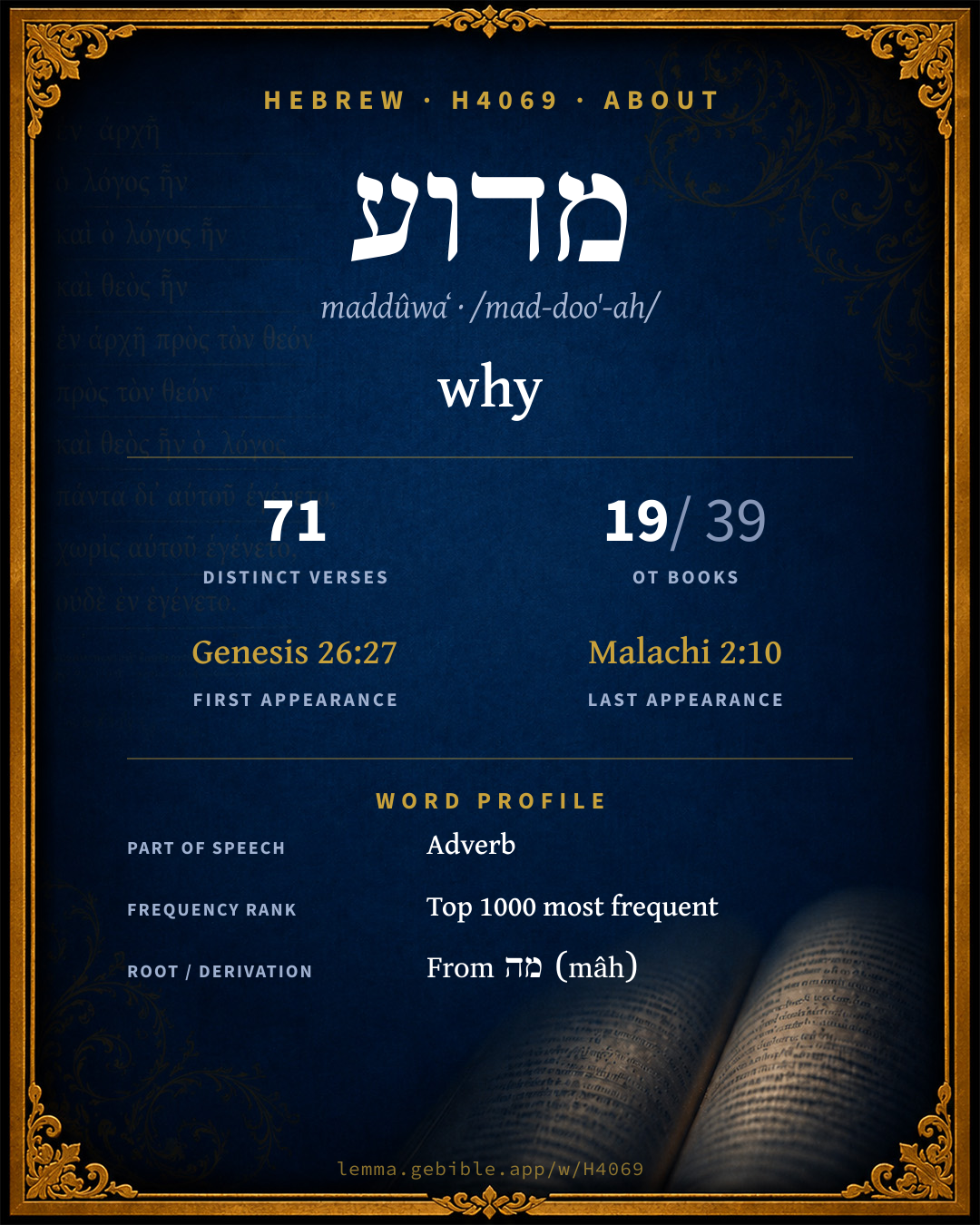
מַדּוּעַ
why
Full lexicon entry — Brown-Driver-Briggs (BDB)
From Brown-Driver-Briggs (BDB)
Where this word appears
Grammar key — what these labels mean
Part of speech
- Particle
- A short function word — article, negation, interrogative, the sign of the direct object, and the like.
Every verse where H4069 appears in the Book of 2 Samuel — 10 distinct verses. Click any verse to open its interlinear word-by-word view. Verse text shown in the World English Bible for context — . Each verse’s Hebrew form is shown with its reference; the English is not keyword-highlighted, since the data carries no word-level English alignment. Use “Compare translations” on any verse to read it across multiple English versions. This concordance covers the Hebrew Bible; Septuagint (Greek Old Testament) occurrences are not indexed here.
2 Samuel
- 2 Samuel 3:7 מַדּ֥וּעַ ptcl inter Now Saul had a concubine, whose name was Rizpah, the daughter of Aiah: and [Ish-bosheth] said to Abner, Why have you gone in to my father's concubine?
- 2 Samuel 11:10 מַדּ֖וּעַ ptcl inter When they had told David, saying, Uriah didn't go down to his house, David said to Uriah, Haven't you come from a journey? why did you not go down to your house?
- 2 Samuel 11:20 מַדּ֛וּעַ ptcl inter it shall be that, if the king's wrath arise, and he tells you, 'Why did you go so near to the city to fight? Didn't you know that they would shoot from the wall?
- 2 Samuel 12:9 מַדּ֜וּעַ ptcl inter Why have you despised the word of Yahweh, to do that which is evil in his sight? You have struck Uriah the Hittite with the sword, and have taken his wife to be your wife, and have slain him with the sword of the children of Ammon.
- 2 Samuel 13:4 מַדּ֣וּעַ ptcl inter He said to him, Why, son of the king, are you thus lean from day to day? Won't you tell me? Amnon said to him, I love Tamar, my brother Absalom's sister.
- 2 Samuel 16:10 מַדּ֖וּעַ ptcl inter The king said, What have I to do with you, you sons of Zeruiah? Because he curses, and because Yahweh has said to him, Curse David; who then shall say, Why have you done so?
- 2 Samuel 18:11 וּ/מַדּ֛וּעַ conj + ptcl inter Joab said to the man who told him, Behold, you saw it, and why didn't you strike him there to the ground? and I would have given you ten [pieces of] silver, and a sash.
- 2 Samuel 19:41 מַדּוּעַ֩ ptcl inter Behold, all the men of Israel came to the king, and said to the king, Why have our brothers the men of Judah stolen you away, and brought the king, and his household, over the Jordan, and all David's men with him?
- 2 Samuel 19:43 וּ/מַדּ֨וּעַ֙ conj + ptcl inter The men of Israel answered the men of Judah, and said, We have ten parts in the king, and we have also more [right] in David than you: why then did you despise us, that our advice should not be first had in bringing back our king? The words of the men of Judah were fiercer than the words of the men of Israel.
- 2 Samuel 24:21 מַדּ֛וּעַ ptcl inter Araunah said, Why is my lord the king come to his servant? David said, To buy the threshing floor of you, to build an altar to Yahweh, that the plague may be stayed from the people.
About this entry
At a glance — auto-summarized from this page’s data, not written by a person. Every figure links to its source below. This summary describes the numbers; it doesn’t interpret them.
“why” is the headline sense of the Hebrew verb מדוע (maddûwaʻ). Its earliest occurrence is Genesis 26:27. It turns up in 71 verses across 19 books, a moderately common footprint. It clusters with מה, מא and מדי under a shared root. See the sense tree, 71-verse concordance, and the renderings breakdown below.
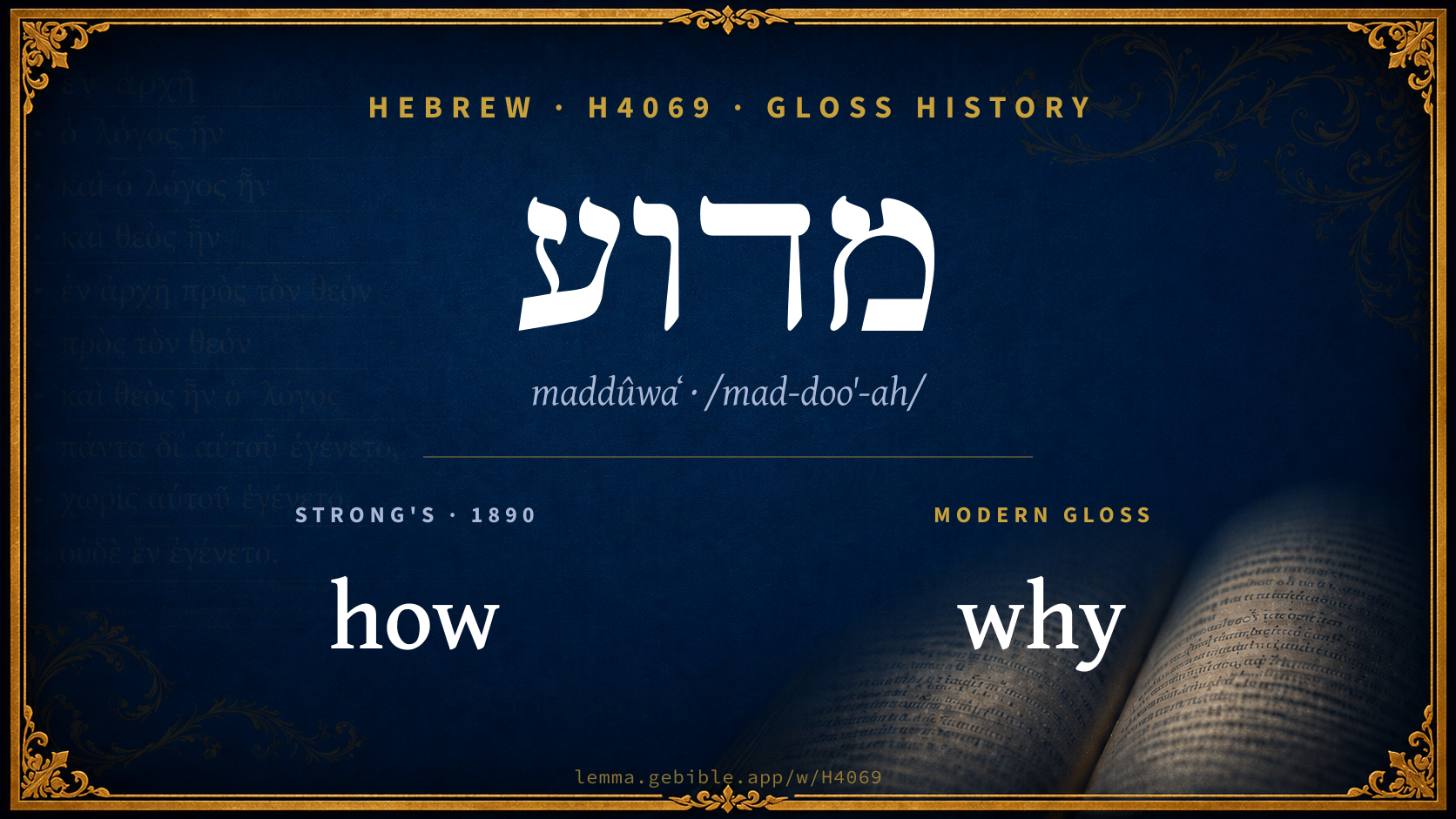
Gloss history
Strong's 1890 vs modern scholarship
About this word
Strong's H4069 catalogs a Hebrew word from the Hebrew Old Testament.
These counts are not copied from any lexicon or concordance. They are computed here, from the morphology-tagged Hebrew Old Testament. What Lemma adds →
- 71
- distinct verses
- The word appears in 71 distinct verses.
- 19 / 39
- OT books
- The word appears in 19 of 39 Old Testament books.
- #550
- by frequency
- Top 1000 most frequent Hebrew words (rank 550 of 8,640 Hebrew words by occurrence).
View all 71 occurrences in the concordance →
By section of the Old Testament
By traditional corpus
Conventional, traditional groupings — biblical authorship is debated, so this is a traditional corpus grouping, not an authorship claim. Each share is this word’s portion of its verses in that division of the Hebrew canon. Each figure is a share of the word’s 71 distinct verses.
- Prophets (Nevi'im) 48 verses · 68%
- Writings (Ketuvim) 13 verses · 18%
- Torah (Pentateuch) 10 verses · 14%
How translations render this word
Counts come from each version’s own published word-to-Strong’s tagging or interlinear alignment — an approximate guide to how each version renders this word, not a word-level alignment the data otherwise carries. Because each total is that version’s own tagged count, the per-version totals vary from one another and need not match the appearance or distinct-verse counts above. These counts may also differ from a printed concordance because Lemma counts each distinctly tagged rendering and does not collapse phrase taggings into a single head-word total. This is a fixed set of word-tagged versions (KJV, ASV, BSB, ULT) and does not change with the reading translation you choose elsewhere. Each version’s license is shown beside its name below (and on Sources).
- King James Version: Wherefore 2×, Why 2×
- American Standard Version: Them 2×
- Berean Standard Bible: Why 63×, Why then 6×
- unfoldingWord Literal Text: Why 61×
King James Version Public Domain
Renders H4069 across 6 tagged occurrences — most commonly:
Plus 2 renderings that appear only once — usually multi-word phrases or single function words the recovered tagging swept in, not distinct renderings.
American Standard Version Public Domain
Renders H4069 across 6 tagged occurrences — most commonly:
Plus 4 renderings that appear only once — usually multi-word phrases or single function words the recovered tagging swept in, not distinct renderings.
Berean Standard Bible Public Domain
Renders H4069 across 72 tagged occurrences — most commonly:
Plus 3 renderings that appear only once — usually multi-word phrases or single function words the recovered tagging swept in, not distinct renderings.
unfoldingWord Literal Text CC BY-SA 4.0
Renders H4069 across 68 tagged occurrences — most commonly:
Plus 7 renderings that appear only once — usually multi-word phrases or single function words the recovered tagging swept in, not distinct renderings.
Senses in BDB
The 1 sense BDB distinguishes for this word, in lexicon order (not ranked by frequency or importance). The full entry — with sub-senses — is in the Lexicon Entry tab.
- why?, on what account?, wherefore?
Word origin
and (Ez 18, 19) מַדֻּעַ adv. wherefore? (prob. contr. from מַה־יָּדוּעַ what being known? i.e. from what motive? so Ges Ew§ 325 c Ol§ 222 f, cf. in Gk. τί μαθών;)—wherefore? on what account? Gn 26:27 מַדּוּעַ בָּאתֶם אֵלָ֑י, 40:7 Ex 1:18; 2:18; 3:3 (in an indirect question), 5:14; 18:14 Lv 10:17 Jos 17:14 (all in Hex), Ju 5:28(×28) 2 S 3:7; 11:10 etc., Is 5:4; 50:2; 63:2 (all in Is.); in Jer. 16 times, often rhetorically, after a double question introduced by הֲ … אִם, expressing affected surprise: †2:14 (v. Gf) is Israel a slave (unable to defend himself)? wherefore, then, is he become a prey? (some other cause must therefore be found for Israel’s misfortune), v 31; 8:5, 19, 22; 14:19; 22:28; 49:1, cf. 30:6; Jb 3:12; 18:3 (never in ψ).
— Brown-Driver-Briggs (Oxford 1906, public domain), digitized via Sefaria, supplemented by the OpenScriptures HebrewLexicon (CC BY 4.0). See Sources.
Derived from מה (mâh) (H4100) — what.
Forms in the corpus
The 23 distinct written forms H4069 takes in the Hebrew Bible, most frequent first — each parse links to that state’s occurrences in the concordance. Hebrew forms include their vowel points and cantillation, so a single lemma takes many written forms.
| Form | Parsing | Example | Uses |
|---|---|---|---|
| מַדּ֖וּעַ | Particle, Interrogative | Exodus 3:3 | 10 |
| מַדּ֗וּעַ | Particle, Interrogative | Exodus 18:14 | 8 |
| מַדּוּעַ֩ | Particle, Interrogative | 2 Samuel 19:41 | 7 |
| מַדּ֛וּעַ | Particle, Interrogative | Exodus 2:18 | 6 |
| מַדּ֣וּעַ | Particle, Interrogative | 2 Samuel 13:4 | 6 |
| מַדּ֜וּעַ | Particle, Interrogative | 1 Samuel 20:27 | 5 |
| מַדּ֥וּעַ | Particle, Interrogative | Exodus 1:18 | 4 |
| מַדּ֨וּעַ֙ | Particle, Interrogative | Esther 3:3 | 4 |
| מַ֭דּוּעַ | Particle, Interrogative | Job 3:12 | 3 |
| וּ/מַדּ֖וּעַ | Particle, Interrogative | 1 Kings 1:13 | 2 |
| וּ/מַדּ֥וּעַ | Particle, Interrogative | Judges 11:26 | 2 |
| וּ/מַדּ֨וּעַ֙ | Particle, Interrogative | 2 Samuel 19:43 | 2 |
| מַדּ֤וּעַ | Particle, Interrogative | 1 Samuel 21:1 | 2 |
| מַדּ֨וּעַ | Particle, Interrogative | Isaiah 50:2 | 2 |
| וּ/מַדּ֕וּעַ | Particle, Interrogative | 1 Kings 2:43 | 1 |
| וּ/מַדּ֛וּעַ | Particle, Interrogative | 2 Samuel 18:11 | 1 |
| וּ/מַדּ֜וּעַ | Adverb | Judges 11:7 | 1 |
| וּ/מַדּוּעַ֩ | Particle, Interrogative | 1 Samuel 20:2 | 1 |
| מַ֝דּ֗וּעַ | Particle, Interrogative | Job 21:4 | 1 |
| מַ֠דּוּעַ | Particle, Interrogative | 2 Kings 4:23 | 1 |
| מַדּ֡וּעַ | Particle, Interrogative | Exodus 5:14 | 1 |
| מַדּ֧וּעַ | Particle, Interrogative | Isaiah 5:4 | 1 |
| מַדֻּ֛עַ | Particle, Interrogative | Ezekiel 18:19 | 1 |
Same root — word family
Other BDB entries built from the same root as H4069, grouped by Strong’s listed origin. These share a root / origin per the lexicon — not necessarily a shared meaning. Each links to that word’s own entry.
Derives from
Shares the same root
- מא mâʼ H3964 what
- מדי madday H4078 what is enough, sufficiency, enough
- מה mâh H4101 whatever
- מהה mâhahh H4102 to delay
- מי mîy H4310 who
- מן mân H4478 manna
- מתלאה mattᵉlâʼâh H4972 weariness
Proper names from this root
People and places named from this root — a name, not an additional meaning of the word.
Compare all same-root words → Showing 4 of 10 — not the complete family. 1 of the same-root words is a proper name (a person or place). They share a root, not necessarily a meaning.
Septuagint verse parallels
This word appears in 65 verses that also exist in the Greek Old Testament (Septuagint), out of the 71 Hebrew verses it occurs in. You can read those verses in Greek by switching the Old Testament edition to the Septuagint.
Read these verses in the Septuagint
- Genesis 26:27
- Exodus 1:18
- Leviticus 10:17
- Numbers 12:8
- Joshua 17:14
- Judges 5:28
- Ruth 2:10
- 1 Samuel 20:2
- 2 Samuel 3:7
- 1 Kings 1:6
- 2 Kings 4:23
- 2 Chronicles 24:6
This is a verse-level parallel only — the same verses exist in both the Hebrew and Greek Old Testaments. No word-level Hebrew↔Greek correspondence is claimed: the data carries no such alignment, so no Greek word is shown as this Hebrew word’s translation. Coverage is not total — the Septuagint omits the deuterocanon and renumbers the Psalms, so some Hebrew verses have no direct Greek parallel.