
2 Samuel 18:11

Hebrew (Westminster Leningrad Codex) 2 Samuel 18:11 appears in the Hebrew Old Testament. The text above is from the Westminster Leningrad Codex. Each word links to its Strong’s number, a concise gloss, and parsing drawn from the Open Scriptures Hebrew Bible morphology. Click any word for its full Brown-Driver-Briggs (BDB) entry.
Download image
Cite this verse

2 Samuel 18:11 (World English Bible). Public Domain. Lemma interlinear Bible study tool, https://lemma.gebible.app/v/2-samuel/18/11.

Show BibTeX & RIS
BibTeX
RIS
English Translation
Joab said to the man who told him, Behold, you saw it, and why didn't you strike him there to the ground? and I would have given you ten [pieces of] silver, and a sash.
World English Bible · Public Domain
Download a study sheet

One document with this verse’s original text, its word-by-word gloss line, the meaning frame, cross-references with their text, attributed commentary, and full source and license credits — printable, and it pastes into notes with its structure intact.

This verse Autodidact and up

Study sheet (.html) Plain text (.txt)

A passage Seminary Student

Up to 50 verses in one chapter. A passage sheet keeps up to 6 commentary sources and 12 cross-references per verse, in the order this page ranks them, and says so on the sheet whenever that leaves anything out. Ask for a single verse and you get the Autodidact verse sheet above.

Everything on this page stays free to read, with no account — the sheet is a download of what is already on screen, not access to it.

Want to remove ads? Support Godless Engineer
Compare translations 3

The same verse in 3 English versions, stacked beneath the original-language interlinear above. Click any original word for its lexicon entry.

Each is an independent rendering of the whole verse — the interlinear is not word-aligned to these translations.

Highlighted words mark where these versions differ — a whole-verse word diff, not a word-by-word alignment.

  • World English Bible Public Domain
    Joab said to the man who told him, Behold, you saw it, and why didn't you strike him there to the ground? and I would have given you ten [pieces of] silver, and a sash.
  • King James Version Public Domain
    And Joab said unto the man that told him, And, behold, thou sawest him, and why didst thou not smite him there to the ground? and I would have given thee ten shekels of silver, and a girdle.
  • unfoldingWord Literal Text CC BY-SA 4.0
    And Joab said to the man declaring to him, “And behold, you saw, so why did you not strike him there to the ground? For to me to give to you ten silver and one belt.”

unfoldingWord Literal Text — © unfoldingWord, licensed CC BY-SA 4.0. Word-aligned USFM3 via Door43 (git.door43.org/unfoldingWord/en_ult).

Versions to compare (up to 4)

3 of 4 selected

Show all 18 translations

Every available English version of this verse, each an independent rendering of the whole verse.

  • World English Bible Public Domain
    Joab said to the man who told him, Behold, you saw it, and why didn't you strike him there to the ground? and I would have given you ten [pieces of] silver, and a sash.
  • Berean Standard Bible Public Domain
    “You just saw him!” Joab exclaimed. “Why did you not strike him to the ground right there? I would have given you ten shekels of silver and a warrior’s belt!”
  • Majority Standard Bible Public Domain
    “You just saw him!” Joab exclaimed. “Why did you not strike him to the ground right there? I would have given you ten shekels of silver and a warrior’s belt!”
  • King James Version Public Domain
    And Joab said unto the man that told him, And, behold, thou sawest him, and why didst thou not smite him there to the ground? and I would have given thee ten shekels of silver, and a girdle.
  • American Standard Version (1901) Public Domain
    And Joab said unto the man that told him, And, behold, thou sawest it, and why didst thou not smite him there to the ground? and I would have given thee ten `pieces of' silver, and a girdle.
  • Revised Version (1885) Public Domain
    And Joab said unto the man that told him, And behold, thou sawest it, and why didst thou not smite him there to the ground? and I would have given thee ten pieces of silver, and a girdle.
  • Geneva Bible (1599) Public Domain
    Then Ioab saide vnto the man that tolde him, And hast thou in deede seene? why then diddest thou not there smite him to the grounde, and I woulde haue giuen thee ten shekels of siluer, and a girdle?
  • Douay-Rheims (1899) Public Domain
    And Joab said to the man that told him: If thou sawest him, why didst thou not stab him to the ground, and I would have given thee ten sicles of silver, and belt?
  • Young's Literal Translation Public Domain
    And Joab saith to the man who is declaring `it' to him, `And lo, thou hast seen -- and wherefore didst thou not smite him there to the earth -- and on me to give to thee ten silverlings and one girdle?'
  • Literal Standard Version CC BY-SA 4.0
    And Joab says to the man who is declaring [it] to him, “And behold, you have seen—and why did you not strike him there to the earth—and [it would be] on me to give to you ten pieces of silver and one girdle?”
  • Unlocked Literal Bible CC BY-SA 4.0
    Joab said to the man who told him about Absalom, “Look! You saw him! Why did you not strike him down to the ground? I would have given you ten silver shekels and a belt.”
  • unfoldingWord Literal Text CC BY-SA 4.0
    And Joab said to the man declaring to him, “And behold, you saw, so why did you not strike him there to the ground? For to me to give to you ten silver and one belt.”
  • Darby Bible Public Domain
    And Joab said to the man that told him, And behold, thou sawest [him], and why didst thou not smite him there to the ground? and I would have given thee ten silver pieces and a girdle.
  • World Messianic Bible Public Domain
    Joab said to the man who told him, “Behold, you saw it, and why didn’t you strike him there to the ground? I would have given you ten pieces of silver and a sash.”
  • Webster's Bible Public Domain
    And Joab said to the man that told him, And behold, thou sawest him, and why didst thou not smite him there to the ground? and I would have given thee ten shekels of silver, and a girdle.
  • Free Bible Version CC BY-SA 4.0
    “What! You saw him like that?” Joab said to the man. “Why didn't you kill him right then and there? I would have given you ten shekels of silver and a soldier's belt as a reward!”
  • Bible in Basic English Public Domain
    And Joab said to the man who had given him the news, If you saw this, why did you not put your sword through him, and I would have given you ten bits of silver and a band for your robe?
  • JPS Tanakh (1917) Public Domain
    And Joab said unto the man that told him: 'And, behold, thou sawest it, and why didst thou not smite him there to the ground? and I would have had to give thee ten pieces of silver, and a girdle.'

Literal Standard Version (2020), Covenant Press — licensed CC BY-SA 4.0. Text via the HelloAO Bible API (eBible.org). Unlocked Literal Bible (unfoldingWord) — licensed CC BY-SA 4.0. Text via the HelloAO Bible API (eBible.org). unfoldingWord Literal Text — © unfoldingWord, licensed CC BY-SA 4.0. Word-aligned USFM3 via Door43 (git.door43.org/unfoldingWord/en_ult). Free Bible Version, Dr. Jonathan Gallagher — licensed CC BY-SA 4.0. Text via the HelloAO Bible API (eBible.org).

Word by word

More ways to search: Search by grammar → Find every occurrence → Compare this word →

Practice this passage: Drill this verse → Learn its vocabulary →

וַחֲגֹרָ֖ה
chăgôwr
H2290
“and · belt”
Conjunction + Noun, Common, Feminine, Singular, Absolute
Part of Speech
Conjunction + Noun
Type
Common
Gender
Feminine
Number
Singular
State
Absolute
Full BDB Definition

Origin: from H2296

TWOT: 604a , 604c

girdle, belt - girdle, loin-covering, belt, loin-cloth, armour
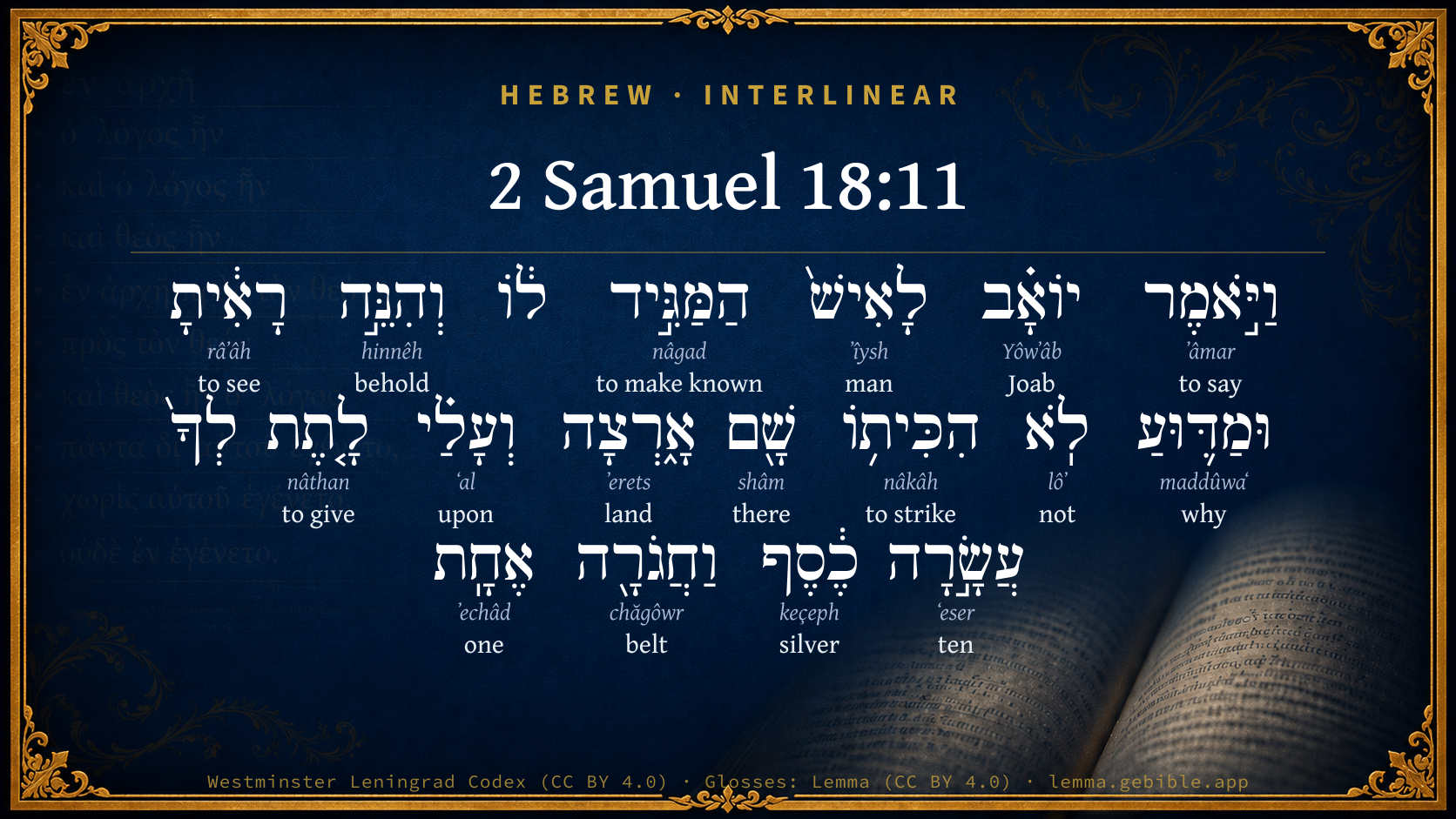
  1. וַיֹּ֣אמֶר ʼâmar H559 “and · to say” Conjunction + Verb, Qal, Sequential Imperfect, 3rd Person, Masculine, Singular
  2. יוֹאָ֗ב Yôwʼâb H3097 “Joab” Noun, Proper
  3. לָאִישׁ֙ ʼîysh H376 “to/for the · man” Preposition, Determined + Noun, Common, Masculine, Singular, Absolute
  4. הַמַּגִּ֣יד nâgad H5046 “the · making known” Particle, Definite Article + Verb, Hiphil, Participle Active, Masculine, Singular, Absolute
  5. וְהִנֵּ֣ה hinnêh H2009 “and · behold” Conjunction + Particle, Demonstrative
  6. רָאִ֔יתָ râʼâh H7200 “to see” Verb, Qal, Perfect, 2nd Person, Masculine, Singular
  7. וּמַדּ֛וּעַ maddûwaʻ H4069 “and · why” Conjunction + Particle, Interrogative
  8. לֹֽא lôʼ H3808 “not” Particle, Negative
  9. הִכִּית֥וֹ nâkâh H5221 “to strike · him” Verb, Hiphil, Perfect, 2nd Person, Masculine, Singular + Suffix, Personal, 3rd Person, Masculine, Singular
  10. שָׁ֖ם shâm H8033 “there” Adverb
  11. אָ֑רְצָה ʼerets H776 “land · toward” Noun, Common, Both, Singular, Absolute + Suffix, Demonstrative
  12. וְעָלַ֗י ʻal H5921 “and · upon · me” Conjunction + Preposition + Suffix, Personal, 1st Person, Common, Singular
  13. לָ֤תֶת nâthan H5414 “to give” Preposition + Verb, Qal, Infinitive Construct
  14. עֲשָׂ֣רָה ʻeser H6235 “ten” Adjective, Cardinal number, Masculine, Singular, Absolute
  15. כֶ֔סֶף keçeph H3701 “silver” Noun, Common, Masculine, Singular, Absolute
  16. אֶחָֽת ʼechâd H259 “one” Adjective, Cardinal number, Feminine, Singular, Absolute

About this verse

These counts appear in no published source. They are computed here, from the morphology-tagged text and Lemma’s own curated glosses. What Lemma adds →

19
words
17
distinct lemmas
Historical
section

Notable vocabulary

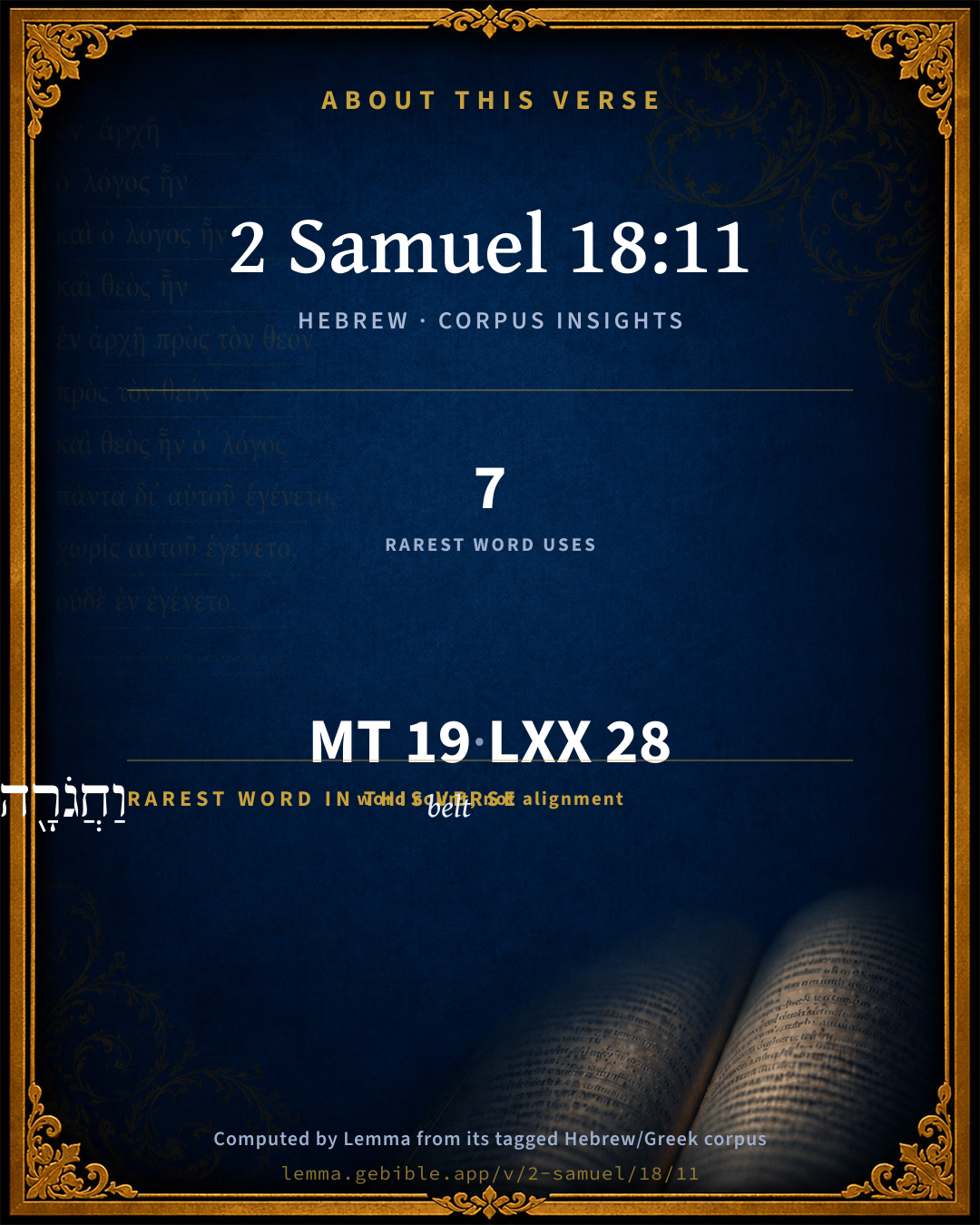
The rarest word here is וַחֲגֹרָ֖ה belt H2290 — appearing just 7 times in the whole Hebrew Bible.

Shared distinctive vocabulary

וַחֲגֹרָ֖ה belt H2290 occurs in 7 verses of the Hebrew Bible. Also found in:

Grammatical profile

  • 5 verbs
  • 5 nouns
  • 2 adjectives
  • 3 prepositions
  • 1 adverb
  • 3 particles

Verb forms

  • וַיֹּ֣אמֶר Qal · Sequential Imperfect
  • הַמַּגִּ֣יד Hiphil · Participle Active
  • רָאִ֔יתָ Qal · Perfect
  • הִכִּית֥וֹ Hiphil · Perfect
  • לָ֤תֶת Qal · Infinitive Construct

Hebrew & Septuagint length

In English translation the verse runs 35 words from the Hebrew and 40 from the Septuagint (LXX English) — closely comparable.

A rough comparison of the two English renderings, which tokenize alike — not a word-level alignment.

Word counts can differ between the Hebrew and the Greek without any difference in meaning — e.g. the Hebrew direct-object marker אֵת has no separate Greek word, and Greek often adds the article ὁ.

In the original languages it is 19 Hebrew tokens and 28 Greek tokens — but the two are counted differently (Hebrew bundles its prefixes and suffixes into one token; the Greek is in lemma form), so that isn’t a like-for-like length.

Hebrew and Greek witnesses Masoretic Hebrew ↔ Greek Septuagint

The same verse in the two great witnesses to the Old Testament, shown verse-for-verse.

These are two independent witnesses, not word-aligned to each other, and the Septuagint is shown in lemma (dictionary) form.

Hebrew 2 Samuel 18:11 Masoretic · Westminster Leningrad Codex

וַיֹּ֣אמֶר יוֹאָ֗ב לָאִישׁ֙ הַמַּגִּ֣יד ל֔וֹ וְהִנֵּ֣ה רָאִ֔יתָ וּמַדּ֛וּעַ לֹֽא הִכִּית֥וֹ שָׁ֖ם אָ֑רְצָה וְעָלַ֗י לָ֤תֶת לְךָ֙ עֲשָׂ֣רָה כֶ֔סֶף וַחֲגֹרָ֖ה אֶחָֽת

Joab said to the man who told him, Behold, you saw it, and why didn't you strike him there to the ground? and I would have given you ten [pieces of] silver, and a sash.

World English Bible · Public Domain

Greek LXX 2 Samuel 18:11 Septuagint · lemma form

καί εἶπον ιωαβ ὁ ἀνήρ ὁ ἀποἀγγέλλω καί ἰδού ὁράω τίς ὅτι οὐ πατάσσω αὐτός εἰς ὁ γῆ καί ἐγώ ἄν δίδωμι σύ δέκα ἀργύριον καί παραζώνη εἷς

And Joab said to the man who reported it to him, And, behold, you did see him: why did you not strike him there to the ground? and I would have given you ten pieces of silver, and a girdle.

LXX2012 (modern English Septuagint) · Public Domain

Hebrew: Westminster Leningrad Codex (CC BY 4.0). Greek: Septuagint (public domain); English from LXX2012 (modern English Septuagint) (Public Domain). How the Septuagint differs from the Hebrew →

Targum (Aramaic paraphrase)

1

The Targum is the ancient Jewish Aramaic paraphrase of the Hebrew Scriptures — an interpretive translation, not the Hebrew text itself. Onkelos (literal) and Pseudo-Jonathan (expansive) render the Torah, and Jonathan the Prophets. Coverage is partial: where no permissively-licensed English translation exists for a verse, only the Aramaic is shown. This is verse-level text, not a word-by-word alignment to the Hebrew.

  1. Targum Jonathan Prophets (Joshua–Malachi)
    וַאֲמַר יוֹאָב לְגַבְרָא דִמְחַוֵי לֵיהּ וְהָא חֲזֵיתָא וּמָא דֵין לָא מְחִיתָהוּ תַמָן וּרְמִיתָהִי לְאַרְעָא וַעֲלֵי פּוֹן לְמִתַּן לָךְ עֲסַר סִלְעִין דִכְסַף וְאִסְפַּנְקִי חֲדָא:

    (no public-domain English translation for this verse)

    Targum Jonathan — Aramaic: “Mikraot Gedolot” (public domain). English: “Sefaria Community Translation” (CC0 1.0 (public-domain dedication)); “London "Chaldee Paraphrase," 1871” (public domain). Text via Sefaria.

Commentary

Notes on 2 Samuel 18:11 from classic Christian and Jewish commentators (each source and its license shown beneath its notes). The classic Christian expositions comment on the surrounding passage and are grouped to its opening verse, so a note may address several verses; the Jewish commentaries on the Tanakh (Rashi and others) are per-verse, so they appear only where the commentator wrote on this verse.

Lemma curates 59 commentaries, every one of them public domain or Creative Commons licensed, each selected and text-cleaned for this edition rather than reprinted as found. About our sources →

Trapp's Complete Commentary

John Trapp

2Sa 18:11 And Joab said unto the man that told him, And, behold, thou sawest [him], and why didst thou not smite him there to the ground? and I would have given thee ten [shekels] of silver, and a girdle.

Ver. 11. And I would have given thee.] And will do still, if thou wilt yet do it: for though Joab wished Absalom slain as a public pest; yet he had rather it should have been done by another, than by himself, or by his command. Politicians use to put others before them in dangerous actions, and, with the ape, to take nuts out of the fire with the paw of the cat.

Ten shekels of silver, and a girdle,] i.e., A purse, as Mar 6:8, or a military belt, as an ensign of honour.

John Trapp, A Commentary or Exposition upon All the Books of the Old and New Testament (1647–1656) — public domain. Text from a community e-Sword module.

Tyndale Open Study Notes

Tyndale Open Resources

18:11 Perhaps a hero’s belt was a sword belt that decorated a soldier for bravery and courage in battle (cp. 1 Sam 18:4).

Tyndale Open Study Notes — © Tyndale Open Resources, licensed CC BY-SA 4.0. Text via the HelloAO Bible API.

Jamieson, Fausset & Brown

Robert Jamieson, A. R. Fausset & David Brown

Joab said unto the man that told him, . . . I would have given thee ten shekels of silver, and a girdle--that is, would have raised him from the ranks to the status of a commissioned officer. Besides a sum of money, a girdle, curiously and richly wrought, was among the ancient Hebrews a mark of honor, and sometimes bestowed as a reward of military merit. This soldier, however, who may be taken as a fair sample of David's faithful subjects, had so great a respect for the king's wishes, that no prospect of reward would have tempted him to lay violent hands on Absalom. But Joab's stern sense of public duty, which satisfied him that there could be neither safety to the king, nor peace to the kingdom, nor security to him and other loyal subjects, so long as that turbulent prince lived, overcame his sensibilities, and looking upon the charge given to the generals as more befitting a parent than a prince, he ventured to disobey it.

Jamieson, Fausset & Brown — Commentary Critical and Explanatory on the Whole Bible (1871) — public domain (CC PDM 1.0). Text via the HelloAO Bible API.

Adam Clarke's Commentary

Verse 11. And a girdle.] The military belt was the chief ornament of a soldier, and was highly prized in all ancient nations; it was also a rich present from one chieftain to another. Jonathan gave his to David, as the highest pledge of his esteem and perpetual friendship, 1Sa 18:4. And Ajax gave his to Hector, as a token of the highest respect. - Hom. Il. vii., ver. 305.

Adam Clarke's Commentary on the Bible (1810–1826) — public domain. Text from a community e-Sword/MySword module.

The Cambridge Bible for Schools and Colleges

gen. ed. J. J. S. Perowne

11. ten shekels] Shekels is rightly supplied, as in 1Ki_10:29, and elsewhere. The shekel weighed about half an ounce; but its real value at the time cannot be fixed.

a girdle] An essential article of Oriental dress, often of costly materials and highly ornamented. Cp. 1Sa_18:4.

The Cambridge Bible for Schools and Colleges (gen. ed. J. J. S. Perowne; Cambridge University Press, 1878–1918) — public domain. Text from a community e-Sword module.

John Gill's Exposition

And Joab said unto the man that told him,.... That gave the above account of him:

and, behold, thou sawest him; in reality; or, "didst thou see him?" is it a fact?

and why didst thou not smite him there to the ground; kill him on the spot, that he might have dropped from the tree to the ground:

and I would have given thee ten shekels of silver; on the news of it, for doing it, which was near twenty four shillings of our money; Josephus says (i) fifty shekels; the Arabic version has it ten thousand talents of silver, too great a sum by far:

and a girdle? which was a mark of great honour, and a token of a commission under him, and of investing: him with a military office; see Sa1 18:4; it used to be given as an honorary reward to soldiers that behaved well, as on the contrary it was reckoned a reproach to be ungirt, or the girdle to be taken away (k).

(i) Ut supra. (Antiqu. l. 7. c. 10. sect. 2.) (k) Vide Lydium de re militare, l. 3. c. 6.

John Gill's Exposition of the Whole Bible (1746–1763) — public domain (CC PDM 1.0). Text via the HelloAO Bible API.

Albert Barnes' Notes on the Bible

Ten shekels - (About 25 shillings.) The word “shekel” is understood, as in Gen 20:16; Gen 37:28. See the Exo 38:24 note.

A girdle - Girdles were costly articles of Hebrew dress used to put money in Mat 10:9, and given as presents 1Sa 18:4.

Albert Barnes' Notes on the Bible (1834–1885) — public domain. Text from a community e-Sword/MySword module.

Haydock's Catholic Bible Commentary

Silver, somewhat above a guinea: sicles are not expressed in Hebrew. (Haydock) --- Belt, the richest part of armour. Jonathan and Ajax made presents of their belts to David and Hector, 1 Kings xviii. 4. (Homer, Iliad H.) See Job xiii. 18. The Romans wore very splendid belts. Balteus et notis fulserunt cingula bullis. (Claud., Proserp. ii.)

George Leo Haydock (1774–1849), Haydock's Catholic Family Bible and Commentary, 1859 edition — public domain. Excludes Psalms (Douay-Rheims chapter numbering differs from Protestant) and Deuterocanonical books (Catholic canon only).

Matthew Poole's English Annotations

Why didst thou not smite him down from the oak, and with thy spear nail him to the ground?

A girdle; a military belt of more than ordinary price, as a testimony of thy valour and good service. See Poole on "1Sa 18:4".

Matthew Poole's English Annotations on the Holy Bible (1683–1685) — public domain. Text from a community e-Sword/MySword module.

Whedon's Commentary on the Bible

Daniel D. Whedon

11. Go to battle in thine own person — Literally, thy presence going into the battle. Unlike Ahithophel, who counselled him to stay at Jerusalem, (2Sa_18:3,) Hushai advises him to go himself to the war.

Daniel D. Whedon (gen. ed.), Commentary on the Old and New Testaments (1874–1909) — public domain. Text from a community e-Sword module.

The Pulpit Commentary

A girdle. This was an important article of dress, (Eze_23:15) and was often richly embroidered. Absalom"s death was well deserved, and there can be little doubt that, if he had gained the victory, he would have massacred David and all his family. The dishonour done to his father at Jerusalem was even intended by Ahithophel to render all reconciliation impossible. But Joab was disobeying the king"s express orders, and as Absalom was incapable of making resistance, he ought to have taken him prisoner, and left it to David to decide what his punishment should be.

The Pulpit Commentary (1880–1919), ed. H.D.M. Spence-Jones & Joseph S. Exell — public domain. Text from a community e-Sword module.

Lesson kit

Teaching starters — assembled from the data on this page, not authored interpretation. Every prompt links to the verse data it draws on. Edit before teaching.

2 Samuel, in the Historical, opens this verse with 19 words (17 distinct Hebrew lemmas). Its most distinctive word is chăgôwr (“belt”). A historical commentator’s framing appears above. Read the whole chapter for the surrounding context.

Discussion questions

  1. How does “belt” (chăgôwr) shape what this verse is saying?
  2. Genesis 3:7 shares the word «belt» with this verse. How do the two illuminate each other?
  3. These translations render this verse differently. What is at stake in choosing one wording over another?
  4. The verb «וַיֹּ֣אמֶר» is Qal Sequential Imperfect. How does its form color the action?
  5. Reading how Trapp's Complete Commentary and Tyndale Open Study Notes read this verse, where do the two commentators agree and where do they part?

Things to notice

Reading settings

Reading text

Shown beneath each verse's original-language words.

Old Testament
Old Testament edition

Read the OT as the Masoretic Hebrew (MT) or the Greek Septuagint (LXX).

English shown for the Greek Septuagint (in the Hebrew ↔ Greek comparison).

Comparing translations? Open the Compare panel on any verse page to stack up to four side by side.