
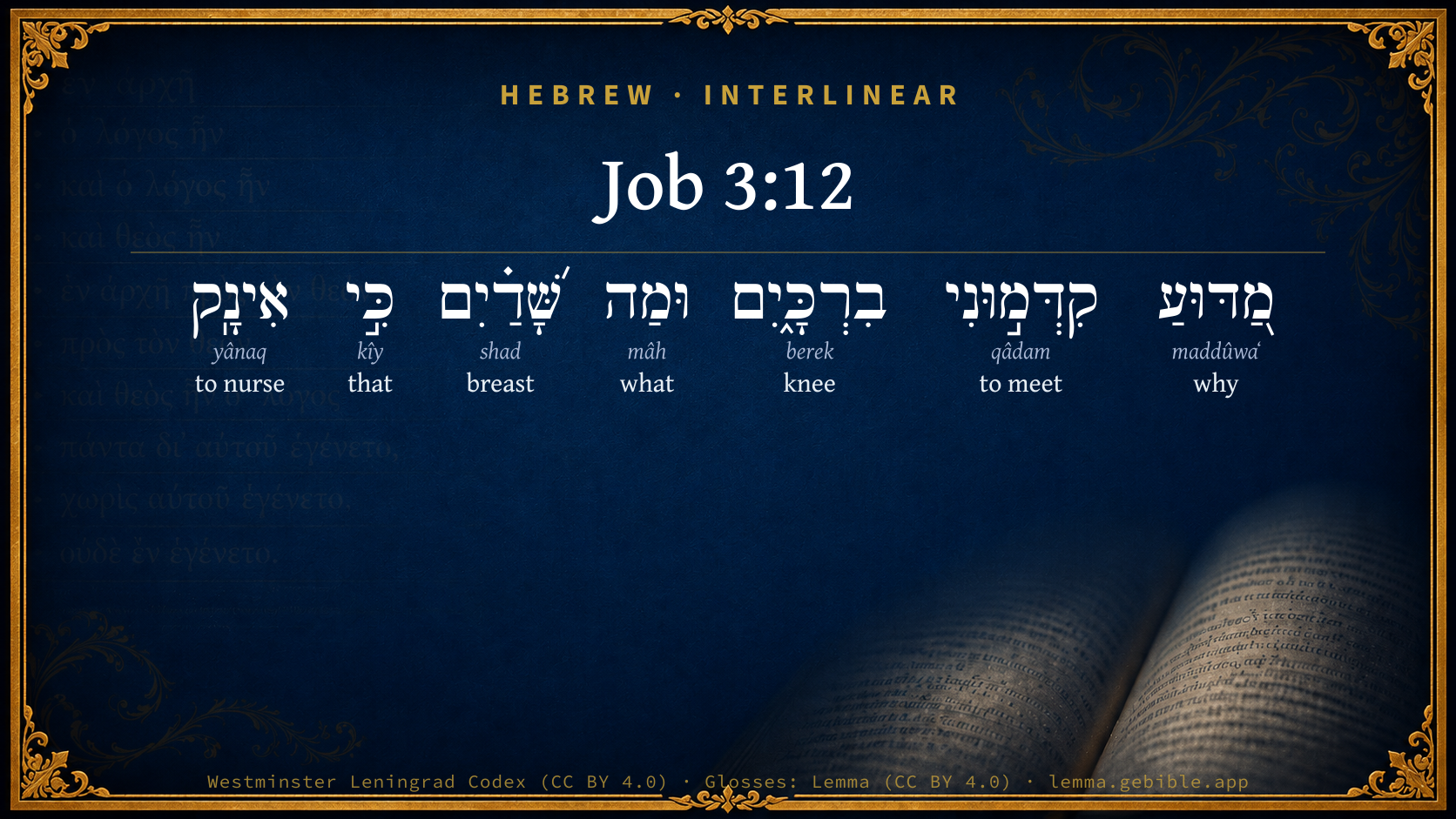
Job 3:12

Hebrew (Westminster Leningrad Codex) Job 3:12 appears in the Hebrew Old Testament. The text above is from the Westminster Leningrad Codex. Each word links to its Strong’s number, a concise gloss, and parsing drawn from the Open Scriptures Hebrew Bible morphology. Click any word for its full Brown-Driver-Briggs (BDB) entry.
Download image
Cite this verse

Job 3:12 (World English Bible). Public Domain. Lemma interlinear Bible study tool, https://lemma.gebible.app/v/job/3/12.

Show BibTeX & RIS
BibTeX
RIS
English Translation
Why did the knees receive me? Or why the breast, that I should suck?
World English Bible · Public Domain
Download a study sheet

One document with this verse’s original text, its word-by-word gloss line, the meaning frame, cross-references with their text, attributed commentary, and full source and license credits — printable, and it pastes into notes with its structure intact.

This verse Autodidact and up

Study sheet (.html) Plain text (.txt)

A passage Seminary Student

Up to 50 verses in one chapter. A passage sheet keeps up to 6 commentary sources and 12 cross-references per verse, in the order this page ranks them, and says so on the sheet whenever that leaves anything out. Ask for a single verse and you get the Autodidact verse sheet above.

Everything on this page stays free to read, with no account — the sheet is a download of what is already on screen, not access to it.

Want to remove ads? Support Godless Engineer
Compare translations 3

The same verse in 3 English versions, stacked beneath the original-language interlinear above. Click any original word for its lexicon entry.

Each is an independent rendering of the whole verse — the interlinear is not word-aligned to these translations.

Highlighted words mark where these versions differ — a whole-verse word diff, not a word-by-word alignment.

  • World English Bible Public Domain
    Why did the knees receive me? Or why the breast, that I should suck?
  • King James Version Public Domain
    Why did the knees prevent me? or why the breasts that I should suck?
  • unfoldingWord Literal Text CC BY-SA 4.0
    Why did knees welcome me, and why breasts, that I should suck?

unfoldingWord Literal Text — © unfoldingWord, licensed CC BY-SA 4.0. Word-aligned USFM3 via Door43 (git.door43.org/unfoldingWord/en_ult).

Versions to compare (up to 4)

3 of 4 selected

Show all 18 translations

Every available English version of this verse, each an independent rendering of the whole verse.

  • World English Bible Public Domain
    Why did the knees receive me? Or why the breast, that I should suck?
  • Berean Standard Bible Public Domain
    Why were there knees to receive me, and breasts that I should be nursed?
  • Majority Standard Bible Public Domain
    Why were there knees to receive me, and breasts that I should be nursed?
  • King James Version Public Domain
    Why did the knees prevent me? or why the breasts that I should suck?
  • American Standard Version (1901) Public Domain
    Why did the knees receive me? Or why the breast, that I should suck?
  • Revised Version (1885) Public Domain
    Why did the knees receive me? or why the breasts, that I should suck?
  • Geneva Bible (1599) Public Domain
    Why did the knees preuent me? and why did I sucke the breasts?
  • Douay-Rheims (1899) Public Domain
    Why received upon the knees? why suckled at the breasts?
  • Young's Literal Translation Public Domain
    Wherefore have knees been before me? And what `are' breasts, that I suck?
  • Literal Standard Version CC BY-SA 4.0
    Why have knees been before me? And what [are] breasts, that I suck?
  • Unlocked Literal Bible CC BY-SA 4.0
    Why did her knees welcome me? Why did her breasts receive me so that I should suck?
  • unfoldingWord Literal Text CC BY-SA 4.0
    Why did knees welcome me, and why breasts, that I should suck?
  • Darby Bible Public Domain
    Why did the knees meet me? and wherefore the breasts, that I should suck?
  • World Messianic Bible Public Domain
    Why did the knees receive me? Or why the breast, that I should nurse?
  • Webster's Bible Public Domain
    Why did the knees receive me? or why the breasts that I should be nursed?
  • Free Bible Version CC BY-SA 4.0
    Why was there a lap for me to lie on, or breasts for me to suck?
  • Bible in Basic English Public Domain
    Why did the knees take me, or why the breasts that they might give me milk?
  • JPS Tanakh (1917) Public Domain
    Why did the knees receive me? And wherefore the breasts, that I should suck?

Literal Standard Version (2020), Covenant Press — licensed CC BY-SA 4.0. Text via the HelloAO Bible API (eBible.org). Unlocked Literal Bible (unfoldingWord) — licensed CC BY-SA 4.0. Text via the HelloAO Bible API (eBible.org). unfoldingWord Literal Text — © unfoldingWord, licensed CC BY-SA 4.0. Word-aligned USFM3 via Door43 (git.door43.org/unfoldingWord/en_ult). Free Bible Version, Dr. Jonathan Gallagher — licensed CC BY-SA 4.0. Text via the HelloAO Bible API (eBible.org).

Word by word

More ways to search: Search by grammar → Find every occurrence → Compare this word →

Practice this passage: Drill this verse → Learn its vocabulary →

About this verse

These counts appear in no published source. They are computed here, from the morphology-tagged text and Lemma’s own curated glosses. What Lemma adds →

7
words
7
distinct lemmas
Wisdom
section

Notable vocabulary

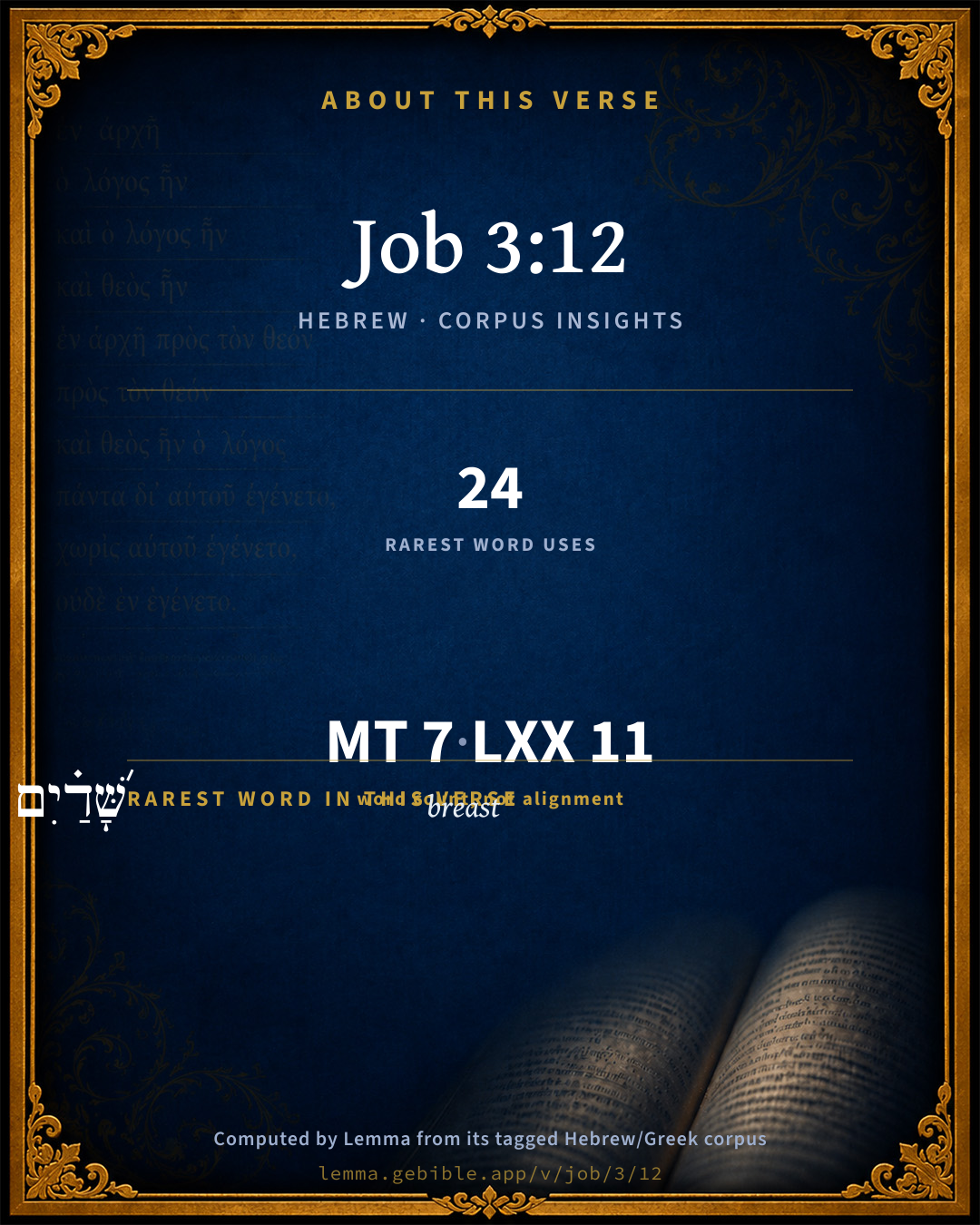
The rarest word here is שָּׁ֝דַ֗יִם breast H7699 — appearing just 24 times in the whole Hebrew Bible.

Shared distinctive vocabulary

שָּׁ֝דַ֗יִם breast H7699 occurs in 24 verses of the Hebrew Bible. Also found in:

Grammatical profile

  • 2 verbs
  • 2 nouns
  • 1 conjunction
  • 2 particles

Verb forms

  • קִדְּמ֣וּנִי Piel · Perfect
  • אִינָֽק Qal · Imperfect

Hebrew & Septuagint length

In English translation the verse runs 14 words from the Hebrew and 14 from the Septuagint (LXX English) — the same length.

A rough comparison of the two English renderings, which tokenize alike — not a word-level alignment.

Word counts can differ between the Hebrew and the Greek without any difference in meaning — e.g. the Hebrew direct-object marker אֵת has no separate Greek word, and Greek often adds the article ὁ.

In the original languages it is 7 Hebrew tokens and 11 Greek tokens — but the two are counted differently (Hebrew bundles its prefixes and suffixes into one token; the Greek is in lemma form), so that isn’t a like-for-like length.

Cross-references

4

Topical passages linked to Job 3:12 in the Treasury of Scripture Knowledge — connected by theme and wording, ordered by reader-vote popularity; previews shown in the World English Bible.

  • Genesis 30:3 She said, "Behold, my maid Bilhah. Go in to her, that she may bear on my knees, and I also may obtain children by her."
  • Isaiah 66:12 For thus says Yahweh, Behold, I will extend peace to her like a river, and the glory of the nations like an overflowing stream: and you shall suck [of it]; you shall be borne on the side, and shall be dandled on the knees.
  • Genesis 50:23 Joseph saw Ephraim's children to the third generation. The children also of Machir, the son of Manasseh, were born on Joseph's knees.
  • Ezekiel 16:4–5 As for your birth, in the day you were born your navel was not cut, neither were you washed in water to cleanse you; you weren't salted at all, nor swaddled at all.

Cross-references courtesy of OpenBible.info (CC BY 4.0).

Hebrew and Greek witnesses Masoretic Hebrew ↔ Greek Septuagint

The same verse in the two great witnesses to the Old Testament, shown verse-for-verse.

These are two independent witnesses, not word-aligned to each other, and the Septuagint is shown in lemma (dictionary) form.

Hebrew Job 3:12 Masoretic · Westminster Leningrad Codex

מַ֭דּוּעַ קִדְּמ֣וּנִי בִרְכָּ֑יִם וּמַה שָּׁ֝דַ֗יִם כִּ֣י אִינָֽק

Why did the knees receive me? Or why the breast, that I should suck?

World English Bible · Public Domain

Greek LXX Job 3:12 Septuagint · lemma form

ἵνα τίς δέ συνἀντάω ἐγώ γόνυ ἵνα τίς δέ μαστός θηλάζω

and why did the knees support me? and why did I suck the breasts?

LXX2012 (modern English Septuagint) · Public Domain

Hebrew: Westminster Leningrad Codex (CC BY 4.0). Greek: Septuagint (public domain); English from LXX2012 (modern English Septuagint) (Public Domain). How the Septuagint differs from the Hebrew →

Commentary

Notes on Job 3:12 from classic Christian and Jewish commentators (each source and its license shown beneath its notes). The classic Christian expositions comment on the surrounding passage and are grouped to its opening verse, so a note may address several verses; the Jewish commentaries on the Tanakh (Rashi and others) are per-verse, so they appear only where the commentator wrote on this verse.

Lemma curates 59 commentaries, every one of them public domain or Creative Commons licensed, each selected and text-cleaned for this edition rather than reprinted as found. About our sources →

Trapp's Complete Commentary

John Trapp

Job 3:12 Why did the knees prevent me? or why the breasts that I should suck?

Ver. 12. Why did the knees prevent me?] Why did the too officious midwife lay me on her lap, and not let me alone to perish by my fatal helplessness? Man is a poor shiftless creature; and Pliny rails at nature for producing him so forlorn, naked, and unable to help himself; but he knew not that this was a fruit of sin. Cicero indeed could say (whether he believed himself therein I know not), Cum primum nascimur, in omni continuo pravitate versamur, as soon as we are born we are head and ears all over in wickedness; but Pliny was not so persuaded, as I have elsewhere showed.

Or why the breasts that I should suck?] Why did not my mother turn tigress, and cast me out when newly born? Why was she not cruel, like the ostriches in the wilderness, that refuse to give suck to their young ones? Rather we may ask, Why doth not Job, out of his deepest discontent, think much of such a mercy; and rather bless God, first, for filling two such bottles with milk for him, ready against he came into the world? and then, for giving his mother a heart to suckle him, which some nice or unnatural women will not, being therein worse than those sea monsters, Lam 4:3, that help their young? The heathens called their Ceres (queen of plenty) Mammosam, as the nurse of all living creatures; and there are that derive God’s name Shaddai from shad, a dug; because, as he openeth the hand, so he draws out the breast to every living thing. And for his saints, they may suck and be satisfied with the full strutting breasts of his consolations, the two Testaments, Isa 66:11. And whatever Job now (under a heavy temptation, which, like lead, sunk downward, and carried his soul with. it) may misjudge, they may sit and sing thankfully with David, Lord, thou (and not the midwife) art he that took me out of the womb; thou (and not my mother) keptest me in safety when I hung upon the breasts; neither then only, but afterwards, for puerilitas est periculorum pelagus, and the preserver of men keepeth us still from a thousand deaths and dangers. And is this matter of complaint, and not rather of thankfulness?

John Trapp, A Commentary or Exposition upon All the Books of the Old and New Testament (1647–1656) — public domain. Text from a community e-Sword module.

Jamieson, Fausset & Brown

Robert Jamieson, A. R. Fausset & David Brown

Why did the knees prevent me?--Old English for "anticipate my wants." The reference is to the solemn recognition of a new-born child by the father, who used to place it on his knees as his own, whom he was bound to rear (Gen 30:3; Gen 50:23; Isa 66:12).

Jamieson, Fausset & Brown — Commentary Critical and Explanatory on the Whole Bible (1871) — public domain (CC PDM 1.0). Text via the HelloAO Bible API.

Adam Clarke's Commentary

Verse 12. Why did the knees prevent me?] Why was I dandled on the knees? Why was I nourished by the breasts? In either of the above cases I had neither been received into a mother's lap, nor hung upon a mother's breasts.

Adam Clarke's Commentary on the Bible (1810–1826) — public domain. Text from a community e-Sword/MySword module.

Ellicott's Commentary for English Readers

(12) Prevent—i.e., “Why was I nursed with care instead of being allowed to fall to the ground and be killed?”

A Bible Commentary for English Readers, edited by Charles John Ellicott (1878–1897) — public domain. Text from a community e-Sword module.

The Cambridge Bible for Schools and Colleges

gen. ed. J. J. S. Perowne

12. the knees prevent me] Rather, receive, or meet me. The reference may be to the father’s knees, on which the new born child was laid, or more general. As to the expression, see Gen_50:23; Isa_66:12. The sufferer’s eye runs over all the chances of death which he had miserably lost, when he came from the womb, was laid upon the knees, and pressed to the breasts. The sorrow of his later years transmutes (as it does still with others) the tender affections and solicitudes lavished on his infancy, and makes them seem bitter cruelties.

The Cambridge Bible for Schools and Colleges (gen. ed. J. J. S. Perowne; Cambridge University Press, 1878–1918) — public domain. Text from a community e-Sword module.

John Gill's Exposition

Why did the knees prevent me?.... Not of the mother, as Jarchi, but of the midwife, who received him into her lap, and nourished and cherished him, washed him with water, salted, and swaddled him; or it may be of his father, with whom it was usual to take the child on his knees as soon as born, see Gen 50:23; which custom obtained among the Greeks and Romans (o); hence the goddess Levana (p) had her name, causing the father in this way to own his child; his concern is, that he did not fall to the ground as he came out of his mother's womb, and with that fall die; and that he was prevented from falling by the officious knees of the midwife; that he was not suffered to fall, and be left there, without having any of the usual things done to him for the comfort and preservation of life, which was sometimes the case, Eze 16:4,

or why the breasts that I should suck? since a miscarrying womb was not given, and death did not seize him immediately upon birth, but all proper care was taken to prevent it, he asks, why was there milk in the breasts of his mother or nurse to suckle and nourish him? why were there not dry breasts, such as would afford no milk, that so he might have been starved? thus he wishes the kindest things in nature and Providence had been withheld from him.

(o) Homer. Iliad. 9. Vid. Barthii Animadv. ad Claudian. in Nupt. Honor. ver. 341. (p) Kipping. Antiqu. Roman. l. 1. c. 1. sect. 10.

John Gill's Exposition of the Whole Bible (1746–1763) — public domain (CC PDM 1.0). Text via the HelloAO Bible API.

Albert Barnes' Notes on the Bible

Why did the knees prevent me? - That is, the lap of the nurse or of the mother, probably the latter. The sense is, that if he had not been delicately and tenderly nursed, he would have died at once. He came helpless into the world, and but for the attention of others he would have soon died. Jahn supposes (Archae section 161) that it was a common custom for the father, on the birth of a son, to clasp the new-born child to his bosom, while music was heard to sound, and by this ceremony to declare it as his own. That there was some such recognition of a child or expression of paternal regard, is apparent from Gen 50:23. Probably, however, the whole sense of the passage is expressed by the tender care which is necessarily shown to the new-born infant to preserve it alive. The word rendered “prevent” here קדם qâdam, means properly to anticipate, to go before, as the English word “prevent” formerly did; and hence, it means to go to meet anyone in order to aid him in any way. There is much beauty in the word here. It refers to the provision which God has made in the tender affection of the parent to “anticipate” the needs of the child. The arrangement has been made beforehand. God has taken care when the feeble and helpless infant is born, that tender affection has been already created and prepared to meet it. It has not to be created then; it is not to be excited by the suffering of the child; it is already in existence as an active, powerful, and self-denying principle, to “anticipate” the needs of the newborn babe, and to save it from death.

Albert Barnes' Notes on the Bible (1834–1885) — public domain. Text from a community e-Sword/MySword module.

Haydock's Catholic Bible Commentary

Knees, by my father or grandfather, Genesis xxx 3. (Homer, Iliad ix.) (Calmet)

George Leo Haydock (1774–1849), Haydock's Catholic Family Bible and Commentary, 1859 edition — public domain. Excludes Psalms (Douay-Rheims chapter numbering differs from Protestant) and Deuterocanonical books (Catholic canon only).

Matthew Poole's English Annotations

Why did the knees prevent me? why did the midwife or nurse receive me, and lay me upon her knees, and did not suffer me to fall upon the bare ground, and there to lie, in a neglected and forlorn condition, till merciful death had taken me out of this miserable world, into which the cruel kindness of my mother and midwife hath betrayed me?

Why the breasts that I should suck? Why did the breasts prevent me, (which may be fitly understood out of the former member,) to wit, from perishing through hunger, or supply me, that I should have what to suck? Seeing my mother had not a miscarrying womb, but did unhappily bring me forth why had she not dry breasts? or why were there any breasts for me which I might suck? Thus Job most unthankfully and unworthily despiseth and traduceth these wonderful and singular mercies of God towards poor helpless infants, because of the present inconveniencies which he had by means of them.

Matthew Poole's English Annotations on the Holy Bible (1683–1685) — public domain. Text from a community e-Sword/MySword module.

Whedon's Commentary on the Bible

Daniel D. Whedon

12. Knees — Metaphorically for lap.

Prevent — An old English word, meaning anticipate. It was the custom, at a very ancient period, for the father, while music in the meanwhile was heard to sound, to clasp the new-born child to his bosom, and by this ceremony he was understood to declare it to be his own. Gen_50:23. (JAHN, Archaeology, 161.) Among many ancient nations the father possessed the power of determining whether the child should be permitted to live. It was thus both in Greece and Rome. In Athens, Solon is said to have allowed the parent of the child to put it to death. The Emperor Augustus followed the sad custom by ordering a great-grandchild to be exposed to death. But child-murder and abortion among the Jews were punishable with death, according to the law. (DOLLINGER, Gentile, etc., 2:246, 271, 342.) It is more natural to interpret the passage as referring to the deep affection which nature has implanted within the bosom of the mother, which anticipates the helplessness and varied wants of the infant. The more pure the religion of the parent, the deeper, the more unselfish and abiding, the parental affection.

Daniel D. Whedon (gen. ed.), Commentary on the Old and New Testaments (1874–1909) — public domain. Text from a community e-Sword module.

The Pulpit Commentary

Why did the knees prevent me? i.e. "Why did my mother take me on her knees and nurse me, instead of casting me on the ground, where I should have perished?" There seems to be an allusion to the practice of parents only bringing up a certain number of their children (see Rosenmuller, "Scholia in Vit. Test.," vol. 5. p. 101). Or why the breasts that I should suck? i.e. "Why were breasts offered to me, that I should suck them? How much better would it have been if I had been allowed to perish of inanition!"

The Pulpit Commentary (1880–1919), ed. H.D.M. Spence-Jones & Joseph S. Exell — public domain. Text from a community e-Sword module.

John Wesley's Explanatory Notes

The knees - Why did the midwife or nurse receive and lay me upon her knees, and not suffer me to fall upon the bare ground, 'till death had taken me out of this miserable world, into which their cruel kindness hath betrayed me? Why did the breasts prevent me from perishing through hunger, or supply me that should have what to suck? Thus Job unthankfully despises these wonderful mercies of God towards poor helpless infants.

John Wesley, Explanatory Notes Upon the Whole Bible (1754–1765) — public domain. Text via the GEBible commentary corpus.

Rashi

Rabbi Shlomo Yitzchaki (Rashi)

Why did knees receive me Why did the knees of my mother receive me before my death?

that I should suck [Why] was it decreed upon me to suck them? As he is speaking on the day of his birth, he mentions those subsequent events in the future tense.

Rashi on the Tanakh — English translations: “The Judaica Press complete Tanach with Rashi, translated by A. J. Rosenberg” (CC BY 4.0); “Pentateuch with Rashi's commentary by M. Rosenbaum and A.M. Silbermann, 1929-1934” (public domain); “The Metsudah Tanach series, Lakewood, N.J” (CC BY 4.0); and “The Book of Joshua, Metsudah Publications, 1997” (CC BY 4.0). Text via Sefaria.

Lesson kit

Teaching starters — assembled from the data on this page, not authored interpretation. Every prompt links to the verse data it draws on. Edit before teaching.

Job, in the Wisdom, opens this verse with 7 words (7 distinct Hebrew lemmas). Its most distinctive word is shad (“breast”). A historical commentator’s framing appears above. Read the whole chapter for the surrounding context.

Discussion questions

  1. The word shad carries the sense “breast.” How does it shape the verse?
  2. How does Genesis 49:25, which shares the word «breast», read alongside this verse?
  3. These translations render this verse differently; the difference is in the English rendering, not the original. What questions does that raise?
  4. «קִדְּמ֣וּנִי» is a Piel Perfect verb. How does that grammatical form shape the action described?
  5. Compare how Trapp's Complete Commentary and Jamieson, Fausset & Brown read this verse. Where do they agree or differ?

Things to notice

Reading settings

Reading text

Shown beneath each verse's original-language words.

Old Testament
Old Testament edition

Read the OT as the Masoretic Hebrew (MT) or the Greek Septuagint (LXX).

English shown for the Greek Septuagint (in the Hebrew ↔ Greek comparison).

Comparing translations? Open the Compare panel on any verse page to stack up to four side by side.