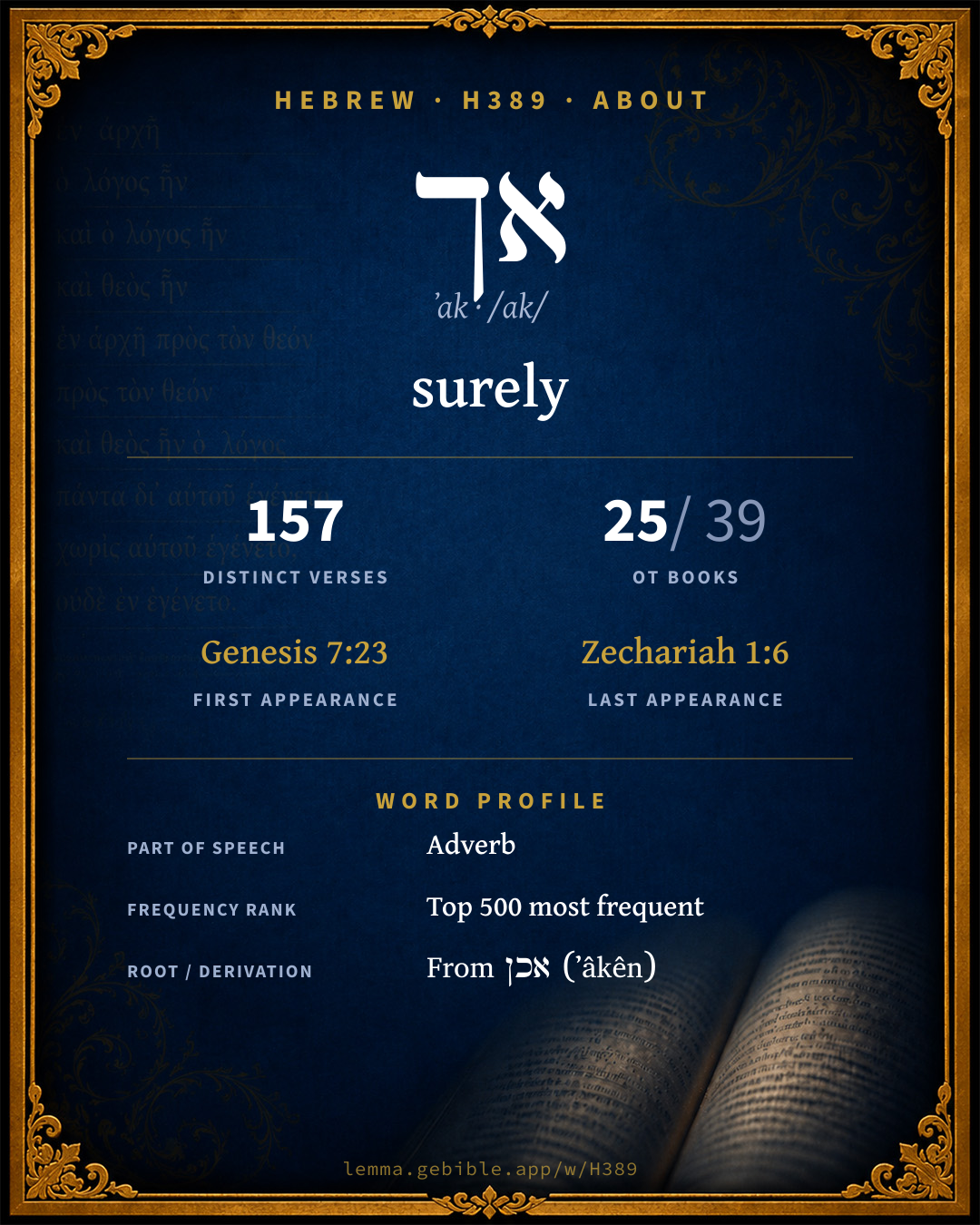
אַךְ
surely
‘surely’ is one of 2 main senses fuller range ↓
Full lexicon entry — Brown-Driver-Briggs (BDB)
From Brown-Driver-Briggs (BDB)
Where this word appears
Grammar key — what these labels mean
Part of speech
- Particle
- A short function word — article, negation, interrogative, the sign of the direct object, and the like.
Every verse where H389 appears in the Book of Ezekiel — 1 distinct verse. Click any verse to open its interlinear word-by-word view. Verse text shown in the World English Bible for context — . Each verse’s Hebrew form is shown with its reference; the English is not keyword-highlighted, since the data carries no word-level English alignment. Use “Compare translations” on any verse to read it across multiple English versions. This concordance covers the Hebrew Bible; Septuagint (Greek Old Testament) occurrences are not indexed here.
Ezekiel
About this entry
At a glance — auto-summarized from this page’s data, not written by a person. Every figure links to its source below. This summary describes the numbers; it doesn’t interpret them.
אך (ʼak) is a Hebrew verb most often rendered “surely.” Debuting at Genesis 7:23, it then recurs through the corpus. With 157 verses in 25 books, it is a common word in the Hebrew Bible. It is not a single-sense word — see its full sense range. For the data behind this summary, explore the sense tree and the renderings breakdown below.
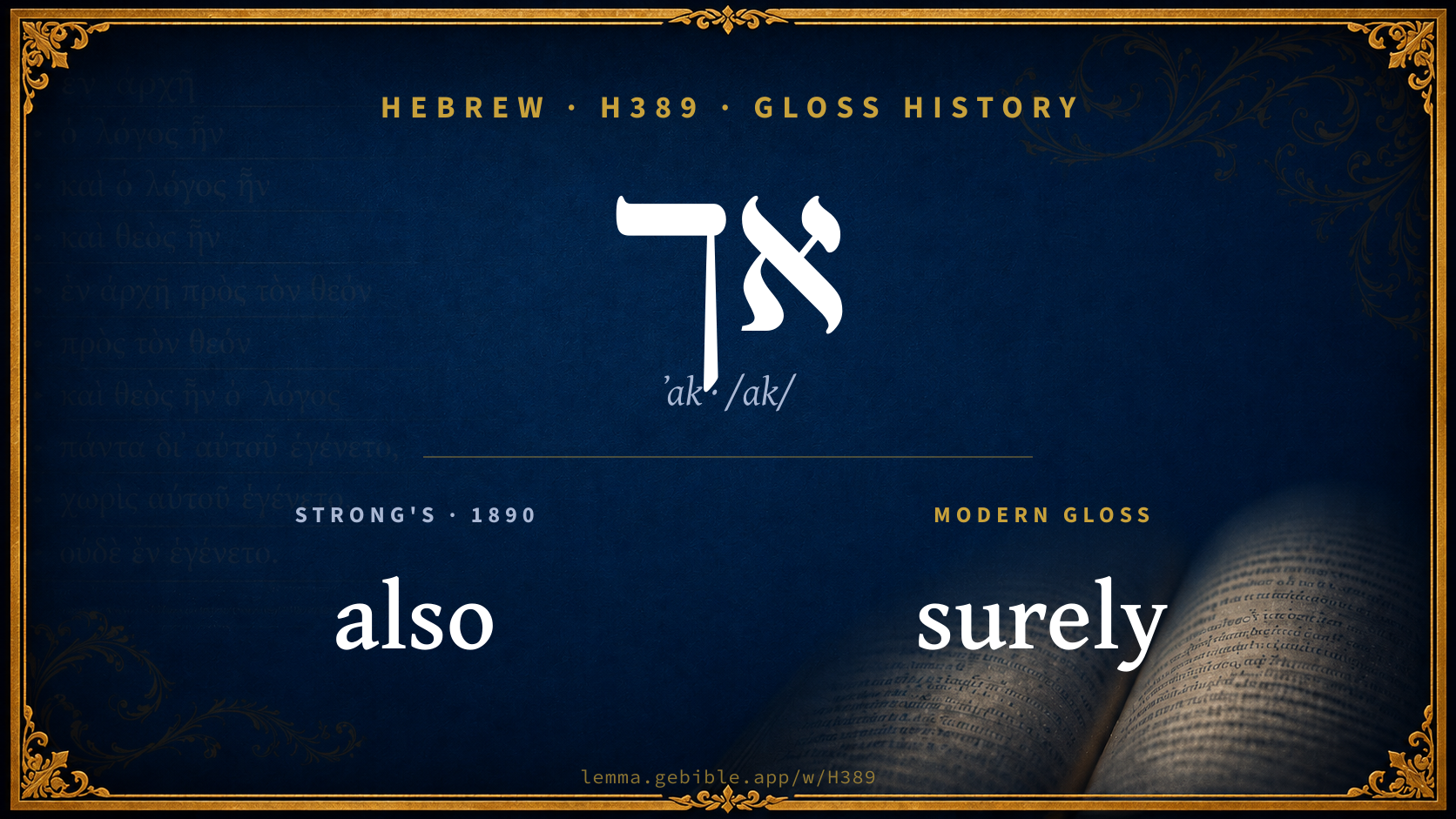
Gloss history
Strong's 1890 vs modern scholarship
About this word
Strong's H389 catalogs a Hebrew word from the Hebrew Old Testament.
These counts are not copied from any lexicon or concordance. They are computed here, from the morphology-tagged Hebrew Old Testament. What Lemma adds →
- 157
- distinct verses
- The word appears in 157 distinct verses.
- 25 / 39
- OT books
- The word appears in 25 of 39 Old Testament books.
- #285
- by frequency
- Top 500 most frequent Hebrew words (rank 285 of 8,640 Hebrew words by occurrence).
View all 157 occurrences in the concordance →
By section of the Old Testament
By traditional corpus
Conventional, traditional groupings — biblical authorship is debated, so this is a traditional corpus grouping, not an authorship claim. Each share is this word’s portion of its verses in that division of the Hebrew canon. Each figure is a share of the word’s 157 distinct verses.
- Prophets (Nevi'im) 69 verses · 44%
- Writings (Ketuvim) 45 verses · 29%
- Torah (Pentateuch) 43 verses · 27%
How translations render this word
Counts come from each version’s own published word-to-Strong’s tagging or interlinear alignment — an approximate guide to how each version renders this word, not a word-level alignment the data otherwise carries. Because each total is that version’s own tagged count, the per-version totals vary from one another and need not match the appearance or distinct-verse counts above. These counts may also differ from a printed concordance because Lemma counts each distinctly tagged rendering and does not collapse phrase taggings into a single head-word total. This is a fixed set of word-tagged versions (KJV, ASV, BSB, ULT) and does not change with the reading translation you choose elsewhere. Each version’s license is shown beside its name below (and on Sources).
- King James Version: Notwithstanding 2×, Surely 2×, Yet 2×
- American Standard Version: Howbeit 3×, But 2×, Them 2×
- Berean Standard Bible: But 31×, Surely 26×, Only 15×
- unfoldingWord Literal Text: Surely 47×, Only 43×, But 17×
King James Version Public Domain
Renders H389 across 22 tagged occurrences — most commonly:
Plus 16 renderings that appear only once — usually multi-word phrases or single function words the recovered tagging swept in, not distinct renderings.
American Standard Version Public Domain
Renders H389 across 22 tagged occurrences — most commonly:
Plus 15 renderings that appear only once — usually multi-word phrases or single function words the recovered tagging swept in, not distinct renderings.
Berean Standard Bible Public Domain
Renders H389 across 138 tagged occurrences — most commonly:
Plus 31 renderings that appear only once — usually multi-word phrases or single function words the recovered tagging swept in, not distinct renderings. Not rendered by a distinct English word in 21 further occurrences.
unfoldingWord Literal Text CC BY-SA 4.0
Renders H389 across 160 tagged occurrences — most commonly:
Plus 12 renderings that appear only once — usually multi-word phrases or single function words the recovered tagging swept in, not distinct renderings.
Senses in the full BDB
What do BDB’s symbols mean?
BDB uses these scholarly abbreviations:
| Symbol | Meaning |
|---|---|
| 𝔊 | the Septuagint (the ancient Greek translation, LXX) |
| 𝔙 | the Vulgate (the Latin translation) |
| 𝔖 | the Syriac version (the Peshitta) |
| 𝔗 | the Targum (the Aramaic translation) |
| ψ | the Psalms |
| √ | root (the underlying root or stem) |
| ‖ | parallel passage (a synonymous or contrasted parallel) |
| † | the dagger: every passage where the word occurs is cited |
The 6 senses and sub-senses the full Brown-Driver-Briggs lexicon distinguishes for this word, in lexicon order (not ranked by frequency), with BDB’s own verbatim wording and sub-sense lettering. Shown in Hebrew script with BDB’s own scholarly abbreviations. The condensed entry is in the Lexicon Entry tab. See also the Forms in the corpus table below.
- 1. asseverative, often introducing with emphasis the expression of a truth (or supposed truth) newly perceived, especially in colloquial language, surely, no doubt; Gn 26:9 אַךְ הִנֵּה אִשְׁתְּךָ הִוא of a surety, lo, she is thy wife! 29:14; 44:28 Ju 3:24; 20:39 1 S 16:6 surely the anointed of י׳ is before him! 25:21 Je 5:4 ψ 58:12; 73:1, 13; but also in other cases, though rarely, Is 34:14, 15 Zp 3:7 ψ 23:6; 139:11; 140:14 Jb 16:7; 18:21; & rather singularly Ex 12:15; 31:13 Lv 23:27, 39 (all P). e.g. Genesis 26:9
- 2. restrictive:
- a. in contrast to what precedes, howbeit, yet, but: Gn 9:4 howbeit, flesh with the life thereof … ye shall not eat, 20:12 Ex 21:21 Lv 21:23; 27:26 Nu 18:15, 17 2 S 3:13; Je 10:24 correct me, אַךְ בְּמִשְׁפָּט but with judgment, Jb 2:6; 13:15; sts. with an advers. force, as Is 14:15; 43:24; before an imper. (minimizing the request), Gn 23:13 only, if thou wilt, I pray thee, hear me! 27:13 Ju 10:15 1 S 18:17 1 K 17:13 al. So 1 S 8:9 אַךְ כִּי (v. כִּי 1 d; and cf. πλὴν ὅτι). e.g. Genesis 9:4
- b. in contrast to other ideas generally:—(α) Gn 7:23; 18:32 אַךְ הַפַּעַם only this once (so Ex 10:17 al.) 34:15 Ex 12:16 (note accents), 1 S 18:8 וְעוֹד לוֹ אַךְ הַמְּלוּכָה and there yet remains for him only the kingdom, 21:5 Isa 45:14 אַךְ בְּךָ אֵל only in thee is God! ψ 62:2 etc. Jb 14:22; ψ 37:8 fret not thyself אַךְ לְהָרֵעַ (which leadeth) only to do evil, Pr 11:24 he that withholdeth more than is meet אַךְ לְמַחְסוֹר (tendeth) only to penury, 14:23; 21:5; 22:16; (β) attaching itself closely to the foll. word (usually an adj., rarely a verb), only, i.e. exclusively, altogether, utterly Dt 16:15 and thou shalt be אַךְ שָׂמֵחַ altogether rejoicing, 28:29 (cf. v 33 רַק) Isa 16:7 אַךְ נְכָאִים utterly stricken, 19:11 Je 16:19 nought but lies, 32:30 Ho 12:12 Jb 19:13 אַךְ זָרוּ are wholly estranged (with play on אַכְזָר cruel). e.g. Genesis 7:23
- c. as an adv. of time (with inf. abs.), twice: Gn 27:30 אַךְ יָצֹא יָצָא יַעֲקֹב … וְעֵשָׂו בָּא only just (or scarcely) had Jacob gone out, … and (= when) Esau came in, Ju 7:19.—וְאַךְ thrice: Gn 9:5 and only (second limitation of v 3); Nu 22:20 but only; Jos 22:19 but howbeit. e.g. Genesis 27:30
- —In some passages the affirmative and restrictive senses agree equally with the context; and authorities read the Hebrew differently. Thus only = nought but, altogether, is adopted by Ges Ew Hi De in ψ 23:6; 62:10; 73:1, 13; by Ew Hi De in 39:6, 7 (Che surely); by Ges Ew De in 39:12 (but Hi Che surely); by Ew Hi in 73:18 (De Che surely); by Ges Hi De in 139:11 (Ew doch). Isa 45:14 Ges Ew Hi Di only; but De Che of a truth. e.g. Psalms 23:6
Senses from the full Brown-Driver-Briggs lexicon (Brown, Driver, Briggs; Oxford 1906 — public domain), digitized via Sefaria, supplemented by the OpenScriptures HebrewLexicon (CC BY 4.0). Full attribution on Sources.
Word origin
adv. (perh. from the same demonstr. root found also in כִּי, כֹּה, כֵּן). 1. surely. 2. with a restrictive force, emphasizing what follows: a. in contrast to what precedes, howbeit; b. in contrast with other ideas generally, only.
— Brown-Driver-Briggs (Oxford 1906, public domain), digitized via Sefaria, supplemented by the OpenScriptures HebrewLexicon (CC BY 4.0). See Sources.
Derived from אכן (ʼâkên) (H403) — surely.
Jastrow Dictionary
A second Hebrew/Aramaic lexicon for comparison, covering Aramaic and post-biblical (Talmudic, Targumic, Midrashic) usage that the biblical-Hebrew BDB does not. Matched by lemma rather than by Strong’s number, so a lemma may carry more than one Jastrow headword (shown separately below), and the entries cover usage well beyond the Bible.
אַךְ I
- only, but. Pes. 5ᵃ אך חלק the word akh (Ex. XII, 15 ‘but on the first [preceding] day’) intimates a division of the day between two categories as to the laws concerning that day. Kerith 7ᵃ; a. fr.—Pl. (אַכִּים) אַכִּין the word akh in the Biblical texts. Y. Ber. IX, 14ᵇ bot., a. e. א׳ ורקין מיעוטין the akh and the rak intimate limiting qualifications. e.g. Exodus 12:15
אַךְ II
- (v. אָנַךְ
- 2. affliction, calamity. B. Mets. 59ᵇ; v. חֲכָךְ. Gen. R. s. 32, end; Tanḥ. Noah 9, ed. Bub. 3, cmp. preced.
*אַךְ III
- = אֵיךְ, only with חדא together. Targ. Prov. XXII, 18 (ed. Vien. אֵיךְ).
A Dictionary of the Targumim, the Talmud Babli and Yerushalmi, and the Midrashic Literature (Marcus Jastrow; London, Luzac, 1903) — Public Domain. Digitized via Sefaria. Digitized via Sefaria. Full attribution on Sources.
Forms in the corpus
The 16 distinct written forms H389 takes in the Hebrew Bible, most frequent first — each parse links to that state’s occurrences in the concordance. Hebrew forms include their vowel points and cantillation, so a single lemma takes many written forms.
| Form | Parsing | Example | Uses |
|---|---|---|---|
| אַךְ | Particle, Accusative | Genesis 7:23 | 53 |
| אַ֣ךְ | Particle, Accusative | Deuteronomy 14:7 | 40 |
| אַ֥ךְ | Particle, Accusative | Deuteronomy 16:15 | 12 |
| אַ֚ךְ | Particle, Accusative | Exodus 12:15 | 11 |
| אַ֤ךְ | Particle, Accusative | 1 Samuel 20:39 | 11 |
| אַ֛ךְ | Particle, Accusative | Genesis 23:13 | 9 |
| אַ֗ךְ | Particle, Accusative | Deuteronomy 12:22 | 7 |
| אַ֖ךְ | Particle, Accusative | Genesis 20:12 | 4 |
| אַךְ֩ | Particle, Accusative | 1 Samuel 25:21 | 4 |
| אַ֡ךְ | Particle, Accusative | Leviticus 23:27 | 2 |
| אַ֧ךְ | Particle, Accusative | Isaiah 14:15 | 2 |
| וְ/אַ֨ךְ | Adverb | Genesis 9:5 | 2 |
| אַ֕ךְ | Particle, Accusative | Numbers 31:23 | 1 |
| אַ֠ךְ | Particle, Accusative | 2 Kings 13:6 | 1 |
| אַ֭ךְ | Particle, Accusative | Job 33:8 | 1 |
| וְ/אַ֗ךְ | Adverb | Numbers 22:20 | 1 |
Septuagint verse parallels
This word appears in 152 verses that also exist in the Greek Old Testament (Septuagint), out of the 157 Hebrew verses it occurs in. You can read those verses in Greek by switching the Old Testament edition to the Septuagint.
Read these verses in the Septuagint
- Genesis 7:23
- Exodus 10:17
- Leviticus 11:4
- Numbers 1:49
- Deuteronomy 12:22
- Joshua 3:4
- Judges 3:24
- 1 Samuel 1:23
- 2 Samuel 2:10
- 1 Kings 11:12
- 2 Kings 5:7
- 1 Chronicles 22:12
This is a verse-level parallel only — the same verses exist in both the Hebrew and Greek Old Testaments. No word-level Hebrew↔Greek correspondence is claimed: the data carries no such alignment, so no Greek word is shown as this Hebrew word’s translation. Coverage is not total — the Septuagint omits the deuterocanon and renumbers the Psalms, so some Hebrew verses have no direct Greek parallel.