
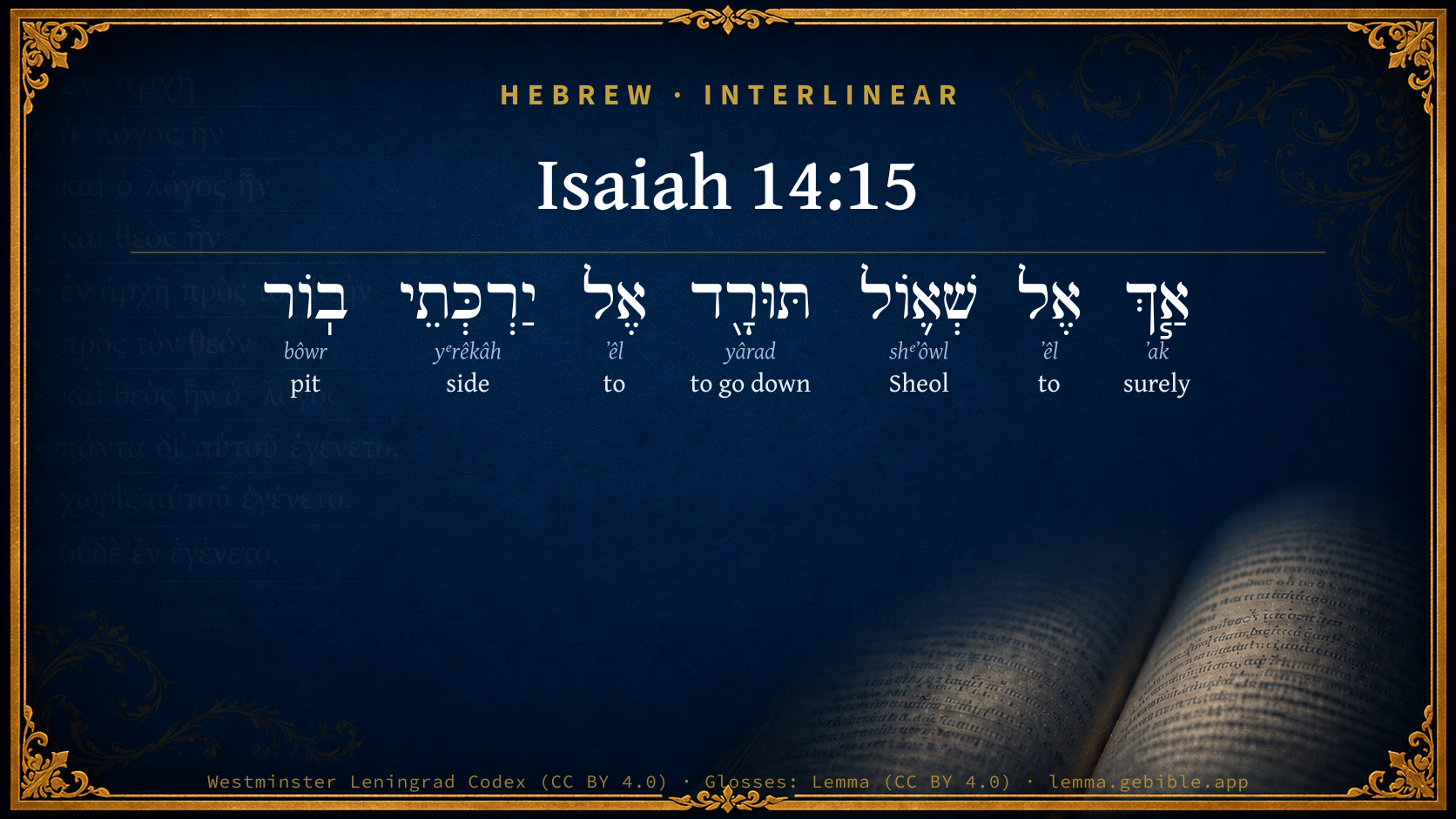
Isaiah 14:15

Hebrew (Westminster Leningrad Codex) Isaiah 14:15 appears in the Hebrew Old Testament. The text above is from the Westminster Leningrad Codex. Each word links to its Strong’s number, a concise gloss, and parsing drawn from the Open Scriptures Hebrew Bible morphology. Click any word for its full Brown-Driver-Briggs (BDB) entry.
Download image
Cite this verse

Isaiah 14:15 (World English Bible). Public Domain. Lemma interlinear Bible study tool, https://lemma.gebible.app/v/isaiah/14/15.

Show BibTeX & RIS
BibTeX
RIS
English Translation
Yet you shall be brought down to Sheol, to the uttermost parts of the pit.
World English Bible · Public Domain
Download a study sheet

One document with this verse’s original text, its word-by-word gloss line, the meaning frame, cross-references with their text, attributed commentary, and full source and license credits — printable, and it pastes into notes with its structure intact.

This verse Autodidact and up

Study sheet (.html) Plain text (.txt)

A passage Seminary Student

Up to 50 verses in one chapter. A passage sheet keeps up to 6 commentary sources and 12 cross-references per verse, in the order this page ranks them, and says so on the sheet whenever that leaves anything out. Ask for a single verse and you get the Autodidact verse sheet above.

Everything on this page stays free to read, with no account — the sheet is a download of what is already on screen, not access to it.

Want to remove ads? Support Godless Engineer
Compare translations 3

The same verse in 3 English versions, stacked beneath the original-language interlinear above. Click any original word for its lexicon entry.

Each is an independent rendering of the whole verse — the interlinear is not word-aligned to these translations.

Highlighted words mark where these versions differ — a whole-verse word diff, not a word-by-word alignment.

  • World English Bible Public Domain
    Yet you shall be brought down to Sheol, to the uttermost parts of the pit.
  • King James Version Public Domain
    Yet thou shalt be brought down to hell, to the sides of the pit.
  • unfoldingWord Literal Text CC BY-SA 4.0
    But you have been brought down to Sheol, to the recesses of the Pit.

unfoldingWord Literal Text — © unfoldingWord, licensed CC BY-SA 4.0. Word-aligned USFM3 via Door43 (git.door43.org/unfoldingWord/en_ult).

Versions to compare (up to 4)

3 of 4 selected

Show all 18 translations

Every available English version of this verse, each an independent rendering of the whole verse.

  • World English Bible Public Domain
    Yet you shall be brought down to Sheol, to the uttermost parts of the pit.
  • Berean Standard Bible Public Domain
    But you will be brought down to Sheol, to the lowest depths of the Pit.
  • Majority Standard Bible Public Domain
    But you will be brought down to Sheol, to the lowest depths of the Pit.
  • King James Version Public Domain
    Yet thou shalt be brought down to hell, to the sides of the pit.
  • American Standard Version (1901) Public Domain
    Yet thou shalt be brought down to Sheol, to the uttermost parts of the pit.
  • Revised Version (1885) Public Domain
    Yet thou shalt be brought down to hell, to the uttermost parts of the pit.
  • Geneva Bible (1599) Public Domain
    But thou shalt bee brought downe to the graue, to the sides of the pit.
  • Douay-Rheims (1899) Public Domain
    But yet thou shalt be brought down to hell, into the depth of the pit.
  • Young's Literal Translation Public Domain
    Only -- unto Sheol thou art brought down, Unto the sides of the pit.
  • Literal Standard Version CC BY-SA 4.0
    Only—you are brought down to Sheol, || To the sides of the pit.
  • Unlocked Literal Bible CC BY-SA 4.0
    Yet you are now brought down to Sheol, to the depths of the pit.
  • unfoldingWord Literal Text CC BY-SA 4.0
    But you have been brought down to Sheol, to the recesses of the Pit.
  • Darby Bible Public Domain
    none the less art thou brought down to Sheol, to the recesses of the pit.
  • World Messianic Bible Public Domain
    Yet you shall be brought down to Sheol, to the depths of the pit.
  • Webster's Bible Public Domain
    Yet thou shalt be brought down to hell, to the sides of the pit.
  • Free Bible Version CC BY-SA 4.0
    But you are dragged down to the grave, into the depths of the pit.
  • Bible in Basic English Public Domain
    But you will come down to the underworld, even to its inmost parts.
  • JPS Tanakh (1917) Public Domain
    Yet thou shalt be brought down to the nether-world, to the uttermost parts of the pit.

Literal Standard Version (2020), Covenant Press — licensed CC BY-SA 4.0. Text via the HelloAO Bible API (eBible.org). Unlocked Literal Bible (unfoldingWord) — licensed CC BY-SA 4.0. Text via the HelloAO Bible API (eBible.org). unfoldingWord Literal Text — © unfoldingWord, licensed CC BY-SA 4.0. Word-aligned USFM3 via Door43 (git.door43.org/unfoldingWord/en_ult). Free Bible Version, Dr. Jonathan Gallagher — licensed CC BY-SA 4.0. Text via the HelloAO Bible API (eBible.org).

Word by word

More ways to search: Search by grammar → Find every occurrence → Compare this word →

Practice this passage: Drill this verse → Learn its vocabulary →

About this verse

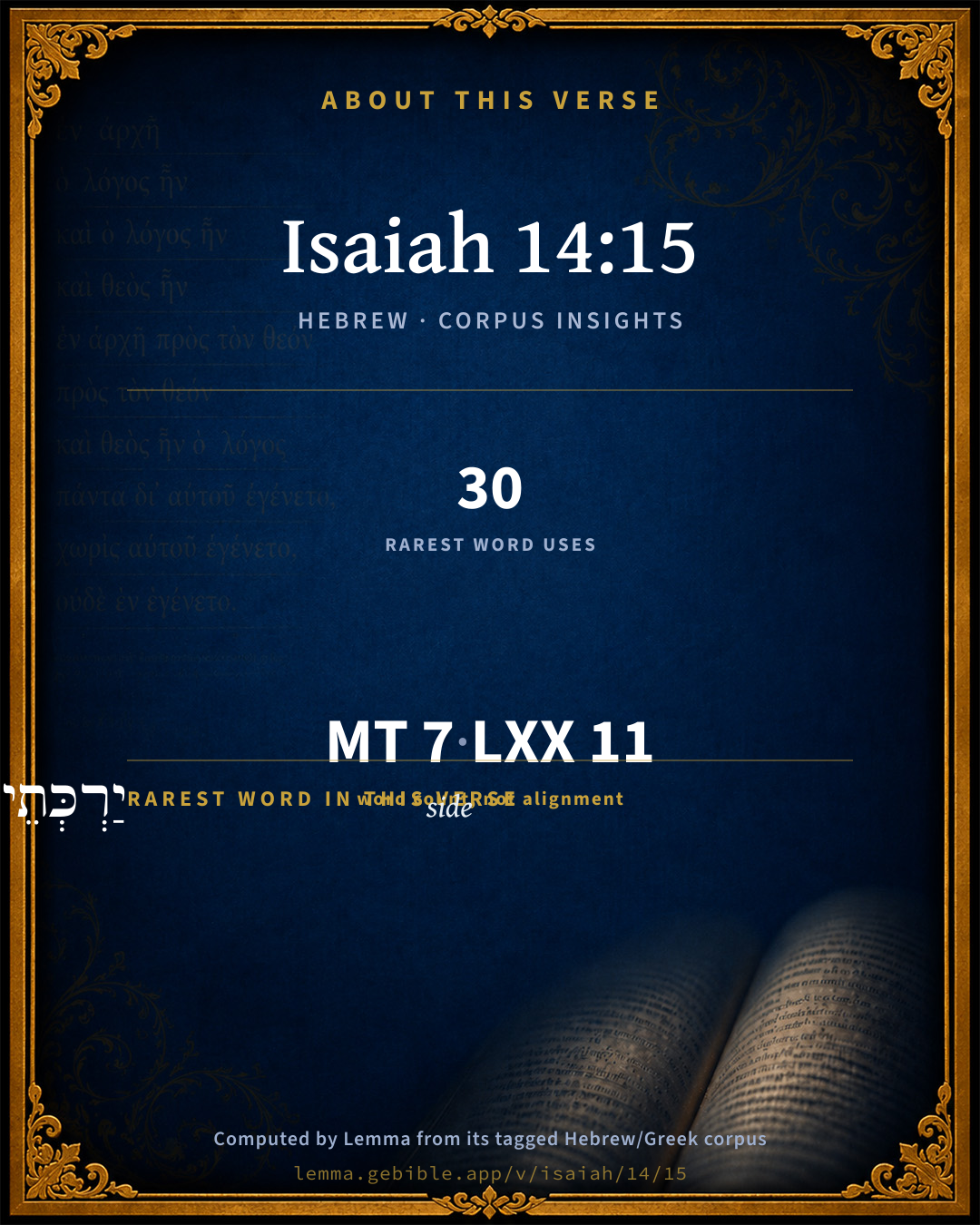
These counts appear in no published source. They are computed here, from the morphology-tagged text and Lemma’s own curated glosses. What Lemma adds →

7
words
6
distinct lemmas
Prophets
section

Shared distinctive vocabulary

יַרְכְּתֵי side H3411 occurs in 28 verses of the Hebrew Bible. Also found in:

Grammatical profile

  • 1 verb
  • 3 nouns
  • 2 prepositions
  • 1 particle

Verb forms

  • תּוּרָ֖ד Hophal · Imperfect

Repetition

A word recurs within this verse — often emphatic in Hebrew:

  • אֶל to H413 ×2

Hebrew & Septuagint length

In English translation the verse runs 15 words from the Hebrew and 15 from the Septuagint (LXX English) — the same length.

A rough comparison of the two English renderings, which tokenize alike — not a word-level alignment.

Word counts can differ between the Hebrew and the Greek without any difference in meaning — e.g. the Hebrew direct-object marker אֵת has no separate Greek word, and Greek often adds the article ὁ.

In the original languages it is 7 Hebrew tokens and 11 Greek tokens — but the two are counted differently (Hebrew bundles its prefixes and suffixes into one token; the Greek is in lemma form), so that isn’t a like-for-like length.

Cross-references

7

Topical passages linked to Isaiah 14:15 in the Treasury of Scripture Knowledge — connected by theme and wording, ordered by reader-vote popularity; previews shown in the World English Bible.

  • Matthew 11:23 You, Capernaum, who are exalted to Heaven, you will go down to Hades. For if the mighty works had been done in Sodom which were done in you, it would have remained until this day.
  • Ezekiel 32:23 whose graves are set in the uttermost parts of the pit, and her company is round about her grave; all of them slain, fallen by the sword, who caused terror in the land of the living.
  • Acts 12:22–23 The people shouted, "The voice of a god, and not of a man!"
  • Luke 10:15 You, Capernaum, who are exalted to heaven, will be brought down to Hades.
  • Revelation 19:20 The beast was taken, and with him the false prophet who worked the signs in his sight, with which he deceived those who had received the mark of the beast and those who worshiped his image. These two were thrown alive into the lake of fire that burns with sulfur.
  • Isaiah 14:3–11 It shall happen in the day that Yahweh shall give you rest from your sorrow, and from your trouble, and from the hard service in which you were made to serve,
  • Ezekiel 28:8–9 They shall bring you down to the pit; and you shall die the death of those who are slain, in the heart of the seas.

Cross-references courtesy of OpenBible.info (CC BY 4.0).

Hebrew and Greek witnesses Masoretic Hebrew ↔ Greek Septuagint

The same verse in the two great witnesses to the Old Testament, shown verse-for-verse.

These are two independent witnesses, not word-aligned to each other, and the Septuagint is shown in lemma (dictionary) form.

Hebrew Isaiah 14:15 Masoretic · Westminster Leningrad Codex

אַ֧ךְ אֶל שְׁא֛וֹל תּוּרָ֖ד אֶל יַרְכְּתֵי בֽוֹר

Yet you shall be brought down to Sheol, to the uttermost parts of the pit.

World English Bible · Public Domain

Greek LXX Isaiah 14:15 Septuagint · lemma form

νῦν δέ εἰς ᾅδης καταβαίνω καί εἰς ὁ θεμέλιον ὁ γῆ

But now you shall go down to hell, even to the foundations of the earth.

LXX2012 (modern English Septuagint) · Public Domain

Hebrew: Westminster Leningrad Codex (CC BY 4.0). Greek: Septuagint (public domain); English from LXX2012 (modern English Septuagint) (Public Domain). How the Septuagint differs from the Hebrew →

Targum (Aramaic paraphrase)

1

The Targum is the ancient Jewish Aramaic paraphrase of the Hebrew Scriptures — an interpretive translation, not the Hebrew text itself. Onkelos (literal) and Pseudo-Jonathan (expansive) render the Torah, and Jonathan the Prophets. Coverage is partial: where no permissively-licensed English translation exists for a verse, only the Aramaic is shown. This is verse-level text, not a word-by-word alignment to the Hebrew.

  1. Targum Jonathan Prophets (Joshua–Malachi)
    בְּרַם לִשְׁאוֹל תִּתְחַת לִסְיָפֵי גוֹב בֵּית אַבְדָנָא:

    But to the grave thou shalt be brought down, to the ends of the pit of the place of perdition.

    Targum Jonathan — Aramaic: “Mikraot Gedolot” (public domain). English: “Sefaria Community Translation” (CC0 1.0 (public-domain dedication)); “London "Chaldee Paraphrase," 1871” (public domain). Text via Sefaria.

Commentary

Notes on Isaiah 14:15 from classic Christian and Jewish commentators (each source and its license shown beneath its notes). The classic Christian expositions comment on the surrounding passage and are grouped to its opening verse, so a note may address several verses; the Jewish commentaries on the Tanakh (Rashi and others) are per-verse, so they appear only where the commentator wrote on this verse.

Lemma curates 59 commentaries, every one of them public domain or Creative Commons licensed, each selected and text-cleaned for this edition rather than reprinted as found. About our sources →

Trapp's Complete Commentary

John Trapp

Isa 14:15 Yet thou shalt be brought down to hell, to the sides of the pit.

Ver. 15. Yet thou shalt be brought down be hell.] To the counterpoint of thy haughtiest conceits, ad infimam erebi sedem. So a merry fellow said that Xerxes, that great warrior who took upon him to control the sea, was now mending old shoes under a shop board in hell.

To the sides of the pit,] i.e., Of the infernal lake: A tartesso in tartarum detrusus; { a} from the sides of the north, {Isa 14:13} whither thou hadst pierced thyself, ad latera luci, to the sides of the pit, and to an odd corner of the burying place. This was a foul fall, and worse than that of Hermannus Ferrariensis, who, having been canonised for a saint, was thirty years after unburied, and burnt for a heretic by Pope Boniface VIII, {b} or that of Thomas a Becket, of whom, forty-eight years after he had been sainted, it was disputed among the doctors of Paris whether he were damned or saved? {c}

{a} Adagium Homericum.

{b} Jac. Rev. Hist. Pontif., 195.

{c} Daniel’s History, fol. 99.

John Trapp, A Commentary or Exposition upon All the Books of the Old and New Testament (1647–1656) — public domain. Text from a community e-Sword module.

Joseph Benson's Commentary

Isa 14:15-17. Yet thou shalt be brought down to hell — To the grave, and the state of the dead; to the sides of the pit — And lodged there in the lowest state of misery and degradation. They that see thee — In this humbled and wretched state, shall narrowly look upon thee — As not knowing thee at first sight, and hardly believing their own eyes, because of this great alteration of thy condition, a change which, to them, seemed next to impossible. Is this the man that made the earth to tremble — All the nations of the earth? that did shake the kingdoms — At his pleasure? that made the world a wilderness — By slaying or carrying away captive its inhabitants, and destroying its produce: that opened not the house of his prisoners — That did not restore them to their own country, as Cyrus afterward did the Jews; but kept them in perpetual slavery, Jer 50:33. By this the prophet signifies both his irresistible power, and his continued cruelty.

Joseph Benson's Commentary on the Old and New Testaments (1811–1818) — public domain. Text from a community e-Sword module.

Tyndale Open Study Notes

Tyndale Open Resources

14:15-17 This is a restatement of 14:9-11. The dead spirits inhabiting the place of the dead will be startled and amazed that the Babylonian king, who ruled the world with his merciless might, has absolutely no power in death.

Tyndale Open Study Notes — © Tyndale Open Resources, licensed CC BY-SA 4.0. Text via the HelloAO Bible API.

Jamieson, Fausset & Brown

Robert Jamieson, A. R. Fausset & David Brown

to hell--to Sheol (Isa 14:6), thou who hast said, "I will ascend into heaven" (Mat 11:23).

sides of the pit--antithetical to the "sides of the north" (Isa 14:13). Thus the reference is to the sides of the sepulcher round which the dead were arranged in niches. But MAURER here, as in Isa 14:13, translates, "the extreme," or innermost parts of the sepulchre: as in Eze 32:23 (compare Sa1 24:3).

Jamieson, Fausset & Brown — Commentary Critical and Explanatory on the Whole Bible (1871) — public domain (CC PDM 1.0). Text via the HelloAO Bible API.

Ellicott's Commentary for English Readers

(15) Yet thou shalt be brought . . .—We note in the use of the same words (“ the sides, or recesses,” of the pit), as in the previous verse, the contrast of an indignant sarcasm. Yes, the prophet seems to say, the proud king has found his way to those “recesses;” but they are not in heaven, but in Hades.

A Bible Commentary for English Readers, edited by Charles John Ellicott (1878–1897) — public domain. Text from a community e-Sword module.

The Cambridge Bible for Schools and Colleges

gen. ed. J. J. S. Perowne

15. thou shalt be brought down to Sheol] Such is the end of the “vaulting ambition that o’erleaps itself.” The Babylonian Hades (Aralu) seems to have been conceived as situated under the mountain of the gods. The pit means Sheol, and the sides of the pit are its inmost recesses, the most dismal part of a land of darkness. These apparently are reserved for those who have not obtained honourable burial on earth (see below on Isa_14:18-20).

The Cambridge Bible for Schools and Colleges (gen. ed. J. J. S. Perowne; Cambridge University Press, 1878–1918) — public domain. Text from a community e-Sword module.

John Gill's Exposition

Yet thou shalt be brought down to hell,.... Into a very low and miserable condition; see Mat 11:23 instead of ascending to heaven: or "to the grave"; though, inasmuch as afterwards a burial is denied him, the word may be taken for the infernal pit, and so is, as much as can be, opposed to heaven; and this will be true of antichrist, when the beast and false prophet will be cast alive into the lake of fire, Rev 19:20,

to the sides of the pit; instead of being on the mount of the congregation in the sides of the north; another word for hell, the pit of corruption, and the bottomless pit. The Targum is,

"to the ends of the lake of the house of perdition;''

the place of everlasting destruction.

John Gill's Exposition of the Whole Bible (1746–1763) — public domain (CC PDM 1.0). Text via the HelloAO Bible API.

Albert Barnes' Notes on the Bible

Yet thou shalt be brought down to hell - Hebrew, ‘To sheol’ (compare Isa 14:9).

To the sides of the pit - The word ‘pit,’ here, is evidently synonymous with “hell” or “hades,” represented as a deep, dark region under ground. The dead were often buried in caves, and the descent was often dark and dreary, to the vaults where they reposed. Hence, it is always represented as going down; or, as the “inferior” regions. The ‘sides of the pit’ here stand opposed to the ‘sides of the north.’ He had sought to “ascend” to the one; he should be “brought down” to the other. The reference here is, doubtless, to the land of shades; to the dark and dismal regions where the departed dead are supposed to dwell - to “sheol.” So the parallelism proves. But the image or figure is taken from the custom of burying, where, in a deep natural cavern, or a sepulchre excavated from a rock, the dead were ranged around the “sides” of the cavern in niches or recesses excavated for that purpose (see the note at Isa 14:9).

Albert Barnes' Notes on the Bible (1834–1885) — public domain. Text from a community e-Sword/MySword module.

Haydock's Catholic Bible Commentary

Depth. Hebrew, "sides," (ver. 13.) or holes dug out of a cavern. (Calmet)

George Leo Haydock (1774–1849), Haydock's Catholic Family Bible and Commentary, 1859 edition — public domain. Excludes Psalms (Douay-Rheims chapter numbering differs from Protestant) and Deuterocanonical books (Catholic canon only).

Whedon's Commentary on the Bible

Daniel D. Whedon

15. Down to hell — To hades, as in Mat_11:23.

To the sides — To the recesses — the side burial places. The image is taken from the shelves and recesses of sepulchres.

Daniel D. Whedon (gen. ed.), Commentary on the Old and New Testaments (1874–1909) — public domain. Text from a community e-Sword module.

The Pulpit Commentary

Thou shalt be brought down; rather, thou art brought down (comp. vers. 9-11). The sides of the pit; or, the recesses the "lowest parts" of the pit. With those words the third stanza terminates.

The Pulpit Commentary (1880–1919), ed. H.D.M. Spence-Jones & Joseph S. Exell — public domain. Text from a community e-Sword module.

J. A. Alexander on Isaiah

Joseph Addison Alexander

But instead of being exalted to heaven, “thou shalt only be brought down to hell, to the depths of the pit.” Against the strict application of the last clause to the grave is the subsequent description of the royal body as unburied. But the imagery is unquestionably borrowed from the grave. Some understand by sides the horizontal excavations in the oriental sepulchres or catacombs. But according to its probable etymology the Hebrew word does not mean ‘sides’ in the ordinary sense, but rather ‘hinder parts’ and then remote parts or extremities, as it is explained by the Targum here and in v. 13. The specific reference may be either to extreme height, extreme distance, or extreme depth, according to the context. Here the last sense is required by the mention of the pit, and the word is accordingly translated in the Vulgate profundum.

Joseph Addison Alexander, The Prophecies of Isaiah (1846–1847; New York: Scribner, 1870–1878) — public domain. Text from a community e-Sword module.

Scofield Reference Notes

C. I. Scofield

hell

Heb. "Sheol," Also; Is 14:9 (See Scofield "Hab 2:5").

The Scofield Reference Bible (1917 edition), notes by C. I. Scofield — public domain. Text from a community e-Sword module.

unfoldingWord translationNotes

Door43 World Missions Community

Connecting Statement:

This is part of the taunt song that the Israelites will sing to the king of Babylon.

Yet you are now brought down to Sheol

This can be stated in active form. AT: "But now God has sent you down to Sheol" (See: Active or Passive)

Is this the man

The people will use this question either to mock the king of Babylon, or to express their shock at what has happened to him. AT: "Surely, this is not the man" (See: Rhetorical Question)

who made the earth tremble

Possible meanings are 1) the earth trembled as the king's army marched to conquer people, or 2) this refers to the people of the earth trembling in fear of him. (See: Metonymy)

shook kingdoms

Possible meanings are 1) this is a metaphor for "conquered kingdoms" or 2) this is metonymy for "terrified the people of kingdoms." (See: Metaphor and Metonymy)

who made the world like a wilderness

"who made the places where people lived into a wilderness"

translationWords

Hades

kingdom

world

desert

prison

unfoldingWord translationNotes — © Distant Shores Media and the Door43 World Missions Community, licensed CC BY-SA 4.0. Source: git.door43.org/Door43/en_tn.

Lesson kit

Teaching starters — assembled from the data on this page, not authored interpretation. Every prompt links to the verse data it draws on. Edit before teaching.

Isaiah, in the Prophets, opens this verse with 7 words (6 distinct Hebrew lemmas). Its most distinctive word is yᵉrêkâh (“side”). A historical commentator’s framing appears above. Read the whole chapter for the surrounding context.

Discussion questions

  1. The word yᵉrêkâh carries the sense “side.” How does it shape the verse?
  2. Genesis 49:13 shares the word «side» with this verse. How do the two illuminate each other?
  3. “to” occurs 2× in this one verse. What is the effect of the repetition?
  4. These translations render this verse differently; the difference is in the English rendering, not the original. What questions does that raise?
  5. The verb «תּוּרָ֖ד» is Hophal Imperfect. How does its form color the action?
  6. Reading how Trapp's Complete Commentary and Joseph Benson's Commentary read this verse, where do the two commentators agree and where do they part?

Things to notice

Reading settings

Reading text

Shown beneath each verse's original-language words.

Old Testament
Old Testament edition

Read the OT as the Masoretic Hebrew (MT) or the Greek Septuagint (LXX).

English shown for the Greek Septuagint (in the Hebrew ↔ Greek comparison).

Comparing translations? Open the Compare panel on any verse page to stack up to four side by side.