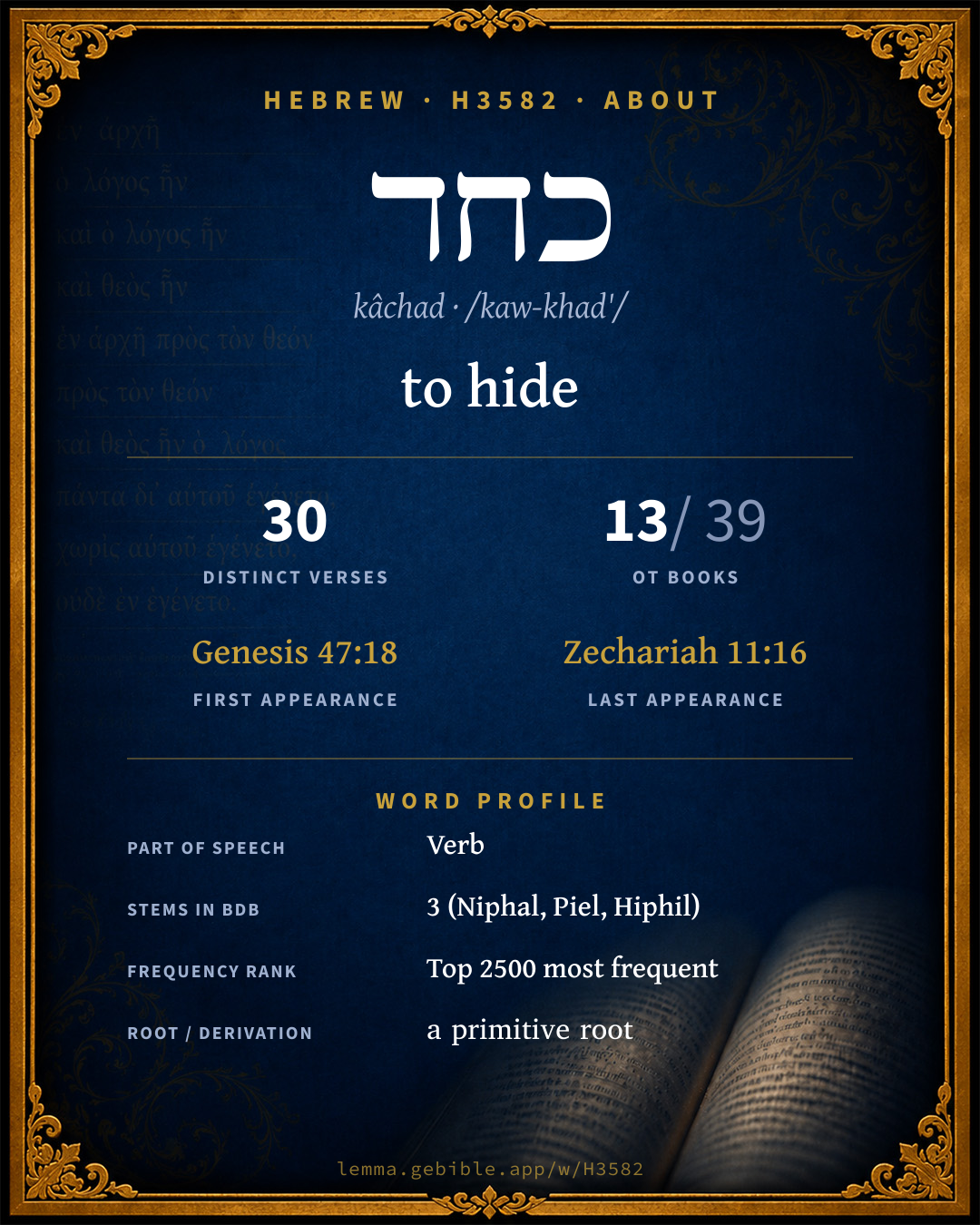
כָּחַד
to hide
also: conceal, cut off, cut down, make desolate fuller range ↓
Full lexicon entry — Brown-Driver-Briggs (BDB)
From Brown-Driver-Briggs (BDB)
Where this word appears
See every Piel verb in the Hebrew Bible →
Grammar key — what these labels mean
Part of speech
- Verb
- An action or state-of-being word.
Stem
- Piel
- An intensive or resultative active stem.
- Niphal
- Usually the simple passive or reflexive of the Qal (“he was written”). Here: ‘be hidden’
- Hiphil
- The causative active stem (“he caused / brought about”). Here: ‘hide’
Form
- Jussive
- A third- or second-person volitional form expressing wish or command (“let him write”).
- Perfect
- A completed action or state — Hebrew marks aspect (completeness) more than strict tense (“he wrote”).
- Imperfect
- An incomplete, ongoing, or future action (“he will / would write”).
- Infinitive Construct
- A bound verbal noun, frequently with prepositions (“to write / in writing”).
- Participle Passive
- A verbal adjective expressing action received (“written”).
- Sequential Imperfect
- An imperfect with prefixed waw — the standard past-narrative form (waw-consecutive imperfect).
- Sequential Perfect
- A perfect with prefixed waw continuing a preceding imperfect or command (waw-consecutive perfect).
- Participle Active
- A verbal adjective expressing ongoing or characteristic action (“writing / one who writes”).
State
- Absolute
- The independent form of a noun, not bound to a following word.
Person
- 2nd Person
- The one addressed (“you”).
- 3rd Person
- The one spoken about (“he / she / it / they”).
- 1st Person
- The speaker (“I / we”).
Gender
- Masculine
- Grammatically masculine.
- Common
- Either gender — not distinguished for this form.
- Feminine
- Grammatically feminine.
Number
- Singular
- One.
- Plural
- More than one (in Hebrew, generally three or more).
Grammatical forms 23 distinct
- Verb, Piel, Jussive, 2nd Person, Masculine, Singular 4 times (13%)
- Verb, Niphal, Perfect, 3rd Person, Masculine, Singular 3 times (9%)
- Verb, Niphal, Perfect, 3rd Person, Common, Plural 2 times (6%)
- Verb, Piel, Imperfect, 1st Person, Common, Plural 2 times (6%)
- Verb, Piel, Perfect, 1st Person, Common, Singular 2 times (6%)
- Verb, Piel, Perfect, 3rd Person, Common, Plural 2 times (6%)
- Verb, Hiphil, Infinitive Construct 1 time (3%)
- Verb, Niphal, Participle Passive, Feminine, Singular, Absolute 1 time (3%)
+15 more forms (15 occurrences)
Parsed forms decoded from the imported morphology (morphhb / Westminster Leningrad Codex — WLC text public domain, morphhb tagging CC BY 4.0), counted across 32 parsed occurrences — not distinct verses.
Every verse where H3582 appears — 30 distinct verses across 13 books. Click any verse to open its interlinear word-by-word view. Verse text shown in the World English Bible for context — . Each verse’s Hebrew form is shown with its reference; the English is not keyword-highlighted, since the data carries no word-level English alignment. Use “Compare translations” on any verse to read it across multiple English versions. This concordance covers the Hebrew Bible; Septuagint (Greek Old Testament) occurrences are not indexed here.
Genesis 1 verse
Exodus 2 verses
- Exodus 9:15 וַ/תִּכָּחֵ֖ד conj + Niphal wimpf 2ms For now I would have put forth my hand, and struck you and your people with pestilence, and you would have been cut off from the earth;
- Exodus 23:23 וְ/הִכְחַדְתִּֽי/ו conj + Hiphil wpf 1cs + sfx pers 3ms For my angel shall go before you, and bring you in to the Amorite, the Hittite, the Perizzite, the Canaanite, the Hivite, and the Jebusite; and I will cut them off.
Joshua 1 verse
1 Samuel 2 verses
- 1 Samuel 3:17 תְכַחֵ֖ד תְּכַחֵ֤ד Piel juss 2ms Piel impf 2ms He said, "What is the thing that [Yahweh] has spoken to you? Please don't hide it from me. God do so to you, and more also, if you hide anything from me of all the things that he spoke to you."
- 1 Samuel 3:18 כִחֵ֖ד Piel pf 3ms Samuel told him every whit, and hid nothing from him. He said, It is Yahweh: let him do what seems him good.
2 Samuel 2 verses
- 2 Samuel 14:18 תְכַחֲדִ֤י Piel juss 2fs Then the king answered the woman, Please don't hide anything from me that I shall ask you. The woman said, Let my lord the king now speak.
- 2 Samuel 18:13 יִכָּחֵ֣ד Niphal impf 3ms Otherwise if I had dealt falsely against his life (and there is no matter hid from the king), then you yourself would have set yourself against [me].
1 Kings 1 verse
2 Chronicles 1 verse
Job 7 verses
- Job 4:7 נִכְחָֽדוּ Niphal pf 3cp "Remember, now, whoever perished, being innocent? Or where were the upright cut off?
- Job 6:10 כִ֝חַ֗דְתִּי Piel pf 1cs Be it still my consolation, Yes, let me exult in pain that doesn't spare, That I have not denied the words of the Holy One.
- Job 15:18 כִֽ֝חֲד֗וּ Piel pf 3cp (Which wise men have told From their fathers, and have not hidden it;
- Job 15:28 נִכְחָד֗וֹת Niphal ptcp.act fp He has lived in desolate cities, In houses which no one inhabited, Which were ready to become heaps.
- Job 20:12 יַ֝כְחִידֶ֗/נָּה Hiphil impf 3ms + sfx pers 3fs "Though wickedness is sweet in his mouth, Though he hide it under his tongue,
- Job 22:20 נִכְחַ֣ד Niphal pf 3ms Saying, 'Surely those who rose up against us are cut off, The fire has consumed the remnant of them.'
- Job 27:11 אֲכַחֵֽד Piel impf 1cs I will teach you about the hand of God. That which is with the Almighty will I not conceal.
Psalms 5 verses
- Psalms 40:10 כִחַ֥דְתִּי Piel pf 1cs I have not hidden your righteousness within my heart. I have declared your faithfulness and your salvation. I have not concealed your loving kindness and your truth from the great assembly.
- Psalms 69:5 נִכְחָֽדוּ Niphal pf 3cp God, you know my foolishness. My sins aren't hidden from you.
- Psalms 78:4 נְכַחֵ֨ד Piel impf 1cp We will not hide them from their children, Telling to the generation to come the praises of Yahweh, His strength, and his wondrous works that he has done.
- Psalms 83:4 וְ/נַכְחִידֵ֣/ם conj + Hiphil impf 1cp + sfx pers 3mp "Come," they say, "and let's destroy them as a nation, That the name of Israel may be remembered no more."
- Psalms 139:15 נִכְחַ֥ד Niphal pf 3ms My frame wasn't hidden from you, When I was made in secret, Woven together in the depths of the earth.
Isaiah 1 verse
Jeremiah 3 verses
- Jeremiah 38:14 תְּכַחֵ֥ד Piel juss 2ms Then Zedekiah the king sent, and took Jeremiah the prophet to him into the third entry that is in the house of Yahweh: and the king said to Jeremiah, I will ask you a thing; hide nothing from me.
- Jeremiah 38:25 תְּכַחֵ֥ד Piel juss 2ms But if the princes hear that I have talked with you, and they come to you, and tell you, Declare to us now what you have said to the king; don't hide it from us, and we will not put you to death; also what the king said to you:
- Jeremiah 50:2 תְּכַחֵ֑דוּ Piel juss 2mp Declare you among the nations and publish, and set up a standard; publish, and don't conceal: say, Babylon is taken, Bel is disappointed, Merodach is dismayed; her images are disappointed, her idols are dismayed.
Hosea 1 verse
Zechariah 3 verses
- Zechariah 11:8 וָ/אַכְחִ֛ד conj + Hiphil wimpf 1cs I cut off the three shepherds in one month; for my soul was weary of them, and their soul also loathed me.
- Zechariah 11:9 וְ/הַ/נִּכְחֶ֨דֶת֙ תִּכָּחֵ֔ד conj + ptcl def.art + Niphal ptcp.pass fs Niphal impf 3fs Then I said, "I will not feed you. That which dies, let it die; and that which is to be cut off, let it be cut off; and let those who are left eat each other's flesh."
- Zechariah 11:16 הַ/נִּכְחָד֤וֹת ptcl def.art + Niphal ptcp.pass fp For, behold, I will raise up a shepherd in the land, who will not visit those who are cut off, neither will seek those who are scattered, nor heal that which is broken, nor feed that which is sound; but he will eat the flesh of the fat sheep, and will tear their hoofs in pieces.
About this entry
At a glance — auto-summarized from this page’s data, not written by a person. Every figure links to its source below. This summary describes the numbers; it doesn’t interpret them.
“to hide” is the headline sense of the Hebrew verb כחד (kâchad). First canonically at Genesis 47:18, it enters the text early. With 30 verses in 13 books, it is a moderately common word in the Hebrew Bible. Across 3 stems, its meaning turns on the binyan (Niphal, Piel). See the sense tree, 30-verse concordance, and the renderings breakdown below.
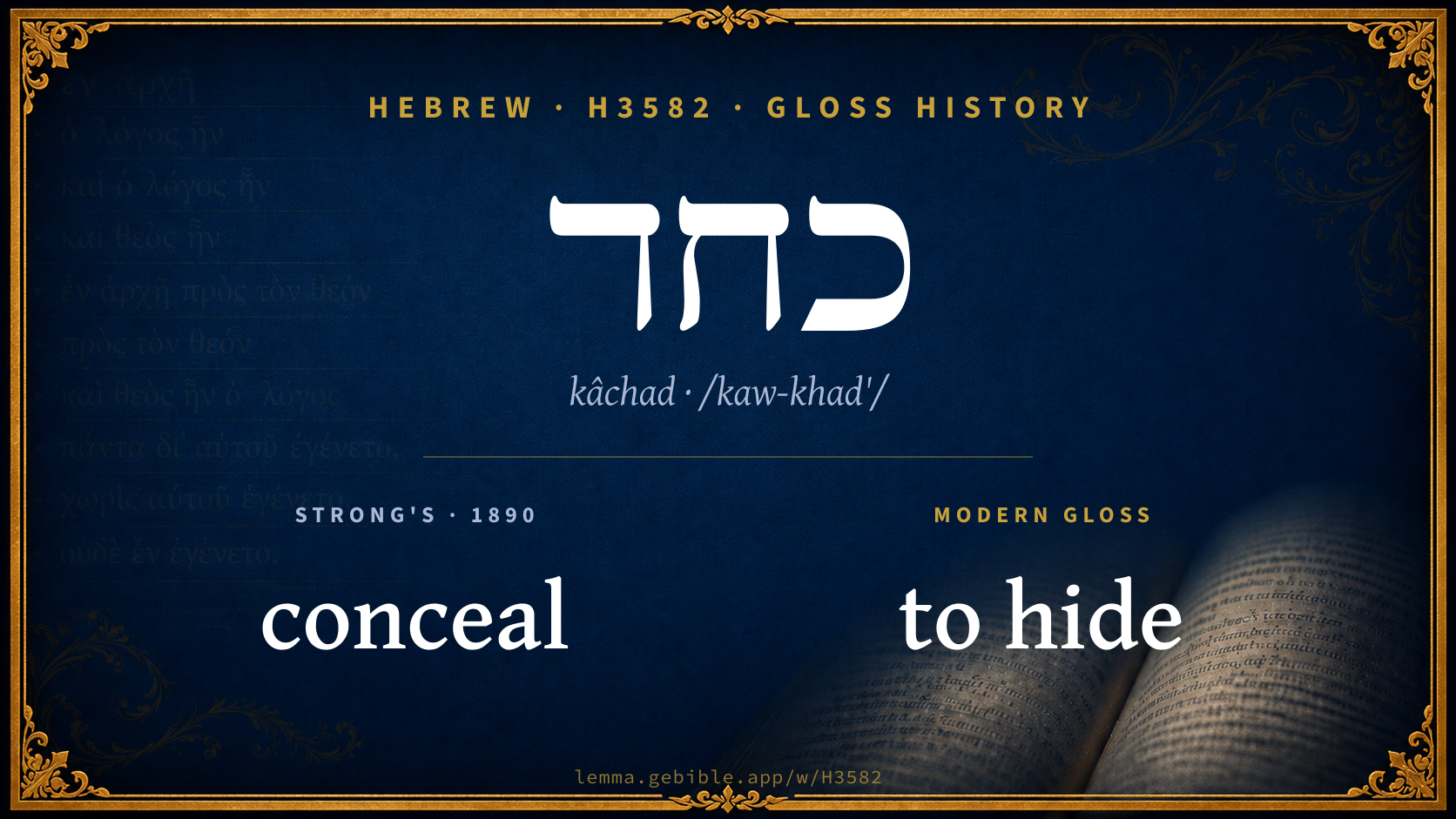
Gloss history
Strong's 1890 vs modern scholarship
About this word
Strong's H3582 catalogs a Hebrew word from the Hebrew Old Testament.
These counts are not copied from any lexicon or concordance. They are computed here, from the morphology-tagged Hebrew Old Testament. What Lemma adds →
- 30
- distinct verses
- The word appears in 30 distinct verses.
- 13 / 39
- OT books
- The word appears in 13 of 39 Old Testament books.
- #1,086
- by frequency
- Top 2500 most frequent Hebrew words (rank 1,086 of 8,640 Hebrew words by occurrence).
View all 30 occurrences in the concordance →
By section of the Old Testament
By traditional corpus
Conventional, traditional groupings — biblical authorship is debated, so this is a traditional corpus grouping, not an authorship claim. Each share is this word’s portion of its verses in that division of the Hebrew canon. Each figure is a share of the word’s 30 distinct verses.
- Prophets (Nevi'im) 14 verses · 47%
- Writings (Ketuvim) 13 verses · 43%
- Torah (Pentateuch) 3 verses · 10%
How translations render this word
Counts come from each version’s own published word-to-Strong’s tagging or interlinear alignment — an approximate guide to how each version renders this word, not a word-level alignment the data otherwise carries. Because each total is that version’s own tagged count, the per-version totals vary from one another and need not match the appearance or distinct-verse counts above. These counts may also differ from a printed concordance because Lemma counts each distinctly tagged rendering and does not collapse phrase taggings into a single head-word total. This is a fixed set of word-tagged versions (KJV, ASV, BSB, ULT) and does not change with the reading translation you choose elsewhere. Each version’s license is shown beside its name below (and on Sources).
- King James Version: Hide 4×, Cut off 2×, Hid 2×
- American Standard Version: Are cut off 2×, Cut off 2×, Hid 2×
- Berean Standard Bible: Hide 6×, Hidden 3×, Conceal 2×
- unfoldingWord Literal Text: Hide 6×, Hidden 5×, Is 3×
King James Version Public Domain
Renders H3582 across 32 tagged occurrences — most commonly:
Plus 20 renderings that appear only once — usually multi-word phrases or single function words the recovered tagging swept in, not distinct renderings.
American Standard Version Public Domain
Renders H3582 across 32 tagged occurrences — most commonly:
Plus 24 renderings that appear only once — usually multi-word phrases or single function words the recovered tagging swept in, not distinct renderings.
Berean Standard Bible Public Domain
Renders H3582 across 32 tagged occurrences — most commonly:
Plus 19 renderings that appear only once — usually multi-word phrases or single function words the recovered tagging swept in, not distinct renderings.
unfoldingWord Literal Text CC BY-SA 4.0
Renders H3582 across 46 tagged occurrences — most commonly:
Plus 25 renderings that appear only once — usually multi-word phrases or single function words the recovered tagging swept in, not distinct renderings.
7 senses and sub-senses in the full BDB
Hebrew verbs can shift meaning by stem (binyan): Qal is the basic action, Niphal is often passive or reflexive, Piel often intensifies or makes it factitive, and Hiphil is typically causative. The senses below are grouped under the stem BDB assigns to each.
What do BDB’s symbols mean?
BDB uses these scholarly abbreviations:
| Symbol | Meaning |
|---|---|
| 𝔊 | the Septuagint (the ancient Greek translation, LXX) |
| 𝔙 | the Vulgate (the Latin translation) |
| 𝔖 | the Syriac version (the Peshitta) |
| 𝔗 | the Targum (the Aramaic translation) |
| ψ | the Psalms |
| √ | root (the underlying root or stem) |
| ‖ | parallel passage (a synonymous or contrasted parallel) |
| † | the dagger: every passage where the word occurs is cited |
The 7 senses and sub-senses the full Brown-Driver-Briggs lexicon distinguishes for this word, in lexicon order (not ranked by frequency), with BDB’s own verbatim wording and sub-sense lettering. Shown in Hebrew script with BDB’s own scholarly abbreviations. The condensed entry is in the Lexicon Entry tab. See also the Forms in the corpus table below.
Niphal
- Pf. 3 ms. נִכְחַד Ho 5:3 + 2 times; 3 pl. נִכְחָ֑דוּ Jb 4:7 ψ 69:6; Impf. 3 ms. יִכָּחֵד 2 S 18:13, etc.; Pt. נִכְחֶדֶת Zc 11:9; pl. נִכְחָדוֹת Zc 11:16 Jb 15:28;— e.g. Hosea 5:3
- 1. be hidden, sq. מִן pers., 2 S 18:13 Ho 5:3 ψ 69:6; 139:15. e.g. 2 Samuel 18:13
- 2. be effaced, destroyed Zc 11:9 Jb 4:7; 15:28 (עָרִים נִכְחָדוֹת), 22:20, sq. מִן־הָאָרֶץ Ex 9:15 (J); Pt. intrans. of incomplete process = going to ruin Zc 11:9(×2), 16. e.g. Zechariah 11:9
Piel
- Pf. כִּחֵד 1 S 3:18; 1 s. כִּחַדְתִּי Jb 6:10 ψ 40:11; 3 pl. כִּחֲדוּ Jb 15:18; כִּחֵ֑דוּ Is 3:9; Impf. 2 ms. תְּכַחֵד Jos 7:19 + 4 times; 2 fs. תְּכַחֲדִי 2 S 14:18; 1 s. אֲכַחֵד Jb 27:11; 2 mpl. תְּכַחֵ֑דוּ Je 50:2; 1 pl. נְכַחֵד Gn 47:18 ψ 78:4;—hide, sq. מִן pers. Gn 47:18 (J), Jos 7:19 (JE), 1 S 3:17(×2), 18 2 S 14:18 Je 38:14, 25 ψ 78:4; sq. לְ pers. ψ 40:11 conceal toward, with ref. to, i.e. from; without prep. Is 3:9 Je 50:2 Jb 15:18; 27:11; = disown Jb 6:10. e.g. 1 Samuel 3:18
Hiphil
- Pf. 1 s. consec. sf. וְהִכְחַדְתִּיו Ex 23:23; Impf. 3 ms. וַיַּכְחֵד 2 Ch 32:21, sf. יַכְחִידֶנָּה Jb 20:12; 1 s. וָאַכְחִד Zc 11:8; 1 pl. sf. וְנַכְחִידֵם ψ 83:5; Inf. cstr. לְהַכְחִיד 1 K 13:34;— e.g. Exodus 23:23
- 1. hide, in fig. יַכְחִידֶנָּה תַּחַת לְשֹׁנוֹ Jb 20:12 (obj. wickedness) e.g. Job 20:12
- 2. efface, annihilate Ex 23:23 (E), 1 K 13:34 (‖ חַשְׁמִיד), Zc 11:8 2 Ch 32:21; sq. מִגּוֹי ψ 83:5, i.e. from being (so that they be not) a nation. e.g. Exodus 23:23
Senses from the full Brown-Driver-Briggs lexicon (Brown, Driver, Briggs; Oxford 1906 — public domain), digitized via Sefaria, supplemented by the OpenScriptures HebrewLexicon (CC BY 4.0). Full attribution on Sources.
Word origin
vb. not in Qal; Pi. Hiph. hide, efface; Niph. (usually) pass. (Aramaic אתכחדו be effaced †Jb 4:7; ܟܚܶܕ is revere, Pt. venerable, Pa. put to shame, Ethpa. be ashamed; Ethiopic ክሕደ deny, apostatize)—
— Brown-Driver-Briggs (Oxford 1906, public domain), digitized via Sefaria, supplemented by the OpenScriptures HebrewLexicon (CC BY 4.0). See Sources.
Origin: a primitive root
Jastrow Dictionary
A second Hebrew/Aramaic lexicon for comparison, covering Aramaic and post-biblical (Talmudic, Targumic, Midrashic) usage that the biblical-Hebrew BDB does not. Matched by lemma rather than by Strong’s number, so a lemma may carry more than one Jastrow headword (shown separately below), and the entries cover usage well beyond the Bible.
חַד I
- 1. pointed, sharp. Ḥull. 64ᵃ ראשה אחד חד if one side of the egg is pointed, the other rounded (כַּד); ib. (Chald.) רישיה חד חד.—Pl. חַדִּין. Ib.—Fem. חַדָּה. Snh. 94ᵃ. Ber. 10ᵃ אפי׳ חרב ח׳ וכ׳ even if a sharpened sword is laid on one’s throat, one must not despair of praying for divine mercy. Gen. R. s. 16 (play on ח̇ד̇ק̇ל̇, Gen. II, 14) שהיתה ק̇ל̇ה וח̇ד̇ה וכ׳ (Greece) who was rash and sharp in her decrees. e.g. Genesis 2:14
- 2. swift. Pl. as ab. Ber. 59ᵇ (play on חדקל) its waters ח׳ וקלין are swift and light.—V. חַדָּה.
חַד II
- , חֲדָא c. = h. אֶחָד, one, singular, particular. Targ. Gen. I, 5; a. v. fr.—חד בשבא first day in the week. Targ. II Esth. III, 7.—Targ. Ps. XXVII, 4. Targ. Ez. XVIII, 10 (some ed. חדת); a. fr.—Y. Ab. Zar. I, 39ᵇ bot. בחד בשובא, v. supra. Meg. 11ᵃ, a. fr. חד … וחד וכ׳ one authority …, another authority &c. Ber. 28ᵃ חדא היא לך או חדת וכ׳ is this a unique subject to thee (the only thing learned from R. Joḥ.) or a novel (strange) thing?—Gitt. 44ᵃ; Bekh. 3ᵃ טפי חד one time more (eleven times the value of the sold object); a. v. fr.—[Sabb. 67ᵃ bot. חד חד, v. חַרְחַר.]—כַּחֲדָא [like one,] together, simultaneously. Targ. Ps. II, 2; a. fr.—לַחֲדָא singularly, very much, too much. Targ. Gen. I, 31. Targ. Ps. CXIX, 8; a. fr.
כָּחַד
- to diminish.
- to withhold, deny. Num. R. s. 13 לא כ׳ מיעקב did not withhold (the truth) from &c.
- to destroy. Num. R. s. 20 לקללן ולהַכְחִידָן to curse and destroy them. Ex. R. s. 12; a. e.
- to be destroyed. Ib. היית נ׳ מן וכ׳ thou wouldst have been wiped out from the earth.
כְּחַד
- [Y. Sabb. VII, 10ᵃ bot. מכחד, v. בְּחַר.]
- to be destroyed. Targ. Job IV, 7.
כַּחַד
- constr. (preced.) missing, being missed. Targ. Ps. CXXXIX, 16 (ed. Lag. a. oth. בחד, Var. כ׳).
A Dictionary of the Targumim, the Talmud Babli and Yerushalmi, and the Midrashic Literature (Marcus Jastrow; London, Luzac, 1903) — Public Domain. Digitized via Sefaria. Digitized via Sefaria. Full attribution on Sources.
Forms in the corpus
The 29 distinct written forms H3582 takes in the Hebrew Bible, most frequent first — each parse links to that stem’s occurrences in the concordance. Hebrew forms include their vowel points and cantillation, so a single lemma takes many written forms.
Septuagint verse parallels
This word appears in 29 verses that also exist in the Greek Old Testament (Septuagint), out of the 30 Hebrew verses it occurs in. You can read those verses in Greek by switching the Old Testament edition to the Septuagint.
Read these verses in the Septuagint
- Genesis 47:18
- Exodus 9:15
- Joshua 7:19
- 1 Samuel 3:17
- 2 Samuel 14:18
- 1 Kings 13:34
- 2 Chronicles 32:21
- Job 4:7
- Psalms 40:10
- Isaiah 3:9
- Jeremiah 38:14
- Hosea 5:3
This is a verse-level parallel only — the same verses exist in both the Hebrew and Greek Old Testaments. No word-level Hebrew↔Greek correspondence is claimed: the data carries no such alignment, so no Greek word is shown as this Hebrew word’s translation. Coverage is not total — the Septuagint omits the deuterocanon and renumbers the Psalms, so some Hebrew verses have no direct Greek parallel.