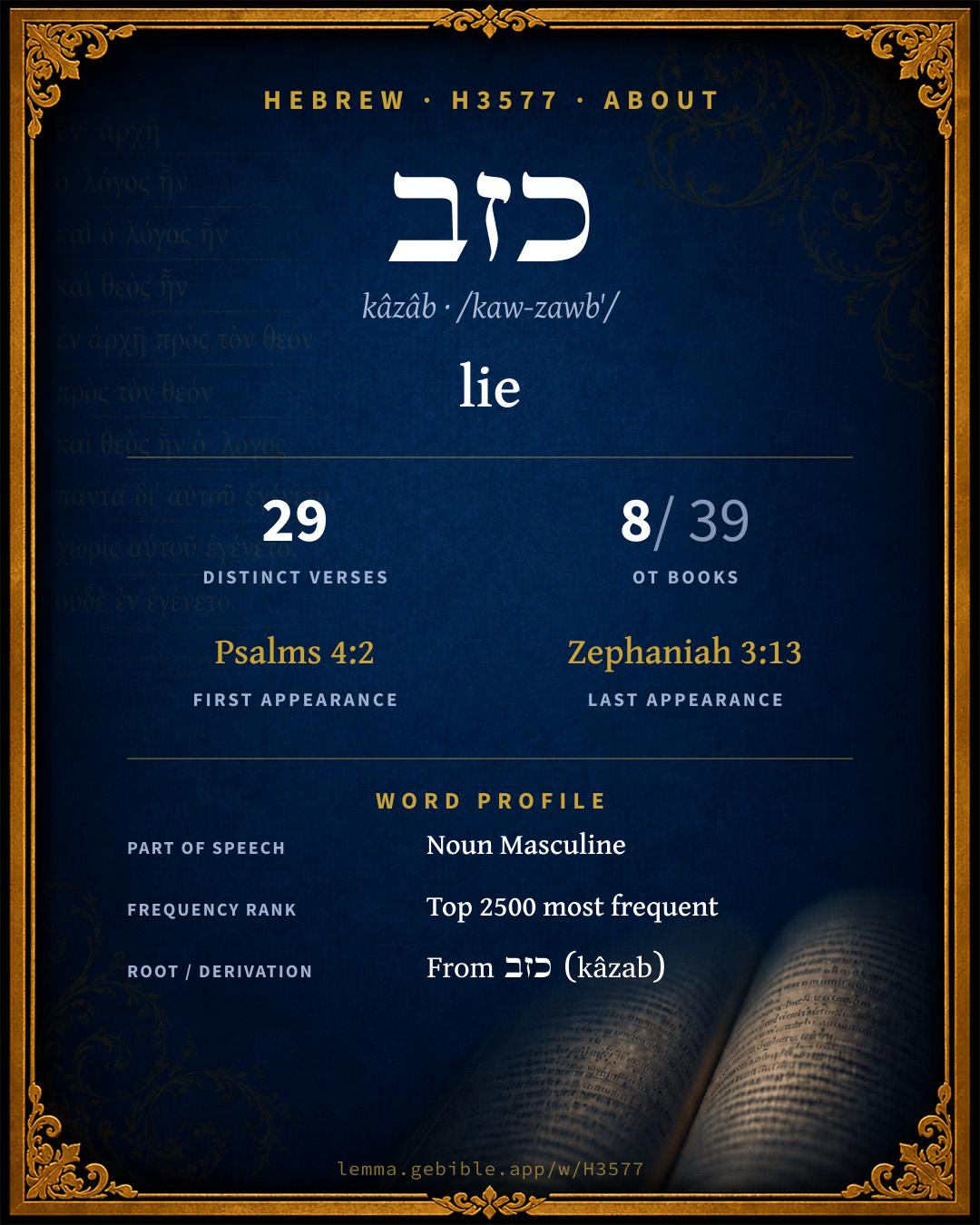
כָּזָב
lie
Full lexicon entry — Brown-Driver-Briggs (BDB)
From Brown-Driver-Briggs (BDB)
Where this word appears
See every Absolute-state word in the Hebrew Bible →
Grammar key — what these labels mean
Part of speech
- Noun
- A naming word — a person, place, thing, or idea.
Noun type
- Common
- A common noun — a general class of person, place, or thing (“king,” “city,” “water”), not a specific name.
State
- Absolute
- The independent form of a noun, not bound to a following word.
- Construct
- A noun bound to a following noun in a possessive / “of” relationship (the construct chain).
Gender
- Masculine
- Grammatically masculine.
Number
- Singular
- One.
- Plural
- More than one (in Hebrew, generally three or more).
Grammatical forms
- Noun, Common, Masculine, Singular, Absolute 20 times (69%)
- Noun, Common, Masculine, Plural, Absolute 8 times (28%)
- Noun, Common, Masculine, Plural, Construct 1 time (3%)
Parsed forms decoded from the imported morphology (morphhb / Westminster Leningrad Codex — WLC text public domain, morphhb tagging CC BY 4.0), counted across 29 parsed occurrences — not distinct verses.
Every verse where H3577 appears — 29 distinct verses across 8 books. Click any verse to open its interlinear word-by-word view. Verse text shown in the World English Bible for context — . Each verse’s Hebrew form is shown with its reference; the English is not keyword-highlighted, since the data carries no word-level English alignment. Use “Compare translations” on any verse to read it across multiple English versions. This concordance covers the Hebrew Bible; Septuagint (Greek Old Testament) occurrences are not indexed here.
Psalms 6 verses
- Psalms 4:2 כָזָ֣ב n c ms You sons of men, how long shall my glory be turned into dishonor? Will you love vanity, and seek after falsehood? Selah.
- Psalms 5:6 כָ֫זָ֥ב n c ms You will destroy those who speak lies. Yahweh abhors the blood-thirsty and deceitful man.
- Psalms 40:4 כָזָֽב n c ms Blessed is the man who makes Yahweh his trust, And doesn't respect the proud, nor such as turn aside to lies.
- Psalms 58:3 כָזָֽב n c ms The wicked go astray from the womb. They are wayward as soon as they are born, speaking lies.
- Psalms 62:4 כָ֫זָ֥ב n c ms They fully intend to throw him down from his lofty place. They delight in lies. They bless with their mouth, but they curse inwardly. Selah.
- Psalms 62:9 כָּזָ֪ב n c ms Surely men of low degree are just a breath, And men of high degree are a lie. In the balances they will go up. They are together lighter than a breath.
Proverbs 9 verses
- Proverbs 6:19 כְּ֭זָבִים n c mp A false witness who utters lies, And he who sows discord among brothers.
- Proverbs 14:5 כְּ֝זָבִ֗ים n c mp A truthful witness will not lie, But a false witness pours out lies.
- Proverbs 14:25 כְּזָבִ֣ים n c mp A truthful witness saves souls, But a false witness is deceitful.
- Proverbs 19:5 כְּ֝זָבִ֗ים n c mp A false witness shall not be unpunished. He who pours out lies shall not go free.
- Proverbs 19:9 כְּזָבִ֣ים n c mp A false witness shall not be unpunished. He who utters lies shall perish.
- Proverbs 19:22 כָּזָֽב n c ms That which makes a man to be desired is his kindness. A poor man is better than a liar.
- Proverbs 21:28 כְּזָבִ֥ים n c mp A false witness will perish, And a man who listens speaks to eternity.
- Proverbs 23:3 כְּזָבִֽים n c mp Don't be desirous of his dainties, Seeing they are deceitful food.
- Proverbs 30:8 כָּזָ֡ב n c ms Remove far from me falsehood and lies. Give me neither poverty nor riches. Feed me with the food that is needful for me;
Isaiah 2 verses
- Isaiah 28:15 כָזָ֛ב n c ms Because you have said, We have made a covenant with death, and with Sheol are we at agreement; when the overflowing scourge shall pass through, it shall not come to us; for we have made lies our refuge, and under falsehood have we hid ourselves:
- Isaiah 28:17 כָזָ֔ב n c ms I will make justice the line, and righteousness the plummet; and the hail shall sweep away the refuge of lies, and the waters shall overflow the hiding-place.
Ezekiel 7 verses
- Ezekiel 13:6 כָּזָ֔ב n c ms They have seen falsehood and lying divination, who say, Yahweh says; but Yahweh has not sent them: and they have made men to hope that the word would be confirmed.
- Ezekiel 13:7 כָּזָ֖ב n c ms Haven't you seen a false vision, and haven't you spoken a lying divination, in that you say, Yahweh says; but I have not spoken?
- Ezekiel 13:8 כָּזָ֑ב n c ms Therefore thus says the Lord Yahweh: Because you have spoken falsehood, and seen lies, therefore, behold, I am against you, says the Lord Yahweh.
- Ezekiel 13:9 כָּזָב֒ n c ms My hand shall be against the prophets who see false visions, and who divine lies: they shall not be in the council of my people, neither shall they be written in the writing of the house of Israel, neither shall they enter into the land of Israel; and you shall know that I am the Lord Yahweh.
- Ezekiel 13:19 כָזָֽב n c ms You have profaned me among my people for handfuls of barley and for pieces of bread, to kill the souls who should not die, and to save the souls alive who should not live, by your lying to my people who listen to lies.
- Ezekiel 21:29 כָּזָ֑ב n c ms while they see for you false visions, while they divine lies to you, to lay you on the necks of the wicked who are deadly wounded, whose day is come in the time of the iniquity of the end.
- Ezekiel 22:28 כָּזָ֑ב n c ms Her prophets have daubed for them with whitewash, seeing false visions, and divining lies to them, saying, Thus says the Lord Yahweh, when Yahweh has not spoken.
Daniel 1 verse
Hosea 2 verses
- Hosea 7:13 כְּזָבִֽים n c mp Woe to them! For they have wandered from me. Destruction to them! For they have trespassed against me. Though I would redeem them, Yet they have spoken lies against me.
- Hosea 12:1 כָּזָ֥ב n c ms Ephraim feeds on wind, And chases the east wind. He continually multiplies lies and desolation. They make a covenant with Assyria, And oil is carried into Egypt.
Amos 1 verse
Zephaniah 1 verse
About this entry
At a glance — auto-summarized from this page’s data, not written by a person. Every figure links to its source below. This summary describes the numbers; it doesn’t interpret them.
כזב (kâzâb) is a Hebrew noun most often rendered “lie.” It first appears in Psalms 4:2. The Hebrew Bible uses it across 29 verses — moderately common. Proverbs dominates its distribution — 9 of 29 verses. Sharing its root, it stands alongside כזב, אכזב and כדב. For the data behind this summary, explore the sense tree and the renderings breakdown below.
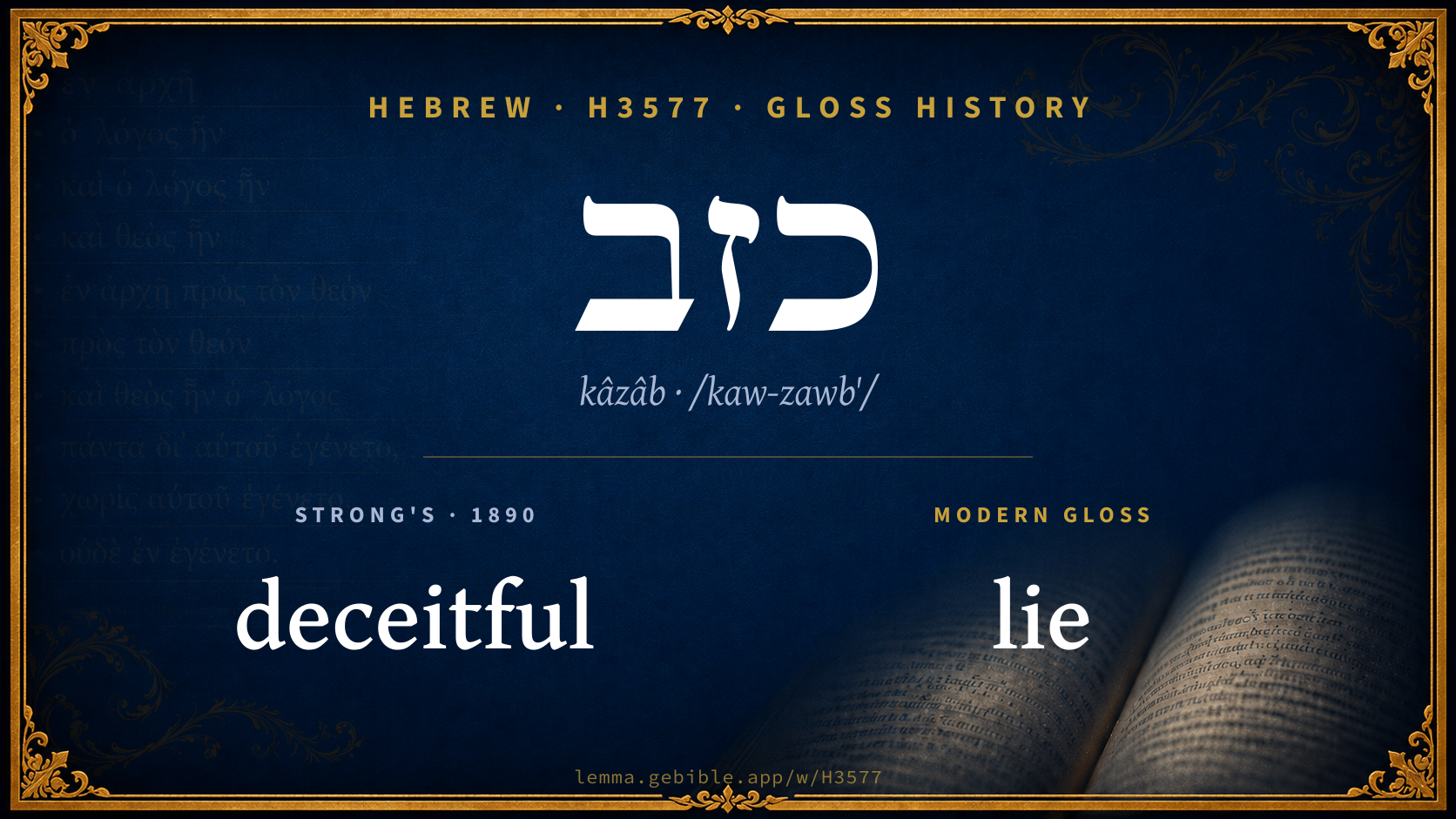
Gloss history
Strong's 1890 vs modern scholarship
About this word
Strong's H3577 catalogs a Hebrew word from the Hebrew Old Testament.
These counts are not copied from any lexicon or concordance. They are computed here, from the morphology-tagged Hebrew Old Testament. What Lemma adds →
- 29
- distinct verses
- The word appears in 29 distinct verses.
- 8 / 39
- OT books
- The word appears in 8 of 39 Old Testament books.
- #1,160
- by frequency
- Top 2500 most frequent Hebrew words (rank 1,160 of 8,640 Hebrew words by occurrence).
View all 29 occurrences in the concordance →
By section of the Old Testament
By traditional corpus
Conventional, traditional groupings — biblical authorship is debated, so this is a traditional corpus grouping, not an authorship claim. Each share is this word’s portion of its verses in that division of the Hebrew canon. Each figure is a share of the word’s 29 distinct verses.
- Writings (Ketuvim) 16 verses · 55%
- Prophets (Nevi'im) 13 verses · 45%
How translations render this word
Counts come from each version’s own published word-to-Strong’s tagging or interlinear alignment — an approximate guide to how each version renders this word, not a word-level alignment the data otherwise carries. Because each total is that version’s own tagged count, the per-version totals vary from one another and need not match the appearance or distinct-verse counts above. These counts may also differ from a printed concordance because Lemma counts each distinctly tagged rendering and does not collapse phrase taggings into a single head-word total. This is a fixed set of word-tagged versions (KJV, ASV, BSB, ULT) and does not change with the reading translation you choose elsewhere. Each version’s license is shown beside its name below (and on Sources).
- King James Version: Lies 20×, Lying 2×
- American Standard Version: Lies 15×, Lying 2×, Told me lies 2×
- Berean Standard Bible: Lies 14×, Lying 4×, Speak lying 2×
- unfoldingWord Literal Text: Lies 13×, Falsehood 4×, Lie 3×
King James Version Public Domain
Renders H3577 across 30 tagged occurrences — most commonly:
Plus 8 renderings that appear only once — usually multi-word phrases or single function words the recovered tagging swept in, not distinct renderings. Not rendered by a distinct English word in 1 further occurrence.
American Standard Version Public Domain
Renders H3577 across 30 tagged occurrences — most commonly:
Plus 11 renderings that appear only once — usually multi-word phrases or single function words the recovered tagging swept in, not distinct renderings.
Berean Standard Bible Public Domain
Renders H3577 across 27 tagged occurrences — most commonly:
Plus 7 renderings that appear only once — usually multi-word phrases or single function words the recovered tagging swept in, not distinct renderings. Not rendered by a distinct English word in 4 further occurrences.
unfoldingWord Literal Text CC BY-SA 4.0
Renders H3577 across 29 tagged occurrences — most commonly:
Plus 4 renderings that appear only once — usually multi-word phrases or single function words the recovered tagging swept in, not distinct renderings.
Senses in BDB
The 1 sense BDB distinguishes for this word, in lexicon order (not ranked by frequency or importance). The full entry — with sub-senses — is in the Lexicon Entry tab.
- a lie, untruth, falsehood, deceptive thing
Word origin
n.m. Am 2:4 lie, falsehood, deceptive thing;—abs. כ׳ Ho 12:2 + 19 times; pl. abs. כְּזָבִים Ju 16:10 + 9 times; sf. כִּזְבֵיהֶם Am 2:4;—lie, falsehood, c. דִּבֶּר Ju 16:10, 13 Ho 7:13 Zp 3:13 Dn 11:27 ψ 5:7; 58:4, so Ez 13:8 Co (by transp. כ׳ with שָׁוְא, cf. v 6, 7, 9); c. יָפִיחַ (in Pr) Pr 6:19; 14:5, 25; 19:5, 9; of false prophecies (divinations) c. אָמַר, מִקְסַם כ׳ Ez 13:7; c. קָסָם v 9; 21:34; 22:28 + 13:6 𝔊 Co (קָסוֹם כ׳, for MT קֶסֶם כ׳); c. שָׁמַע 13:19, בִּקֵּשׁ ψ 4:3; c. רָצָה delight in 62:5; so in the phr. דְּבַר־כ׳ Pr 30:8, אִישׁ כ׳ 19:22 = liar, עֵד כְּזָבִים 21:28 = false witness; of idols as a lie (res ementita) Am 2:4, so prob. שָׂטֵי כ׳ those turning aside to a lie ψ 40:5 (cf. אָוֶן, אֱלִיל, הֶבֶל, שֶׁקֶר); then of empty human pretensions כ׳ וָשֹׁד יַרְבֶּה Ho 12:2, Is 28:15 (‖ שֶׁקֶר), v 17 (מַחְסֵה כ׳), ψ 62:10 (‖ הֶבֶל; cf. כֹּזֵב 116:11); לֶחֶם כְּזָבִים Pr 23:3 = deceptive (disappointing) bread.
— Brown-Driver-Briggs (Oxford 1906, public domain), digitized via Sefaria, supplemented by the OpenScriptures HebrewLexicon (CC BY 4.0). See Sources.
Derived from כזב (kâzab) (H3576) — to lie.
Jastrow Dictionary
A second Hebrew/Aramaic lexicon for comparison, covering Aramaic and post-biblical (Talmudic, Targumic, Midrashic) usage that the biblical-Hebrew BDB does not. Matched by lemma rather than by Strong’s number, so a lemma may carry more than one Jastrow headword (shown separately below), and the entries cover usage well beyond the Bible.
כָּזַב
- [to shrink, cmp. כָּחַשׁ,] to fail, dry up (of watercourses); to be false, to lie; to flatter. Tosef. Par. IX (VIII), 2 מפני שכָּזְבָה וכ׳ because it gave out during the war.—Snh. 82ᵇ (play on כזבי, Num. XXV, 15) כזבה באביה she was false to her father (in disobeying his instructions). Tanḥ. Sh’laḥ 5 לא כָזַבְתִּי לך I did not tell thee a falsehood; a. e. e.g. Numbers 25:15
- same. Par. VIII, 9 המים המְכַזְּבִים waters which fail at certain times. Y. Taan. II, 65ᵇ bot. (ref. to Num. XXIII, 19) אם יאמר … מְכַזֵּב הוא if a man says, I am a God, he is a deceiver. Num. R. s. 23 (ref. to Num. l. c.) איש עושה לאל שיְכַזֵּב a man (through his prayer) may cause God to fail (to execute his evil decrees); Tanḥ. Masé 7 לא איש עושה לאל שיכ׳ does not a man cause God &c.?—Yoma 69ᵇ לא כִיזְּבוּ לו Ms. M. (ed. בו) they would not be false in His praise (flatter); a. fr.—Part. pass. מְכוּזָּב, pl. מְכוּזָּבִים reduced. Ruth. R. to I, 1 (play on כזבה, I Chr. IV, 22) אלו בניו שהיו מכ׳ that refers to his (Elimelech’s) sons who were reduced (died). e.g. Numbers 23:19
כְּזַב
- ,Pa. כַּזֵּב same. Targ. Job VI, 28 (Ms. כד׳). Targ. Prov. XIV, 5 (ed. Lag. מכדב); v. כְּדב.
כָּזָב
- preced.) falsehood.—Pl. כְּזָבִים. Pesik. Baḥod., p. 154ᵃ; Lev. R. s. 29 הבלים וכ׳ vain and false things. Cant. R. to II, 13 (play on סתו, ib. 11) that is the wicked (Roman) government שמסיתה … בכְזָבֶיהָ which entices the world and leads it astray with its falsehoods. Pesik. R. s. 40 כ׳ שישראל מכזבים וכ׳ the falsehoods which the Israelites commit during the whole year.—[Ex. R. s. 42 כזבים, v. כּוּב.]—[מדבר כזב, v. כּוּב.]
A Dictionary of the Targumim, the Talmud Babli and Yerushalmi, and the Midrashic Literature (Marcus Jastrow; London, Luzac, 1903) — Public Domain. Digitized via Sefaria. Digitized via Sefaria. Full attribution on Sources.
Forms in the corpus
The 20 distinct written forms H3577 takes in the Hebrew Bible, most frequent first — each parse links to that state’s occurrences in the concordance. Hebrew forms include their vowel points and cantillation, so a single lemma takes many written forms.
Same root — word family
Other BDB entries built from the same root as H3577, grouped by Strong’s listed origin. These share a root / origin per the lexicon — not necessarily a shared meaning. Each links to that word’s own entry.
Derives from
Shares the same root
Proper names from this root
People and places named from this root — a name, not an additional meaning of the word.
Compare all same-root words → Showing 4 of 7 — not the complete family. 3 of the same-root words are proper names (people or places). They share a root, not necessarily a meaning.
Septuagint verse parallels
This word appears in 29 verses that also exist in the Greek Old Testament (Septuagint), out of the 29 Hebrew verses it occurs in. You can read those verses in Greek by switching the Old Testament edition to the Septuagint.
Read these verses in the Septuagint
This is a verse-level parallel only — the same verses exist in both the Hebrew and Greek Old Testaments. No word-level Hebrew↔Greek correspondence is claimed: the data carries no such alignment, so no Greek word is shown as this Hebrew word’s translation. Coverage is not total — the Septuagint omits the deuterocanon and renumbers the Psalms, so some Hebrew verses have no direct Greek parallel.