
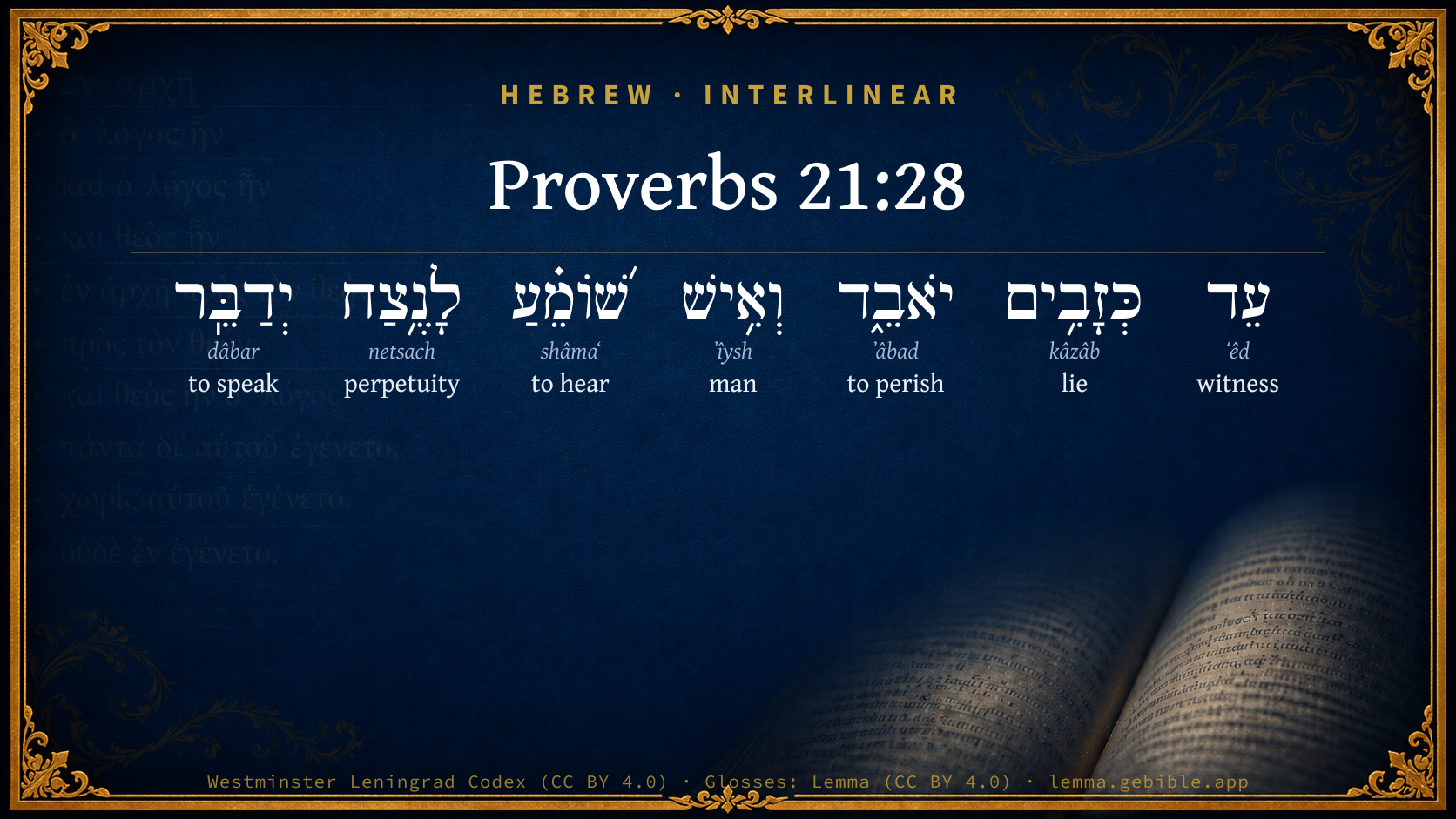
Proverbs 21:28

Hebrew (Westminster Leningrad Codex) Proverbs 21:28 appears in the Hebrew Old Testament. The text above is from the Westminster Leningrad Codex. Each word links to its Strong’s number, a concise gloss, and parsing drawn from the Open Scriptures Hebrew Bible morphology. Click any word for its full Brown-Driver-Briggs (BDB) entry.
Download image
Cite this verse

Proverbs 21:28 (World English Bible). Public Domain. Lemma interlinear Bible study tool, https://lemma.gebible.app/v/proverbs/21/28.

Show BibTeX & RIS
BibTeX
RIS
English Translation
A false witness will perish, And a man who listens speaks to eternity.
World English Bible · Public Domain
Download a study sheet

One document with this verse’s original text, its word-by-word gloss line, the meaning frame, cross-references with their text, attributed commentary, and full source and license credits — printable, and it pastes into notes with its structure intact.

This verse Autodidact and up

Study sheet (.html) Plain text (.txt)

A passage Seminary Student

Up to 50 verses in one chapter. A passage sheet keeps up to 6 commentary sources and 12 cross-references per verse, in the order this page ranks them, and says so on the sheet whenever that leaves anything out. Ask for a single verse and you get the Autodidact verse sheet above.

Everything on this page stays free to read, with no account — the sheet is a download of what is already on screen, not access to it.

Want to remove ads? Support Godless Engineer
Compare translations 3

The same verse in 3 English versions, stacked beneath the original-language interlinear above. Click any original word for its lexicon entry.

Each is an independent rendering of the whole verse — the interlinear is not word-aligned to these translations.

Highlighted words mark where these versions differ — a whole-verse word diff, not a word-by-word alignment.

  • World English Bible Public Domain
    A false witness will perish, And a man who listens speaks to eternity.
  • King James Version Public Domain
    A false witness shall perish: but the man that heareth speaketh constantly.
  • unfoldingWord Literal Text CC BY-SA 4.0
    A witness of lies will perish, but a listening man will speak to perpetuity.

unfoldingWord Literal Text — © unfoldingWord, licensed CC BY-SA 4.0. Word-aligned USFM3 via Door43 (git.door43.org/unfoldingWord/en_ult).

Versions to compare (up to 4)

3 of 4 selected

Show all 18 translations

Every available English version of this verse, each an independent rendering of the whole verse.

  • World English Bible Public Domain
    A false witness will perish, And a man who listens speaks to eternity.
  • Berean Standard Bible Public Domain
    A lying witness will perish, but the man who listens to truth will speak forever.
  • Majority Standard Bible Public Domain
    A lying witness will perish, but the man who listens to truth will speak forever.
  • King James Version Public Domain
    A false witness shall perish: but the man that heareth speaketh constantly.
  • American Standard Version (1901) Public Domain
    A false witness shall perish; But the man that heareth shall speak so as to endure.
  • Revised Version (1885) Public Domain
    A false witness shall perish: but the man that heareth shall speak unchallenged.
  • Geneva Bible (1599) Public Domain
    A false witnes shall perish: but hee that heareth, speaketh continually.
  • Douay-Rheims (1899) Public Domain
    A lying witness shall perish: an obedient man shall speak of victory.
  • Young's Literal Translation Public Domain
    A false witness doth perish, And an attentive man for ever speaketh.
  • Literal Standard Version CC BY-SA 4.0
    A false witness perishes, || And an attentive man speaks forever.
  • Unlocked Literal Bible CC BY-SA 4.0
    A false witness will perish, but the one who listens will speak for all time.
  • unfoldingWord Literal Text CC BY-SA 4.0
    A witness of lies will perish, but a listening man will speak to perpetuity.
  • Darby Bible Public Domain
    A lying witness shall perish; and a man that heareth shall speak constantly.
  • World Messianic Bible Public Domain
    A false witness will perish. A man who listens speaks to eternity.
  • Webster's Bible Public Domain
    A false witness shall perish: but the man that heareth speaketh constantly.
  • Free Bible Version CC BY-SA 4.0
    The lies of a false witness vanish away, but the words of a reliable witness will stand.
  • Bible in Basic English Public Domain
    A false witness will be cut off,...
  • JPS Tanakh (1917) Public Domain
    A false witness shall perish; but the man that obeyeth shall speak unchallenged.

Literal Standard Version (2020), Covenant Press — licensed CC BY-SA 4.0. Text via the HelloAO Bible API (eBible.org). Unlocked Literal Bible (unfoldingWord) — licensed CC BY-SA 4.0. Text via the HelloAO Bible API (eBible.org). unfoldingWord Literal Text — © unfoldingWord, licensed CC BY-SA 4.0. Word-aligned USFM3 via Door43 (git.door43.org/unfoldingWord/en_ult). Free Bible Version, Dr. Jonathan Gallagher — licensed CC BY-SA 4.0. Text via the HelloAO Bible API (eBible.org).

Word by word

More ways to search: Search by grammar → Find every occurrence → Compare this word →

Practice this passage: Drill this verse → Learn its vocabulary →

About this verse

These counts appear in no published source. They are computed here, from the morphology-tagged text and Lemma’s own curated glosses. What Lemma adds →

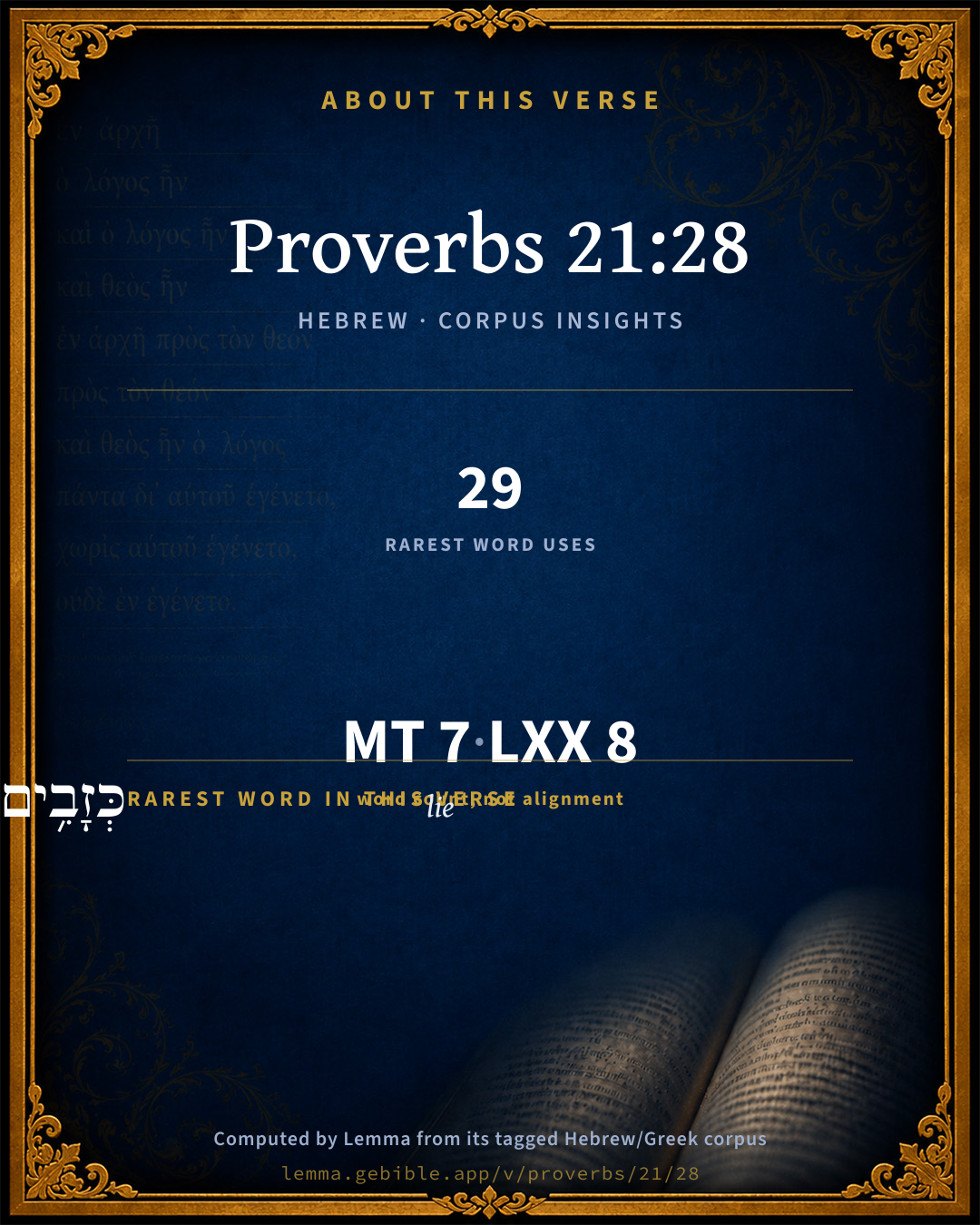
7
words
7
distinct lemmas
Wisdom
section

Shared distinctive vocabulary

כְּזָבִ֥ים lie H3577 occurs in 29 verses of the Hebrew Bible. Also found in:

Grammatical profile

  • 3 verbs
  • 4 nouns

Verb forms

  • יֹאבֵ֑ד Qal · Imperfect
  • שׁ֝וֹמֵ֗עַ Qal · Participle Active
  • יְדַבֵּֽר Piel · Imperfect

Hebrew & Septuagint length

In English translation the verse runs 13 words from the Hebrew and 12 from the Septuagint (LXX English) — closely comparable.

A rough comparison of the two English renderings, which tokenize alike — not a word-level alignment.

Word counts can differ between the Hebrew and the Greek without any difference in meaning — e.g. the Hebrew direct-object marker אֵת has no separate Greek word, and Greek often adds the article ὁ.

In the original languages it is 7 Hebrew tokens and 8 Greek tokens — but the two are counted differently (Hebrew bundles its prefixes and suffixes into one token; the Greek is in lemma form), so that isn’t a like-for-like length.

Cross-references

11

Topical passages linked to Proverbs 21:28 in the Treasury of Scripture Knowledge — connected by theme and wording, ordered by reader-vote popularity; previews shown in the World English Bible.

  • 2 Corinthians 4:13 But having the same spirit of faith, according to that which is written, "I believed, and therefore I spoke." We also believe, and therefore also we speak;
  • Proverbs 19:5 A false witness shall not be unpunished. He who pours out lies shall not go free.
  • Proverbs 19:9 A false witness shall not be unpunished. He who utters lies shall perish.
  • Deuteronomy 19:16–19 If an unrighteous witness rise up against any man to testify against him of wrong-doing,
  • Proverbs 25:18 A man who gives false testimony against his neighbor Is like a club, a sword, or a sharp arrow.
  • Exodus 23:1 "You shall not spread a false report. Don't join your hand with the wicked to be a malicious witness.
  • Proverbs 6:19 A false witness who utters lies, And he who sows discord among brothers.
  • Proverbs 12:19 Truth's lips will be established forever, But a lying tongue is only momentary.
  • Acts 12:15 They said to her, "You are crazy!" But she insisted that it was so. They said, "It is his angel."
  • 2 Corinthians 1:17–20 When I therefore was thus determined, did I show fickleness? Or the things that I purpose, do I purpose according to the flesh, that with me there should be the "Yes, yes" and the "No, no?"
  • Titus 3:8 This saying is faithful, and concerning these things I desire that you affirm confidently, so that those who have believed God may be careful to maintain good works. These things are good and profitable to men;

Cross-references courtesy of OpenBible.info (CC BY 4.0).

Hebrew and Greek witnesses Masoretic Hebrew ↔ Greek Septuagint

The same verse in the two great witnesses to the Old Testament, shown verse-for-verse.

These are two independent witnesses, not word-aligned to each other, and the Septuagint is shown in lemma (dictionary) form.

Hebrew Proverbs 21:28 Masoretic · Westminster Leningrad Codex

עֵד כְּזָבִ֥ים יֹאבֵ֑ד וְאִ֥ישׁ שׁ֝וֹמֵ֗עַ לָנֶ֥צַח יְדַבֵּֽר

A false witness will perish, And a man who listens speaks to eternity.

World English Bible · Public Domain

Greek LXX Proverbs 21:28 Septuagint · lemma form

μάρτυς ψευδής ἀποὀλλύω ἀνήρ δέ ὑπήκοος φυλάσσω λαλέω

A false witness shall perish; but an obedient man will speak cautiously.

LXX2012 (modern English Septuagint) · Public Domain

On this verse, The Cambridge Bible for Schools and Colleges discusses the Septuagint’s reading. Read the note in Commentary ↓

Hebrew: Westminster Leningrad Codex (CC BY 4.0). Greek: Septuagint (public domain); English from LXX2012 (modern English Septuagint) (Public Domain). How the Septuagint differs from the Hebrew →

Commentary

Notes on Proverbs 21:28 from classic Christian and Jewish commentators (each source and its license shown beneath its notes). The classic Christian expositions comment on the surrounding passage and are grouped to its opening verse, so a note may address several verses; the Jewish commentaries on the Tanakh (Rashi and others) are per-verse, so they appear only where the commentator wrote on this verse.

Lemma curates 59 commentaries, every one of them public domain or Creative Commons licensed, each selected and text-cleaned for this edition rather than reprinted as found. About our sources →

Trapp's Complete Commentary

John Trapp

Pro 21:28 A false witness shall perish: but the man that heareth speaketh constantly.

Ver. 28. A false witness shall perish.] {See Trapp on "Pro 19:5"} The Scythians had a law that if any man did duo peccata contorquere, bind two sins together, a lie and an oath, he was to lose his head, because this was the way to take away all faith and truth among men.

But the man that heareth speaketh constantly.] He testifieth confidently what he knoweth assuredly; he is always also in the same tale, as Paul was in the plea to the chief captain, to Felix, to Festus, and to Agrippa. Not so Bellarmine. How oft doth that loud liar forget himself, and write contradictions? As for instance, in one place he affirmeth that it can by no means be proved by Scripture that any part of Scripture is the very word of God. Sed mendax redarguit seipsum, saith Pareus. {a} But the liar confutes himself by saying elsewhere, besides other arguments to evince the divinity of the canonical Scripture, it giveth sufficient testimony to itself. {b}

{a} Paraeus in Rev 22:16.

{b} Bel de Verb. Dei, lib. i. cap. 2.

John Trapp, A Commentary or Exposition upon All the Books of the Old and New Testament (1647–1656) — public domain. Text from a community e-Sword module.

Joseph Benson's Commentary

Pro 21:28. A false witness — Hebrew, עד כזבים, A witness of lies; one who is forward to swear or speak false things, or such things as he hath neither heard nor seen, but devised in his own heart; shall perish — Shall be severely punished, either by God or men, and shall be confounded and silenced, because none will for the future regard or credit his testimony. But the man that heareth — Before he speaks, and witnesseth nothing but what he has heard or seen, and knows to be true; speaketh constantly —

Doth not contradict himself, but always affirms the same thing. Or, as most interpreters render לנצח ידבר, speaketh, or may, or shall speak for ever. He dare speak freely and boldly; and, when liars are cut off, he lives, and is in a capacity of speaking and bearing witness again and again, as occasion requires, as long as he lives, and his testimony will be received.

Joseph Benson's Commentary on the Old and New Testaments (1811–1818) — public domain. Text from a community e-Sword module.

Geneva Bible (1599)

Geneva Bible translators

He may boldly testify the truth that he hath heard.

Geneva Bible (1599) marginal notes — public domain. Text via Bolls.life.

Matthew Henry's Commentary

Here is, 1. The doom of a false witness. He who, for favour to one side or malice to the other, gives in a false evidence, or makes an affidavit of that which he knows to be false, or at least does not know to be true, if it be discovered, his reputation will be ruined. A man may tell a lie perhaps in his haste; but he that gives a false testimony does it with deliberation and solemnity, and it cannot but be a presumptuous sin, and a forfeiture of man's credit. But, though he should not be discovered, he himself shall be ruined; the vengeance he imprecated upon himself, when he took the false oath, will come upon him. 2. The praise of him that is conscientious: He who hears (that is, obeys) the command of God, which is to speak every man truth with his neighbour, he who testifies nothing but what he has heard and knows to be true, speaks constantly (that is, consistently with himself); he is always in the same story; he speaks in finem - to the end; people will give credit to him and hear him out; he speaks unto victory; he carries the cause, which the false witness shall lose; he shall speak to eternity. What is true is true eternally. The lip of truth is established for ever.

Matthew Henry's Commentary on the Whole Bible (1708–1710) — public domain (CC PDM 1.0). Text via the HelloAO Bible API.

Jamieson, Fausset & Brown

Robert Jamieson, A. R. Fausset & David Brown

(Compare Pro 19:5).

that heareth--or heeds instruction, and so grows wise.

speaketh constantly--or sincerely (compare Hab 1:5), and hence is believed (Pro 12:19; Jam 1:19).

Jamieson, Fausset & Brown — Commentary Critical and Explanatory on the Whole Bible (1871) — public domain (CC PDM 1.0). Text via the HelloAO Bible API.

Ellicott's Commentary for English Readers

(28) But the man that heareth (carefully, and repeats accurately) speaketh constantly (his testimony will live).—Comp., “he being dead yet speaketh,” Heb_11:4.

A Bible Commentary for English Readers, edited by Charles John Ellicott (1878–1897) — public domain. Text from a community e-Sword module.

The Cambridge Bible for Schools and Colleges

gen. ed. J. J. S. Perowne

28. that heareth] Either (1) who listens to the voice of duty and of conscience (ἀνὴρ ὑπήκοος, LXX.; vir obediens, Vulg.); or (2) who simply states in evidence what he has heard, “the truth, the whole truth, and nothing but the truth” (qui non nisi quæ ipse audivit testatur Maurer). Comp. ὃ ἑωράκαμεν καὶ ἀκηκόαμεν ἀπαγγέλλομεν ὑμῖν, 1Jn_1:3.

constantly] Lit. for ever, so as to endure, R.V. marg. He will live on to speak, in contrast to the false witness who will perish. This preserves the parallelism better than shall speak unchallenged, (R.V. text), i.e. shall speak on, without being interrupted by cross-questioning, or objection, because his testimony will carry conviction, and be listened to with respectful silence.

The Cambridge Bible for Schools and Colleges (gen. ed. J. J. S. Perowne; Cambridge University Press, 1878–1918) — public domain. Text from a community e-Sword module.

John Gill's Exposition

A false witness shall perish,.... As witness he shall perish in his reputation, no credit shall be given him, he shall not be admitted an evidence, or a witness in any cause, being found a false one; and as a man, he shall be punished in body or estate by the civil magistrate, and his soul shall perish eternally, unless he has true repentance for his sin: or, a witness of lies shall perish (k) it may be applied to any teacher of false doctrine; and to the man of sin, and his followers, that speak lies in hypocrisy; everyone that loves and makes a lie shall die the second death, and be excluded from eternal happiness, Rev 21:8;

but the man that heareth; before he speaks, and speaks what he hears, and does not devise things himself; but witnesses the truth, and nothing else, to the best of his knowledge:

speaketh constantly; invariably and consistently, what is all of a piece, and by which he ah, des; or "continually", as Jarchi; or "for ever"; he is made use of as a witness as long as he lives, whenever there is occasion for him; the Vulgate Latin version renders it, "he speaks victory"; his testimony, being true and valid, carries the cause: it, nay be applied to a faithful teacher, who hearkens to the word of God, and speaks according to that; such an one speaks out, he doctrine of the word constantly, boldly, with certainty, without any hesitation or staggering.

(k) "testis mendaciorum", Montanus, Junius & Tremellius, Cocceius, Gejerus, Michaelis, Schultens.

John Gill's Exposition of the Whole Bible (1746–1763) — public domain (CC PDM 1.0). Text via the HelloAO Bible API.

Albert Barnes' Notes on the Bible

Speaketh constantly - His testimony abides evermore who repeats simply what he has heard, whether from the lips of men or from the voice within, in contrast with “the false witness.”

Albert Barnes' Notes on the Bible (1834–1885) — public domain. Text from a community e-Sword/MySword module.

Haydock's Catholic Bible Commentary

Obedient. Attentive, faithful witness, shall speak with triumph, or he who obeys the law, shall gain the victory over the devil, &c. (Philippians ii. 8.)

George Leo Haydock (1774–1849), Haydock's Catholic Family Bible and Commentary, 1859 edition — public domain. Excludes Psalms (Douay-Rheims chapter numbering differs from Protestant) and Deuterocanonical books (Catholic canon only).

Matthew Poole's English Annotations

A false witness, Heb. a witness of lies; one who is forward to swear or speak false things, or such things as he hath not heard nor learned from others, nor seen, but devised in his own heart.

Shall perish; shall be severely punished, either by God or men, and shall be confounded and silenced, because none will for the future regard or credit his testimony. The man that heareth; he who hears before he speaks, and witnesseth nothing but what he hath heard or seen, and knows to be true.

Speaketh constantly; doth not contradict himself, but always affirmeth the same thing. Or, as most other interpreters render the words, speaketh (or, may speak, dare speak freely and boldly) for ever; when liars are cut off, he lives, and is in a capacity of speaking and bearing witness again and again, as occasion requires, as long as he lives, and his testimony will be received.

Matthew Poole's English Annotations on the Holy Bible (1683–1685) — public domain. Text from a community e-Sword/MySword module.

Whedon's Commentary on the Bible

Daniel D. Whedon

28. A false witness — A witness of lies; one who testifies falsely.

Shall perish — יאבד, (yobhedh.) It is possible that this verb is used here in its primitive sense, shall lose himself, namely, by wandering.

But the man that heareth — Who has heard attentively the words spoken, and testified accordingly.

Speaketh — Shall be allowed to speak freely, a privilege not conceded to the “false witness,” who, because of prevarications, is stopped. Compare Pro_12:17; Pro_19:5; Pro_19:9. “Human testimony is one of the chief agencies of society. Without it the social organization could not be sustained, nor its machinery kept in motion. Much of what must necessarily be known in conducting the affairs of life we owe to the veracity of witnesses. Hence the many precepts in this book respecting it, enforcing the obligation of a strict observance of the ninth commandment in the disclosure.” — Conant. Compare Exo_20:16.

Daniel D. Whedon (gen. ed.), Commentary on the Old and New Testaments (1874–1909) — public domain. Text from a community e-Sword module.

The Pulpit Commentary

For the first hemistich, see Pro_6:19 Pro_19:5, Pro_19:9. Shall perish. His testimony is worthless, and both he and it come to nothing. The man that heareth speaketh constantly; Vulgate, vir obediens; Septuagint, Anhkoov fulassomenov lalhsei , "An obedient man will speak guardedly." "The man that heareth" is one who is attentive, who listens before he speaks, and reports only what he has heard. Such a one will speak "for continuance," so that what he says is never falsified, or silenced, or refuted. Vulgate, loquetur victoriam. And so Aquila, Theodotion, and Symmachus, eiv nikov . Revised Version, unchallenged. The expression thus rendered is lanetsach, which means, in Hebrew at any rate, in perpetuum, "for continuance." But St. Jerome"s rendering has been much used by the Fathers, who have drawn therefrom lessons of obedience. Thus St. Augustine, "In Psalm.," 70., "Sola obedientia tenet palmam, sola inobedientia invenit poenam." St. Gregory, "Moral," 35:28, "An obedient man in truth speaketh of victories, because, when we humbly submit ourselves to the voice of another, we overcome ourselves in our heart" (Oxford transl.). See a long dissertation on obedience in the note of Corn a Lapide on this passage of Proverbs.

The Pulpit Commentary (1880–1919), ed. H.D.M. Spence-Jones & Joseph S. Exell — public domain. Text from a community e-Sword module.

John Wesley's Explanatory Notes

Heareth - He witnesses nothing but what he has heard or seen. Constantly - Always affirms the same thing.

John Wesley, Explanatory Notes Upon the Whole Bible (1754–1765) — public domain. Text via the GEBible commentary corpus.

Keil & Delitzsch

C. F. Keil & F. Delitzsch

28 A false witness shall perish;

But he who heareth shall always speak truth.

The lxx translate 28b by ἀνὴρ δὲ φυλασσόμενος λαλήσει. Cappellus supposes that they read לנצר for לנצה, which, however, cannot mean "taking care." Hitzig further imagines שׂמח for שׁמע, and brings out the meaning: "the man that rejoiceth to deliver shall speak." But where in all the world does נצר mean "to deliver"? It means, "to guard, preserve;" and to reach the meaning of "to deliver," a clause must be added with מן, as מרע. When one who speaks lies (עד כּזבים), and a man who hears (אישׁ שּׁומע, plene, and with the orthophonic Dagesh), are contrasted, the former is one who fancifully or malevolently falsifies the fact, and the latter is one who before he speaks hears in order that he may say nothing that he has not surely heard. As לב שׁמע, Kg1 3:9, means an obedient heart, so here אישׁ שּׁומע means a man who attentively hears, carefully proves. Such an one will speak לנצח, i.e., not: according to the truth, and not: for victory (Aquila, Symmachus, Theodotion, εἰς νῖκος), i.e., so that accomplishes it (Oetinger); for the Heb. נצח has neither that Arab. nor this Aram. signification; but, with the transference of the root meaning of radiating or streaming over, to time, continuous existence (vid., Orelli, Synonyma der Zeit und Ewigkeit, pp. 96-97), thus: he will speak for continuance, i.e., either: without ever requiring to be silent, or, which we prefer: so that what he says stands; on the contrary, he who testifies mere fictions, i.e., avers that they are truth, is destroyed (28a = Pro 19:9, cf. 5): he himself comes to nothing, since his testimonies are referred to their groundlessness and falsity; for שׁקר אין לו רגלים, the lie has no feet on which it can stand, it comes to nothing sooner or later.

Keil & Delitzsch — Biblical Commentary on the Old Testament (1861–1891) — public domain (CC PDM 1.0). Text via the HelloAO Bible API. (Old Testament only.)

Bridges on Proverbs

Charles Bridges

The last clause of the proverb seems to fix and restrict the first. A false witness often becomes so by the culpable habit of thoughtlessly repeating, without examination or certain knowledge. A man may thus do very serious injury to his neighbor’s character or property. It proves a very loose conscience, and an utter want of that "charity, which covers," instead of exposing faults.†1 It is "rejoicing in iniquity," rather than "rejoicing in truth."†2 This false witness will certainly be punished by God;†3 and even ’by man he will be confounded and silenced. No one for the future will regard or receive his testimony.’†4 But the man that heareth — the true witness who speaketh only what he heareth, and is fully acquainted with — he speaketh constantly — to conviction. He holds to his testimony and never contradicts himself. He ’speaks the truth, the whole truth, and nothing but the truth.’ His word, even if it had been slighted at first, gains more and more credit and authority, when the false witness shall have perished. (Pro 12:19 .)

Thus "the faithful and true witness" declared for himself and his servants — "We speak that we do know, and testify that we have seen."†5 The Apostles, to give solid weight to their testimony, would fill up the vacancy in their body only from among those, "who had companied with them all the time that the Lord Jesus went in and out among them" (Act 1:21-22 ); as if those only, who had heard, would speak constantly. They claimed authority to their commission, as having heard from the mouth of God, and therefore being assured of its divine warrant.†6 And indeed this constitutes the main power of testimony. A feeble and hesitating tone is spiritless and ineffective. (2Co 1:17 .) A decided accredited presentment of truth — speaking constantly — commands conviction. "We believe, and therefore we speak." (2Co 4:13 .)

Footnotes:

†1 Pro 10:12.

†2 Contrast 1Co 13:1-13 .

†3 Pro 19:5, Pro 19:9 .

†4 Poole in loco.

†5 Rev 3:14. Joh 3:11 .

†6 1Co 1:23 ; 1Co 15:3-4 . 2Pe 1:16-18 . 1Jn 1:1-3 .

Charles Bridges, An Exposition of the Book of Proverbs (1846) — public domain. Text from a community e-Sword module.

Kretzmann's Popular Commentary

Paul E. Kretzmann

v. 28. A false witness shall perish, Pro 19:5-9; but the man that heareth speaketh constantly, being modest and lending a ready ear to instruction, he is able to render reliable testimony, not being obliged to cease for uncertainty or a muddled condition of his mind.

Paul E. Kretzmann, Popular Commentary of the Bible (1921–1924) — public domain. Text from a community e-Sword module.

Rashi

Rabbi Shlomo Yitzchaki (Rashi)

but an obedient man who obeys what is written in the Torah: “You shall not bear false witness against your neighbor.”

forever Always.

Rashi on the Tanakh — English translations: “The Judaica Press complete Tanach with Rashi, translated by A. J. Rosenberg” (CC BY 4.0); “Pentateuch with Rashi's commentary by M. Rosenbaum and A.M. Silbermann, 1929-1934” (public domain); “The Metsudah Tanach series, Lakewood, N.J” (CC BY 4.0); and “The Book of Joshua, Metsudah Publications, 1997” (CC BY 4.0). Text via Sefaria.

Lesson kit

Teaching starters — assembled from the data on this page, not authored interpretation. Every prompt links to the verse data it draws on. Edit before teaching.

Proverbs, in the Wisdom, opens this verse with 7 words (7 distinct Hebrew lemmas). Its most distinctive word is kâzâb (“lie”). A historical commentator’s framing appears above. Read the whole chapter for the surrounding context.

Discussion questions

  1. The word kâzâb carries the sense “lie.” How does it shape the verse?
  2. Psalms 4:2 shares the word «lie» with this verse. How do the two illuminate each other?
  3. These translations render this verse differently. What is at stake in choosing one wording over another?
  4. The verb «יֹאבֵ֑ד» is Qal Imperfect. How does its form color the action?
  5. Reading how Trapp's Complete Commentary and Joseph Benson's Commentary read this verse, where do the two commentators agree and where do they part?

Things to notice

Reading settings

Reading text

Shown beneath each verse's original-language words.

Old Testament
Old Testament edition

Read the OT as the Masoretic Hebrew (MT) or the Greek Septuagint (LXX).

English shown for the Greek Septuagint (in the Hebrew ↔ Greek comparison).

Comparing translations? Open the Compare panel on any verse page to stack up to four side by side.