Numbers 25:15

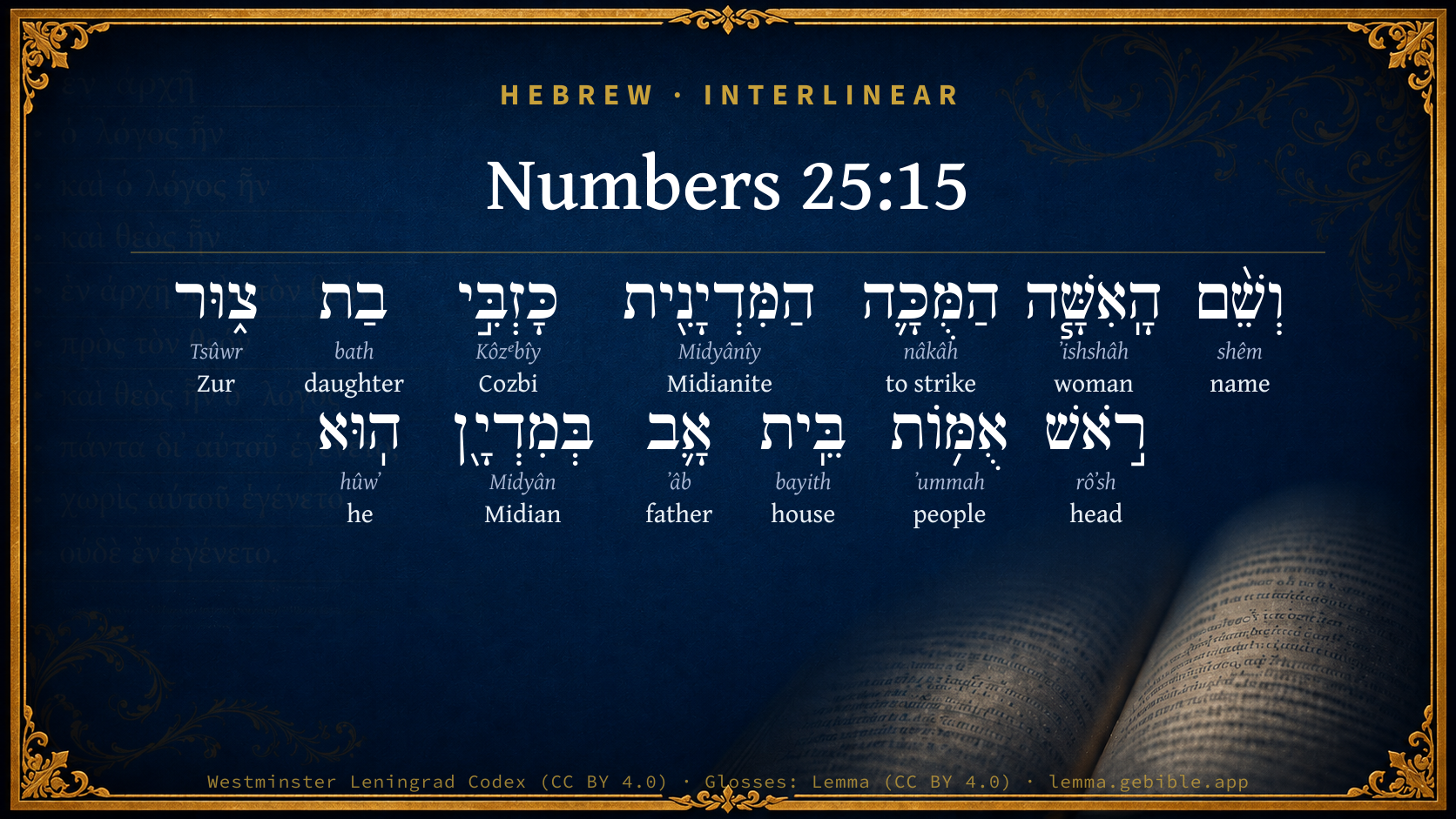
Hebrew (Westminster Leningrad Codex) Numbers 25:15 appears in the Hebrew Old Testament. The text above is from the Westminster Leningrad Codex. Each word links to its Strong’s number, a concise gloss, and parsing drawn from the Open Scriptures Hebrew Bible morphology. Click any word for its full Brown-Driver-Briggs (BDB) entry.
Download image
Cite this verse

Numbers 25:15 (World English Bible). Public Domain. Lemma interlinear Bible study tool, https://lemma.gebible.app/v/numbers/25/15.

Show BibTeX & RIS
BibTeX
RIS
English Translation
The name of the Midianite woman who was slain was Cozbi, the daughter of Zur; he was head of the people of a fathers' house in Midian.
World English Bible · Public Domain
Highlights
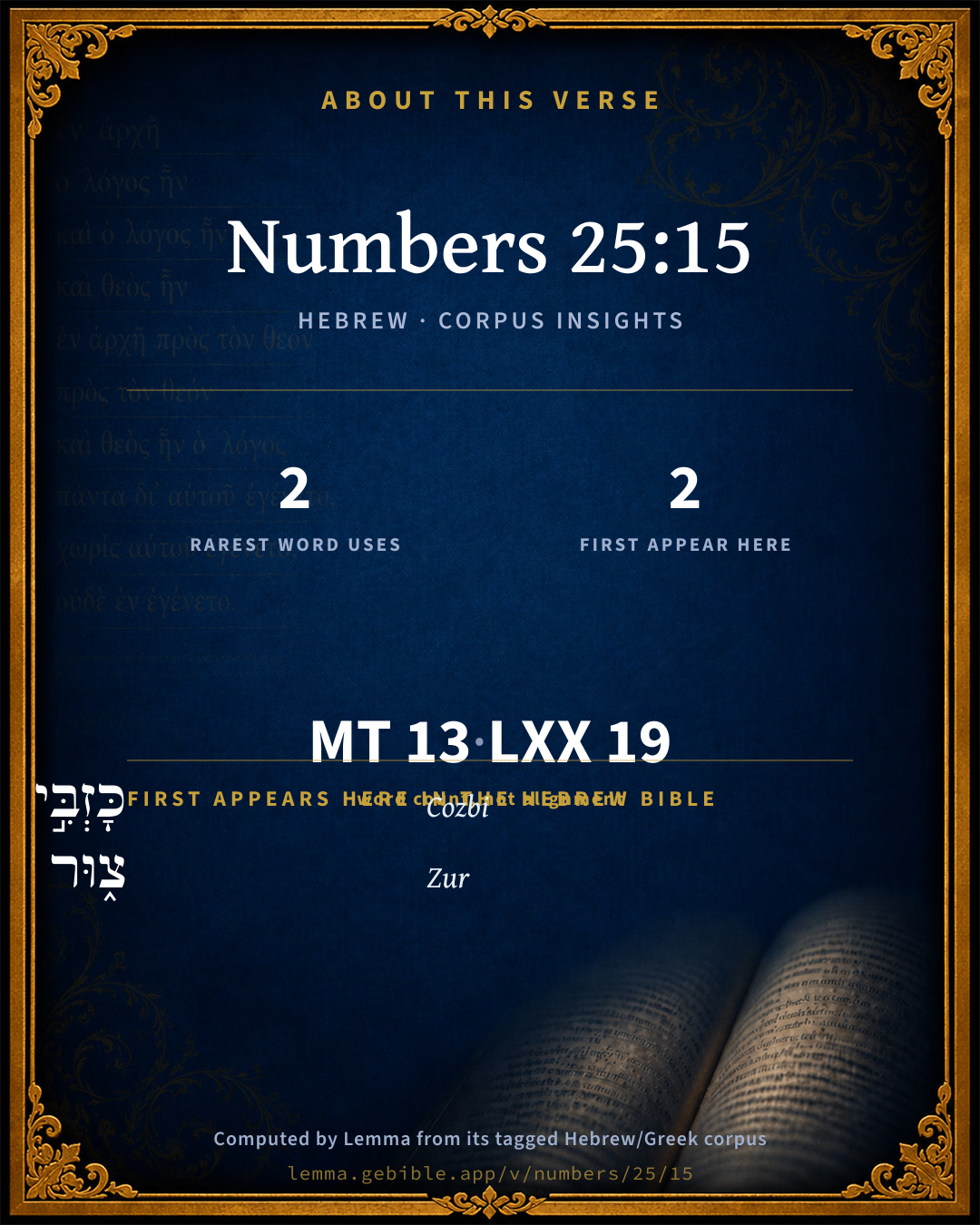
  • 2 first appearances in the Hebrew Bible
Full analysis ↓
Download a study sheet

One document with this verse’s original text, its word-by-word gloss line, the meaning frame, cross-references with their text, attributed commentary, and full source and license credits — printable, and it pastes into notes with its structure intact.

This verse Autodidact and up

Study sheet (.html) Plain text (.txt)

A passage Seminary Student

Up to 50 verses in one chapter. A passage sheet keeps up to 6 commentary sources and 12 cross-references per verse, in the order this page ranks them, and says so on the sheet whenever that leaves anything out. Ask for a single verse and you get the Autodidact verse sheet above.

Everything on this page stays free to read, with no account — the sheet is a download of what is already on screen, not access to it.

Want to remove ads? Support Godless Engineer
Compare translations 3

The same verse in 3 English versions, stacked beneath the original-language interlinear above. Click any original word for its lexicon entry.

Each is an independent rendering of the whole verse — the interlinear is not word-aligned to these translations.

Highlighted words mark where these versions differ — a whole-verse word diff, not a word-by-word alignment.

  • World English Bible Public Domain
    The name of the Midianite woman who was slain was Cozbi, the daughter of Zur; he was head of the people of a fathers' house in Midian.
  • King James Version Public Domain
    And the name of the Midianitish woman that was slain was Cozbi, the daughter of Zur; he was head over a people, and of a chief house in Midian.
  • unfoldingWord Literal Text CC BY-SA 4.0
    And the name of the woman, the struck down Midanite woman, was Kozbi the daughter of Zur, who was the head of a tribe of a house of a father in Midian.

unfoldingWord Literal Text — © unfoldingWord, licensed CC BY-SA 4.0. Word-aligned USFM3 via Door43 (git.door43.org/unfoldingWord/en_ult).

Versions to compare (up to 4)

3 of 4 selected

Show all 18 translations

Every available English version of this verse, each an independent rendering of the whole verse.

  • World English Bible Public Domain
    The name of the Midianite woman who was slain was Cozbi, the daughter of Zur; he was head of the people of a fathers' house in Midian.
  • Berean Standard Bible Public Domain
    And the name of the slain Midianite woman was Cozbi, the daughter of Zur, a tribal chief of a Midianite family.
  • Majority Standard Bible Public Domain
    And the name of the slain Midianite woman was Cozbi, the daughter of Zur, a tribal chief of a Midianite family.
  • King James Version Public Domain
    And the name of the Midianitish woman that was slain was Cozbi, the daughter of Zur; he was head over a people, and of a chief house in Midian.
  • American Standard Version (1901) Public Domain
    And the name of the Midianitish woman that was slain was Cozbi, the daughter of Zur; he was head of the people of a fathers' house in Midian.
  • Revised Version (1885) Public Domain
    And the name of the Midianitish woman that was slain was Cozbi, the daughter of Zur; he was head of the people of a fathers’ house in Midian.
  • Geneva Bible (1599) Public Domain
    And the name of the Midianitish woman, that was slayne, was Cozbi the daughter of Zur, who was head ouer the people of his fathers house in Midian.
  • Douay-Rheims (1899) Public Domain
    And the Madianite woman, that was slain with him, was called Cozbi the daughter of Sur, a most noble prince among the Madianites.
  • Young's Literal Translation Public Domain
    and the name of the woman who is smitten, the Midianitess, `is' Cozbi daughter of Zur, head of a people -- of the house of a father in Midian `is' he.
  • Literal Standard Version CC BY-SA 4.0
    and the name of the woman who is struck, the Midianitess, [is] Cozbi daughter of Zur; he [is] head of peoples of a father’s house in Midian.
  • Unlocked Literal Bible CC BY-SA 4.0
    The name of the Midianite woman who was killed was Kozbi daughter of Zur, who was head of a tribe and family in Midian.
  • unfoldingWord Literal Text CC BY-SA 4.0
    And the name of the woman, the struck down Midanite woman, was Kozbi the daughter of Zur, who was the head of a tribe of a house of a father in Midian.
  • Darby Bible Public Domain
    And the name of the Midianitish woman that was slain was Cozbi, the daughter of Zur; he was tribal head of a father's house in Midian.
  • World Messianic Bible Public Domain
    The name of the Midianite woman who was slain was Cozbi, the daughter of Zur. He was head of the people of a fathers’ house in Midian.
  • Webster's Bible Public Domain
    And the name of the Midianitish woman that was slain was Cozbi the daughter of Zur; he was head over a people, and of a chief house in Midian.
  • Free Bible Version CC BY-SA 4.0
    The name of the Midianite woman who was killed was Cozbi, daughter of Zur, a family leader of a Midianite tribe.
  • Bible in Basic English Public Domain
    And the woman of Midian who was put to death was Cozbi, the daughter of Zur; he was the head of a family in Midian.
  • JPS Tanakh (1917) Public Domain
    And the name of the Midianitish woman that was slain was Cozbi, the daughter of Zur; he was head of the people of a fathers' house in Midian.

Literal Standard Version (2020), Covenant Press — licensed CC BY-SA 4.0. Text via the HelloAO Bible API (eBible.org). Unlocked Literal Bible (unfoldingWord) — licensed CC BY-SA 4.0. Text via the HelloAO Bible API (eBible.org). unfoldingWord Literal Text — © unfoldingWord, licensed CC BY-SA 4.0. Word-aligned USFM3 via Door43 (git.door43.org/unfoldingWord/en_ult). Free Bible Version, Dr. Jonathan Gallagher — licensed CC BY-SA 4.0. Text via the HelloAO Bible API (eBible.org).

Word by word

More ways to search: Search by grammar → Find every occurrence → Compare this word →

Practice this passage: Drill this verse → Learn its vocabulary →

כָּזְבִּ֣י
Kôzᵉbîy
H3579
“Cozbi”
Noun, Proper
Part of Speech
Noun
Type
Proper
Full BDB Definition

Origin: from H3576

TWOT: None

Cozbi = "my lie" - a daughter of Zur, a chief of the Midianites, who was slain by Phinehas because of her adultery
  1. וְשֵׁ֨ם shêm H8034 “and · name of” Conjunction + Noun, Common, Masculine, Singular, Construct
  2. הָֽאִשָּׁ֧ה ʼishshâh H802 “the · woman” Particle, Definite Article + Noun, Common, Feminine, Singular, Absolute
  3. הַמֻּכָּ֛ה nâkâh H5221 “the · struck” Particle, Definite Article + Verb, Hophal, Participle Passive, Feminine, Singular, Absolute
  4. הַמִּדְיָנִ֖ית Midyânîy H4084 “the · Midianite” Particle, Definite Article + Adjective, Adjective, Feminine, Singular, Absolute
  5. בַת bath H1323 “daughter of” Noun, Common, Feminine, Singular, Construct
  6. צ֑וּר Tsûwr H6698 “Zur” Noun, Proper
  7. רֹ֣אשׁ rôʼsh H7218 “head of” Noun, Common, Masculine, Singular, Construct
  8. אֻמּ֥וֹת ʼummah H523 “peoples” Noun, Common, Feminine, Plural, Absolute
  9. בֵּֽית bayith H1004 “house of” Noun, Common, Masculine, Singular, Construct
  10. אָ֛ב ʼâb H1 “father” Noun, Common, Masculine, Singular, Absolute
  11. בְּמִדְיָ֖ן Midyân H4080 “in/at · Midian” Preposition + Noun, Proper
  12. הֽוּא hûwʼ H1931 “he” Pronoun, Personal, 3rd Person, Masculine, Singular

About this verse

These counts appear in no published source. They are computed here, from the morphology-tagged text and Lemma’s own curated glosses. What Lemma adds →

13
words
13
distinct lemmas
Pentateuch
section

Notable vocabulary

The rarest word here is כָּזְבִּ֣י Cozbi H3579 — appearing just 2 times in the whole Hebrew Bible.

First appearance in Scripture

These words make their first canonical appearance in the Hebrew Bible here:

  • כָּזְבִּ֣י Cozbi H3579
  • צ֑וּר Zur H6698

Shared distinctive vocabulary

כָּזְבִּ֣י Cozbi H3579 occurs in 2 verses of the Hebrew Bible. Also found in:

Grammatical profile

  • 1 verb
  • 10 nouns
  • 1 adjective
  • 1 pronoun

Verb forms

  • הַמֻּכָּ֛ה Hophal · Participle Passive

Hebrew & Septuagint length

In English translation the verse runs 27 words from the Hebrew and 32 from the Septuagint (LXX English) — closely comparable.

A rough comparison of the two English renderings, which tokenize alike — not a word-level alignment.

Word counts can differ between the Hebrew and the Greek without any difference in meaning — e.g. the Hebrew direct-object marker אֵת has no separate Greek word, and Greek often adds the article ὁ.

In the original languages it is 13 Hebrew tokens and 19 Greek tokens — but the two are counted differently (Hebrew bundles its prefixes and suffixes into one token; the Greek is in lemma form), so that isn’t a like-for-like length.

Cross-references

3

Topical passages linked to Numbers 25:15 in the Treasury of Scripture Knowledge — connected by theme and wording, ordered by reader-vote popularity; previews shown in the World English Bible.

  • Numbers 31:8 They killed the kings of Midian with the rest of their slain: Evi, and Rekem, and Zur, and Hur, and Reba, the five kings of Midian: Balaam also the son of Beor they killed with the sword.
  • Joshua 13:21 and all the cities of the plain, and all the kingdom of Sihon king of the Amorites, who reigned in Heshbon, whom Moses struck with the chiefs of Midian, Evi, and Rekem, and Zur, and Hur, and Reba, the princes of Sihon, who lived in the land.
  • Numbers 25:18 for they vex you with their wiles, with which they have deceived you in the matter of Peor, and in the matter of Cozbi, the daughter of the prince of Midian, their sister, who was slain on the day of the plague in the matter of Peor.

Cross-references courtesy of OpenBible.info (CC BY 4.0).

Hebrew and Greek witnesses Masoretic Hebrew ↔ Greek Septuagint

The same verse in the two great witnesses to the Old Testament, shown verse-for-verse.

These are two independent witnesses, not word-aligned to each other, and the Septuagint is shown in lemma (dictionary) form.

Hebrew Numbers 25:15 Masoretic · Westminster Leningrad Codex

וְשֵׁ֨ם הָֽאִשָּׁ֧ה הַמֻּכָּ֛ה הַמִּדְיָנִ֖ית כָּזְבִּ֣י בַת צ֑וּר רֹ֣אשׁ אֻמּ֥וֹת בֵּֽית אָ֛ב בְּמִדְיָ֖ן הֽוּא

The name of the Midianite woman who was slain was Cozbi, the daughter of Zur; he was head of the people of a fathers' house in Midian.

World English Bible · Public Domain

Greek LXX Numbers 25:15 Septuagint · lemma form

καί ὄνομα ὁ γυνή ὁ μαδιανῖτις ὁ πλήσσω χασβι θυγάτηρ σουρ ἄρχων ἔθνος ομμωθ οἶκος πατριά εἰμί ὁ μαδιαν

And the name of the Madianitish woman who was struck, was Chasbi, daughter of Sur, a prince of the nation of Ommoth: it is a chief house among the people of Madiam.

LXX2012 (modern English Septuagint) · Public Domain

Hebrew: Westminster Leningrad Codex (CC BY 4.0). Greek: Septuagint (public domain); English from LXX2012 (modern English Septuagint) (Public Domain). How the Septuagint differs from the Hebrew →

Targum (Aramaic paraphrase)

2

The Targum is the ancient Jewish Aramaic paraphrase of the Hebrew Scriptures — an interpretive translation, not the Hebrew text itself. Onkelos (literal) and Pseudo-Jonathan (expansive) render the Torah, and Jonathan the Prophets. Coverage is partial: where no permissively-licensed English translation exists for a verse, only the Aramaic is shown. This is verse-level text, not a word-by-word alignment to the Hebrew.

  1. Targum Onkelos Torah (Genesis–Deuteronomy)
    וְשׁוּם אִתְּתָא דְאִתְקְטִילַת מִדְיָנֵיתָא כָּזְבִּי בַּת צוּר רֵישׁ אוּמֵי בֵּית אַבָּא בְּמִדְיָן הוּא

    (no public-domain English translation for this verse)

    Targum Onkelos — Aramaic: “Onkelos Genesis” (public domain); “Onkelos Exodus” (public domain); “Onkelos Leviticus” (public domain); “Onkelos Numbers” (public domain); “Onkelos Deuteronomy” (public domain). English: “Sefaria Community Translation” (CC0 1.0 (public-domain dedication)); “J.W. Etheridge. The Targums of Onkelos and Jonathan Ben Uzziel on the Pentateuch. London: Longmans, Green, 1862” (public domain). Text via Sefaria.

  2. Targum Pseudo-Jonathan Torah (Genesis–Deuteronomy)
    וְשׁוּם אִתְּתָא קְטִילְתָּא מִדְיָינֵיתָא כָּזְבִּי בְּרַת צוּר דְמִתְקַרְיָיא שְׁלוֹנָאֵי בְּרַת בָּלָק רֵישׁ אוּמָא דְמוֹאָב בְּמִדְיָן בֵּית מוֹתְבֵיהּ הוּא

    And the name of the Midianite woman who was killed was Kosbi, daughter of Zur, who was called Shelonae, a daughter of Balak, the prince of the people of Moab, whose dwelling-place was in Midian.

    Targum Pseudo-Jonathan — Aramaic: “Targum Jonathan on Genesis” (public domain); “Targum Jonathan on Exodus” (public domain); “Targum Jonathan on Leviticus” (public domain); “Targum Jonathan on Numbers” (public domain); “Targum Jonathan on Deuteronomy” (public domain). English: “The Targum of Jonathan ben Uzziel, trans. J. W. Etheridge, London, 1862” (public domain). Text via Sefaria.

Commentary

Notes on Numbers 25:15 from classic Christian and Jewish commentators (each source and its license shown beneath its notes). The classic Christian expositions comment on the surrounding passage and are grouped to its opening verse, so a note may address several verses; the Jewish commentaries on the Tanakh (Rashi and others) are per-verse, so they appear only where the commentator wrote on this verse.

Lemma curates 59 commentaries, every one of them public domain or Creative Commons licensed, each selected and text-cleaned for this edition rather than reprinted as found. About our sources →

Ellicott's Commentary for English Readers

(15) Head over a people, and of a chief house in Midian.—Better, head of the tribes (or, communities) of a father’s house in Midian. Several of the Midianitish tribes, or smaller divisions of a father’s house, may have descended from one tribe-father. In Num_31:8, Zur is described as one of the five kings of Midian who were slain by the Israelites.

A Bible Commentary for English Readers, edited by Charles John Ellicott (1878–1897) — public domain. Text from a community e-Sword module.

The Cambridge Bible for Schools and Colleges

gen. ed. J. J. S. Perowne

15. the daughter of Zur] Zur is named as one of the five Midianite kings, in Num_31:8.

The Cambridge Bible for Schools and Colleges (gen. ed. J. J. S. Perowne; Cambridge University Press, 1878–1918) — public domain. Text from a community e-Sword module.

John Gill's Exposition

And the Lord spake unto Moses,.... This was some time after the above affair happened; how long it was is not certain; and a little time before the death of Moses, see Num 31:1,

saying; as follows.

John Gill's Exposition of the Whole Bible (1746–1763) — public domain (CC PDM 1.0). Text via the HelloAO Bible API.

Matthew Poole's English Annotations

Zur; one of the kings or princes or Midian, Num 31:8; Jos 13:21.

Of a chief house, or, and over her father’ s house.

Matthew Poole's English Annotations on the Holy Bible (1683–1685) — public domain. Text from a community e-Sword/MySword module.

The Pulpit Commentary

Head over a people, and of a chief house in Midian. Rather, "head of tribes (twOMau, for the use of which cf. Gen_25:16) of a father"s house in Midian." It seems to mean that several clans descended from one tribe-father looked up to Zur as their head. In Num_31:8 he is called one of the five "kings" of Midian. That the daughter of such a man should have been selected, and should have been willing, to play such a part throws a strong light upon the studied character and the peculiar danger of the seduction.

The Pulpit Commentary (1880–1919), ed. H.D.M. Spence-Jones & Joseph S. Exell — public domain. Text from a community e-Sword module.

Rashi

Rabbi Shlomo Yitzchaki (Rashi)

ושם האשה המכה וגו׳ AND THE NAME OF THE [MIDIANITISH] WOMAN WHO WAS SMITTEN etc. — This is stated to show you the hatred the Midianites bore to Israel — that they abandoned even a princess to prostitution in order to make Israel sin (Midrash Tanchuma, Pinchas 2).

ראש אמות [HE WAS] THE HEAD OF THE PEOPLE — He was one of the five kings of Midian, Evi and Rekem and Zur etc. (31:8). He, however, was the most important of all of them, as it is said, “the head of the people”, but because he made himself despicable by abandoning his daughter to prostitution it enumerates him not first but only third (Midrash Tanchuma, Pinchas 2).

בית אב — Midian had five fathers’ houses: Ephah and Epher, and Hanoch, and Abida and Eldoah (Genesis 25:4) — and this man was king of one of them.

Rashi on the Tanakh — English translations: “The Judaica Press complete Tanach with Rashi, translated by A. J. Rosenberg” (CC BY 4.0); “Pentateuch with Rashi's commentary by M. Rosenbaum and A.M. Silbermann, 1929-1934” (public domain); “The Metsudah Tanach series, Lakewood, N.J” (CC BY 4.0); and “The Book of Joshua, Metsudah Publications, 1997” (CC BY 4.0). Text via Sefaria.

Lesson kit

Teaching starters — assembled from the data on this page, not authored interpretation. Every prompt links to the verse data it draws on. Edit before teaching.

Numbers, in the Pentateuch, opens this verse with 13 words (13 distinct Hebrew lemmas). Its most distinctive word is Kôzᵉbîy (“Cozbi”). A historical commentator’s framing appears above. Read the whole chapter for the surrounding context.

Discussion questions

  1. What does “Cozbi” (Kôzᵉbîy) contribute to the verse as a whole?
  2. 2 words make their first appearance in Scripture here. What does this debut establish?
  3. How does Numbers 25:18, which shares the word «Cozbi», read alongside this verse?
  4. These translations render this verse differently. What is at stake in choosing one wording over another?
  5. «הַמֻּכָּ֛ה» is a Hophal Participle Passive verb. How does that grammatical form shape the action described?
  6. Compare how Ellicott's Commentary for English Readers and The Cambridge Bible for Schools and Colleges read this verse. Where do they agree or differ?

Things to notice

Reading settings

Reading text

Shown beneath each verse's original-language words.

Old Testament
Old Testament edition

Read the OT as the Masoretic Hebrew (MT) or the Greek Septuagint (LXX).

English shown for the Greek Septuagint (in the Hebrew ↔ Greek comparison).

Comparing translations? Open the Compare panel on any verse page to stack up to four side by side.