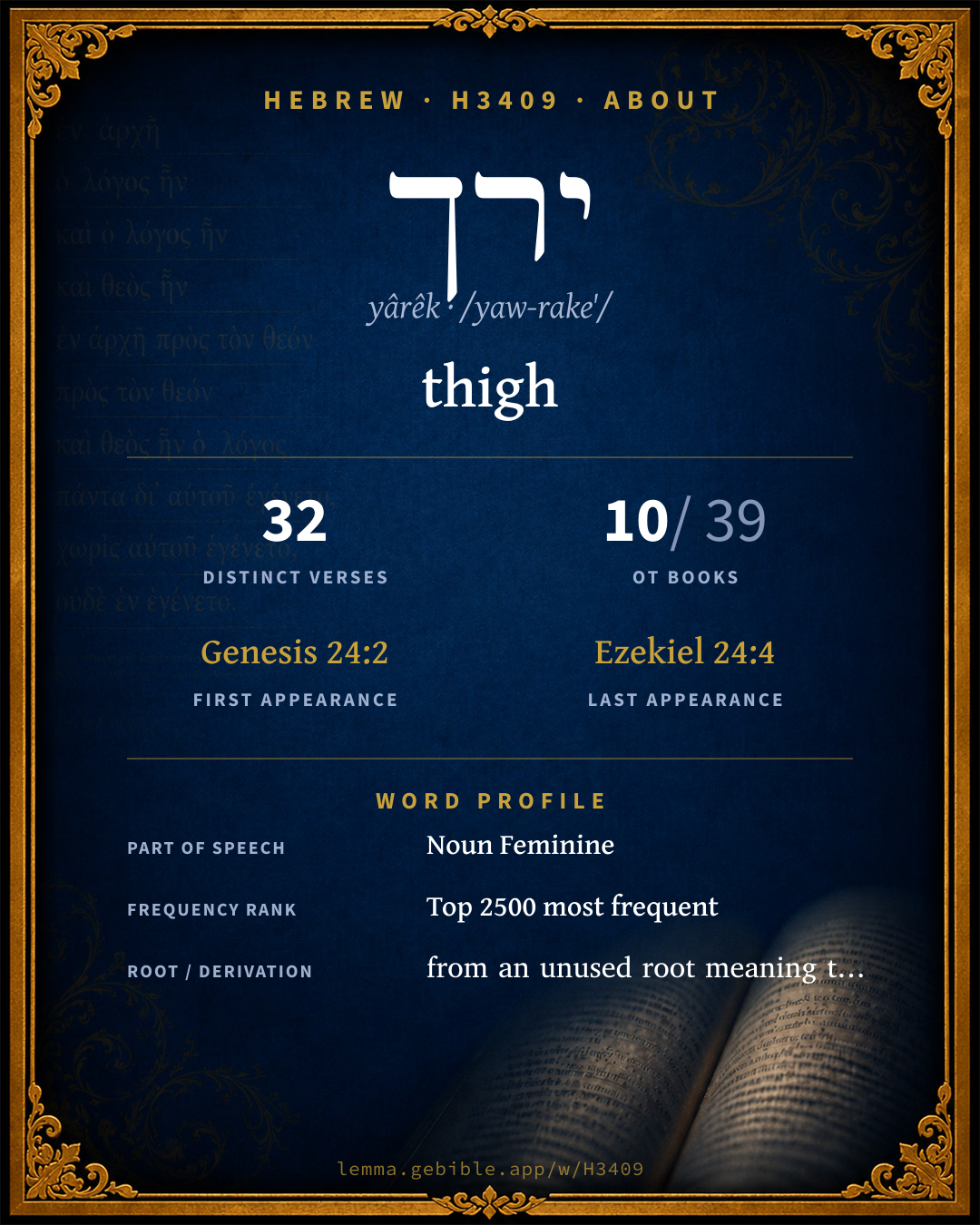
יָרֵךְ
thigh
also: side, loin, base fuller range ↓
Full lexicon entry — Brown-Driver-Briggs (BDB)
From Brown-Driver-Briggs (BDB)
Where this word appears
See every Construct-state word in the Hebrew Bible →
Grammar key — what these labels mean
Part of speech
- Noun
- A naming word — a person, place, thing, or idea.
Noun type
- Common
- A common noun — a general class of person, place, or thing (“king,” “city,” “water”), not a specific name.
State
- Construct
- A noun bound to a following noun in a possessive / “of” relationship (the construct chain).
- Absolute
- The independent form of a noun, not bound to a following word.
Gender
- Feminine
- Grammatically feminine.
Number
- Singular
- One.
- Dual
- Exactly two — for natural pairs and some measures of time.
Grammatical forms
- Noun, Common, Feminine, Singular, Construct 25 times (74%)
- Noun, Common, Feminine, Singular, Absolute 7 times (21%)
- Noun, Common, Feminine, Dual, Absolute 1 time (3%)
- Noun, Common, Feminine, Dual, Construct 1 time (3%)
Parsed forms decoded from the imported morphology (morphhb / Westminster Leningrad Codex — WLC text public domain, morphhb tagging CC BY 4.0), counted across 34 parsed occurrences — not distinct verses.
Every verse where H3409 appears — 32 distinct verses across 10 books. Click any verse to open its interlinear word-by-word view. Verse text shown in the World English Bible for context — . Each verse’s Hebrew form is shown with its reference; the English is not keyword-highlighted, since the data carries no word-level English alignment. Use “Compare translations” on any verse to read it across multiple English versions. This concordance covers the Hebrew Bible; Septuagint (Greek Old Testament) occurrences are not indexed here.
Genesis 7 verses
- Genesis 24:2 יְרֵכִֽ/י n c fs cs + sfx pers 1cs Abraham said to his servant, the elder of his house, who ruled over all that he had, "Please put your hand under my thigh.
- Genesis 24:9 יֶ֥רֶךְ n c fs cs The servant put his hand under the thigh of Abraham his master, and swore to him concerning this matter.
- Genesis 32:25 יְרֵכ֑/וֹ יֶ֣רֶךְ n c fs cs + sfx pers 3ms n c fs cs When he saw that he didn't prevail against him, he touched the hollow of his thigh, and the hollow of Jacob's thigh was strained, as he wrestled.
- Genesis 32:31 יְרֵכֽ/וֹ n c fs cs + sfx pers 3ms The sun rose on him as he passed over Peniel, and he limped because of his thigh.
- Genesis 32:32 הַ/יָּרֵ֔ךְ יֶ֣רֶךְ ptcl def.art + n c fs n c fs cs Therefore the children of Israel don't eat the sinew of the hip, which is on the hollow of the thigh, to this day, because he touched the hollow of Jacob's thigh in the sinew of the hip.
- Genesis 46:26 יְרֵכ֔/וֹ n c fs cs + sfx pers 3ms All the souls who came with Jacob into Egypt, who were his direct descendants, besides Jacob's sons' wives, all the souls were sixty-six.
- Genesis 47:29 יְרֵכִ֑/י n c fs cs + sfx pers 1cs The time drew near that Israel must die, and he called his son Joseph, and said to him, "If now I have found favor in your sight, please put your hand under my thigh, and deal kindly and truly with me. Please don't bury me in Egypt,
Exodus 7 verses
- Exodus 1:5 יֶֽרֶךְ n c fs cs All the souls who came out of the Jacob's body were seventy souls, and Joseph was in Egypt already.
- Exodus 25:31 יְרֵכָ֣/הּ n c fs cs + sfx pers 3fs "You shall make a lampstand of pure gold. Of hammered work shall the lampstand be made, even its base, its shaft, its cups, its buds, and its flowers, shall be of one piece with it.
- Exodus 28:42 יְרֵכַ֖יִם n c fd You shall make them linen breeches to cover the flesh of their nakedness; from the loins even to the thighs they shall reach:
- Exodus 32:27 יְרֵכ֑/וֹ n c fs cs + sfx pers 3ms He said to them, "Thus says Yahweh, the God of Israel, 'Every man put his sword on his thigh, and go back and forth from gate to gate throughout the camp, and every man kill his brother, and every man his companion, and every man his neighbor."
- Exodus 37:17 יְרֵכָ֣/הּ n c fs cs + sfx pers 3fs He made the lampstand of pure gold. He made the lampstand of beaten work. Its base, its shaft, its cups, its buds, and its flowers were of one piece with it.
- Exodus 40:22 יֶ֥רֶךְ n c fs cs He put the table in the tent of meeting, on the side of the tent northward, outside of the veil.
- Exodus 40:24 יֶ֥רֶךְ n c fs cs He put the lampstand in the tent of meeting, opposite the table, on the side of the tent southward.
Leviticus 1 verse
Numbers 6 verses
- Numbers 3:29 יֶ֥רֶךְ n c fs cs The families of the sons of Kohath shall encamp on the south side of the tabernacle.
- Numbers 3:35 יֶ֧רֶךְ n c fs cs The prince of the fathers' house of the families of Merari was Zuriel the son of Abihail. They shall encamp on the north side of the tabernacle.
- Numbers 5:21 יְרֵכֵ/ךְ֙ n c fs cs + sfx pers 2fs then the priest shall cause the woman to swear with the oath of cursing, and the priest shall tell the woman, 'Yahweh make you a curse and an oath among your people, when Yahweh allows your thigh to fall away, and your body to swell;
- Numbers 5:22 יָרֵ֑ךְ n c fs and this water that brings a curse will go into your bowels, and make your body swell, and your thigh fall away.' The woman shall say, 'Amen, Amen.'
- Numbers 5:27 יְרֵכָ֑/הּ n c fs cs + sfx pers 3fs When he has made her drink the water, then it shall happen, if she is defiled, and has committed a trespass against her husband, that the water that causes the curse will enter into her and become bitter, and her body will swell, and her thigh will fall away: and the woman will be a curse among her people.
- Numbers 8:4 יְרֵכָ֥/הּ n c fs cs + sfx pers 3fs This was the workmanship of the lampstand, beaten work of gold. From its base to its flowers, it was beaten work: according to the pattern which Yahweh had shown Moses, so he made the lampstand.
Judges 4 verses
- Judges 3:16 יֶ֥רֶךְ n c fs cs Ehud made him a sword which had two edges, a cubit in length; and he girded it under his clothing on his right thigh.
- Judges 3:21 יֶ֣רֶךְ n c fs cs Ehud put forth his left hand, and took the sword from his right thigh, and thrust it into his body:
- Judges 8:30 יְרֵכ֑/וֹ n c fs cs + sfx pers 3ms Gideon had seventy sons conceived from his body; for he had many wives.
- Judges 15:8 יָרֵ֖ךְ n c fs He struck them hip and thigh with a great slaughter: and he went down and lived in the cleft of the rock of Etam.
2 Kings 1 verse
Psalms 1 verse
Song of Solomon 2 verses
- Song of Solomon 3:8 יְרֵכ֔/וֹ n c fs cs + sfx pers 3ms They all handle the sword, and are expert in war. Every man has his sword on his thigh, Because of fear in the night.
- Song of Solomon 7:1 יְרֵכַ֔יִ/ךְ n c fd cs + sfx pers 2fs How beautiful are your feet in sandals, prince's daughter! Your rounded thighs are like jewels, The work of the hands of a skillful workman.
Jeremiah 1 verse
Ezekiel 2 verses
- Ezekiel 21:12 יָרֵֽךְ n c fs Cry and wail, son of man; for it is on my people, it is on all the princes of Israel: they are delivered over to the sword with my people; strike therefore on your thigh.
- Ezekiel 24:4 יָרֵ֣ךְ n c fs gather the pieces of it into it, even every good piece, the thigh, and the shoulder; fill it with the choice bones.
About this entry
At a glance — auto-summarized from this page’s data, not written by a person. Every figure links to its source below. This summary describes the numbers; it doesn’t interpret them.
“thigh” is the headline sense of the Hebrew noun ירך (yârêk). Beyond “thigh” it also covers “side”, “loin”, and “base” — see its full sense range. It appears 32 verses across 10 books of the Hebrew Bible, among its moderately common vocabulary. First canonically at Genesis 24:2, it enters the text early. Related forms include ירכה. The sections below give every sense, occurrence, and version rendering.
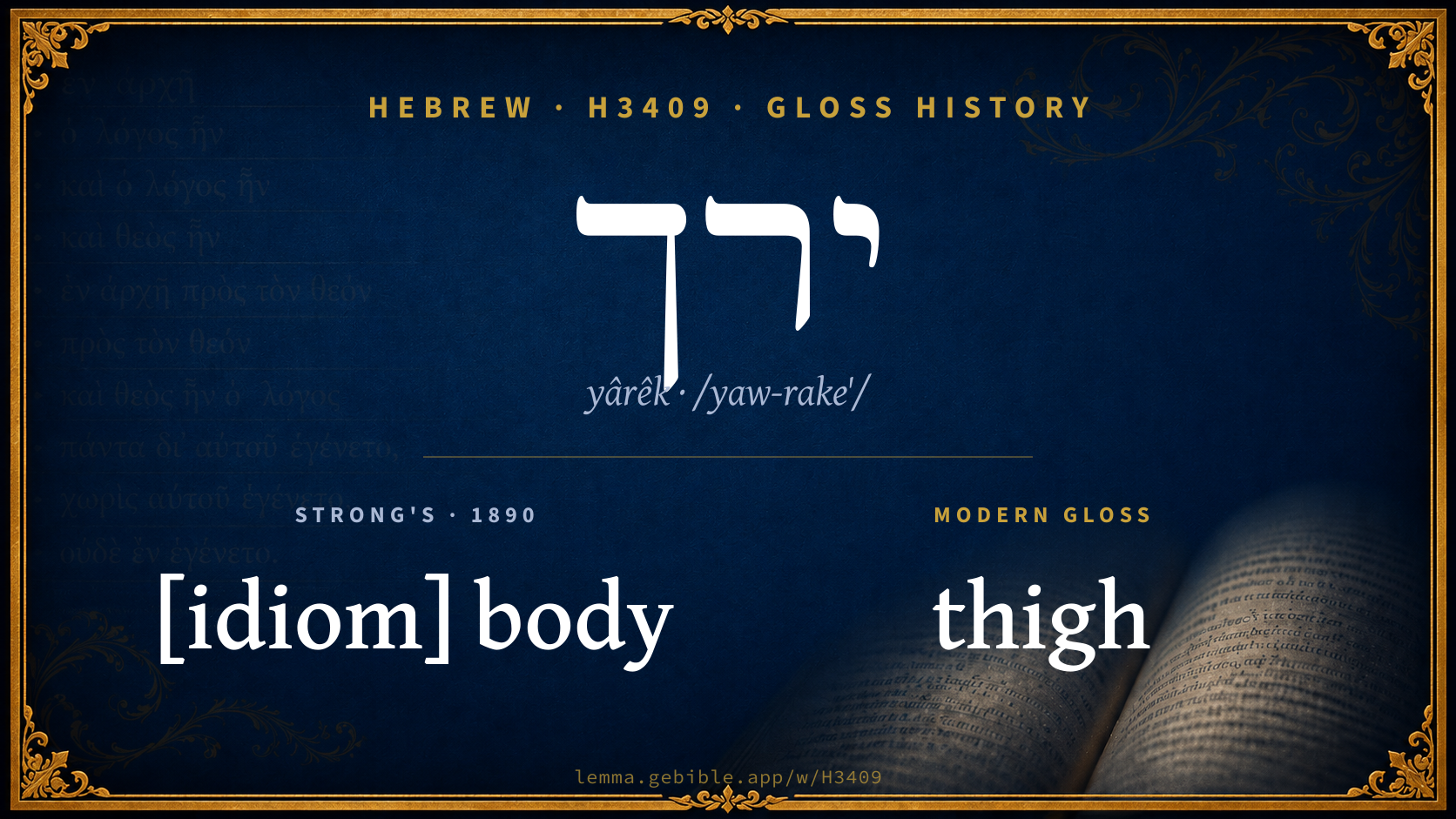
Gloss history
Strong's 1890 vs modern scholarship
About this word
Strong's H3409 catalogs a Hebrew word from the Hebrew Old Testament.
These counts are not copied from any lexicon or concordance. They are computed here, from the morphology-tagged Hebrew Old Testament. What Lemma adds →
- 32
- distinct verses
- The word appears in 32 distinct verses.
- 10 / 39
- OT books
- The word appears in 10 of 39 Old Testament books.
- #1,041
- by frequency
- Top 2500 most frequent Hebrew words (rank 1,041 of 8,640 Hebrew words by occurrence).
View all 32 occurrences in the concordance →
By section of the Old Testament
By traditional corpus
Conventional, traditional groupings — biblical authorship is debated, so this is a traditional corpus grouping, not an authorship claim. Each share is this word’s portion of its verses in that division of the Hebrew canon. Each figure is a share of the word’s 32 distinct verses.
- Torah (Pentateuch) 21 verses · 66%
- Prophets (Nevi'im) 8 verses · 25%
- Writings (Ketuvim) 3 verses · 9%
How translations render this word
Counts come from each version’s own published word-to-Strong’s tagging or interlinear alignment — an approximate guide to how each version renders this word, not a word-level alignment the data otherwise carries. Because each total is that version’s own tagged count, the per-version totals vary from one another and need not match the appearance or distinct-verse counts above. These counts may also differ from a printed concordance because Lemma counts each distinctly tagged rendering and does not collapse phrase taggings into a single head-word total. This is a fixed set of word-tagged versions (KJV, ASV, BSB, ULT) and does not change with the reading translation you choose elsewhere. Each version’s license is shown beside its name below (and on Sources).
- King James Version: Thigh 14×, Side 7×, Shaft 3×
- American Standard Version: Thigh 13×, Side 6×, 's thigh 2×
- Berean Standard Bible: Thigh 11×, Side 9×, Base 3×
- unfoldingWord Literal Text: Thigh 13×, Side of 5×, Hip 3×
King James Version Public Domain
Renders H3409 across 34 tagged occurrences — most commonly:
Plus 4 renderings that appear only once — usually multi-word phrases or single function words the recovered tagging swept in, not distinct renderings.
American Standard Version Public Domain
Renders H3409 across 34 tagged occurrences — most commonly:
Plus 7 renderings that appear only once — usually multi-word phrases or single function words the recovered tagging swept in, not distinct renderings.
Berean Standard Bible Public Domain
Renders H3409 across 29 tagged occurrences — most commonly:
Plus 3 renderings that appear only once — usually multi-word phrases or single function words the recovered tagging swept in, not distinct renderings. Not rendered by a distinct English word in 5 further occurrences.
unfoldingWord Literal Text CC BY-SA 4.0
Renders H3409 across 33 tagged occurrences — most commonly:
Plus 3 renderings that appear only once — usually multi-word phrases or single function words the recovered tagging swept in, not distinct renderings.
Senses in the full BDB
What do BDB’s symbols mean?
BDB uses these scholarly abbreviations:
| Symbol | Meaning |
|---|---|
| 𝔊 | the Septuagint (the ancient Greek translation, LXX) |
| 𝔙 | the Vulgate (the Latin translation) |
| 𝔖 | the Syriac version (the Peshitta) |
| 𝔗 | the Targum (the Aramaic translation) |
| ψ | the Psalms |
| √ | root (the underlying root or stem) |
| ‖ | parallel passage (a synonymous or contrasted parallel) |
| † | the dagger: every passage where the word occurs is cited |
The 5 senses and sub-senses the full Brown-Driver-Briggs lexicon distinguishes for this word, in lexicon order (not ranked by frequency), with BDB’s own verbatim wording and sub-sense lettering. Shown in Hebrew script with BDB’s own scholarly abbreviations. The condensed entry is in the Lexicon Entry tab. See also the Forms in the corpus table below.
- 1. thigh,
- a. outside of thigh, where sword was worn, שִׂים חֶרֶב עַל־יְרֵכוֹ Ex 32:27 (E); וַיַּחְגֹּר אֹתָהּ עַל־יֶרֶךְ יְמִינוֹ Ju 3:16 and he girded it upon his right thigh, v 21 ψ 45:4 Ct 3:8; כַּף הַיָּרֵךְ Gn 32:33 hollow of the thigh, v 26(×2), 33 (all J); חַמּוּקֵי יְרֵכַיִךְ Ct 7:2 the roundings of thy thighs; מִמָּתְנַיִם וְעַד־יְרֵכַיִם Ex 28:42 (P); ‖ בֶּטֶן Nu 5:21, 22, 27 (P); צֹלֵעַ עַל־יְרֵכוֹ Gn 32:32 (J), limping upon his thigh; סָפַק עַל־יָרֵךְ Je 31:19 and (c. אֶל־) Ez 21:17, smite upon thigh, in token of consternation; וַיַּךְ אוֹתָם שׁוֹק עַל־ יָרֵךְ Ju 15:8 and he smote them, hip upon thigh, a great slaughter. e.g. Exodus 32:27
- b. thigh = loins, as seat of procreative power (RSK 34; Sem i, 360 (380)) יֹצְאֵי ירך those proceeding from the loins of any one Gn 46:26 Ex 1:5 (both P), Ju 8:30; hence שִׂים יַד תַּחַת ירך place the hand under thigh, in taking oath Gn 24:2, 9 (J), 47:29. e.g. Genesis 46:26
- 2. side (flank) of altar 2 K 16:14 Lv 1:11 (P); of tabernacle Ex 40:22, 24 Nu 3:29, 35 (all P); also יֶרֶךְ הַשַּׁעַר (for MT תּוֹךְ הַשּׁ׳) 𝔊 Th We Dr Bu Kit. e.g. 2 Kings 16:14
- 3. base (loins) of candlestick Ex 25:31; 37:17 Nu 8:4 (all P). e.g. Exodus 25:31
Senses from the full Brown-Driver-Briggs lexicon (Brown, Driver, Briggs; Oxford 1906 — public domain), digitized via Sefaria, supplemented by the OpenScriptures HebrewLexicon (CC BY 4.0). Full attribution on Sources.
Word origin
n.f. Nu 5:27 thigh, loin, side, base (NH id.; Aramaic יַרְכָּא; Zinj. ירך loin; Assyrian arku, arkâtu, back, rear, hereafter DlHWB 242; Arabic وَرِكٌ hip)—abs. יָרֵךְ Ju 15:8 + 6 times; cstr. יֶ֫רֶךְ Gn 24:9 + 11 times + 2 S 3:27 (v. infr.); sf. יְרֵכִי Gn 24:2; 47:29; יְרֵכֵךְ Nu 5:21; יְרֵכוֹ Gn 32:26 + 6 times; יְרֵכָהּ Ex 25:31 + 3 times; du. יְרֵכַיִם Ex 28:42; sf. יְרֵכַיִךְ Ct 7:2;—
— Brown-Driver-Briggs (Oxford 1906, public domain), digitized via Sefaria, supplemented by the OpenScriptures HebrewLexicon (CC BY 4.0). See Sources.
Origin: from an unused root meaning to be soft
Jastrow Dictionary
A second Hebrew/Aramaic lexicon for comparison, covering Aramaic and post-biblical (Talmudic, Targumic, Midrashic) usage that the biblical-Hebrew BDB does not. Matched by lemma rather than by Strong’s number, so a lemma may carry more than one Jastrow headword (shown separately below), and the entries cover usage well beyond the Bible.
יָרֵךְ
- , constr. יֶרֶךְ f. (b. h.; cmp. ארך) [length-side,]
- 1. haunch, thigh, i.e. “the thick and fleshy member which commences at the bottom of the spine and extends to the lower leg (שׁוֹק)” (Ges. H. Dict. s. v.). Ḥull. VII, 1 נוהג בי׳ של ימין applies to the right leg. Ib. 2 שולח אדם י׳ וכ׳ one may send to a gentile a haunch with the nervus ischiadicus (v. גִּיד) in it. Sot. 11ᵇ; Ex. R. s. 1 י׳ מכאן וי׳ מכאן וכ׳ a leg on one side, and a leg on the other, and the potter’s mould between; a. fr.—Y. Pes. VII, beg. 34ᵃ כיָרֵיךְ עבה עבד וכ׳ R. J … wants the Passover lamb roasted like a thick (stuffed) thigh.—יוצאי י׳ descendants. B. Bath. VIII, 2 כל יוצאי יְרֵיכוֹ של בן וכ׳ all direct descendants of the (deceased) son (male heir) have the precedence to the daughter (the decedent’s sister); a. fr.—Du. יְרֵכַיִם. Tosef. Ohol. III, 4, sq.—Pl. יְרֵיכוֹת. Sot. l. c.; Ex. R. l. c. (expl. אָבְנַיִם, Ex. I, 16) בשעה … יְרֵכיֹתֶיהָ … כאבנים when a woman is about to give birth, her thighs grow cold like stones. e.g. Exodus 1:16
- 2. side. Gen. R. s. 69, v. חָדד. Meg. 13ᵃ אין אשה … בי׳ של חבירתה a woman is made jealous only by the side of another woman (rival).
- 3. the perpendicular stroke of a letter, leg. Y. Meg. I, 71ᶜ top יְרֵיכוֹ של ה"א the leg (stroke on the left side) of the He; ib. י׳ קטנה a small indication of it. Ib. אם גורדו … י׳ קטנה if he erases the (blotted letter Gimmel) and there remains a slight leg (indication of the vertical stroke connecting the head of the Gimmel with its foot).—Pl. as ab. Gitt. 20ᵃ, v. חָקַק. Sabb. 138ᵇ כירה … אחת מִיְּרֵכוֹתֶיהָ a portable stove one of whose legs is off.
יְרַךְ
- Targ. O. Num. V, 22 יירך ed. Berl. (Mss. יַרְכָּא, יָרֵךְ; ed. יַרְכִין pl.). Ib. 21. Targ. Ex. I, 5; a. fr.—Gen. R. s. 78 מטלע על יַרְכֵיה (not יריכה) limping on his thigh; a. e.—Pl. יִרְכָן, יַרְכָּן, (יַרְכִין). Targ. Ex. XXVIII, 42; a. e.—[B. Bath. 4ᵇ, v. דָּיְכֵי.]
A Dictionary of the Targumim, the Talmud Babli and Yerushalmi, and the Midrashic Literature (Marcus Jastrow; London, Luzac, 1903) — Public Domain. Digitized via Sefaria. Digitized via Sefaria. Full attribution on Sources.
Forms in the corpus
The 20 distinct written forms H3409 takes in the Hebrew Bible, most frequent first — each parse links to that state’s occurrences in the concordance. Hebrew forms include their vowel points and cantillation, so a single lemma takes many written forms.
Same root — word family
Other BDB entries built from the same root as H3409, grouped by Strong’s listed origin. These share a root / origin per the lexicon — not necessarily a shared meaning. Each links to that word’s own entry.
Derived from this word
Compare all same-root words → They share a root, not necessarily a meaning.
Septuagint verse parallels
This word appears in 32 verses that also exist in the Greek Old Testament (Septuagint), out of the 32 Hebrew verses it occurs in. You can read those verses in Greek by switching the Old Testament edition to the Septuagint.
Read these verses in the Septuagint
- Genesis 24:2
- Exodus 1:5
- Leviticus 1:11
- Numbers 3:29
- Judges 3:16
- 2 Kings 16:14
- Psalms 45:3
- Song of Solomon 3:8
- Jeremiah 31:19
- Ezekiel 21:12
This is a verse-level parallel only — the same verses exist in both the Hebrew and Greek Old Testaments. No word-level Hebrew↔Greek correspondence is claimed: the data carries no such alignment, so no Greek word is shown as this Hebrew word’s translation. Coverage is not total — the Septuagint omits the deuterocanon and renumbers the Psalms, so some Hebrew verses have no direct Greek parallel.