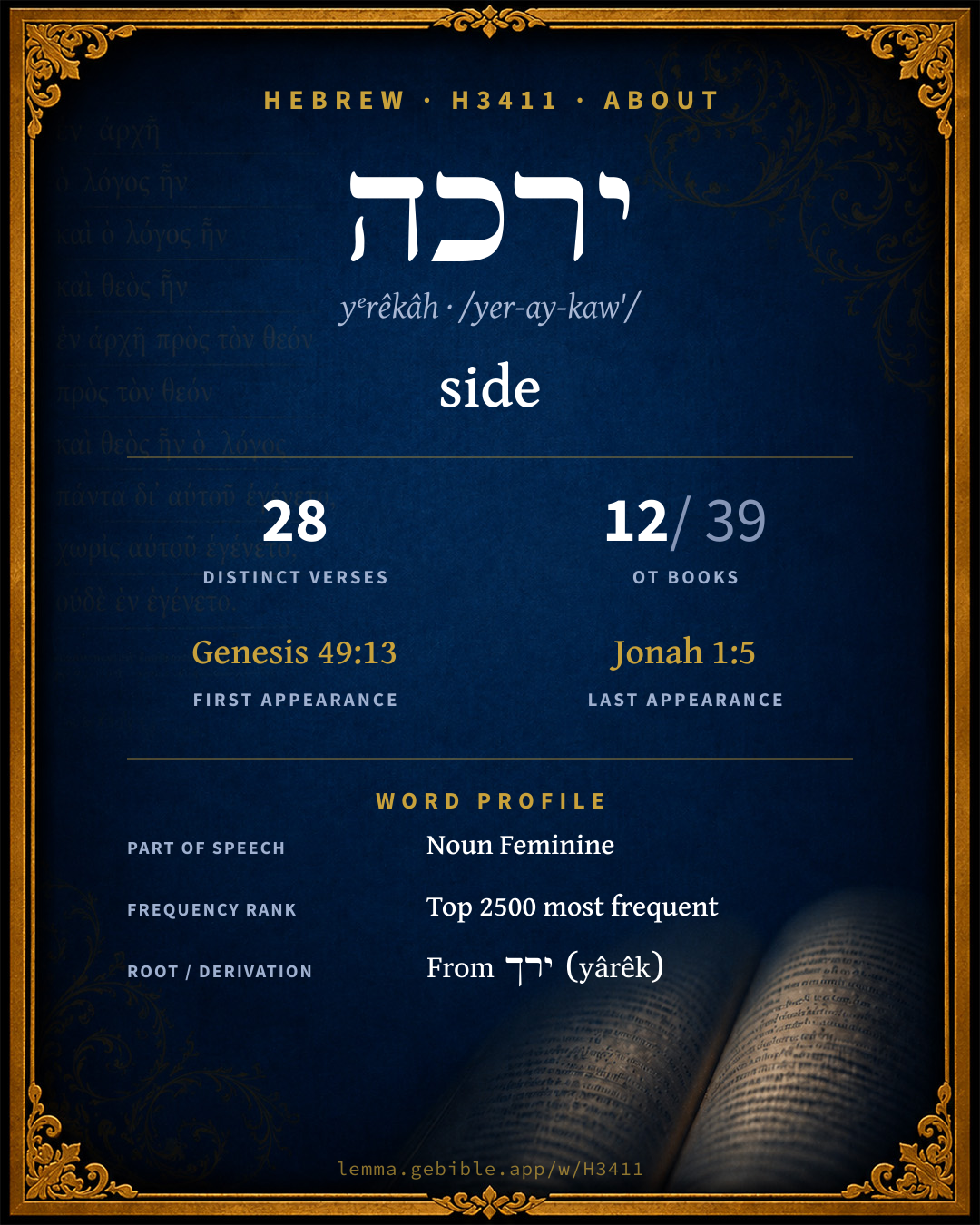
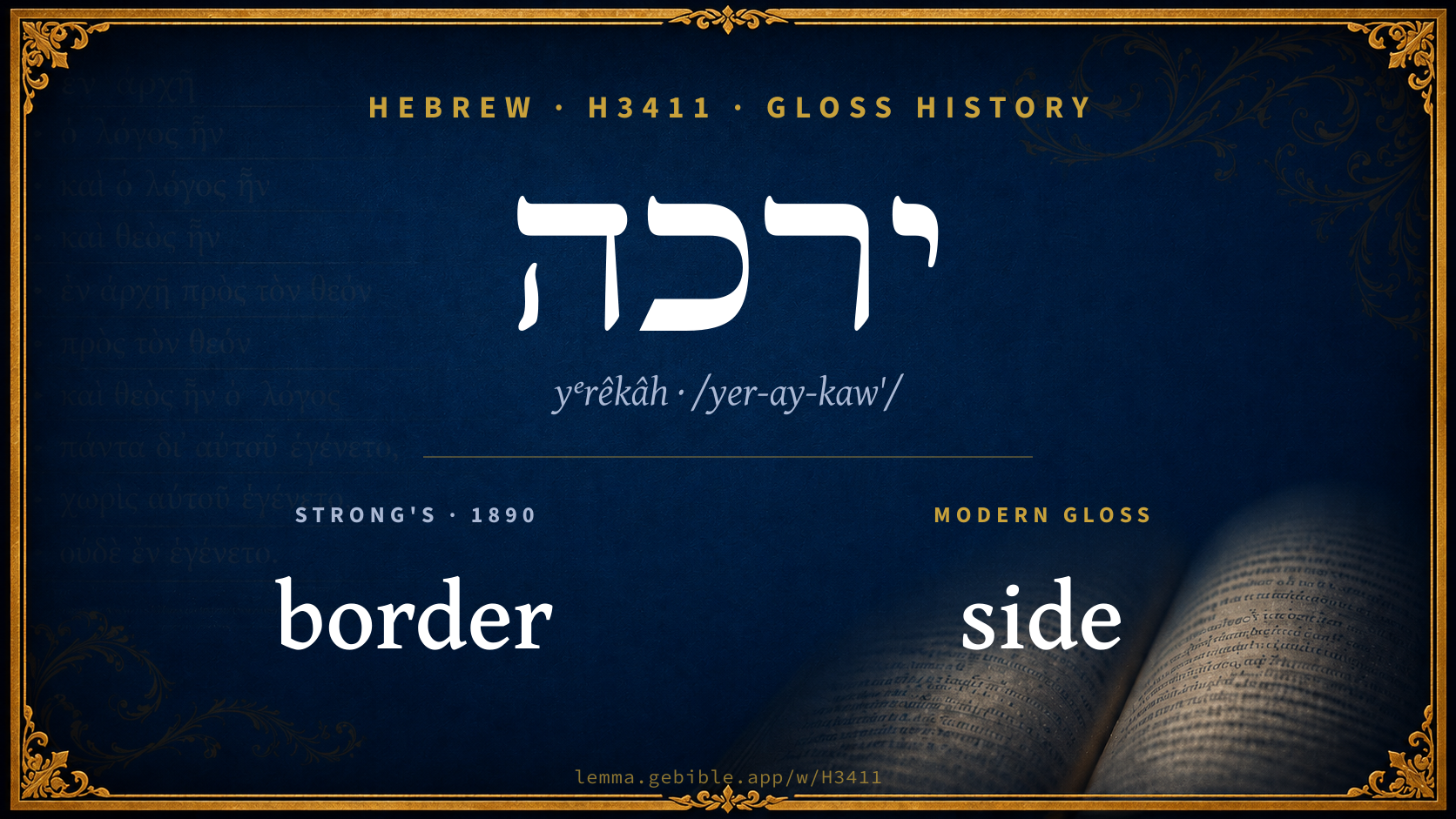
יַרְכָה
side
also: flank, extreme parts, recesses fuller range ↓
Full lexicon entry — Brown-Driver-Briggs (BDB)
From Brown-Driver-Briggs (BDB)
Where this word appears
See every Construct-state word in the Hebrew Bible →
Grammar key — what these labels mean
Part of speech
- Noun
- A naming word — a person, place, thing, or idea.
Noun type
- Common
- A common noun — a general class of person, place, or thing (“king,” “city,” “water”), not a specific name.
State
- Construct
- A noun bound to a following noun in a possessive / “of” relationship (the construct chain).
- Absolute
- The independent form of a noun, not bound to a following word.
Gender
- Feminine
- Grammatically feminine.
Number
- Dual
- Exactly two — for natural pairs and some measures of time.
- Singular
- One.
Grammatical forms
- Noun, Common, Feminine, Dual, Construct 23 times (77%)
- Noun, Common, Feminine, Dual, Absolute 5 times (17%)
- Noun, Common, Feminine, Singular, Construct 2 times (7%)
Parsed forms decoded from the imported morphology (morphhb / Westminster Leningrad Codex — WLC text public domain, morphhb tagging CC BY 4.0), counted across 30 parsed occurrences — not distinct verses.
Every verse where H3411 appears — 28 distinct verses across 12 books. Click any verse to open its interlinear word-by-word view. Verse text shown in the World English Bible for context — . Each verse’s Hebrew form is shown with its reference; the English is not keyword-highlighted, since the data carries no word-level English alignment. Use “Compare translations” on any verse to read it across multiple English versions. This concordance covers the Hebrew Bible; Septuagint (Greek Old Testament) occurrences are not indexed here.
Genesis 1 verse
Exodus 6 verses
- Exodus 26:22 וּֽ/לְ/יַרְכְּתֵ֥י conj + prep + n c fd cs For the far part of the tent westward you shall make six boards.
- Exodus 26:23 בַּ/יַּרְכָתָֽיִם prep det + n c fd Two boards shall you make for the corners of the tent in the far part.
- Exodus 26:27 לַ/יַּרְכָתַ֖יִם prep det + n c fd and five bars for the boards of the other side of the tent, and five bars for the boards of the side of the tent, for the far part westward.
- Exodus 36:27 וּֽ/לְ/יַרְכְּתֵ֥י conj + prep + n c fd cs For the far part of the tent westward he made six boards.
- Exodus 36:28 בַּ/יַּרְכָתָֽיִם prep det + n c fd He made two boards for the corners of the tent in the far part.
- Exodus 36:32 לַ/יַּרְכָתַ֖יִם prep det + n c fd and five bars for the boards of the other side of the tent, and five bars for the boards of the tent for the hinder part westward.
Judges 2 verses
- Judges 19:1 בְּ/יַרְכְּתֵ֣י prep + n c fd cs It happened in those days, when there was no king in Israel, that there was a certain Levite sojourning on the farther side of the hill-country of Ephraim, who took to him a concubine out of Bethlehem Judah.
- Judges 19:18 יַרְכְּתֵ֣י n c fd cs He said to him, We are passing from Bethlehem Judah to the farther side of the hill-country of Ephraim; from there am I, and I went to Bethlehem Judah: and I am [now] going to the house of Yahweh; and there is no man who takes me into his house.
1 Samuel 1 verse
1 Kings 1 verse
2 Kings 1 verse
Psalms 2 verses
- Psalms 48:2 יַרְכְּתֵ֣י n c fd cs Beautiful in elevation, the joy of the whole earth, Is Mount Zion, on the north sides, The city of the great King.
- Psalms 128:3 בְּ/יַרְכְּתֵ֪י prep + n c fd cs Your wife will be as a fruitful vine, In the innermost parts of your house; Your children like olive plants, Around your table.
Isaiah 3 verses
- Isaiah 14:13 בְּ/יַרְכְּתֵ֥י prep + n c fd cs You said in your heart, I will ascend into heaven, I will exalt my throne above the stars of God; and I will sit on the mountain of congregation, in the uttermost parts of the north;
- Isaiah 14:15 יַרְכְּתֵי n c fd cs Yet you shall be brought down to Sheol, to the uttermost parts of the pit.
- Isaiah 37:24 יַרְכְּתֵ֣י n c fd cs By your servants have you defied the Lord, and have said, With the multitude of my chariots am I come up to the height of the mountains, to the innermost parts of Lebanon; and I will cut down the tall cedars of it, and the choice fir trees of it; and I will enter into its farthest height, the forest of its fruitful field;
Jeremiah 4 verses
- Jeremiah 6:22 מִ/יַּרְכְּתֵי prep + n c fd cs Thus says Yahweh, Behold, a people comes from the north country; and a great nation shall be stirred up from the uttermost parts of the earth.
- Jeremiah 25:32 מִ/יַּרְכְּתֵי prep + n c fd cs Thus says Yahweh of hosts, Behold, evil shall go forth from nation to nation, and a great tempest shall be raised up from the uttermost parts of the earth.
- Jeremiah 31:8 מִ/יַּרְכְּתֵי prep + n c fd cs Behold, I will bring them from the north country, and gather them from the uttermost parts of the earth, [and] with them the blind and the lame, the woman with child and her who travails with child together: a great company shall they return here.
- Jeremiah 50:41 מִ/יַּרְכְּתֵי prep + n c fd cs Behold, a people comes from the north; and a great nation and many kings shall be stirred up from the uttermost parts of the earth.
Ezekiel 5 verses
- Ezekiel 32:23 בְּ/יַרְכְּתֵי prep + n c fd cs whose graves are set in the uttermost parts of the pit, and her company is round about her grave; all of them slain, fallen by the sword, who caused terror in the land of the living.
- Ezekiel 38:6 יַרְכְּתֵ֥י n c fd cs Gomer, and all his hordes; the house of Togarmah in the uttermost parts of the north, and all his hordes; even many peoples with you.
- Ezekiel 38:15 מִ/יַּרְכְּתֵ֣י prep + n c fd cs You shall come from your place out of the uttermost parts of the north, you, and many peoples with you, all of them riding on horses, a great company and a mighty army;
- Ezekiel 39:2 מִ/יַּרְכְּתֵ֣י prep + n c fd cs and I will turn you about, and will lead you on, and will cause you to come up from the uttermost parts of the north; and I will bring you on the mountains of Israel;
- Ezekiel 46:19 ב/ירכת/ם בַּ/יַּרְכָתַ֖יִם prep + n c fs cs + sfx pers 3mp prep det + n c fd Then he brought me through the entry, which was at the side of the gate, into the holy chambers for the priests, which looked toward the north: and, behold, there was a place on the hinder part westward.
Amos 1 verse
Jonah 1 verse
About this entry
At a glance — auto-summarized from this page’s data, not written by a person. Every figure links to its source below. This summary describes the numbers; it doesn’t interpret them.
“side” is the headline sense of the Hebrew noun ירכה (yᵉrêkâh). Translators differ — “sides” in the King James Version, then “recesses of” (unfoldingWord Literal Text), as the renderings breakdown shows. It turns up in 28 verses across 12 books, a moderately common footprint. First canonically at Genesis 49:13, it enters the text early. Not a single-sense word, it carries 3 senses, among them “flank”, “extreme parts”, and “recesses”. The sections below give every sense, occurrence, and version rendering.
Gloss history
Strong's 1890 vs modern scholarship
About this word
Strong's H3411 catalogs a Hebrew word from the Hebrew Old Testament.
These counts are not copied from any lexicon or concordance. They are computed here, from the morphology-tagged Hebrew Old Testament. What Lemma adds →
- 28
- distinct verses
- The word appears in 28 distinct verses.
- 12 / 39
- OT books
- The word appears in 12 of 39 Old Testament books.
- #1,139
- by frequency
- Top 2500 most frequent Hebrew words (rank 1,139 of 8,640 Hebrew words by occurrence).
View all 28 occurrences in the concordance →
By section of the Old Testament
By traditional corpus
Conventional, traditional groupings — biblical authorship is debated, so this is a traditional corpus grouping, not an authorship claim. Each share is this word’s portion of its verses in that division of the Hebrew canon. Each figure is a share of the word’s 28 distinct verses.
- Prophets (Nevi'im) 19 verses · 68%
- Torah (Pentateuch) 7 verses · 25%
- Writings (Ketuvim) 2 verses · 7%
How translations render this word
Counts come from each version’s own published word-to-Strong’s tagging or interlinear alignment — an approximate guide to how each version renders this word, not a word-level alignment the data otherwise carries. Because each total is that version’s own tagged count, the per-version totals vary from one another and need not match the appearance or distinct-verse counts above. These counts may also differ from a printed concordance because Lemma counts each distinctly tagged rendering and does not collapse phrase taggings into a single head-word total. This is a fixed set of word-tagged versions (KJV, ASV, BSB, ULT) and does not change with the reading translation you choose elsewhere. Each version’s license is shown beside its name below (and on Sources).
- King James Version: Sides 14×, Two sides 4×, Coasts 3×
- American Standard Version: Uttermost parts 7×, Innermost parts 5×, Hinder part 4×
- Berean Standard Bible: Rear 4×, Ends 3×, Far 3×
- unfoldingWord Literal Text: Recesses of 6×, Back 4×, And 2×
King James Version Public Domain
Renders H3411 across 28 tagged occurrences — most commonly:
Plus 5 renderings that appear only once — usually multi-word phrases or single function words the recovered tagging swept in, not distinct renderings.
American Standard Version Public Domain
Renders H3411 across 28 tagged occurrences — most commonly:
Plus 9 renderings that appear only once — usually multi-word phrases or single function words the recovered tagging swept in, not distinct renderings.
Berean Standard Bible Public Domain
Renders H3411 across 28 tagged occurrences — most commonly:
Plus 12 renderings that appear only once — usually multi-word phrases or single function words the recovered tagging swept in, not distinct renderings.
unfoldingWord Literal Text CC BY-SA 4.0
Renders H3411 across 29 tagged occurrences — most commonly:
Plus 9 renderings that appear only once — usually multi-word phrases or single function words the recovered tagging swept in, not distinct renderings.
Senses in BDB
The 3 senses BDB distinguishes for this word, in lexicon order (not ranked by frequency or importance). The full entry — with sub-senses — is in the Lexicon Entry tab.
- flank, side, extreme parts, recesses
- side
- sides, recesses (dual)
Word origin
[ יַרְכָה, or יְרֵכָה ] flank, side, du. extreme parts, recesses
— Brown-Driver-Briggs (Oxford 1906, public domain), digitized via Sefaria, supplemented by the OpenScriptures HebrewLexicon (CC BY 4.0). See Sources.
Derived from ירך (yârêk) (H3409) — thigh.
Forms in the corpus
The 17 distinct written forms H3411 takes in the Hebrew Bible, most frequent first — each parse links to that state’s occurrences in the concordance. Hebrew forms include their vowel points and cantillation, so a single lemma takes many written forms.
Same root — word family
Other BDB entries built from the same root as H3411, grouped by Strong’s listed origin. These share a root / origin per the lexicon — not necessarily a shared meaning. Each links to that word’s own entry.
Derives from
Derived from this word
Compare all same-root words → They share a root, not necessarily a meaning.
Septuagint verse parallels
This word appears in 26 verses that also exist in the Greek Old Testament (Septuagint), out of the 28 Hebrew verses it occurs in. You can read those verses in Greek by switching the Old Testament edition to the Septuagint.
Read these verses in the Septuagint
- Genesis 49:13
- Exodus 26:22
- Judges 19:1
- 1 Samuel 24:3
- 1 Kings 6:16
- 2 Kings 19:23
- Psalms 48:2
- Isaiah 14:13
- Jeremiah 6:22
- Ezekiel 32:23
- Amos 6:10
- Jonah 1:5
This is a verse-level parallel only — the same verses exist in both the Hebrew and Greek Old Testaments. No word-level Hebrew↔Greek correspondence is claimed: the data carries no such alignment, so no Greek word is shown as this Hebrew word’s translation. Coverage is not total — the Septuagint omits the deuterocanon and renumbers the Psalms, so some Hebrew verses have no direct Greek parallel.