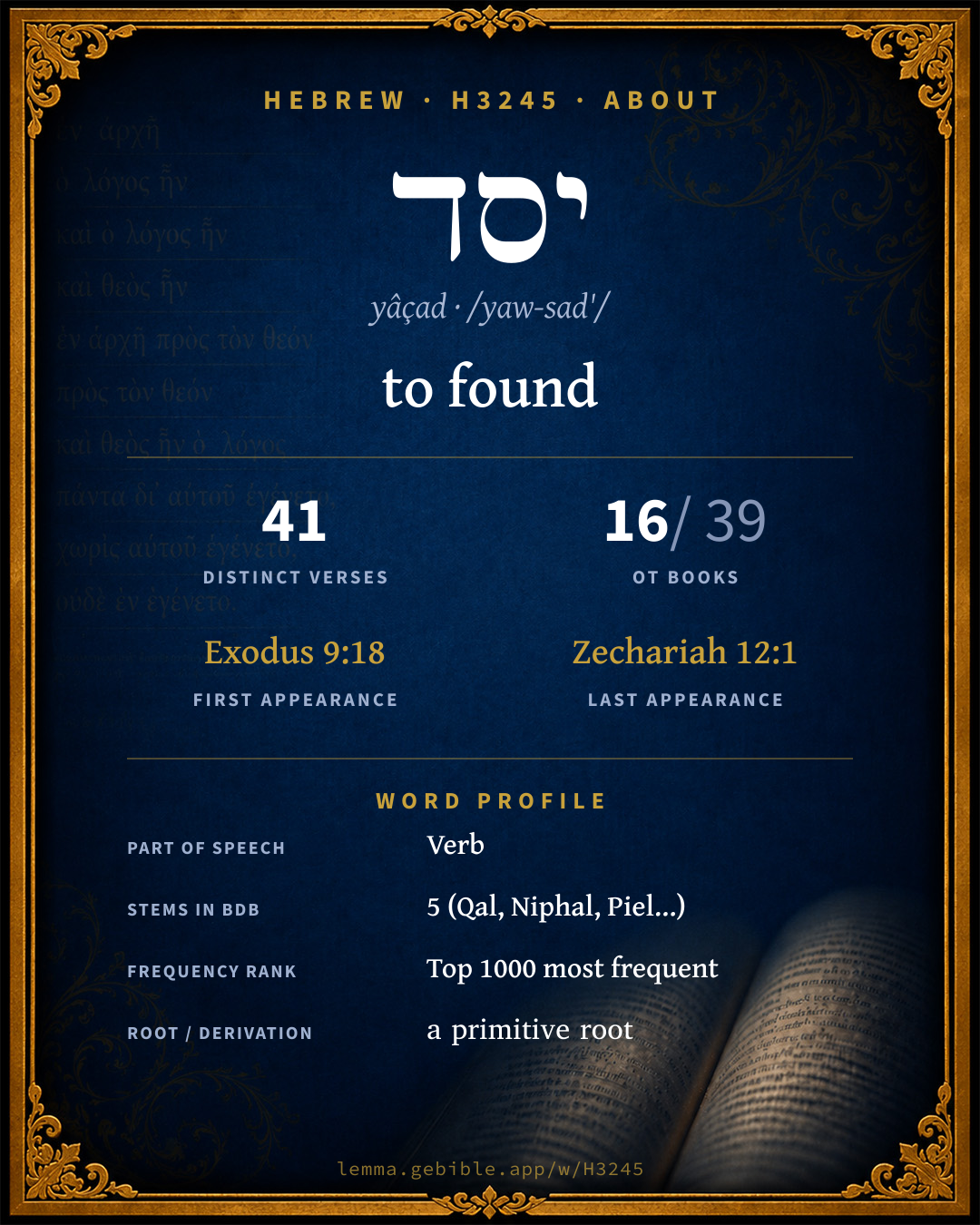
יָסַד
to found
also: fix, establish, lay foundation fuller range ↓
Full lexicon entry — Brown-Driver-Briggs (BDB)
From Brown-Driver-Briggs (BDB)
Where this word appears
See every Hophal verb in the Hebrew Bible →
Grammar key — what these labels mean
Part of speech
- Verb
- An action or state-of-being word.
Stem
- Pual
- The passive counterpart of the Piel.
- Piel
- An intensive or resultative active stem. Here: ‘found’
- Qal
- The basic, simple active stem — the plain form of the verb (“he wrote”).
- Hophal
- The passive counterpart of the Hiphil (“he was caused to…”). Here: ‘be founded’
- Niphal
- Usually the simple passive or reflexive of the Qal (“he was written”). Here: ‘fix or seat themselves close together’
Form
- Perfect
- A completed action or state — Hebrew marks aspect (completeness) more than strict tense (“he wrote”).
- Participle Active
- A verbal adjective expressing ongoing or characteristic action (“writing / one who writes”).
- Infinitive Construct
- A bound verbal noun, frequently with prepositions (“to write / in writing”).
- Participle Passive
- A verbal adjective expressing action received (“written”).
- Sequential Perfect
- A perfect with prefixed waw continuing a preceding imperfect or command (waw-consecutive perfect).
- Imperfect
- An incomplete, ongoing, or future action (“he will / would write”).
State
- Absolute
- The independent form of a noun, not bound to a following word.
Person
- 3rd Person
- The one spoken about (“he / she / it / they”).
- 2nd Person
- The one addressed (“you”).
- 1st Person
- The speaker (“I / we”).
Gender
- Masculine
- Grammatically masculine.
- Common
- Either gender — not distinguished for this form.
- Feminine
- Grammatically feminine.
Number
- Singular
- One.
- Plural
- More than one (in Hebrew, generally three or more).
1 verse where H3245 appears in the Hophal stem in the Book of 2 Chronicles. Filtered view — show all forms. Click any verse to open its interlinear word-by-word view. Verse text shown in the World English Bible for context — . Each verse’s Hebrew form is shown with its reference; the English is not keyword-highlighted, since the data carries no word-level English alignment. Use “Compare translations” on any verse to read it across multiple English versions. This concordance covers the Hebrew Bible; Septuagint (Greek Old Testament) occurrences are not indexed here.
2 Chronicles
About this entry
At a glance — auto-summarized from this page’s data, not written by a person. Every figure links to its source below. This summary describes the numbers; it doesn’t interpret them.
יסד (yâçad) is a Hebrew verb most often rendered “to found.” The verb spans 5 stems, from Qal to Niphal. The Hebrew Bible uses it across 41 verses — moderately common. Debuting at Exodus 9:18, it then recurs through the corpus. Related forms include יסד, יסוד and מוסד. The sections below give every sense, occurrence, and version rendering.
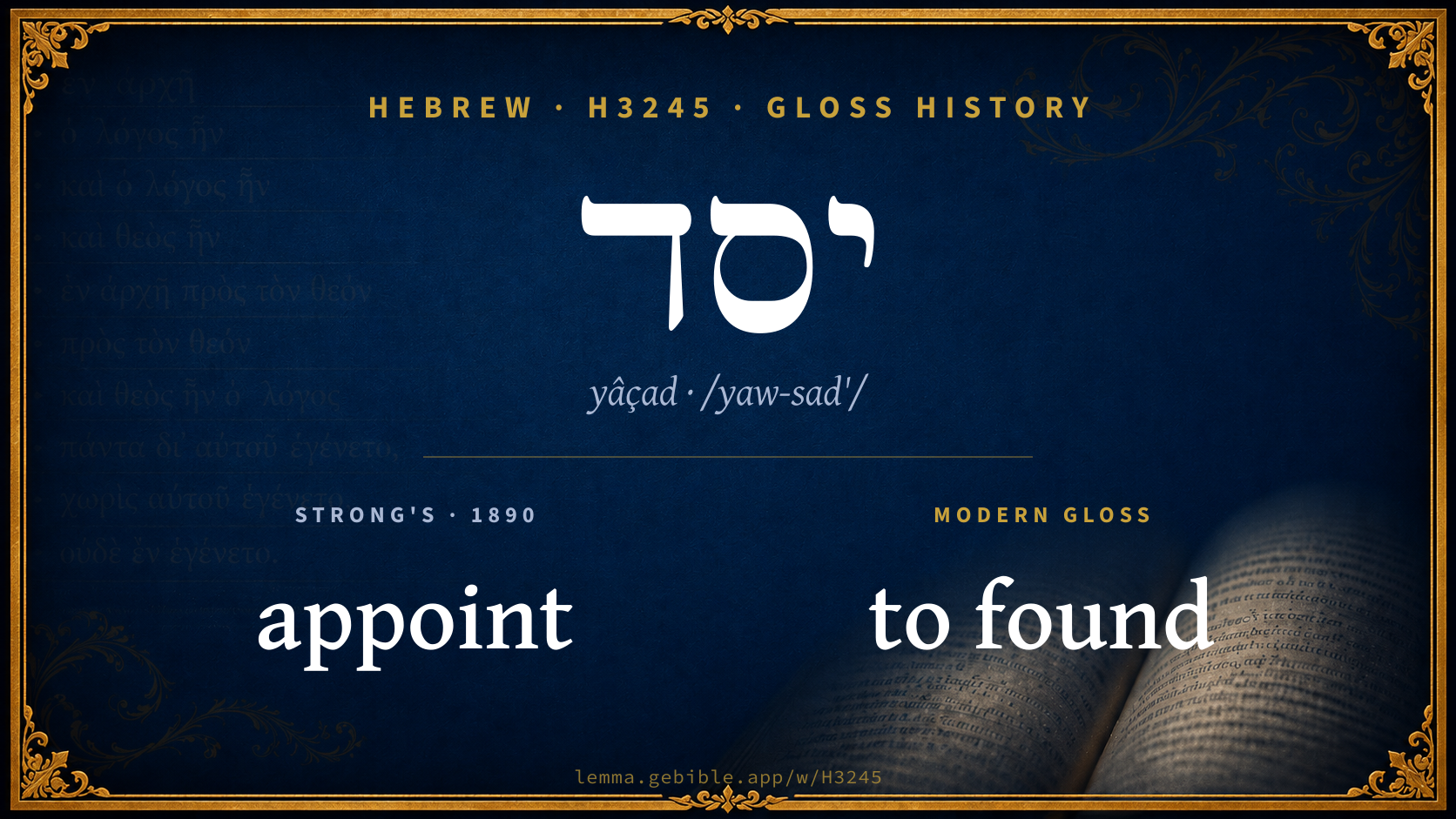
Gloss history
Strong's 1890 vs modern scholarship
About this word
Strong's H3245 catalogs a Hebrew word from the Hebrew Old Testament.
These counts are not copied from any lexicon or concordance. They are computed here, from the morphology-tagged Hebrew Old Testament. What Lemma adds →
- 41
- distinct verses
- The word appears in 41 distinct verses.
- 16 / 39
- OT books
- The word appears in 16 of 39 Old Testament books.
- #864
- by frequency
- Top 1000 most frequent Hebrew words (rank 864 of 8,640 Hebrew words by occurrence).
View all 41 occurrences in the concordance →
By section of the Old Testament
By traditional corpus
Conventional, traditional groupings — biblical authorship is debated, so this is a traditional corpus grouping, not an authorship claim. Each share is this word’s portion of its verses in that division of the Hebrew canon. Each figure is a share of the word’s 41 distinct verses.
- Writings (Ketuvim) 21 verses · 51%
- Prophets (Nevi'im) 19 verses · 46%
- Torah (Pentateuch) 1 verse · 2%
How translations render this word
Counts come from each version’s own published word-to-Strong’s tagging or interlinear alignment — an approximate guide to how each version renders this word, not a word-level alignment the data otherwise carries. Because each total is that version’s own tagged count, the per-version totals vary from one another and need not match the appearance or distinct-verse counts above. These counts may also differ from a printed concordance because Lemma counts each distinctly tagged rendering and does not collapse phrase taggings into a single head-word total. This is a fixed set of word-tagged versions (KJV, ASV, BSB, ULT) and does not change with the reading translation you choose elsewhere. Each version’s license is shown beside its name below (and on Sources).
- King James Version: Foundation 6×, Hath founded 3×, Was laid 3×
- American Standard Version: Foundation 5×, Laid 3×, Was laid 3×
- Berean Standard Bible: Founded 3×, Foundation 2×, Was laid 2×
- unfoldingWord Literal Text: Was founded 4×, Founded 3×, Founding of 3×
King James Version Public Domain
Renders H3245 across 46 tagged occurrences — most commonly:
Plus 28 renderings that appear only once — usually multi-word phrases or single function words the recovered tagging swept in, not distinct renderings. Not rendered by a distinct English word in 1 further occurrence.
American Standard Version Public Domain
Renders H3245 across 46 tagged occurrences — most commonly:
Plus 31 renderings that appear only once — usually multi-word phrases or single function words the recovered tagging swept in, not distinct renderings.
Berean Standard Bible Public Domain
Renders H3245 across 43 tagged occurrences — most commonly:
Plus 34 renderings that appear only once — usually multi-word phrases or single function words the recovered tagging swept in, not distinct renderings.
unfoldingWord Literal Text CC BY-SA 4.0
Renders H3245 across 46 tagged occurrences — most commonly:
Plus 32 renderings that appear only once — usually multi-word phrases or single function words the recovered tagging swept in, not distinct renderings.
9 senses and sub-senses in the full BDB
Hebrew verbs can shift meaning by stem (binyan): Qal is the basic action, Niphal is often passive or reflexive, Piel often intensifies or makes it factitive, and Hiphil is typically causative. The senses below are grouped under the stem BDB assigns to each. This entry also uses Pual (the passive of Piel) and Hophal (the passive of Hiphil).
What do BDB’s symbols mean?
BDB uses these scholarly abbreviations:
| Symbol | Meaning |
|---|---|
| 𝔊 | the Septuagint (the ancient Greek translation, LXX) |
| 𝔙 | the Vulgate (the Latin translation) |
| 𝔖 | the Syriac version (the Peshitta) |
| 𝔗 | the Targum (the Aramaic translation) |
| ψ | the Psalms |
| √ | root (the underlying root or stem) |
| ‖ | parallel passage (a synonymous or contrasted parallel) |
| † | the dagger: every passage where the word occurs is cited |
The 9 senses and sub-senses the full Brown-Driver-Briggs lexicon distinguishes for this word, in lexicon order (not ranked by frequency), with BDB’s own verbatim wording and sub-sense lettering. Shown in Hebrew script with BDB’s own scholarly abbreviations. The condensed entry is in the Lexicon Entry tab. See also the Forms in the corpus table below.
Qal
- Pf. יָסַד ψ 104:5; Pr 3:19; sf. יְסָדָהּ ψ 24:2 + 3 times; 3 fs. יָסְֽדָה Is 48:13; יָסַדְתָּ ψ 104:8; יָסַ֑֫דְתָּ 102:26; sf. יְסַדְתּוֹ Hab 1:12; יְסַדְתָּם ψ 89:12; 119:152; וִיסַדְתִּיךְ consec. Is 54:11; Inf. וִיסוֹד 2 Ch 24:27; לִיסּוֹד 31:7 (v. Ges§ 69, 2, R. 1; Baer לְיִסּוֹד); לִיסֹד Is 51:16; יָסְדִי Jb 38:4; יָסְדוֹ Ezr 3:12; Pt. יֹסֵד Is 51:13 Zc 12:1 + Is 28:16 (Che crit. n., MT יִסַּד);—found, establish, c. acc., the earth ψ 24:2 (‖ כונן), cf. 78:69 (obj. om.), 89:12; 102:26; 104:5 cf. v 8 (sq. לְ), Pr 3:19; Is 48:13; Jb 38:4; Is 51:13, 16; Zc 12:1, vault of heaven Am 9:6; of founding the second temple Ezr 3:12, of restoration under Joash, Inf. יְסוֹד 2 Ch 24:27; metaph. of future Israel Is 54:11; of י׳, establish the Chaldaean (as his instrument) להוכיח for correction Hb 1:12 (‖ שִׂים), his commandments ψ 119:152; in weakened sense (si vera l.) יָסַד לְצִיִּים Is 23:13 appoint a city for desert-creatures (on meaning in context, v. Di); appoint, fix Ezr 7:9 emend. (v. יְסֻד); found, begin, heaps of offerings in י׳’s house 2 Ch 31:7. e.g. Psalms 104:5
Niphal
- Pf. 3 pl. נוֹסְדוּ ψ 2:2; Impf. 2 ms. תִּוָּסֵד Is 44:28; Inf. הִוָּסְדָהּ Ex 9:18; הִוָּֽסְדָם ψ 31:14;— e.g. Psalms 2:2
- 1. fix or seat themselves close together, sit in conclave ψ 2:2; 31:14 (> Bae from ܣܘܳܕܳܐ ὁμιλία), but Lag’s emend. נוֹעֲדוּ is prob. (cf. Ne 6:2). e.g. Psalms 2:2
- 2. be founded, Is 44:28 (temple), Ex 9:18 (Egypt). e.g. Isaiah 44:28
Piel
- Pf. יִסַּד Is 14:32 + 3 times, יִסְּדָהּ 1 K 16:34; יִסַּ֫דְתָּ ψ 8:3; יִסְּדוּ Zc 4:9 Ezr 3:10; Impf. יְיַסְּדֶנָּה Jos 6:26; Inf. לְיַסֵּד 1 K 5:31— e.g. Isaiah 14:32
- 1. found (= Qal), sq. acc., city Jos 6:26 (JE), 1 K 16:34, temple 1 K 5:31; Zc 4:9; Ezr 3:10; Zion Is 14:32; 28:16 הִנְנִי יִסַּד (read יֹסֵד; v. supr.) e.g. Joshua 6:26
- 2. establish ψ 8:3 sq. עֹז; appoint, ordain (late) 1 Ch 9:22 (sq. acc.), Est 1:8 (abs.) e.g. Psalms 8:3
Pual
- Pf. יֻסַּד 1 K 6:37 + 2 times; יֻסָּ֑ד Ezr 3:6; Pt. מְיֻסָּ֑ד 1 K 7:10; מְיֻסָּדִים Ct 5:15; be founded, be laid, of a foundation 1 K 6:37; Ezr 3:6; Hg 2:18; Zc 8:9; Pt. = subst. foundation 1 K 7:10, cf. מוסד infr.; pillars set on bases, sim. of legs Ct 5:15. e.g. 1 Kings 6:37
Hophal
- be founded: Inf. הוּסַד 2 Ch 3:3 Ezr 3:11; Pt. מוּסָּד Is 28:16;—the being founded, founding, עַל הוּסַד בֵּית י׳ Ezr 3:11 because of the founding (laying the foundation) of the house of י׳; וְאֵלֶּה הוּסַד שְׁלֹמֹה לִבְנוֹת וגו׳ 2 Ch 3:3 and this is (lit. these are) the founding Solomon to build the house of God. i.e this is the foundation which Solomon laid for building, etc.; Pt. מוּסָד מוּסָּד Is 28:16 a foundation founded, i.e. well laid (cf. חֵפֵשׂ מְחֻפָּשׂ, חָכָם מְחֻכָּם). e.g. 2 Chronicles 3:3
Senses from the full Brown-Driver-Briggs lexicon (Brown, Driver, Briggs; Oxford 1906 — public domain), digitized via Sefaria, supplemented by the OpenScriptures HebrewLexicon (CC BY 4.0). Full attribution on Sources.
Word origin
vb. establish, found, fix (NH id. especially Pi; Aramaic יְסַד perhaps orig. fix firm or close; Arabic وِسَادٌ pillow; vb. denom. ii. fix as a pillow against one; v. lean against, recline, Lane 2940 Saad Gn 28:11; in Heb. usually fix firm so as to found)—
— Brown-Driver-Briggs (Oxford 1906, public domain), digitized via Sefaria, supplemented by the OpenScriptures HebrewLexicon (CC BY 4.0). See Sources.
Origin: a primitive root
Jastrow Dictionary
A second Hebrew/Aramaic lexicon for comparison, covering Aramaic and post-biblical (Talmudic, Targumic, Midrashic) usage that the biblical-Hebrew BDB does not. Matched by lemma rather than by Strong’s number, so a lemma may carry more than one Jastrow headword (shown separately below), and the entries cover usage well beyond the Bible.
יָסַד
- v. סַד) [to join, fasten; denom. יְסוֹד, whence יָסַד] to found, establish. Tanḥ. B’resh. 1 ובה … וי׳ ארץ and with it (the Torah) he stretched the heavens and established the earth. Meg. 3ᵃ; Sabb. 104ᵃ; Succ. 44ᵃ וחזרו וִיסָדוּם and they reintroduced them. Ib. 20ᵃ, v. עֶזְרָא; a. fr. e.g. Genesis 1:1
- 1. to establish; to join in between. Y. Erub. V, 22ᶜ שער היסוד ששם היו מְיַיסְּדִין וכ׳ the Eastern Gate was named the Foundation Gate, because there they (in their meetings) established the decisions of the Law; a. e.—Part. pass. מְיוּסָּד. Ib. שער התווך שהוא מי׳ בין וכ׳ it was named the Middle Gate because it was fastened in between two gates; a. e.
- 2. to rebuild (a ruin). Tosef. B. Mets. XI, 4 לא יאמר לו הריני מייסד עמך מכנגד וכ׳ (not עמו) he has no right to say, I will help thee rebuild the party wall from where my (higher situated) ground commences and upward, אלא מייסד עמו וכ׳ but he must help him build from the bottom (of the neighbor’s ground) &c.; Y. ib. X, beg. 12ᶜ; (B. Bath. 6ᵇ מסייע מלמטה). [Cant. R. to I, 2 שהרי חבירו בא ליַסֵּד עליו כן the next following sentence comes to found upon it a base (thus proving that the reading is דּוֹדֶיךָ and not דּוֹדַיִךְ). Some eds. read לימד; Ab. Zar. II, 5 חבירו מלמד; Yalk. Cant. 981 מוכיח.]
- to be established. Tanḥ. l. c. העולם לא נ׳ וכ׳ the world has been founded on nothing but the Law.
יְסַד
- Targ. Ps. LXXVIII, 69; a. e.
- same. Ib. CIV, 5.
- , Ittof. אִתּוֹסָד to be fastened, supported, founded. Targ. Job. XLI, 15, sq.—Targ. Ps. LXXXVII, 1.—Targ. II Chr. XXXI, 7 לאִתּוֹסָדָא (ed. Lag. לאִתְיַסְּרָא).
A Dictionary of the Targumim, the Talmud Babli and Yerushalmi, and the Midrashic Literature (Marcus Jastrow; London, Luzac, 1903) — Public Domain. Digitized via Sefaria. Digitized via Sefaria. Full attribution on Sources.
Forms in the corpus
The 36 distinct written forms H3245 takes in the Hebrew Bible, most frequent first — each parse links to that stem’s occurrences in the concordance. Hebrew forms include their vowel points and cantillation, so a single lemma takes many written forms.
Same root — word family
Other BDB entries built from the same root as H3245, grouped by Strong’s listed origin. These share a root / origin per the lexicon — not necessarily a shared meaning. Each links to that word’s own entry.
Derived from this word
- יסד yᵉçud H3246 foundation
- יסוד yᵉçôwd H3247 foundation
- מוסד mûwçâd H4143 foundation
- מוסד môwçâd H4144 foundation
- מיסדה mᵉyuççâdâh H4328 foundation
- מסד maççad H4527 foundation
- סוד çôwd H5475 council
Compare all same-root words → Showing 4 of 8 — not the complete family. They share a root, not necessarily a meaning.
Septuagint verse parallels
This word appears in 36 verses that also exist in the Greek Old Testament (Septuagint), out of the 41 Hebrew verses it occurs in. You can read those verses in Greek by switching the Old Testament edition to the Septuagint.
Read these verses in the Septuagint
- Exodus 9:18
- Joshua 6:26
- 1 Kings 5:17
- 1 Chronicles 9:22
- 2 Chronicles 3:3
- Ezra 3:6
- Esther 1:8
- Job 38:4
- Psalms 2:2
- Proverbs 3:19
- Song of Solomon 5:15
- Isaiah 14:32
This is a verse-level parallel only — the same verses exist in both the Hebrew and Greek Old Testaments. No word-level Hebrew↔Greek correspondence is claimed: the data carries no such alignment, so no Greek word is shown as this Hebrew word’s translation. Coverage is not total — the Septuagint omits the deuterocanon and renumbers the Psalms, so some Hebrew verses have no direct Greek parallel.