Zechariah 4:9

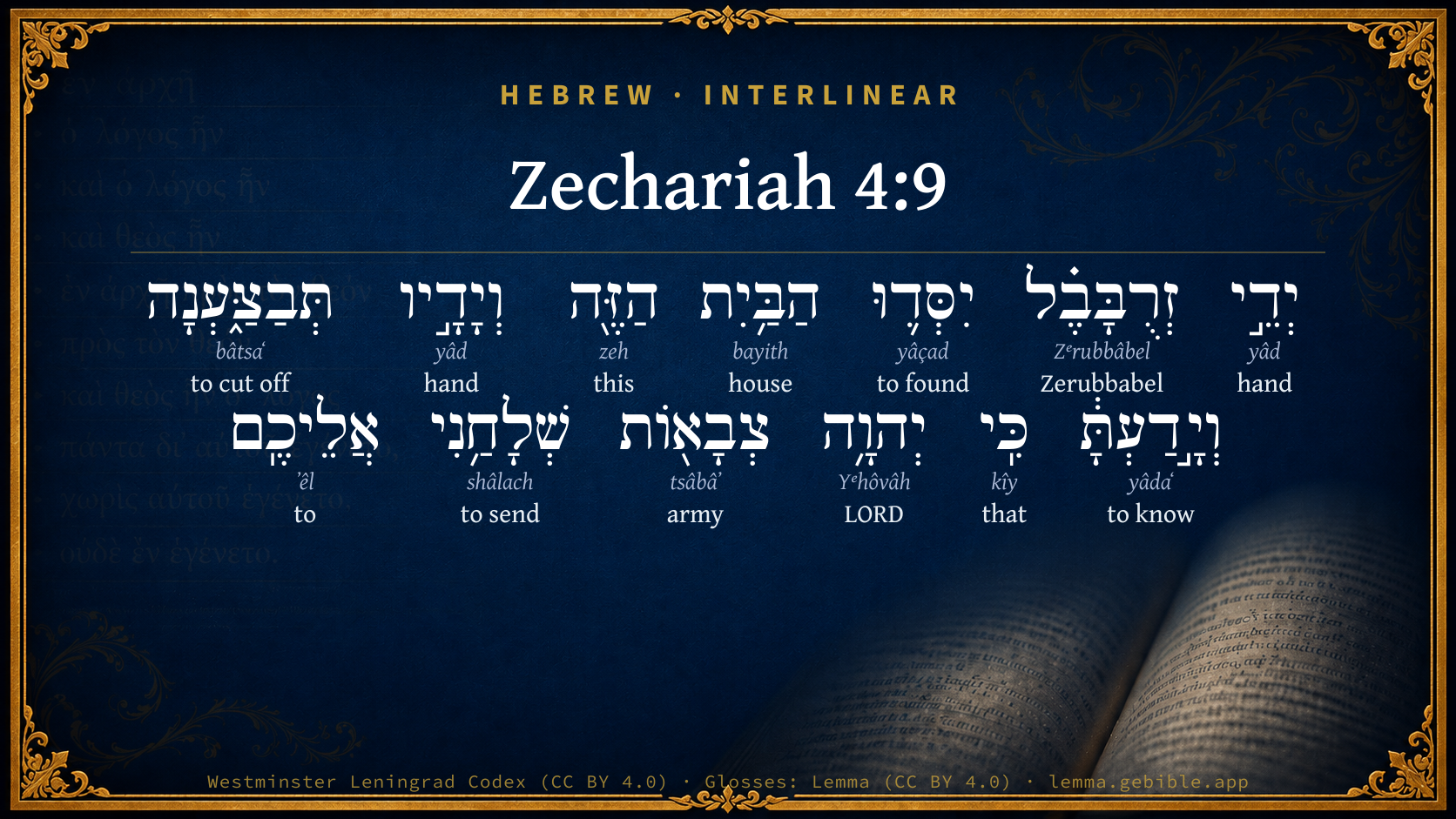
Hebrew (Westminster Leningrad Codex) Zechariah 4:9 appears in the Hebrew Old Testament. The text above is from the Westminster Leningrad Codex. Each word links to its Strong’s number, a concise gloss, and parsing drawn from the Open Scriptures Hebrew Bible morphology. Click any word for its full Brown-Driver-Briggs (BDB) entry.
Download image
Cite this verse

Zechariah 4:9 (World English Bible). Public Domain. Lemma interlinear Bible study tool, https://lemma.gebible.app/v/zechariah/4/9.

Show BibTeX & RIS
BibTeX
RIS
English Translation
"The hands of Zerubbabel have laid the foundation of this house. His hands shall also finish it; and you will know that Yahweh of Hosts has sent me to you.
World English Bible · Public Domain
Download a study sheet

One document with this verse’s original text, its word-by-word gloss line, the meaning frame, cross-references with their text, attributed commentary, and full source and license credits — printable, and it pastes into notes with its structure intact.

This verse Autodidact and up

Study sheet (.html) Plain text (.txt)

A passage Seminary Student

Up to 50 verses in one chapter. A passage sheet keeps up to 6 commentary sources and 12 cross-references per verse, in the order this page ranks them, and says so on the sheet whenever that leaves anything out. Ask for a single verse and you get the Autodidact verse sheet above.

Everything on this page stays free to read, with no account — the sheet is a download of what is already on screen, not access to it.

Want to remove ads? Support Godless Engineer
Compare translations 3

The same verse in 3 English versions, stacked beneath the original-language interlinear above. Click any original word for its lexicon entry.

Each is an independent rendering of the whole verse — the interlinear is not word-aligned to these translations.

Highlighted words mark where these versions differ — a whole-verse word diff, not a word-by-word alignment.

  • World English Bible Public Domain
    "The hands of Zerubbabel have laid the foundation of this house. His hands shall also finish it; and you will know that Yahweh of Hosts has sent me to you.
  • King James Version Public Domain
    The hands of Zerubbabel have laid the foundation of this house; his hands shall also finish it; and thou shalt know that the LORD of hosts hath sent me unto you.
  • unfoldingWord Literal Text CC BY-SA 4.0
    ‘The hands of Zerubbabel have founded this house, and his hands will complete it.’ And you will know that Yahweh of Armies has sent me to you.

unfoldingWord Literal Text — © unfoldingWord, licensed CC BY-SA 4.0. Word-aligned USFM3 via Door43 (git.door43.org/unfoldingWord/en_ult).

Versions to compare (up to 4)

3 of 4 selected

Show all 18 translations

Every available English version of this verse, each an independent rendering of the whole verse.

  • World English Bible Public Domain
    "The hands of Zerubbabel have laid the foundation of this house. His hands shall also finish it; and you will know that Yahweh of Hosts has sent me to you.
  • Berean Standard Bible Public Domain
    “The hands of Zerubbabel have laid the foundation of this house, and his hands will complete it. Then you will know that the LORD of Hosts has sent me to you.
  • Majority Standard Bible Public Domain
    “The hands of Zerubbabel have laid the foundation of this house, and his hands will complete it. Then you will know that the LORD of Hosts has sent me to you.
  • King James Version Public Domain
    The hands of Zerubbabel have laid the foundation of this house; his hands shall also finish it; and thou shalt know that the LORD of hosts hath sent me unto you.
  • American Standard Version (1901) Public Domain
    The hands of Zerubbabel have laid the foundation of this house; his hands shall also finish it; and thou shalt know that Jehovah of hosts hath sent me unto you.
  • Revised Version (1885) Public Domain
    The hands of Zerubbabel have laid the foundation of this house; his hands shall also finish it; and thou shalt know that the LORD of hosts hath sent me unto you.
  • Geneva Bible (1599) Public Domain
    The handes of Zerubbabel haue layde the foundation of this house: his handes shall also finish it, and thou shalt knowe that the Lord of hostes hath sent me vnto you.
  • Douay-Rheims (1899) Public Domain
    The hands of Zorobabel have laid the foundations of this house, and his hands shall finish it: and you shall know that the Lord of hosts hath sent me to you.
  • Young's Literal Translation Public Domain
    Hands of Zerubbabel did found this house, And his hands do finish it, And thou hast known that Jehovah of Hosts Hath sent me unto you.
  • Literal Standard Version CC BY-SA 4.0
    “Hands of Zerubbabel founded this house, || And his hands finish it, || And you have known that YHWH of Hosts || Has sent Me to you.
  • Unlocked Literal Bible CC BY-SA 4.0
    “The hands of Zerubbabel have laid the foundation of this house and his hands will bring it to completion.” Then you will know that Yahweh of hosts has sent me to you.
  • unfoldingWord Literal Text CC BY-SA 4.0
    ‘The hands of Zerubbabel have founded this house, and his hands will complete it.’ And you will know that Yahweh of Armies has sent me to you.
  • Darby Bible Public Domain
    The hands of Zerubbabel have laid the foundation of this house; and his hands shall finish it: and thou shalt know that Jehovah of hosts hath sent me unto you.
  • World Messianic Bible Public Domain
    “The hands of Zerubbabel have laid the foundation of this house. His hands shall also finish it; and you will know that the LORD of Hosts has sent me to you.
  • Webster's Bible Public Domain
    The hands of Zerubbabel have laid the foundation of this house; his hands shall also finish it; and thou shalt know that the LORD of hosts hath sent me to you.
  • Free Bible Version CC BY-SA 4.0
    Zerubbabel with his own hands laid the foundations for this Temple, and it will be completed the same way. Then you will know the Lord Almighty has sent me.
  • Bible in Basic English Public Domain
    The hands of Zerubbabel have put the base of this house in place, and his hands will make it complete; and it will be clear to you that the Lord of armies has sent me to you.
  • JPS Tanakh (1917) Public Domain
    'The hands of Zerubbabel have laid the foundation of this house; his hands shall also finish it; and thou shalt know that the LORD of hosts hath sent me unto you.

Literal Standard Version (2020), Covenant Press — licensed CC BY-SA 4.0. Text via the HelloAO Bible API (eBible.org). Unlocked Literal Bible (unfoldingWord) — licensed CC BY-SA 4.0. Text via the HelloAO Bible API (eBible.org). unfoldingWord Literal Text — © unfoldingWord, licensed CC BY-SA 4.0. Word-aligned USFM3 via Door43 (git.door43.org/unfoldingWord/en_ult). Free Bible Version, Dr. Jonathan Gallagher — licensed CC BY-SA 4.0. Text via the HelloAO Bible API (eBible.org).

Word by word

More ways to search: Search by grammar → Find every occurrence → Compare this word →

Practice this passage: Drill this verse → Learn its vocabulary →

תְּבַצַּ֑עְנָה
bâtsaʻ
H1214
“to cut off”
Verb, Piel, Imperfect, 3rd Person, Feminine, Plural
Part of Speech
Verb
Stem
Piel
Form
Imperfect
Person
3rd Person
Gender
Feminine
Number
Plural
Full BDB Definition

Origin: a primitive root

TWOT: 267

to cut off, break off, gain by unrighteous violence, get, finish, be covetous, be greedy - (Qal) - to cut off - to stop - to gain wrongfully or by violence - (Piel) - to cut off, sever - to finish, complete, accomplish - to violently make gain of
  1. יְדֵ֣י yâd H3027 “hands of” Noun, Common, Both, Dual, Construct
  2. זְרֻבָּבֶ֗ל Zᵉrubbâbel H2216 “Zerubbabel” Noun, Proper
  3. יִסְּד֛וּ yâçad H3245 “to found” Verb, Piel, Perfect, 3rd Person, Common, Plural
  4. הַבַּ֥יִת bayith H1004 “the · house” Particle, Definite Article + Noun, Common, Masculine, Singular, Absolute
  5. הַזֶּ֖ה zeh H2088 “the · this” Particle, Definite Article + Pronoun, Demonstrative, Masculine, Singular
  6. וְיָדָ֣יו yâd H3027 “and · hands · his” Conjunction + Noun, Common, Both, Dual, Construct + Suffix, Personal, 3rd Person, Masculine, Singular
  7. וְיָ֣דַעְתָּ֔ yâdaʻ H3045 “and · to know” Conjunction + Verb, Qal, Perfect, 2nd Person, Masculine, Singular
  8. כִּֽי kîy H3588 “that” Conjunction
  9. יְהוָ֥ה Yᵉhôvâh H3068 “LORD” Noun, Proper
  10. צְבָא֖וֹת tsâbâʼ H6635 “armies” Noun, Common, Both, Plural, Absolute
  11. שְׁלָחַ֥נִי shâlach H7971 “to send · me” Verb, Qal, Perfect, 3rd Person, Masculine, Singular + Suffix, Personal, 1st Person, Common, Singular
  12. אֲלֵיכֶֽם ʼêl H413 “to · you” Preposition + Suffix, Personal, 2nd Person, Masculine, Plural

About this verse

These counts appear in no published source. They are computed here, from the morphology-tagged text and Lemma’s own curated glosses. What Lemma adds →

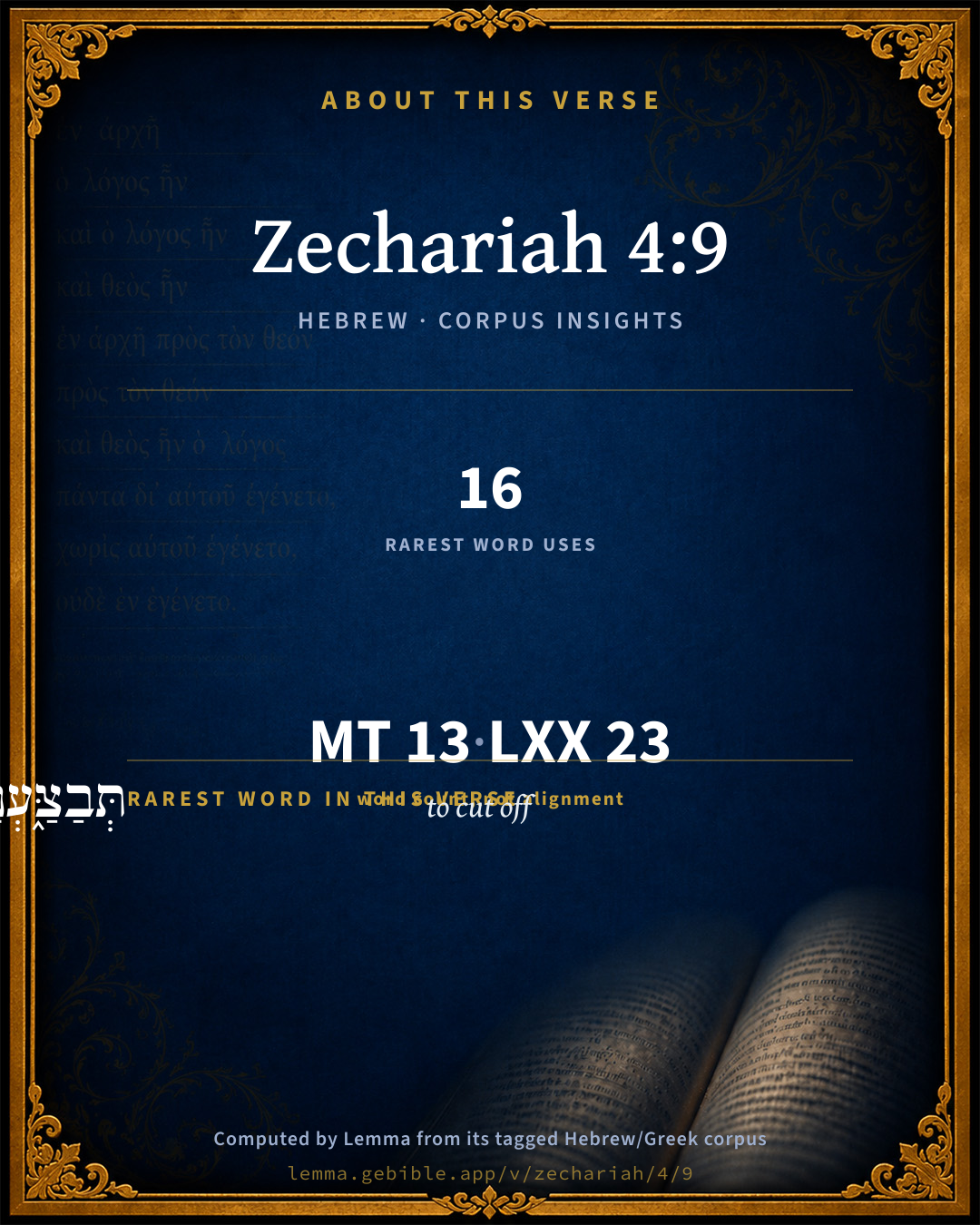
13
words
12
distinct lemmas
Prophets
section

Notable vocabulary

The rarest word here is תְּבַצַּ֑עְנָה to cut off H1214 — appearing just 16 times in the whole Hebrew Bible.

Shared distinctive vocabulary

תְּבַצַּ֑עְנָה to cut off H1214 occurs in 16 verses of the Hebrew Bible. Also found in:

Grammatical profile

  • 4 verbs
  • 6 nouns
  • 1 pronoun
  • 1 preposition
  • 1 conjunction

Verb forms

  • יִסְּד֛וּ Piel · Perfect
  • תְּבַצַּ֑עְנָה Piel · Imperfect
  • וְיָ֣דַעְתָּ֔ Qal · Perfect
  • שְׁלָחַ֥נִי Qal · Perfect

Repetition

A word recurs within this verse — often emphatic in Hebrew:

  • יְדֵ֣י hand H3027 ×2

Hebrew & Septuagint length

In English translation the verse runs 30 words from the Hebrew and 30 from the Septuagint (LXX English) — the same length.

A rough comparison of the two English renderings, which tokenize alike — not a word-level alignment.

Word counts can differ between the Hebrew and the Greek without any difference in meaning — e.g. the Hebrew direct-object marker אֵת has no separate Greek word, and Greek often adds the article ὁ.

In the original languages it is 13 Hebrew tokens and 23 Greek tokens — but the two are counted differently (Hebrew bundles its prefixes and suffixes into one token; the Greek is in lemma form), so that isn’t a like-for-like length.

Cross-references

14

Topical passages linked to Zechariah 4:9 in the Treasury of Scripture Knowledge — connected by theme and wording, ordered by reader-vote popularity; previews shown in the World English Bible.

  • Ezra 6:14–15 The elders of the Jews built and prospered, through the prophesying of Haggai the prophet and Zechariah the son of Iddo. They built and finished it, according to the commandment of the God of Israel, and according to the decree of Cyrus, and Darius, and Artaxerxes king of Persia.
  • Zechariah 6:12–13 and speak to him, saying, 'Thus says Yahweh of Hosts, "Behold, the man whose name is the Branch: and he shall grow up out of his place; and he shall build the temple of Yahweh;
  • Ezra 5:16 Then came the same Sheshbazzar, and laid the foundations of the house of God which is in Jerusalem: and since that time even until now has it been in building, and yet it is not completed.
  • Zechariah 6:15 Those who are far off shall come and build in the temple of Yahweh; and you shall know that Yahweh of hosts has sent me to you. This will happen, if you will diligently obey the voice of Yahweh your God."'"
  • Hebrews 12:2 looking to Jesus, the author and perfecter of faith, who for the joy that was set before him endured the cross, despising shame, and has sat down at the right hand of the throne of God.
  • Ezra 3:8–13 Now in the second year of their coming to the house of God at Jerusalem, in the second month, began Zerubbabel the son of Shealtiel, and Jeshua the son of Jozadak, and the rest of their brothers the priests and the Levites, and all those who were come out of the captivity to Jerusalem, and appointed the Levites, from twenty years old and upward, to have the oversight of the work of the house of Yahweh.
  • Zechariah 2:8–9 For thus says Yahweh of hosts: 'For honor he has sent me to the nations which plundered you; for he who touches you touches the apple of his eye.
  • John 3:17 For God didn't send his Son into the world to judge the world, but that the world should be saved through him.
  • John 17:21 that they may all be one; even as you, Father, are in me, and I in you, that they also may be one in us; that the world may believe that you sent me.
  • Isaiah 48:16 Come you near to me, hear you this; from the beginning I have not spoken in secret; from the time that it was, there am I: and now the Lord Yahweh has sent me, and his Spirit.
  • Zechariah 2:11 Many nations shall join themselves to Yahweh in that day, and shall be my people; and I will dwell in the midst of you, and you shall know that Yahweh of Hosts has sent me to you.
  • Matthew 16:18 I also tell you that you are Peter, and on this rock I will build my assembly, and the gates of Hades will not prevail against it.
  • John 8:16–18 Even if I do judge, my judgment is true, for I am not alone, but I am with the Father who sent me.
  • John 5:36–37 But the testimony which I have is greater than that of John, for the works which the Father gave me to accomplish, the very works that I do, testify about me, that the Father has sent me.

Cross-references courtesy of OpenBible.info (CC BY 4.0).

Hebrew and Greek witnesses Masoretic Hebrew ↔ Greek Septuagint

The same verse in the two great witnesses to the Old Testament, shown verse-for-verse.

These are two independent witnesses, not word-aligned to each other, and the Septuagint is shown in lemma (dictionary) form.

Hebrew Zechariah 4:9 Masoretic · Westminster Leningrad Codex

יְדֵ֣י זְרֻבָּבֶ֗ל יִסְּד֛וּ הַבַּ֥יִת הַזֶּ֖ה וְיָדָ֣יו תְּבַצַּ֑עְנָה וְיָ֣דַעְתָּ֔ כִּֽי יְהוָ֥ה צְבָא֖וֹת שְׁלָחַ֥נִי אֲלֵיכֶֽם

"The hands of Zerubbabel have laid the foundation of this house. His hands shall also finish it; and you will know that Yahweh of Hosts has sent me to you.

World English Bible · Public Domain

Greek LXX Zechariah 4:9 Septuagint · lemma form

ὁ χείρ ζοροβαβελ θεμελιόω ὁ οἶκος οὗτος καί ὁ χείρ αὐτός ἐπιτελέω αὐτός καί ἐπιγιγνώσκω διότι κύριος παντοκράτωρ ἐκ ἀποστέλλω ἐγώ πρός σύ

The hands of Zorobabel have laid the foundation of this house, and his hands shall finish it: and you shall know that the Lord Almighty has sent me to you.

LXX2012 (modern English Septuagint) · Public Domain

Hebrew: Westminster Leningrad Codex (CC BY 4.0). Greek: Septuagint (public domain); English from LXX2012 (modern English Septuagint) (Public Domain). How the Septuagint differs from the Hebrew →

Targum (Aramaic paraphrase)

1

The Targum is the ancient Jewish Aramaic paraphrase of the Hebrew Scriptures — an interpretive translation, not the Hebrew text itself. Onkelos (literal) and Pseudo-Jonathan (expansive) render the Torah, and Jonathan the Prophets. Coverage is partial: where no permissively-licensed English translation exists for a verse, only the Aramaic is shown. This is verse-level text, not a word-by-word alignment to the Hebrew.

  1. Targum Jonathan Prophets (Joshua–Malachi)
    יְדֵי זְרֻבָּבֶל שְׁרִיאָה לְמִבְנֵי בֵיתָא הָדֵין וִידוֹהִי יְשַׁכְלְלוּנֵיהּ וְתֵידְעוּן אֲרֵי יְיָ צְבָאוֹת שַׁלְחַנִי לְאִתְנַבָּאָה לְכוֹן:

    (no public-domain English translation for this verse)

    Targum Jonathan — Aramaic: “Mikraot Gedolot” (public domain). English: “Sefaria Community Translation” (CC0 1.0 (public-domain dedication)); “London "Chaldee Paraphrase," 1871” (public domain). Text via Sefaria.

Commentary

Notes on Zechariah 4:9 from classic Christian and Jewish commentators (each source and its license shown beneath its notes). The classic Christian expositions comment on the surrounding passage and are grouped to its opening verse, so a note may address several verses; the Jewish commentaries on the Tanakh (Rashi and others) are per-verse, so they appear only where the commentator wrote on this verse.

Lemma curates 59 commentaries, every one of them public domain or Creative Commons licensed, each selected and text-cleaned for this edition rather than reprinted as found. About our sources →

Trapp's Complete Commentary

John Trapp

Zec 4:9 The hands of Zerubbabel have laid the foundation of this house; his hands shall also finish it; and thou shalt know that the LORD of hosts hath sent me unto you.

Ver. 9. The hands of Zerubbabel have laid the foundation of this house; his hands] Here the scope of this stately vision is plainly held forth, and without a parable. What the Scripture speaketh darkly in one place it speaks plainly in another. The Rabbis have a saying, that there is a mountain of sense hanging upon every apex of the word of God. They have also another saying, Nulla est obiectio in lege, quae non habet solutionem in latere, i.e. there is not any doubt in the law, but may be resolved out of the law. Zerubbabel is both founder and finisher of the temple. Those that will have it not to be finished till about the sixth year of Darius Nothus make him to be very long lived; and tell us that God granteth to one a longer life than ordinary, because he hath something to be done by them (Pemble, of the Persian Monarchy). The distrustful Jews began to despise those small beginnings of a building; and to despair of ever seeing it perfected, by reason of those mountains of opposition they met with, and thought they should never dig down or get over. The work shall be done, saith God, and Zerubbabel, how unlikely soever, shall do it. Believe the prophets and ye shall prosper. It shall never be said of Zerubbabel, as of the foolish builder, "This man began, but could not finish," Luk 14:30; or, as a foreigner, seeing Christ Church in Oxford, said to it, Egregium opus; Cardinalis iste instituit collegium, et absolvit culinam. A pretty piece of work! A college begun, and a kitchen finished. It was God that set Zerubbabel to work; and he doth not use do things to halves. He is Alpha and Omega, the beginner and ender, the author and finisher, Heb 12:2 "I am confident of this very thing," saith Paul, "that he that hath begun a good work in you will perform it," Php 1:6. And, "faithful is he that calleth you, who also will do it," 1Th 5:24. And, "the Lord will perfect that which concerneth me" (saith David); "forsake not the work of thine own hands," Psa 138:8. Look upon the wounds of thine hands, and despise not the works of thine hands, said Queen Elizabeth. Thus if men pray in the Holy Ghost, keep themselves in the love of God, and look for the mercy of our Lord Jesus Christ unto eternal life; they shall be builded up in their most holy faith, whereby Christ shall dwell in their hearts, as in his holy temple, Jdg 1:20-21.

And thou shalt know] Thou, Zechariah, shalt know, that the

Lord of hosts hath sent me] His angel, as his internuncio, see Luk 1:19. Or, thou Zerubbabel shalt know, that I, Zechariah, come not to thee of mine own mind, but on God’s message, and am therefore to be believed. When Ehud told Eglon he had a message from God, though he were a heathen and a fat unwieldy man, he stood up to receive it, Jdg 3:20, though that message was a messenger of death, a dagger. in his bowels. Should not we hearken to the Father of spirits, and live? Heb 12:9; should the consolations of God be small with us? Job 15:11. Should we, instead of wrestling with God by prayer (so putting his promises in suit), wrangle with him, by cavilling objections? Ipse dixit it spoke for itself, among Pythagoras’ scholars went current; if their master said it it was enough; and shall we that are taught of God not give the like credit to our Master in heaven? shall we not yield him the obedience of faith?

John Trapp, A Commentary or Exposition upon All the Books of the Old and New Testament (1647–1656) — public domain. Text from a community e-Sword module.

MacLaren's Expositions of Holy Scripture

Alexander MacLaren

Zechariah

THE SOURCE OF POWER

THE FOUNDER AND FINISHER OF THE TEMPLE

Zec 4:9.

I am afraid that Zerubbabel is very little more than a grotesque name to most Bible-readers, so I may be allowed a word of explanation as to him and as to the original force of my text. He was a prince of the blood royal of Israel, and the civil leader of the first detachment of returning exiles. With Joshua, the high priest, he came, at the head of a little company, to Palestine, and there pathetically attempted, with small resources, to build up some humble house that might represent the vanished glories of Solomon’s Temple. Political enmity on the part of the surrounding tribes stopped the work for nearly twenty years. During all that time, the hole in the ground, where the foundations had been dug and a few courses of stones been laid, gaped desolate, a sad reminder to the feeble band of the failure of their hopes. But with the accession of a new Persian king, new energy sprang up, and new, favourable circumstances developed themselves. The Prophet Zechariah came to the front, although quite a young man, and became the mainspring of the renewed activity in building the Temple. The words of my text are, of course, in their plain, original meaning, the prophetic assurance that the man, grown an old man by this time, who had been honoured to take the first spadeful of soil out of the earth should be the man ‘to bring forth the headstone with shoutings of Grace, grace unto it!’

But whilst that is the original application, and whilst the words open to us a little door into long years of constrained suspension of work and discouraged hope, I think we shall not be wrong if we recognise in them something deeper than a reference to the Prince of David’s line, concerning whom they were originally spoken. I take them to be, in the true sense of the term, a Messianic prophecy; and I take it that, just because Zerubbabel, a member of that royal house from which the Messiah was to come, was the builder of the Temple, he was a prophetic person. What was true about him primarily is thereby shown to have a bearing upon the greater Son of David who was to come thereafter, and who was to build the Temple of the Lord. In that aspect I desire to look at the words now: ‘His hands have laid the foundation of the house, and His hands shall also finish it.’

I. There is, then, here a large truth as to Christ, the true Temple-builder.

It is the same blessed message which was given from His own lips long centuries after, when He spoke from heaven to John in Patmos, and said, ‘I am Alpha and Omega, the First and the Last.’ The first letter of the Greek alphabet, and the last letter of the Greek alphabet, and all the letters that lie between, and all the words that you can make out of the letters-they are all from Him, and He underlies everything.

Now that is true about creation, in the broadest and in the most absolute sense. For what does the New Testament say, with the consenting voice of all its writers? ‘In the beginning was the Word, and the Word was with God, and the Word was God. Without Him was not anything made that was made.’ His hands laid the foundations of this great house of the universe, with its ‘many mansions.’ And what says Paul? ‘He is the Beginning, in Him all things consist’ . . . ‘that in all things He might have the pre-eminence.’ And what says He Himself from heaven? ‘I am the First and the Last.’ So, in regard to everything in the universe, Christ is its origin, and Christ is its goal and its end. He ‘has laid the foundation, and His hands shall also finish it.’

But, further, we turn to the application which is the more usual one, and say that He is the Beginner and Finisher of the work of redemption, which is His only from its inception to its accomplishment, from the first breaking of the ground for the foundations of the Temple to the triumphant bringing forth of the last stone that crowns the corner and gleams on the topmost pinnacle of the completed structure. There is nothing about Jesus Christ, as it seems to me, more manifest, unless our eyes are blinded by prejudice, than that the Carpenter of Nazareth, who grew up amidst the ordinary conditions of infant manhood, was trained as other Jewish children, increased in wisdom, spoke a language that had been moulded by man, and inherited His nation’s mental and spiritual equipment, yet stands forth on the pages of these four Gospels as a perfectly original man, to put it on the lowest ground, and as owing nothing to any predecessor, and not as merely one in a series, or naturally accounted for by reference to His epoch or conditions. He makes a new beginning; He presents a perfectly fresh thing in the history of human nature. Just as His coming was the introduction into the heart of humanity of a new type, the second Adam, the Lord from heaven, so the work that He does is all His own. He does it all Himself, for all that His servants do in carrying out the purposes dear to His heart is done by His working in and through them, and though we are fellow-labourers with Him, His hands alone lay every stone of the Temple.

Not only does my text, in its highest application, point to Jesus Christ as the Author of redemption from its very beginning, but it also declares that all through the ages His hand is at work. ‘Shall also finish it’-then He is labouring at it now; and we have not to think of a Christ who once worked, and has left to us the task of developing the consequences of His completed activity, but of a Christ who is working on and on, steadily and persistently. The builders of some great edifice, whilst they are laying its lower courses, are down upon our level, and as the building rises the scaffolding rises, and sometimes the platform where they stand is screened off by some frail canvas stretched round it, so that we cannot see them as they ply their work with trowel and mortar. So Christ came down to earth to lay the courses of His Temple that had to rest upon earth, but now the scaffolding is raised and He is working at the top stories. Though out of our sight, He is at work as truly and energetically as He was when He was down here. You remember how strikingly one of the Evangelists puts that thought in the last words of his Gospel-if, indeed, they are his words. ‘He was received up into heaven, and sat at the right hand of God, and they went everywhere, preaching the word.’ Well, that looks as if there were a sad separation between the Commander and the soldiers that He had ordered to the front, as if He were sitting at ease on a hill overlooking the battlefield from a safe distance and sending His men to death. But the next words bring Him and them together-’The Lord also working with them, and confirming the word with signs following.’ And so, brethren, a work begun, continued, and ended by the same immortal Hand, is the work on which the redemption of the world depends.

II. Notice, secondly, that we have here the assurance of the triumph of the Gospel.

No doubt, in the long-forgotten days in which my text was spoken, there were plenty of over-prudent calculators in the little band of exiles who said, ‘What is the use of our trying to build in face of all this opposition and with these poor resources of ours?’ They would throw cold water enough on the works of Zerubbabel, and on Zechariah who inspired them. But there came the great word of promise to them, ‘He shall bring forth the headstone with shoutings.’ The text is the cure for all such calculations by us Christian people, and by others than Christian people. When we begin to count up resources, and to measure these against the work to be done, there is little wonder if good men and bad men sometimes concur in thinking that the Gospel of Jesus Christ has very little chance of conquering the world. And that is perfectly true, unless you take Him into the calculation, and then the probabilities look altogether different. We are but like a long row of ciphers, but put one significant figure in front of the row of ciphers and it comes to be of value. And so, if you are calculating the probabilities of the success of Christianity in the world and forget to start with Christ, you have left out the principal factor in the problem. Churches lose their fervour, their members die and pass away. He renews and purifies the corrupted Church, and He liveth for ever. Therefore, because we may say, with calm confidence, ‘His hands have laid the foundation of the house, and His hands are at work on all the courses of it as it rises,’ we may be perfectly sure that the Temple which He founded, at which He still toils, shall be completed, and not stand a gaunt ruin, looking on which passers-by will mockingly say, ‘This man began to build and was not able to finish.’ When Brennus conquered Rome, and the gold for the city’s ransom was being weighed, he clashed his sword into the scale to outweigh the gold. Christ’s sword is in the scale, and it weighs more than the antagonism of the world and the active hostility of hell. ‘His hands have laid the foundation; His hands shall also finish it.’

III. Still further, here is encouragement for despondent and timid Christians.

Jesus Christ is not going to leave you half way across the bog. That is not His manner of guiding us. He began; He will finish. Remember the words of Paul which catch up this same thought: ‘Being confident of this very thing, that He which hath begun a good work in you will perfect the same until the day of Jesus Christ.’ Brethren! if the seed of the kingdom is in our hearts, though it be but as a grain of mustard seed, be sure of this, that He will watch over it and bless the springing thereof. So, although when we think of ourselves, our own slowness of progress, our own feeble resolutions, our own wayward hearts, our own vacillating wills, our many temptations, our many corruptions, our many follies, we may well say to ourselves, ‘Will there ever be any greater completeness in this terribly imperfect Christian character of mine than there is to-day?’ Let us be of good cheer, and not think only of ourselves, but much rather of Him who works on and in and for us. If we lift up our hearts to Him, and keep ourselves near Him, and let Him work, He will work. If we do not-like the demons in the old monastic stories, who every night pulled down the bit of walling that the monks had in the daytime built for their new monastery-by our own hands pull down what He, by His hand, has built up, the structure will rise, and we shall be ‘builded together for a habitation of God through the Spirit.’ Be of good cheer, only keep near the Master, and let Him do what He desires to do for us all. God is ‘faithful who hath called us to the fellowship of His Son,’ and He also will do it.

IV. Lastly, here is a striking contrast to the fate which attends all human workers.

There are very few of us who even partially seem to be happy enough to begin and finish any task, beyond the small ones of our daily life. Authors die, with books half finished, with sentences half finished sometimes, where the pen has been laid down. No man starts an entirely fresh line of action; he inherits much from his past. No man completes a great work that he undertakes; he leaves it half-finished, and coming generations, if it is one of the great historical works of the world, work out its consequences for good or for evil. The originator has to be contented with setting the thing going and handing on unfinished tasks to his successors. That is the condition under which we live. We have to be contented to do our little bit of work, that will fit in along with that of a great many others, like a chain of men who stand between a river and a burning house, and pass the buckets from end to end. How many hands does it take to make a pin? How many did it take to make the cloth of our dress? The shepherd out in Australia, the packer in Melbourne, the sailors on the ship that brought the wool home, the railwayman that took it to Bradford, the spinner, the weaver, the dyer, the finisher, the tailor-they all had a hand in it, and the share of none of them was fit to stand upright by itself, as it were, without something on either side of it to hold it up.

So it is in all our work in the world, and eminently in our Christian work. We have to be contented with being parts of a mighty whole, to do our small piece of service, and not to mind though it cannot be singled out in the completed whole. What does that matter, as long as it is there? The waters of the brook are lost in the river, and it, in turn, in the sea. But each drop is there, though indistinguishable.

Multiplication of joy comes from division of labour, ‘One soweth and another reapeth,’ and the result is that there are two to be glad over the harvest instead of one-’that he that soweth and he that reapeth may rejoice together.’ So it is a good thing that the hands that laid the foundations so seldom are the hands that finish the work; for thereby there are more admitted into the social gladness of the completed results. The navvy that lifted the first spadeful of earth in excavating for the railway line, and the driver of the locomotive over the completed track, are partners in the success and in the joy. The forgotten bishop who, I know not how many centuries ago, laid the foundations of Cologne Cathedral, and the workmen who, a few years since, took down the old crane that had stood for long years on the spire, and completed it to the slender apex, were partners in one work that reached through the ages.

So let us do our little bit of work, and remember that whilst we do it, He for whom we are doing it is doing it in us, and let us rejoice to know that at the last we shall share in the ‘joy of our Lord,’ when He sees of the travail of His soul and is satisfied. Though He builds all Himself, yet He will let us have the joy of feeling that we are labourers together with Him. ‘Ye are God’s building’; but the Builder permits us to share in His task and in His triumph.

Alexander MacLaren, Expositions of Holy Scripture (1904–1910) — public domain. Text from a community e-Sword module.

Geneva Bible (1599)

Geneva Bible translators

Meaning, the Prophet, that I am Christ sent of my Father for the building and preservation of my spiritual Temple.

Geneva Bible (1599) marginal notes — public domain. Text via Bolls.life.

Jamieson, Fausset & Brown

Robert Jamieson, A. R. Fausset & David Brown

Zerubbabel . . . shall . . . finish it-- (Ezr 6:15) in the sixth year of Darius' reign.

Lord . . . sent me unto you-- (Zac 2:9). The Divine Angel announces that in what He has just spoken, He has been commissioned by God the Father.

Jamieson, Fausset & Brown — Commentary Critical and Explanatory on the Whole Bible (1871) — public domain (CC PDM 1.0). Text via the HelloAO Bible API.

John Calvin's Commentaries

This is what the angel had in view in these words, The hands of Zerubbabel have founded this house. Of the foundation there was indeed no doubt; but many believed that the building would ever remain unfinished, for Satan had already by means of the most powerful enemies impeded its progress. As then despair had laid hold on the minds of almost all, the angel declares that Zerubbabel would gain his object in finishing the temple which he had begun.

He afterwards adds, Thou shalt know that God has sent me to you. Of this knowledge we have spoken elsewhere. The meaning is, that the event would be a sure and suitable proof, that nothing had been rashly undertaken by them, but that the temple was built by God’s command, for his power would be evident in its completion. And he addresses the Prophet, who though he was fully persuaded of the event and of the fulfillment of this prophecy, yet learnt by what took place that the angel who gave the promise was sent from above. We have said elsewhere that there are two kinds of knowledge; one is of faith, which we derive from the word, though the thing itself does not appear; the other is of experience, when God adds accomplishment to the promise, and proves that he had not spoken in vain and this is the knowledge which the angel means when he says, Thou shalt know that I have been sent from above to you.

Now if this be applied to Christ, it may, as I have said, be justly done; for it is certain that angels were then sent in such a manner that Christ was the chief. Since, then, nothing was undertaken as to the building of the temple without Christ being the leader, he rightly says here that he was sent by the Father. It afterwards follows —

John Calvin's Commentaries (1540-1563) — public domain. Text from the Calvin Translation Society English edition (1840s-50s) via the Christian Classics Ethereal Library (ccel.org). Calvin's coverage is partial (roughly two-thirds of the Bible); uncommented books and verses are honest gaps, never fabricated. The 19th-century editor's footnotes and remarks are omitted so the notes are faithfully Calvin's own voice.

Ellicott's Commentary for English Readers

(9) Thou . . . unto you.—Such a change in number is common in Hebrew, especially when addressing a nation, which at one time is looked on as a corporate unity, at another as a collection of individuals. Or “thou” may have been addressed to Zerubbabel, and “you” to the people, when the prophet delivered his oracle to them.

A Bible Commentary for English Readers, edited by Charles John Ellicott (1878–1897) — public domain. Text from a community e-Sword module.

The Cambridge Bible for Schools and Colleges

gen. ed. J. J. S. Perowne

9. thou shalt know, &c.] It is again asserted that the divine mission of the angel shall be proved by the accomplishment of that which he predicts. Comp. Zec_2:11; Deu_18:22.

The Cambridge Bible for Schools and Colleges (gen. ed. J. J. S. Perowne; Cambridge University Press, 1878–1918) — public domain. Text from a community e-Sword module.

John Gill's Exposition

For who hath despised the day of small things?.... This literally refers to the building of the second temple, which was contemptible to the enemies of Judah, Sanballat, and others; and little in the eyes of many of the Jews themselves, who had seen the former temple; yet not in the eyes of the Lord of hosts, Ezr 3:12 and so the Targum paraphrases the words,

"for who is he that despiseth this day, because the building is small?''

but in the spiritual sense, to the building up of the church by conversion: the first work of conversion may be called day "of small things" to men; it may be called a "day", because a time of light into themselves, their sin and danger, and the way from it; the day of Christ's power upon the soul, in making it willing to quit all, and be saved by him; a season in which there is a display of the love, grace, and mercy of God unto it; and is the day of its espousals to Christ; and the day of salvation, of the knowledge and application of it; and of good tidings, of peace, pardons, and life, by Christ; and yet a day of "small things": not that what is done or made known are small things in themselves; but the light and knowledge which young converts have of themselves, of Christ, and of the doctrines of the Gospel, is but small; and so is their faith in Christ, but a mere venture on him, or a peradventure there may be salvation in him for them also; and their spiritual strength to exercise grace, do their duty, comfort from Christ, and in the promises and experience of the everlasting love of God, are but small at first; yet this day of small things is not to be "despised": it is not by Jehovah the Father, who regards their prayers, and does not despise them, though like the chatterings of a crane or swallow; he takes them by the hand, leads them, and teaches them to walk by faith, and proportions their duty to their strength, and their strength to their day: nor by Jesus Christ, who delights in their applications to him, and never rejects them; regards his buds in his vineyards, the beginnings of grace; the lambs in his flock, the weak and feeble; and the bruised reed, and smoking flax, who have but little light and grace: nor by the Holy Spirit, who helps their infirmities, makes intercession for them with groans unutterable; carries on the good work in them, and performs it till the day of Christ: nor should it be despised by men of greater light, faith, and experience; though it is no wonder they should be despised by carnal men; but even for them to despise one of the little ones that believe in him is resented by him. The interest of Christ in general is sometimes "a day of small things": it was so among the Jews at the time of Christ's ascension; and among the Gentiles, at the first preaching of the Gospel to them; and so it was at the time of the Reformation, and is so now: Jacob is small, but there is a day coming, called the great day of Jezreel, Hos 1:11.

For they shall rejoice, and shall see the plummet in the hand of Zerubbabel with those seven: which may literally respect the building of the second temple; and that was expressed not only at the laying of the foundation, Ezr 3:11 but at the carrying of it on, and especially at the finishing of it, Ezr 6:14 when they saw the building rise under, the direction and encouragement of Zerubbabel, who is represented here as a master builder, with a "plummet" in his hand; which is an instrument used by masons and carpenters, to draw perpendicular lines with, in order to judge whether the building is upright; and is so called from a piece of lead fastened at the end of a cord or thread. In the Hebrew text it is called a "stone of tin" (r); it may be, in those times, they used a stone for this purpose, cased with tin or lead. And, "those seven" with him may mean seven principal persons that joined with him, and assisted him in this work: though some interpret them of the seven lamps, and the seven pipes to them, in the candlestick; and the Targum explains them of "seven rows of stone", measured by the plummet: but rather they are to be understood of the eyes of the Lord, after mentioned, which were upon the Jews, in favour of the building, that it might not be caused to cease by their enemies, Ezr 5:5 though Cocceius chooses to render the words thus, "and those seven shall rejoice, and see the plummet in the hand of Zerubbabel"; and applies them to the seven churches of Asia, representatives of the whole church of Christ, in successive periods, rejoicing at the growing interest of Christ; and doubtless the mystical and spiritual sense of the words is, that it is matter of rejoicing to gracious souls when the spiritual building goes forward, under the direction and encouragement of Christ. The carrying on of the work of grace in particular believers affords joy and pleasure. This work is in the hands and under the care of Christ; it is curiously wrought and framed by line and rule, and goes on to perfection; which being observed by others, though it is the nature of grace to desire more, yet it does not envy the gifts and graces of others, but rejoices at them. The carrying on of the work of God in the church in general is an occasion of great joy to the saints; they rejoice that it is in such hands; not in the hands of ministers or magistrates, or even angels, but in the hands of Christ; who is so great, and has condescended to engage in it; has so much wisdom to manage and conduct it; is so faithful in everything he is concerned, and is so able to go through with it: they rejoice that it is carried on with so much exactness; that the whole building is so fitly framed and compacted together; everything in the church being done according to the plummet of God's everlasting love and eternal purposes, which plummet is with Christ, Rom 8:39 according to which persons are called by grace; the blessings of grace are bestowed on them; and they are put in such an office or place in the church: and as this building goes on by an increase of persons, or an addition of such as shall be saved; and by an increase of grace, gifts, and spiritual knowledge in them; it is matter of joy to angels and men, and especially to the ministers of the Gospel.

They are the eyes of the Lord, or "the eyes of the Lord are they" (s),

which run to and fro through the whole earth; these design not the angels, who walk to and fro through the earth, Zac 6:7 nor the various gifts and graces of the Spirit, Rev 5:6 but rather the infinite providence of God, signified by an "eye"; it being intuitive, omniscient, approbative of that which is good, and vindictive of that which is evil; loving to, and careful of, the saints, making them prosperous and successful: and by "seven eyes", to denote the perfection and fulness of it; and these being said to run to and fro throughout the earth, expresses the large compass of persons and things it reaches to: and it may he observed, that the carrying on of the work of God, both in particular persons, and in the church of God in general, is attended with and owing to his special providence, as well as grace.

(r) "lapidem stanni", Montanus, Drusius, Cocceius; "lapidem stanneum", V. L. Vatablus, Calvin; "lapidem stannum", i. e. "cum stanno", so Burkius. (s) "oculi Jehovae sunt illi".

John Gill's Exposition of the Whole Bible (1746–1763) — public domain (CC PDM 1.0). Text via the HelloAO Bible API.

Matthew Poole's English Annotations

The hands; perhaps (as is customary) he did lay the first stone with his own hands; or rather, his direction, and command, and under his conduct.

Have laid the foundation, in the second year of Cyrus, perhaps forty years ago, likelier seventeen, but be those years more or less,

he shall finish it: thus the prophet expressly promiseth from the Lord, both continuance of Zerubbabel’s life, care, and power, as also his success in this work, to encourage both him and the Jews.

And thou, whoever thou art that dost hear me, both Zerubbabel and all among the Jews, shalt know, shall be fully assured, and certainly know,

that the Lord of hosts, God of truth and mercy, our God from our fathers, who remembers his covenant, hath sent me, commanded me to preach these things, unto you, returned captives and poor builders of this stately and magnificent house.

Matthew Poole's English Annotations on the Holy Bible (1683–1685) — public domain. Text from a community e-Sword/MySword module.

The Pulpit Commentary

Have laid the foundation. Zerubbabel had commenced the rebuilding in the second year of the return, in the second month; (Ezr_3:8) it had been hindered by the opposition of the neighbouring people, (Ezr_4:1-5, Ezr_4:24) and was not resumed till the second year of Darius. Shall finish it. The temple was finished in Darius"s sixth year. (Ezr_6:15) Thou shalt know, etc. The truth of the angel"s mission would be proved by the event, viz. the successful issue. (comp. Zec_2:9, 11 6:15 Deu_18:22) The completion of the material temple was a pledge of the establishment of the spiritual temple, the Church of God.

The Pulpit Commentary (1880–1919), ed. H.D.M. Spence-Jones & Joseph S. Exell — public domain. Text from a community e-Sword module.

John Wesley's Explanatory Notes

Thou - Zerubbabel and all the Jews.

John Wesley, Explanatory Notes Upon the Whole Bible (1754–1765) — public domain. Text via the GEBible commentary corpus.

Rashi

Rabbi Shlomo Yitzchaki (Rashi)

Zerubbabel’s hands founded this house from beginning to end, in the days of Cyrus I.

and his hands shall complete it now. The word תְּבַצַעְנָה is an expression of completion, as in (Isa. 10: 12) “when the Lord completes all His work.”

Rashi on the Tanakh — English translations: “The Judaica Press complete Tanach with Rashi, translated by A. J. Rosenberg” (CC BY 4.0); “Pentateuch with Rashi's commentary by M. Rosenbaum and A.M. Silbermann, 1929-1934” (public domain); “The Metsudah Tanach series, Lakewood, N.J” (CC BY 4.0); and “The Book of Joshua, Metsudah Publications, 1997” (CC BY 4.0). Text via Sefaria.

Lesson kit

Teaching starters — assembled from the data on this page, not authored interpretation. Every prompt links to the verse data it draws on. Edit before teaching.

Zechariah, in the Prophets, opens this verse with 13 words (12 distinct Hebrew lemmas). Its most distinctive word is bâtsaʻ (“to cut off”). A historical commentator’s framing appears above. Read the whole chapter for the surrounding context.

Discussion questions

  1. The word bâtsaʻ carries the sense “to cut off.” How does it shape the verse?
  2. Job 6:9 shares the word «to cut off» with this verse. How do the two illuminate each other?
  3. “hand” occurs 2× in this one verse. What is the effect of the repetition?
  4. These translations render this verse differently; the difference is in the English rendering, not the original. What questions does that raise?
  5. The verb «יִסְּד֛וּ» is Piel Perfect. How does its form color the action?
  6. Reading how Trapp's Complete Commentary and MacLaren's Expositions of Holy Scripture read this verse, where do the two commentators agree and where do they part?

Things to notice

Reading settings

Reading text

Shown beneath each verse's original-language words.

Old Testament
Old Testament edition

Read the OT as the Masoretic Hebrew (MT) or the Greek Septuagint (LXX).

English shown for the Greek Septuagint (in the Hebrew ↔ Greek comparison).

Comparing translations? Open the Compare panel on any verse page to stack up to four side by side.