
Psalms 104:8

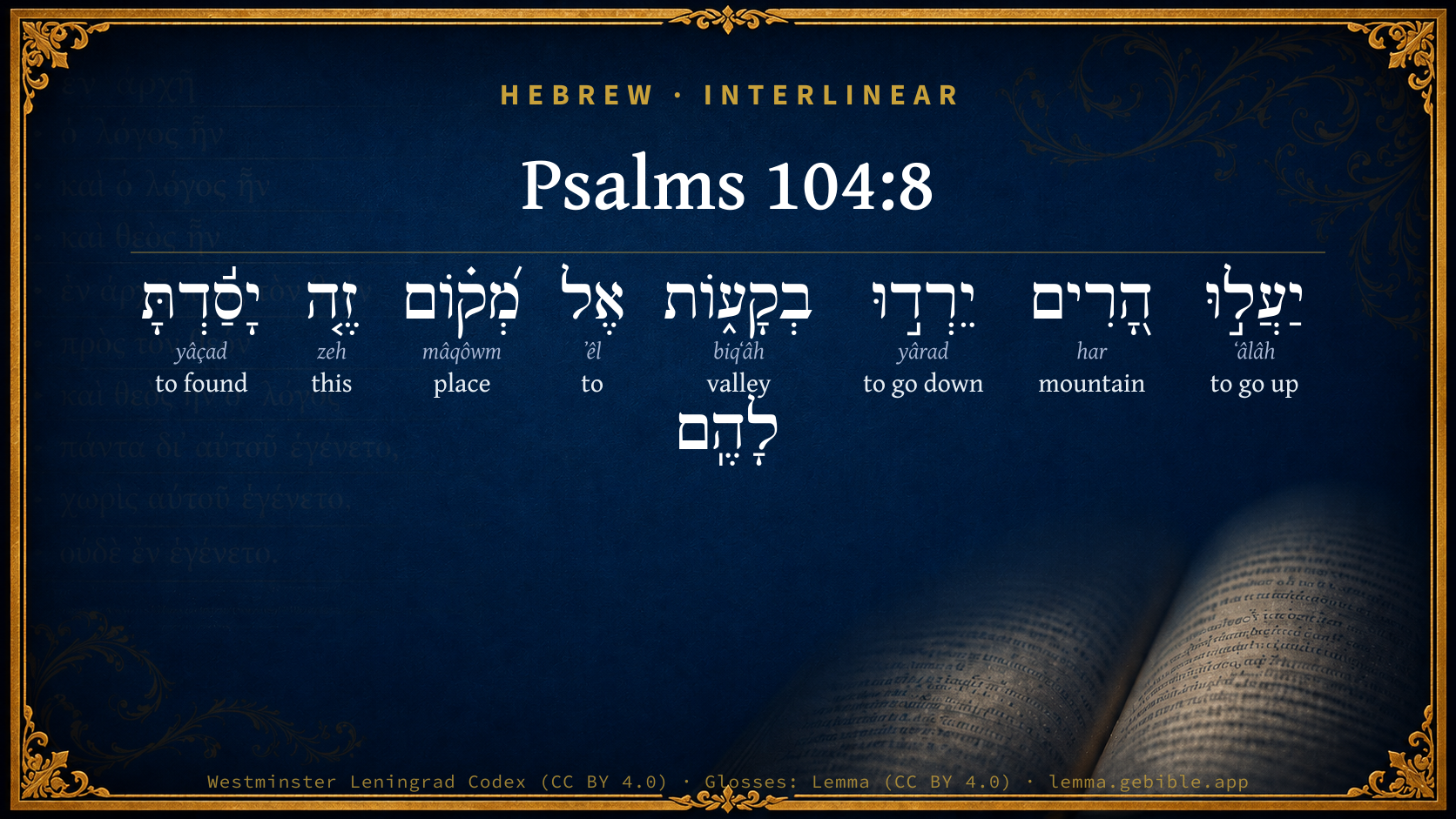
Hebrew (Westminster Leningrad Codex) Psalms 104:8 appears in the Hebrew Old Testament. The text above is from the Westminster Leningrad Codex. Each word links to its Strong’s number, a concise gloss, and parsing drawn from the Open Scriptures Hebrew Bible morphology. Click any word for its full Brown-Driver-Briggs (BDB) entry.
Download image
Cite this verse

Psalms 104:8 (World English Bible). Public Domain. Lemma interlinear Bible study tool, https://lemma.gebible.app/v/psalms/104/8.

Show BibTeX & RIS
BibTeX
RIS
English Translation
The mountains rose, The valleys sank down, To the place which you had assigned to them.
World English Bible · Public Domain
Download a study sheet

One document with this verse’s original text, its word-by-word gloss line, the meaning frame, cross-references with their text, attributed commentary, and full source and license credits — printable, and it pastes into notes with its structure intact.

This verse Autodidact and up

Study sheet (.html) Plain text (.txt)

A passage Seminary Student

Up to 50 verses in one chapter. A passage sheet keeps up to 6 commentary sources and 12 cross-references per verse, in the order this page ranks them, and says so on the sheet whenever that leaves anything out. Ask for a single verse and you get the Autodidact verse sheet above.

Everything on this page stays free to read, with no account — the sheet is a download of what is already on screen, not access to it.

Want to remove ads? Support Godless Engineer
Compare translations 3

The same verse in 3 English versions, stacked beneath the original-language interlinear above. Click any original word for its lexicon entry.

Each is an independent rendering of the whole verse — the interlinear is not word-aligned to these translations.

Highlighted words mark where these versions differ — a whole-verse word diff, not a word-by-word alignment.

  • World English Bible Public Domain
    The mountains rose, The valleys sank down, To the place which you had assigned to them.
  • King James Version Public Domain
    They go up by the mountains; they go down by the valleys unto the place which thou hast founded for them.
  • unfoldingWord Literal Text CC BY-SA 4.0
    They ascended the mountains; they descended the valleys, to the place that you had appointed for them.

unfoldingWord Literal Text — © unfoldingWord, licensed CC BY-SA 4.0. Word-aligned USFM3 via Door43 (git.door43.org/unfoldingWord/en_ult).

Versions to compare (up to 4)

3 of 4 selected

Show all 18 translations

Every available English version of this verse, each an independent rendering of the whole verse.

  • World English Bible Public Domain
    The mountains rose, The valleys sank down, To the place which you had assigned to them.
  • Berean Standard Bible Public Domain
    the mountains rose and the valleys sank to the place You assigned for them—
  • Majority Standard Bible Public Domain
    the mountains rose and the valleys sank to the place You assigned for them—
  • King James Version Public Domain
    They go up by the mountains; they go down by the valleys unto the place which thou hast founded for them.
  • American Standard Version (1901) Public Domain
    (The mountains rose, the valleys sank down) Unto the place which thou hadst founded for them.
  • Revised Version (1885) Public Domain
    They went up by the mountains, they went down by the valleys, unto the place which thou hadst founded for them.
  • Geneva Bible (1599) Public Domain
    And the mountaines ascend, and the valleis descend to the place which thou hast established for them.
  • Douay-Rheims (1899) Public Domain
    The mountains ascend, and the plains descend into the place which thou hast founded for them.
  • Young's Literal Translation Public Domain
    They go up hills -- they go down valleys, Unto a place Thou hast founded for them.
  • Literal Standard Version CC BY-SA 4.0
    They go up hills—they go down valleys, || To a place You have founded for them.
  • Unlocked Literal Bible CC BY-SA 4.0
    The mountains rose, and the valleys spread out into the places that you had appointed for them.
  • unfoldingWord Literal Text CC BY-SA 4.0
    They ascended the mountains; they descended the valleys, to the place that you had appointed for them.
  • Darby Bible Public Domain
    The mountains rose, the valleys sank, unto the place which thou hadst founded for them; --
  • World Messianic Bible Public Domain
    The mountains rose, the valleys sank down, to the place which you had assigned to them.
  • Webster's Bible Public Domain
    They go up by the mountains; they go down by the valleys to the place which thou hast founded for them.
  • Free Bible Version CC BY-SA 4.0
    The mountains rose up and the valleys sank down to where you had determined.
  • Bible in Basic English Public Domain
    The mountains came up and the valleys went down into the place which you had made ready for them.
  • JPS Tanakh (1917) Public Domain
    The mountains rose, the valleys sank down — unto the place which Thou hadst founded for them;

Literal Standard Version (2020), Covenant Press — licensed CC BY-SA 4.0. Text via the HelloAO Bible API (eBible.org). Unlocked Literal Bible (unfoldingWord) — licensed CC BY-SA 4.0. Text via the HelloAO Bible API (eBible.org). unfoldingWord Literal Text — © unfoldingWord, licensed CC BY-SA 4.0. Word-aligned USFM3 via Door43 (git.door43.org/unfoldingWord/en_ult). Free Bible Version, Dr. Jonathan Gallagher — licensed CC BY-SA 4.0. Text via the HelloAO Bible API (eBible.org).

Word by word

More ways to search: Search by grammar → Find every occurrence → Compare this word →

Practice this passage: Drill this verse → Learn its vocabulary →

About this verse

These counts appear in no published source. They are computed here, from the morphology-tagged text and Lemma’s own curated glosses. What Lemma adds →

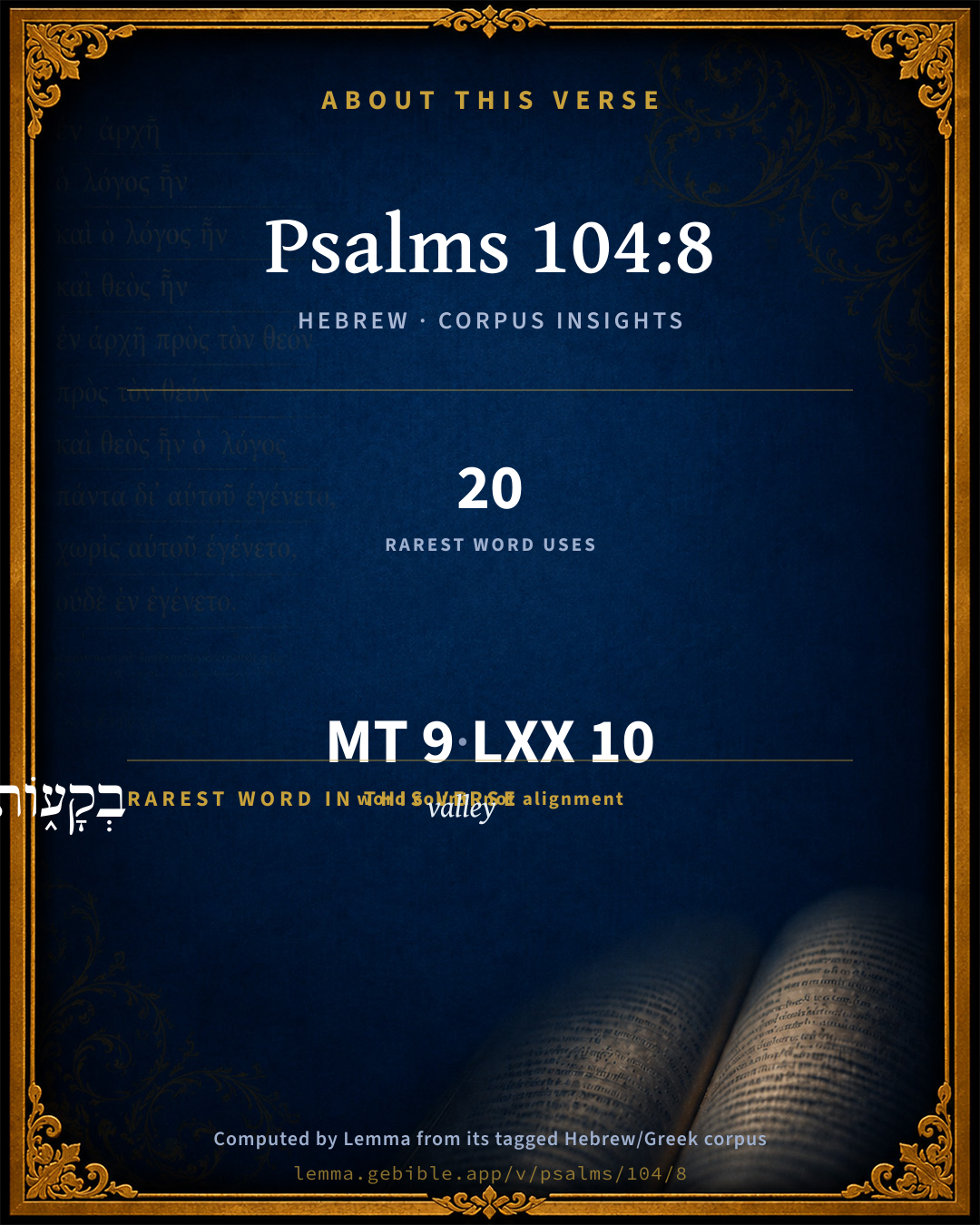
9
words
8
distinct lemmas
Wisdom
section

Notable vocabulary

The rarest word here is בְקָע֑וֹת valley H1237 — appearing just 20 times in the whole Hebrew Bible.

Shared distinctive vocabulary

בְקָע֑וֹת valley H1237 occurs in 20 verses of the Hebrew Bible. Also found in:

Grammatical profile

  • 3 verbs
  • 3 nouns
  • 1 pronoun
  • 2 prepositions

Verb forms

  • יַעֲל֣וּ Qal · Imperfect
  • יֵרְד֣וּ Qal · Imperfect
  • יָסַ֬דְתָּ Qal · Perfect

Hebrew & Septuagint length

In English translation the verse runs 16 words from the Hebrew and 20 from the Septuagint (LXX English) — closely comparable.

A rough comparison of the two English renderings, which tokenize alike — not a word-level alignment.

Word counts can differ between the Hebrew and the Greek without any difference in meaning — e.g. the Hebrew direct-object marker אֵת has no separate Greek word, and Greek often adds the article ὁ.

In the original languages it is 9 Hebrew tokens and 10 Greek tokens — but the two are counted differently (Hebrew bundles its prefixes and suffixes into one token; the Greek is in lemma form), so that isn’t a like-for-like length.

Cross-references

2

Topical passages linked to Psalms 104:8 in the Treasury of Scripture Knowledge — connected by theme and wording, ordered by reader-vote popularity; previews shown in the World English Bible.

  • Genesis 8:5 The waters receded continually until the tenth month. In the tenth month, on the first day of the month, the tops of the mountains were seen.
  • Psalms 33:7 He gathers the waters of the sea together as a heap. He lays up the deeps in storehouses.

Cross-references courtesy of OpenBible.info (CC BY 4.0).

Hebrew and Greek witnesses Masoretic Hebrew ↔ Greek Septuagint

The same verse in the two great witnesses to the Old Testament, shown verse-for-verse.

You’re reading Greek Psalm 103 (Hebrew Psalm 104). The Septuagint counts the superscription, so verse numbers can differ from the Hebrew — chapter-level alignment, not verse-by-verse. Numbering follows Rahlfs.

These are two independent witnesses, not word-aligned to each other, and the Septuagint is shown in lemma (dictionary) form.

Hebrew Psalms 104:8 Masoretic · Westminster Leningrad Codex

יַעֲל֣וּ הָ֭רִים יֵרְד֣וּ בְקָע֑וֹת אֶל מְ֝ק֗וֹם זֶ֤ה יָסַ֬דְתָּ לָהֶֽם

The mountains rose, The valleys sank down, To the place which you had assigned to them.

World English Bible · Public Domain

Greek LXX Greek Psalm 103:8 Septuagint · lemma form

ἀναβαίνω ὄρος καί καταβαίνω πεδίον εἰς τόπος ὅς θεμελιόω αὐτός

They go up to the mountains, and down to the plains, to the place which you have founded for them.

LXX2012 (modern English Septuagint) · Public Domain

On this verse, Albert Barnes' Notes on the Bible discusses the Septuagint’s reading. Read the note in Commentary ↓

Hebrew: Westminster Leningrad Codex (CC BY 4.0). Greek: Septuagint (public domain); English from LXX2012 (modern English Septuagint) (Public Domain). How the Septuagint differs from the Hebrew →

Commentary

Notes on Psalms 104:8 from classic Christian and Jewish commentators (each source and its license shown beneath its notes). The classic Christian expositions comment on the surrounding passage and are grouped to its opening verse, so a note may address several verses; the Jewish commentaries on the Tanakh (Rashi and others) are per-verse, so they appear only where the commentator wrote on this verse.

Lemma curates 59 commentaries, every one of them public domain or Creative Commons licensed, each selected and text-cleaned for this edition rather than reprinted as found. About our sources →

The Cambridge Bible for Schools and Colleges

gen. ed. J. J. S. Perowne

8. (The mountains rise, the vales sink down,)

Unto the place which thou hadst founded for them.

The ‘rebuke’ of God is His command, uttered as it were with a voice of thunder (Psa_18:15; Isa_50:2). It is best to follow the marg. of A.V. and R.V. in taking Psa_104:8 a as a parenthesis, describing the result of this Divine command. Mountains and valleys appear (Gen_1:9) as the waters retire to the place appointed for them. Cp. Ov. Metam. i. 344 f.

“Flumina subsidunt, colles exire videntur,

Surgit humus, crescunt loca, decrescentibus undis.”

See also Milton, Par. Lost, vii. 285 ff.

The rendering of the A.V. and R.V., which is also grammatically possible, appears to describe the commotion of the waters as the great deep breaks up and they seek their appointed place.

The Cambridge Bible for Schools and Colleges (gen. ed. J. J. S. Perowne; Cambridge University Press, 1878–1918) — public domain. Text from a community e-Sword module.

Trapp's Complete Commentary

John Trapp

Psa 104:8 They go up by the mountains; they go down by the valleys unto the place which thou hast founded for them.

Ver. 8. They go up by the mountains] They run any way, in post haste, breaking through thick and thin, and nowhere resting, till embodied in the abyss, their elemental place and station. This is check to our dulness and disobedience. If a man had been present, saith one, when God thus commanded the seas to retreat from the earth, he might have seen both a terrible and a joyful spectacle.

John Trapp, A Commentary or Exposition upon All the Books of the Old and New Testament (1647–1656) — public domain. Text from a community e-Sword module.

Joseph Benson's Commentary

Psa 104:8. They go up by the mountains — Rather, They went up mountains: they went down valleys, &c. — They went over hill and dale, as we say; they neither stopped at the former, nor lodged in the latter, but made the best of their way to the place founded for them. The psalmist is “describing the motion of the waters in mountains and valleys, when, at God’s command, they filed off from the surface of the earth, into the posts assigned them.” Some interpret the psalmist’s meaning to be, that, in that first division of the waters from the earth, part went upward and became springs in the mountains, but the greatest part went downward to the channels made for them. Thus Dr. Waterland: They climb the mountains; they fall down on the valleys. The Hebrew, however, may be rendered, (as it is by some, both ancient and later interpreters,) The mountains ascended; the valleys descended; that is, when the waters were separated, part of the earth appeared to be high, and formed the mountains, and a part to be low, and constituted the valleys or low grounds. So Bishop Patrick: “Immediately the dry land was seen, part of which rose up in lofty hills; and the rest sunk down in lowly valleys, where thou hast cut channels for the waters to run into the main ocean, the place thou hast appointed for them.” But the former sense seems most agreeable to the context, because he speaks of the waters both in the foregoing and following verses.

Joseph Benson's Commentary on the Old and New Testaments (1811–1818) — public domain. Text from a community e-Sword module.

Keil & Delitzsch

C. F. Keil & F. Delitzsch

Psa 104:8 continues with the words אל־מקום (cf. Gen 1:9, אחד אל־מקום): the waters retreat to the place which (זה, cf. Psa 104:26, for אשׁר, Gen 39:20) God has assigned to them as that which should contain them. He hath set a bound (גּבוּל, synon. חק, Pro 8:29; Jer 5:22) for them beyond which they may not flow forth again to cover the earth, as the primordial waters of chaos have done.

Keil & Delitzsch — Biblical Commentary on the Old Testament (1861–1891) — public domain (CC PDM 1.0). Text via the HelloAO Bible API. (Old Testament only.)

J. A. Alexander on Psalms

Joseph Addison Alexander

8. (Psa 104:8) They go up mountains, they go down valleys, to this place thou past founded for them. The first clause is a beautiful description of the fluctuations which attend the subsidence of swollen waters, not only in the case of Noah's flood (Gen 8:4-5) to which the words relate in the first instance, but in all other cases, where the same rule still holds good, so that the verse, by an insensible transition, founds the statement of a general truth on that of a particular event. The use of the demonstrative (this) is highly idiomatic. The original construction is, to a place, this (which) thou host founded for them. This form of expression is equivalent to pointing with the hand, and therefore adds not a little to the graphic vividness of the description.

Joseph Addison Alexander, The Psalms Translated and Explained (1850) — public domain. Text from a community e-Sword module.

Tyndale Open Study Notes

Tyndale Open Resources

104:8 The earth originates in God’s will.

Tyndale Open Study Notes — © Tyndale Open Resources, licensed CC BY-SA 4.0. Text via the HelloAO Bible API.

Adam Clarke's Commentary

Verse 8. They go up by the mountains; they go down by the valleys] Taking the words as they stand here, springs seem to be what are intended. But it is difficult to conceive how the water could ascend, through the fissures of mountains, to their tops, and then come down their sides so as to form rivulets to water the valleys. Most probably all the springs in mountains and hills are formed from waters which fall on their tops in the form of rain, or from clouds that, passing over them, are arrested, and precipitate their contents, which, sinking down, are stopped by some solid strata, till, forcing their way at some aperture at their sides, they form springs and fountains. Possibly, however, vapours and exhalations are understood; these by evaporation ascend to the tops of mountains, where they are condensed and precipitated. Thus the vapours ascend, and then come down to the valleys, forming fountains and rivulets in those places which the providence of God has allotted them; that is, continuous valleys, with such a degree of inclination as determines their waters to run in that direction till they reach another river, or fall into the ocean.

Some have thought there is a reference to the breaking up on the fountains of the great deep, at the time of the flood; while the protrusion of the waters would raise the circumambient crust, so as to form mountains, the other parts, falling in to fill up the vacuum occasioned by the waters which were thrown up from the central abyss, would constitute valleys.

Ovid seems to paraphrase this verse: -

Jussit et extendi campos, subsidere valles,

Fronde tegi sylvas, lapidosos surgere montes.

Met. lib. i., ver. 43.

"He shades the woods, the valleys he restrains

With rocky mountains, and extends the plains."

DRYDEN.

Adam Clarke's Commentary on the Bible (1810–1826) — public domain. Text from a community e-Sword/MySword module.

Ellicott's Commentary for English Readers

(8) They go up.—This translation is grammatically possible, but is inconsistent with the preceding description. It is better therefore to take the clause parenthetically, and to make hills and valleys the subjects. Hills rise, valleys sink, an interesting anticipation of the disclosures of geology, which, though in a different sense, tells of the upheaval of mountains and depression of valleys. Two passages in Ovid have been adduced in illustration (Met. i. 43, 344). And Milton, no doubt with the psalm as well as Ovid in his mind, wrote

“Immediately the mountains huge appear

Emergent,” &c—Paradise Lost, book vii.

A Bible Commentary for English Readers, edited by Charles John Ellicott (1878–1897) — public domain. Text from a community e-Sword module.

John Gill's Exposition

They go up by the mountains, they go down by the valleys,.... The Targum is,

"they ascend out of the deep to the mountains;''

that is, the waters, when they went off the earth at the divine orders, steered their course up the mountains, and then went down by the valleys to the place appointed for them; they went over hills and dales, nothing could stop them or retard their course till they came to their proper place; which is another instance of the almighty power of the Son of God. Some render the words, "the mountains ascended, the valleys descended (m)"; and then the meaning is, when the depth of waters were called off the earth, the mountains and valleys appeared, the one seemed to rise up and the other to go down; but the former reading seems best, and emblematically describes the state of God's people in this world, in their passage to their appointed place; who have sometimes mountains of difficulties to go over, and which seem insuperable, and yet they surmount them; sometimes they are upon the mount of heaven by contemplation, and have their hearts and affections above; they mount up with wings as eagles; sometimes they are upon the mount of communion with God, and by his favour their mount stands strong, and they think they shall never be moved; at other times they are down in the valleys, in a low estate and condition; in low frames of soul, in a low exercise of grace, and in the valley of the shadow of death, of afflictive providences in soul or body: and as the waters, thus steering their course under a divine direction, and by an almighty power, at length came unto the place which, the psalmist says, thou hast founded for them, meaning the seas; which the Lord founded and prepared for the reception of them; and which collection of waters in one place he called by that name, Gen 1:10. So the Lord's people, through a variety of circumstances, trials, and exercises, will be all brought safe to the place appointed for them, and prepared by Christ in his Father's house; where they will be swallowed up in the boundless ocean of everlasting love.

(m) So Pagninus, Musculus, Cocceius.

John Gill's Exposition of the Whole Bible (1746–1763) — public domain (CC PDM 1.0). Text via the HelloAO Bible API.

Albert Barnes' Notes on the Bible

They go up by the mountains ... - That is, when they were gathered together into seas. They seemed to roll and tumble over hills and mountains, and to run down in valleys, until they found the deep hollows which had been formed for seas, and where they were permanently collected together. The margin here is, “The mountains ascend, the valleys descend.” So it is translated in the Septuagint, in the Latin Vulgate, by Luther, and by DeWette. The more natural idea, however, is that in our translation: “They (the waters) go up mountains; they descend valleys.”

Unto the place - The deep hollows of the earth, which seem to have been scooped out to make a place for them.

Which thou hast founded for them - Where thou hast laid a permanent foundation for them on which to rest; that is, which thou hast prepared for them.

Albert Barnes' Notes on the Bible (1834–1885) — public domain. Text from a community e-Sword/MySword module.

Matthew Poole's English Annotations

In that first division of the waters from the earth, some part of them by God’s command, contrary to their own nature, went upwards, and became springs in the mountains, and the greatest part went downwards to the channels made for them. Others, both ancient and later interpreters, read the words thus, The mountains ascend, the valleys descend; when the waters were separated, part of the earth went upward, and made the mountains; and part went downward, and made the valleys or low grounds. But our translation seems the best, as being most agreeable to the context, because he speaks of the waters both in the foregoing and following verses.

Unto the place which thou hast founded for them; unto their proper channels and receptacles which God provided for them.

Matthew Poole's English Annotations on the Holy Bible (1683–1685) — public domain. Text from a community e-Sword/MySword module.

The Treasury of David

Charles H. Spurgeon

Ver. 8. The vanquished waters are henceforth obedient. They go up by the mountains, climbing in the form of clouds even to the summits of the Alps.

They go down by the valleys unto the place which thou hast founded for them: they are as willing to descend in rain, and brooks, and torrents as they were eager to ascend in mists. The loyalty of the mighty waters to the laws of their God is most notable; the fierce flood, the boisterous rapid; the tremendous torrent, are only forms of that gentle dew which trembles on the tiny blade of grass, and in those ruder shapes they are equally obedient to the laws which their Maker has impressed upon them. Not so much as a solitary particle of spray ever breaks rank, or violates the command of the Lord of sea and land, neither do the awful cataracts and terrific floods revolt from his sway. It is very beautiful among the mountains to see the divine system of water supplythe rising of the fleecy vapours, the distillation of the pure fluid, the glee with which the newborn element leaps down the crags to reach the rivers, and the strong eagerness with which the rivers seek the ocean, their appointed place.

Ver. 8. They go up by the mountains, etc. The Targum is, "They ascend out of the deep to the mountains"; that is, the waters, when they went off the earth at the divine orders, steered their course up the mountains, and then went down by the valleys to the place appointed for them; they went over hills and dales, nothing could stop them or retard their course till they came to their proper place; which is another instance of the almighty power of the Son of God. John Gill.

Psalms 104:9*

Charles H. Spurgeon's The Treasury of David (1869–1885) — public domain. Psalms only. Text from a community e-Sword/MySword module.

Whedon's Commentary on the Bible

Daniel D. Whedon

8. Up by the mountains… down by the valleys—A reference to the subsidence of the waters to the present bed of the ocean.

Unto the place which thou hast founded for them—This shows that the deep cavity of the ocean, being a sunken area, “varying in depth from 1,000 feet or less, to probably 50,000 feet,” was not left to the blind operation of natural causes, but was a matter of divine forethought and design.

Daniel D. Whedon (gen. ed.), Commentary on the Old and New Testaments (1874–1909) — public domain. Text from a community e-Sword module.

The Pulpit Commentary

They go up by the mountains; they go down by the valleys; rather, they went up mountains; they went down valleys. In the general commotion of the waters, as they "hasted away," sometimes vast waves swept over mountain tops, sometimes huge floods washed down the courses of valleys a graphic description of the scene which no eye saw, but which the poet figures to himself a turmoil and confusion beyond that even of the great Deluge itself. (see Gen_7:17-19 Gen_8:1-3) Unto the place which thou hast (rather, hadst) founded for them. The ocean bed, which had, in intention, been already prepared to receive them.

The Pulpit Commentary (1880–1919), ed. H.D.M. Spence-Jones & Joseph S. Exell — public domain. Text from a community e-Sword module.

John Wesley's Explanatory Notes

Go up - In that first division of the waters from the earth, part went upwards, and became springs in the mountains, the greatest part went downwards to the channels made for them.

John Wesley, Explanatory Notes Upon the Whole Bible (1754–1765) — public domain. Text via the GEBible commentary corpus.

unfoldingWord translationNotes

Door43 World Missions Community

The mountains rose, and the valleys spread out

Here the psalmist speaks of God causing the mountains and valleys to move and change as if they chose to move themselves. They are described this way to emphasize God's power. (See: Personification)

a boundary for them that they will not cross

Here the psalmist speaks of God causing the waters not to cross the boundary that he created for them as if the waters themselves chose not to cross it. They are described this way to emphasize God's authority over them. AT: "a boundary for them that they cannot cross" (See: Personification)

boundary

border

for them

The word "them" refers to the waters.

translationWords

raise

appoint

unfoldingWord translationNotes — © Distant Shores Media and the Door43 World Missions Community, licensed CC BY-SA 4.0. Source: git.door43.org/Door43/en_tn.

Lesson kit

Teaching starters — assembled from the data on this page, not authored interpretation. Every prompt links to the verse data it draws on. Edit before teaching.

Psalms, in the Wisdom, opens this verse with 9 words (8 distinct Hebrew lemmas). Its most distinctive word is biqʻâh (“valley”). A historical commentator’s framing appears above. Read the whole chapter for the surrounding context.

Discussion questions

  1. How does “valley” (biqʻâh) shape what this verse is saying?
  2. How does Genesis 11:2, which shares the word «valley», read alongside this verse?
  3. The translations on this page render this verse differently — a whole-verse word diff, not a word-by-word alignment. What might account for the different wordings?
  4. «יַעֲל֣וּ» is a Qal Imperfect verb. How does that grammatical form shape the action described?
  5. Compare how The Cambridge Bible for Schools and Colleges and Trapp's Complete Commentary read this verse. Where do they agree or differ?

Things to notice

Reading settings

Reading text

Shown beneath each verse's original-language words.

Old Testament
Old Testament edition

Read the OT as the Masoretic Hebrew (MT) or the Greek Septuagint (LXX).

English shown for the Greek Septuagint (in the Hebrew ↔ Greek comparison).

Comparing translations? Open the Compare panel on any verse page to stack up to four side by side.