
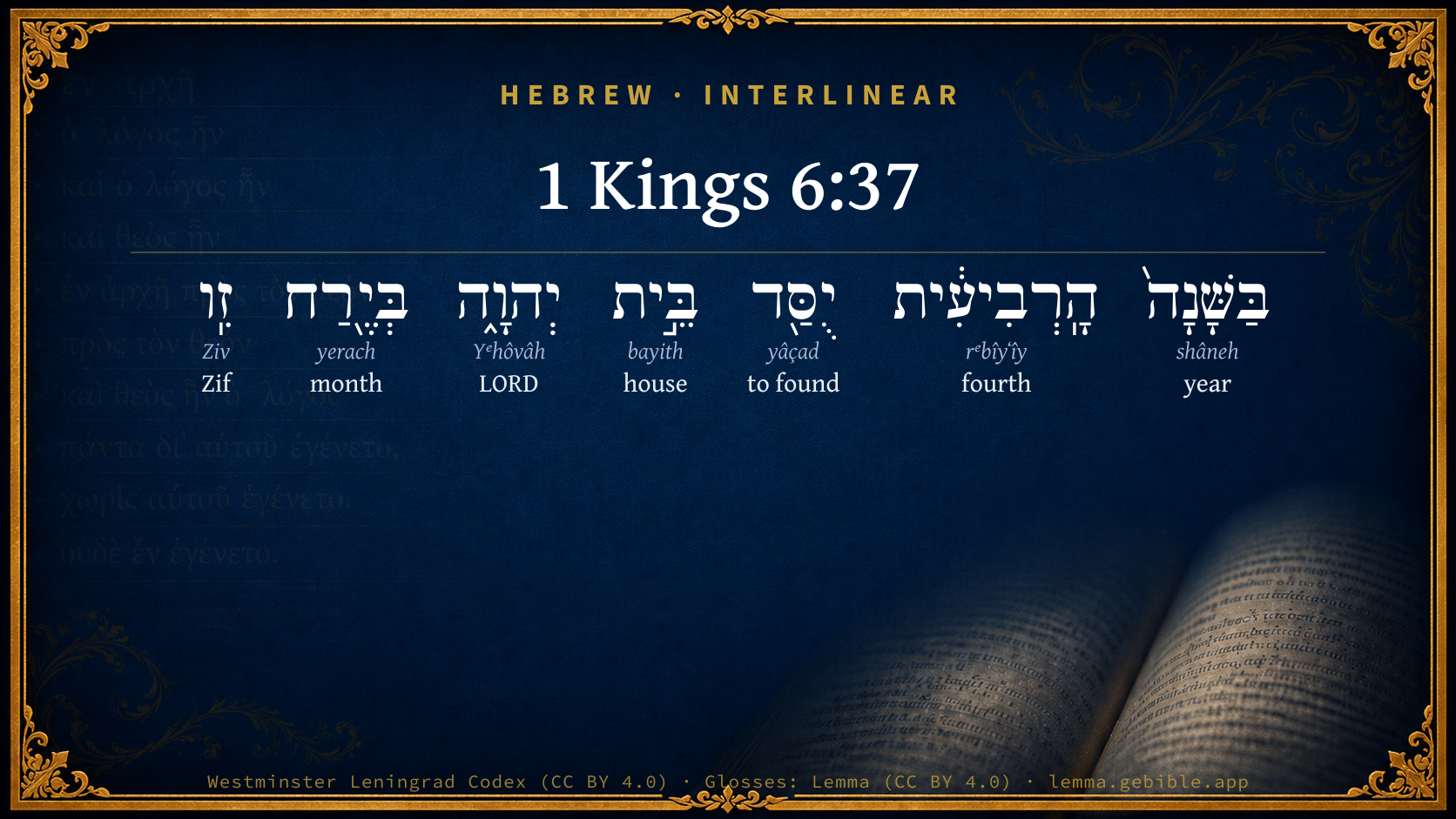
1 Kings 6:37

Hebrew (Westminster Leningrad Codex) 1 Kings 6:37 appears in the Hebrew Old Testament. The text above is from the Westminster Leningrad Codex. Each word links to its Strong’s number, a concise gloss, and parsing drawn from the Open Scriptures Hebrew Bible morphology. Click any word for its full Brown-Driver-Briggs (BDB) entry.
Download image
Cite this verse

1 Kings 6:37 (World English Bible). Public Domain. Lemma interlinear Bible study tool, https://lemma.gebible.app/v/1-kings/6/37.

Show BibTeX & RIS
BibTeX
RIS
English Translation
In the fourth year was the foundation of the house of Yahweh laid, in the month Ziv.
World English Bible · Public Domain
Download a study sheet

One document with this verse’s original text, its word-by-word gloss line, the meaning frame, cross-references with their text, attributed commentary, and full source and license credits — printable, and it pastes into notes with its structure intact.

This verse Autodidact and up

Study sheet (.html) Plain text (.txt)

A passage Seminary Student

Up to 50 verses in one chapter. A passage sheet keeps up to 6 commentary sources and 12 cross-references per verse, in the order this page ranks them, and says so on the sheet whenever that leaves anything out. Ask for a single verse and you get the Autodidact verse sheet above.

Everything on this page stays free to read, with no account — the sheet is a download of what is already on screen, not access to it.

Want to remove ads? Support Godless Engineer
Compare translations 3

The same verse in 3 English versions, stacked beneath the original-language interlinear above. Click any original word for its lexicon entry.

Each is an independent rendering of the whole verse — the interlinear is not word-aligned to these translations.

Highlighted words mark where these versions differ — a whole-verse word diff, not a word-by-word alignment.

  • World English Bible Public Domain
    In the fourth year was the foundation of the house of Yahweh laid, in the month Ziv.
  • King James Version Public Domain
    In the fourth year was the foundation of the house of the LORD laid, in the month Zif:
  • unfoldingWord Literal Text CC BY-SA 4.0
    In the fourth year, the house of Yahweh was founded, in the month of Ziv.

unfoldingWord Literal Text — © unfoldingWord, licensed CC BY-SA 4.0. Word-aligned USFM3 via Door43 (git.door43.org/unfoldingWord/en_ult).

Versions to compare (up to 4)

3 of 4 selected

Show all 18 translations

Every available English version of this verse, each an independent rendering of the whole verse.

  • World English Bible Public Domain
    In the fourth year was the foundation of the house of Yahweh laid, in the month Ziv.
  • Berean Standard Bible Public Domain
    The foundation of the house of the LORD was laid in the fourth year of Solomon’s reign, in the month of Ziv.
  • Majority Standard Bible Public Domain
    The foundation of the house of the LORD was laid in the fourth year of Solomon’s reign, in the month of Ziv.
  • King James Version Public Domain
    In the fourth year was the foundation of the house of the LORD laid, in the month Zif:
  • American Standard Version (1901) Public Domain
    In the fourth year was the foundation of the house of Jehovah laid, in the month Ziv.
  • Revised Version (1885) Public Domain
    In the fourth year was the foundation of the house of the LORD laid, in the month Ziv.
  • Geneva Bible (1599) Public Domain
    In the fourth yeere was the foundation of the house of the Lord layed in the moneth of Zif:
  • Douay-Rheims (1899) Public Domain
    And he carved cherubims, and palm trees, and carved work standing very much out: and he overlaid all with golden plates in square work by rule.
  • Young's Literal Translation Public Domain
    In the fourth year hath the house of Jehovah been founded, in the month Zif,
  • Literal Standard Version CC BY-SA 4.0
    In the fourth year the house of YHWH has been founded, in the month of Ziv,
  • Unlocked Literal Bible CC BY-SA 4.0
    The foundation of the house of Yahweh was laid in the fourth year, in the month of Ziv.
  • unfoldingWord Literal Text CC BY-SA 4.0
    In the fourth year, the house of Yahweh was founded, in the month of Ziv.
  • Darby Bible Public Domain
    In the fourth year was the foundation of the house of Jehovah laid, in the month Zif;
  • World Messianic Bible Public Domain
    The foundation of the LORD’s house was laid in the fourth year, in the month Ziv.
  • Webster's Bible Public Domain
    In the fourth year was the foundation of the house of the LORD laid, in the month Zif:
  • Free Bible Version CC BY-SA 4.0
    The foundation of the Lord's Temple was laid in the fourth year of Solomon's reign, in the month of Ziv.
  • Bible in Basic English Public Domain
    In the fourth year the base of the house was put in its place, in the month Ziv.
  • JPS Tanakh (1917) Public Domain
    In the fourth year was the foundation of the house of the LORD laid, in the month Ziv.

Literal Standard Version (2020), Covenant Press — licensed CC BY-SA 4.0. Text via the HelloAO Bible API (eBible.org). Unlocked Literal Bible (unfoldingWord) — licensed CC BY-SA 4.0. Text via the HelloAO Bible API (eBible.org). unfoldingWord Literal Text — © unfoldingWord, licensed CC BY-SA 4.0. Word-aligned USFM3 via Door43 (git.door43.org/unfoldingWord/en_ult). Free Bible Version, Dr. Jonathan Gallagher — licensed CC BY-SA 4.0. Text via the HelloAO Bible API (eBible.org).

Word by word

More ways to search: Search by grammar → Find every occurrence → Compare this word →

Practice this passage: Drill this verse → Learn its vocabulary →

About this verse

These counts appear in no published source. They are computed here, from the morphology-tagged text and Lemma’s own curated glosses. What Lemma adds →

7
words
7
distinct lemmas
Historical
section

Notable vocabulary

The rarest word here is זִֽו Zif H2099 — appearing just 2 times in the whole Hebrew Bible.

Shared distinctive vocabulary

זִֽו Zif H2099 occurs in 2 verses of the Hebrew Bible. Also found in:

Grammatical profile

  • 1 verb
  • 5 nouns
  • 1 adjective

Verb forms

  • יֻסַּ֖ד Pual · Perfect

Cross-references

2

Topical passages linked to 1 Kings 6:37 in the Treasury of Scripture Knowledge — connected by theme and wording, ordered by reader-vote popularity; previews shown in the World English Bible.

  • 1 Kings 6:1 It happened in the four hundred and eightieth year after the children of Israel were come out of the land of Egypt, in the fourth year of Solomon's reign over Israel, in the month Ziv, which is the second month, that he began to build the house of Yahweh.
  • 2 Chronicles 3:2 He began to build in the second [day] of the second month, in the fourth year of his reign.

Cross-references courtesy of OpenBible.info (CC BY 4.0).

Hebrew and Greek witnesses Masoretic Hebrew ↔ Greek Septuagint

The same verse in the two great witnesses to the Old Testament, shown verse-for-verse.

These are two independent witnesses, not word-aligned to each other, and the Septuagint is shown in lemma (dictionary) form.

Hebrew 1 Kings 6:37 Masoretic · Westminster Leningrad Codex

בַּשָּׁנָה֙ הָֽרְבִיעִ֔ית יֻסַּ֖ד בֵּ֣ית יְהוָ֑ה בְּיֶ֖רַח זִֽו

In the fourth year was the foundation of the house of Yahweh laid, in the month Ziv.

World English Bible · Public Domain

On this verse, The Cambridge Bible for Schools and Colleges discusses the Septuagint’s reading. Read the note in Commentary ↓

Hebrew: Westminster Leningrad Codex (CC BY 4.0). Greek: Septuagint (public domain); English from a public-domain English Septuagint. How the Septuagint differs from the Hebrew →

Targum (Aramaic paraphrase)

1

The Targum is the ancient Jewish Aramaic paraphrase of the Hebrew Scriptures — an interpretive translation, not the Hebrew text itself. Onkelos (literal) and Pseudo-Jonathan (expansive) render the Torah, and Jonathan the Prophets. Coverage is partial: where no permissively-licensed English translation exists for a verse, only the Aramaic is shown. This is verse-level text, not a word-by-word alignment to the Hebrew.

  1. Targum Jonathan Prophets (Joshua–Malachi)
    וּבְשַׁתָּא רְבִיעִיתָא שָׁרֵי לְאִשְׁתַּכְלָלָא בֵּית מַקְדְשָׁא דַייָ בְּיֶרַח זִיו נִצָנַיָא:

    (no public-domain English translation for this verse)

    Targum Jonathan — Aramaic: “Mikraot Gedolot” (public domain). English: “Sefaria Community Translation” (CC0 1.0 (public-domain dedication)); “London "Chaldee Paraphrase," 1871” (public domain). Text via Sefaria.

Commentary

Notes on 1 Kings 6:37 from classic Christian and Jewish commentators (each source and its license shown beneath its notes). The classic Christian expositions comment on the surrounding passage and are grouped to its opening verse, so a note may address several verses; the Jewish commentaries on the Tanakh (Rashi and others) are per-verse, so they appear only where the commentator wrote on this verse.

Lemma curates 59 commentaries, every one of them public domain or Creative Commons licensed, each selected and text-cleaned for this edition rather than reprinted as found. About our sources →

Jamieson, Fausset & Brown

Robert Jamieson, A. R. Fausset & David Brown

THE TIME TAKEN TO BUILD IT. (Kg1 6:37-38)

In the fourth year was the foundation laid--The building was begun in the second month of the fourth year and completed in the eighth month of the eleventh year of Solomon's reign, comprising a period of seven and a half years, which is reckoned here in round numbers. It was not a very large, but a very splendid building, requiring great care, and ingenuity, and division of labor. The immense number of workmen employed, together with the previous preparation of the materials, serves to account for the short time occupied in the process of building.

Next: 1 Kings Chapter 7

Jamieson, Fausset & Brown — Commentary Critical and Explanatory on the Whole Bible (1871) — public domain (CC PDM 1.0). Text via the HelloAO Bible API.

Trapp's Complete Commentary

John Trapp

1Ki 6:37 In the fourth year was the foundation of the house of the LORD laid, in the month Zif:

Ver. 37. In the fourth year,] sc., Of Solomon’s reign. See 1Ki 6:1.

John Trapp, A Commentary or Exposition upon All the Books of the Old and New Testament (1647–1656) — public domain. Text from a community e-Sword module.

Joseph Benson's Commentary

1Ki 6:37-38. In the fourth year, &c. — This was mentioned 1Ki 6:1, and is here repeated to subjoin, in the next words, how long the house was in building. In the eleventh year, in the month Bul — As the second month was called Zif, for the reason before given, so the eighth month was called Bul, which signifies to wither, because then the leaves of the trees began to wither and fall off, and the whole vegetable creation to droop and die. So he was seven years in building — “That is,” says Mr. Locke, “speaking in a round number, for he was seven years and six months; neither is this mode of speaking unusual in Scripture.” It is not strange that this work took up so much time; for though the temple, properly so called, was but a small edifice, yet the many courts, offices, chambers, and other buildings about it, above ground and below, made the whole a vast pile; and the exquisiteness of the art, and fewness of the artists that could be employed, made a longer time requisite. Indeed, all things considered, it must be acknowledged Solomon made an extraordinary despatch; for, if the building of Diana’s temple at Ephesus employed all Asia for two hundred years; and no fewer than three hundred and sixty thousand men were occupied for twenty years together in erecting one pyramid, as Pliny affirms, lib. 36, chap. 12, no reasonable man can wonder that this temple was seven years and a half in building. See Calmet, and Univ. Hist., vol. 4. octavo. Now let us see what this temple typifies:

1. Christ himself is the true temple. He himself spoke of the temple of his body: and in him dwelt all the fulness of the Godhead. In him all the Israel of God meet, and through him have access with confidence to God.

2. Every believer is a living temple, in whom the Spirit of God dwelleth: we are wonderfully made by the divine providence, but more wonderfully made anew by the divine grace; and as Solomon’s temple was built on a rock, so are we built on Christ.

3. The church is a mystical temple, enriched and beautified, not with gold and precious stones, but with the gifts and graces of the Spirit. Angels are ministering spirits, attending the church, and all the members of it, on all sides.

4. Heaven is the everlasting temple; there the church will be fixed, and no longer moveable: the cherubim there always attend upon the throne of glory. In the temple there was no noise of axes or hammers: every thing is quiet and serene in heaven. All that shall be stones in that building, must here be fitted and made ready for it; must be hewed and squared by the divine grace, and so made meet for a place in that temple.

Joseph Benson's Commentary on the Old and New Testaments (1811–1818) — public domain. Text from a community e-Sword module.

Ellicott's Commentary for English Readers

(37) Zif (the “brightness of flowers”) corresponds to about May;

A Bible Commentary for English Readers, edited by Charles John Ellicott (1878–1897) — public domain. Text from a community e-Sword module.

The Cambridge Bible for Schools and Colleges

gen. ed. J. J. S. Perowne

37–38. Completion of Solomon’s Temple (Not in Chronicles)

37. In the fourth year] i.e. Of king Solomon’s reign. See 1Ki_6:1. The LXX. (both Vat. and Alex.) omits these two verses, adding at the end of 36 καὶ ᾠκοδόμησε τὸ καταπέτασμα τῆς αὐλῆς τοῦ αἰλὰμ τοῦ οἴκου τοῦ κατὰ πρόσωπον τοῦ ναοῦ.

The Cambridge Bible for Schools and Colleges (gen. ed. J. J. S. Perowne; Cambridge University Press, 1878–1918) — public domain. Text from a community e-Sword module.

Whedon's Commentary on the Bible

Daniel D. Whedon

37. The month Zif — See on 1Ki_6:1.

Daniel D. Whedon (gen. ed.), Commentary on the Old and New Testaments (1874–1909) — public domain. Text from a community e-Sword module.

The Pulpit Commentary

In the fourth year was the foundation of the house of the Lord laid, in the month Zif see on ver. 1.

HOMILIES BY J. WAITE Vers. 37, 38.

The Glorious House of the Lord.

In comparison with other sacred shrines of antiquity the temple of Solomon was small in its dimensions and brief in the time of its building. Nor will the mere fact of its material splendour account for the extraordinary interest with which it has ever been regarded an interest in which Jew, Mohammedan, and Christian alike participate. The place it occupied, the part it performed in the religious history of the world, will alone account for this. If it is necessary to suppose any pre-existing model as suggesting the plan of its structure, it is to Assyria and not to Egypt, as some have thought, that we should look for such a type. But however this may be, it has a deep Divine meaning which raises it above comparison with any other temple that the hand of man has ever reared. Let us look on it now as the ancient symbol of the Church of the living God, that fellowship of newborn souls of whom St. Peter says, "Ye also as living stones are built up a spiritual house," etc.. (1Pe_2:5) Note certain points of special interest in this analogy those features of the temple which are suggestive of similar features in the spiritual fabric of the redeemed Church.

I THE FIRMNESS OF ITS FOUNDATION. The threshing floor of Araunah, the site of the temple, was part of the plateau on the top of Mount Moriah. (2Ch_3:1) Solomon, as we are told by Josephus, in order to enlarge the area, built massive walls on the sloping sides of the mountain, filling in the spaces with earth; and the foundations of these walls were composed of huge stones bedded and, as it were, mortised in the solid rock How forcibly are we reminded of the word of Christ to Peter, "Upon this rock will I build my Church, and the gates of hell shall not prevail against it". (Mat_16:18) Whatever the bearing of this word on the disciple himself may be, it is certain that it cannot refer to him apart from the grand confession he has just made Thou art the Christ, the son of the living God." Peter may be one of the great foundation stones, but Christ Himself is the solid, primary, unhewn Rock on which the fabric rests. Not so much any truth about Him, but the personal Christ in the grandeur of His being, the integrity of His righteousness, the strength and fidelity of his wondrous love, is the Church"s firm foundation.

II THE SILENT PROCESS OF ITS STRUCTURE. "There was neither hammer, nor axe, nor any tool of iron heard in the house while it was in building (ver. 7). This was probably in obedience to the prohibition recorded in Exo_20:26 and Deu_27:5. It expressed the king"s sense of the sanctity of the work. The tranquillity of the scene must not be broken by the clang of inharmonious sounds. "Like some tall palm the noiseless fabric grew." The fact is suggestive. The building up of the Church of God is a silent, hidden process. Outward visible agencies must be employed, but the real constructive forces are out of sight. Truth works secretly and silently in the souls of men. "The kingdom of God cometh not with observation." Noise and show are out of harmony with the sanctity of it. Clamour and violence only hinder the work. Let us not mistake a restless, busy, fussy zeal for the externalities of Church life for true spiritual service. This is often in inverse ratio to the amount of real edification. The best machinery works with least friction and noise. The quiet, thoughtful workers, who move on steadily by the inspiration of their holy purpose, without much public recognition, may after all be the most efficient builders of the temple of God.

III THE VARIETY OF THE AGENCIES BY WHICH THE WORE WAS DONE. Foreign power was enlisted in the service Hiram and his artificers. Cedars from Lebanon, gold and silver and precious stones from Ophir and Parvaim, brass "without weight" from the foundries of Succoth and Zarethan all were consecrated to it. So also with the spiritual fabric. The resources of the world are at the command of Him who rears it. "All things serve His might." All beings, with all their faculties, are at His disposal All streams of human interest, and thought, and speech, and activity may be made tributary to the great river of His purpose. Our faith rests in the assurance that it is so that just as our physical life is nourished by all sorts of ministries, near and remote, so the kingdom of truth and righteousness in the world is being built up by a vast variety of agencies which it is beyond our power to trace. All human affairs are but as the scaffolding within which the structure of God"s great house is slowly rising to its completion. To this structure it is that the prophetic word, in its deepest meaning, may be applied, "The sons of strangers shall build up thy walls". (Isa_60:10) And in its final consummation shall befulfilled the apocalyptic picture, "The kings of the earth do bring their glory and honour into it.". (Rev_21:22)

IV THE MINGLED STRENGTH AND BEAUTY OF THE FABRIC. The blocks of stone were lined with cedar planks, and the cedar overlaid with plates of gold; the walls covered with carved "cherubims and palm trees and open flowers;" the brazen pillars crowned with "lily work." The building was not of large dimensions, but wonderful for its combination of solidity and adornment, partaking of the firmness of the rocky mount on which it stood, glittering in the sunlight, the crowning glory of the royal city. How much more truly may we say of the spiritual temple, "Strength and beauty are in His sanctuary." There is no strength like that of truth and righteousness; no beauty like that of holy character: strength drawn from Christ, the living Foundation, the reflected beauty of that purer heaven which is the eternal home of God.

V THE ORDERLY ARRANGEMENT OF ITS PARTS AND APPURTENANCES. The temple was framed apparently after the model of the tabernacle, but with doubled dimensions and more enduring materials, and that was "after the pattern shown to Moses in the mount all regulated with regard to the due administration of the service of God. Courts, chambers, galleries, altars, layers, utensils all consecrated to some sacred use, or meant to enshrine some high symbolic meaning. The gathering up of a complex variety of parts in one grand structural unity. Such is the Church an aggregate of various but harmonious and mutually helpful parts. "There are diversities of gifts and administrations and operations, but the same Spirit". (1Co_12:4) "All the building fitly framed together," etc.. (Eph_2:13) "The whole body fitly joined together and compacted by that which every joint supplieth,". (Eph_4:16) It would seem necessary that the social religious life should assume some visible organized form; and though there may be no such form or forms ecclesiastical that can claim to have the stamp of distinct Divine approval, yet all are Divine so far as they minister to the general edification and preserve "the unity of the spirit in the bond of peace." They each and all have their place in the Divine order, if they help to fulfil the holy uses, and to heighten the glory of the great temple of the Lord.

VI ITS SUBLIME DISTINCTION AS THE HABITATION OF GOD (see vers. 12, 18, etc.) This was but the repetition of a more ancient promise. (Exo_25:8 Exo_29:45) And what are all these promises, with all the marvellous manifestations that verified them, but typical foreshadowings of the richer grace by virtue of which the Church becomes "the habitation of God through the Spirit"? "The Most High dwells not in temples made with hands;" His dwelling place is the fellowship of redeemed souls. W.

The Pulpit Commentary (1880–1919), ed. H.D.M. Spence-Jones & Joseph S. Exell — public domain. Text from a community e-Sword module.

Keil & Delitzsch

C. F. Keil & F. Delitzsch

The time consumed in building. - The foundation was laid in the fourth year in the month Ziv (see Kg1 6:1), and it was finished in the eleventh year in the month Bul, i.e., the eighth month, so that it was built in seven years, or, more precisely, seven years and a half, "according to all its matters and all its due." בּוּל for יבוּל signifies proventus; בּוּל ירח is therefore the fruit month, the month of tree fruits. The name probably originated with the Phoenicians, with whom the fruit ripened later; and it is said to be found upon the great Sidonian inscription (compare Dietrich on Ges. Lex. s. v.). For the other explanations see Ges. Thes. p. 560. In comparison with other large buildings of antiquity,

(Note: According to Pliny (H. N. 36, c. 14), all Asia was building at the celebrated temple of Diana at Ephesus for 220 years.)

and also of modern times, the work was executed in a very short time. But we must bear in mind that the building was not a very large one, notwithstanding all its splendour; that an unusually large number of workmen were employed upon it; and that the preparation of the materials, more especially the hewing of the stones, took place at Lebanon, and for the most part preceded the laying of the foundation of the temple, so that this is not to be included in the seven years and a half.

Moreover, the period mentioned probably refers to the building of the temple-house and court of the priests only, and to the general arrangement of the outer court, and does not include the completion of the underground works which were necessary to prepare the space required for them, and of which only a portion may have been carried out by Solomon.

(Note: The account given by Josephus of these substructures does not show very clearly how much originated with Solomon, and how much belongs to the following centuries. At the close of his description of Solomon's temple (Ant. viii. 3, 9), he states that, in order to obtain the same level for the ἔξωθεν ἱερόν, i.e., the outer court of the temple, as that of the ναός, he had large valleys filled up, into which it was difficult to look down on account of their depth, by raising the ground to the height of 400 cubits, so as to make them level with the top of the mountain; and in the de Bell. Jud. v. 5, 1, after describing the temple-mountain as a mighty hill, the summit of which hardly sufficed for the temple-house and altar when the building was commenced, because it sloped off on all sides, he adds: "Solomon therefore caused a wall to be raised on the eastern side, and had a porch built upon the ground that was heaped up, and on the other sides the temple (ναός) was naked (γυμνός)." But in the description of the temple of Herod (Ant. xv. 11, 3) he says: "The temple was surrounded by enormous porticos (στοαί), which rested upon a large wall, and were the largest work of which men have ever heard. It was a steep rocky hill, rising gradually towards the eastern part of the city up to the highest point. This hill Solomon surrounded with a wall by very great works up to the very apex, and walled it round, commencing at the root, which is surrounded by a deep ravine, with stones which were fastened together with lead, ... and continuing to the top, so that the size and height of the building, which was completed as a square, were immense," etc. The flat obtained in this manner is then described by Josephus as a περίβολος of four stadia in circumference, namely, one stadium on each side. Now, although it was the outer court of the temple of Herod (the court of the Gentiles) which first had this circumference (see my bibl. Archol. i. pp. 143,144), and Josephus, de Bell. Jud. v. 5, 1, relates that subsequently (τοῖς ἑξῆς αἰῶσιν) the levelling of the hill was carried out to even a greater extent, as the people still continued to heap up earth, it is quite conceivable that Solomon may have planned the area of the temple with this circumference. And this conjecture acquires great probability from the fact that, according to the researches of Robinson (Pal. i. pp. 420ff.; Recent Investigations concerning the Topography of Jerusalem, pp. 68ff.; and Later Biblical Researches, pp. 173ff.), there are layers of enormous square stones in the lowest part of the south-western and south-eastern corners of the present Haram wall, the dimensions of which, apart from the fact that they are hewn with grooved edges, point to an early Israelitish origin, so that they might very well be relics of the Solomonian substructures of the temple-hill. There is also a remnant of the arch of a bridge of the same construction on the southern portion of the western wall of the Haram, which points to a bridge that led across from Moriah to Zion, and "appears to remove all the objections to the identity of this part of the enclosure of the mosque with that of the ancient temple" (Rob. Pal. i. p. 426). "Here then," adds Robinson (Pal. i. pp. 427,428), "we have indisputable remains of Jewish antiquity, consisting of an important portion of the western wall of the ancient temple area. They are probably to be referred to a period long antecedent to the days of Herod; for the labours of this splendour-loving tyrant appear to have been confined to the body of the temple and the porticos around the court. The magnitude of the stones also, and the workmanship, as compared with other remaining monuments of Herod, seem to point to an earlier origin. In the accounts we have of the destruction of the temple by the Chaldaeans, and its rebuilding by Zerubbabel under Darius, no mention is made of these exterior walls. The former temple was destroyed by fire, which would not affect these foundations; nor is it probable that a feeble colony of returning exiles could have accomplished works like these. There seems, therefore, little room for hesitation in referring them back to the days of Solomon, or rather of his successors, who, according to Josephus, built up here immense walls, 'immoveable for all time.' "

But however probable this assumption may be, the successors of Solomon cannot come into consideration at all, since Josephus says nothing of the kind, and the biblical accounts are not favourable to this conjecture. With the division of the kingdom after the death of Solomon the might of the kings of Judah was broken; and the accounts of the new court which Jehoshaphat built, i.e., of the restoration of the inner court (Ch2 20:5), and of the repairs of the temple by Joash (Kg2 12:5.; Ch2 24:4.) and Josiah (Kg2 22:5.; Ch2 34:8.), do not produce the impression that the walls so costly or so large could have been built at that time. The statement of Josephus (l.c. de Bell. Jud. v. 5, 1) concerning the gradual extension of the levelled hill, has reference to the enlargement of the temple area towards the north, inasmuch as he adds to the words already quoted: "and cutting through the north wall, they took in as much as was afterwards occupied by the circumference of the whole temple." - If, therefore, the remains of the ancient wall which have been mentioned, with their stones of grooved edges, are of early Israelitish origin, we must trace them to Solomon; and this is favoured still further by the fact, that when Solomon had a magnificent palace built for himself opposite to the temple (see Kg1 7:1-12), he would assuredly connect the temple-mountain with Zion by a bridge. - Even J. Berggren (Bibel u. Josephus ber Jerus. u. d. heil. Grab.) thinks it probable that "the so-called remains of an arch in the western Haram wall may be, as Robinson at first indicated, a relic of that ancient and marvellous xystus bridge, with which the Davidic steps on the two steep sides of the valley of the Tyropoeum, constructed for the purpose of going from Moriah to Zion or from Zion to Moriah, were connected.")

The importance of the temple is clearly expressed in Kg1 8:13, Kg1 8:27; Kg1 9:3; Ch2 6:2, and other passages. It was to be a house built as the dwelling-place for Jehovah, a place for His seat for ever; not indeed in any such sense as that the house could contain God within its space, when the heavens of heavens cannot contain Him (Kg1 8:27), but a house where the name of Jehovah is or dwells (Kg1 8:16.; Ch2 6:5; cf. Sa2 7:13, etc.), i.e., where God manifests His presence in a real manner to His people, and shows Himself to them as the covenant God, so that Israel may there worship Him and receive an answer to its prayers. The temple had therefore the same purpose as the tabernacle, whose place it took, and which it resembled in its fundamental form, its proportions, divisions, and furniture. As the glory of the Lord entered into the tabernacle in the cloud, so did it into the temple also at its dedication, to sanctify it as the place of the gracious presence of God (Kg1 8:10; Ch2 5:14). The temple thereby became not only a visible pledge of the lasting duration of the covenant, by virtue of which God would dwell among His people, but also a copy of the kingdom of God, which received at its erection an embodiment answering to its existing condition at the time. As the tabernacle, with its resemblance to a nomad's tent, answered to the time when Israel had not yet found rest in the promised land of the Lord; so was the temple, regarded as an immoveable house, a pledge that Israel had not acquired its lasting inheritance in Canaan, and that the kingdom of God on earth had obtained a firm foundation in the midst of it. - This relation between the temple and the tabernacle will serve to explain all the points of difference which present themselves between these two sanctuaries, notwithstanding their agreement in fundamental forms and in all essential particulars. As a house or palace of Jehovah, the temple was not only built of solid and costly materials, with massive walls of square stones, and with floors, ceilings, walls, and doors of cedar, cypress, and olive woods - these almost imperishable kinds of wood - but was also provided with a hall like the palaces of earthly kings, and with side buildings in three stories in which to keep the utensils requisite for a magnificent ceremonial, though care was taken that there adjoining and side buildings were not attached directly to the main building so as to violate the indestructibility and perfectness of the house of God, but merely helped to exalt it and elevate its dignity. And the increased size of the inner rooms, whilst the significant forms and measures of the tabernacle were preserved, was also essentially connected with this. Whereas the length and breadth of the dwelling were doubled, and the height of the whole house tripled, the form of a cube was still retained for the Most Holy Place as the stamp of the perfected kingdom of God (see Comm. on Pent. p. 441), and the space was fixed at twenty cubits in length, breadth, and height. On the other hand, in the case of the Holy Place the sameness of height and breadth were sacrificed to the harmonious proportions of the house or palace, as points of inferior importance; and the measurements were thirty cubits in height, twenty cubits in breadth, and forty cubits in length; so that ten as the number of perfectness was preserved as the standard even here. And in order to exhibit still further the perfectness and glory of the house of God, the walls were not constructed of ordinary quarry-stone, but of large square stones prepared at the quarry, and the walls were panelled within with costly wood after the manner of the palaces of Hither Asia, the panelling being filled with carved work and overlaid with gold plate. And whereas the overlaying of the whole of the interior with gold shadowed forth the glory of the house as the residence of the heavenly King, the idea of this house of God was still more distinctly expressed in the carved work of the walls. In the tabernacle the walls were decorated with tapestries in costly colours and interwoven figures of cherubim; but in the temple they were ornamented with carved work of figures of cherubim, palms, and opening flowers. To the figures of cherubim, as representations of the heavenly spirits which surround the Lord of glory and set forth the psychical life at its highest stage, there are thus added flowers, and still more particularly palms, those "princes of the vegetable kingdom," which, with their fine majestic growth, and their large, fresh, evergreen leaves, unite within themselves the whole of the fulness and glory of the vegetable life; to set forth the sanctuary (probably with special reference to Canaan as the land of palms, and with an allusion to the glory of the King of peace, inasmuch as the palm is not only the sign of Palestine, but also the symbol of peace) "as a place that was ever verdant, abiding in all the freshness of strength, and enfolding within itself the fulness of life," and thereby to make it a scene of health and life, of peace and joy, a "paradise of God," where the righteous who are planted there flourish, and blossom, and bear fruit to old age (Psa 92:13). And this idea of the house, as an immoveable dwelling-place of God, is in perfect harmony with the setting up of two colossal cherubim in the Most Holy Place, which filled the whole space with their outspread wings, and overshadowed the ark of the covenant, to show that the ark of the covenant with its small golden cherubim upon the Capporeth, which had journeyed with the people through the desert to Canaan, was henceforth to have there a permanent and unchangeable abode.

Keil & Delitzsch — Biblical Commentary on the Old Testament (1861–1891) — public domain (CC PDM 1.0). Text via the HelloAO Bible API. (Old Testament only.)

Scofield Reference Notes

C. I. Scofield

Zif

Second month, i.e. May.

The Scofield Reference Bible (1917 edition), notes by C. I. Scofield — public domain. Text from a community e-Sword module.

unfoldingWord translationNotes

Door43 World Missions Community

the fourth year ... the eleventh year

The words "fourth" and "eleventh" are the ordinal forms of "four" and "eleven." You may need to make explicit the event from which the writer counts the years. AT: "the fourth year after Solomon became king ... the eleventh year after Solomon became king" (See: Ordinal Numbers and Assumed Knowledge and Implicit Information)

house of Yahweh

"the temple"

in the month of Ziv

"Ziv" is the name of the second month of the Hebrew calendar. It is during the last part of April and the first part of May on Western calendars. See how you translated this in 1 Kings 6:1. (See: Hebrew Months and How to Translate Names)

in the month of Bul, which is the eighth month

"Bul" is the eighth month of the Hebrew calendar. It is during the last part of October and the first part of November on Western calendars. (See: Hebrew Months and Ordinal Numbers and How to Translate Names)

the house was finished in all its parts and conforming to all its specifications

This can be translated in active form. AT: "they finished building every part of the house. They built it exactly the way Solomon had told them to build it"

Solomon took

Solomon would have commanded his workers to do this work. AT: "It took Solomon's workers" (See: Metonymy)

translationWords

found

house of God

year

temple

unfoldingWord translationNotes — © Distant Shores Media and the Door43 World Missions Community, licensed CC BY-SA 4.0. Source: git.door43.org/Door43/en_tn.

Rashi

Rabbi Shlomo Yitzchaki (Rashi)

In the fourth year. Of Shlomo Hamelech[’s reign].

The foundation was laid— of the Beis Hamikdosh house of Adonoy. Its foundation was begun.

Rashi on the Tanakh — English translations: “The Judaica Press complete Tanach with Rashi, translated by A. J. Rosenberg” (CC BY 4.0); “Pentateuch with Rashi's commentary by M. Rosenbaum and A.M. Silbermann, 1929-1934” (public domain); “The Metsudah Tanach series, Lakewood, N.J” (CC BY 4.0); and “The Book of Joshua, Metsudah Publications, 1997” (CC BY 4.0). Text via Sefaria.

Lesson kit

Teaching starters — assembled from the data on this page, not authored interpretation. Every prompt links to the verse data it draws on. Edit before teaching.

1 Kings, in the Historical, opens this verse with 7 words (7 distinct Hebrew lemmas). Its most distinctive word is Ziv (“Zif”). A historical commentator’s framing appears above. Read the whole chapter for the surrounding context.

Discussion questions

  1. How does “Zif” (Ziv) shape what this verse is saying?
  2. How does 1 Kings 6:1, which shares the word «Zif», read alongside this verse?
  3. These translations render this verse differently; the difference is in the English rendering, not the original. What questions does that raise?
  4. «יֻסַּ֖ד» is a Pual Perfect verb. How does that grammatical form shape the action described?
  5. Compare how Jamieson, Fausset & Brown and Trapp's Complete Commentary read this verse. Where do they agree or differ?

Things to notice

Reading settings

Reading text

Shown beneath each verse's original-language words.

Old Testament
Old Testament edition

Read the OT as the Masoretic Hebrew (MT) or the Greek Septuagint (LXX).

English shown for the Greek Septuagint (in the Hebrew ↔ Greek comparison).

Comparing translations? Open the Compare panel on any verse page to stack up to four side by side.