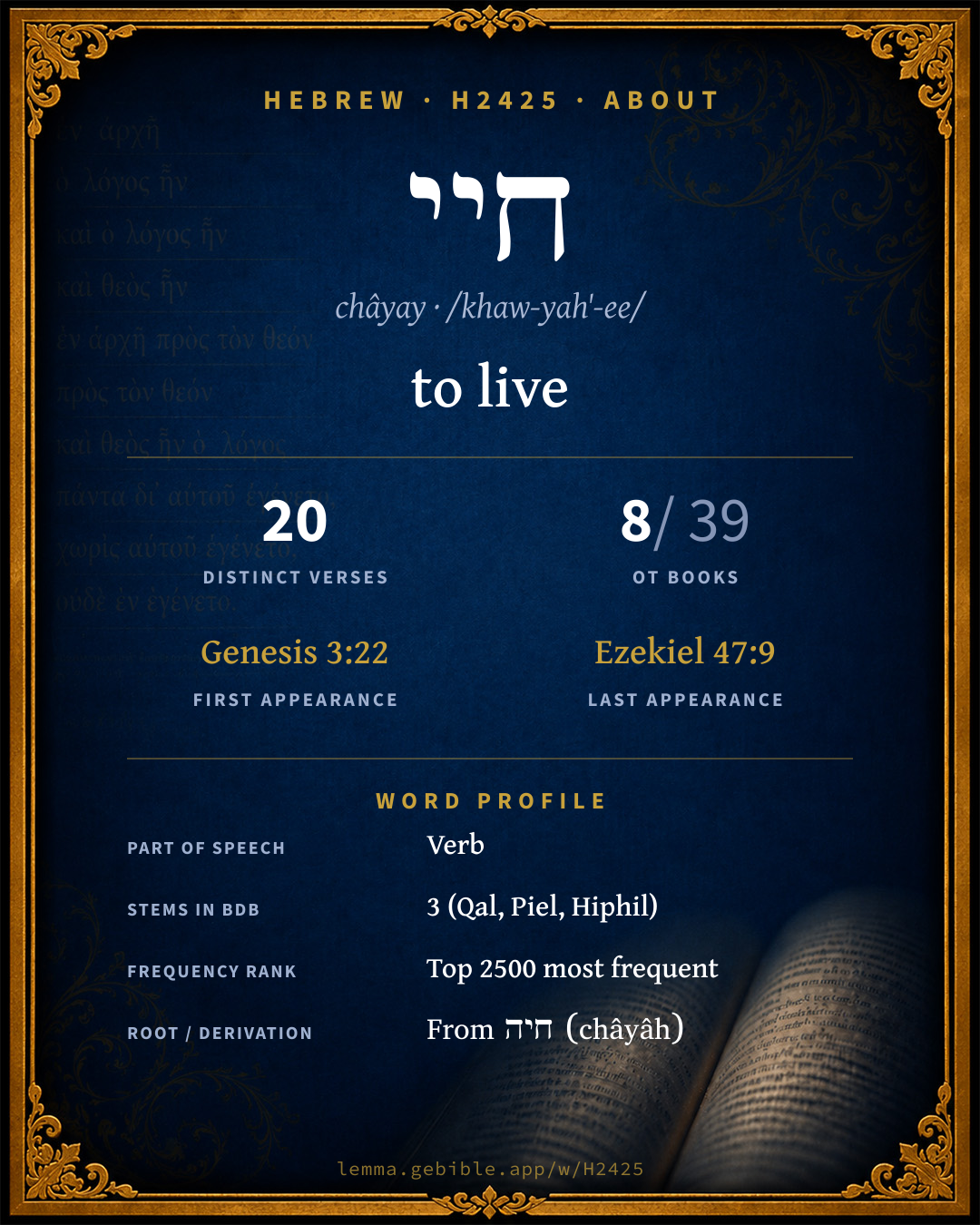
חָיַי
to live
also: have life, remain alive, sustain life, live prosperously fuller range ↓
Full lexicon entry — Brown-Driver-Briggs (BDB)
From Brown-Driver-Briggs (BDB)
Where this word appears
Grammar key — what these labels mean
Part of speech
- Verb
- An action or state-of-being word.
Stem
- Qal
- The basic, simple active stem — the plain form of the verb (“he wrote”). Here: ‘live’
Form
- Sequential Perfect
- A perfect with prefixed waw continuing a preceding imperfect or command (waw-consecutive perfect).
- Perfect
- A completed action or state — Hebrew marks aspect (completeness) more than strict tense (“he wrote”).
Person
- 3rd Person
- The one spoken about (“he / she / it / they”).
Gender
- Masculine
- Grammatically masculine.
- Feminine
- Grammatically feminine.
Number
- Singular
- One.
Every verse where H2425 appears in the Book of Genesis — 3 distinct verses. Click any verse to open its interlinear word-by-word view. Verse text shown in the World English Bible for context — . Each verse’s Hebrew form is shown with its reference; the English is not keyword-highlighted, since the data carries no word-level English alignment. Use “Compare translations” on any verse to read it across multiple English versions. This concordance covers the Hebrew Bible; Septuagint (Greek Old Testament) occurrences are not indexed here.
Genesis
- Genesis 3:22 וָ/חַ֥י conj + Qal wpf 3ms Yahweh God said, "Behold, the man has become like one of us, knowing good and evil. Now, lest he put forth his hand, and also take of the tree of life, and eat, and live forever..."
- Genesis 5:5 חַ֔י Qal pf 3ms All the days that Adam lived were nine hundred thirty years, then he died.
- Genesis 25:7 חָ֑י Qal pf 3ms These are the days of the years of Abraham's life which he lived: one hundred seventy-five years.
About this entry
At a glance — auto-summarized from this page’s data, not written by a person. Every figure links to its source below. This summary describes the numbers; it doesn’t interpret them.
At its core, חיי (châyay) means “to live.” First canonically at Genesis 3:22, it enters the text early. It appears 20 verses across 8 books of the Hebrew Bible, among its uncommon vocabulary. The word gravitates to Ezekiel (30%), then Deuteronomy and Genesis. Different stems carry different senses — BDB groups them under 3 stems, among them Qal and Piel. Each statement above links to its evidence; the full detail follows below.
Gloss history
Strong's 1890 vs modern scholarship
About this word
Strong's H2425 catalogs a Hebrew word from the Hebrew Old Testament.
These counts are not copied from any lexicon or concordance. They are computed here, from the morphology-tagged Hebrew Old Testament. What Lemma adds →
- 20
- distinct verses
- The word appears in 20 distinct verses.
- 8 / 39
- OT books
- The word appears in 8 of 39 Old Testament books.
- #1,513
- by frequency
- Top 2500 most frequent Hebrew words (rank 1,513 of 8,640 Hebrew words by occurrence).
View all 20 occurrences in the concordance →
Most concentrated in
- Ezekiel 6 verses 30%
- Deuteronomy 4 verses 20%
- Genesis 3 verses 15%
By section of the Old Testament
By traditional corpus
Conventional, traditional groupings — biblical authorship is debated, so this is a traditional corpus grouping, not an authorship claim. Each share is this word’s portion of its verses in that division of the Hebrew canon. Each figure is a share of the word’s 20 distinct verses.
- Torah (Pentateuch) 12 verses · 60%
- Prophets (Nevi'im) 7 verses · 35%
- Writings (Ketuvim) 1 verse · 5%
How translations render this word
Counts come from each version’s own published word-to-Strong’s tagging or interlinear alignment — an approximate guide to how each version renders this word, not a word-level alignment the data otherwise carries. Because each total is that version’s own tagged count, the per-version totals vary from one another and need not match the appearance or distinct-verse counts above. These counts may also differ from a printed concordance because Lemma counts each distinctly tagged rendering and does not collapse phrase taggings into a single head-word total. This is a fixed set of word-tagged versions (KJV, ASV, BSB, ULT) and does not change with the reading translation you choose elsewhere. Each version’s license is shown beside its name below (and on Sources).
- King James Version: He shall even live 3×, Live 3×, Lived 3×
- American Standard Version: He shall live 3×, Live 3×, Lived 3×
- unfoldingWord Literal Text: Live 4×, He lived 3×, Will live 3×
King James Version Public Domain
Renders H2425 across 22 tagged occurrences — most commonly:
Plus 11 renderings that appear only once — usually multi-word phrases or single function words the recovered tagging swept in, not distinct renderings. Not rendered by a distinct English word in 1 further occurrence.
American Standard Version Public Domain
Renders H2425 across 22 tagged occurrences — most commonly:
Plus 11 renderings that appear only once — usually multi-word phrases or single function words the recovered tagging swept in, not distinct renderings.
unfoldingWord Literal Text CC BY-SA 4.0
Renders H2425 across 21 tagged occurrences — most commonly:
Plus 7 renderings that appear only once — usually multi-word phrases or single function words the recovered tagging swept in, not distinct renderings.
25 senses and sub-senses in the full BDB
Hebrew verbs can shift meaning by stem (binyan): Qal is the basic action, Niphal is often passive or reflexive, Piel often intensifies or makes it factitive, and Hiphil is typically causative. The senses below are grouped under the stem BDB assigns to each.
What do BDB’s symbols mean?
BDB uses these scholarly abbreviations:
| Symbol | Meaning |
|---|---|
| 𝔊 | the Septuagint (the ancient Greek translation, LXX) |
| 𝔙 | the Vulgate (the Latin translation) |
| 𝔖 | the Syriac version (the Peshitta) |
| 𝔗 | the Targum (the Aramaic translation) |
| ψ | the Psalms |
| √ | root (the underlying root or stem) |
| ‖ | parallel passage (a synonymous or contrasted parallel) |
| † | the dagger: every passage where the word occurs is cited |
The 25 senses and sub-senses the full Brown-Driver-Briggs lexicon distinguishes for this word, in lexicon order (not ranked by frequency), with BDB’s own verbatim wording and sub-sense lettering. Shown in Hebrew script with BDB’s own scholarly abbreviations. The condensed entry is in the Lexicon Entry tab. See also the Forms in the corpus table below.
Qal
- Pf. חָיָה Ec 6:6 + 4 times; יְ֯חָיָה Je 21:9; 38:2; חַי Gn 5:5 + 23 times (this and the following form are treated as ע״ע, the original weakness of the stem final י admitting of either ל״ה or ע״ע, Ges§ 761); וְחֵי Lv 25:36 (Bö§ 1181); 3 fs. חָֽיְתָה Gn 12:13 Je 38:17; וָחָ֑יָה Ex 1:16 (for חַיָּה Bö§ 1123 (3), Sam. חיתה); 2 ms. חָיִיתָ Dt 30:16, חָיִתָה Je 38:17; 3 m. pl. תָיוּ Nu 14:38, וְחָיוּ consec. Nu 4:19 + Zc 10:9 (where read Pi. וְתִיּוּ StaZAW i, 1881, 22 so 𝔊), וִחְיִיתֶם Ez 37:5 + 2 times; Impf. יִחְיֶה Gn 17:18 + 27 times; יְחִי Dt 33:6 + 10 times; וִיתִי ψ 49:10 + 2 times; וְיֶ֑חִי Is 38:21, וַיְחִי Gn 5:3 + 37 times; וַיֶּ֑חִי Dt 4:33 + 4 times; 3 fs. תִּחְיַה Jos 6:17, תְּחִי Gn 19:20 + 5 times; 2 ms. תִּחְיֶה Gn 27:40 + 7 times; 2 fs. תִּחְיִי 2 K 4:7; 1 s. אֶחְיֶה 2 K 1:2 + 8 times; 3 mpl. יִחְיוּ Jos 9:21 + 8 times; 3 fpl. תִּחְיֶינָה Ez 13:19; 37:3; 2 mpl. תִּחְיוּ Dt 4:1 + 2 times; תִּחְיוּן Dt 5:30; 8:1; 1 pl. נִחְיֶה 2 K 7:4 + 7 times; Imv. וֶחְיֵה Gn 20:7 Pr 4:4, וֶחְיֶ֯ה Pr 7:2; fs. חֲיִי Ez 16:6(×2); mpl. וִחְיוּ Gn 42:18 + 7 times; Inf. abs. חָיֹה 2 K 8:10 + 6 times; חָיוֹ Ez 3:21 + 3 times; cstr. לִחְיוֹת Ez 33:12, sf. חֲיוֹתָם Jos 5:8;— e.g. Ecclesiastes 6:6
- 1. live:
- a. have life, Gn 31:32(E), Ex 33:20(J), Nu 4:19 (P), Dt 30:16 +; also in phrase וַיְחִי and he lived (so many years) with acc. of time, Gn 5:3–30 (16 times) 9:28; 11:11–26 (14 times) 47:28 (all P), 50:22 (E), 2 K 14:17 = 2 Ch 25:25 Jb 42:16. e.g. Genesis 31:32
- b. continue in life, remain alive Gn 20:7 (E), Lv 25:36 2 S 12:22 +; also †ח׳ נפשׁ live, of the soul or the self Gn 12:13; 19:20 (J), 1 K 20:32 ψ 119:175 Je 38:2, 17, 20 Is 55:3; וְחַי הַיָּ֑לֶד and the boy may live 2 S 12:22; †ח׳ לִפְנֵי live in the presence of Gn 17:18 (P) Ho 6:2; †ח׳ ב׳ live among La 4:20. e.g. Genesis 20:7
- c. sustain life, live on or upon (על), of the animal life, by the sword Gn 27:40 (J), by bread Dt 8:3; elsewhere in pregnant sense of fulness of life in divine favour, sustained by (על) everything that issueth out of the mouth of י׳ Dt 8:3; his promises (?) Is 38:16; of wicked man, by repentance Ez 33:19; c. בְּ by the statutes and judgments of י׳ if a man do them, Lv 18:5 (H) Ez 20:11, 13, 21, 25 Ne 9:29; צַדִּיק בֶּאֱמוּנָתוֹ יִחְיֶה a righteous man by his faithfulness shall live Hb 2:4. e.g. Genesis 27:40
- d. live(prosperously) יְחִי הַמֶּלֶך may the king live 1 S 10:24 2 S 16:16(×2) 1 K 1:25, 31, 34, 39 2 K 11:12 2 Ch 23:11; יְחִי לְבַבְכֶם ψ 22:27; 69:33; המלך לעולם יחיה Ne 2:3. e.g. 1 Samuel 10:24
- 2. be quickened, revive:
- a. from sickness Nu 21:8, 9 Jos 5:8 (E) 2 K 1:2; 8:8, 9, 10, 14; 2 K 20:1, 7 = Is 38:1, 9, 21. e.g. Numbers 21:8
- b. from discouragement of the spirit Gn 45:27 (E). e.g. Genesis 45:27
- c. from faintness Ju 15:19. e.g. Judges 15:19
- d. from death 2 K 13:21 Jb 14:14 Is 26:14, 19; by return of נפשׁ 1 K 17:22, of רוּחַ Ez 37:3, 5, 6, 9, 10, 14 (and so Ju 15:19 c). e.g. 2 Kings 13:21
Piel
- Pf. 3 ms. חִיָּה ψ 22:30; 3 fs. sf. חִיָּ֑תְנִי ψ 119:50; 2 ms. sf. חִיִּיתַנִי ψ 30:4; חִיִּיתָ֑נִי ψ 119:93; 3 pl. חִיּוּ Ju 21:14, הַחִיִּיתֶם Nu 31:15; Impf. יְחַיֶּה 1 S 27:9 +, etc.; Imv. sf. חַיֵּנִי ψ 119:25 + 8 times, חַיֵּיהוּ Hb 3:2; Inf. cstr. חַיּוֹת Gn 7:3 Ez 13:19; sf. חַיֹּתֵנוּ Dt 6:24 +, etc.; Pt. מְחַיֶּה Ne 9:6 1 S 2:6;— e.g. Psalms 22:30
- 1. preserve alive, let live Ex 1:17, 18, 22; 22:17 Jos 9:15 (JE), Gn 12:12 (J), Nu 31:15 (P), Dt 6:24; 20:16 Ju 21:14 1 S 27:9, 11 1 K 18:5 2 K 7:4 Je 49:11 Ez 3:18 Hb 3:2 Jb 36:6 ψ 30:4; 33:19; 41:3; 138:7; ח׳ נפשׁ preserve oneself alive ψ 22:30 Ez 18:27, or preserve persons alive Ex 13:18, 19, or preserve life 1 K 20:31; ח׳ זרע preserve seed alive Gn 7:3; 19:32, 34 (J); keep in existence heaven and earth Ne 9:6; nourish, young cow Is 7:21, lamb 2 S 12:3. e.g. Exodus 1:17
- 2. give life, to man when created Jb 33:4. e.g. Job 33:4
- 3. quicken, revive, refresh:
- a. restore to life, the dead 1 S 2:6 Dt 32:39 Ho 6:2; the dying ψ 71:20. e.g. 1 Samuel 2:6
- b. cause to grow, grain Ho 14:8. e.g. Hosea 14:8
- c. restore, a ruined city 1 Ch 11:8, stones destroyed by fire Ne 3:34. e.g. 1 Chronicles 11:8
- d. revive, the people of י׳ by י׳ himself with fulness of life in his favour ψ 80:19; 85:7; 119:25, 37, 40, 50, 88, 93, 107, 149, 154, 156, 159; 143:11 Ec 7:12. e.g. Psalms 80:19
Hiphil
- Pf. הֶחֱיָה Jos 6:25 + 5 times; 2 ms. sf. הֶחֱיִתָנוּ Gn 47:25; 1 s. הֶחֱיֵיתִי Nu 22:33, הַחֲיִתֶם Jos 2:13 Ju 8:19; Imv. sf. הַחֲיֵינִי Is 38:16; הַחֲיוּ Nu 31:18; Inf. abs. הַחֲיֵה Jos 9:20; cstr. הַחֲיוֹת Gn 6:20 + 6 times; הַחֲיֹת Gn 6:19; 50:20; sf. הַחֲיֹתוֹ Ez 13:22;— e.g. Joshua 6:25
- 1. preserve alive, let live Gn 45:7; 50:20 (E) 47:25 Nu 22:33 Jos 2:13; 6:25 (all J), 14:10 (D); Gn 6:19, 20 Nu 31:18 Jos 9:20 (P), Ju 8:19 2 S 8:2 Ez 13:22; with נפשׁ Gn 19:19 (J). e.g. Genesis 45:7
- 2. quicken, revive:
- a. restore to health, a leper 2 K 5:7, Hezekiah Is 38:16. e.g. 2 Kings 5:7
- b. revive the לֵב and רוּחַ Is 57:15(×2). e.g. Isaiah 57:15
- c. restore to life, the dead 2 K 8:1, 5(×3). e.g. 2 Kings 8:1
Senses from the full Brown-Driver-Briggs lexicon (Brown, Driver, Briggs; Oxford 1906 — public domain), digitized via Sefaria, supplemented by the OpenScriptures HebrewLexicon (CC BY 4.0). Full attribution on Sources.
Word origin
vb. live (NH Ph. id.; Arabic حَىَّ, حَيِىَ; Sab. חיו MordtZMG 1876, 28; Ethiopic ሐይወ Aramaic ܚܝܳܐ, חֲיָא; Palm. חיי life, life-time, Vog 32, 74)—
— Brown-Driver-Briggs (Oxford 1906, public domain), digitized via Sefaria, supplemented by the OpenScriptures HebrewLexicon (CC BY 4.0). See Sources.
Derived from חיה (châyâh) (H2421) — to live.
Jastrow Dictionary
A second Hebrew/Aramaic lexicon for comparison, covering Aramaic and post-biblical (Talmudic, Targumic, Midrashic) usage that the biblical-Hebrew BDB does not. Matched by lemma rather than by Strong’s number, so a lemma may carry more than one Jastrow headword (shown separately below), and the entries cover usage well beyond the Bible.
חיי
- (b. h.)
- 1. to live. Tam. 32ᵃ מה … ויִחְיֶה what must man do in order to live (long)?; a. v. fr.—Part. חָי (v. חַי).—Keth. I, 6 לא מפיה אנו חָיִין we do not live on what comes from her lips, i.e. we do not go by her evidence. Y. ib. II, 26ᶜ bot. אנו כחיין מפיה we (the court) are again in the condition of dependence on her own evidence. Y. Shebi. II, 34ᵃ top שהן חָיִין מִמֵּי וכ׳ they live (draw nourishment) from the waters of last year; ib. (הוא חָיָיה) הוא חָיָה it draws &c.—Snh. 108ᵃ לא חיין ולא נידונין they have no share in the resurrection nor will they be judged; a. fr.
- 2. to heal; to recover, regain health. Keth. 6ᵃ, a. e. עד שתִּחְיֶה המכה until the wound is healed up. Ḥull. 7ᵇ וחָיָה and did recover; וחָיָת and it (the wound) healed up; a. fr. [Y. Maasr. I, 48ᵈ חיתה; Y. Shebi. IV, 35ᵇ bot. חייתה, v. חוּת.]
- to be recalled to life, to resurrect. Ab. IV, 22 והמתים להֵחָיוֹת and the dead are destined to be revived. Snh. 90ᵇ שעתיד להחיות that he (Aaron) will resurrect.
- 1. to keep alive, sustain. Tam. 32ᵃ יְחַיֶּה את עצמו let him feed himself (his passions, be selfish). Yoma 71ᵃ מְחַיֶּה חיים He who sustains the living; a. fr.
- 2. to recall to life, to revive. Snh. l. c. הקב"ה מְחַיֶּיה מתים the Lord revives the dead. Ib. מה שאני ממית אני מְחַיֶּה what I put to death, I revive again; a. fr.
- same. Ib. 92ᵇ מתים שה׳ יחזקאל the dead whom Ezekiel revived (Ez. XXXVII). Ib. והַחֲיֵיה מתים וכ׳ and revive the dead in the valley of Dura; a. fr.
חֲיִי
- Targ. Gen. V, 3; a. v. fr.—Part. חָאִי, חָיֵי. Targ. Y. Num. XXI, 8. Targ. Deut. VIII, 3; a. fr.—Taan. 25ᵃ דחֲיִית … או דחָיֵינָא (v. Ms. M. a. Rashi) is what I have lived more or what I have yet to live? Answ. דחֲיַית what thou hast lived. Snh. 81ᵃ מאן דעביד לכולהו הוא דח׳ will he only live who practiced all these virtues?; a. fr.—Ḥull. 7ᵇ הא קחזינא דחָיֵי but do’nt we see that they do recover?—Snh. 91ᵃ דחָיִין מיתי דמיתי חָיִין if those who live must die, can those who died, live again?; a. fr.
- as preced. Pi. Targ. Ps. LXXI, 20 תְּחַיֵּי (some ed. תֶּחִי). Targ. Job XXXVI, 6; a. fr.
- , אַחְיָיא same. Targ. II Kings VIII, 1.—Targ. Y. II, Deut. III, 1; a. e.
חַיֵּי
- 1. life, v. חַיִּין.
- 2. the living, v. חַי ch.,
A Dictionary of the Targumim, the Talmud Babli and Yerushalmi, and the Midrashic Literature (Marcus Jastrow; London, Luzac, 1903) — Public Domain. Digitized via Sefaria. Digitized via Sefaria. Full attribution on Sources.
Forms in the corpus
The 9 distinct written forms H2425 takes in the Hebrew Bible, most frequent first — each parse links to that stem’s occurrences in the concordance. Hebrew forms include their vowel points and cantillation, so a single lemma takes many written forms.
| Form | Parsing | Example | Uses |
|---|---|---|---|
| וָ/חָֽי | Verb, Qal, Sequential Perfect, 3rd Person, Masculine, Singular | Deuteronomy 4:42 | 6 |
| וָ/חָ֑י | Verb, Qal, Sequential Perfect, 3rd Person, Masculine, Singular | Deuteronomy 19:4 | 4 |
| וָ/חַ֣י | Verb, Qal, Sequential Perfect, 3rd Person, Masculine, Singular | Ezekiel 20:13 | 3 |
| וָ/חַ֥י | Verb, Qal, Sequential Perfect, 3rd Person, Masculine, Singular | Ezekiel 20:11 | 2 |
| וָ/חָ֔י | Verb, Qal, Sequential Perfect, 3rd Person, Masculine, Singular | Ezekiel 47:9 | 1 |
| וָ/חָֽיָה | Verb, Qal, Sequential Perfect, 3rd Person, Feminine, Singular | Exodus 1:16 | 1 |
| חַ֔י | Verb, Qal, Perfect, 3rd Person, Masculine, Singular | Genesis 5:5 | 1 |
| חַ֣י | Verb, Qal, Perfect, 3rd Person, Masculine, Singular | 1 Samuel 20:31 | 1 |
| חָ֑י | Verb, Qal, Perfect, 3rd Person, Masculine, Singular | Genesis 25:7 | 1 |
Same root — word family
Other BDB entries built from the same root as H2425, grouped by Strong’s listed origin. These share a root / origin per the lexicon — not necessarily a shared meaning. Each links to that word’s own entry.
Derives from
Shares the same root
- חי chay H2416 living
- חיא chăyâʼ H2418 to live
- חיה châyeh H2422 lively
- חיות chayûwth H2424 living
- מחיה michyâh H4241 sustenance
Proper names from this root
People and places named from this root — a name, not an additional meaning of the word.
Compare all same-root words → Showing 4 of 9 — not the complete family. 2 of the same-root words are proper names (people or places). They share a root, not necessarily a meaning.
Septuagint verse parallels
This word appears in 19 verses that also exist in the Greek Old Testament (Septuagint), out of the 20 Hebrew verses it occurs in. You can read those verses in Greek by switching the Old Testament edition to the Septuagint.
Read these verses in the Septuagint
This is a verse-level parallel only — the same verses exist in both the Hebrew and Greek Old Testaments. No word-level Hebrew↔Greek correspondence is claimed: the data carries no such alignment, so no Greek word is shown as this Hebrew word’s translation. Coverage is not total — the Septuagint omits the deuterocanon and renumbers the Psalms, so some Hebrew verses have no direct Greek parallel.