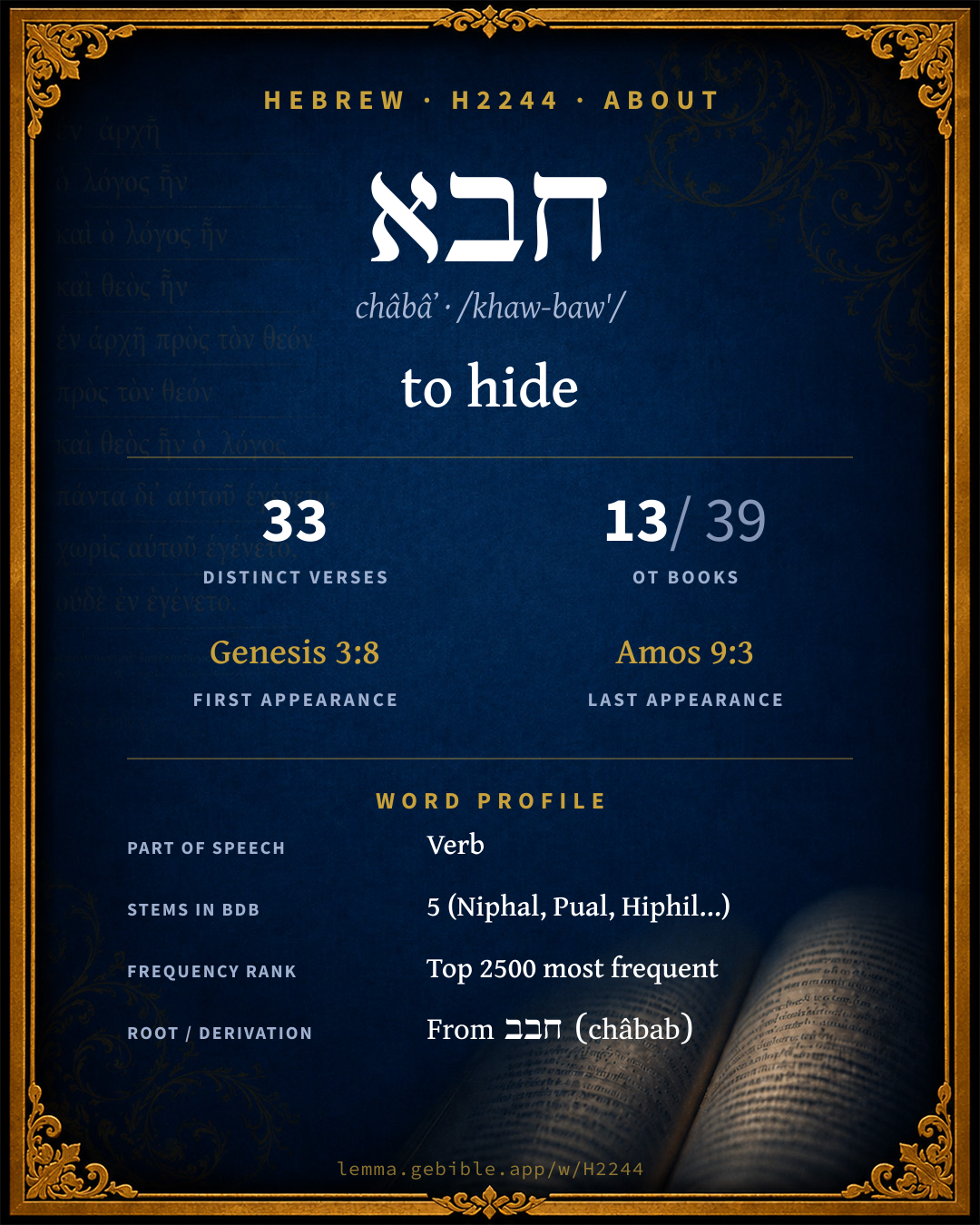
חָבָא
to hide
‘to hide’ is one of 5 main senses fuller range ↓
Full lexicon entry — Brown-Driver-Briggs (BDB)
From Brown-Driver-Briggs (BDB)
Where this word appears
See every Niphal verb in the Hebrew Bible →
Grammar key — what these labels mean
Part of speech
- Verb
- An action or state-of-being word.
Stem
- Hithpael
- The reflexive or reciprocal stem (the subject acts on itself). Here: ‘draw back’
- Niphal
- Usually the simple passive or reflexive of the Qal (“he was written”).
- Hiphil
- The causative active stem (“he caused / brought about”).
- Hophal
- The passive counterpart of the Hiphil (“he was caused to…”).
- Pual
- The passive counterpart of the Piel.
Form
- Participle Active
- A verbal adjective expressing ongoing or characteristic action (“writing / one who writes”).
- Infinitive Construct
- A bound verbal noun, frequently with prepositions (“to write / in writing”).
- Perfect
- A completed action or state — Hebrew marks aspect (completeness) more than strict tense (“he wrote”).
- Participle Passive
- A verbal adjective expressing action received (“written”).
- Sequential Perfect
- A perfect with prefixed waw continuing a preceding imperfect or command (waw-consecutive perfect).
- Sequential Imperfect
- An imperfect with prefixed waw — the standard past-narrative form (waw-consecutive imperfect).
- Imperfect
- An incomplete, ongoing, or future action (“he will / would write”).
State
- Absolute
- The independent form of a noun, not bound to a following word.
Person
- 3rd Person
- The one spoken about (“he / she / it / they”).
- 2nd Person
- The one addressed (“you”).
- 1st Person
- The speaker (“I / we”).
Gender
- Masculine
- Grammatically masculine.
- Common
- Either gender — not distinguished for this form.
- Feminine
- Grammatically feminine.
Number
- Singular
- One.
- Plural
- More than one (in Hebrew, generally three or more).
Grammatical forms 25 distinct
- Verb, Hithpael, Participle Active, Masculine, Singular, Absolute 3 times (9%)
- Verb, Niphal, Perfect, 3rd Person, Common, Plural 3 times (9%)
- Verb, Niphal, Infinitive Construct 2 times (6%)
- Verb, Niphal, Participle Passive, Masculine, Singular, Absolute 2 times (6%)
- Verb, Hiphil, Perfect, 3rd Person, Feminine, Singular 2 times (6%)
- Verb, Hithpael, Participle Active, Masculine, Plural, Absolute 2 times (6%)
- Verb, Niphal, Sequential Perfect, 2nd Person, Masculine, Singular 1 time (3%)
- Verb, Niphal, Sequential Imperfect, 1st Person, Common, Singular 1 time (3%)
+17 more forms (17 occurrences)
Parsed forms decoded from the imported morphology (morphhb / Westminster Leningrad Codex — WLC text public domain, morphhb tagging CC BY 4.0), counted across 33 parsed occurrences — not distinct verses.
Every verse where H2244 appears — 33 distinct verses across 13 books. Click any verse to open its interlinear word-by-word view. Verse text shown in the World English Bible for context — . Each verse’s Hebrew form is shown with its reference; the English is not keyword-highlighted, since the data carries no word-level English alignment. Use “Compare translations” on any verse to read it across multiple English versions. This concordance covers the Hebrew Bible; Septuagint (Greek Old Testament) occurrences are not indexed here.
Genesis 3 verses
- Genesis 3:8 וַ/יִּתְחַבֵּ֨א conj + Hithpael wimpf 3ms They heard the voice of Yahweh God walking in the garden in the cool of the day, and the man and his wife hid themselves from the presence of Yahweh God among the trees of the garden.
- Genesis 3:10 וָ/אֵחָבֵֽא conj + Niphal wimpf 1cs The man said, "I heard your voice in the garden, and I was afraid, because I was naked; and I hid myself."
- Genesis 31:27 נַחְבֵּ֨אתָ֙ Niphal pf 2ms Why did you flee secretly, and deceive me, and didn't tell me, that I might have sent you away with mirth and with songs, with tambourine and with harp;
Joshua 5 verses
- Joshua 6:17 הֶחְבְּאַ֔תָה Hiphil pf 3fs The city shall be devoted, even it and all that is therein, to Yahweh: only Rahab the prostitute shall live, she and all who are with her in the house, because she hid the messengers that we sent.
- Joshua 6:25 הֶחְבִּ֨יאָה֙ Hiphil pf 3fs But Rahab the prostitute, and her father's household, and all that she had, did Joshua save alive; and she lived in the midst of Israel to this day, because she hid the messengers, whom Joshua sent to spy out Jericho.
- Joshua 10:16 וַ/יֵּחָבְא֥וּ conj + Niphal wimpf 3mp These five kings fled, and hid themselves in the cave at Makkedah.
- Joshua 10:17 נֶחְבְּאִ֥ים Niphal ptcp.act mp It was told Joshua, saying, The five kings are found, hidden in the cave at Makkedah.
- Joshua 10:27 נֶחְבְּאוּ Niphal pf 3cp It happened at the time of the going down of the sun, that Joshua commanded, and they took them down off the trees, and cast them into the cave in which they had hidden themselves, and laid great stones on the mouth of the cave, to this very day.
Judges 1 verse
1 Samuel 6 verses
- 1 Samuel 10:22 נֶחְבָּ֖א Niphal ptcp.pass ms Therefore they asked of Yahweh further, Is there yet a man to come here? Yahweh answered, Behold, he has hid himself among the baggage.
- 1 Samuel 13:6 וַ/יִּֽתְחַבְּא֣וּ conj + Hithpael wimpf 3mp When the men of Israel saw that they were in a strait (for the people were distressed), then the people did hide themselves in caves, and in thickets, and in rocks, and in coverts, and in pits.
- 1 Samuel 14:11 הִתְחַבְּאוּ Hithpael pf 3cp Both of them disclosed themselves to the garrison of the Philistines: and the Philistines said, Behold, the Hebrews come forth out of the holes where they had hid themselves.
- 1 Samuel 14:22 הַ/מִּֽתְחַבְּאִ֤ים ptcl def.art + Hithpael ptcp.act mp Likewise all the men of Israel who had hid themselves in the hill-country of Ephraim, when they heard that the Philistines fled, even they also followed hard after them in the battle.
- 1 Samuel 19:2 וְ/נַחְבֵּֽאתָ conj + Niphal wpf 2ms Jonathan told David, saying, Saul my father seeks to kill you: now therefore, please take care of yourself in the morning, and live in a secret place, and hide yourself:
- 1 Samuel 23:23 יִתְחַבֵּ֣א Hithpael impf 3ms See therefore, and take knowledge of all the lurking-places where he hides himself, and come you again to me of a certainty, and I will go with you: and it shall happen, if he be in the land, that I will search him out among all the thousands of Judah.
2 Samuel 1 verse
1 Kings 2 verses
- 1 Kings 18:4 וַֽ/יַּחְבִּיאֵ֞/ם conj + Hiphil wimpf 3ms + sfx pers 3mp for it was so, when Jezebel cut off the prophets of Yahweh, that Obadiah took one hundred prophets, and hid them by fifty in a cave, and fed them with bread and water.)
- 1 Kings 18:13 וָ/אַחְבִּא֩ conj + Hiphil wimpf 1cs Wasn't it told my lord what I did when Jezebel killed the prophets of Yahweh, how I hid one hundred men of Yahweh's prophets by fifty in a cave, and fed them with bread and water?
2 Kings 2 verses
- 2 Kings 6:29 וַ/תַּחְבִּ֖א conj + Hiphil wimpf 3fs So we boiled my son, and ate him: and I said to her on the next day, Give your son, that we may eat him; and she has hid her son.
- 2 Kings 11:3 מִתְחַבֵּ֖א Hithpael ptcp.act ms He was with her hid in the house of Yahweh six years. Athaliah reigned over the land.
1 Chronicles 1 verse
2 Chronicles 3 verses
- 2 Chronicles 18:24 לְ/הֵחָבֵֽא prep + Niphal inf.cs Micaiah said, Behold, you shall see on that day, when you shall go into an inner chamber to hide yourself.
- 2 Chronicles 22:9 מִתְחַבֵּ֣א Hithpael ptcp.act ms He sought Ahaziah, and they caught him (now he was hiding in Samaria), and they brought him to Jehu, and killed him; and they buried him, for they said, He is the son of Jehoshaphat, who sought Yahweh with all his heart. The house of Ahaziah had no power to hold the kingdom.
- 2 Chronicles 22:12 מִתְחַבֵּ֖א Hithpael ptcp.act ms He was with them hid in the house of God six years: and Athaliah reigned over the land.
Job 5 verses
- Job 5:21 תֵּחָבֵ֑א Niphal impf 2ms You shall be hidden from the scourge of the tongue, Neither shall you be afraid of destruction when it comes.
- Job 24:4 חֻ֝בְּא֗וּ Pual pf 3cp They turn the needy out of the way. The poor of the earth all hide themselves.
- Job 29:8 וְ/נֶחְבָּ֑אוּ conj + Niphal pf 3cp The young men saw me and hid themselves, The aged rose up and stood;
- Job 29:10 נֶחְבָּ֑אוּ Niphal pf 3cp The voice of the nobles was hushed, And their tongue stuck to the roof of their mouth.
- Job 38:30 יִתְחַבָּ֑אוּ Hithpael impf 3mp The waters become hard like stone, When the surface of the deep is frozen.
Isaiah 2 verses
- Isaiah 42:22 הָחְבָּ֑אוּ Hophal pf 3cp But this is a people robbed and plundered; they are all of them snared in holes, and they are hid in prison-houses: they are for a prey, and none delivers; for a spoil, and none says, Restore.
- Isaiah 49:2 הֶחְבִּיאָ֑/נִי Hiphil pf 3ms + sfx pers 1cs and he has made my mouth like a sharp sword; in the shadow of his hand has he hid me: and he has made me a polished shaft; in his quiver has he kept me close:
Daniel 1 verse
Amos 1 verse
About this entry
At a glance — auto-summarized from this page’s data, not written by a person. Every figure links to its source below. This summary describes the numbers; it doesn’t interpret them.
“to hide” is the headline sense of the Hebrew verb חבא (châbâʼ). Across 5 stems, its meaning turns on the binyan (Niphal, Pual). It appears 33 verses across 13 books of the Hebrew Bible, among its moderately common vocabulary. Scripture first uses it in Genesis 3:8. It shares a root with חבב, חב and חבה. See the sense tree, 33-verse concordance, and the renderings breakdown below.
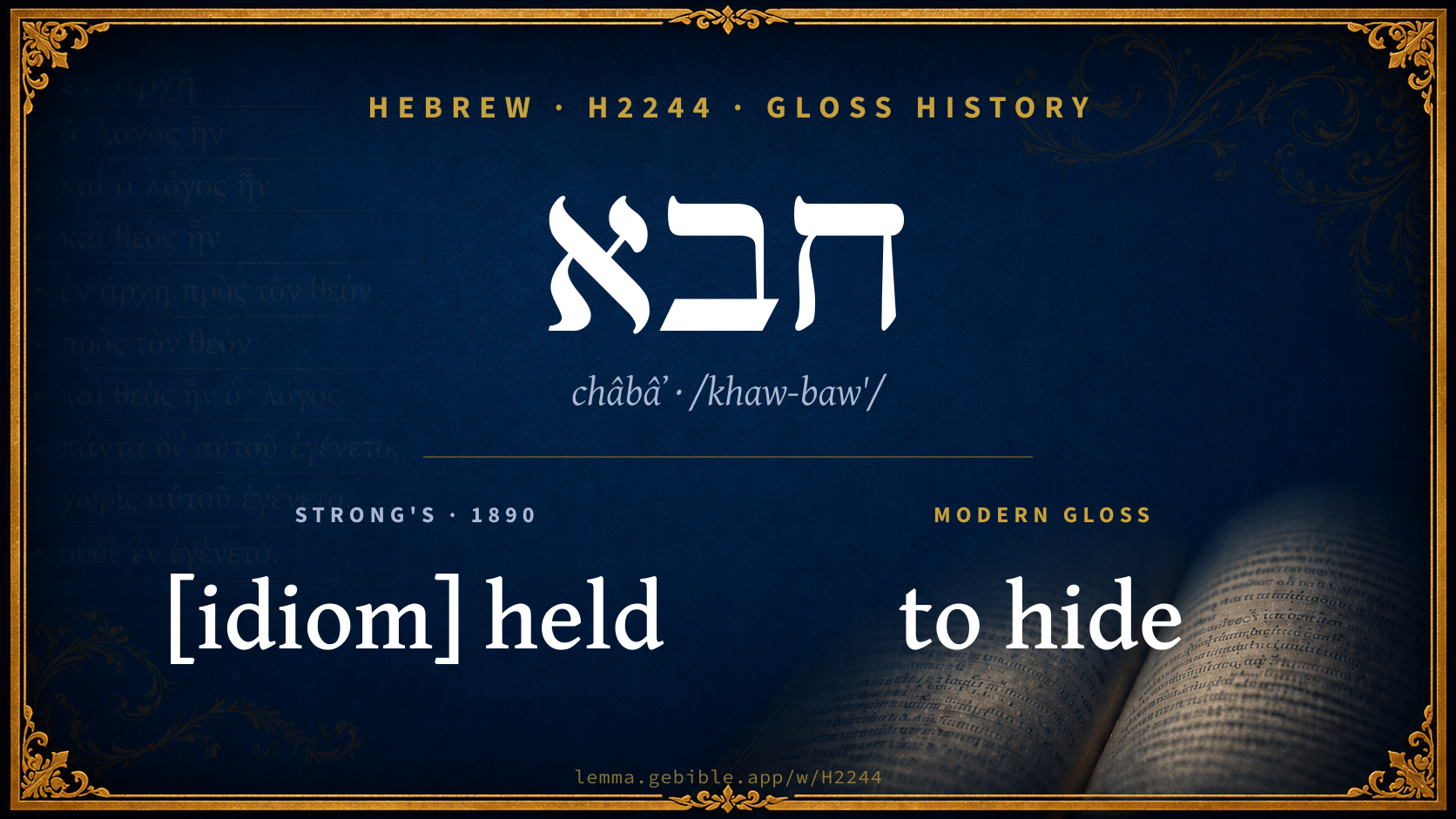
Gloss history
Strong's 1890 vs modern scholarship
About this word
Strong's H2244 catalogs a Hebrew word from the Hebrew Old Testament.
These counts are not copied from any lexicon or concordance. They are computed here, from the morphology-tagged Hebrew Old Testament. What Lemma adds →
- 33
- distinct verses
- The word appears in 33 distinct verses.
- 13 / 39
- OT books
- The word appears in 13 of 39 Old Testament books.
- #1,064
- by frequency
- Top 2500 most frequent Hebrew words (rank 1,064 of 8,640 Hebrew words by occurrence).
View all 33 occurrences in the concordance →
By section of the Old Testament
By traditional corpus
Conventional, traditional groupings — biblical authorship is debated, so this is a traditional corpus grouping, not an authorship claim. Each share is this word’s portion of its verses in that division of the Hebrew canon. Each figure is a share of the word’s 33 distinct verses.
- Prophets (Nevi'im) 20 verses · 61%
- Writings (Ketuvim) 10 verses · 30%
- Torah (Pentateuch) 3 verses · 9%
How translations render this word
Counts come from each version’s own published word-to-Strong’s tagging or interlinear alignment — an approximate guide to how each version renders this word, not a word-level alignment the data otherwise carries. Because each total is that version’s own tagged count, the per-version totals vary from one another and need not match the appearance or distinct-verse counts above. These counts may also differ from a printed concordance because Lemma counts each distinctly tagged rendering and does not collapse phrase taggings into a single head-word total. This is a fixed set of word-tagged versions (KJV, ASV, BSB, ULT) and does not change with the reading translation you choose elsewhere. Each version’s license is shown beside its name below (and on Sources).
- King James Version: Hid 5×, Hide 3×, She hid 2×
- American Standard Version: Hid 3×, Behold 2×, Him 2×
- Berean Standard Bible: Hidden 3×, Hid themselves 2×, She hid 2×
- unfoldingWord Literal Text: She hid 3×, Hid themselves 2×, Hide themselves 2×
King James Version Public Domain
Renders H2244 across 33 tagged occurrences — most commonly:
Plus 23 renderings that appear only once — usually multi-word phrases or single function words the recovered tagging swept in, not distinct renderings.
American Standard Version Public Domain
Renders H2244 across 33 tagged occurrences — most commonly:
Plus 24 renderings that appear only once — usually multi-word phrases or single function words the recovered tagging swept in, not distinct renderings.
Berean Standard Bible Public Domain
Renders H2244 across 33 tagged occurrences — most commonly:
Plus 26 renderings that appear only once — usually multi-word phrases or single function words the recovered tagging swept in, not distinct renderings.
unfoldingWord Literal Text CC BY-SA 4.0
Renders H2244 across 36 tagged occurrences — most commonly:
Plus 25 renderings that appear only once — usually multi-word phrases or single function words the recovered tagging swept in, not distinct renderings.
Senses in the full BDB
Hebrew verbs can shift meaning by stem (binyan): Qal is the basic action, Niphal is often passive or reflexive, Piel often intensifies or makes it factitive, and Hiphil is typically causative. The senses below are grouped under the stem BDB assigns to each. This entry also uses Pual (the passive of Piel), Hophal (the passive of Hiphil), and Hithpael (reflexive or reciprocal).
What do BDB’s symbols mean?
BDB uses these scholarly abbreviations:
| Symbol | Meaning |
|---|---|
| 𝔊 | the Septuagint (the ancient Greek translation, LXX) |
| 𝔙 | the Vulgate (the Latin translation) |
| 𝔖 | the Syriac version (the Peshitta) |
| 𝔗 | the Targum (the Aramaic translation) |
| ψ | the Psalms |
| √ | root (the underlying root or stem) |
| ‖ | parallel passage (a synonymous or contrasted parallel) |
| † | the dagger: every passage where the word occurs is cited |
The 6 senses and sub-senses the full Brown-Driver-Briggs lexicon distinguishes for this word, in lexicon order (not ranked by frequency), with BDB’s own verbatim wording and sub-sense lettering. Shown in Hebrew script with BDB’s own scholarly abbreviations. The condensed entry is in the Lexicon Entry tab. See also the Forms in the corpus table below.
Niphal
- . hide oneself
Pual
- . have been hidden
Hiphil
- . hide, trans.
Hophal
- . be hidden
Hithpael
- 1. draw back, hide oneself
- 2. draw together, thicken, harden
Senses from the full Brown-Driver-Briggs lexicon (Brown, Driver, Briggs; Oxford 1906 — public domain), digitized via Sefaria, supplemented by the OpenScriptures HebrewLexicon (CC BY 4.0). Full attribution on Sources.
Word origin
[ חָבָא ] vb. withdraw, hide (not in Qal )
— Brown-Driver-Briggs (Oxford 1906, public domain), digitized via Sefaria, supplemented by the OpenScriptures HebrewLexicon (CC BY 4.0). See Sources.
Derived from חבב (châbab) (H2245) — to love.
Jastrow Dictionary
A second Hebrew/Aramaic lexicon for comparison, covering Aramaic and post-biblical (Talmudic, Targumic, Midrashic) usage that the biblical-Hebrew BDB does not. Matched by lemma rather than by Strong’s number, so a lemma may carry more than one Jastrow headword (shown separately below), and the entries cover usage well beyond the Bible.
חָבָא
- , v. חבי
חֻבָּא
- , חוּבָּא.
חֵבָא
- , B. Kam. 101ᵇ, v. חֵבָה
חֲבֵי
- Bekh. 43ᵇ, v. infra.
- to hide one’s self; to be hidden, covered. Targ. Lam. I, 3. Targ. Y. Gen. VII, 19, sq. (ed. pr. = O. אתחפ׳).—Bekh. 43ᵇ דחַבְיָא מִיחְבֵּי (Rashi, ed. מִחְ׳) when the head is hidden (between the shoulders). B. Kam. 60ᵇ מִחְבֵּי חַבּוּיֵי וכ׳ he hides himself and walks (by the way-sides).
A Dictionary of the Targumim, the Talmud Babli and Yerushalmi, and the Midrashic Literature (Marcus Jastrow; London, Luzac, 1903) — Public Domain. Digitized via Sefaria. Digitized via Sefaria. Full attribution on Sources.
Forms in the corpus
The 32 distinct written forms H2244 takes in the Hebrew Bible, most frequent first — each parse links to that stem’s occurrences in the concordance. Hebrew forms include their vowel points and cantillation, so a single lemma takes many written forms.
Same root — word family
Other BDB entries built from the same root as H2244, grouped by Strong’s listed origin. These share a root / origin per the lexicon — not necessarily a shared meaning. Each links to that word’s own entry.
Derives from
Shares the same root
Derived from this word
Proper names from this root
People and places named from this root — a name, not an additional meaning of the word.
Compare all same-root words → Showing 4 of 6 — not the complete family. 1 of the same-root words is a proper name (a person or place). They share a root, not necessarily a meaning.
Septuagint verse parallels
This word appears in 33 verses that also exist in the Greek Old Testament (Septuagint), out of the 33 Hebrew verses it occurs in. You can read those verses in Greek by switching the Old Testament edition to the Septuagint.
Read these verses in the Septuagint
- Genesis 3:8
- Joshua 6:17
- Judges 9:5
- 1 Samuel 10:22
- 2 Samuel 17:9
- 1 Kings 18:4
- 2 Kings 6:29
- 1 Chronicles 21:20
- 2 Chronicles 18:24
- Job 5:21
- Isaiah 42:22
- Daniel 10:7
This is a verse-level parallel only — the same verses exist in both the Hebrew and Greek Old Testaments. No word-level Hebrew↔Greek correspondence is claimed: the data carries no such alignment, so no Greek word is shown as this Hebrew word’s translation. Coverage is not total — the Septuagint omits the deuterocanon and renumbers the Psalms, so some Hebrew verses have no direct Greek parallel.