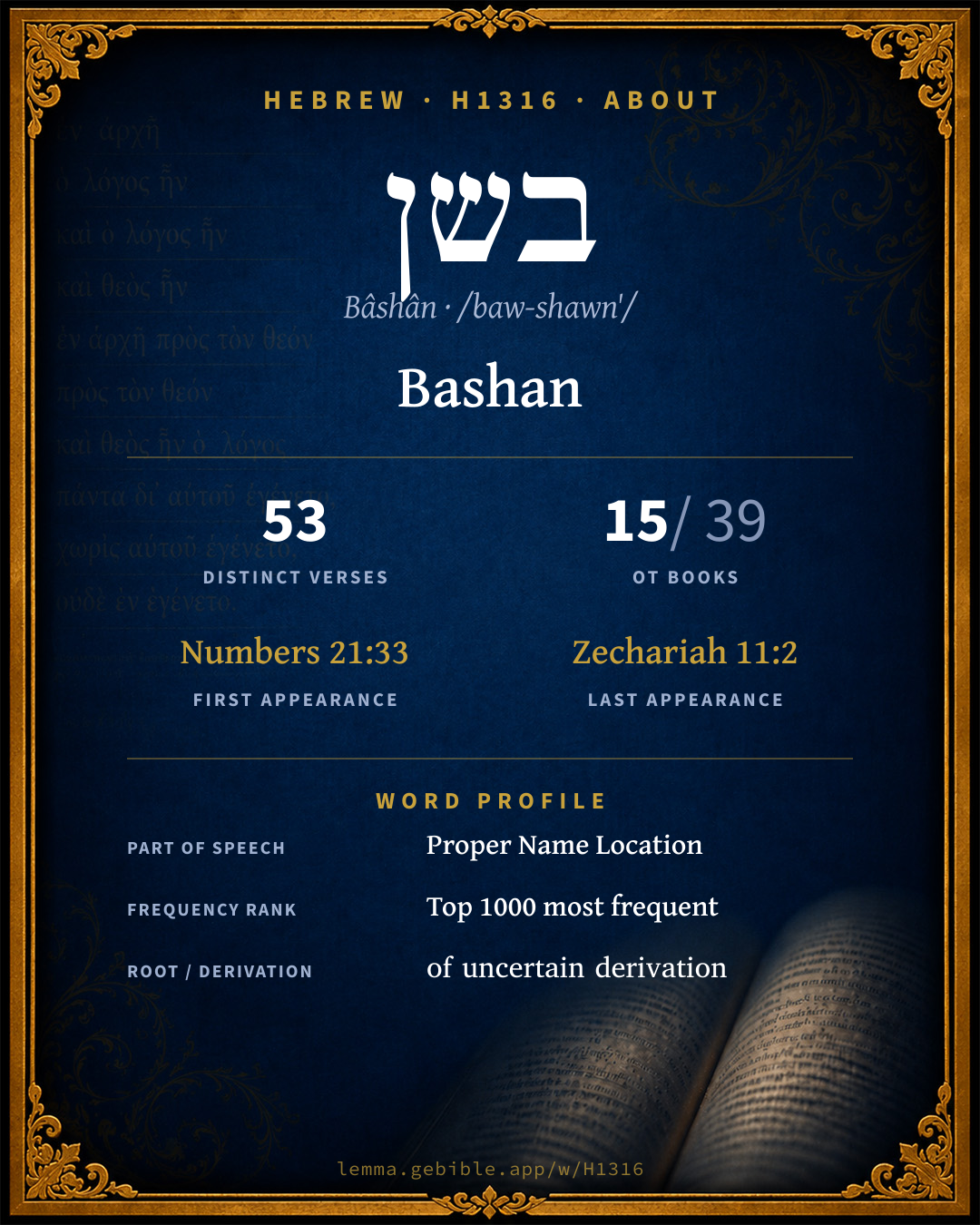
בָּשָׁן
Bashan
BDB lists 2 entries for ‘Bashan’ fuller range ↓
Full lexicon entry — Brown-Driver-Briggs (BDB)
From Brown-Driver-Briggs (BDB)
Where this word appears
Grammar key — what these labels mean
Part of speech
- Noun
- A naming word — a person, place, thing, or idea.
Noun type
- Proper
- A name of a specific person, place, or people (e.g. Abraham, Zion, Israel).
Every verse where H1316 appears in the Book of Micah — 1 distinct verse. Click any verse to open its interlinear word-by-word view. Verse text shown in the World English Bible for context — . Each verse’s Hebrew form is shown with its reference; the English is not keyword-highlighted, since the data carries no word-level English alignment. Use “Compare translations” on any verse to read it across multiple English versions. This concordance covers the Hebrew Bible; Septuagint (Greek Old Testament) occurrences are not indexed here.
Micah
About this entry
At a glance — auto-summarized from this page’s data, not written by a person. Every figure links to its source below. This summary describes the numbers; it doesn’t interpret them.
“Bashan” is the headline sense of the Hebrew name בשן (Bâshân). First canonically at Numbers 21:33, it enters the text early. The Hebrew Bible uses it across 53 verses — moderately common. More than a quarter of its appearances fall in Deuteronomy. The sections below give every occurrence and version rendering.
Gloss history
Strong's 1890 vs modern scholarship
About this word
Strong's H1316 catalogs a Hebrew word from the Hebrew Old Testament.
These counts are not copied from any lexicon or concordance. They are computed here, from the morphology-tagged Hebrew Old Testament. What Lemma adds →
- 53
- distinct verses
- The word appears in 53 distinct verses.
- 15 / 39
- OT books
- The word appears in 15 of 39 Old Testament books.
- #639
- by frequency
- Top 1000 most frequent Hebrew words (rank 639 of 8,640 Hebrew words by occurrence).
View all 53 occurrences in the concordance →
Most concentrated in
- Deuteronomy 13 verses 25%
- Joshua 13 verses 25%
- 1 Chronicles 6 verses 11%
By section of the Old Testament
By traditional corpus
Conventional, traditional groupings — biblical authorship is debated, so this is a traditional corpus grouping, not an authorship claim. Each share is this word’s portion of its verses in that division of the Hebrew canon. Each figure is a share of the word’s 53 distinct verses.
- Prophets (Nevi'im) 26 verses · 49%
- Torah (Pentateuch) 15 verses · 28%
- Writings (Ketuvim) 12 verses · 23%
How translations render this word
Counts come from each version’s own published word-to-Strong’s tagging or interlinear alignment — an approximate guide to how each version renders this word, not a word-level alignment the data otherwise carries. Because each total is that version’s own tagged count, the per-version totals vary from one another and need not match the appearance or distinct-verse counts above. These counts may also differ from a printed concordance because Lemma counts each distinctly tagged rendering and does not collapse phrase taggings into a single head-word total. This is a fixed set of word-tagged versions (KJV, ASV, BSB, ULT) and does not change with the reading translation you choose elsewhere. Each version’s license is shown beside its name below (and on Sources).
- King James Version: Bashan 49×, All bashan 6×
- American Standard Version: Bashan 46×, All bashan 6×
- Berean Standard Bible: Bashan 56×
- unfoldingWord Literal Text: Bashan 56×
King James Version Public Domain
Renders H1316 across 60 tagged occurrences — most commonly:
Plus 5 renderings that appear only once — usually multi-word phrases or single function words the recovered tagging swept in, not distinct renderings.
American Standard Version Public Domain
Renders H1316 across 60 tagged occurrences — most commonly:
Plus 8 renderings that appear only once — usually multi-word phrases or single function words the recovered tagging swept in, not distinct renderings.
Berean Standard Bible Public Domain
Renders H1316 across 58 tagged occurrences — most commonly:
Plus 2 renderings that appear only once — usually multi-word phrases or single function words the recovered tagging swept in, not distinct renderings. Not rendered by a distinct English word in 2 further occurrences.
unfoldingWord Literal Text CC BY-SA 4.0
Renders H1316 across 59 tagged occurrences — most commonly:
Plus 3 renderings that appear only once — usually multi-word phrases or single function words the recovered tagging swept in, not distinct renderings.
Senses in BDB
The 2 senses BDB distinguishes for this word, in lexicon order (not ranked by frequency or importance). The full entry — with sub-senses — is in the Lexicon Entry tab.
- Bashan = "fruitful"
- a district east of the Jordan known for its fertility which was given to the half-tribe of Manasseh
Word origin
n.pr.terr.m. Dt 3:3 (smooth (& fertile) land) Bashan, first mentioned as kingdom of Og, E. of Jordan, stretching from stream Jabboḳ (thus including northern Gilead) northward to Hermon, between Gennesaret (W) and mts of Hauran (E); cf. Di Nu 21:33 Wetzst Hauran 82; later a type of fertility;—usually c. art. הַבּ׳ Nu 21:33(×2); 32:33; Dt 1:4 + 30 times Dt Jos; 1 K 4:13, 19 2 K 10:33; 1 Ch 5:11, 12, 16, 23; 6:47, 56; Ne 9:22 ψ 68:23; 135:11; 136:20; Je 22:20; 50:19 (‖ הַכַּרְמֶל), Mi 7:14 (‖ id.), Na 1:4) (‖ id.; personif., subj. of אֻמְלַל), Is 33:9 (‖ id.; personif. subj. of נֹעֵר); הַר־בָּשָׁן (i.e. range of Hauran) ψ 68:16(×2) (called הַר־אלהים,—from a sanctuary there?—& הַר־גַּבְנֻנִּים many-peaked mt.); of stately trees אַלּוֹנֵי הַבּ׳ Is 2:13 (still seen on western slope of mts. of Hauran, Wetzst Hauran 88); אַלּוֹנֵי ב׳ Zc 11:2 (fig. of prominent men); אַלּוֹנִים מִבּ׳ Ez 27:6; of bulls אַבִּירֵי ב׳ ψ 22:13 (‖ פָּרִים, fig.); so בְּנֵי־ב׳ Dt 32:14 (+ כָּרִים וְאֵילִים also עַתּוּדִים, cf. בָּקָר & צֹאן v a; vid. בֵּן 1. j. (ν)); appar. more general is מְרִיאֵי ב׳ Ez 39:18 (ref. to אֵילִים כָּרִים וְעַתּוּדִים פָּרִים … כֻּלָּם); once of kine (fem., fig. of luxurious and haughty women of Samaria) Am 4:1 פָּרוֹת הַבּ׳.
— Brown-Driver-Briggs (Oxford 1906, public domain), digitized via Sefaria, supplemented by the OpenScriptures HebrewLexicon (CC BY 4.0). See Sources.
Origin: of uncertain derivation
Jastrow Dictionary
A second Hebrew/Aramaic lexicon for comparison, covering Aramaic and post-biblical (Talmudic, Targumic, Midrashic) usage that the biblical-Hebrew BDB does not. Matched by lemma rather than by Strong’s number, so a lemma may carry more than one Jastrow headword (shown separately below), and the entries cover usage well beyond the Bible.
שֵׁן
- c. (b. h.;
- 1. tooth, tooth-like projection. Sabb. VI, 5 (64ᵇ) שן תותבת ושן של זהב an inserted (natural) tooth or an (artificial) gold tooth; (Bab. ed. שן תותכת שן וכ׳, Ms. O. ושן, v. Rashi a. l.). Ib. 10, v. שׁוּעָל; a. fr.—Esp. (sub. נזק) the damage done by an animal’s eating. B. Kam. 2ᵇ שלשה … הקרן והשן והרגל three chief damages are mentioned (in the Scriptural text) with reference to the ox: damage by the horn, by the tooth, and by the foot. Ib. תולדה דשן, v. נְשִׁיכָה. Ib. שן יש הנאה וכ׳, v. הֶיזֵּק. Ib. אשן ורגל it refers to damages by the tooth and by the foot; שן ורגל היכא כתיבי where is the damage by the tooth or the foot written (in the Biblical text)? Ib. ובער זו השן ubhiʿer (Ex. XXII, 4) this refers to damage by the tooth; a. fr.—Du. שִׁנַּיִים, שִׁנַּיִם, שִׁי׳. Ḥull. I, 2 בכל … והש׳ you may cut ritually with anything, except … with teeth in the jaw. Ib. ואם החליקו שִׁינֶּיהָ and if the teeth of the saw have been made smooth. Keth. 71ᵇ בין שיניה, v. אֶצְבַּע. Ib. 16ᵃ, v. כֶּרֶס. Kel. XIII, 8 שניטלו שִׁינָּיו (a hackle) whose teeth are broken off. Gen. R. s. 33 חשש רבי את שיניו וכ׳ Rabbi suffered from tooth-ache for thirteen years. Keth. 111ᵇ טוב המלבין ש׳ וכ׳ he who causes his neighbor to show the white of his teeth (who makes him cheerful) does better than he who gives him milk to drink. Ib. א"ת לבן ש׳ אלא לבון ש׳ read not l’ben shinnayim (Gen. XLIX, 12) but libbun shinnayim (whitening of teeth, cheerfulness); a. fr.— any organ of the body resembling teeth, gland.—Du. as ab. Y. Yeb. VI, beg. 7ᵇ בית הש׳ that part of the vagina which has glands; מבין הש׳ ולפנים from the glands and farther inside; Nidd. 41ᵇ. Ḥull. 16ᵇ שיניו נושרות the glands of his rectum will fall off; Sabb. 82ᵃ; a. e. e.g. Exodus 22:4
- 3. cliff, peak. Gen. R. s. 74 כשן הזה של וכ׳ (the stone which Jacob put up was) as large as the peak of Tiberias; Yalk. ib. 130; a. e.
- 4. (sub. של פיל) ivory. Num. R. s. 312 (play on מי יג̇ור̇ … חזק כש̇ן̇ (ג̇ר̇ש̇ון̇ who can abide snow and hail, and cold and heat? He who is as strong as ivory (or marble?); אין שן אלא לשון חזק וכ׳ shen has the meaning of strong (ref. to Cant. V, 14); a. e e.g. Song of Solomon 5:14
- 5. marble. Cant. R. to V, 11; Yalk. ib. 991, v. עֶשֶׁת.
שֵׁן ²
- Targ. O. Deut. XXXII, 24. Targ. Ex. XXI, 24. Targ. I Kings X, 22 (v. פִּילָא I). Ib. 18. Targ. I Sam. XIV, 4; a. fr.—Y. Kil. IX, 32ᵇ bot; האי שִׁינָּךְ וכ׳ how is that tooth of thine?; Y. Keth. XII, 35ᵃ bot.; Gen. R. s. 33. Ib. יהב ידיה על שִׁינֵּיה וכ׳ he put his hand on his (Rabbi’s) tooth, and it was cured.—Gitt. 68ᵇ ומנח להו אש׳ דטורא וכ׳ he puts it (the Shamir) on the peak of a mountain, and the mountain bursts. Snh. 96ᵇ תא אש׳ דטורא (Rashi דטורי) come (to Jerusalem) even if it be necessary to march over the cliffs of mountains (differ. in Rashi); Yalk. Is. 287; a. fr.—ש׳ דדור, שן דור pr. n. pl. the Cliff of Dor (v. Hildesh. Beitr. pp. 4; 10). Y. Shebi. VI, 36ᶜ (not דרור); Tosef. Shebi. IV, 11 שורא דרור (corr. acc.); Sifré Deut. 51 [read:] מדבר שר שן דור; Yalk. ib. 874 (corr. acc.).—Pl. שִׁנִּין, שִׁנַּיָּא, שִׁנֵּי, שִׁי׳. Targ. Am. IV, 6 (not שְׁנִין). Targ. Prov. X, 26.—Targ. Jer. XLIX, 16. Targ. Y. Gen. XLIX, 21 (not שֵׁינֵי); a. fr.—Y. Kil. IX, 32ᵇ תלת … חשש (ב)שִׁינּוֹי suffered from tooth-ache for thirteen years. Ib. חד שִׁינַּיי וכ׳ one of my teeth annoys me; (Y. Keth. l. c. חד שינא).—Sabb. 82ᵃ, v. כַּרְכְּשָׁא; a. fr.
A Dictionary of the Targumim, the Talmud Babli and Yerushalmi, and the Midrashic Literature (Marcus Jastrow; London, Luzac, 1903) — Public Domain. Digitized via Sefaria. Digitized via Sefaria. Full attribution on Sources.
Forms in the corpus
The 32 distinct written forms H1316 takes in the Hebrew Bible, most frequent first — each parse links to that state’s occurrences in the concordance. Hebrew forms include their vowel points and cantillation, so a single lemma takes many written forms.
| Form | Parsing | Example | Uses |
|---|---|---|---|
| הַ/בָּשָׁ֔ן | Noun, Proper | Deuteronomy 1:4 | 6 |
| בַּ/בָּשָׁ֖ן | Noun, Proper | Deuteronomy 4:43 | 5 |
| הַ/בָּשָׁ֑ן | Noun, Proper | Deuteronomy 3:1 | 5 |
| הַ/בָּשָׁ֖ן | Noun, Proper | Deuteronomy 3:3 | 4 |
| בַּ/בָּשָׁ֔ן | Noun, Proper | 1 Chronicles 6:62 | 3 |
| בַּ/בָּשָֽׁן | Noun, Proper | Deuteronomy 3:4 | 3 |
| הַ/בָּשָׁ֗ן | Noun, Proper | Deuteronomy 3:11 | 3 |
| הַ/בָּשָֽׁן | Noun, Proper | Deuteronomy 33:22 | 3 |
| הַ/בָּשָׁן֙ | Noun, Proper | Amos 4:1 | 3 |
| הַ/בָּשָׁ֨ן | Noun, Proper | Deuteronomy 3:1 | 2 |
| וְ/הַ/בָּשָֽׁן | Noun, Proper | 2 Kings 10:33 | 2 |
| בַ/בָּשָׁן֙ | Noun, Proper | Joshua 21:6 | 1 |
| בָשָׁ֔ן | Noun, Proper | Zechariah 11:2 | 1 |
| בָשָׁ֖ן | Noun, Proper | Ezekiel 39:18 | 1 |
| בָשָׁ֛ן | Noun, Proper | Micah 7:14 | 1 |
| בָשָׁ֣ן | Noun, Proper | Psalms 22:12 | 1 |
| בָשָׁן֙ | Noun, Proper | Deuteronomy 32:14 | 1 |
| בַּ/בָּשָׁ֑ן | Noun, Proper | Joshua 13:31 | 1 |
| בַּ/בָּשָׁן֒ | Noun, Proper | Joshua 22:7 | 1 |
| בַּ/בָּשָׁן֙ | Noun, Proper | Joshua 21:27 | 1 |
| בָּשָׁ֑ן | Noun, Proper | Psalms 68:15 | 1 |
| בָּשָׁ֖ן | Noun, Proper | Isaiah 33:9 | 1 |
| בָּשָֽׁן | Noun, Proper | Psalms 68:15 | 1 |
| בָּשָׁן֙ | Noun, Proper | Nahum 1:4 | 1 |
| הַ/בָּשָׁ֜ן | Noun, Proper | Joshua 13:30 | 1 |
| הַ/בָּשָׁ֧ן | Noun, Proper | Deuteronomy 29:7 | 1 |
| וְ/הַ/בָּשָׁ֑ן | Noun, Proper | Jeremiah 50:19 | 1 |
| וְ/הַ/בָּשָׁ֔ן | Noun, Proper | Joshua 17:5 | 1 |
| וּ/בַ/בָּשָׁ֖ן | Noun, Proper | Jeremiah 22:20 | 1 |
| מִ/בָּ֔שָׁן | Noun, Proper | Ezekiel 27:6 | 1 |
| מִ/בָּשָׁ֞ן | Noun, Proper | 1 Chronicles 5:23 | 1 |
| מִ/בָּשָׁ֣ן | Noun, Proper | Psalms 68:22 | 1 |
Bible dictionary
Public-domain dictionary articles matched to this entry by name (Bashan). A biblical name can be shared by more than one person or place, so an article may treat several.
Easton's Bible Dictionary · M. G. Easton, 1897
Light soil, first mentioned in Gen. 14:5, where it is said that Chedorlaomer and his confederates "smote the Rephaim in Ashteroth," where Og the king of Bashan had his residence. At the time of Israel's entrance into the Promised Land, Og came out against them, but was utterly routed (Num. 21:33-35; Deut. 3:1-7). This country extended from Gilead in the south to Hermon in the north, and from the Jordan on the west to Salcah on the east. Along with the half of Gilead it was given to the half-tribe of Manasseh (Josh. 13:29-31). Golan, one of its cities, became a "city of refuge" (Josh. 21:27). Argob, in Bashan, was one of Solomon's commissariat districts (1 Kings 4:13). The cities of Bashan were taken by Hazael (2 Kings 10:33), but were soon after reconquered by Jehoash (2 Kings 13:25), who overcame the Syrians in three battles, according to the word of Elisha (19). From this time Bashan almost disappears from history, although we read of the wild cattle of its rich pastures (Ezek. 39:18; Ps. 22:12), the oaks of its forests (Isa. 2:13; Ezek. 27:6; Zech. 11:2), and the beauty of its extensive plains (Amos 4:1; Jer. 50:19). Soon after the conquest, the name "Gilead" was given to the whole country beyond Jordan. After the Exile, Bashan was divided into four districts, (1.) Gaulonitis, or Jaulan, the most western; (2.) Auranitis, the Hauran (Ezek. 47:16); (3.) Argob or Trachonitis, now the Lejah; and (4.) Batanaea, now Ard-el-Bathanyeh, on the east of the Lejah, with many deserted towns almost as perfect as when they were inhabited. (See HAURAN.)
Smith's Bible Dictionary · William Smith, 1863
(fruitful), a district on the east of Jordan. It is sometimes spoken of as the "land of Bashan," (1 Chronicles 5:11) and comp. Numb 21:33; 32:33 And sometimes as "all Bashan." (3:10,13; Joshua 12:5; 13:12,30) It was taken by the children of Israel after their conquest of the land of Sihon from Arnon to Jabbok. The limits of Bashan are very strictly defined. It extended from the "border of Gilead" on the south to Mount Hermon on the north, (3:3,10,14; Joshua 12:5; 1 Chronicles 5:23) and from the Arabah or Jordan valley on the west to Salchah (Sulkhad) and the border of the Geshurites and the Maachathites on the east. (Joshua 12:3-5; 3:10) This important district was bestowed on the half-tribe of Manasseh, (Joshua 13:29-31) together with "half Gilead." This country is now full of interesting ruins, which have lately been explored and from which much light has been thrown upon Bible times. See Porter's "Giant Cities of Bashan."
Hitchcock's Bible Names Dictionary · Roswell D. Hitchcock, 1869
in the tooth, in ivory
Classic public-domain reference works; full attribution on Sources.
Septuagint verse parallels
This word appears in 47 verses that also exist in the Greek Old Testament (Septuagint), out of the 53 Hebrew verses it occurs in. You can read those verses in Greek by switching the Old Testament edition to the Septuagint.
Read these verses in the Septuagint
- Numbers 21:33
- Deuteronomy 1:4
- Joshua 9:10
- 1 Kings 4:13
- 2 Kings 10:33
- 1 Chronicles 5:11
- Psalms 68:15
- Isaiah 2:13
- Jeremiah 22:20
- Ezekiel 27:6
- Amos 4:1
- Micah 7:14
This is a verse-level parallel only — the same verses exist in both the Hebrew and Greek Old Testaments. No word-level Hebrew↔Greek correspondence is claimed: the data carries no such alignment, so no Greek word is shown as this Hebrew word’s translation. Coverage is not total — the Septuagint omits the deuterocanon and renumbers the Psalms, so some Hebrew verses have no direct Greek parallel.