Ezekiel 27:6

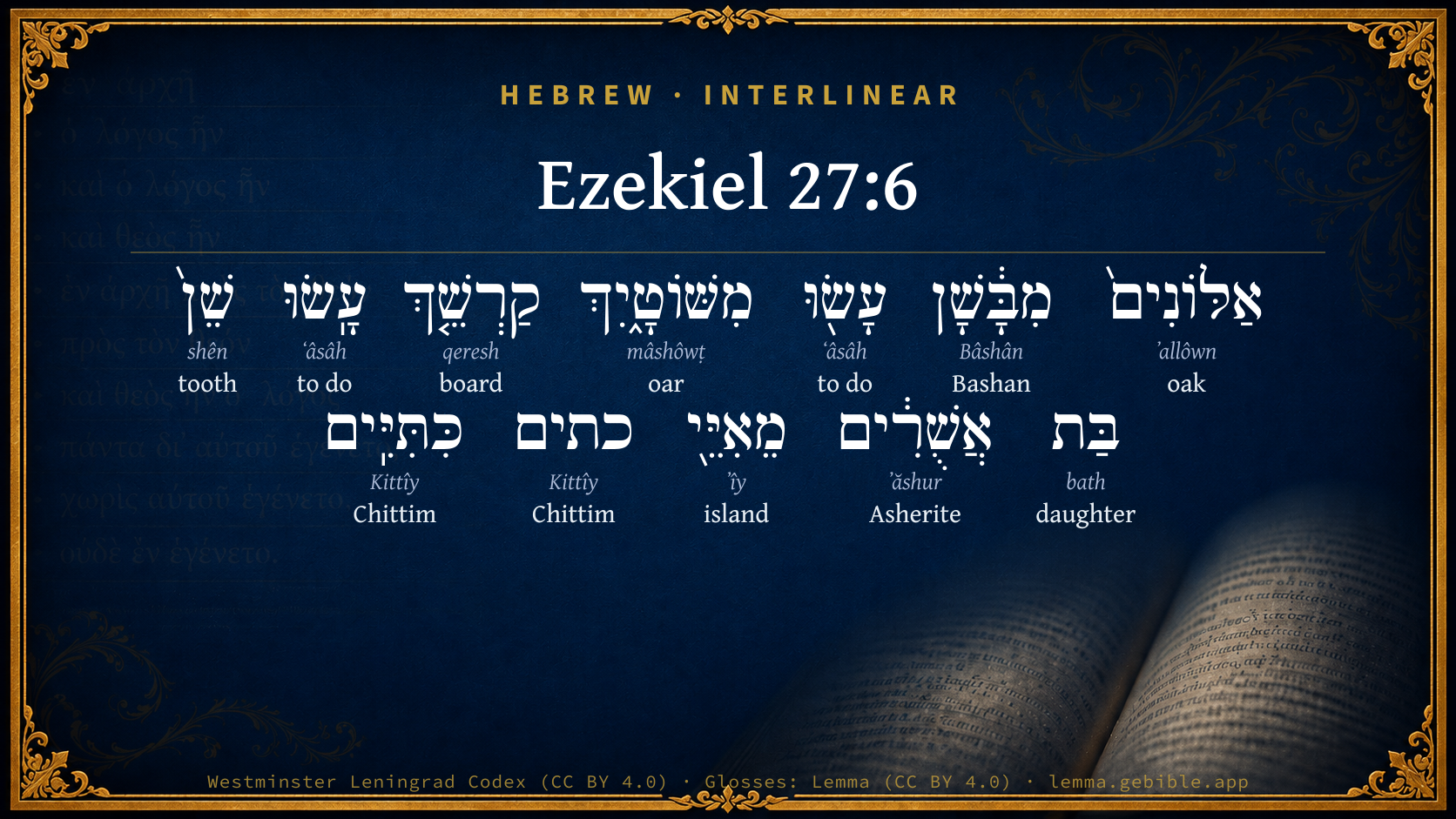
Hebrew (Westminster Leningrad Codex) Ezekiel 27:6 appears in the Hebrew Old Testament. The text above is from the Westminster Leningrad Codex. Each word links to its Strong’s number, a concise gloss, and parsing drawn from the Open Scriptures Hebrew Bible morphology. Click any word for its full Brown-Driver-Briggs (BDB) entry.
Download image
Cite this verse

Ezekiel 27:6 (World English Bible). Public Domain. Lemma interlinear Bible study tool, https://lemma.gebible.app/v/ezekiel/27/6.

Show BibTeX & RIS
BibTeX
RIS
English Translation
Of the oaks of Bashan have they made your oars; they have made your benches of ivory inlaid in boxwood, from the isles of Kittim.
World English Bible · Public Domain
Highlights
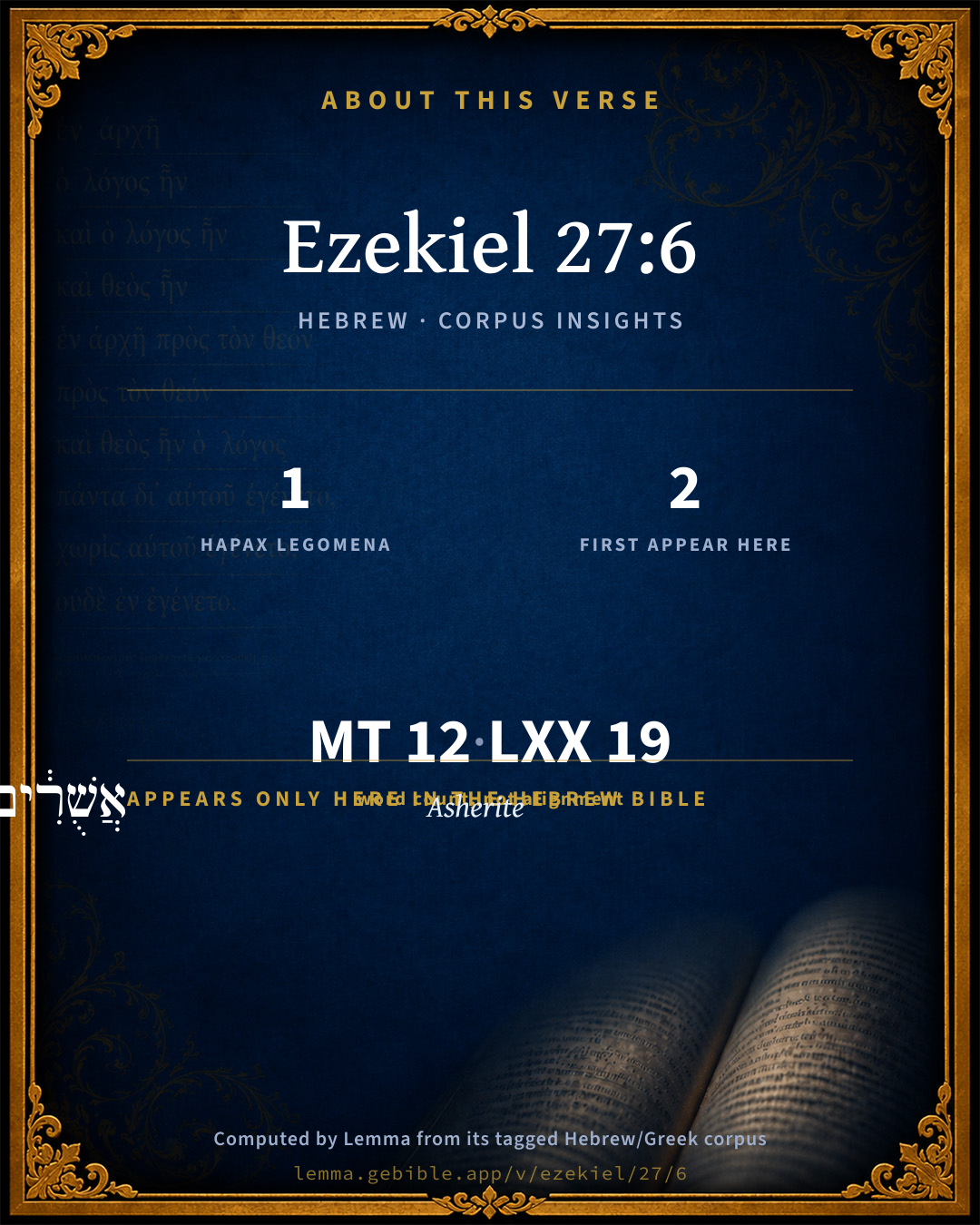
  • 1 hapax legomenon — only here in the Hebrew Bible
  • 2 first appearances in the Hebrew Bible
Full analysis ↓
Download a study sheet

One document with this verse’s original text, its word-by-word gloss line, the meaning frame, cross-references with their text, attributed commentary, and full source and license credits — printable, and it pastes into notes with its structure intact.

This verse Autodidact and up

Study sheet (.html) Plain text (.txt)

A passage Seminary Student

Up to 50 verses in one chapter. A passage sheet keeps up to 6 commentary sources and 12 cross-references per verse, in the order this page ranks them, and says so on the sheet whenever that leaves anything out. Ask for a single verse and you get the Autodidact verse sheet above.

Everything on this page stays free to read, with no account — the sheet is a download of what is already on screen, not access to it.

Want to remove ads? Support Godless Engineer
Compare translations 3

The same verse in 3 English versions, stacked beneath the original-language interlinear above. Click any original word for its lexicon entry.

Each is an independent rendering of the whole verse — the interlinear is not word-aligned to these translations.

Highlighted words mark where these versions differ — a whole-verse word diff, not a word-by-word alignment.

  • World English Bible Public Domain
    Of the oaks of Bashan have they made your oars; they have made your benches of ivory inlaid in boxwood, from the isles of Kittim.
  • King James Version Public Domain
    Of the oaks of Bashan have they made thine oars; the company of the Ashurites have made thy benches of ivory, brought out of the isles of Chittim.
  • unfoldingWord Literal Text CC BY-SA 4.0
    They made your oars from the oaks of Bashan; they made your decks out of cypress wood from Cyprus, and they overlaid them with ivory.

unfoldingWord Literal Text — © unfoldingWord, licensed CC BY-SA 4.0. Word-aligned USFM3 via Door43 (git.door43.org/unfoldingWord/en_ult).

Versions to compare (up to 4)

3 of 4 selected

Show all 18 translations

Every available English version of this verse, each an independent rendering of the whole verse.

  • World English Bible Public Domain
    Of the oaks of Bashan have they made your oars; they have made your benches of ivory inlaid in boxwood, from the isles of Kittim.
  • Berean Standard Bible Public Domain
    Of oaks from Bashan they made your oars; of wood from the coasts of Cyprus they made your deck, inlaid with ivory.
  • Majority Standard Bible Public Domain
    Of oaks from Bashan they made your oars; of wood from the coasts of Cyprus they made your deck, inlaid with ivory.
  • King James Version Public Domain
    Of the oaks of Bashan have they made thine oars; the company of the Ashurites have made thy benches of ivory, brought out of the isles of Chittim.
  • American Standard Version (1901) Public Domain
    Of the oaks of Bashan have they made thine oars; they have made thy benches of ivory inlaid in boxwood, from the isles of Kittim.
  • Revised Version (1885) Public Domain
    Of the oaks of Bashan have they made thine oars; they have made thy benches of ivory inlaid in boxwood, from the isles of Kittim.
  • Geneva Bible (1599) Public Domain
    Of ye okes of Bashan haue they made thine ores: the company of the Assyrians haue made thy banks of yuorie, brought out of ye yles of Chittim.
  • Douay-Rheims (1899) Public Domain
    They have cut thy oars out of the oaks of Basan: and they have made thee benches of Indian ivory and cabins with things brought from the islands of Italy.
  • Young's Literal Translation Public Domain
    Of oaks of Bashan they made thine oars, Thy bench they have made of ivory, A branch of Ashurim from isles of Chittim.
  • Literal Standard Version CC BY-SA 4.0
    They made your oars of oaks from Bashan, || They have made your bench of ivory, || A branch of Ashurim from islands of Chittim.
  • Unlocked Literal Bible CC BY-SA 4.0
    They made your oars from the oaks of Bashan; they made your decks out of cypress wood from Cyprus, and they overlaid them with ivory.
  • unfoldingWord Literal Text CC BY-SA 4.0
    They made your oars from the oaks of Bashan; they made your decks out of cypress wood from Cyprus, and they overlaid them with ivory.
  • Darby Bible Public Domain
    Of the oaks of Bashan did they make thine oars; they made thy benches of ivory, inlaid in box-wood, out of the isles of Chittim.
  • World Messianic Bible Public Domain
    They have made your oars of the oaks of Bashan. They have made your benches of ivory inlaid in cypress wood from the islands of Kittim.
  • Webster's Bible Public Domain
    Of the oaks of Bashan have they made thy oars; the company of the Ashurites have made thy benches of ivory, brought out of the isles of Chittim.
  • Free Bible Version CC BY-SA 4.0
    They made your oars with oaks from Bashan. They had wood from the island of Cyprus brought to make your deck and inlaid it with ivory.
  • Bible in Basic English Public Domain
    Of oak-trees from Bashan they have made your driving blades; they have made your floors of ivory and boxwood from the sea-lands of Kittim.
  • JPS Tanakh (1917) Public Domain
    Of the oaks of Bashan have they made thine oars; thy deck have they made of ivory inlaid in larch, from the isles of the Kittites.

Literal Standard Version (2020), Covenant Press — licensed CC BY-SA 4.0. Text via the HelloAO Bible API (eBible.org). Unlocked Literal Bible (unfoldingWord) — licensed CC BY-SA 4.0. Text via the HelloAO Bible API (eBible.org). unfoldingWord Literal Text — © unfoldingWord, licensed CC BY-SA 4.0. Word-aligned USFM3 via Door43 (git.door43.org/unfoldingWord/en_ult). Free Bible Version, Dr. Jonathan Gallagher — licensed CC BY-SA 4.0. Text via the HelloAO Bible API (eBible.org).

Word by word

More ways to search: Search by grammar → Find every occurrence → Compare this word →

Practice this passage: Drill this verse → Learn its vocabulary →

אֲשֻׁרִ֔ים
ʼăshur
H839
“Asherite”
Noun, Proper
Part of Speech
Noun
Type
Proper
Full BDB Definition

Origin: contracted for H8391

TWOT: 183e

one from the tribe of Asher
  1. אַלּוֹנִים֙ ʼallôwn H437 “oaks” Noun, Common, Masculine, Plural, Absolute
  2. מִבָּ֔שָׁן Bâshân H1316 “from · Bashan” Preposition + Noun, Proper
  3. עָשׂ֖וּ ʻâsâh H6213 “to do” Verb, Qal, Perfect, 3rd Person, Common, Plural
  4. מִשּׁוֹטָ֑יִךְ mâshôwṭ H4880 “oars · your” Noun, Common, Masculine, Plural, Construct + Suffix, Personal, 2nd Person, Feminine, Singular
  5. קַרְשֵׁ֤ךְ qeresh H7175 “board · your” Noun, Common, Masculine, Singular, Construct + Suffix, Personal, 2nd Person, Feminine, Singular
  6. עָֽשׂוּ ʻâsâh H6213 “to do” Verb, Qal, Perfect, 3rd Person, Common, Plural
  7. שֵׁן֙ shên H8127 “tooth” Noun, Common, Both, Singular, Absolute
  8. בַּת bath H1323 “daughter of” Noun, Common, Feminine, Singular, Construct
  9. מֵאִיֵּ֖י ʼîy H339 “from · islands of” Preposition + Noun, Common, Masculine, Plural, Construct
  10. כתים Kittîy H3794 “Chittim” Noun, Gentilic, Masculine, Plural, Absolute
  11. כִּתִּיִּֽים Kittîy H3794 “Chittim” Noun, Gentilic, Masculine, Plural, Absolute

About this verse

These counts appear in no published source. They are computed here, from the morphology-tagged text and Lemma’s own curated glosses. What Lemma adds →

12
words
10
distinct lemmas
Prophets
section

Notable vocabulary

1 hapax legomenon — a word that appears only here in the entire Hebrew Bible:

  • אֲשֻׁרִ֔ים Asherite H839

First appearance in Scripture

These words make their first canonical appearance in the Hebrew Bible here:

  • מִשּׁוֹטָ֑יִךְ oar H4880
  • אֲשֻׁרִ֔ים Asherite H839

Shared distinctive vocabulary

מִשּׁוֹטָ֑יִךְ oar H4880 occurs in 2 verses of the Hebrew Bible. Also found in:

Grammatical profile

  • 2 verbs
  • 10 nouns

Verb forms

  • עָשׂ֖וּ Qal · Perfect
  • עָֽשׂוּ Qal · Perfect

Repetition

Words recur within this verse — often emphatic in Hebrew:

  • עָשׂ֖וּ to do H6213 ×2
  • כתים Chittim H3794 ×2

Hebrew & Septuagint length

In English translation the verse runs 25 words from the Hebrew and 29 from the Septuagint (LXX English) — closely comparable.

A rough comparison of the two English renderings, which tokenize alike — not a word-level alignment.

Word counts can differ between the Hebrew and the Greek without any difference in meaning — e.g. the Hebrew direct-object marker אֵת has no separate Greek word, and Greek often adds the article ὁ.

In the original languages it is 12 Hebrew tokens and 19 Greek tokens — but the two are counted differently (Hebrew bundles its prefixes and suffixes into one token; the Greek is in lemma form), so that isn’t a like-for-like length.

Cross-references

8

Topical passages linked to Ezekiel 27:6 in the Treasury of Scripture Knowledge — connected by theme and wording, ordered by reader-vote popularity; previews shown in the World English Bible.

  • Genesis 10:4 The sons of Javan: Elishah, Tarshish, Kittim, and Dodanim.
  • Isaiah 2:13 For all the cedars of Lebanon, that are high and lifted up, For all the oaks of Bashan,
  • Zechariah 11:2 Wail, fir tree, for the cedar has fallen, Because the stately ones are destroyed. Wail, you oaks of Bashan, For the strong forest has come down.
  • Jeremiah 2:10 For pass over to the isles of Kittim, and see; and send to Kedar, and consider diligently; and see if there has been such a thing.
  • Numbers 21:33 They turned and went up by the way of Bashan: and Og the king of Bashan went out against them, he and all his people, to battle at Edrei.
  • Numbers 24:24 But ships [shall come] from the coast of Kittim, They shall afflict Asshur, and shall afflict Eber; He also shall come to destruction.
  • Isaiah 23:12 He said, You shall no more rejoice, you oppressed virgin daughter of Sidon: arise, pass over to Kittim; even there shall you have no rest.
  • Jeremiah 22:20 Go up to Lebanon, and cry; and lift up your voice in Bashan, and cry from Abarim; for all your lovers are destroyed.

Cross-references courtesy of OpenBible.info (CC BY 4.0).

Hebrew and Greek witnesses Masoretic Hebrew ↔ Greek Septuagint

The same verse in the two great witnesses to the Old Testament, shown verse-for-verse.

These are two independent witnesses, not word-aligned to each other, and the Septuagint is shown in lemma (dictionary) form.

Hebrew Ezekiel 27:6 Masoretic · Westminster Leningrad Codex

אַלּוֹנִים֙ מִבָּ֔שָׁן עָשׂ֖וּ מִשּׁוֹטָ֑יִךְ קַרְשֵׁ֤ךְ עָֽשׂוּ שֵׁן֙ בַּת אֲשֻׁרִ֔ים מֵאִיֵּ֖י כתים כִּתִּיִּֽים

Of the oaks of Bashan have they made your oars; they have made your benches of ivory inlaid in boxwood, from the isles of Kittim.

World English Bible · Public Domain

Greek LXX Ezekiel 27:6 Septuagint · lemma form

ἐκ ὁ βασανίτις ποιέω ὁ κώπη σύ ὁ ἱερός σύ ποιέω ἐκ ἔλεφας οἶκος ἀλσώδης ἀπό νήσος ὁ χεττιιν

They made your oars of wood out of the land of Basan; your sacred utensils they made of ivory, your shady houses of wood from the isles of Chetiim.

LXX2012 (modern English Septuagint) · Public Domain

On this verse, Haydock's Catholic Bible Commentary discusses the Septuagint’s reading. Read the note in Commentary ↓

Hebrew: Westminster Leningrad Codex (CC BY 4.0). Greek: Septuagint (public domain); English from LXX2012 (modern English Septuagint) (Public Domain). How the Septuagint differs from the Hebrew →

Targum (Aramaic paraphrase)

1

The Targum is the ancient Jewish Aramaic paraphrase of the Hebrew Scriptures — an interpretive translation, not the Hebrew text itself. Onkelos (literal) and Pseudo-Jonathan (expansive) render the Torah, and Jonathan the Prophets. Coverage is partial: where no permissively-licensed English translation exists for a verse, only the Aramaic is shown. This is verse-level text, not a word-by-word alignment to the Hebrew.

  1. Targum Jonathan Prophets (Joshua–Malachi)
    בְּלוּטִין מִמַתְנָן עֲבַדוּ מְשׁוֹטֵי סְפִינָךְ תְּרוֹמֵי תַרְעָךְ דַפִּין דְאֶשְׁכְּרוֹעִין מְכַבְשִׁין בְּשֵׁן דְפִיל בֵּית חוֹפָאָה לְאִתְיָטְרוּן מִמְדִינַת אַפּוּלְיָא:

    (no public-domain English translation for this verse)

    Targum Jonathan — Aramaic: “Mikraot Gedolot” (public domain). English: “Sefaria Community Translation” (CC0 1.0 (public-domain dedication)); “London "Chaldee Paraphrase," 1871” (public domain). Text via Sefaria.

Commentary

Notes on Ezekiel 27:6 from classic Christian and Jewish commentators (each source and its license shown beneath its notes). The classic Christian expositions comment on the surrounding passage and are grouped to its opening verse, so a note may address several verses; the Jewish commentaries on the Tanakh (Rashi and others) are per-verse, so they appear only where the commentator wrote on this verse.

Lemma curates 59 commentaries, every one of them public domain or Creative Commons licensed, each selected and text-cleaned for this edition rather than reprinted as found. About our sources →

The Cambridge Bible for Schools and Colleges

gen. ed. J. J. S. Perowne

6. The oars of the great ship were made of oaks of Bashan; cf. Isa_2:13; Zec_11:2. The term “oars” occurs in another form, Eze_27:27, but probably with no difference of meaning. The rest of Eze_27:6 should read: thy deck they made of ivory (inlaid) in sherbin wood from the isles of Chittim (the words bath teasshur should no doubt be read bitheasshur, in theasshur). This tree is mentioned as growing in Lebanon, Isa_41:19; Isa_60:13; it is usually considered to be the tree called in Arabic sherbîn, a species of cedar. Others contend for box or larch. The term “deck” is literally “board,” e.g. of the boards of the sanctuary, Exo_26:15 seq. Chittim is Cyprus, called after the town Kition (Larnaka), but probably the name embraced the coasts of Asia Minor and Greece or perhaps even of Italy (Dan_11:30; 1Ma_1:1; 1Ma_8:5).

The Cambridge Bible for Schools and Colleges (gen. ed. J. J. S. Perowne; Cambridge University Press, 1878–1918) — public domain. Text from a community e-Sword module.

Trapp's Complete Commentary

John Trapp

Eze 27:6 [Of] the oaks of Bashan have they made thine oars; the company of the Ashurites have made thy benches [of] ivory, [brought] out of the isles of Chittim.

Ver. 6. Of the cakes of Bashan.] Those very best of the best. See Eze 27:5.

Out of the isles of Chittim,] i.e., Of Greece and the Archipelago, {Gen 10:4} far set and dear bought. Benches and decks might well have been made of worse matters: sed opulentiam fere sequitur superbia, luxus, libido, &c.; wealth breeds swelth, which is a dangerous symptom, as in the body, so in the mind too.

“ Pulcherrima regna

Luxuries vitiis, odiisque superbia vertit. ”

- Claudian.

John Trapp, A Commentary or Exposition upon All the Books of the Old and New Testament (1647–1656) — public domain. Text from a community e-Sword module.

Geneva Bible (1599)

Geneva Bible translators

Which is taken for Greece and Italy.

Geneva Bible (1599) marginal notes — public domain. Text via Bolls.life.

Jamieson, Fausset & Brown

Robert Jamieson, A. R. Fausset & David Brown

Bashan--celebrated for its oaks, as Lebanon was for its cedars.

the company of . . . Ashurites--the most skilful workmen summoned from Assyria. Rather, as the Hebrew orthography requires, "They have made thy (rowing) benches of ivory inlaid in the daughter of cedars" [MAURER], or, the best boxwood. FAIRBAIRN, with BOCHART, reads the Hebrew two words as one: "Thy plankwork (deck: instead of 'benches,' as the Hebrew is singular) they made ivory with boxes." English Version, with MAURER'S correction, is simpler.

Chittim--Cyprus and Macedonia, from which, PLINY tells us, the best boxwood came [GROTIUS].

Jamieson, Fausset & Brown — Commentary Critical and Explanatory on the Whole Bible (1871) — public domain (CC PDM 1.0). Text via the HelloAO Bible API.

Adam Clarke's Commentary

Verse 6. Of the oaks of Bashan] Some translate alder, others the pine.

The company of the Ashurites] The word אשרים asherim is by several translated boxwood. The seats or benches being made of this wood inlaid with ivory.

Isles of Chittim] The Italian islands; the islands of Greece; Cyprus. Calmet says Macedonia is meant.

Adam Clarke's Commentary on the Bible (1810–1826) — public domain. Text from a community e-Sword/MySword module.

Ellicott's Commentary for English Readers

(6) The company of the Ashurites have made thy benches of ivory.—The literal rendering of this clause (with two words of doubtful meaning left blank) is, they made thy . . . of tooth (ivory), daughter of . . . The sense will depend upon the filling up of these blanks. For the first there need be no difficulty. The word is used in Exo_26:16 of the boards of the tabernacle, and here it is undoubtedly used of some planking about the ship; but it is in the singular number. It is hardly likely, therefore, to mean “benches” (i.e., seats for the oarsmen), since there were usually two or three tiers of these on each side of the ship. It is now generally taken collectively of the planking of the deck. If the Hebrew text, as it stands, is quite correct, we must read the other word “daughter of Ashurites,” for there is no authority for rendering “daughter” by company. It is difficult or impossible to make any intelligible sense of this; but if the two Hebrew words now written separately be joined together, we shall have “in box-wood,” the word being the same as in Isa_60:13. There will still be a little doubt, as there is so often in Scripture, as to the exact wood intended, whether box-wood or the sherbin-cedar; but the general sense is plain—“ they have made thy deck of ivory, inlaid in box-wood.”

Isles of Chittim.—Chittim is the Old Testament name for Cyprus, and hence “isles of Chittim” (as in Jer_2:10) stands for the islands and coasts whose fleets, in coming to the East, made their rendezvous at Cyprus. Thither were brought both the ivory from the African coast and the precious woods from various quarters.

A Bible Commentary for English Readers, edited by Charles John Ellicott (1878–1897) — public domain. Text from a community e-Sword module.

John Gill's Exposition

Fine linen with broidered work from Egypt,.... From whence came the finest and whitest linen; and which they embroidered with needlework, which looked very beautiful. Pliny (x) says there were four sorts of linen in Egypt, called Tanitic, Pelusiac, Butic, and Tentyritic, from the names and provinces where they were produced; of the second sort the garments of the high priest among the Jews were made; for they say (y), on the day of atonement he was in the morning clothed with Pelusiac garments; that is, with garments made of linen which came from Pelusium, a well known city in Egypt; and which Jarchi (z) says was the best, and in the greatest esteem; and one of the Misnic commentators says (a) that the linen from Pelusium is fine and beautiful, and comes from the land of Raamses; and observes, that, in the Jerusalem Targum, Raamses is said to be Pelusium; but though they are not one and the same place, yet they are both in the same country, Egypt, and near one another; and with this sort of linen the priests of Hercules were clothed, according to Silius (b); and so the "shesh", or linen, of which the garments of the Jewish priests in common were made, was linen from Egypt; and which their Rabbins (c) say is the best, and is only found there. The Phoenicians, of which Tyre was a principal city, took linen of Egypt, and traded with other nations with it, as well as made use of it for themselves; particularly with the Ethiopians, the inhabitants of the isle of Cernes, now called the Canaries, who took of them Egyptian goods, as linen, &c.; in lieu of which they had of them elephants' teeth, the skins of lions, leopards, deer, and other creatures (d): now such fine linen as this

was that which thou spreadest forth to be thy sail: not content with canvass or coarse linen, which would have done as well, they must have the finest Egyptian linen, and this very curiously embroidered, to make their sails of they spread upon their masts, to receive the wind; at least this they spread "for a flag" (e), standard or ensign, as, the word may be rendered; when they hoisted up their colours on any occasion, they were such as these: "blue and purple, from the isles of Elishah, was that which covered thee"; meaning not garments made of cloth of these colours, which the master of the vessel or mariners wore; but the tilts, or tents, or canopies erected on the decks, where they sat sheltered from the rain, wind, or sun; these were made of stuff died of a violet and purple colour, the best they could get; and which they fetched from the isles of Elishah, or the Aegean sea, from Coa, Rhodia, Nisyrus, and other places famous for purple, as Tyre itself afterwards was. The Targum is,

"from the province of Italy;''

or of Apulia, as others (f); see Rev 18:12.

(x) Nat. Hist. l. 19. c. 1. (y) Misn. Yoma, c. 3. sect. 7. (z) Gloss. in T. Bab. Yoma, fol. 34. 2. (a) Bartenora in Misn. Yoma, ib. (b) "----Velantur corpore lino, Et Pelusiaco praefulget stamine vertex." L. 3. de Bell. Punic. (c) Aben Ezra in Exod. xxv. 4. (d) Vid. Reinesium de Lingua Punica, c. 2. sect. 13. (e) "in signum, sive vexillum", Gussetius; so some in Bootius. (f) So R. Sol. Urbin. Ohel Moed, fol. 48. 1.

John Gill's Exposition of the Whole Bible (1746–1763) — public domain (CC PDM 1.0). Text via the HelloAO Bible API.

Albert Barnes' Notes on the Bible

The company ... ivory - Rather, “thy benches (or, deck) made they of ivory with boxwood” (or, larch), i. e., boxwood inlaid with ivory.

The isles - (or, coasts) of Chittim is a phrase used constantly for Greece and the Grecian islands. It may probably be extended to other islands in the Mediterranean sea Gen 10:5, and there ivory may have been brought from the coasts of North Africa.

Albert Barnes' Notes on the Bible (1834–1885) — public domain. Text from a community e-Sword/MySword module.

Haydock's Catholic Bible Commentary

Benches. Septuagint, "temples." --- Italy. Hebrew Cetim. Macedonia. (Bochart) (Calmet) --- All distant places were styled islands, (Haydock) when they went by water to them.

George Leo Haydock (1774–1849), Haydock's Catholic Family Bible and Commentary, 1859 edition — public domain. Excludes Psalms (Douay-Rheims chapter numbering differs from Protestant) and Deuterocanonical books (Catholic canon only).

Matthew Poole's English Annotations

Oaks; of pines, say some; of chesnut-trees, say others: but, since oaks, and those of Bashan, are famous in sacred dendrology, I know not why we should not keep to our own version, since the primary notation of the Hebrew leads us to it.

The company of the Ashurites: as we read these words, there arise many difficulties in the expounding them. If the conjecture of the learned Bochart be well considered, it will seem very probable the words would be better rendered thus; Thy benches they have made of ivory, with box brought out, &c. For the isles of Chittim afforded many amid large box trees, Whereas ivory, or the elephant’s tooth, we know, is the merchandise of other countries, and the elephant a foreigner to all the parts of Europe; nor are the teeth of elephants of that largeness to afford breadth for seats and benches; nor shall we find any such company of Ashurites, if we inquire for them. I shall therefore subscribe to that learned man in the opinion, that here are two words read divided, and by mistake translated as divided words, which ought to have been read in one word, and so translated as it is in Isa 41:19, where we translate האשׁים, box; then all is plain, and the sense this, That from the isles, and parts about the Ionian, Ægean, and other seas of the Mediterranean, where this box tree is native, as in Corsica, Apulia, &c. and of great growth and firmness, fit to saw into boards for benches, they were conveyed to Tyrus, where their artists inlaid these box boards with ivory, and made them beautiful seats in their galleys and ships.

Matthew Poole's English Annotations on the Holy Bible (1683–1685) — public domain. Text from a community e-Sword/MySword module.

Whedon's Commentary on the Bible

Daniel D. Whedon

6. The company of the Ashurites have made thy benches of ivory, brought out of the isles of Chittim — R.V., “they have made thy benches [deck] of ivory inlaid in boxwood [larch], from the isles of Kittim.” Kittim, or Chittim, is generally connected with Kition in Cyprus and supposed to mean in a general sense “Cyprians.” (Compare Num_24:24.) Hommel, however, connects the word with the well-known Kheta, or Hittites, though specially applied to Cilicia or Cyprus; Jensen, with a Phoenician word, Kitti, referring to a people dwelling west of Cyprus; “perhaps the Greeks of Europe in Greece as well as in the regions west of it, perhaps all the other inhabitants of Italy included.” The isles of Chittim “certainly had a broad meaning in later times, being used much as ‘the Indies’ in the time of Elizabeth” (Dan_11:30). Phoenicia enjoyed a great reputation for its work in ivory (1Ki_22:39; Psa_45:8). The “oaks of Bashan” were always celebrated (Isa_2:13; Zec_11:2).

Daniel D. Whedon (gen. ed.), Commentary on the Old and New Testaments (1874–1909) — public domain. Text from a community e-Sword module.

The Pulpit Commentary

The high plateau of Bashan, the region east of the sea of Galilee and the Jordan, now known as the Hauran, was famous then, as it is now, for its oak forests and its wild cattle. (Psa_22:12) The company of the Ashurites, etc.; better, with the Revised Version, they have made thy benches of ivory inlaid in boxwood. The Authorized Version follows the present Hebrew text, but the name of the nation there is not the same as that of the Assyrians, and corresponds with the Ashurites of 2Sa_2:9 an obscure tribe of Canaanites, possibly identical with theGeshurites. A difference of punctuation or spelling (Bithasshurim for Bath-asshu-rim) gives the meaning which the Revised Version follows; thasshur being used in Isa_41:19 and Isa_60:13 for the box tree, or perhaps cypress, or larch, as forming part of the glory of Lebanon. The use of ivory in ship or house building seems to have been one of the arts for which Tyre was famous. So we have the ivory palace of Ahab, after he had married his Sidonian queen (1Ki_22:39) and those of the monarch who had married a Tyrian princess in Psa_45:8 (see also. (Amo_3:15) For the use of such inlaid wood in later times, see Virgil, "AEneid," 10:137. Either the ivory or the wood is said to come from the isles of Chittim. The word was about as wide in its use as the "Indies" in the time of Elizabeth. Josephus ("Ant.," 1:6. 1) identifies it with Cyprus, which perhaps retains a memorial of it in Citium. The Vulgate, as in Num_24:24, identifies it here with Italy, and in Dan_11:30 translates the "ships of Chittim" as trieres et Romani, while in RAPC 1Ma 1:1, it is used of Greece as including Macedonia. In Gen_10:4 the Kittim appear as descended from Javan, i.e. are classed as Greeks or Ionians. The ivory which the Tyrians used probably came from Northern Africa, and may have been supplied through Carthage or other Phoenician colonies. A supply may have come also from Ethiopia through Egypt, or from the Red Sea ports, with which the Phoenicians carried on a trade with Arabia. Inlaid ivory-work, sometimes in wood, sometimes with enamel, is found both in Egyptian and Assyrian remains ("Dict. Bible," s.v. "Ivory

The Pulpit Commentary (1880–1919), ed. H.D.M. Spence-Jones & Joseph S. Exell — public domain. Text from a community e-Sword module.

John Wesley's Explanatory Notes

With box - From the isles, and parts about the Ionian, Aegean, and other seas of the Mediterranean, where box-tree is a native, and of great growth and firmness, fit to saw into boards for benches; they were conveyed to Tyre, where their artists inlaid these box boards with ivory, and made them beautiful seats in their ships.

John Wesley, Explanatory Notes Upon the Whole Bible (1754–1765) — public domain. Text via the GEBible commentary corpus.

unfoldingWord translationNotes

Door43 World Missions Community

Connecting Statement:

Yahweh continues giving Ezekiel his message to Tyre. The city of Tyre continues to be described as if it were a beautiful ship. (See: Metaphor)

General Information:

"They" in these verses refers to the builders of Tyre. "Your" refers to Tyre.

oars

long pieces of wood with flat blades at one end that people use to make a boat move

decks

the parts of the boat that people can walk on

overlaid them

"covered them"

ivory

a white, beautiful, and hard material that is made from the long teeth of some animals

sails

large pieces of cloth that move a ship when the wind blows on them

Your sails were made from colorful linen from Egypt that served as your banner

The sails of the ship are compared to the banners or flags of Tyre. (See: Simile)

translationWords

oak

Bashan

Cyprus

Egypt

unfoldingWord translationNotes — © Distant Shores Media and the Door43 World Missions Community, licensed CC BY-SA 4.0. Source: git.door43.org/Door43/en_tn.

Rashi

Rabbi Shlomo Yitzchaki (Rashi)

oaks [Heb. אַלוֹנִים,] a kind of tree that does not produce fruit, chesne in Old French.

your oars [Heb. מִשּׁוֹטָיִם.] They are the boards that are wide at the end, with which they guide the ship, rames in French.

your rudder [Heb. קַרְשֵּׁך, lit. your board.] This is the wide board at the second end of the ship, opposite the mast at the other end, with which they steer the ship in all directions and direct it on its course, and the captain holds it. In the language of the Mishnah (B. B. 91a) קְבַרְנִיט, and in French gouvernail, rudder.

they made of ivory inlaid in cypresses [Heb. שֵּׁן בַּת-אֵשֻּׁרִים.] It is impossible for it to be of anything but wood, and this is בּתאשּׁרים, as if it were one word, an expression of (Isa 41: 19): “firs and cypresses (וּתְאַשּׁוּר).” Both of them, Jonathan rendered אֶשּׁכְּרוֹעִן. He compares the rudder of Tyre to a rudder of cypress inlaid with ivory [and] with nails for beauty and strength, for so did Jonathan render: boards of cypresses inlaid with ivory, בֵּיתחוֹפָאָה לְאִתְיָטְרוּן, so that its cover should not fall. However, Jonathan explained this rudder as applying to the city, concerning the boards of its gates.

Rashi on the Tanakh — English translations: “The Judaica Press complete Tanach with Rashi, translated by A. J. Rosenberg” (CC BY 4.0); “Pentateuch with Rashi's commentary by M. Rosenbaum and A.M. Silbermann, 1929-1934” (public domain); “The Metsudah Tanach series, Lakewood, N.J” (CC BY 4.0); and “The Book of Joshua, Metsudah Publications, 1997” (CC BY 4.0). Text via Sefaria.

Lesson kit

Teaching starters — assembled from the data on this page, not authored interpretation. Every prompt links to the verse data it draws on. Edit before teaching.

Ezekiel, in the Prophets, opens this verse with 12 words (10 distinct Hebrew lemmas). Its most distinctive word is ʼăshur (“Asherite”). A historical commentator’s framing appears above. Read the whole chapter for the surrounding context.

Discussion questions

  1. How does “Asherite” (ʼăshur) shape what this verse is saying?
  2. This verse holds 1 word here found nowhere else in the Hebrew Bible. What might the rare word draw attention to?
  3. 2 words here appear for the first time in Scripture. What is being introduced at this debut?
  4. Ezekiel 27:29 shares the word «oar» with this verse. How do the two illuminate each other?
  5. “to do” occurs 2× in this one verse. What is the effect of the repetition?
  6. These translations render this verse differently; the difference is in the English rendering, not the original. What questions does that raise?
  7. The verb «עָשׂ֖וּ» is Qal Perfect. How does its form color the action?
  8. Reading how The Cambridge Bible for Schools and Colleges and Trapp's Complete Commentary read this verse, where do the two commentators agree and where do they part?

Things to notice

  • 1 word in this verse appears nowhere else in the Hebrew Bible.
  • 2 words make their first canonical appearance in Scripture here.
  • This verse counts 12 Hebrew ↔ 19 Greek words.
  • These translations choose different wording for 16 words in this verse.
  • “to do” occurs 2× in this single verse.

Reading settings

Reading text

Shown beneath each verse's original-language words.

Old Testament
Old Testament edition

Read the OT as the Masoretic Hebrew (MT) or the Greek Septuagint (LXX).

English shown for the Greek Septuagint (in the Hebrew ↔ Greek comparison).

Comparing translations? Open the Compare panel on any verse page to stack up to four side by side.