
1 Chronicles 5:11

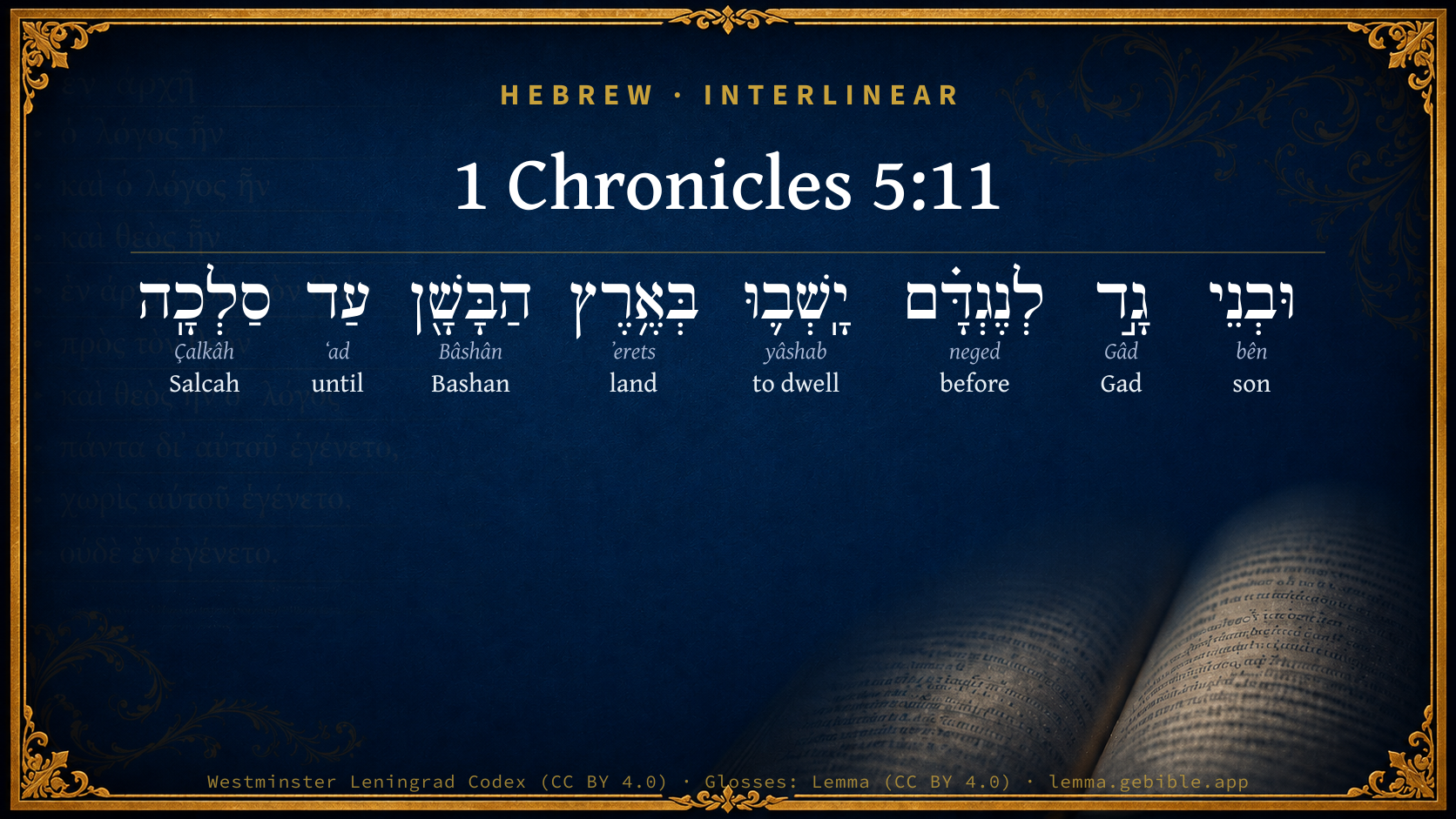
Hebrew (Westminster Leningrad Codex) 1 Chronicles 5:11 appears in the Hebrew Old Testament. The text above is from the Westminster Leningrad Codex. Each word links to its Strong’s number, a concise gloss, and parsing drawn from the Open Scriptures Hebrew Bible morphology. Click any word for its full Brown-Driver-Briggs (BDB) entry.
Download image
Cite this verse

1 Chronicles 5:11 (World English Bible). Public Domain. Lemma interlinear Bible study tool, https://lemma.gebible.app/v/1-chronicles/5/11.

Show BibTeX & RIS
BibTeX
RIS
English Translation
The sons of Gad lived over against them, in the land of Bashan to Salecah:
World English Bible · Public Domain
Download a study sheet

One document with this verse’s original text, its word-by-word gloss line, the meaning frame, cross-references with their text, attributed commentary, and full source and license credits — printable, and it pastes into notes with its structure intact.

This verse Autodidact and up

Study sheet (.html) Plain text (.txt)

A passage Seminary Student

Up to 50 verses in one chapter. A passage sheet keeps up to 6 commentary sources and 12 cross-references per verse, in the order this page ranks them, and says so on the sheet whenever that leaves anything out. Ask for a single verse and you get the Autodidact verse sheet above.

Everything on this page stays free to read, with no account — the sheet is a download of what is already on screen, not access to it.

Want to remove ads? Support Godless Engineer
Compare translations 3

The same verse in 3 English versions, stacked beneath the original-language interlinear above. Click any original word for its lexicon entry.

Each is an independent rendering of the whole verse — the interlinear is not word-aligned to these translations.

Highlighted words mark where these versions differ — a whole-verse word diff, not a word-by-word alignment.

  • World English Bible Public Domain
    The sons of Gad lived over against them, in the land of Bashan to Salecah:
  • King James Version Public Domain
    And the children of Gad dwelt over against them, in the land of Bashan unto Salcah:
  • unfoldingWord Literal Text CC BY-SA 4.0
    And the sons of Gad dwelled to the front of them in the land of Bashan unto Salekah:

unfoldingWord Literal Text — © unfoldingWord, licensed CC BY-SA 4.0. Word-aligned USFM3 via Door43 (git.door43.org/unfoldingWord/en_ult).

Versions to compare (up to 4)

3 of 4 selected

Show all 18 translations

Every available English version of this verse, each an independent rendering of the whole verse.

  • World English Bible Public Domain
    The sons of Gad lived over against them, in the land of Bashan to Salecah:
  • Berean Standard Bible Public Domain
    The descendants of Gad lived next to the Reubenites in the land of Bashan, as far as Salecah:
  • Majority Standard Bible Public Domain
    The descendants of Gad lived next to the Reubenites in the land of Bashan, as far as Salecah:
  • King James Version Public Domain
    And the children of Gad dwelt over against them, in the land of Bashan unto Salcah:
  • American Standard Version (1901) Public Domain
    And the sons of Gad dwelt over against them, in the land of Bashan unto Salecah:
  • Revised Version (1885) Public Domain
    And the sons of Gad dwelt over against them, in the land of Bashan unto Salecah:
  • Geneva Bible (1599) Public Domain
    And the children of Gad dwelt ouer against them in the land of Bashan, vnto Salchah.
  • Douay-Rheims (1899) Public Domain
    And the children of Gad dwelt over against them in the land of Basan, as far as Selcha:
  • Young's Literal Translation Public Domain
    And the sons of Gad, over-against them have dwelt in the land of Bashan unto Salcah,
  • Literal Standard Version CC BY-SA 4.0
    And the sons of Gad have dwelt opposite them in the land of Bashan to Salcah:
  • Unlocked Literal Bible CC BY-SA 4.0
    The members of the tribe of Gad lived near them, in the land of Bashan as far as Salekah.
  • unfoldingWord Literal Text CC BY-SA 4.0
    And the sons of Gad dwelled to the front of them in the land of Bashan unto Salekah:
  • Darby Bible Public Domain
    And the children of Gad dwelt over against them, in the land of Bashan, as far as Salcah:
  • World Messianic Bible Public Domain
    The sons of Gad lived beside them in the land of Bashan to Salecah:
  • Webster's Bible Public Domain
    And the children of Gad dwelt over against them, in the land of Bashan to Salcah:
  • Free Bible Version CC BY-SA 4.0
    Next to them the descendants of Gad lived in Basha, all the way to Salecah.
  • Bible in Basic English Public Domain
    And the sons of Gad were living opposite to them, in the land of Bashan as far as Salecah:
  • JPS Tanakh (1917) Public Domain
    And the sons of Gad dwelt over against them, in the land of Bashan unto Salcah:

Literal Standard Version (2020), Covenant Press — licensed CC BY-SA 4.0. Text via the HelloAO Bible API (eBible.org). Unlocked Literal Bible (unfoldingWord) — licensed CC BY-SA 4.0. Text via the HelloAO Bible API (eBible.org). unfoldingWord Literal Text — © unfoldingWord, licensed CC BY-SA 4.0. Word-aligned USFM3 via Door43 (git.door43.org/unfoldingWord/en_ult). Free Bible Version, Dr. Jonathan Gallagher — licensed CC BY-SA 4.0. Text via the HelloAO Bible API (eBible.org).

Word by word

More ways to search: Search by grammar → Find every occurrence → Compare this word →

Practice this passage: Drill this verse → Learn its vocabulary →

About this verse

These counts appear in no published source. They are computed here, from the morphology-tagged text and Lemma’s own curated glosses. What Lemma adds →

8
words
8
distinct lemmas
Historical
section

Notable vocabulary

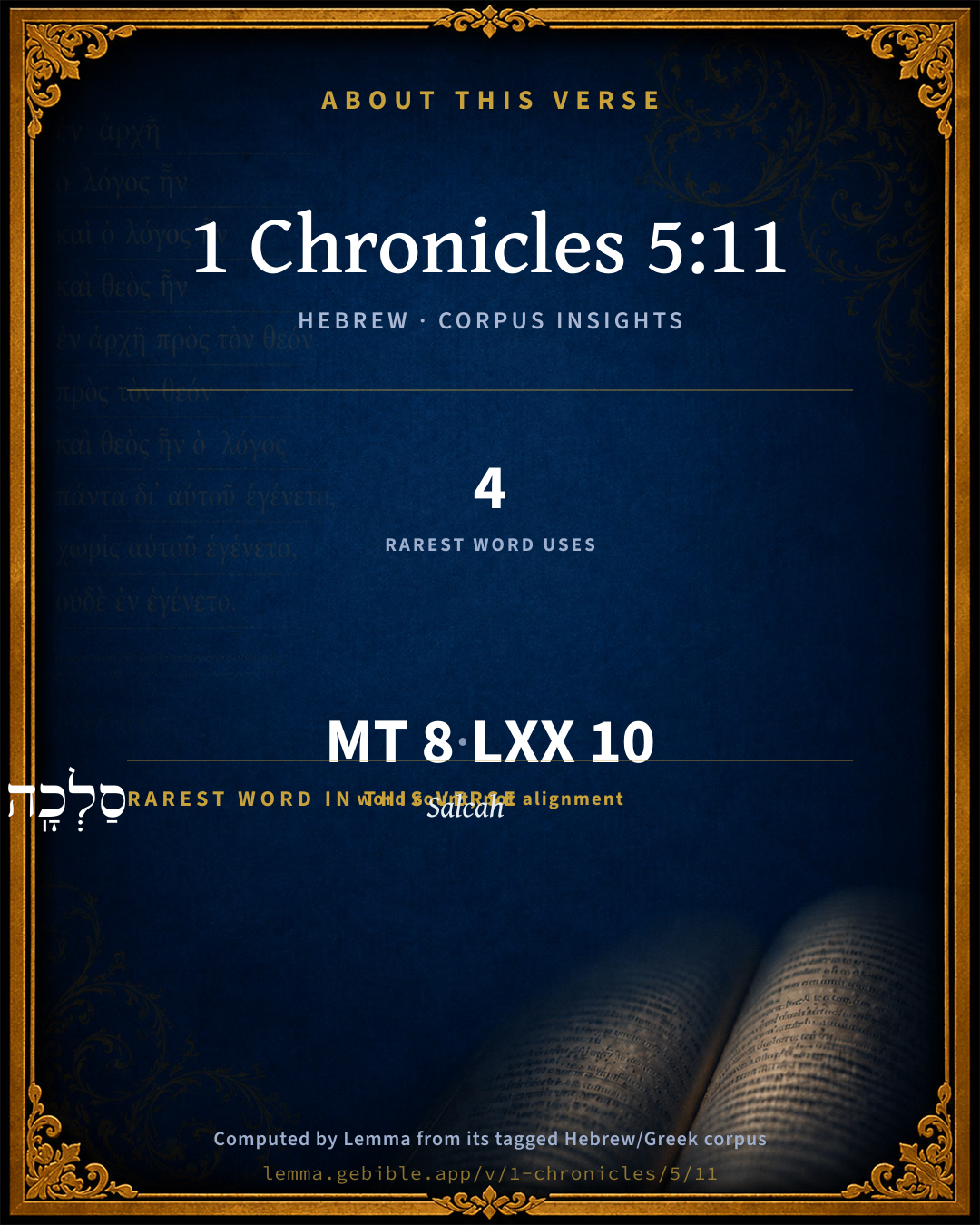
The rarest word here is סַלְכָֽה Salcah H5548 — appearing just 4 times in the whole Hebrew Bible.

Shared distinctive vocabulary

סַלְכָֽה Salcah H5548 occurs in 4 verses of the Hebrew Bible. Also found in:

Grammatical profile

  • 1 verb
  • 5 nouns
  • 2 prepositions

Verb forms

  • יָֽשְׁב֛וּ Qal · Perfect

Hebrew & Septuagint length

In English translation the verse runs 15 words from the Hebrew and 16 from the Septuagint (LXX English) — closely comparable.

A rough comparison of the two English renderings, which tokenize alike — not a word-level alignment.

Word counts can differ between the Hebrew and the Greek without any difference in meaning — e.g. the Hebrew direct-object marker אֵת has no separate Greek word, and Greek often adds the article ὁ.

In the original languages it is 8 Hebrew tokens and 10 Greek tokens — but the two are counted differently (Hebrew bundles its prefixes and suffixes into one token; the Greek is in lemma form), so that isn’t a like-for-like length.

Cross-references

4

Topical passages linked to 1 Chronicles 5:11 in the Treasury of Scripture Knowledge — connected by theme and wording, ordered by reader-vote popularity; previews shown in the World English Bible.

  • Joshua 13:11 and Gilead, and the border of the Geshurites and Maacathites, and all Mount Hermon, and all Bashan to Salecah;
  • Joshua 13:24–28 Moses gave to the tribe of Gad, to the children of Gad, according to their families.
  • Numbers 32:34–36 The children of Gad built Dibon, and Ataroth, and Aroer,
  • Deuteronomy 3:10–17 all the cities of the plain, and all Gilead, and all Bashan, to Salecah and Edrei, cities of the kingdom of Og in Bashan.

Cross-references courtesy of OpenBible.info (CC BY 4.0).

Hebrew and Greek witnesses Masoretic Hebrew ↔ Greek Septuagint

The same verse in the two great witnesses to the Old Testament, shown verse-for-verse.

These are two independent witnesses, not word-aligned to each other, and the Septuagint is shown in lemma (dictionary) form.

Hebrew 1 Chronicles 5:11 Masoretic · Westminster Leningrad Codex

וּבְנֵי גָ֣ד לְנֶגְדָּ֗ם יָֽשְׁב֛וּ בְּאֶ֥רֶץ הַבָּשָׁ֖ן עַד סַלְכָֽה

The sons of Gad lived over against them, in the land of Bashan to Salecah:

World English Bible · Public Domain

Greek LXX 1 Chronicles 5:11 Septuagint · lemma form

υἱός γαδ κατέναντι αὐτός καταοἰκέω ἐν ὁ βασαν ἕως σελχα

The sons of Gad lived over against them in the land of Basan even to Sela.

LXX2012 (modern English Septuagint) · Public Domain

Hebrew: Westminster Leningrad Codex (CC BY 4.0). Greek: Septuagint (public domain); English from LXX2012 (modern English Septuagint) (Public Domain). How the Septuagint differs from the Hebrew →

Commentary

Notes on 1 Chronicles 5:11 from classic Christian and Jewish commentators (each source and its license shown beneath its notes). The classic Christian expositions comment on the surrounding passage and are grouped to its opening verse, so a note may address several verses; the Jewish commentaries on the Tanakh (Rashi and others) are per-verse, so they appear only where the commentator wrote on this verse.

Lemma curates 59 commentaries, every one of them public domain or Creative Commons licensed, each selected and text-cleaned for this edition rather than reprinted as found. About our sources →

Jamieson, Fausset & Brown

Robert Jamieson, A. R. Fausset & David Brown

THE LINE OF GAD. (1Ch. 5:11-26)

the children of Gad dwelt over against them--The genealogy of the Gadites and the half-tribe of Manasseh (Ch1 5:24) is given along with that of the Reubenites, as these three were associated in a separate colony.

Jamieson, Fausset & Brown — Commentary Critical and Explanatory on the Whole Bible (1871) — public domain (CC PDM 1.0). Text via the HelloAO Bible API.

Trapp's Complete Commentary

John Trapp

1Ch 5:11 And the children of Gad dwelt over against them, in the land of Bashan unto Salchah:

Ver. 11. In the land of Bashan.] Bashan was the name both of the whole country and the chief city; like as Muscovia is at this day.

John Trapp, A Commentary or Exposition upon All the Books of the Old and New Testament (1647–1656) — public domain. Text from a community e-Sword module.

Ellicott's Commentary for English Readers

(11-17) THE SONS OF GAD, THEIR CLANS, TERRITORY, AND REGISTRATION.

(11) And the children of Gad dwelt over against them.—That is, adjoining them on the east of Jordan.

In the land of Bashan unto Salcah.—(Jos_13:11.) Bashan, the ancient dominion of the giant Og (Num_21:33-35; Deu_3:1-12). Salcah now Sulkhad, on the south-east slope of Jebel Hauran in the extreme east of Gilead.

(12) Joel the chief (or, first; literally, head), and Shaphan the next (or second.)—Gen_46:15 enumerates seven sons of Gad, a number corresponding with the clans of 1Ch_5:13; but none of the names are the same.

In Bashan.—This expression goes to prove that clans, not individuals, are intended.

Joel is also the head Reubenite house (1Ch_5:4).

(13) And their brethren of the house of their fathers.—And their kinsmen (fellow-tribesmen), according to their father-houses (clans). The verse names seven inferior clans of the Gadites, whose seats are assigned in 1Ch_5:16.

These, viz., the clans of 1Ch_5:13, were sons of Abihail, whose line is retraced through seven generations to Buz, of whom nothing further is known. The name has occurred Gen_22:21 as that of a son of Nahor; and Job_32:2, as that of the clan of Elihu the Buzite.

(15) Ahi the son of Abdial, the son of Guni (was) head of their clans. Perhaps Ahi was chieftain or prince of the sons of Abihail at the time when this register was drawn up (1Ch_5:17).

(16) And they dwelt in Gilead.—The seats of the Gadites of 1Ch_5:13 were in the country east of Jordan.

In Bashan, defines the locality more precisely. It was the northern region of Gilead.

And in her towns.—Heb., her daughters.

And in all the suburbs of Sharon.—Rather, pasture-grounds or sheep-walks.

Sharon.—The well-known plain of this name lay west of Jordan, between Carmel and Joppa, along the coast of the Great Sea. The old conjecture that Shirion, i.e., mount Hermon (Deu_3:9; Psa_29:6) should be read, is probably right.

Upon their borders.—That is, their extremities (Num_34:4-5). The Gadites fed their flocks in the glens opening out at the foot of the mountains, here called their exits or outlets.

(17) All these.—That is, the Gadite clans.

Were reckoned by genealogies (or registered) in the days of Jotham king of Judah, i.e., after 757 B.C., according to Biblical chronology.

And in the days of Jeroboam (the second), king of Israel, who reigned from 825-784, according to the data of Kings. Clearly, therefore, more than one registration is the basis of the above statistics. That of Jeroboam was the earlier in point of time; but the chronicler names the king of Judah first honoris causa. Jeroboam II., a vigorous king, who “restored the border of Israel from the entry of Hamath to the sea of the Arabah” (2Ki_14:25), may have taken this census of the tribes east of Jordan, with a view to fiscal purposes. Jotham or his father, the great Uzziah, appears to have recovered Gad for Judah during the anarchy that succeeded the fall of Jehu’s dynasty in the northern kingdom.

A Bible Commentary for English Readers, edited by Charles John Ellicott (1878–1897) — public domain. Text from a community e-Sword module.

The Cambridge Bible for Schools and Colleges

gen. ed. J. J. S. Perowne

11–17. The Genealogy and Settlements of Gad

11. Bashan] the wide district extending from the Jabbok on the S. to Hermon in the N. and from the Sea of Galilee on the W. to the mountains of Hauran on the E. Cp. 1Ch_5:23.

Salchah] R.V. Salecah, is probably represented at the present day by the ruins of Salkhad due S. of the Jebel Hauran and almost due E. of Bostra.

The Cambridge Bible for Schools and Colleges (gen. ed. J. J. S. Perowne; Cambridge University Press, 1878–1918) — public domain. Text from a community e-Sword module.

John Gill's Exposition

Joel the chief,.... In this and the following verse are reckoned up the principal men in the tribe of Gad, and the chief of all was Joel, another from him in the tribe of Reuben, Ch1 5:4.

and Shapham the next; the second chief man, from whom, Reland (x) conjectures, Shophan, a city in the tribe of Gad, had its name, Num 32:35.

and Jaanai; from whom Danjaan might be called, as Michaelis intimates, Sa2 24:6.

and Shaphat in Bashan; not Shaphat the father of Elisha, according to a tradition of the Jews, mentioned by Kimchi; which is not at all probable.

(x) Palestin. Illustrat. par. 2. p. 602.

John Gill's Exposition of the Whole Bible (1746–1763) — public domain (CC PDM 1.0). Text via the HelloAO Bible API.

Albert Barnes' Notes on the Bible

From this passage and from the subsequent account of the Manassites 1Ch 5:23-24, the Gadites extended themselves to the north at the expense of their brethren, gradually occupying a considerable portion of the tract originally allotted to the “half tribe.”

Albert Barnes' Notes on the Bible (1834–1885) — public domain. Text from a community e-Sword/MySword module.

Haydock's Catholic Bible Commentary

Selcha, not far from Jabok, Deuteronomy iii. 10. (Calmet)

George Leo Haydock (1774–1849), Haydock's Catholic Family Bible and Commentary, 1859 edition — public domain. Excludes Psalms (Douay-Rheims chapter numbering differs from Protestant) and Deuterocanonical books (Catholic canon only).

The Pulpit Commentary

Vers. 11-17. The tribe of Gad is taken next, and occupies but few lines. Gad was born seventh in order of all the sons of Jacob, (Gen_30:9-12) and first of the children of Leah"s maid Zilpah. The compiler seems to pass easily on to Gad, from the mere circumstance of the name of the tribe being so constantly linked with that preceding, in the matter of local settlement on the east of Jordan, after the journeyings of the wilderness. (Jos_13:7, Jos_13:8) The geography in vers. 11 and 16 offers very little difficulty. Compared with the time of the first settling of the Gadites (Deu_3:10-13; Jos_13:25, Jos_13:30) it is evident that they had pushed their borders further to the north, trenching somewhat upon the lot of the half-tribe Manasseh, as they also in turn extended their limits northward to Hermon (ver. 23). This reconciles Jos_13:30 with thepresent passage. Salcah, or (Authorized Version) Salchah (Deu_3:10; Jos_13:11) is probably to be identified as the modern Sulkhad, at the extreme eastern point of the plain Hauran, which is bordered by the desert. "In Gilead in Bashan" may be read, with some, as two coordinate places, separating them by a stop; or may point to a time when Bashan included the upper half of Gilead. Sharon, which Keil, quoting Reland, "Pal. Ill.," 370, would make the well-known Sharon of Carmel and the Mediterranean, is, though unmentioned elsewhere, probably distinguished sufficiently from it by the absence of the article, which is invariably prefixed to the other. Stanley"s suggestion ("Sinai and Palestine," edit. 1866, pp. 484, 485, 260) would seem exceedingly apt, that it is one in fact, as one in derivation and meaning, with the Mishor (i.e. "level]ands," "table-land") of Gilead and Bashan. With this explanation, however, the term "suburbs" does not so well agree. Upon the other side, distant as the well-known Sharon is, a link of connection might be found with it, in that the other Manasseh half-tribe stretched into its plains; and in that case the last word of the verse, might mean (Jos_17:9) "the outgoings" of the land or regions in question to the "sea"-coast.

The Pulpit Commentary (1880–1919), ed. H.D.M. Spence-Jones & Joseph S. Exell — public domain. Text from a community e-Sword module.

Keil & Delitzsch

C. F. Keil & F. Delitzsch

Joel the chief,.... In this and the following verse are reckoned up the principal men in the tribe of Gad, and the chief of all was Joel, another from him in the tribe of Reuben, Ch1 5:4.

and Shapham the next; the second chief man, from whom, Reland (x) conjectures, Shophan, a city in the tribe of Gad, had its name, Num 32:35.

and Jaanai; from whom Danjaan might be called, as Michaelis intimates, Sa2 24:6.

and Shaphat in Bashan; not Shaphat the father of Elisha, according to a tradition of the Jews, mentioned by Kimchi; which is not at all probable.

(x) Palestin. Illustrat. par. 2. p. 602.

Keil & Delitzsch — Biblical Commentary on the Old Testament (1861–1891) — public domain (CC PDM 1.0). Text via the HelloAO Bible API. (Old Testament only.)

Kretzmann's Popular Commentary

Paul E. Kretzmann

The Posterity of Gad and of Half-Manasseh.

v. 11. And the children of Gad dwelt over against them, just north of them, in the land of Bashan unto Salcah, in Central Gilead, southeast of the Sea of Galilee:

v. 12. Joel, the chief, and Shapham, the next, and Jaanai, and Shaphat in Bashan, all of these continuing the line of Gad after the settlement in the Land of Promise.

v. 13. And their brethren of the house of their fathers, by the families at whose head they stood, and which were named after them, were Michael, and Meshullam, and Sheba, and Jorai, and Jachan, and Zia, and Heber, seven. The pedigree of these brothers is now given through eight generations.

v. 14. These are the children of Abihail, the son of Huri, the son of Jaroah, the son of Gilead, the son of Michael, the son of Jeshishai, the son of Jahdo, the son of Buz:

v. 15. Ahi, the son of Abdiel, the son of Guni, chief of the house of their fathers.

v. 16. And they dwelt in Gilead, in Bashan, in the middle and northern part of the district so called, including the country immediately east of the Sea of Galilee, and in her towns, and in all the suburbs, that is, the pastures, of Sharon, east of Jordan, upon their borders, literally, "their goings out," to the very end of the districts included in these geographical designations.

v. 17. All these were reckoned by genealogies in the days of Jotham, king of Judah, about 758-742, and in the days of Jeroboam, king of Israel, about 824-783 B. C. These were the two registrations of the tribe noted in history, at which time the genealogical tables were revised.

v. 18. The sons of Reuben, and the Gadites, and half the tribe of Manasseh, the tribes which occupied the country east of Jordan, of valiant men, men able to bear buckler and sword, the ordinary equipment of a foot-soldier in those days, and to shoot with bow, and skilful in war, were four and forty thousand seven hundred and threescore, that went out to the war, this being their standing army.

v. 19. And they made war with the Hagarites, descendants of Hagar, at first identified with the Edomites, but later applied to a special tribe of Arabian Bedouins, with Jetur, and Nephesh, and Nodab, the name of the first tribe being preserved in Iturea, west of Lebanon.

v. 20. And they were helped against them, the Lord Himself taking their part, and the Hagarites were delivered into their hand, and all that were with them, probably in return for raids which had been made by the desert nomads; for they cried to God in the battle, and He was intreated of them, because they put their trust in Him, for these events took place while the tribes of the country east of Jordan were still faithful to the Lord.

v. 21. And they took away their cattle, as a bit of welcome plunder; of their camels fifty thousand, and of sheep two hundred and fifty thousand, and of asses two thousand, and of men an hundred thousand, of captive and of slain. The great numbers give an idea of the wealth in the possession of these desert tribes.

v. 22. For there fell down many slain, because the war was of God, He it was that gave them success. And they dwelt in their steads, colonizing the district themselves, until the captivity.

v. 23. And the children of the half-tribe of Manasseh dwelt in the land; they increased from Bashan, the greater part of which they occupied, unto Baal-hermon and Senir, east of Lebanon, and unto Mount Hermon, the high mountain in the southern part of the Anti-Lebanon range.

v. 24. And these were the heads of the house of their fathers, even Epher, and Ishi, and Eliel, and Azriel, and Jeremiah, and Hodaviah, and Jahdiel, mighty men of valor, famous men, whose names were mentioned with respect everywhere, and heads of the house of their fathers, of the smaller division of the tribe known as the father-house.

v. 25. And they transgressed against the God of their fathers, all the Israelites living east of Jordan were unfaithful to Jehovah, and went a-whoring after the gods of the people of the land, in a form of spiritual adultery, whom God destroyed before them.

v. 26. And the God of Israel stirred up the spirit of Pul, king of Assyria, who began the oppression of Israel, 2Ki 15:19, and the spirit of Tilgath-pilneser, king of Assyria, his son and successor, and he carried them away, even the Reubenites, and the Gadites, and the half-tribe of Manasseh, and brought them unto Halah, and Habor, and Hara, or the mountain, and to the river Gozan, in Upper Media, toward the Caspian Sea, unto this day. As in this case, so in others, the just punishment of the Lord always struck the malefactors.

Paul E. Kretzmann, Popular Commentary of the Bible (1921–1924) — public domain. Text from a community e-Sword module.

unfoldingWord translationNotes

Door43 World Missions Community

Salekah

This is the name of a city. (See: How to Translate Names)

Joel ... Shapham ... Janai ... Shaphat ... Michael ... Meshullam ... Sheba ... Jorai ... Jakan ... Zia ... Eber

These are the names of men.

translationWords

Gad

Bashan

head

unfoldingWord translationNotes — © Distant Shores Media and the Door43 World Missions Community, licensed CC BY-SA 4.0. Source: git.door43.org/Door43/en_tn.

Rashi

Rabbi Shlomo Yitzchaki (Rashi)

And the sons of Gad dwelt opposite them alongside them, like (Gen. 33:12): “...and I will go alongside you (לְנֶגְדֶּךָ).”

Rashi on the Tanakh — English translations: “The Judaica Press complete Tanach with Rashi, translated by A. J. Rosenberg” (CC BY 4.0); “Pentateuch with Rashi's commentary by M. Rosenbaum and A.M. Silbermann, 1929-1934” (public domain); “The Metsudah Tanach series, Lakewood, N.J” (CC BY 4.0); and “The Book of Joshua, Metsudah Publications, 1997” (CC BY 4.0). Text via Sefaria.

Lesson kit

Teaching starters — assembled from the data on this page, not authored interpretation. Every prompt links to the verse data it draws on. Edit before teaching.

1 Chronicles, in the Historical, opens this verse with 8 words (8 distinct Hebrew lemmas). Its most distinctive word is Çalkâh (“Salcah”). A historical commentator’s framing appears above. Read the whole chapter for the surrounding context.

Discussion questions

  1. The word Çalkâh carries the sense “Salcah.” How does it shape the verse?
  2. Deuteronomy 3:10 shares the word «Salcah» with this verse. How do the two illuminate each other?
  3. These translations render this verse differently. What is at stake in choosing one wording over another?
  4. The verb «יָֽשְׁב֛וּ» is Qal Perfect. How does its form color the action?
  5. Reading how Jamieson, Fausset & Brown and Trapp's Complete Commentary read this verse, where do the two commentators agree and where do they part?

Things to notice

Reading settings

Reading text

Shown beneath each verse's original-language words.

Old Testament
Old Testament edition

Read the OT as the Masoretic Hebrew (MT) or the Greek Septuagint (LXX).

English shown for the Greek Septuagint (in the Hebrew ↔ Greek comparison).

Comparing translations? Open the Compare panel on any verse page to stack up to four side by side.