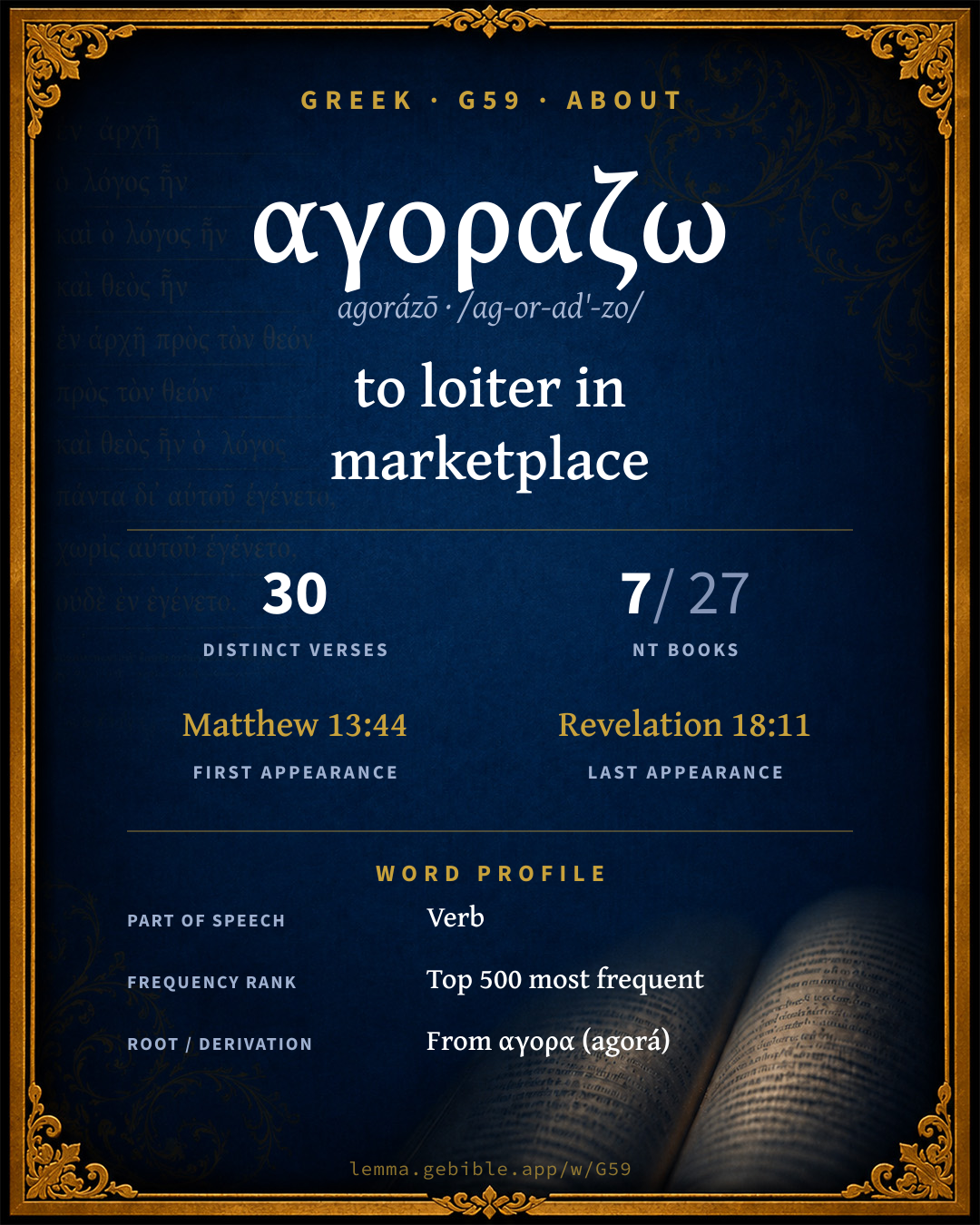
ἀγοράζω
to loiter in marketplace
‘to loiter in marketplace’ is one of 3 main senses fuller range ↓
Full lexicon entry — Thayer's Greek Lexicon
From Thayer's Greek Lexicon
Where this word appears
See every Aorist-tense verb in the Greek New Testament →
Grammar key — what these labels mean
Part of speech
- Verb
- An action or state-of-being word.
Tense
- Aorist
- Action viewed as a simple whole, without regard to duration — often past (perfective aspect).
- Present
- Ongoing or general action in present time (imperfective aspect).
- Imperfect
- Continuous or repeated action in past time (“was writing”).
- Perfect
- A completed past action with continuing present results.
Voice
- Active
- The subject performs the action.
- Passive
- The subject receives the action.
Mood
- Infinitive
- A verbal noun (“to write”), unmarked for person or number.
- Subjunctive
- Expresses probability, purpose, or possibility (the mood of contingency).
- Indicative
- States a fact or asks a factual question (the mood of reality).
- Participle
- A verbal adjective (“writing,” “having written”).
- Imperative
- Expresses a command or request.
Case
- Accusative
- The case of the direct object and of extent.
- Nominative
- The case of the subject (and the predicate nominative).
Person
- 1st person
- The speaker (“I / we”).
- 3rd person
- The one spoken about (“he / she / it / they”).
- 2nd person
- The one addressed (“you”).
Gender
- Masculine
- Grammatically masculine.
Number
- Plural
- More than one.
- Singular
- One.
Grammatical forms 19 distinct
- Verb, Aorist, Active, Infinitive 3 times (10%)
- Verb, Aorist, Active, Subjunctive, 1st person, Plural 3 times (10%)
- Verb, Aorist, Active, Subjunctive, 3rd person, Plural 3 times (10%)
- Verb, Aorist, Active, Indicative, 1st person, Singular 2 times (7%)
- Verb, Aorist, Active, Indicative, 3rd person, Plural 2 times (7%)
- Verb, Aorist, Passive, Indicative, 2nd person, Plural 2 times (7%)
- Verb, Present, Active, Indicative, 3rd person, Singular 2 times (7%)
- Verb, Present, Active, Participle, Accusative, Plural, Masculine 2 times (7%)
+11 more forms (11 occurrences)
Parsed forms decoded from the imported morphology (Robinson–Tischendorf, public domain), counted across 30 parsed occurrences — not distinct verses.
Every verse where G59 appears — 30 distinct verses across 7 books. Click any verse to open its interlinear word-by-word view. Verse text shown in the World English Bible for context — . Each verse’s Greek form is shown with its reference; the English is not keyword-highlighted, since the data carries no word-level English alignment. Use “Compare translations” on any verse to read it across multiple English versions. This concordance covers the Greek New Testament; Septuagint (Greek Old Testament) occurrences of this word are not indexed here.
Matthew 7 verses
- Matthew 13:44 ἀγοράζει pres act ind 3sg "Again, the Kingdom of Heaven is like a treasure hidden in the field, which a man found, and hid. In his joy, he goes and sells all that he has, and buys that field.
- Matthew 13:46 ἠγόρασεν aor act ind 3sg who having found one pearl of great price, he went and sold all that he had, and bought it.
- Matthew 14:15 ἀγοράσωσιν aor act subj 3pl When evening had come, his disciples came to him, saying, "This place is deserted, and the hour is already late. Send the multitudes away, that they may go into the villages, and buy themselves food."
- Matthew 21:12 ἀγοράζοντας pres act ptcp acc pl masc Jesus entered into the temple of God, and drove out all of those who sold and bought in the temple, and overthrew the money-changers' tables and the seats of those who sold the doves.
- Matthew 25:9 ἀγοράσατε aor act impv 2pl But the wise answered, saying, 'What if there isn't enough for us and you? You go rather to those who sell, and buy for yourselves.'
- Matthew 25:10 ἀγοράσαι aor act inf While they went away to buy, the bridegroom came, and those who were ready went in with him to the marriage feast, and the door was shut.
- Matthew 27:7 ἠγόρασαν aor act ind 3pl They took counsel, and bought the potter's field with them, to bury strangers in.
Mark 5 verses
- Mark 6:36 ἀγοράσωσιν aor act subj 3pl Send them away, that they may go into the surrounding country and villages, and buy themselves bread, for they have nothing to eat."
- Mark 6:37 ἀγοράσωμεν aor act subj 1pl But he answered them, "You give them something to eat." They asked him, "Shall we go and buy two hundred denarii worth of bread, and give them something to eat?"
- Mark 11:15 ἀγοράζοντας pres act ptcp acc pl masc They came to Jerusalem, and Jesus entered into the temple, and began to throw out those who sold and those who bought in the temple, and overthrew the tables of the money-changers, and the seats of those who sold the doves.
- Mark 15:46 ἀγοράσας aor act ptcp nom sg masc He bought a linen cloth, and taking him down, wound him in the linen cloth, and laid him in a tomb which had been cut out of a rock. He rolled a stone against the door of the tomb.
- Mark 16:1 ἠγόρασαν aor act ind 3pl When the Sabbath was past, Mary Magdalene, and Mary the mother of James, and Salome, bought spices, that they might come and anoint him.
Luke 5 verses
- Luke 9:13 ἀγοράσωμεν aor act subj 1pl But he said to them, "You give them something to eat." They said, "We have no more than five loaves and two fish, unless we should go and buy food for all these people."
- Luke 14:18 ἠγόρασα aor act ind 1sg They all as one began to make excuses. "The first said to him, 'I have bought a field, and I must go and see it. Please have me excused.'
- Luke 14:19 ἠγόρασα aor act ind 1sg "Another said, 'I have bought five yoke of oxen, and I must go try them out. Please have me excused.'
- Luke 17:28 ἠγόραζον impf act ind 3pl Likewise, even as it happened in the days of Lot: they ate, they drank, they bought, they sold, they planted, they built;
- Luke 22:36 ἀγορασάτω aor act impv 3sg Then he said to them, "But now, whoever has a purse, let him take it, and likewise a wallet. Whoever has none, let him sell his cloak, and buy a sword.
John 3 verses
- John 4:8 ἀγοράσωσιν aor act subj 3pl For his disciples had gone away into the city to buy food.
- John 6:5 ἀγοράσωμεν aor act subj 1pl Jesus therefore lifting up his eyes, and seeing that a great multitude was coming to him, said to Philip, "Where are we to buy bread, that these may eat?"
- John 13:29 ἀγόρασον aor act impv 2sg For some thought, because Judas had the money box, that Jesus said to him, "Buy what things we need for the feast," or that he should give something to the poor.
1 Corinthians 3 verses
- 1 Corinthians 6:20 ἠγοράσθητε aor pass ind 2pl for you were bought with a price. Therefore glorify God in your body and in your spirit, which are God's.
- 1 Corinthians 7:23 ἠγοράσθητε aor pass ind 2pl You were bought with a price. Don't become bondservants of men.
- 1 Corinthians 7:30 ἀγοράζοντες pres act ptcp nom pl masc and those who weep, as though they didn't weep; and those who rejoice, as though they didn't rejoice; and those who buy, as though they didn't possess;
2 Peter 1 verse
Revelation 6 verses
- Revelation 3:18 ἀγοράσαι aor act inf I counsel you to buy from me gold refined by fire, that you may become rich; and white garments, that you may clothe yourself, and that the shame of your nakedness may not be revealed; and eye salve to anoint your eyes, that you may see.
- Revelation 5:9 ἠγόρασας aor act ind 2sg They sang a new song, saying, "You are worthy to take the book, And to open its seals: For you were killed, And bought us for God with your blood, Out of every tribe, language, people, and nation,
- Revelation 13:17 ἀγοράσαι aor act inf and that no one would be able to buy or to sell, unless he has that mark, the name of the beast or the number of his name.
- Revelation 14:3 ἠγορασμένοι perf pass ptcp nom pl masc They sing a new song before the throne, and before the four living creatures and the elders. No one could learn the song except the one hundred forty-four thousand, those who had been redeemed out of the earth.
- Revelation 14:4 ἠγοράσθησαν aor pass ind 3pl These are those who were not defiled with women, for they are virgins. These are those who follow the Lamb wherever he goes. These were redeemed by Jesus from among men, the first fruits to God and to the Lamb.
- Revelation 18:11 ἀγοράζει pres act ind 3sg The merchants of the earth weep and mourn over her, for no one buys their merchandise any more;
About this entry
At a glance — auto-summarized from this page’s data, not written by a person. Every figure links to its source below. This summary describes the numbers; it doesn’t interpret them.
“to loiter in marketplace” is the headline sense of the Greek verb αγοραζω (agorázō). First canonically at Matthew 13:44, it enters the text early. The Greek New Testament uses it across 30 verses — moderately common. Catalogued under 3 senses, its meaning is not single-sense. It shares a root with αγορα, αγοραιος and εγειρω. The sections below give every sense, occurrence, and version rendering.
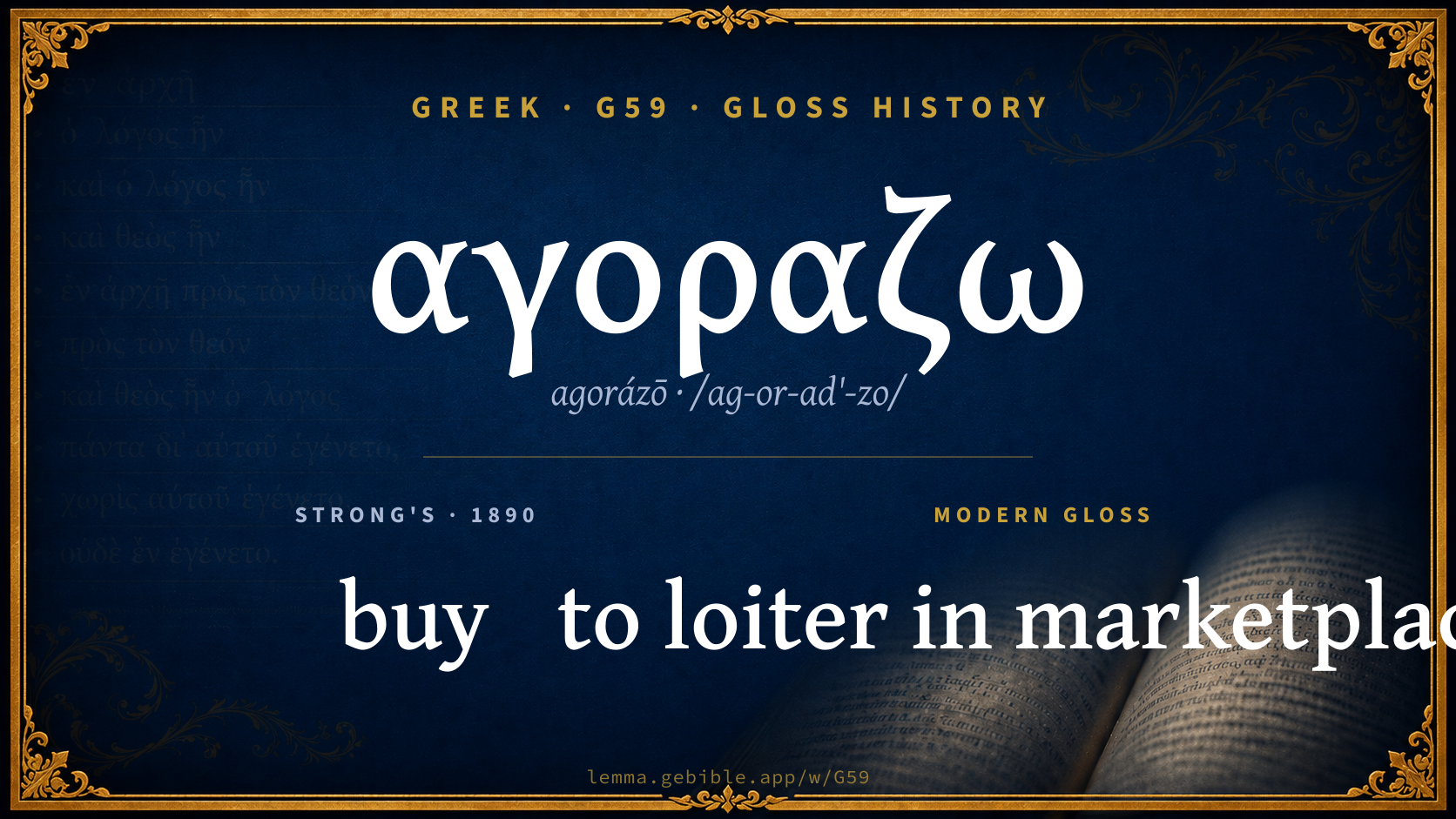
Gloss history
Strong's 1890 vs modern scholarship
About this word
Strong's G59 catalogs a Greek word from the Greek New Testament.
These counts are not copied from any lexicon or concordance. They are computed here, from the morphology-tagged Greek New Testament. What Lemma adds →
- 30
- distinct verses
- The word appears in 30 distinct verses.
- 7 / 27
- NT books
- The word appears in 7 of 27 New Testament books.
- #463
- by frequency
- Top 500 most frequent Greek words (rank 463 of 5,347 Greek words by occurrence).
View all 30 occurrences in the concordance →
Most concentrated in
- Matthew 7 verses 23%
- Revelation 6 verses 20%
- Mark 5 verses 17%
By section of the New Testament
By traditional corpus
Conventional, traditional groupings — biblical authorship is debated, so this is a traditional corpus grouping, not an authorship claim. Some books belong to more than one corpus (Luke is in both the Gospels and the Lukan corpus, and so on), so these shares overlap and need not total 100%. Each figure is a share of the word’s 30 distinct verses.
- Gospels 20 verses · 67%
- Johannine 9 verses · 30%
- Revelation 6 verses · 20%
- Lukan (Luke–Acts) 5 verses · 17%
- Pauline corpus 3 verses · 10%
- General (Catholic) Epistles 1 verse · 3%
How translations render this word
Counts come from each version’s own published word-to-Strong’s tagging or interlinear alignment — an approximate guide to how each version renders this word, not a word-level alignment the data otherwise carries. Because each total is that version’s own tagged count, the per-version totals vary from one another and need not match the appearance or distinct-verse counts above. These counts may also differ from a printed concordance because Lemma counts each distinctly tagged rendering and does not collapse phrase taggings into a single head-word total. This is a fixed set of word-tagged versions (KJV, ASV, BSB, ULT) and does not change with the reading translation you choose elsewhere. Each version’s license is shown beside its name below (and on Sources).
- King James Version: Buy 11×, Bought 6×, Buyeth 2×
- American Standard Version: Buy 9×, Bought 6×, Buyeth 2×
- Berean Standard Bible: Buy 12×, Bought 5×, Buying 2×
- unfoldingWord Literal Text: Buy 6×, Bought 3×, Buying 3×
King James Version Public Domain
Renders G59 across 31 tagged occurrences — most commonly:
Plus 6 renderings that appear only once — usually multi-word phrases or single function words the recovered tagging swept in, not distinct renderings.
American Standard Version Public Domain
Renders G59 across 30 tagged occurrences — most commonly:
Plus 11 renderings that appear only once — usually multi-word phrases or single function words the recovered tagging swept in, not distinct renderings. Not rendered by a distinct English word in 1 further occurrence.
Berean Standard Bible Public Domain
Renders G59 across 30 tagged occurrences — most commonly:
Plus 7 renderings that appear only once — usually multi-word phrases or single function words the recovered tagging swept in, not distinct renderings.
unfoldingWord Literal Text CC BY-SA 4.0
Renders G59 across 31 tagged occurrences — most commonly:
Plus 8 renderings that appear only once — usually multi-word phrases or single function words the recovered tagging swept in, not distinct renderings.
Senses in Thayer's
The 3 senses Thayer's distinguishes for this word, in lexicon order (not ranked by frequency or importance). The full entry — with sub-senses — is in the Lexicon Entry tab.
- to be in the market place, to attend it
- to do business there, buy or sell
- of idle people: to haunt the market place, lounge there
Word origin
Derived from αγορα (agorá) (G58) — assembly.
From G58 ; properly to go to market that is (by implication) to purchase ; specifically to redeem : - buy redeem.
— Strong’s Exhaustive Concordance (1890), public domain.
Forms in the corpus
The 19 distinct written forms G59 takes in the Greek New Testament, most frequent first — each parse links to that tense’s occurrences in the concordance.
Same root — word family
Other Thayer's entries built from the same root as G59, grouped by Strong’s listed origin. These share a root / origin per the lexicon — not necessarily a shared meaning. Each links to that word’s own entry.
Derives from
Shares the same root
Proper names from this root
People and places named from this root — a name, not an additional meaning of the word.
Compare all same-root words → Showing 4 of 5 — not the complete family. 1 of the same-root words is a proper name (a person or place). They share a root, not necessarily a meaning.
Septuagint usage
The same Greek word αγοραζω appears 16 times in the Greek Old Testament (Septuagint), across 15 verses in 7 books.
- 16
- LXX occurrences
- Tagged occurrences of this Greek word in the Septuagint.
- 15
- verses
- Distinct Septuagint verses containing this word.
- 7 / 39
- OT books
- The word appears in 7 of the 39 Old Testament books.
Sample Septuagint occurrences
- Genesis 41:57 ἀγοράζω
- Deuteronomy 2:6 ἀγοράζω
- 1 Chronicles 21:24 ἀγοράζω
- 2 Chronicles 1:16 ἀγοράζω
- Ezra 20:32 ἀγοράζω
- Isaiah 24:2 ἀγοράζω
- Jeremiah 44:12 ἀγοράζω
Septuagint occurrences (same lexeme)
Every verse where the same Strong’s number (G59) appears in the Greek Septuagint. Verse text shown in the World English Bible for context; the Greek form is the matched word — the English is not keyword-highlighted.
- Genesis 41:57 ἀγοράζω All countries came into Egypt, to Joseph, to buy grain, because the famine was severe in all the earth.
- Genesis 42:5 ἀγοράζω The sons of Israel came to buy among those who came, for the famine was in the land of Canaan.
- Genesis 42:7 ἀγοράζω Joseph saw his brothers, and he recognized them, but acted like a stranger to them, and spoke roughly with them. He said to them, "Where did you come from?" They said, "From the land of Canaan to buy food."
- Genesis 43:4 ἀγοράζω If you will send our brother with us, we will go down and buy you food,
- Genesis 43:22 ἀγοράζω We have brought down other money in our hand to buy food. We don't know who put our money in our sacks."
- Genesis 44:25 ἀγοράζω Our father said, 'Go again, buy us a little food.'
- Genesis 47:14 ἀγοράζω Joseph gathered up all the money that was found in the land of Egypt, and in the land of Canaan, for the grain which they bought: and Joseph brought the money into Pharaoh's house.
- Deuteronomy 2:6 ἀγοράζω You shall purchase food of them for money, that you may eat; and you shall also buy water of them for money, that you may drink.
- 1 Chronicles 21:24 ἀγοράζω King David said to Ornan, No; but I will most assuredly buy it for the full price: for I will not take that which is your for Yahweh, nor offer a burnt-offering without cost.
- 2 Chronicles 1:16 ἀγοράζω The horses which Solomon had were brought out of Egypt and from Kue; the king's merchants purchased them from Kue.
- 2 Chronicles 34:11 ἀγοράζω even to the carpenters and to the builders gave they it, to buy hewn stone, and timber for couplings, and to make beams for the houses which the kings of Judah had destroyed.
- Ezra 20:32 ἀγοράζω
- Isaiah 24:2 ἀγοράζω It shall be, as with the people, so with the priest; as with the servant, so with his master; as with the maid, so with her mistress; as with the buyer, so with the seller; as with the creditor, so with the debtor; as with the taker of interest, so with the giver of interest to him.
- Isaiah 55:1 ἀγοράζω Ho, everyone who thirsts, come you to the waters, and he who has no money; come you, buy, and eat; yes, come, buy wine and milk without money and without price.
- Jeremiah 44:12 ἀγοράζω I will take the remnant of Judah, that have set their faces to go into the land of Egypt to sojourn there, and they shall all be consumed; in the land of Egypt shall they fall; they shall be consumed by the sword and by the famine; they shall die, from the least even to the greatest, by the sword and by the famine; and they shall be an object of horror, [and] an astonishment, and a curse, and a reproach.
These are occurrences of the same Greek lexeme (G59) in the Septuagint — not a translation of any one Hebrew word. The store carries no word-level Hebrew↔Greek alignment, so no Hebrew original is asserted here. Counts come from the recovered LXX Strong's tagging — high-frequency vocabulary is well covered, while rare or late forms may be untagged — so they reflect tagged occurrences and may slightly undercount.