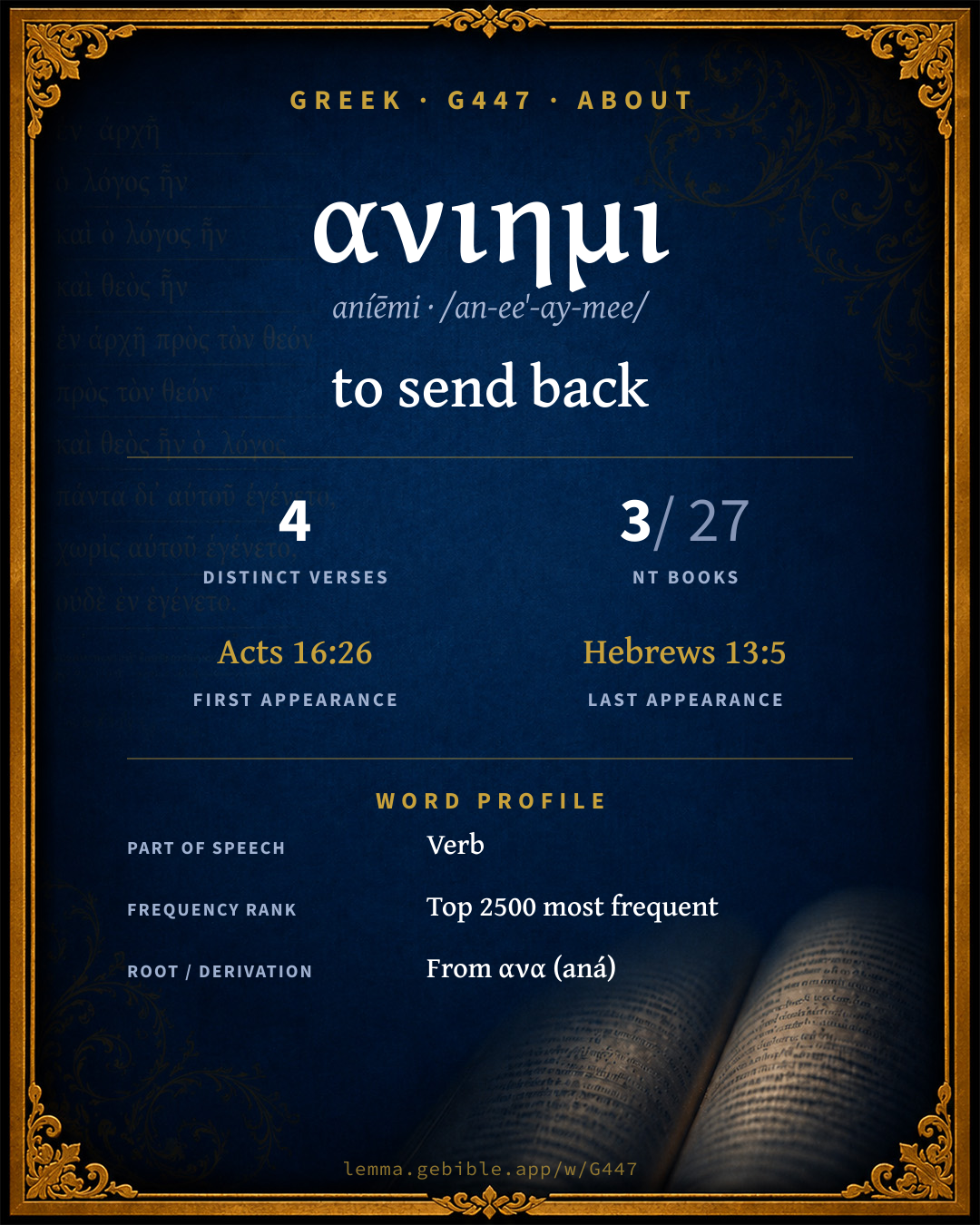
ἀνίημι
to send back
also: relax, loosen fuller range ↓
Full lexicon entry — Thayer's Greek Lexicon
From Thayer's Greek Lexicon
Where this word appears
Grammar key — what these labels mean
Part of speech
- Verb
- An action or state-of-being word.
Tense
- Aorist
- Action viewed as a simple whole, without regard to duration — often past (perfective aspect).
- Present
- Ongoing or general action in present time (imperfective aspect).
Voice
- Active
- The subject performs the action.
- Passive
- The subject receives the action.
Mood
- Participle
- A verbal adjective (“writing,” “having written”).
- Subjunctive
- Expresses probability, purpose, or possibility (the mood of contingency).
- Indicative
- States a fact or asks a factual question (the mood of reality).
Case
- Nominative
- The case of the subject (and the predicate nominative).
Person
- 1st person
- The speaker (“I / we”).
- 3rd person
- The one spoken about (“he / she / it / they”).
Gender
- Masculine
- Grammatically masculine.
Number
- Plural
- More than one.
- Singular
- One.
Every verse where G447 appears in the Book of Hebrews — 1 distinct verse. Click any verse to open its interlinear word-by-word view. Verse text shown in the World English Bible for context — . Each verse’s Greek form is shown with its reference; the English is not keyword-highlighted, since the data carries no word-level English alignment. Use “Compare translations” on any verse to read it across multiple English versions. This concordance covers the Greek New Testament; Septuagint (Greek Old Testament) occurrences of this word are not indexed here.
Hebrews
About this entry
At a glance — auto-summarized from this page’s data, not written by a person. Every figure links to its source below. This summary describes the numbers; it doesn’t interpret them.
ανιημι — transliterated aníēmi — is a Greek verb carrying the sense “to send back.” The Greek New Testament uses it only 4 verses. Its uses cluster heavily in Acts (50% of all occurrences). Debuting at Acts 16:26, it then recurs through the corpus. The lexical range runs to 3 senses — “to send back” plus “relax” and “loosen”. The sections below give every sense, occurrence, and version rendering.
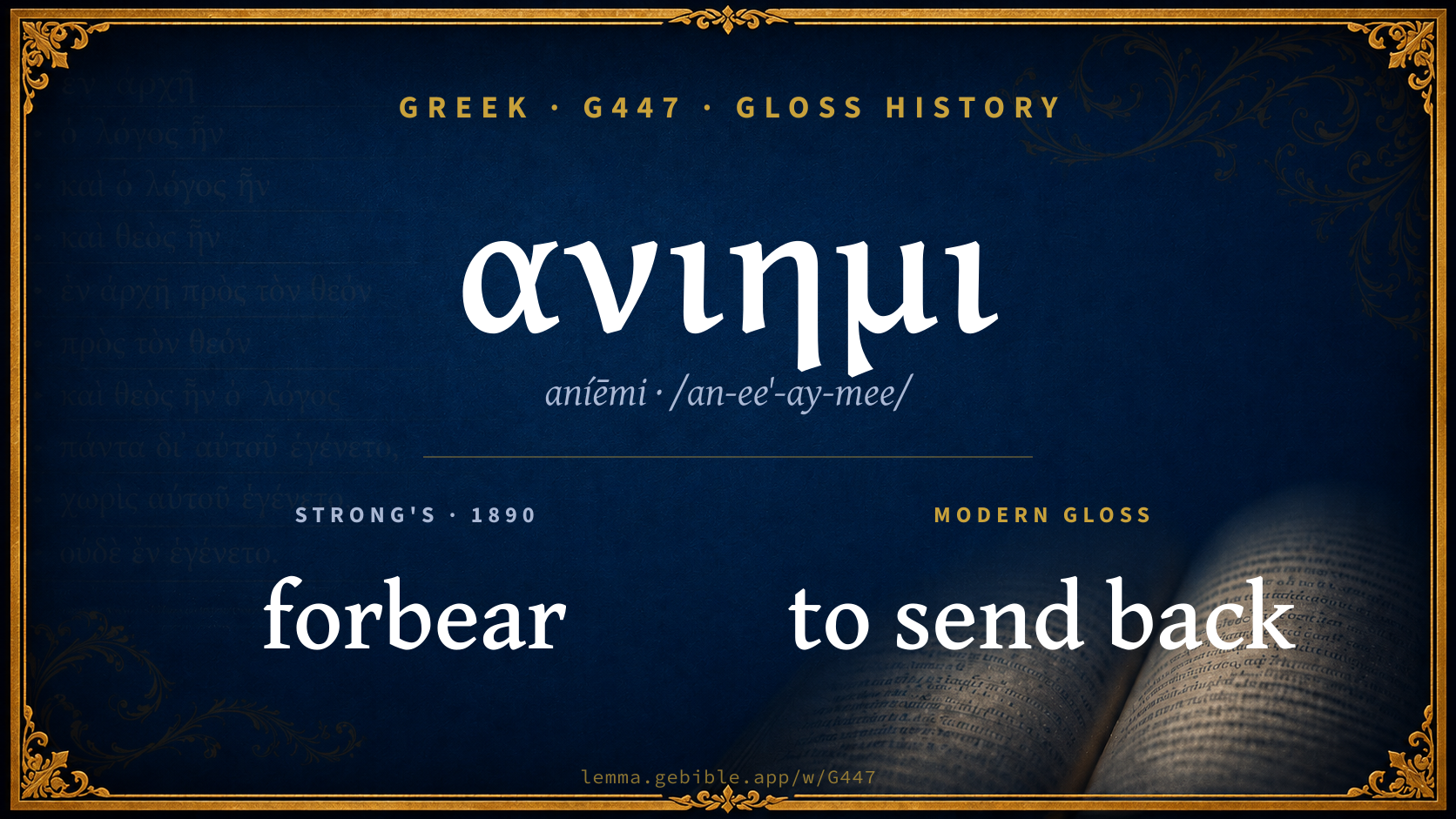
Gloss history
Strong's 1890 vs modern scholarship
About this word
Strong's G447 catalogs a Greek word from the Greek New Testament.
These counts are not copied from any lexicon or concordance. They are computed here, from the morphology-tagged Greek New Testament. What Lemma adds →
- 4
- distinct verses
- The word appears in 4 distinct verses.
- 3 / 27
- NT books
- The word appears in 3 of 27 New Testament books.
- #1,877
- by frequency
- Top 2500 most frequent Greek words (rank 1,877 of 5,347 Greek words by occurrence).
View all 4 occurrences in the concordance →
By section of the New Testament
By traditional corpus
Conventional, traditional groupings — biblical authorship is debated, so this is a traditional corpus grouping, not an authorship claim. Some books belong to more than one corpus (Luke is in both the Gospels and the Lukan corpus, and so on), so these shares overlap and need not total 100%. Each figure is a share of the word’s 4 distinct verses.
- Lukan (Luke–Acts) 2 verses · 50%
- Pauline corpus 1 verse · 25%
- Hebrews 1 verse · 25%
How translations render this word
Counts come from each version’s own published word-to-Strong’s tagging or interlinear alignment — an approximate guide to how each version renders this word, not a word-level alignment the data otherwise carries. Because each total is that version’s own tagged count, the per-version totals vary from one another and need not match the appearance or distinct-verse counts above. These counts may also differ from a printed concordance because Lemma counts each distinctly tagged rendering and does not collapse phrase taggings into a single head-word total. This is a fixed set of word-tagged versions (KJV, ASV, BSB, ULT) and does not change with the reading translation you choose elsewhere. Each version’s license is shown beside its name below (and on Sources).
- King James Version: Forbearing 1×, Leave 1×, Loosed 1×
- American Standard Version: Fail 1×, Forbear 1×, I will 1×
- Berean Standard Bible: Came loose 1×, Give up 1×, They loosened 1×
- unfoldingWord Literal Text: Having loosened 1×, I will 1×, Leave 1×
King James Version Public Domain
Renders G447 across 4 tagged occurrences — most commonly:
American Standard Version Public Domain
Renders G447 across 5 tagged occurrences — most commonly:
Berean Standard Bible Public Domain
Renders G447 across 4 tagged occurrences — most commonly:
unfoldingWord Literal Text CC BY-SA 4.0
Renders G447 across 5 tagged occurrences — most commonly:
Senses in Thayer's
The 3 senses Thayer's distinguishes for this word, in lexicon order (not ranked by frequency or importance). The full entry — with sub-senses — is in the Lexicon Entry tab.
- to send back, relax, loosen
- to give up, omit, calm
- to leave, not to uphold, to let sink
Word origin
Derived from ανα (aná) (G303) — among.
From G303 and ἵημι hiē mi (to send ); to let up that is (literally) slacken or (figuratively) desert desist from : - forbear leave loose.
— Strong’s Exhaustive Concordance (1890), public domain.
Forms in the corpus
The 4 distinct written forms G447 takes in the Greek New Testament, most frequent first — each parse links to that tense’s occurrences in the concordance.
| Form | Parsing | Example | Uses |
|---|---|---|---|
| ἀνέθη anéthē | Verb, Aorist, Passive, Indicative, 3rd person, Singular | Acts 16:26 | 1 |
| ἀνέντες anéntes | Verb, Aorist, Active, Participle, Nominative, Plural, Masculine | Acts 27:40 | 1 |
| ἀνιέντες aniéntes | Verb, Present, Active, Participle, Nominative, Plural, Masculine | Ephesians 6:9 | 1 |
| ἀνῶ anō̂ | Verb, Aorist, Active, Subjunctive, 1st person, Singular | Hebrews 13:5 | 1 |
Same root — word family
Other Thayer's entries built from the same root as G447, grouped by Strong’s listed origin. These share a root / origin per the lexicon — not necessarily a shared meaning. Each links to that word’s own entry.
Derives from
Shares the same root
- αναβαινω anabaínō G305 to ascend
- αναβαλλομαι anabállomai G306 to delay
- αναβιβαζω anabibázō G307 to draw up
- αναβλεπω anablépō G308 to look up
- αναβοαω anaboáō G310 to cry out
- αναγγελλω anangéllō G312 to announce
- αναγενναω anagennáō G313 to be born again
- αναγινωσκω anaginṓskō G314 to recognize
- αναγκη anánkē G318 necessity
- αναγνωριζομαι anagnōrízomai G319 to recognize
- αναγω anágō G321 to lead up
- αναδεικνυμι anadeíknymi G322 to proclaim
- αναδεχομαι anadéchomai G324 to take up
- αναδιδωμι anadídōmi G325 to give forth
- αναζαω anazáō G326 to live again
- αναζητεω anazētéō G327 to search out
- αναζωννυμι anazṓnnymi G328 to gird up
- αναζωπυρεω anazōpyréō G329 to inflame
- αναθαλλω anathállō G330 to sprout up
- αναθεωρεω anatheōréō G333 to observe
- αναιρεω anairéō G337 to take away
- ανακαθιζω anakathízō G339 to sit up
- ανακαινιζω anakainízō G340 to renew
- ανακαινοω anakainóō G341 to make new
+51 more words share this root (not shown).
Derived from this word
Compare all same-root words → Showing 4 of 78 — not the complete family. They share a root, not necessarily a meaning.
Septuagint usage
The same Greek word ανιημι appears 34 times in the Greek Old Testament (Septuagint), across 34 verses in 15 books.
- 34
- LXX occurrences
- Tagged occurrences of this Greek word in the Septuagint.
- 34
- verses
- Distinct Septuagint verses containing this word.
- 15 / 39
- OT books
- The word appears in 15 of the 39 Old Testament books.
Sample Septuagint occurrences
- Genesis 18:24 ἀναἵημι
- Exodus 23:11 ἀναἵημι
- Deuteronomy 31:6 ἀναἵημι
- Joshua 24:19 ἀναἵημι
- Judges 8:3 ἀναἵημι
- 1 Samuel 9:5 ἀναἵημι
- 2 Samuel 24:16 ἀναἵημι
- 1 Chronicles 21:15 ἀναἵημι
- 2 Chronicles 10:9 ἀναἵημι
- Ezra 20:32 ἀναἵημι
- Psalms 38:14 ἀναἵημι
- Ecclesiastes 7:18 ἀναἵημι
Septuagint occurrences (same lexeme)
Every verse where the same Strong’s number (G447) appears in the Greek Septuagint. Verse text shown in the World English Bible for context; the Greek form is the matched word — the English is not keyword-highlighted.
- Genesis 18:24 ἀναἵημι What if there are fifty righteous within the city? Will you consume and not spare the place for the fifty righteous who are therein?
- Genesis 49:21 ἀναἵημι "Naphtali is a doe set free, Who bears beautiful fawns.
- Exodus 23:11 ἀναἵημι but the seventh year you shall let it rest and lie fallow, that the poor of your people may eat; and what they leave the animal of the field shall eat. In like manner you shall deal with your vineyard and with your olive grove.
- Deuteronomy 31:6 ἀναἵημι Be strong and of good courage, don't be afraid, nor be scared of them: for Yahweh your God, he it is who does go with you; he will not fail you, nor forsake you.
- Deuteronomy 31:8 ἀναἵημι Yahweh, he it is who does go before you; he will be with you, he will not fail you, neither forsake you: don't be afraid, neither be dismayed.
- Joshua 24:19 ἀναἵημι Joshua said to the people, You can't serve Yahweh; for he is a holy God; he is a jealous God; he will not forgive your disobedience nor your sins.
- Judges 8:3 ἀναἵημι God has delivered into your hand the princes of Midian, Oreb and Zeeb: and what was I able to do in comparison with you? Then their anger was abated toward him, when he had said that.
- 1 Samuel 9:5 ἀναἵημι When they had come to the land of Zuph, Saul said to his servant who was with him, Come, and let us return, lest my father leave off caring for the donkeys, and be anxious for us.
- 1 Samuel 11:3 ἀναἵημι The elders of Jabesh said to him, Give us seven days' respite, that we may send messengers to all the borders of Israel; and then, if there be none to save us, we will come out to you.
- 1 Samuel 12:23 ἀναἵημι Moreover as for me, far be it from me that I should sin against Yahweh in ceasing to pray for you: but I will instruct you in the good and the right way.
- 1 Samuel 15:16 ἀναἵημι Then Samuel said to Saul, Stay, and I will tell you what Yahweh has said to me this night. He said to him, Say on.
- 1 Samuel 23:13 ἀναἵημι Then David and his men, who were about six hundred, arose and departed out of Keilah, and went wherever they could go. It was told Saul that David was escaped from Keilah; and he gave up going there.
- 1 Samuel 27:1 ἀναἵημι David said in his heart, I shall now perish one day by the hand of Saul: there is nothing better for me than that I should escape into the land of the Philistines; and Saul will despair of me, to seek me any more in all the borders of Israel: so shall I escape out of his hand.
- 2 Samuel 24:16 ἀναἵημι When the angel stretched out his hand toward Jerusalem to destroy it, Yahweh repented him of the evil, and said to the angel who destroyed the people, It is enough; now stay your hand. The angel of Yahweh was by the threshing floor of Araunah the Jebusite.
- 1 Chronicles 21:15 ἀναἵημι God sent an angel to Jerusalem to destroy it: and as he was about to destroy, Yahweh saw, and he repented him of the evil, and said to the destroying angel, It is enough; now stay your hand. The angel of Yahweh was standing by the threshing floor of Ornan the Jebusite.
- 1 Chronicles 28:20 ἀναἵημι David said to Solomon his son, Be strong and of good courage, and do it: don't be afraid, nor be dismayed; for Yahweh God, even my God, is with you; he will not fail you, nor forsake you, until all the work for the service of the house of Yahweh is finished.
- 2 Chronicles 10:9 ἀναἵημι He said to them, What counsel give you, that we may return answer to this people, who have spoken to me, saying, Make the yoke that your father did put on us lighter?
- Ezra 20:32 ἀναἵημι
- Psalms 38:14 ἀναἵημι Yes, I am as a man who doesn't hear, In whose mouth are no reproofs.
- Ecclesiastes 7:18 ἀναἵημι It is good that you should take hold of this. Yes, also from that don't withdraw your hand; for he who fears God will come forth from them all.
- Isaiah 1:14 ἀναἵημι My soul hates your New Moons and your appointed feasts; They are a burden to me. I am weary of bearing them.
- Isaiah 2:6 ἀναἵημι For you have forsaken your people, the house of Jacob, Because they are filled from the east, With those who practice divination like the Philistines, And they clasp hands with the children of foreigners.
- Isaiah 2:9 ἀναἵημι Man is brought low, And mankind is humbled; Therefore don't forgive them.
- Isaiah 5:6 ἀναἵημι I will lay it a wasteland. It won't be pruned nor hoed, But it will grow briers and thorns. I will also command the clouds that they rain no rain on it."
- Isaiah 5:24 ἀναἵημι Therefore as the tongue of fire devours the stubble, And as the dry grass sinks down in the flame, So their root shall be as rottenness, And their blossom shall go up as dust; Because they have rejected the law of Yahweh of Hosts, And despised the word of the Holy One of Israel.
- Isaiah 25:11 ἀναἵημι He shall spread forth his hands in the midst of it, as he who swims spreads forth [his hands] to swim; but [Yahweh] will lay low his pride together with the craft of his hands.
- Isaiah 27:10 ἀναἵημι For the fortified city is solitary, a habitation deserted and forsaken, like the wilderness: there shall the calf feed, and there shall he lie down, and consume the branches of it.
- Isaiah 35:3 ἀναἵημι Strengthen you the weak hands, and confirm the feeble knees.
- Isaiah 37:27 ἀναἵημι Therefore their inhabitants were of small power, they were dismayed and confounded; they were as the grass of the field, and as the green herb, as the grass on the housetops, and as a field [of grain] before it is grown up.
- Isaiah 42:2 ἀναἵημι He will not cry, nor lift up his voice, nor cause it to be heard in the street.
- Isaiah 46:4 ἀναἵημι and even to old age I am he, and even to gray hairs will I carry you. I have made, and I will bear; yes, I will carry, and will deliver.
- Isaiah 62:1 ἀναἵημι For Zion's sake will I not hold my peace, and for Jerusalem's sake I will not rest, until her righteousness go forth as brightness, and her salvation as a lamp that burns.
- Jeremiah 15:6 ἀναἵημι You have rejected me, says Yahweh, you are gone backward: therefore have I stretched out my hand against you, and destroyed you; I am weary with repenting.
- Malachi 3:20 ἀναἵημι
These are occurrences of the same Greek lexeme (G447) in the Septuagint — not a translation of any one Hebrew word. The store carries no word-level Hebrew↔Greek alignment, so no Hebrew original is asserted here. Counts come from the recovered LXX Strong's tagging — high-frequency vocabulary is well covered, while rare or late forms may be untagged — so they reflect tagged occurrences and may slightly undercount.