
Psalms 38:14

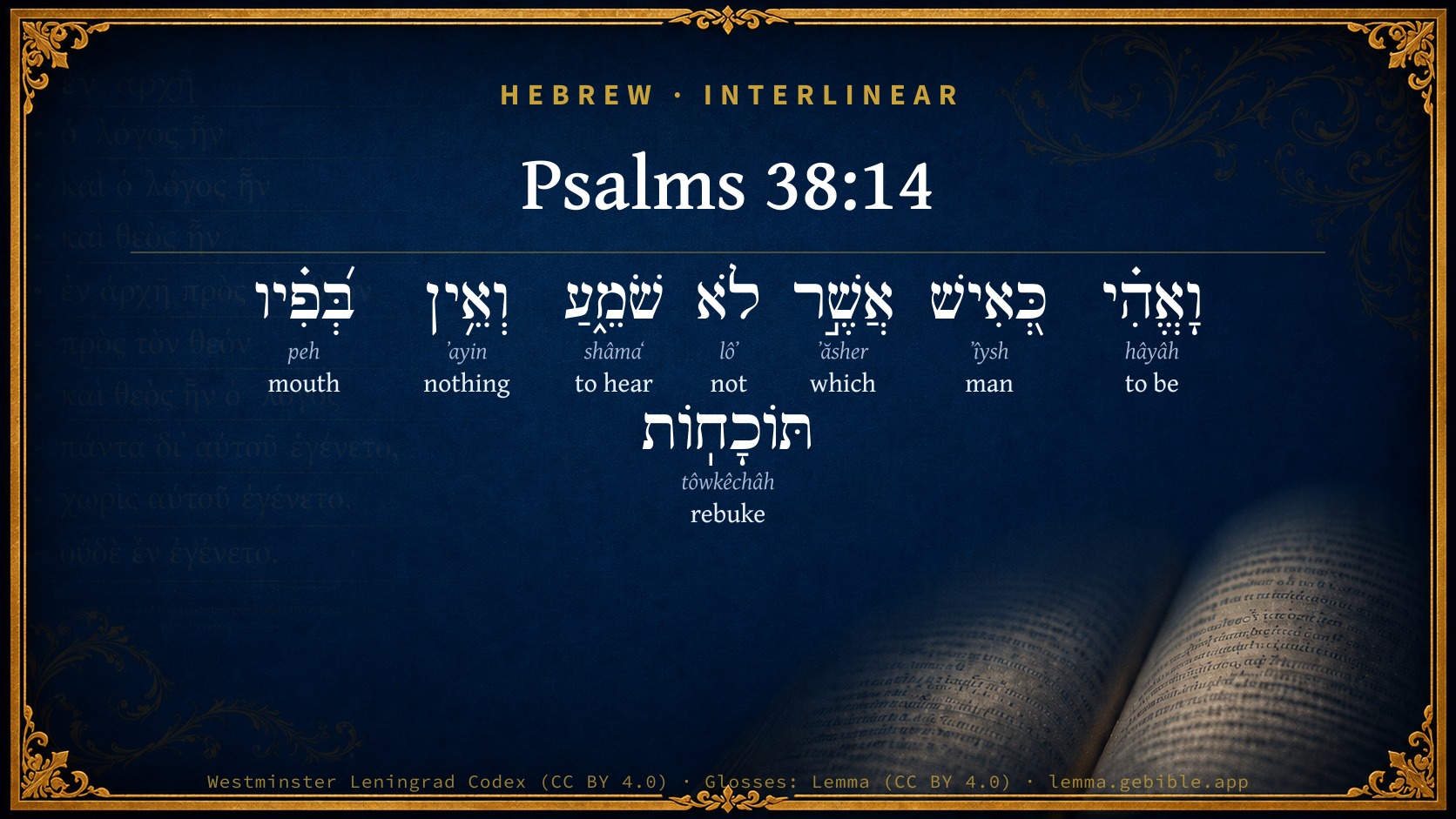
Hebrew (Westminster Leningrad Codex) Psalms 38:14 appears in the Hebrew Old Testament. The text above is from the Westminster Leningrad Codex. Each word links to its Strong’s number, a concise gloss, and parsing drawn from the Open Scriptures Hebrew Bible morphology. Click any word for its full Brown-Driver-Briggs (BDB) entry.
Download image
Cite this verse

Psalms 38:14 (World English Bible). Public Domain. Lemma interlinear Bible study tool, https://lemma.gebible.app/v/psalms/38/14.

Show BibTeX & RIS
BibTeX
RIS
English Translation
Yes, I am as a man who doesn't hear, In whose mouth are no reproofs.
World English Bible · Public Domain
Download a study sheet

One document with this verse’s original text, its word-by-word gloss line, the meaning frame, cross-references with their text, attributed commentary, and full source and license credits — printable, and it pastes into notes with its structure intact.

This verse Autodidact and up

Study sheet (.html) Plain text (.txt)

A passage Seminary Student

Up to 50 verses in one chapter. A passage sheet keeps up to 6 commentary sources and 12 cross-references per verse, in the order this page ranks them, and says so on the sheet whenever that leaves anything out. Ask for a single verse and you get the Autodidact verse sheet above.

Everything on this page stays free to read, with no account — the sheet is a download of what is already on screen, not access to it.

Want to remove ads? Support Godless Engineer
Compare translations 3

The same verse in 3 English versions, stacked beneath the original-language interlinear above. Click any original word for its lexicon entry.

Each is an independent rendering of the whole verse — the interlinear is not word-aligned to these translations.

Highlighted words mark where these versions differ — a whole-verse word diff, not a word-by-word alignment.

  • World English Bible Public Domain
    Yes, I am as a man who doesn't hear, In whose mouth are no reproofs.
  • King James Version Public Domain
    Thus I was as a man that heareth not, and in whose mouth are no reproofs.
  • unfoldingWord Literal Text CC BY-SA 4.0
    And I am like a man who is not hearing, and there are no rebukes in his mouth.

unfoldingWord Literal Text — © unfoldingWord, licensed CC BY-SA 4.0. Word-aligned USFM3 via Door43 (git.door43.org/unfoldingWord/en_ult).

Versions to compare (up to 4)

3 of 4 selected

Show all 18 translations

Every available English version of this verse, each an independent rendering of the whole verse.

  • World English Bible Public Domain
    Yes, I am as a man who doesn't hear, In whose mouth are no reproofs.
  • Berean Standard Bible Public Domain
    I am like a man who cannot hear, whose mouth offers no reply.
  • Majority Standard Bible Public Domain
    I am like a man who cannot hear, whose mouth offers no reply.
  • King James Version Public Domain
    Thus I was as a man that heareth not, and in whose mouth are no reproofs.
  • American Standard Version (1901) Public Domain
    Yea, I am as a man that heareth not, And in whose mouth are no reproofs.
  • Revised Version (1885) Public Domain
    Yea, I am as a man that heareth not, and in whose mouth are no reproofs.
  • Geneva Bible (1599) Public Domain
    Thus am I as a man, that heareth not, and in whose mouth are no reproofes.
  • Douay-Rheims (1899) Public Domain
    But I, as a deaf man, heard not: and as a dumb man not opening his mouth.
  • Young's Literal Translation Public Domain
    Yea, I am as a man who heareth not, And in his mouth are no reproofs.
  • Literal Standard Version CC BY-SA 4.0
    Indeed, I am as a man who does not hear, || And in his mouth are no reproofs.
  • Unlocked Literal Bible CC BY-SA 4.0
    I am like a man who does not hear and who has no reply.
  • unfoldingWord Literal Text CC BY-SA 4.0
    And I am like a man who is not hearing, and there are no rebukes in his mouth.
  • Darby Bible Public Domain
    Yea, I am as a man that heareth not, and in whose mouth are no reproofs.
  • World Messianic Bible Public Domain
    Yes, I am as a man who doesn’t hear, in whose mouth are no reproofs.
  • Webster's Bible Public Domain
    \\38:13\\But I, as a deaf man, heard not; and I was as a dumb man that openeth not his mouth.
  • Free Bible Version CC BY-SA 4.0
    Like a man who can't hear, and who doesn't reply—that's me!
  • Bible in Basic English Public Domain
    So I was like a man whose ears are shut, and in whose mouth there are no sharp words.
  • JPS Tanakh (1917) Public Domain
    (38-15) Yea, I am become as a man that heareth not, and in whose mouth are no arguments.

Literal Standard Version (2020), Covenant Press — licensed CC BY-SA 4.0. Text via the HelloAO Bible API (eBible.org). Unlocked Literal Bible (unfoldingWord) — licensed CC BY-SA 4.0. Text via the HelloAO Bible API (eBible.org). unfoldingWord Literal Text — © unfoldingWord, licensed CC BY-SA 4.0. Word-aligned USFM3 via Door43 (git.door43.org/unfoldingWord/en_ult). Free Bible Version, Dr. Jonathan Gallagher — licensed CC BY-SA 4.0. Text via the HelloAO Bible API (eBible.org).

Word by word

More ways to search: Search by grammar → Find every occurrence → Compare this word →

Practice this passage: Drill this verse → Learn its vocabulary →

About this verse

These counts appear in no published source. They are computed here, from the morphology-tagged text and Lemma’s own curated glosses. What Lemma adds →

8
words
8
distinct lemmas
Wisdom
section

Shared distinctive vocabulary

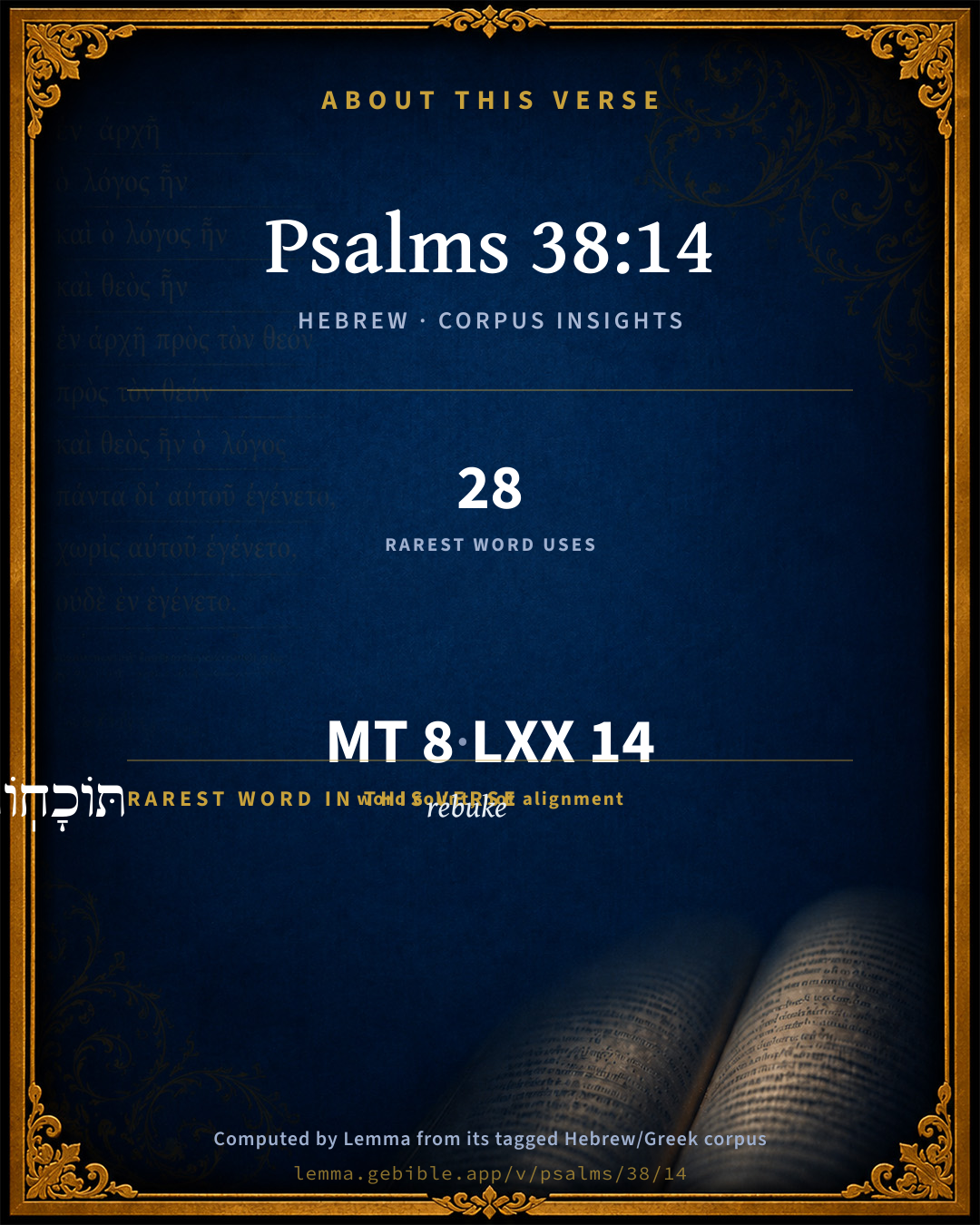
תּוֹכָחֽוֹת rebuke H8433 occurs in 28 verses of the Hebrew Bible. Also found in:

Grammatical profile

  • 2 verbs
  • 3 nouns
  • 3 particles

Verb forms

  • וָאֱהִ֗י Qal · Sequential Imperfect
  • שֹׁמֵ֑עַ Qal · Participle Active

Hebrew & Septuagint length

In English translation the verse runs 15 words from the Hebrew and 17 from the Septuagint (LXX English) — closely comparable.

A rough comparison of the two English renderings, which tokenize alike — not a word-level alignment.

Word counts can differ between the Hebrew and the Greek without any difference in meaning — e.g. the Hebrew direct-object marker אֵת has no separate Greek word, and Greek often adds the article ὁ.

In the original languages it is 8 Hebrew tokens and 14 Greek tokens — but the two are counted differently (Hebrew bundles its prefixes and suffixes into one token; the Greek is in lemma form), so that isn’t a like-for-like length.

Cross-references

4

Topical passages linked to Psalms 38:14 in the Treasury of Scripture Knowledge — connected by theme and wording, ordered by reader-vote popularity; previews shown in the World English Bible.

  • Amos 5:13 Therefore he who is prudent shall keep silence in such a time; For it is an evil time.
  • John 8:6 They said this testing him, that they might have something to accuse him of. But Jesus stooped down, and wrote on the ground with his finger.
  • Mark 15:3–5 The chief priests accused him of many things.
  • Micah 7:5 Don't trust in a neighbor. Don't put confidence in a friend. With the woman lying in your embrace, Be careful of the words of your mouth!

Cross-references courtesy of OpenBible.info (CC BY 4.0).

Hebrew and Greek witnesses Masoretic Hebrew ↔ Greek Septuagint

The same verse in the two great witnesses to the Old Testament, shown verse-for-verse.

You’re reading Greek Psalm 37 (Hebrew Psalm 38). The Septuagint counts the superscription, so verse numbers can differ from the Hebrew — chapter-level alignment, not verse-by-verse. Numbering follows Rahlfs.

These are two independent witnesses, not word-aligned to each other, and the Septuagint is shown in lemma (dictionary) form.

Hebrew Psalms 38:14 Masoretic · Westminster Leningrad Codex

וָאֱהִ֗י כְּ֭אִישׁ אֲשֶׁ֣ר לֹא שֹׁמֵ֑עַ וְאֵ֥ין בְּ֝פִ֗יו תּוֹכָחֽוֹת

Yes, I am as a man who doesn't hear, In whose mouth are no reproofs.

World English Bible · Public Domain

Greek LXX Greek Psalm 37:14 Septuagint · lemma form

ἐγώ δέ ὡσεί κωφός οὐ ἀκούω καί ὡσεί ἄλαλος οὐ ἀναοἴγω ὁ στόμα αὐτός

And I was as a man that hears not, and who has no reproofs in his mouth.

LXX2012 (modern English Septuagint) · Public Domain

Hebrew: Westminster Leningrad Codex (CC BY 4.0). Greek: Septuagint (public domain); English from LXX2012 (modern English Septuagint) (Public Domain). How the Septuagint differs from the Hebrew →

Commentary

Notes on Psalms 38:14 from classic Christian and Jewish commentators (each source and its license shown beneath its notes). The classic Christian expositions comment on the surrounding passage and are grouped to its opening verse, so a note may address several verses; the Jewish commentaries on the Tanakh (Rashi and others) are per-verse, so they appear only where the commentator wrote on this verse.

Lemma curates 59 commentaries, every one of them public domain or Creative Commons licensed, each selected and text-cleaned for this edition rather than reprinted as found. About our sources →

Trapp's Complete Commentary

John Trapp

Psa 38:14 Thus I was as a man that heareth not, and in whose mouth [are] no reproofs.

Ver. 14. Thus I was as a man that heareth not] He doubleth his speech, to show his holy pertinace in a prudent and patient silence, though greatly provoked. David was, as it is reported of Severus, the emperor, επιμελης των πρακτεων, careful of what was to be done by him, but careless of what was said of him by others. As Augustus, he did but laugh at the satires and buffooneries published against him. He knew that as physical pills must not be chewed, but swallowed whole; so must many injuries and indignities, Convitia spreta exolescunt.

John Trapp, A Commentary or Exposition upon All the Books of the Old and New Testament (1647–1656) — public domain. Text from a community e-Sword module.

Joseph Benson's Commentary

Psa 38:14-16. In whose mouth are no reproofs — Or arguments, to convince or confute them, or to defend myself. For in thee do I hope — I bore their behaviour silently and patiently, because I hoped that thou wouldest answer for me, and plead my cause better than I could myself; which I would not prevent by my impatience, or by avenging myself. Or, But in thee do I hope — Though my friends forsake me, and my enemies plot and practise against me, yet I do not despair, because I have thee on my side. For I said, Hear me, &c. — In my heart and prayers I used this argument, which I knew was prevalent. Lest otherwise they should rejoice over me — Namely, in my destruction, which would also reflect dishonour upon thee, who hast undertaken to defend and save me, and for whose sake I suffer so much from these wicked men, Psa 38:20. When my foot slippeth — When I fall, either into any gross sin, or into any misery, as I have now done; they magnify themselves against me — They triumph in the accomplishment of their designs or desires.

Joseph Benson's Commentary on the Old and New Testaments (1811–1818) — public domain. Text from a community e-Sword module.

J. A. Alexander on Psalms

Joseph Addison Alexander

15. (Psa 38:14). And I was as a man who does not hear, and there are not in his mouth replies (or arguments). The same thing is repeated, to make still more prominent the patience and forbearance of the sufferer. Does not hear, literally (is) not hearing. In our idiom the last clause would have been, in whose mouth there are no replies. The meaning reproofs is a secondary one, derived from that of proofs or arguments. See Job 13:6; Job 23:4.—The idea in both verses is, that he endured the evil speaking of his enemies, as one who had nothing to say for himself or in reply to their reproaches. This, while it mortified his pride, and thereby added to his pain, was at the sake time an evidence of faith and patience, and thus prepares the way for the profession in the next verse.

Joseph Addison Alexander, The Psalms Translated and Explained (1850) — public domain. Text from a community e-Sword module.

Adam Clarke's Commentary

Verse 14. No reproofs.] תוכחות tochachoth, arguments or vindications; a forensic term. I was as a man accused in open court, and I could make no defence.

Adam Clarke's Commentary on the Bible (1810–1826) — public domain. Text from a community e-Sword/MySword module.

Ellicott's Commentary for English Readers

(14) Reproofs.—Better, replies or justifications, (For the whole passage comp. Isa_53:7.)

A Bible Commentary for English Readers, edited by Charles John Ellicott (1878–1897) — public domain. Text from a community e-Sword module.

The Cambridge Bible for Schools and Colleges

gen. ed. J. J. S. Perowne

14. Yea, I am become like a man that hath no hearing;

And in whose mouth are no arguments.

No arguments for his own defence. Cp. Job_23:4, where Job desires to argue with God.

The Cambridge Bible for Schools and Colleges (gen. ed. J. J. S. Perowne; Cambridge University Press, 1878–1918) — public domain. Text from a community e-Sword module.

John Gill's Exposition

For in thee, O Lord, do I hope,.... That he would plead his cause against his accusers and revilers, and who sought his hurt; that he should be delivered out of their hands, and out of all his afflictions; that he should be healed of his diseases, both of soul and body, under which he laboured; and should again enjoy the light of God's countenance, and have the discoveries of his pardoning grace and mercy; and this was the reason why he was so calm and quiet amidst the unkindnesses of his friends, and the cruel usage of his enemies;

thou wilt hear, or "answer",

O Lord my God; in the midst of all his distresses of body and mind, he had not given up his interest in God, as his God and Father; which is the great blessing of the covenant of grace, and which ever continues; and is the great support of believers, under whatsoever they meet with in soul and body, from friends or foes; this his God the psalmist believed would not only hear his cries in his sore distress, but hear the reproaches of his enemies, and answer them in a providential way in his own time, by terrible things in righteousness to their conviction and confusion; and therefore he himself was silent.

John Gill's Exposition of the Whole Bible (1746–1763) — public domain (CC PDM 1.0). Text via the HelloAO Bible API.

Albert Barnes' Notes on the Bible

Thus I was as a man that heareth not - The sentiment in the former verse is repeated here to show the greatness of his patience and forbearance, or to fix the attention on the fact that one who was so calumniated and wronged could bear it patiently.

And in whose mouth are no reproofs - As a man who never reproved another; who, whatever might be the wrong which he endured, never replied to it; as he would be who was incapable of reproof, or who had no faculty for reproving. The whole of this is designed to show his entire patience under the wrongs which he suffered.

Albert Barnes' Notes on the Bible (1834–1885) — public domain. Text from a community e-Sword/MySword module.

Matthew Poole's English Annotations

Or arguments, to convince or confute them, or to defend myself.

Matthew Poole's English Annotations on the Holy Bible (1683–1685) — public domain. Text from a community e-Sword/MySword module.

The Treasury of David

Charles H. Spurgeon

Ver. 14. Thus I was as a man that heareth not, and in whose mouth are no reproofs. He repeats the fact of his silence that we may note it, admire it, and imitate it. We have an advocate, and need not therefore plead our own cause. The Lord will rebuke our foes, for vengeance belongs to him; we may therefore wait patiently and find it our strength to sit still.

Ver. 14. Thus I was as a man that heareth not, and in whose mouth are no reproofs. You, who truly know yourselves; by whom silent suffering, secret grief, and hidden joy are understood; by the knowledge of your own unspoken sorrow, unexpressed, because inexpressible feelings, by the consciousness of the unrevealed depths of your own nature, the earnest, but ever unsatisfied yearnings of your spirit, learn to reverence and love those by whom you are surrounded, whose inner life can never be completely read, but whom you are sure must need sacred sympathy and tender consideration. If a secret grief is constantly gnawing my heart, making my voice falter in the song of praise, may not my brother's downcast eye and heavy heart be occasioned by a similar cause; shall I condemn him for his want of gladness? No: but remember, "the heart knoweth his own bitterness, and a stranger doth not intermeddle with his joy." The silent breathings of the spirit are not for our ears; the hot tears which in secret fall, are not for our eyes; in mercy has the veil been drawn round each heart; but by the sacred memory of our own sadness, let our voice be gentle, our look tender, our tread quiet, as we pass amongst the mourners. Jessie Coombs, in "Thoughts for the Inner Life, "1867.

None.

Psalms 38:15*

Charles H. Spurgeon's The Treasury of David (1869–1885) — public domain. Psalms only. Text from a community e-Sword/MySword module.

Whedon's Commentary on the Bible

Daniel D. Whedon

14. No reproofs—The term is judicial, as in Job_23:4, and signifies defence, justification. It is here plural: “I was as a man in whose mouth are no justifications,” no grounds or arguments of defence. Comp. Psa_39:9. Thus when God judges, “every mouth shall be stopped.” Rom_3:19

Daniel D. Whedon (gen. ed.), Commentary on the Old and New Testaments (1874–1909) — public domain. Text from a community e-Sword module.

The Pulpit Commentary

Thus I was as a man that heareth not, and in whose mouth are no reproofs; i.e. I was like a man who is unable to answer, to reprove, or rebuke an adversary. So great was my self-restraint.

The Pulpit Commentary (1880–1919), ed. H.D.M. Spence-Jones & Joseph S. Exell — public domain. Text from a community e-Sword module.

Rashi

Rabbi Shlomo Yitzchaki (Rashi)

But I am as a deaf person Israel hears their reproach from the nations but does not respond. Why? Because I hoped for You, O Lord, that You would redeem me and save me from them.

Rashi on the Tanakh — English translations: “The Judaica Press complete Tanach with Rashi, translated by A. J. Rosenberg” (CC BY 4.0); “Pentateuch with Rashi's commentary by M. Rosenbaum and A.M. Silbermann, 1929-1934” (public domain); “The Metsudah Tanach series, Lakewood, N.J” (CC BY 4.0); and “The Book of Joshua, Metsudah Publications, 1997” (CC BY 4.0). Text via Sefaria.

Lesson kit

Teaching starters — assembled from the data on this page, not authored interpretation. Every prompt links to the verse data it draws on. Edit before teaching.

Psalms, in the Wisdom, opens this verse with 8 words (8 distinct Hebrew lemmas). Its most distinctive word is tôwkêchâh (“rebuke”). A historical commentator’s framing appears above. Read the whole chapter for the surrounding context.

Discussion questions

  1. What does “rebuke” (tôwkêchâh) contribute to the verse as a whole?
  2. 2 Kings 19:3 shares the word «rebuke» with this verse. How do the two illuminate each other?
  3. These translations render this verse differently. What is at stake in choosing one wording over another?
  4. The verb «וָאֱהִ֗י» is Qal Sequential Imperfect. How does its form color the action?
  5. Reading how Trapp's Complete Commentary and Joseph Benson's Commentary read this verse, where do the two commentators agree and where do they part?

Things to notice

Reading settings

Reading text

Shown beneath each verse's original-language words.

Old Testament
Old Testament edition

Read the OT as the Masoretic Hebrew (MT) or the Greek Septuagint (LXX).

English shown for the Greek Septuagint (in the Hebrew ↔ Greek comparison).

Comparing translations? Open the Compare panel on any verse page to stack up to four side by side.