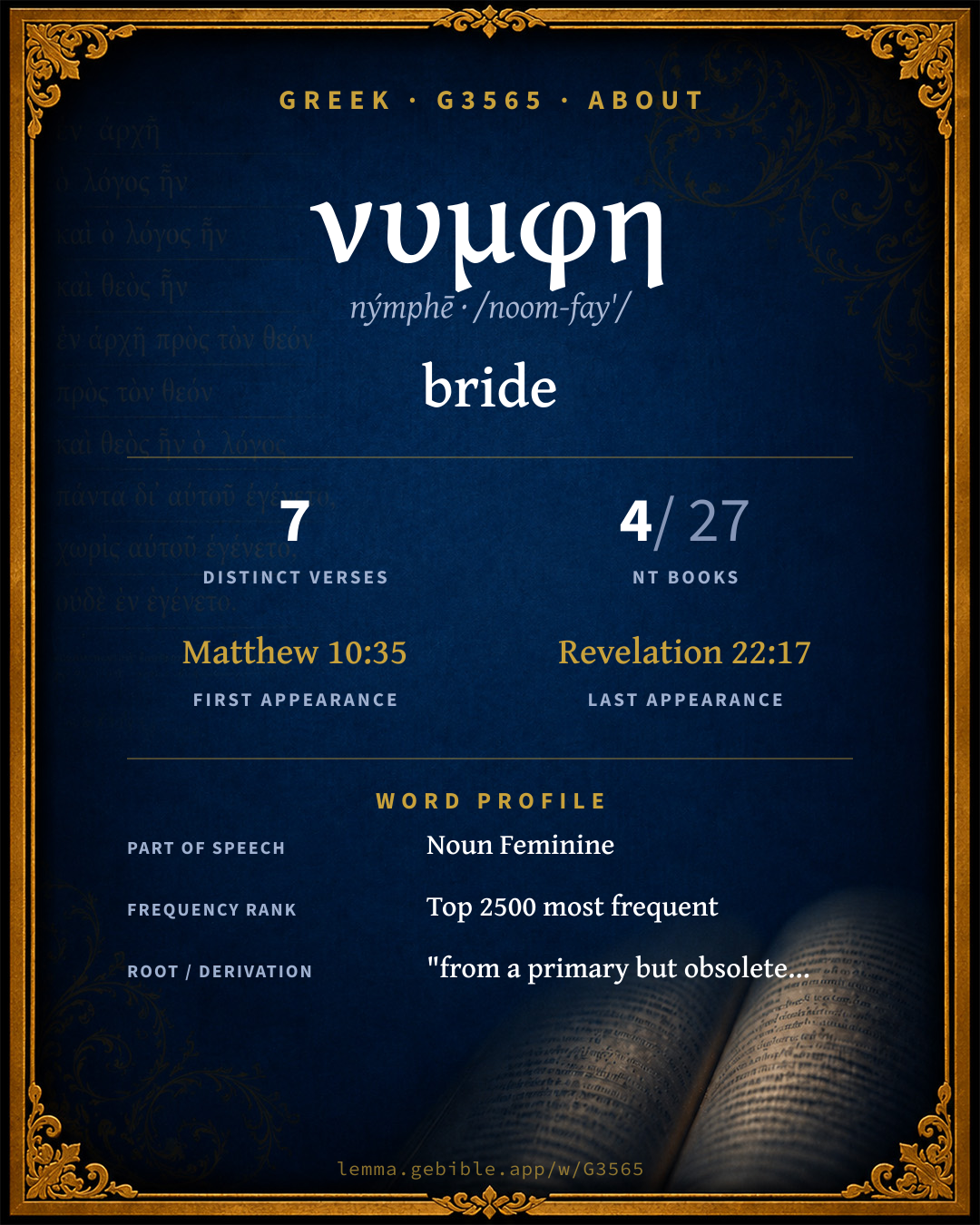
νύμφη
bride
‘bride’ is one of 4 main senses fuller range ↓
Full lexicon entry — Thayer's Greek Lexicon
From Thayer's Greek Lexicon
Where this word appears
See every Accusative-case word in the Greek New Testament →
Grammar key — what these labels mean
Part of speech
- Noun
- A naming word — a person, place, thing, or idea.
Case
- Accusative
- The case of the direct object and of extent.
- Nominative
- The case of the subject (and the predicate nominative).
- Genitive
- The case of source, possession, or “of” — answers “whose / from what.”
Gender
- Feminine
- Grammatically feminine.
Number
- Singular
- One.
Grammatical forms
- Noun, Accusative, Singular, Feminine 5 times (63%)
- Noun, Nominative, Singular, Feminine 2 times (25%)
- Noun, Genitive, Singular, Feminine 1 time (13%)
Parsed forms decoded from the imported morphology (Robinson–Tischendorf, public domain), counted across 8 parsed occurrences — not distinct verses.
Every verse where G3565 appears — 7 distinct verses across 4 books. Click any verse to open its interlinear word-by-word view. Verse text shown in the World English Bible for context — . Each verse’s Greek form is shown with its reference; the English is not keyword-highlighted, since the data carries no word-level English alignment. Use “Compare translations” on any verse to read it across multiple English versions. This concordance covers the Greek New Testament; Septuagint (Greek Old Testament) occurrences of this word are not indexed here.
Matthew 1 verse
Luke 1 verse
John 1 verse
Revelation 4 verses
- Revelation 18:23 νύμφης n gen sg fem The light of a lamp will shine no more at all in you. The voice of the bridegroom and of the bride will be heard no more at all in you; for your merchants were the princes of the earth; for with your sorcery all the nations were deceived.
- Revelation 21:2 νύμφην n acc sg fem I saw the holy city, New Jerusalem, coming down out of heaven from God, made ready like a bride adorned for her husband.
- Revelation 21:9 νύμφην n acc sg fem One of the seven angels who had the seven bowls, who were loaded with the seven last plagues came, and he spoke with me, saying, "Come here. I will show you the wife, the Lamb's bride."
- Revelation 22:17 νύμφη n nom sg fem The Spirit and the bride say, "Come!" He who hears, let him say, "Come!" He who is thirsty, let him come. He who desires, let him take the water of life freely.
About this entry
At a glance — auto-summarized from this page’s data, not written by a person. Every figure links to its source below. This summary describes the numbers; it doesn’t interpret them.
νυμφη (nýmphē) is a Greek noun most often rendered “bride.” It clusters heavily in Revelation, which alone accounts for 57% of its uses. With 7 verses in 4 books, it is an uncommon word in the Greek New Testament. Debuting at Matthew 10:35, it then recurs through the corpus. Its lexical range runs to 4 senses. The sections below give every sense, occurrence, and version rendering.
Gloss history
Strong's 1890 vs modern scholarship
About this word
Strong's G3565 catalogs a Greek word from the Greek New Testament.
These counts are not copied from any lexicon or concordance. They are computed here, from the morphology-tagged Greek New Testament. What Lemma adds →
- 7
- distinct verses
- The word appears in 7 distinct verses.
- 4 / 27
- NT books
- The word appears in 4 of 27 New Testament books.
- #1,240
- by frequency
- Top 2500 most frequent Greek words (rank 1,240 of 5,347 Greek words by occurrence).
View all 7 occurrences in the concordance →
Most concentrated in
- Revelation 4 verses 57%
- Matthew 1 verse 14%
- Luke 1 verse 14%
By section of the New Testament
By traditional corpus
Conventional, traditional groupings — biblical authorship is debated, so this is a traditional corpus grouping, not an authorship claim. Some books belong to more than one corpus (Luke is in both the Gospels and the Lukan corpus, and so on), so these shares overlap and need not total 100%. Each figure is a share of the word’s 7 distinct verses.
- Johannine 5 verses · 71%
- Revelation 4 verses · 57%
- Gospels 3 verses · 43%
- Lukan (Luke–Acts) 1 verse · 14%
How translations render this word
Counts come from each version’s own published word-to-Strong’s tagging or interlinear alignment — an approximate guide to how each version renders this word, not a word-level alignment the data otherwise carries. Because each total is that version’s own tagged count, the per-version totals vary from one another and need not match the appearance or distinct-verse counts above. These counts may also differ from a printed concordance because Lemma counts each distinctly tagged rendering and does not collapse phrase taggings into a single head-word total. This is a fixed set of word-tagged versions (KJV, ASV, BSB, ULT) and does not change with the reading translation you choose elsewhere. Each version’s license is shown beside its name below (and on Sources).
- King James Version: Bride 5×, Daughter in law 3×
- American Standard Version: Bride 5×, Mother in law 2×
- Berean Standard Bible: Bride 5×, Daughter-in-law 3×
- unfoldingWord Literal Text: Bride 5×, Daughter in law 3×
King James Version Public Domain
Renders G3565 across 8 tagged occurrences — most commonly:
American Standard Version Public Domain
Renders G3565 across 8 tagged occurrences — most commonly:
Plus 1 rendering that appears only once — usually multi-word phrases or single function words the recovered tagging swept in, not distinct renderings.
Berean Standard Bible Public Domain
Renders G3565 across 8 tagged occurrences — most commonly:
unfoldingWord Literal Text CC BY-SA 4.0
Renders G3565 across 8 tagged occurrences — most commonly:
Senses in Thayer's
The 4 senses Thayer's distinguishes for this word, in lexicon order (not ranked by frequency or importance). The full entry — with sub-senses — is in the Lexicon Entry tab.
- a betrothed woman, a bride
- a recently married woman, young wife
- a young woman
- a daughter-in-law
Word origin
Origin: "from a primary but obsolete verb nupto (to veil as a bride, cf Latin "nupto," to marry)"
From a primary but obsolete verb νύπτω nuptō (to veil as a bride; compare the Latin nupto to marry ); a young married woman (as veiled ) including a betrothed girl; by implication a son's wife : - bride daughter in law.
— Strong’s Exhaustive Concordance (1890), public domain.
Forms in the corpus
The 3 distinct written forms G3565 takes in the Greek New Testament, most frequent first — each parse links to that case’s occurrences in the concordance.
| Form | Parsing | Example | Uses |
|---|---|---|---|
| νύμφην nýmphēn | Noun, Accusative, Singular, Feminine | Matthew 10:35 | 5 |
| νύμφη nýmphē | Noun, Nominative, Singular, Feminine | Luke 12:53 | 2 |
| νύμφης nýmphēs | Noun, Genitive, Singular, Feminine | Revelation 18:23 | 1 |
Same root — word family
Other Thayer's entries built from the same root as G3565, grouped by Strong’s listed origin. These share a root / origin per the lexicon — not necessarily a shared meaning. Each links to that word’s own entry.
Derived from this word
Proper names from this root
People and places named from this root — a name, not an additional meaning of the word.
Compare all same-root words → 1 of the same-root words is a proper name (a person or place). They share a root, not necessarily a meaning.
Septuagint usage
The same Greek word νυμφη appears 37 times in the Greek Old Testament (Septuagint), across 37 verses in 13 books.
- 37
- LXX occurrences
- Tagged occurrences of this Greek word in the Septuagint.
- 37
- verses
- Distinct Septuagint verses containing this word.
- 13 / 39
- OT books
- The word appears in 13 of the 39 Old Testament books.
Sample Septuagint occurrences
- Genesis 11:31 νύμφη
- Leviticus 18:15 νύμφη
- Ruth 1:6 νύμφη
- 1 Samuel 4:19 νύμφη
- 2 Samuel 17:3 νύμφη
- 1 Chronicles 2:4 νύμφη
- Song of Solomon 4:8 νύμφη
- Isaiah 49:18 νύμφη
- Jeremiah 2:32 νύμφη
- Ezekiel 22:11 νύμφη
- Hosea 4:13 νύμφη
- Joel 1:8 νύμφη
Septuagint occurrences (same lexeme)
Every verse where the same Strong’s number (G3565) appears in the Greek Septuagint. Verse text shown in the World English Bible for context; the Greek form is the matched word — the English is not keyword-highlighted.
- Genesis 11:31 νύμφη Terah took Abram his son, Lot the son of Haran, his son's son, and Sarai his daughter-in-law, his son Abram's wife. They went forth from Ur of the Chaldees, to go into the land of Canaan. They came to Haran, and lived there.
- Genesis 38:11 νύμφη Then Judah said to Tamar, his daughter-in-law, "Remain a widow in your father's house, until Shelah, my son, is grown up;" for he said, "Lest he also die, like his brothers." Tamar went and lived in her father's house.
- Genesis 38:13 νύμφη It was told Tamar, saying, "Behold, your father-in-law is going up to Timnah to shear his sheep."
- Genesis 38:16 νύμφη He turned to her by the way, and said, "Please come, let me come in to you:" for he didn't know that she was his daughter-in-law. She said, "What will you give me, that you may come in to me?"
- Genesis 38:24 νύμφη It happened about three months later, that it was told Judah, saying, "Tamar, your daughter-in-law, has played the prostitute; and moreover, behold, she is with child by prostitution." Judah said, "Bring her forth, and let her be burnt."
- Leviticus 18:15 νύμφη "'You shall not uncover the nakedness of your daughter-in-law: she is your son's wife. You shall not uncover her nakedness.
- Leviticus 20:12 νύμφη "'If a man lies with his daughter-in-law, both of them shall surely be put to death: they have committed a perversion; their blood shall be upon them.
- Ruth 1:6 νύμφη Then she arose with her daughters-in-law, that she might return from the country of Moab: for she had heard in the country of Moab how that Yahweh had visited his people in giving them bread.
- Ruth 1:7 νύμφη She went forth out of the place where she was, and her two daughters-in-law with her; and they went on the way to return to the land of Judah.
- Ruth 1:8 νύμφη Naomi said to her two daughters-in-law, Go, return each of you to her mother's house: Yahweh deal kindly with you, as you have dealt with the dead, and with me.
- Ruth 1:22 νύμφη So Naomi returned, and Ruth the Moabitess, her daughter-in-law, with her, who returned out of the country of Moab: and they came to Bethlehem in the beginning of barley harvest.
- Ruth 2:20 νύμφη Naomi said to her daughter-in-law, Blessed be he of Yahweh, who has not left off his kindness to the living and to the dead. Naomi said to her, The man is a close relative to us, one of our near kinsmen.
- Ruth 2:22 νύμφη Naomi said to Ruth her daughter-in-law, It is good, my daughter, that you go out with his maidens, and that they not meet you in any other field.
- Ruth 4:15 νύμφη He shall be to you a restorer of life, and sustain you in your old age, for your daughter-in-law, who loves you, who is better to you than seven sons, has borne him.
- 1 Samuel 4:19 νύμφη His daughter-in-law, Phinehas' wife, was with child, near to be delivered: and when she heard the news that the ark of God was taken, and that her father-in-law and her husband were dead, she bowed herself and brought forth; for her pains came on her.
- 2 Samuel 17:3 νύμφη and I will bring back all the people to you: the man whom you seek is as if all returned: [so] all the people shall be in peace.
- 1 Chronicles 2:4 νύμφη Tamar his daughter-in-law bore him Perez and Zerah. All the sons of Judah were five.
- Song of Solomon 4:8 νύμφη Come with me from Lebanon, my bride, With me from Lebanon. Look from the top of Amana, From the top of Senir and Hermon, From the lions' dens, From the mountains of the leopards.
- Song of Solomon 4:9 νύμφη You have ravished my heart, my sister, my bride. You have ravished my heart with one of your eyes, With one chain of your neck.
- Song of Solomon 4:10 νύμφη How beautiful is your love, my sister, my bride! How much better is your love than wine! The fragrance of your perfumes than all manner of spices!
- Song of Solomon 4:11 νύμφη Your lips, my bride, drip like the honeycomb. Honey and milk are under your tongue. The smell of your garments is like the smell of Lebanon.
- Song of Solomon 4:12 νύμφη A locked up garden is my sister, my bride; A locked up spring, A sealed fountain.
- Song of Solomon 5:1 νύμφη I have come into my garden, my sister, my bride. I have gathered my myrrh with my spice; I have eaten my honeycomb with my honey; I have drunk my wine with my milk. Friends Eat, friends! Drink, yes, drink abundantly, beloved. Beloved
- Isaiah 49:18 νύμφη Lift up your eyes round about, and see: all these gather themselves together, and come to you. As I live, says Yahweh, you shall surely clothe you with them all as with an ornament, and gird yourself with them, like a bride.
- Isaiah 61:10 νύμφη I will greatly rejoice in Yahweh, my soul shall be joyful in my God; for he has clothed me with the garments of salvation, he has covered me with the robe of righteousness, as a bridegroom decks himself with a garland, and as a bride adorns herself with her jewels.
- Isaiah 62:5 νύμφη For as a young man marries a virgin, so shall your sons marry you; and as the bridegroom rejoices over the bride, so shall your God rejoice over you.
- Jeremiah 2:32 νύμφη Can a virgin forget her ornaments, or a bride her attire? yet my people have forgotten me days without number.
- Jeremiah 7:34 νύμφη Then will I cause to cease from the cities of Judah, and from the streets of Jerusalem, the voice of mirth and the voice of gladness, the voice of the bridegroom and the voice of the bride; for the land shall become a waste.
- Jeremiah 16:9 νύμφη For thus says Yahweh of Hosts, the God of Israel: Behold, I will cause to cease out of this place, before your eyes and in your days, the voice of mirth and the voice of gladness, the voice of the bridegroom and the voice of the bride.
- Jeremiah 25:10 νύμφη Moreover I will take from them the voice of mirth and the voice of gladness, the voice of the bridegroom and the voice of the bride, the sound of the millstones, and the light of the lamp.
- Jeremiah 40:11 νύμφη Likewise when all the Jews who were in Moab, and among the children of Ammon, and in Edom, and who were in all the countries, heard that the king of Babylon had left a remnant of Judah, and that he had set over them Gedaliah the son of Ahikam, the son of Shaphan;
- Ezekiel 22:11 νύμφη One has committed abomination with his neighbor's wife; and another has lewdly defiled his daughter-in-law; and another in you has humbled his sister, his father's daughter.
- Hosea 4:13 νύμφη They sacrifice on the tops of the mountains, And burn incense on the hills, under oaks and poplars and terebinths, Because its shade is good. Therefore your daughters play the prostitute, And your brides commit adultery.
- Hosea 4:14 νύμφη I will not punish your daughters when they play the prostitute, Nor your brides when they commit adultery; Because the men consort with prostitutes, And they sacrifice with the shrine prostitutes; And the people that does not understand will come to ruin.
- Joel 1:8 νύμφη Mourn like a virgin dressed in sackcloth for the husband of her youth!
- Joel 2:16 νύμφη Gather the people. Sanctify the assembly. Assemble the elders. Gather the children, and those who suck the breasts. Let the bridegroom go forth from his room, And the bride out of her chamber.
- Micah 7:6 νύμφη For the son dishonors the father, The daughter rises up against her mother, The daughter-in-law against her mother-in-law; A man's enemies are the men of his own house.
These are occurrences of the same Greek lexeme (G3565) in the Septuagint — not a translation of any one Hebrew word. The store carries no word-level Hebrew↔Greek alignment, so no Hebrew original is asserted here. Counts come from the recovered LXX Strong's tagging — high-frequency vocabulary is well covered, while rare or late forms may be untagged — so they reflect tagged occurrences and may slightly undercount.