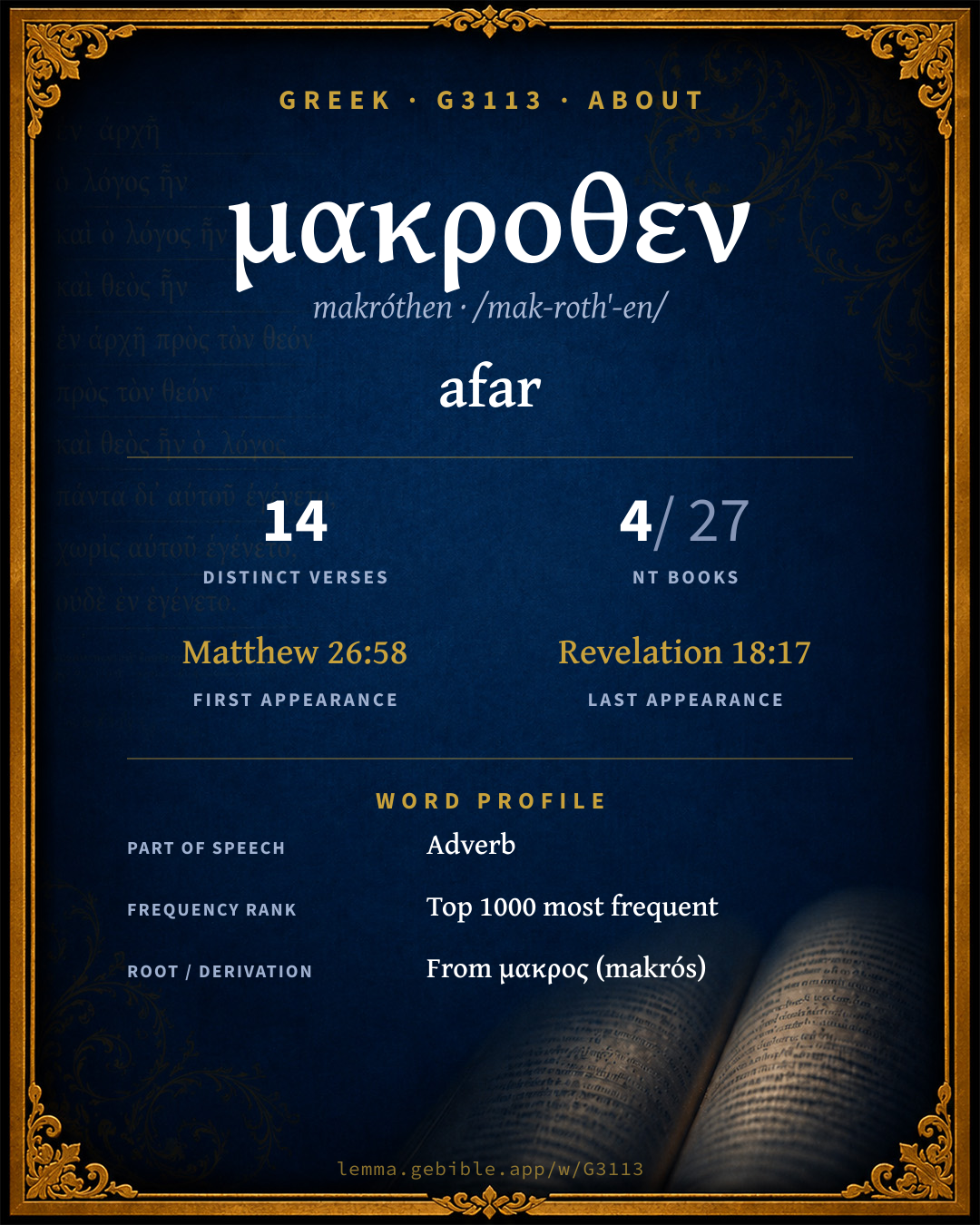
μακρόθεν
afar
Full lexicon entry — Thayer's Greek Lexicon
From Thayer's Greek Lexicon
Where this word appears
Grammar key — what these labels mean
Part of speech
- Adverb
- A word that modifies a verb, adjective, or other adverb.
Every verse where G3113 appears — 14 distinct verses across 4 books. Click any verse to open its interlinear word-by-word view. Verse text shown in the World English Bible for context — . Each verse’s Greek form is shown with its reference; the English is not keyword-highlighted, since the data carries no word-level English alignment. Use “Compare translations” on any verse to read it across multiple English versions. This concordance covers the Greek New Testament; Septuagint (Greek Old Testament) occurrences of this word are not indexed here.
Matthew 2 verses
Mark 5 verses
- Mark 5:6 μακρόθεν adv When he saw Jesus from afar, he ran and bowed down to him,
- Mark 8:3 μακρόθεν adv If I send them away fasting to their home, they will faint on the way, for some of them have come a long way."
- Mark 11:13 μακρόθεν adv Seeing a fig tree afar off having leaves, he came to see if perhaps he might find anything on it. When he came to it, he found nothing but leaves, for it was not the season for figs.
- Mark 14:54 μακρόθεν adv Peter had followed him from a distance, until he came into the court of the high priest. He was sitting with the officers, and warming himself in the light of the fire.
- Mark 15:40 μακρόθεν adv There were also women watching from afar, among whom were both Mary Magdalene, and Mary the mother of James the less and of Joses, and Salome;
Luke 4 verses
- Luke 16:23 μακρόθεν adv In Hades, he lifted up his eyes, being in torment, and saw Abraham far off, and Lazarus at his bosom.
- Luke 18:13 μακρόθεν adv But the tax collector, standing far away, wouldn't even lift up his eyes to heaven, but beat his breast, saying, 'God, be merciful to me, a sinner!'
- Luke 22:54 μακρόθεν adv They seized him, and led him away, and brought him into the high priest's house. But Peter followed from a distance.
- Luke 23:49 μακρόθεν adv All his acquaintances, and the women who followed with him from Galilee, stood at a distance, watching these things.
Revelation 3 verses
- Revelation 18:10 μακρόθεν adv standing far away for the fear of her torment, saying, 'Woe, woe, the great city, Babylon, the strong city! For your judgment has come in one hour.'
- Revelation 18:15 μακρόθεν adv The merchants of these things, who were made rich by her, will stand far away for the fear of her torment, weeping and mourning;
- Revelation 18:17 μακρόθεν adv For in an hour such great riches are made desolate.' Every shipmaster, and everyone who sails anywhere, and mariners, and as many as gain their living by sea, stood far away,
About this entry
At a glance — auto-summarized from this page’s data, not written by a person. Every figure links to its source below. This summary describes the numbers; it doesn’t interpret them.
The Greek verb μακροθεν centers on the idea of “afar.” Older and newer Bibles part ways — “afar” in the King James Version, “distance” (Berean Standard Bible) in modern versions. See the renderings breakdown. It appears 14 verses across 4 books of the Greek New Testament, among its uncommon vocabulary. The word gravitates to Mark (36%), then Luke and Revelation. Its earliest occurrence is Matthew 26:58. For the data behind this summary, explore the sense tree and the renderings breakdown below.
Gloss history
Strong's 1890 vs modern scholarship
About this word
Strong's G3113 catalogs a Greek word from the Greek New Testament.
These counts are not copied from any lexicon or concordance. They are computed here, from the morphology-tagged Greek New Testament. What Lemma adds →
- 14
- distinct verses
- The word appears in 14 distinct verses.
- 4 / 27
- NT books
- The word appears in 4 of 27 New Testament books.
- #814
- by frequency
- Top 1000 most frequent Greek words (rank 814 of 5,347 Greek words by occurrence).
View all 14 occurrences in the concordance →
Most concentrated in
- Mark 5 verses 36%
- Luke 4 verses 29%
- Revelation 3 verses 21%
By section of the New Testament
By traditional corpus
Conventional, traditional groupings — biblical authorship is debated, so this is a traditional corpus grouping, not an authorship claim. Some books belong to more than one corpus (Luke is in both the Gospels and the Lukan corpus, and so on), so these shares overlap and need not total 100%. Each figure is a share of the word’s 14 distinct verses.
- Gospels 11 verses · 79%
- Lukan (Luke–Acts) 4 verses · 29%
- Johannine 3 verses · 21%
- Revelation 3 verses · 21%
How translations render this word
Counts come from each version’s own published word-to-Strong’s tagging or interlinear alignment — an approximate guide to how each version renders this word, not a word-level alignment the data otherwise carries. Because each total is that version’s own tagged count, the per-version totals vary from one another and need not match the appearance or distinct-verse counts above. These counts may also differ from a printed concordance because Lemma counts each distinctly tagged rendering and does not collapse phrase taggings into a single head-word total. This is a fixed set of word-tagged versions (KJV, ASV, BSB, ULT) and does not change with the reading translation you choose elsewhere. Each version’s license is shown beside its name below (and on Sources).
- King James Version: Afar 6×, Afar off 4×
- American Standard Version: Afar 8×, Afar off 4×
- Berean Standard Bible: Distance 12×
- unfoldingWord Literal Text: Distance 8×, Afar 4×
King James Version Public Domain
Renders G3113 across 11 tagged occurrences — most commonly:
Plus 1 rendering that appears only once — usually multi-word phrases or single function words the recovered tagging swept in, not distinct renderings. Not rendered by a distinct English word in 3 further occurrences.
American Standard Version Public Domain
Renders G3113 across 14 tagged occurrences — most commonly:
Plus 2 renderings that appear only once — usually multi-word phrases or single function words the recovered tagging swept in, not distinct renderings.
Berean Standard Bible Public Domain
Renders G3113 across 14 tagged occurrences — most commonly:
Plus 2 renderings that appear only once — usually multi-word phrases or single function words the recovered tagging swept in, not distinct renderings.
unfoldingWord Literal Text CC BY-SA 4.0
Renders G3113 across 14 tagged occurrences — most commonly:
Plus 2 renderings that appear only once — usually multi-word phrases or single function words the recovered tagging swept in, not distinct renderings.
Senses in Thayer's
The 1 sense Thayer's distinguishes for this word, in lexicon order (not ranked by frequency or importance). The full entry — with sub-senses — is in the Lexicon Entry tab.
- from afar, afar
Word origin
Derived from μακρος (makrós) (G3117) — long.
Adverb from G3117 ; from a distance or afar : - afar off from far.
— Strong’s Exhaustive Concordance (1890), public domain.
Same root — word family
Other Thayer's entries built from the same root as G3113, grouped by Strong’s listed origin. These share a root / origin per the lexicon — not necessarily a shared meaning. Each links to that word’s own entry.
Derives from
Shares the same root
- μακραν makrán G3112 far off
- μακροθυμως makrothymṓs G3116 patiently
- μακροχρονιος makrochrónios G3118 long-lived
Compare all same-root words → Showing 4 of 5 — not the complete family. They share a root, not necessarily a meaning.
Septuagint usage
The same Greek word μακροθεν appears 31 times in the Greek Old Testament (Septuagint), across 31 verses in 14 books.
- 31
- LXX occurrences
- Tagged occurrences of this Greek word in the Septuagint.
- 31
- verses
- Distinct Septuagint verses containing this word.
- 14 / 39
- OT books
- The word appears in 14 of the 39 Old Testament books.
Sample Septuagint occurrences
- Genesis 21:16 μακρόθεν
- Exodus 2:4 μακρόθεν
- Deuteronomy 28:49 μακρόθεν
- Joshua 9:6 μακρόθεν
- 1 Samuel 26:13 μακρόθεν
- 2 Kings 2:7 μακρόθεν
- 2 Chronicles 6:32 μακρόθεν
- Ezra 3:13 μακρόθεν
- Psalms 9:22 μακρόθεν
- Proverbs 25:25 μακρόθεν
- Isaiah 60:4 μακρόθεν
- Jeremiah 4:16 μακρόθεν
Septuagint occurrences (same lexeme)
Every verse where the same Strong’s number (G3113) appears in the Greek Septuagint. Verse text shown in the World English Bible for context; the Greek form is the matched word — the English is not keyword-highlighted.
- Genesis 21:16 μακρόθεν She went and sat down opposite him, a good way off, about a bow shot away. For she said, "Don't let me see the death of the child." She sat over against him, and lifted up her voice, and wept.
- Genesis 22:4 μακρόθεν On the third day Abraham lifted up his eyes, and saw the place far off.
- Genesis 37:18 μακρόθεν They saw him afar off, and before he came near to them, they conspired against him to kill him.
- Exodus 2:4 μακρόθεν His sister stood far off, to see what would be done to him.
- Exodus 20:18 μακρόθεν All the people perceived the thunderings, the lightnings, the sound of the trumpet, and the mountain smoking. When the people saw it, they trembled, and stayed at a distance.
- Exodus 20:21 μακρόθεν The people stayed at a distance, and Moses drew near to the thick darkness where God was.
- Exodus 24:1 μακρόθεν He said to Moses, "Come up to Yahweh, you, and Aaron, Nadab, and Abihu, and seventy of the elders of Israel; and worship from a distance.
- Deuteronomy 28:49 μακρόθεν Yahweh will bring a nation against you from far, from the end of the earth, as the eagle flies; a nation whose language you shall not understand;
- Deuteronomy 29:21 μακρόθεν Yahweh will set him apart to evil out of all the tribes of Israel, according to all the curses of the covenant that is written in this book of the law.
- Joshua 9:6 μακρόθεν They went to Joshua to the camp at Gilgal, and said to him, and to the men of Israel, We are come from a far country: now therefore make you a covenant with us.
- Joshua 9:9 μακρόθεν They said to him, From a very far country your servants are come because of the name of Yahweh your God: for we have heard the fame of him, and all that he did in Egypt,
- 1 Samuel 26:13 μακρόθεν Then David went over to the other side, and stood on the top of the mountain afar off; a great space being between them;
- 2 Kings 2:7 μακρόθεν Fifty men of the sons of the prophets went, and stood over against them afar off: and they two stood by the Jordan.
- 2 Chronicles 6:32 μακρόθεν Moreover concerning the foreigner, who is not of your people Israel, when he shall come from a far country for your great name's sake, and your mighty hand, and your outstretched arm; when they shall come and pray toward this house:
- Ezra 3:13 μακρόθεν so that the people could not discern the noise of the shout of joy from the noise of the weeping of the people; for the people shouted with a loud shout, and the noise was heard afar off.
- Ezra 22:43 μακρόθεν
- Psalms 9:22 μακρόθεν
- Psalms 37:12 μακρόθεν The wicked plots against the just, And gnashes at him with his teeth.
- Psalms 137:6 μακρόθεν Let my tongue stick to the roof of my mouth if I don't remember you; If I don't prefer Jerusalem above my chief joy.
- Psalms 138:2 μακρόθεν I will bow down toward your holy temple, And give thanks to your Name for your loving kindness and for your truth; For you have exalted your Name and your Word above all.
- Proverbs 25:25 μακρόθεν Like cold water to a thirsty soul, So is good news from a far country.
- Proverbs 31:14 μακρόθεν She is like the merchant ships. She brings her bread from afar.
- Isaiah 60:4 μακρόθεν Lift up your eyes round about, and see: they all gather themselves together, they come to you; your sons shall come from far, and your daughters shall be carried in the arms.
- Isaiah 60:9 μακρόθεν Surely the isles shall wait for me, and the ships of Tarshish first, to bring your sons from far, their silver and their gold with them, for the name of Yahweh your God, and for the Holy One of Israel, because he has glorified you.
- Jeremiah 4:16 μακρόθεν make you mention to the nations; behold, publish against Jerusalem, [that] watchers come from a far country, and give out their voice against the cities of Judah.
- Jeremiah 6:20 μακρόθεν To what purpose comes there to me frankincense from Sheba, and the sweet cane from a far country? your burnt offerings are not acceptable, nor your sacrifices pleasing to me.
- Jeremiah 8:19 μακρόθεν Behold, the voice of the cry of the daughter of my people from a land that is very far off: isn't Yahweh in Zion? Isn't her King in her? Why have they provoked me to anger with their engraved images, and with foreign vanities?
- Jeremiah 26:27 μακρόθεν
- Jeremiah 28:50 μακρόθεν
- Ezekiel 23:40 μακρόθεν Furthermore you have sent for men who come from far, to whom a messenger was sent, and, behold, they came; for whom you did wash yourself, paint your eyes, and deck yourself with ornaments,
- Habakkuk 1:8 μακρόθεν Their horses also are swifter than leopards, and are more fierce than the evening wolves. Their horsemen press proudly on. Yes, their horsemen come from afar. They fly as an eagle that hurries to devour.
These are occurrences of the same Greek lexeme (G3113) in the Septuagint — not a translation of any one Hebrew word. The store carries no word-level Hebrew↔Greek alignment, so no Hebrew original is asserted here. Counts come from the recovered LXX Strong's tagging — high-frequency vocabulary is well covered, while rare or late forms may be untagged — so they reflect tagged occurrences and may slightly undercount.