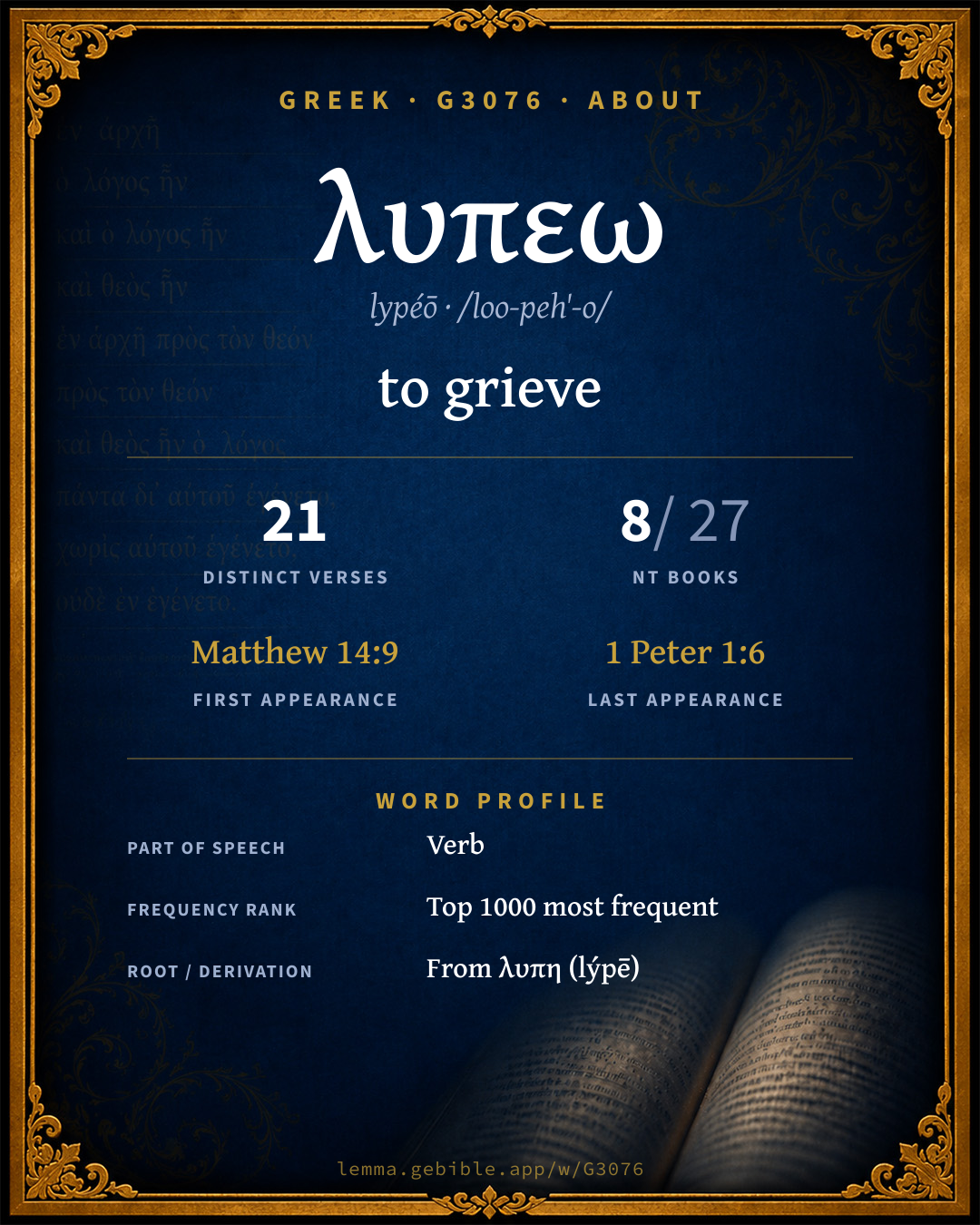
λυπέω
to grieve
‘to grieve’ is one of 4 main senses fuller range ↓
Full lexicon entry — Thayer's Greek Lexicon
From Thayer's Greek Lexicon
Where this word appears
See every Present-tense verb in the Greek New Testament →
Grammar key — what these labels mean
Part of speech
- Verb
- An action or state-of-being word.
Tense
- Aorist
- Action viewed as a simple whole, without regard to duration — often past (perfective aspect).
- Present
- Ongoing or general action in present time (imperfective aspect).
- Perfect
- A completed past action with continuing present results.
- Future
- Action expected in future time.
Voice
- Passive
- The subject receives the action.
- Active
- The subject performs the action.
Mood
- Indicative
- States a fact or asks a factual question (the mood of reality).
- Participle
- A verbal adjective (“writing,” “having written”).
- Infinitive
- A verbal noun (“to write”), unmarked for person or number.
- Subjunctive
- Expresses probability, purpose, or possibility (the mood of contingency).
- Imperative
- Expresses a command or request.
Case
- Nominative
- The case of the subject (and the predicate nominative).
Person
- 2nd person
- The one addressed (“you”).
- 3rd person
- The one spoken about (“he / she / it / they”).
- 1st person
- The speaker (“I / we”).
Gender
- Masculine
- Grammatically masculine.
Number
- Plural
- More than one.
- Singular
- One.
1 distinct verse where G3076 appears in the Future tense, across 1 book. Filtered view — show all forms. Click any verse to open its interlinear word-by-word view. Verse text shown in the World English Bible for context — . Each verse’s Greek form is shown with its reference; the English is not keyword-highlighted, since the data carries no word-level English alignment. Use “Compare translations” on any verse to read it across multiple English versions. This concordance covers the Greek New Testament; Septuagint (Greek Old Testament) occurrences of this word are not indexed here.
John 1 verse
About this entry
At a glance — auto-summarized from this page’s data, not written by a person. Every figure links to its source below. This summary describes the numbers; it doesn’t interpret them.
The Greek verb λυπεω centers on the idea of “to grieve.” Its English rendering has broadened — “sorry” classically, “sorrow” (Berean Standard Bible) and “grieved” (unfoldingWord Literal Text) in modern versions; see the renderings breakdown. Spanning 21 verses in 8 books, it ranks among the uncommon words of the Greek New Testament. 2 Corinthians dominates its distribution — 7 of 21 verses. Lexicons map it across 4 senses. For the data behind this summary, explore the sense tree and the renderings breakdown below.
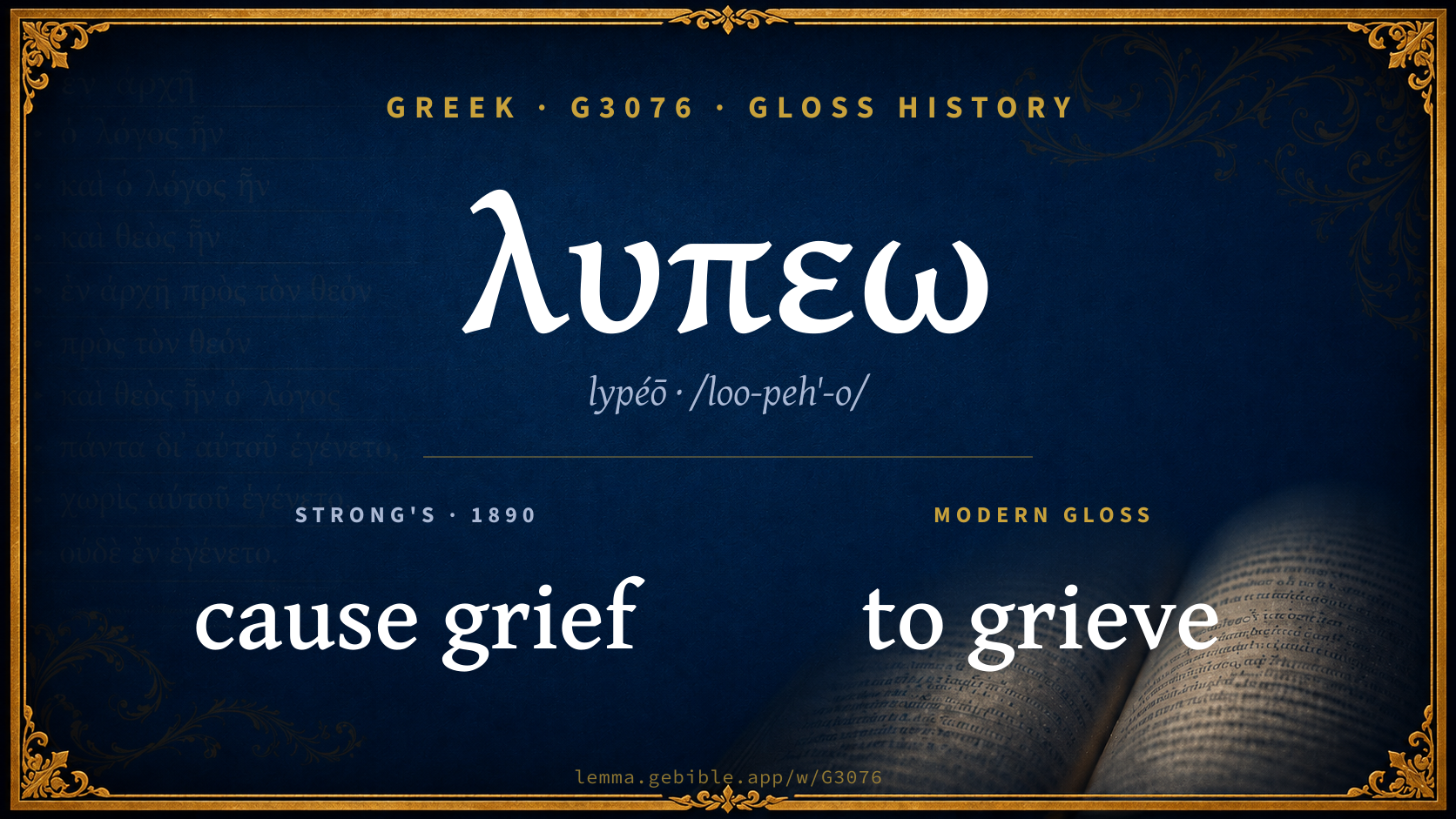
Gloss history
Strong's 1890 vs modern scholarship
About this word
Strong's G3076 catalogs a Greek word from the Greek New Testament.
These counts are not copied from any lexicon or concordance. They are computed here, from the morphology-tagged Greek New Testament. What Lemma adds →
- 21
- distinct verses
- The word appears in 21 distinct verses.
- 8 / 27
- NT books
- The word appears in 8 of 27 New Testament books.
- #513
- by frequency
- Top 1000 most frequent Greek words (rank 513 of 5,347 Greek words by occurrence).
View all 21 occurrences in the concordance →
Most concentrated in
- 2 Corinthians 7 verses 33%
- Matthew 6 verses 29%
- Mark 2 verses 10%
By section of the New Testament
By traditional corpus
Conventional, traditional groupings — biblical authorship is debated, so this is a traditional corpus grouping, not an authorship claim. Some books belong to more than one corpus (Luke is in both the Gospels and the Lukan corpus, and so on), so these shares overlap and need not total 100%. Each figure is a share of the word’s 21 distinct verses.
- Gospels 10 verses · 48%
- Pauline corpus 10 verses · 48%
- Johannine 2 verses · 10%
- General (Catholic) Epistles 1 verse · 5%
How translations render this word
Counts come from each version’s own published word-to-Strong’s tagging or interlinear alignment — an approximate guide to how each version renders this word, not a word-level alignment the data otherwise carries. Because each total is that version’s own tagged count, the per-version totals vary from one another and need not match the appearance or distinct-verse counts above. These counts may also differ from a printed concordance because Lemma counts each distinctly tagged rendering and does not collapse phrase taggings into a single head-word total. This is a fixed set of word-tagged versions (KJV, ASV, BSB, ULT) and does not change with the reading translation you choose elsewhere. Each version’s license is shown beside its name below (and on Sources).
- King James Version: Sorry 5×, Sorrowful 3×, Be sorrowful 2×
- American Standard Version: Sorrowful 4×, Sorry 4×, They were 3×
- Berean Standard Bible: Sorrow 5×, Grieve 2×
- unfoldingWord Literal Text: Grieved 5×, Being grieved 3×, Grieve 3×
King James Version Public Domain
Renders G3076 across 30 tagged occurrences — most commonly:
Plus 14 renderings that appear only once — usually multi-word phrases or single function words the recovered tagging swept in, not distinct renderings.
American Standard Version Public Domain
Renders G3076 across 33 tagged occurrences — most commonly:
Plus 15 renderings that appear only once — usually multi-word phrases or single function words the recovered tagging swept in, not distinct renderings.
Berean Standard Bible Public Domain
Renders G3076 across 26 tagged occurrences — most commonly:
Plus 19 renderings that appear only once — usually multi-word phrases or single function words the recovered tagging swept in, not distinct renderings.
unfoldingWord Literal Text CC BY-SA 4.0
Renders G3076 across 33 tagged occurrences — most commonly:
Plus 15 renderings that appear only once — usually multi-word phrases or single function words the recovered tagging swept in, not distinct renderings.
Senses in Thayer's
The 4 senses Thayer's distinguishes for this word, in lexicon order (not ranked by frequency or importance). The full entry — with sub-senses — is in the Lexicon Entry tab.
- to make sorrowful
- to affect with sadness, cause grief, to throw into sorrow
- to grieve, offend
- to make one uneasy, cause him a scruple
Word origin
Derived from λυπη (lýpē) (G3077) — grief.
From G3077 ; to distress ; reflexively or passively to be sad : - cause grief grieve be in heaviness (be) sorrow (-ful) be (make) sorry.
— Strong’s Exhaustive Concordance (1890), public domain.
Forms in the corpus
The 18 distinct written forms G3076 takes in the Greek New Testament, most frequent first — each parse links to that tense’s occurrences in the concordance.
Septuagint usage
The same Greek word λυπεω appears 32 times in the Greek Old Testament (Septuagint), across 29 verses in 17 books.
- 32
- LXX occurrences
- Tagged occurrences of this Greek word in the Septuagint.
- 29
- verses
- Distinct Septuagint verses containing this word.
- 17 / 39
- OT books
- The word appears in 17 of the 39 Old Testament books.
Sample Septuagint occurrences
- Genesis 4:5 λυπέω
- Deuteronomy 15:10 λυπέω
- 1 Samuel 29:4 λυπέω
- 2 Samuel 13:21 λυπέω
- 2 Kings 13:19 λυπέω
- Ezra 15:6 λυπέω
- Esther 1:12 λυπέω
- Job 31:39 λυπέω
- Psalms 54:3 λυπέω
- Proverbs 25:20 λυπέω
- Isaiah 8:21 λυπέω
- Jeremiah 15:18 λυπέω
Septuagint occurrences (same lexeme)
Every verse where the same Strong’s number (G3076) appears in the Greek Septuagint. Verse text shown in the World English Bible for context; the Greek form is the matched word — the English is not keyword-highlighted.
- Genesis 4:5 λυπέω but he didn't respect Cain and his offering. Cain was very angry, and the expression on his face fell.
- Genesis 45:5 λυπέω Now don't be grieved, nor angry with yourselves, that you sold me here, for God sent me before you to preserve life.
- Deuteronomy 15:10 λυπέω You shall surely give him, and your heart shall not be grieved when you give to him; because that for this thing Yahweh your God will bless you in all your work, and in all that you put your hand to.
- 1 Samuel 29:4 λυπέω But the princes of the Philistines were angry with him; and the princes of the Philistines said to him, Make the man return, that he may go back to his place where you have appointed him, and let him not go down with us to battle, lest in the battle he become an adversary to us: for with what should this [fellow] reconcile himself to his lord? should it not be with the heads of these men?
- 2 Samuel 13:21 λυπέω But when king David heard of all these things, he was very angry.
- 2 Samuel 19:3 λυπέω The people got them by stealth that day into the city, as people who are ashamed steal away when they flee in battle.
- 2 Kings 13:19 λυπέω The man of God was angry with him, and said, You should have struck five or six times: then had you struck Syria until you had consumed it, whereas now you shall strike Syria but thrice.
- Ezra 15:6 λυπέω
- Esther 1:12 λυπέω But the queen Vashti refused to come at the king's commandment by the chamberlains: therefore was the king very angry, and his anger burned in him.
- Esther 2:21 λυπέω In those days, while Mordecai was sitting in the king's gate, two of the king's chamberlains, Bigthan and Teresh, of those who kept the threshold, were angry, and sought to lay hands on the king Ahasuerus.
- Esther 6:12 λυπέω Mordecai came again to the king's gate. But Haman hurried to his house, mourning and having his head covered.
- Job 31:39 λυπέω If I have eaten the fruits of it without money, Or have caused the owners of it to lose their life:
- Psalms 54:3 λυπέω For strangers have risen up against me. Violent men have sought after my soul. They haven't set God before them. Selah.
- Proverbs 25:20 λυπέω As one who takes away a garment in cold weather, Or vinegar on soda, So is one who sings songs to a heavy heart.
- Isaiah 8:21 λυπέω They shall pass through it, sore distressed and hungry; and it shall happen that when they shall be hungry, they shall fret themselves, and curse by their king and by their God, and turn their faces upward:
- Isaiah 15:2 λυπέω They are gone up to Bayith, and to Dibon, to the high places, to weep: Moab wails over Nebo, and over Medeba; on all their heads is baldness, every beard is cut off.
- Isaiah 19:10 λυπέω The pillars [of Egypt] shall be broken in pieces; all those who work for hire [shall be] grieved in soul.
- Isaiah 32:11 λυπέω Tremble, you women who are at ease; be troubled, you careless ones; strip yourselves, and make yourselves naked, and gird [sackcloth] on your loins.
- Isaiah 57:17 λυπέω For the iniquity of his covetousness was I angry, and struck him; I hid [my face] and was angry; and he went on backsliding in the way of his heart.
- Jeremiah 15:18 λυπέω Why is my pain perpetual, and my wound incurable, which refuses to be healed? will you indeed be to me as a deceitful [brook], as waters that fail?
- Lamentations 1:22 λυπέω Let all their wickedness come before you; Do to them, as you have done to me for all my transgressions: For my sighs are many, and my heart is faint.
- Ezekiel 16:43 λυπέω Because you have not remembered the days of your youth, but have raged against me in all these things; therefore, behold, I also will bring your way on your head, says the Lord Yahweh: and you shall not commit this lewdness with all your abominations.
- Daniel 3:50 λυπέω
- Daniel 6:15 λυπέω Then these men assembled together to the king, and said to the king, Know, O king, that it is a law of the Medes and Persians, that no interdict nor statute which the king establishes may be changed.
- Daniel 6:19 λυπέω Then the king arose very early in the morning, and went in haste to the den of lions.
- Jonah 4:1 λυπέω But it displeased Jonah exceedingly, and he was angry.
- Jonah 4:4 λυπέω Yahweh said, "Is it right for you to be angry?"
- Jonah 4:9 λυπέω God said to Jonah, "Is it right for you to be angry about the vine?" He said, "I am right to be angry, even to death."
- Micah 6:3 λυπέω My people, what have I done to you? How have I burdened you? Answer me!
These are occurrences of the same Greek lexeme (G3076) in the Septuagint — not a translation of any one Hebrew word. The store carries no word-level Hebrew↔Greek alignment, so no Hebrew original is asserted here. Counts come from the recovered LXX Strong's tagging — high-frequency vocabulary is well covered, while rare or late forms may be untagged — so they reflect tagged occurrences and may slightly undercount.