
Micah 6:3

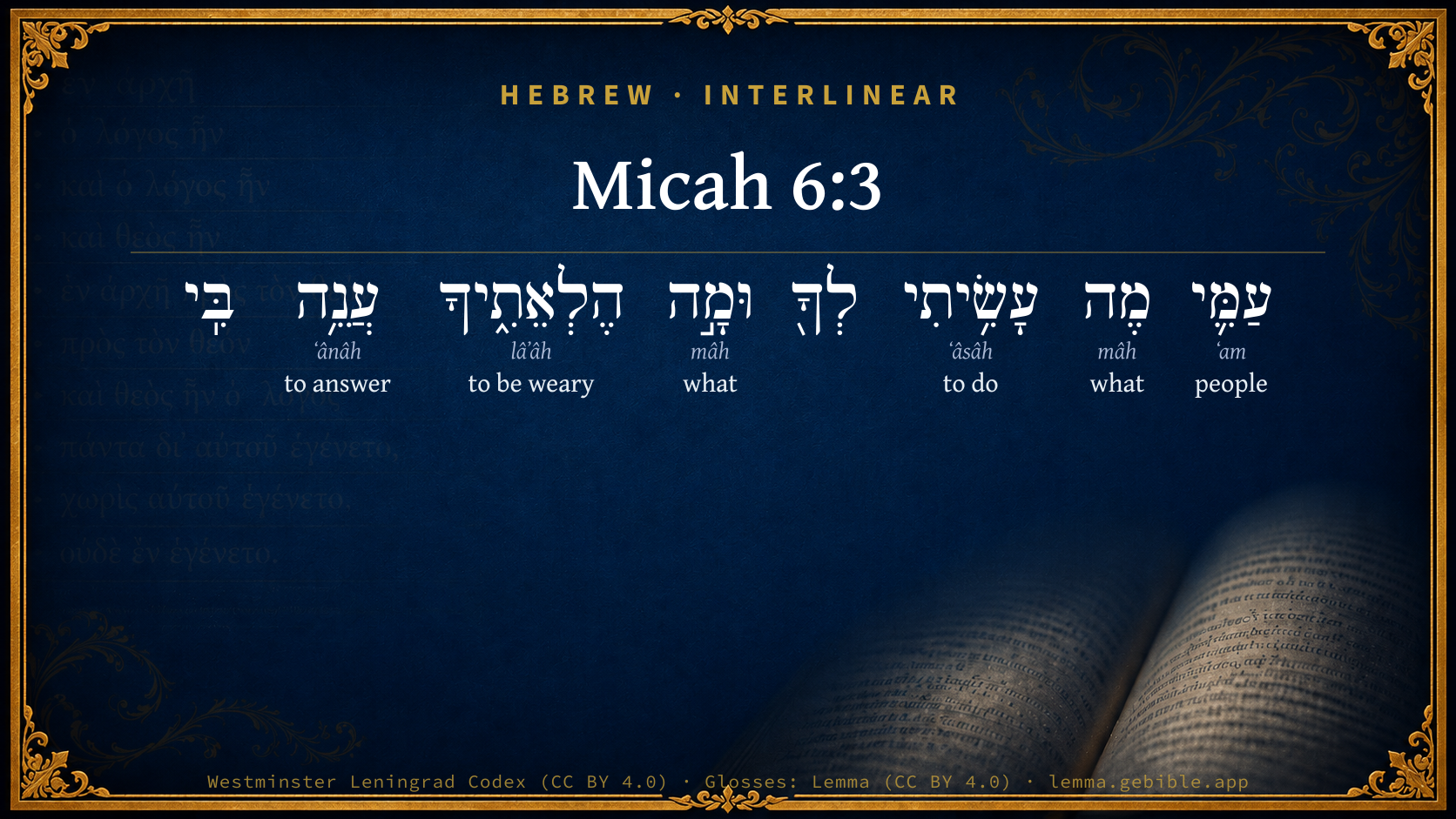
Hebrew (Westminster Leningrad Codex) Micah 6:3 appears in the Hebrew Old Testament. The text above is from the Westminster Leningrad Codex. Each word links to its Strong’s number, a concise gloss, and parsing drawn from the Open Scriptures Hebrew Bible morphology. Click any word for its full Brown-Driver-Briggs (BDB) entry.
Download image
Cite this verse

Micah 6:3 (World English Bible). Public Domain. Lemma interlinear Bible study tool, https://lemma.gebible.app/v/micah/6/3.

Show BibTeX & RIS
BibTeX
RIS
English Translation
My people, what have I done to you? How have I burdened you? Answer me!
World English Bible · Public Domain
Download a study sheet

One document with this verse’s original text, its word-by-word gloss line, the meaning frame, cross-references with their text, attributed commentary, and full source and license credits — printable, and it pastes into notes with its structure intact.

This verse Autodidact and up

Study sheet (.html) Plain text (.txt)

A passage Seminary Student

Up to 50 verses in one chapter. A passage sheet keeps up to 6 commentary sources and 12 cross-references per verse, in the order this page ranks them, and says so on the sheet whenever that leaves anything out. Ask for a single verse and you get the Autodidact verse sheet above.

Everything on this page stays free to read, with no account — the sheet is a download of what is already on screen, not access to it.

Want to remove ads? Support Godless Engineer
Compare translations 3

The same verse in 3 English versions, stacked beneath the original-language interlinear above. Click any original word for its lexicon entry.

Each is an independent rendering of the whole verse — the interlinear is not word-aligned to these translations.

Highlighted words mark where these versions differ — a whole-verse word diff, not a word-by-word alignment.

  • World English Bible Public Domain
    My people, what have I done to you? How have I burdened you? Answer me!
  • King James Version Public Domain
    O my people, what have I done unto thee? and wherein have I wearied thee? testify against me.
  • unfoldingWord Literal Text CC BY-SA 4.0
    “My people, what have I done to you, and how have I wearied you? Testify against me!

unfoldingWord Literal Text — © unfoldingWord, licensed CC BY-SA 4.0. Word-aligned USFM3 via Door43 (git.door43.org/unfoldingWord/en_ult).

Versions to compare (up to 4)

3 of 4 selected

Show all 18 translations

Every available English version of this verse, each an independent rendering of the whole verse.

  • World English Bible Public Domain
    My people, what have I done to you? How have I burdened you? Answer me!
  • Berean Standard Bible Public Domain
    ‘My people, what have I done to you? Testify against Me how I have wearied you!
  • Majority Standard Bible Public Domain
    ‘My people, what have I done to you? Testify against Me how I have wearied you!
  • King James Version Public Domain
    O my people, what have I done unto thee? and wherein have I wearied thee? testify against me.
  • American Standard Version (1901) Public Domain
    O my people, what have I done unto thee? and wherein have I wearied thee? testify against me.
  • Revised Version (1885) Public Domain
    O my people, what have I done unto thee? and wherein have I wearied thee? testify against me.
  • Geneva Bible (1599) Public Domain
    O my people, what haue I done vnto thee? or wherin haue I grieued thee? testifie against me.
  • Douay-Rheims (1899) Public Domain
    O my people, what have I done to thee, or in what have I molested thee? answer thou me.
  • Young's Literal Translation Public Domain
    O My people, what have I done to thee? And what -- have I wearied thee? Testify against Me.
  • Literal Standard Version CC BY-SA 4.0
    O My people, what have I done to you? And how have I wearied you? Testify against Me.
  • Unlocked Literal Bible CC BY-SA 4.0
    “My people, what have I done to you? How have I wearied you? Testify against me!
  • unfoldingWord Literal Text CC BY-SA 4.0
    “My people, what have I done to you, and how have I wearied you? Testify against me!
  • Darby Bible Public Domain
    O my people, what have I done unto thee? and wherein have I wearied thee? testify against me.
  • World Messianic Bible Public Domain
    My people, what have I done to you? How have I burdened you? Answer me!
  • Webster's Bible Public Domain
    O my people, what have I done to thee? and wherein have I wearied thee? testify against me,
  • Free Bible Version CC BY-SA 4.0
    My people, what have I done to you? What is it that I have done to make you tired of me?
  • Bible in Basic English Public Domain
    O my people, what have I done to you? how have I been a weariness to you? give answer against me.
  • JPS Tanakh (1917) Public Domain
    O My people, what have I done unto thee? And wherein have I wearied thee? Testify against Me.

Literal Standard Version (2020), Covenant Press — licensed CC BY-SA 4.0. Text via the HelloAO Bible API (eBible.org). Unlocked Literal Bible (unfoldingWord) — licensed CC BY-SA 4.0. Text via the HelloAO Bible API (eBible.org). unfoldingWord Literal Text — © unfoldingWord, licensed CC BY-SA 4.0. Word-aligned USFM3 via Door43 (git.door43.org/unfoldingWord/en_ult). Free Bible Version, Dr. Jonathan Gallagher — licensed CC BY-SA 4.0. Text via the HelloAO Bible API (eBible.org).

Word by word

More ways to search: Search by grammar → Find every occurrence → Compare this word →

Practice this passage: Drill this verse → Learn its vocabulary →

הֶלְאֵתִ֑יךָ
lâʼâh
H3811
“to be weary · you”
Verb, Hiphil, Perfect, 1st Person, Common, Singular + Suffix, Personal, 2nd Person, Masculine, Singular
Part of Speech
Verb
Stem
Hiphil
Form
Perfect
Person
1st Person
Gender
Common
Number
Singular
Full BDB Definition

Origin: a primitive root

TWOT: 1066

to be weary, be impatient, be grieved, be offended - (Qal) to be weary, be impatient - (Niphal) to be tired of something, weary oneself - (Hiphil) to weary, make weary, exhaust
  1. עַמִּ֛י ʻam H5971 “people · my” Noun, Common, Masculine, Singular, Construct + Suffix, Personal, 1st Person, Common, Singular
  2. מֶה mâh H4100 “what” Particle, Interrogative
  3. עָשִׂ֥יתִי ʻâsâh H6213 “to do” Verb, Qal, Perfect, 1st Person, Common, Singular
  4. וּמָ֣ה mâh H4100 “and · what” Conjunction + Particle, Interrogative
  5. עֲנֵ֥ה ʻânâh H6030 “answer” Verb, Qal, Imperative, 2nd Person, Masculine, Singular

About this verse

These counts appear in no published source. They are computed here, from the morphology-tagged text and Lemma’s own curated glosses. What Lemma adds →

8
words
5
distinct lemmas
Prophets
section

Notable vocabulary

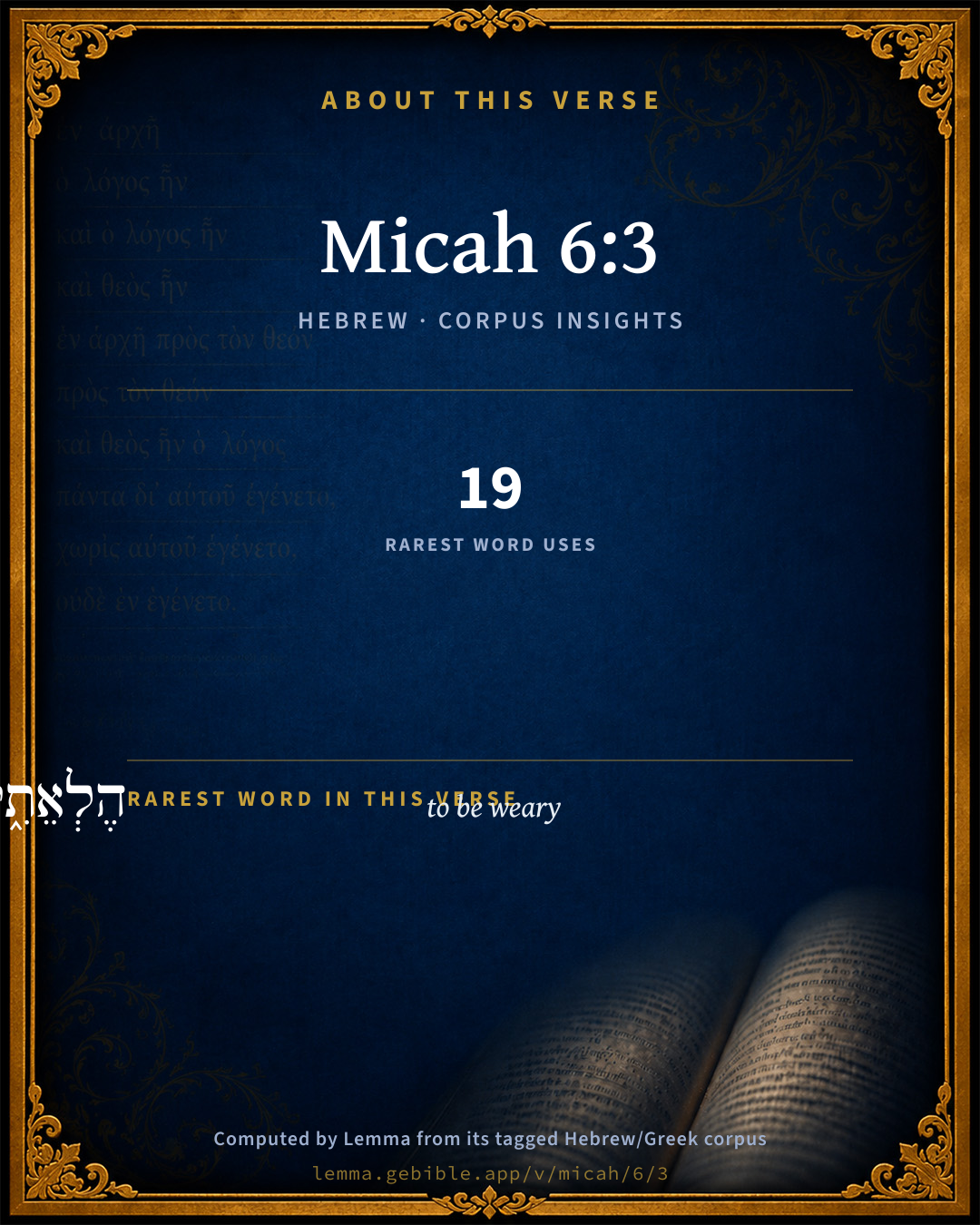
The rarest word here is הֶלְאֵתִ֑יךָ to be weary H3811 — appearing just 19 times in the whole Hebrew Bible.

Shared distinctive vocabulary

הֶלְאֵתִ֑יךָ to be weary H3811 occurs in 18 verses of the Hebrew Bible. Also found in:

Grammatical profile

  • 3 verbs
  • 1 noun
  • 2 prepositions
  • 2 particles

Verb forms

  • עָשִׂ֥יתִי Qal · Perfect
  • הֶלְאֵתִ֑יךָ Hiphil · Perfect
  • עֲנֵ֥ה Qal · Imperative

Repetition

A word recurs within this verse — often emphatic in Hebrew:

Hebrew & Septuagint length

In English translation the verse runs 15 words from the Hebrew and 23 from the Septuagint (LXX English) — the Septuagint runs noticeably longer here. See the side-by-side →

A rough comparison of the two English renderings, which tokenize alike — not a word-level alignment.

Word counts can differ between the Hebrew and the Greek without any difference in meaning — e.g. the Hebrew direct-object marker אֵת has no separate Greek word, and Greek often adds the article ὁ.

Cross-references

10

Topical passages linked to Micah 6:3 in the Treasury of Scripture Knowledge — connected by theme and wording, ordered by reader-vote popularity; previews shown in the World English Bible.

  • Jeremiah 2:5 thus says Yahweh, What unrighteousness have your fathers found in me, that they have gone far from me, and have walked after vanity, and are become vain?
  • Isaiah 43:22–23 Yet you have not called on me, Jacob; but you have been weary of me, Israel.
  • Psalms 81:13 Oh that my people would listen to me, That Israel would walk in my ways!
  • Jeremiah 2:31 Generation, see the word of Yahweh. Have I been a wilderness to Israel? or a land of thick darkness? why say my people, We are broken loose; we will come no more to you?
  • Psalms 50:7 "Hear, my people, and I will speak; Israel, and I will testify against you. I am God, your God.
  • Micah 6:5 My people, remember now what Balak king of Moab devised, And what Balaam the son of Beor answered him from Shittim to Gilgal, That you may know the righteous acts of Yahweh."
  • Romans 3:4–5 May it never be! Yes, let God be found true, but every man a liar. As it is written, "That you might be justified in your words, And might prevail when you come into judgment."
  • Romans 3:19 Now we know that whatever things the law says, it speaks to those who are under the law, that every mouth may be closed, and all the world may be brought under the judgment of God.
  • Psalms 51:4 Against you, and you only, have I sinned, And done that which is evil in your sight; That you may be proved right when you speak, And justified when you judge.
  • Psalms 81:8 "Hear, my people, and I will testify to you, Israel, if you would listen to me!

Cross-references courtesy of OpenBible.info (CC BY 4.0).

Hebrew and Greek witnesses Masoretic Hebrew ↔ Greek Septuagint

The same verse in the two great witnesses to the Old Testament, shown verse-for-verse.

Here the Septuagint runs noticeably longer than the Hebrew — LXX2012 (modern English Septuagint) 23 words vs World English Bible 15. A rough length comparison of the two English translations, not a word-level alignment — read both below.

These are two independent witnesses, not word-aligned to each other, and the Septuagint is shown in lemma (dictionary) form.

Hebrew Micah 6:3 Masoretic · Westminster Leningrad Codex

עַמִּ֛י מֶה עָשִׂ֥יתִי לְךָ֖ וּמָ֣ה הֶלְאֵתִ֑יךָ עֲנֵ֥ה בִּֽי

My people, what have I done to you? How have I burdened you? Answer me!

World English Bible · Public Domain

Greek LXX Micah 6:3 Septuagint · lemma form

λαός ἐγώ τίς ποιέω σύ ἤ τίς λυπέω σύ ἤ τίς παρα ἐνὀχλέω σύ ἀποκρίνω ἐγώ

O my people, what have I done to you? or wherein have I grieved you? or wherein have I troubled you? answer me.

LXX2012 (modern English Septuagint) · Public Domain

Hebrew: Westminster Leningrad Codex (CC BY 4.0). Greek: Septuagint (public domain); English from LXX2012 (modern English Septuagint) (Public Domain). How the Septuagint differs from the Hebrew →

Targum (Aramaic paraphrase)

1

The Targum is the ancient Jewish Aramaic paraphrase of the Hebrew Scriptures — an interpretive translation, not the Hebrew text itself. Onkelos (literal) and Pseudo-Jonathan (expansive) render the Torah, and Jonathan the Prophets. Coverage is partial: where no permissively-licensed English translation exists for a verse, only the Aramaic is shown. This is verse-level text, not a word-by-word alignment to the Hebrew.

  1. Targum Jonathan Prophets (Joshua–Malachi)
    עַמִי מַה טָבָא אֲמָרֵית לְמֶעְבַּד לָךְ וְלָָא עֲבֵידַת אוֹ מְרוֹעָא קַשְׁיָא אַסְגֵיתִי עֲלָךְ אַסְהֵיד בִּי:

    (no public-domain English translation for this verse)

    Targum Jonathan — Aramaic: “Mikraot Gedolot” (public domain). English: “Sefaria Community Translation” (CC0 1.0 (public-domain dedication)); “London "Chaldee Paraphrase," 1871” (public domain). Text via Sefaria.

Commentary

Notes on Micah 6:3 from classic Christian and Jewish commentators (each source and its license shown beneath its notes). The classic Christian expositions comment on the surrounding passage and are grouped to its opening verse, so a note may address several verses; the Jewish commentaries on the Tanakh (Rashi and others) are per-verse, so they appear only where the commentator wrote on this verse.

Lemma curates 59 commentaries, every one of them public domain or Creative Commons licensed, each selected and text-cleaned for this edition rather than reprinted as found. About our sources →

Trapp's Complete Commentary

John Trapp

Mic 6:3 O my people, what have I done unto thee? and wherein have I wearied thee? testify against me.

Ver. 3. O my people, what have I done unto thee?] Or rather, what have I not done to do thee good? "O generation, see ye the word of the Lord," and not hear it only; was ever anything more evidencing and evincing than what I now allege? "Have I been a wilderness unto Israel, a land of darkness?" Jer 2:31. May I not well say unto you, as Themistocles did to his ungrateful countrymen, What? are ye weary of receiving so many benefits from one man? But say, What harm have I ever done you? and wherein have I wearied you, or been troublesome to you? unless it be by daily loading you with lovingkindnesses, Psa 68:19, and bearing with your provocations? Forgive me that injury, 2Co 12:13.

Testify against me] "Put me in remembrance, let us plead together, declare thou against me, that thou mayest be justified," Isa 43:26. See here, first, with what meekness and mildness God proceedeth against sinners: so Isa 5:3. Iudicate quaeso. See, next, that God is content, for our better confliction, to submit his courses unto scanning, and to bring his proceedings with us to a trial before he pass sentence; that "he might be justified when he speaketh, and cleared when he judgeth," Psa 51:4. Here he wills them to plead the cause with him, as it were at even hand; offering to make answer to whatsoever they could object or lay to his charge. Seipsum quasi reum sistit (Gaulther). He maketh himself the defendant, and bids them put in their bill of complaint against him, freely and without fear. This is stupenda sane dignatio, a wonderful condescension indeed. Should he use martial law against us, and as soon as ever we offend (like Draco) write his laws in blood upon us (as one well saith), it were but just and right. But for him to reason and plead with us about the justice of his cause before he proceeds to judgment, this deserves admiration and acknowledgment in the highest degree. O the depth!

John Trapp, A Commentary or Exposition upon All the Books of the Old and New Testament (1647–1656) — public domain. Text from a community e-Sword module.

Joseph Benson's Commentary

Mic 6:3-4. O my people, what have I done unto thee? — What injustice or unkindness? Wherein have I wearied thee? — What grievous, burdensome impositions have I laid upon thee? Or, what have I done, or said, or enjoined, to cause thee to be weary of me? The words allude to the forms of courts of justice, wherein actions are tried between man and man. God allows his people to offer any plea which they could in their own behalf. For I brought thee out of Egypt, &c. — Here, on the other hand, God puts them in mind of the great favours he had bestowed upon them in delivering them out of the Egyptian bondage, by the conduct of Moses and Aaron, and Miriam their sister, who is here mentioned as having been endued with the spirit of prophecy, and raised up to be an assistant to her brothers, and an example and counsellor to the women.

Joseph Benson's Commentary on the Old and New Testaments (1811–1818) — public domain. Text from a community e-Sword module.

The Preacher's Complete Homiletical Commentary

Joseph S. Exell (gen. ed.)

CRITICAL NOTES.]

Mic_6:3. What] opens the suit. Israel, tired with the dealings of God, had backslided from him. Wearied] By demanding what is irksome (Isa_43:23; 1Jn_5:3); or failing to perform what is promised (Jer_2:31).

Mic_6:4. For] God had done good only, deliverance from Egypt and guidance by Moses the chief proofs of it.

Mic_6:5. Now] A very tender word, like our “do now remember,” or “do remember,” beseeching instead of commanding [Pusey]. The special period mentioned and the wonderful acts performed in it display the justice, mercy, and righteousness of God (Jdg_5:11; Psa_24:5).

Mic_6:6.] Remembrance calls ingratitude to mind, and leads to inquiries. Come] (Deu_23:5.) God enthroned on high (Isa_57:15; Psa_115:3. Burnt] Prescribed Leviticus 1. Calves] Thought to be most important (Lev_9:2-3).

Mic_6:7.] “In case of calves value is heightened by quality, in rams by quantity” [Keil]. Climax culminates in first-born. lint this only, of external, heathen origin, atones for sin by sin.

Mic_6:8.] God has showed them in the moral law that he requires; not outward sacrifices of any kind; but the fulfilment of moral obligations in three ways—do justly, love mercy (which are the sum of the second table), and walk humbly, i.e. as a holy nation should, in fellowship with God (cf. Deu_8:14; Deu_10:12; 1Sa_15:22).

WEARINESS IN GOD’S SERVICE UNJUSTIFIABLE.—Mic_6:3-5

Many, like Israel, are weary in the service of God, complain of their lot, and seek to return to the world. God pleads with such, proves that their conduct is unjustifiable. No wrong has been done to them; on the other hand, they have sinned against God. “Wherein have I wearied thee?”

I. God’s claims upon men are just. “O my people.” Israel were God’s people by covenant relationship. God chose them and they promised to serve him. All men are God’s by creation and providence. They are raised to this rank and gifted in their mind by him. Hence God has a just claim upon their homage and life. To refuse is ingratitude and insult.

II. God’s commands are reasonable. God does not demand what is impossible or unreasonable. He does not, like an Eastern tyrant, compel men to serve him with rigour and hardships. God might weary them by unlawful requirements (Isa_43:23); or unfulfilled promises (Jer_2:31); but they weary him with their iniquities (Isa_43:24). “His commands are not grievous,” why then complain or get wearied? “What iniquity have your fathers found in me?”

III. God’s kindness is remarkable. “I brought thee up out of the land of Egypt,” &c Israel were specially blessed.

1. They were redeemed from bondage. “And redeemed thee out of the house of servants.” Instead of a nation of slaves they were priests to God.

2. They were guided in the wilderness. “I sent before thee Moses, Aaron, and Miriam.” They had instruction, intercession, and praise.

3. They were defended in their progress. The power of Balak and the device of Balaam were frustrated, and the curse was turned into a blessing. From Shittim to Gilgal their progress was safe and triumphant. God could have done no more for them, yet they “forgot God their Saviour, who had done great things in Egypt; wondrous things in the land of Ham.” In the review of our life we see goodness and mercy, and abundant reason for gratitude. In deliverance from trouble and the destruction of the enemy, we may read the fulfilment of the promise and the display of the righteousness of God. “Oh that men would praise the Lord for his goodness, and for his wonderful works to the children of men!”

MAN’S QUESTIONS AND GOD’S ANSWERS.—Mic_6:6-8

Come before God not merely with respect, like bowing to a superior—but come with acceptance, in honour and duty (Deu_23:5; Psa_105:2). In whatever spirit these words were uttered, they indicate the importance and necessity of coming to God. They are the recurring question, pressing upon all ages and all individuals—“How shall man be just with God?” They set forth God’s answer to the question and specify the way of acceptance before him.

I. Man’s questions. “Wherewith shall I come,” &c. Convicted by the previous appeal the people inquire how Jehovah may be appeased.

1. By external forms? “With burnt offerings—with calves of a year old?” Men naturally cling first to outward forms, trust to customary rites to heal the schism of the soul. They are liberal in their offerings, zealous in their profession, and ready to sacrifice anything for peace of conscience. But the blood of bulls and of goats cannot take away sin.

2. By human sacrifices? “Shall I give my firstborn?” Nations have “burnt their children in the fire” (2Ki_17:31). They have been driven to desperation in their sin and superstitions, and sought to please God by inventions of their own. Jewish rites and heathen sacrifices were alike in vain. No spotless beast nor human blood could quench the fire of the soul. “There was wanting,” says Porphyry, “some universal method of delivering men’s souls, which no sect of philosophy had ever yet found out.”

II. God’s answer to man’s questions. God has revealed his will to man and showed what is required from him.

1. It is revealed in the written word of God. “He hath showed thee, O man.” In the Scriptures we have an answer to the questions of the soul and the problems of life. Without the Bible man is in the dark. The world by wisdom knew not God. The light of nature is insufficient, and the doings of providence say, It is not in me. We have no need to guess nor grope the way, “the word is nigh unto thee.”

2. It is declared by the servants of God. The prophet plainly declares what God requires. Nothing ceremonial, nothing impracticable. Three things are specially mentioned.

(1) To do justly. Not mere profession, but practice. Justice to God and integrity to man in all our dealings. God’s religion destroys injustice and oppression. We must do injury to none, but right to all. Render to all their due.

(2) To love mercy. We must not only be just, but kind to all. Our mercy, like God’s, must be allied with equity. We must not merely show mercy but love and delight in mercy. Mercy gives more than justice demands. The hard exacting man is not a child of God. “Be ye therefore merciful, as your Father also is merciful.”

(3) To walk humbly with God. To walk with God implies reconciliation, faith, and constant intercourse (Gen_17:1; Heb_11:5). This is the essence of religion and the whole duty of man (Ecc_12:13). This is what God requires from us. The heart, not outward forms; sincerity and truth, not fair profession. “And now, Israel, what doth the Lord thy God require of thee, but to fear the Lord thy God, to walk in all his ways, and to love him, and to serve the Lord thy God with all thy heart and with all thy soul?”

IS IT NOT TRUE.—Mic_6:6-8

Our knowledge of good and evil comes from God. Conscience uninstructed by him is useless. Some things which only seem to be good are sought after most diligently by men who are strictly conscientious. Other things good in themselves, which seem undesirable, are eschewed by the same persons. Human conscience is a depraved conscience. In the text we read the doctrine that God has showed to man that which is both acceptable to himself and profitable to us.

I. The revelation. He hath showed,

1. “What he has revealed. Himself as the chief good. His attributes a subject for praise. His service delightful employment. His favour of infinite value.

2. How he has revealed these things.

(1) By nature. Here he faintly exhibits somewhat of himself.

(2) By history, especially inspired history.

(3) By Jesus Christ. Whatever nature or history has taught, by Jesus is amplified and confirmed. By him we behold the Father’s loving-kindness, tender mercy, forbearing grace.

(4) By our own experience. We are convinced of the blessedness of holiness, of justice, of a humble walk with God; indeed of everything the Lord has declared is good.

II. The requisition. God does not show us what is good merely to enlarge our knowledge, but to insure our service. Every good thing if rightly used redounds to his glory.

1. He requires us to demonstrate our knowledge. The light must not be put under a bushel. The man who hid his Lord’s money was condemned.

2. He requires us to display this in a particular way.

(1) To do justly. It is not enough to speak fairly. Unpractical religion is unscriptural religion.

(2) To love mercy. It is not enough to do merely from a sense of duty. We must delight in the things of God.

(3) To walk humbly with thy God. Nor does God require deeds of justice and love of mercy, without dispensing that grace without which these things can exist. In order to do justly we are invited to walk with God, deserving his justice, receiving his mercy. As a little child, observe the Father’s practice, and as far as you can do like him [Stems and Twigs].

HOMILETIC HINTS AND OUTLINES

Mic_6:4-5. Remember, &c. I. God’s dealings with his people attest—

1. His love;

2. His faithfulness; and

3. His power. II. These dealings are often forgotten. This displays,

1. Thoughtlessness, and

2. Ingratitude. “Micah speaks by a rare idiom of the righteousnesses of the Lord, each act of mercy being a separate effluence of his righteousness. The very names of the places suggest the righteous acts of God, the unrighteous of Israel” [Pusey].

Mic_6:8. Showed good.

1. The thing desired. Good. “Who will show us any good?” Righteousness, love, justice, and humility. II. The method of getting it. God reveals it, hath showed thee. It is not a discovery of man, &c. “Do justly. To do judgment are, chiefly, all acts of equity; to love mercy, all deeds of love. Judgment is what right requires; mercy, what love. Yet, secondarily, to do judgment is to pass righteous judgment in all cases; and so, as to others, judge not according to the appearance, but judge righteous judgment; and as to one’s self also. Judge equitably and kindly of others, humbly of thyself. He addeth, love mercy; being merciful out of love, not of necessity, for God loveth a cheerful giver (2Co_9:7). These acts contain the whole duty of man, corresponding with and formed upon the mercy and justice of God (Psa_101:1; Psa_61:7). All which is due, any how, or in any way, is of judgment; all which is free toward man, although not free toward God, is of mercy. There remains, walk humbly with thy God; not bow thyself only before him, as they had offered (Mic_6:6); nor, again, walk with him only, as did Enoch, Noah, Abraham, Job; but walk humbly (lit. bow down the going). Yet still with thy God; never lifting up thyself, never sleeping, never standing still, but ever walking on, yet ever casting thyself down; and the more thou goest on in grace, the more cast thyself down, as our Lord saith, Luk_17:10” [Pusey].

A good man, like a good angel, is ever in God’s presence, and must therefore walk worthy of the vocation wherewith he is called (Eph_4:1-2), with all modesty of demeanour, especially when he draweth nigh to God in holy exercises. Then it must be his care to exercise three-fold humility. First precedent: before he sets upon God’s service, he must in heart devote and dedicate all that he is and hath as a due debt to the Almighty, saying with David, It is of thine own, Lord (1Ch_29:14). The second is concomitant; when in the performance of good duties he hath grace (this lovely grace of humility especially), “whereby he may serve God acceptably” (Heb_12:28); which is an awful respect to the Divine Majesty with whom we have to do (Heb_4:13). The third is subsequent; when having done his best he is dejected with a sense of his failings, and looking on his plumes he is abashed before God. As many as walk according to this rule, peace be on them, and mercy, and upon the Israel of God (Trapp).

Walk humbly.

1. In prosperity; for God is our benefactor. Everything comes from him.

2. In adversity; for he corrects in wisdom and truth.

3. In all circumstances of life; for he disposes our lot. We are dependent creatures. Our times are in his hands. Wait upon God. He will renew your strength and guide your life.

To doubt thy goodness would be base

Ingratitude in me:

Past favours shall renew my hopes,

And fix my faith in thee.

ILLUSTRATIONS TO CHAPTER 6

Mic_6:3-5.Well fare their hearts who will not only wear out their shoes, but also their feet, in God’s service, and yet gain not a shoe latchet thereby [Thos. Fuller].

Remember. Wherever thou be, let the voice of God be still in thine ear. My son, return inwardly to thy heart, abstract thyself from all things, and mind me only [Leighton].

Mic_6:6-8. God desires not merely outward virtue, but inward purity, and the penitent’s sense of sin is greatly deepened as with astonishment he discovers this truth, and how far he is from satisfying the Divine command. Always has the Holy One estimated men by their inner nature, and not by their outward professions; to him the inward is as visible as the outward, and he rightly judges that the essential character of an action lies in the motive of him who works it [Spurgeon].

The Preacher's Complete Homiletical Commentary (gen. ed. Joseph S. Exell; Funk & Wagnalls, c. 1892) — public domain (pre-1929). A full-Bible homiletical/sermon-outline anthology covering 65 of 66 books (2 John is absent from the source module). Text from a community e-Sword module.

Keil & Delitzsch

C. F. Keil & F. Delitzsch

Mic 6:3-5 open the suit. Mic 6:3. "My people! what have I done unto thee, and with what have I wearied thee? Answer me. Mic 6:4. Yea, I have brought thee up out of the land of Egypt, redeemed thee out of the slave-house, and sent before thee Moses, Aaron, and Miriam. Mic 6:5. My people! remember now what Balak the king of Moab consulted, and what Balaam the son of Beor answered him from Shittim to Gilga; that thou mayest discern the righteous acts of Jehovah." The Lord opens the contest with the question, what He has done to the nation, that it has become tired of Him. The question is founded upon the fact that Israel has fallen away from its God, or broken the covenant. This is not distinctly stated, indeed; but it is clearly implied in the expression הלאתיך, What have I done, that thou hast become weary of me? לאה, in the hiphil, to make a person weary, more particularly to weary the patience of a person, either by demands of too great severity (Isa 43:23), or by failing to perform one's promises (Jer 2:31). ענה בי, answer against me, i.e., accuse me. God has done His people no harm, but has only conferred benefits upon them. Of these He mentions in Mic 6:4 the bringing up out of Egypt and the guidance through the Arabian desert, as being the greatest manifestations of divine grace, to which Israel owes its exaltation into a free and independent nation (cf. Amo 2:10 and Jer 2:6). The kı̄ (for) may be explained from the unexpressed answer to the questions in Mic 6:3 : "Nothing that could cause dissatisfaction with me;" for I have done nothing but confer benefits upon thee. To set forth the leading up out of Egypt as such a benefit, it is described as redemption out of the house of bondage, after Exo 20:2. Moreover, the Lord had given His people prophets, men entrusted with His counsels and enlightened by His Spirit, as leaders into the promised land: viz., Moses, with whom He talked mouth to mouth, as a friend to his friend (Num 12:8); and Aaron, who was not only able as high priest to ascertain the counsel and will of the Lord for the sake of the congregation, by means of the "light and right," but who also, along with Moses, represented the nation before God (Num 12:6; Num 14:5, Num 14:26; Num 16:20; Num 20:7 ff., and 29). Miriam, the sister of the two, is also mentioned along with them, inasmuch as she too was a prophetess (Exo 15:20). In Mic 6:5 God also reminds them of the other great display of grace, viz., the frustration of the plan formed by the Moabitish king Balak to destroy Israel by means of the curses of Balaam (Numbers 22-24). יעץ refers to the plan which Balak concocted with the elders of Midian (Num 22:3 ff.); and ענה, Balaam's answering, to the sayings which this soothsayer was compelled by divine constraint to utter against his will, whereby, as Moses says in Deu 23:5-6, the Lord turned the intended curse into a blessing. The words "from Shittim (Israel's last place of encampment beyond Jordan, in the steppes of Moab; see at Num 22:1 and Num 25:1) to Gilgal" (the first place of encampment in the land of Canaan; see at Jos 4:19-20, and Jos 5:9) do not depend upon זכר־נא, adding a new feature to what has been mentioned already, in the sense of "think of all that took place from Shittim to Gilgal," in which case זכר־נא would have to be repeated in thought; but they are really attached to the clause וּמה עבה וגו, and indicate the result, or the confirmation of Balaam's answer. The period of Israel's journeying from Shittim to Gilgal embraces not only Balak's advice and Balaam's answer, by which the plan invented for the destruction of Israel was frustrated, but also the defeat of the Midianites, who attempted to destroy Israel by seducing it to idolatry, the miraculous crossing of the Jordan, the entrance into the promised land, and the circumcision at Gilgal, by which the generation that had grown up in the desert was received into the covenant with Jehovah, and the whole nation reinstated in its normal relation to its God. Through these acts the Lord had actually put to shame the counsel of Balak, and confirmed the fact that Balaam's answer was inspired by God.

(Note: With this view, which has already been suggested by Hengstenberg, the objections offered by Ewald, Hitzig, and others, to the genuineness of the words "from Shittim to Gilgal," the worthlessness of which has been demonstrated by Caspari, fall to the ground.)

By these divine acts Israel was to discern the tsidqōth Yehōvâh; i.e., not the mercies of Jehovah, for tsedâqâh does not mean mercy, but "the righteous acts of Jehovah," as in Jdg 5:11 and Sa1 12:7. This term is applied to those miraculous displays of divine omnipotence in and upon Israel, for the fulfilment of His counsel of salvation, which, as being emanations of the divine covenant faithfulness, attested the righteousness of Jehovah.

Keil & Delitzsch — Biblical Commentary on the Old Testament (1861–1891) — public domain (CC PDM 1.0). Text via the HelloAO Bible API. (Old Testament only.)

Tyndale Open Study Notes

Tyndale Open Resources

6:3 tired of me: The Lord asks rhetorically if he has done something to turn Israel away from him. But their contempt for God arose from their own ingratitude (6:4-5).

Tyndale Open Study Notes — © Tyndale Open Resources, licensed CC BY-SA 4.0. Text via the HelloAO Bible API.

Jamieson, Fausset & Brown

Robert Jamieson, A. R. Fausset & David Brown

my people--the greatest aggravation of their sin, that God always treated them, and still treats them, as His people.

what have I done unto thee?--save kindness, that thou revoltest from Me (Jer 2:5, Jer 2:31).

wherein have I wearied thee?--What commandments have I enjoined that should have wearied thee as irksome (Jo1 5:3)?

Jamieson, Fausset & Brown — Commentary Critical and Explanatory on the Whole Bible (1871) — public domain (CC PDM 1.0). Text via the HelloAO Bible API.

Adam Clarke's Commentary

Verse 3. O my people, what have I done unto thee?] They are called to show why God should not pronounce sentence upon them. This condescension is truly astonishing! God appears to humble himself to his creatures. You have acted basely, treacherously, and ungratefully to me; this had already been proved by the prophets. What cause have I given you for such conduct? I have required a religious service from you; but have I wearied you by a fatiguing round of difficult duties? If I have, now testify against me; and you shall be first heard, and your plea received, if it be reasonable and good. They are silent; and God proceeds, and states what he has done for them.

Adam Clarke's Commentary on the Bible (1810–1826) — public domain. Text from a community e-Sword/MySword module.

John Calvin's Commentaries

Here God, in the first place, offers to give a reason, if he was accused of any thing. It seems indeed unbecoming the character of God, that he should be thus ready as one guilty to clear himself: but this is said by way of concession; for the Prophet could not otherwise express, that nothing that deserved blame could be found in God. It is a personification, by which a character; not his own, is ascribed to God. It ought not therefore to appear inconsistent, that the Lord stands forth here, and is prepared to hear any accusation the people might have, that he might give an answer, My people! what have I done? By using this kind expression, my people, he renders double their wickedness; for God here descends from his own elevation, and not only addresses his people, in a paternal manner, but stands as it were on the opposite side, and is prepared, if the people had anything to say, to give answer to it, so that they might mutually discuss the question, as it is usually done by friends. Now the more kindly and indulgently the Lord deals with his people, the more enhanced, as I have said, is their sin.

He says first, What have I done to thee? that is, what hast thou to accuse me with? He adds In what have I caused trouble to thee? or, In what have I been troublesome to thee? Testify, he says, against me. This testifying was to be made to the mountains and hills; as though he said, “I am ready to plead my cause before heaven and earth; in a word, before all my creatures.” Some render the passage, “Answer me:” and ענה, one, is also to answer; but the context requires the former meaning; for God conceded so much liberty to the Jews, that they might bring forward against him any fault they had to allege. Testify, he says, against me; that is, there are witnesses present; make public now thy case by stating particulars, I am ready for the defense. We hence see the truth of what I have before stated, — that a character, not his own is ascribed to God: but this is done by way of concession. He afterwards adds —

John Calvin's Commentaries (1540-1563) — public domain. Text from the Calvin Translation Society English edition (1840s-50s) via the Christian Classics Ethereal Library (ccel.org). Calvin's coverage is partial (roughly two-thirds of the Bible); uncommented books and verses are honest gaps, never fabricated. The 19th-century editor's footnotes and remarks are omitted so the notes are faithfully Calvin's own voice.

The Cambridge Bible for Schools and Colleges

gen. ed. J. J. S. Perowne

3. O my people] Jehovah opens the controversy. He assumes, what is too patent for denial, that Israel has fallen away from his God.

wherein have I wearied thee] The requirements of God’s service were not wearisome (as Mic_6:6-7 will show). As long as justice, mercy, and humility are present, Jehovah asks no more. A splendid ceremonial is the luxury of worship, not a necessity.

The Cambridge Bible for Schools and Colleges (gen. ed. J. J. S. Perowne; Cambridge University Press, 1878–1918) — public domain. Text from a community e-Sword module.

John Gill's Exposition

O my people,.... These are the words of the Lord himself by the prophet, expressing his strong affection to the people of Israel, of which his goodness to them was a full proof, and this was an aggravation of their ingratitude to him; they were his people, whom he had chosen for himself above all people of the earth; whom he had redeemed from the house of bondage, had distinguished them by his layouts, and loaded them with his benefits, and yet they sinned against him:

what have I done unto thee? what evil things, what injuries to provoke to such usage? "what iniquity have you", or "your fathers, found in me", to treat me after this manner? have I been "a wilderness", or "a land of darkness", to you? Jer 2:5; have I withheld or denied you anything that was for your good? The Targum is,

"O my people, what good have I said I would do unto thee, and I have not done it?''

all that the Lord had promised he had performed; not one good thing had failed he had spoken of; how much good, and how many good things, had he done for them? nay, what good things were there he had not done for them? and what more could be done for them than what had been done? and yet they sinned against him so grossly; see Isa 5:4;

and wherein have I wearied thee? what heavy yoke have I put upon thee? what grievous commandments have I enjoined thee? is there anything in my service, any duty, too hard, severe, or unreasonable? are the sacrifices required burdensome? "have I caused thee to serve with an offering, and wearied thee with incense?" is there any just reason to say of these things, "what a weariness is it?" See Isa 43:23;

testify against me; declare it publicly, if any good thing has been wanting, or any evil thing done: thus the Lord condescends to have the case fairly debated, and everything said that could be said in their favour, or against him: astonishing condescension and goodness!

John Gill's Exposition of the Whole Bible (1746–1763) — public domain (CC PDM 1.0). Text via the HelloAO Bible API.

Albert Barnes' Notes on the Bible

O My people - This one tender word, twice repeated , contains in one a whole volume of reproof. It sets before the eyes God’s choice of them of His free grace, and the whole history of His loving-kindness, if so they could be ashamed of their thanklessness and turn to Him. “Mine,” He says, “ye are by creation, by Providence, by great deliverances and by hourly love and guardianship, by gifts of nature, the world, and grace; such things have I done for thee; what against thee? ‘what evil have I done unto thee?’” “Thy foot did not swell these forty years” Deu 8:4, for He upbears in all ways where He leads. Wherein have I wearied thee? for “His commandments are not grievious” 1Jo 5:3. Thou hast been weary of Me, O Israel, God says by Isaiah, “I have not wearied thee with incense; thou hast wearied Me with thine iniquities” Isa 43:22-24.

Albert Barnes' Notes on the Bible (1834–1885) — public domain. Text from a community e-Sword/MySword module.

Matthew Poole's English Annotations

O, my people; you whole house of Israel, my people chosen in Abraham, Isaac, and Jacob, multiplied in Egypt, and by many miracles owned, redeemed, and carried through the wilderness, and settled in the Promised Land.

What have I done unto thee? If I have done only good, why art thou weary of me? if thou know any evil I have done, declare it, say what iniquity hast thou found in me, as Jer 2:5,31.

Wherein have I wearied thee? what grievous or burdensome impositions, that thou mightest justly groan under?

Testify against me; speak, declare, spare not; thou who canst not recount all the good I have done for thee, and who canst not find out one evil I ever did to thee, declare what it is hath caused thee to be weary of me.

Matthew Poole's English Annotations on the Holy Bible (1683–1685) — public domain. Text from a community e-Sword/MySword module.

The Pulpit Commentary

O my people. The controversy takes the form of a loving expostulation; and thus in his wonderful condescension Jehovah opens the suit. What have I done unto thee? What has occasioned thy fall from me? Hast thou aught to accuse me of, that thou art wearied of me? Have my requirements been too hard, or have I not kept my promises to thee? (comp. Isa_43:23, etc.; Jer_2:5) Testify. A judicial term; make a formal defence or reply to judicial interrogatories; depose (Num_35:30) (Pusey).

The Pulpit Commentary (1880–1919), ed. H.D.M. Spence-Jones & Joseph S. Exell — public domain. Text from a community e-Sword module.

John Wesley's Explanatory Notes

What have I done - What injustice or unkindness? What grievous, burdensome impositions have I laid upon thee. Wearied thee - Speak, what it is hath caused thee to be weary of me?

John Wesley, Explanatory Notes Upon the Whole Bible (1754–1765) — public domain. Text via the GEBible commentary corpus.

unfoldingWord translationNotes

Door43 World Missions Community

General Information:

This continues Yahweh's lawsuit against the people of Israel. (See: Micah 6:1-2)

My people, what have I done to you? How have I wearied you? Testify against me!

God uses questions to emphasize that he is a good God, and he has done nothing to cause the people to stop worshiping him. AT: "My people, I have been good to you. I have done nothing to make you tired of me. If you think I have, testify against me, now." (See: Rhetorical Question)

to you ... wearied you? Testify ... brought you ... rescued you ... Miriam to you ... remember ... you went ... you may know

Yahweh speaks to the people as if they were one man, so all instances of "you" and all the commands are masculine singular. (See: Forms of You)

house of bondage

A house is a metaphor for a place in which one lives for a long time. The abstract noun "bondage" can be translated as "to be slaves." AT: "the place where you were slaves for a long time" (See: Metaphor)

what Balak ... devised

"the plans Balak ... made to harm you

how Balaam ... answered him

Possible meanings are 1) Balaam obeyed Balak by coming when Balak called him, AT: "how Balaam ... did what Balak asked him to do" or 2) Balaam explained to Balak why Balaam had blessed the Israelites instead of cursing them as Balak had commanded. AT: "what Balaam told Balak" (See: Assumed Knowledge and Implicit Information)

Beor

This is the name of Balaam's father. (See: How to Translate Names)

Shittim

This is the name of a place in Moab.

so you may know the righteous acts of Yahweh

Yahweh refers to himself by his own name. AT: "so that you may remember the righteous things that I, Yahweh, have done for you" (See: First, Second, or Third Person)

translationWords

people of God

testimony

Egypt

house

enslave

Moses

Aaron

Miriam

mind

king

Moab

Balaam

Gilgal

righteous

Yahweh

unfoldingWord translationNotes — © Distant Shores Media and the Door43 World Missions Community, licensed CC BY-SA 4.0. Source: git.door43.org/Door43/en_tn.

Rashi

Rabbi Shlomo Yitzchaki (Rashi)

what have I done for you—Put your heart to recognizing what benefit I have done for you.

and how have I wearied you—with My worship?

Testify against Me Heb. עֲנֵה בִּי

Rashi on the Tanakh — English translations: “The Judaica Press complete Tanach with Rashi, translated by A. J. Rosenberg” (CC BY 4.0); “Pentateuch with Rashi's commentary by M. Rosenbaum and A.M. Silbermann, 1929-1934” (public domain); “The Metsudah Tanach series, Lakewood, N.J” (CC BY 4.0); and “The Book of Joshua, Metsudah Publications, 1997” (CC BY 4.0). Text via Sefaria.

Lesson kit

Teaching starters — assembled from the data on this page, not authored interpretation. Every prompt links to the verse data it draws on. Edit before teaching.

Micah, in the Prophets, opens this verse with 8 words (5 distinct Hebrew lemmas). Its most distinctive word is lâʼâh (“to be weary”). The Greek Septuagint runs longer here. A historical commentator’s framing appears above. Read the whole chapter for the surrounding context.

Discussion questions

  1. The word lâʼâh carries the sense “to be weary.” How does it shape the verse?
  2. How does Genesis 19:11, which shares the word «to be weary», read alongside this verse?
  3. What does the repetition of “what” (2× in this one verse) do in this verse?
  4. The Septuagint runs longer here than the Hebrew. What might account for the difference?
  5. These translations render this verse differently. What is at stake in choosing one wording over another?
  6. «עָשִׂ֥יתִי» is a Qal Perfect verb. How does that grammatical form shape the action described?
  7. Compare how Trapp's Complete Commentary and Joseph Benson's Commentary read this verse. Where do they agree or differ?

Things to notice

Reading settings

Reading text

Shown beneath each verse's original-language words.

Old Testament
Old Testament edition

Read the OT as the Masoretic Hebrew (MT) or the Greek Septuagint (LXX).

English shown for the Greek Septuagint (in the Hebrew ↔ Greek comparison).

Comparing translations? Open the Compare panel on any verse page to stack up to four side by side.