
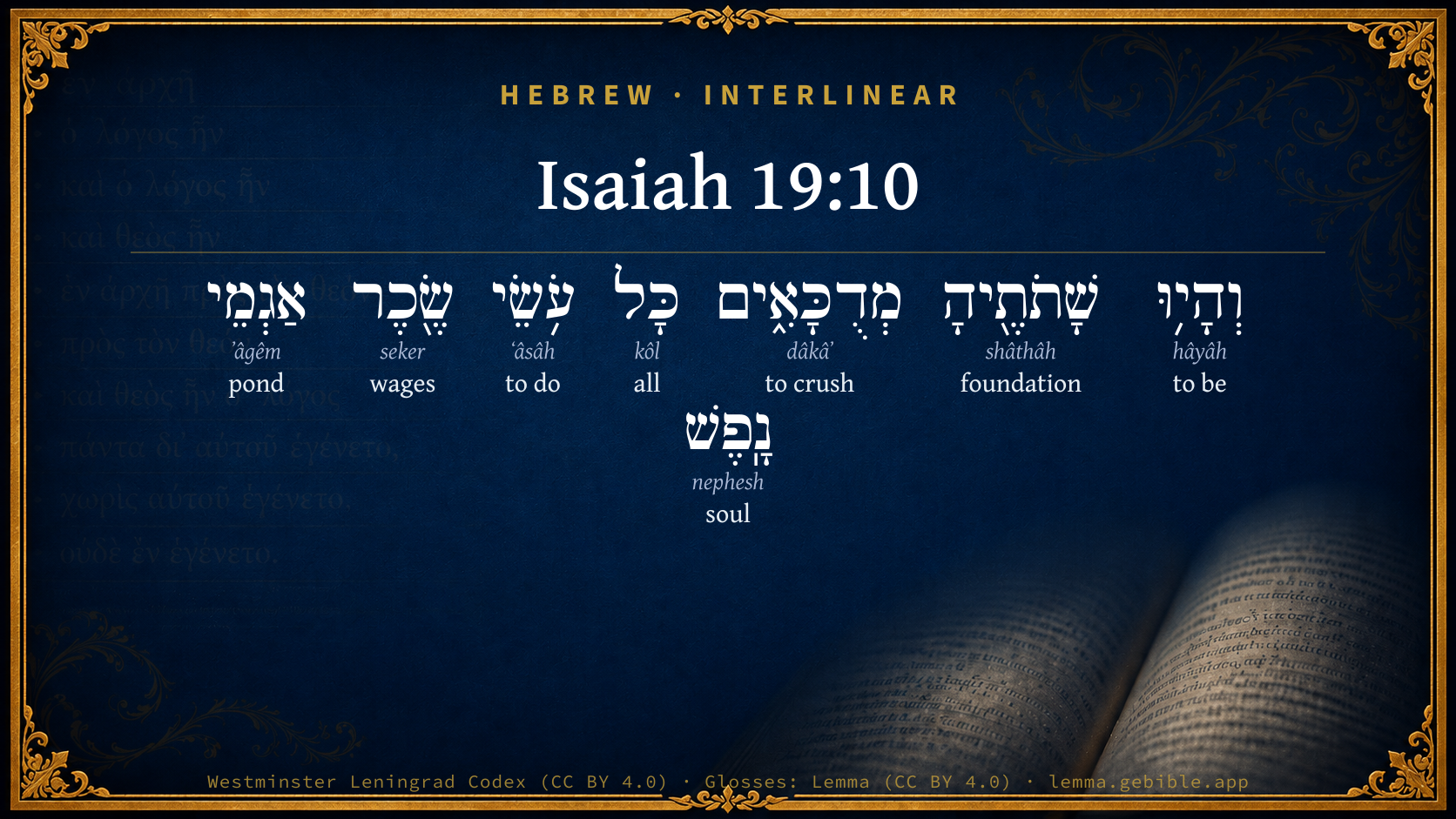
Isaiah 19:10

Hebrew (Westminster Leningrad Codex) Isaiah 19:10 appears in the Hebrew Old Testament. The text above is from the Westminster Leningrad Codex. Each word links to its Strong’s number, a concise gloss, and parsing drawn from the Open Scriptures Hebrew Bible morphology. Click any word for its full Brown-Driver-Briggs (BDB) entry.
Download image
Cite this verse

Isaiah 19:10 (World English Bible). Public Domain. Lemma interlinear Bible study tool, https://lemma.gebible.app/v/isaiah/19/10.

Show BibTeX & RIS
BibTeX
RIS
English Translation
The pillars [of Egypt] shall be broken in pieces; all those who work for hire [shall be] grieved in soul.
World English Bible · Public Domain
Highlights
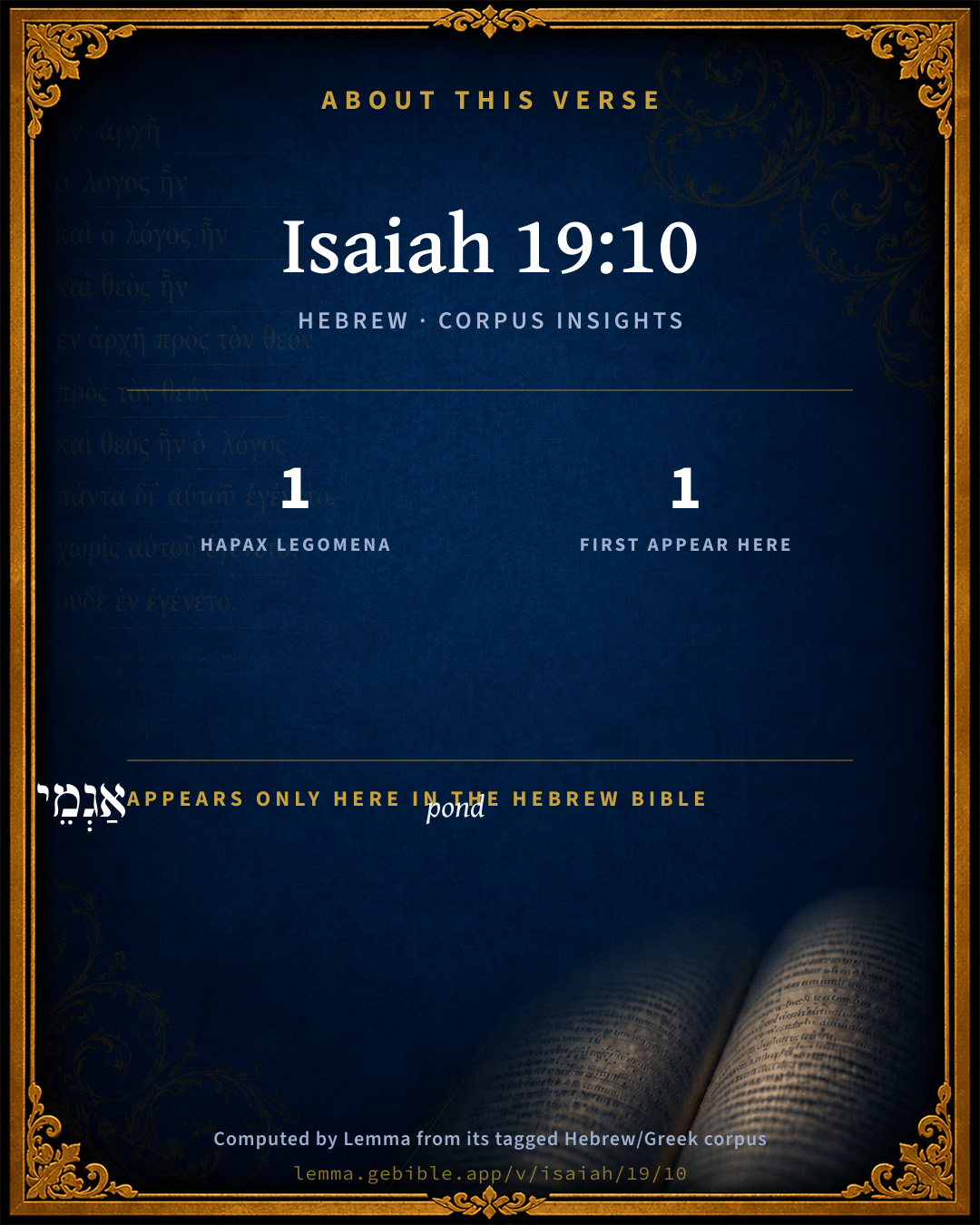
  • 1 hapax legomenon — only here in the Hebrew Bible
  • 1 first appearance in the Hebrew Bible
Full analysis ↓
Download a study sheet

One document with this verse’s original text, its word-by-word gloss line, the meaning frame, cross-references with their text, attributed commentary, and full source and license credits — printable, and it pastes into notes with its structure intact.

This verse Autodidact and up

Study sheet (.html) Plain text (.txt)

A passage Seminary Student

Up to 50 verses in one chapter. A passage sheet keeps up to 6 commentary sources and 12 cross-references per verse, in the order this page ranks them, and says so on the sheet whenever that leaves anything out. Ask for a single verse and you get the Autodidact verse sheet above.

Everything on this page stays free to read, with no account — the sheet is a download of what is already on screen, not access to it.

Want to remove ads? Support Godless Engineer
Compare translations 3

The same verse in 3 English versions, stacked beneath the original-language interlinear above. Click any original word for its lexicon entry.

Each is an independent rendering of the whole verse — the interlinear is not word-aligned to these translations.

Highlighted words mark where these versions differ — a whole-verse word diff, not a word-by-word alignment.

  • World English Bible Public Domain
    The pillars [of Egypt] shall be broken in pieces; all those who work for hire [shall be] grieved in soul.
  • King James Version Public Domain
    And they shall be broken in the purposes thereof, all that make sluices and ponds for fish.
  • unfoldingWord Literal Text CC BY-SA 4.0
    And its foundations will be crushed; all of the workers for hire sad of soul. q1

unfoldingWord Literal Text — © unfoldingWord, licensed CC BY-SA 4.0. Word-aligned USFM3 via Door43 (git.door43.org/unfoldingWord/en_ult).

Versions to compare (up to 4)

3 of 4 selected

Show all 18 translations

Every available English version of this verse, each an independent rendering of the whole verse.

  • World English Bible Public Domain
    The pillars [of Egypt] shall be broken in pieces; all those who work for hire [shall be] grieved in soul.
  • Berean Standard Bible Public Domain
    The workers in cloth will be dejected, and all the hired workers will be sick at heart.
  • Majority Standard Bible Public Domain
    The workers in cloth will be dejected, and all the hired workers will be sick at heart.
  • King James Version Public Domain
    And they shall be broken in the purposes thereof, all that make sluices and ponds for fish.
  • American Standard Version (1901) Public Domain
    And the pillars `of Egypt' shall be broken in pieces; all they that work for hire `shall be' grieved in soul.
  • Revised Version (1885) Public Domain
    And her pillars shall be broken in pieces, all they that work for hire shall be grieved in soul.
  • Geneva Bible (1599) Public Domain
    For their nettes shalbe broken, and all they, that make pondes, shalbe heauie in heart.
  • Douay-Rheims (1899) Public Domain
    And its watery places shall be dry, all they shall mourn that made pools to take fishes.
  • Young's Literal Translation Public Domain
    And its foundations have been smitten, All making wages `are' afflicted in soul.
  • Literal Standard Version CC BY-SA 4.0
    And its foundations have been struck, || All making wages [are] afflicted in soul.
  • Unlocked Literal Bible CC BY-SA 4.0
    The cloth workers of Egypt will be crushed; all who work for hire will be grieved within themselves.
  • unfoldingWord Literal Text CC BY-SA 4.0
    And its foundations will be crushed; all of the workers for hire sad of soul. q1
  • Darby Bible Public Domain
    And her pillars shall be broken in pieces, and all workers for hire shall be sad of soul.
  • World Messianic Bible Public Domain
    The pillars will be broken in pieces. All those who work for hire will be grieved in soul.
  • Webster's Bible Public Domain
    And they shall be broken in the purposes thereof, all that make sluices and ponds for fish.
  • Free Bible Version CC BY-SA 4.0
    The cloth workers will be depressed, and everyone who earns a wage will feel sick inside.
  • Bible in Basic English Public Domain
    And the makers of twisted thread will be crushed, and those who... will be sad in heart.
  • JPS Tanakh (1917) Public Domain
    And her foundations shall be crushed, all they that make dams shall be grieved in soul.

Literal Standard Version (2020), Covenant Press — licensed CC BY-SA 4.0. Text via the HelloAO Bible API (eBible.org). Unlocked Literal Bible (unfoldingWord) — licensed CC BY-SA 4.0. Text via the HelloAO Bible API (eBible.org). unfoldingWord Literal Text — © unfoldingWord, licensed CC BY-SA 4.0. Word-aligned USFM3 via Door43 (git.door43.org/unfoldingWord/en_ult). Free Bible Version, Dr. Jonathan Gallagher — licensed CC BY-SA 4.0. Text via the HelloAO Bible API (eBible.org).

Word by word

More ways to search: Search by grammar → Find every occurrence → Compare this word →

Practice this passage: Drill this verse → Learn its vocabulary →

About this verse

These counts appear in no published source. They are computed here, from the morphology-tagged text and Lemma’s own curated glosses. What Lemma adds →

8
words
8
distinct lemmas
Prophets
section

Notable vocabulary

1 hapax legomenon — a word that appears only here in the entire Hebrew Bible:

  • אַגְמֵי pond H99

First appearance in Scripture

This word makes its first canonical appearance in the Hebrew Bible here:

  • אַגְמֵי pond H99

Shared distinctive vocabulary

שָׁתֹתֶ֖יהָ foundation H8356 occurs in 2 verses of the Hebrew Bible. Also found in:

Grammatical profile

  • 3 verbs
  • 4 nouns
  • 1 adjective

Verb forms

  • וְהָי֥וּ Qal · Sequential Perfect
  • מְדֻכָּאִ֑ים Pual · Participle Passive
  • עֹ֥שֵׂי Qal · Participle Active

Hebrew & Septuagint length

In English translation the verse runs 20 words from the Hebrew and 24 from the Septuagint (LXX English) — closely comparable.

A rough comparison of the two English renderings, which tokenize alike — not a word-level alignment.

Word counts can differ between the Hebrew and the Greek without any difference in meaning — e.g. the Hebrew direct-object marker אֵת has no separate Greek word, and Greek often adds the article ὁ.

Cross-references

3

Topical passages linked to Isaiah 19:10 in the Treasury of Scripture Knowledge — connected by theme and wording, ordered by reader-vote popularity; previews shown in the World English Bible.

  • Exodus 7:19 Yahweh said to Moses, "Tell Aaron, 'Take your rod, and stretch out your hand over the waters of Egypt, over their rivers, over their streams, and over their pools, and over all their ponds of water, that they may become blood; and there shall be blood throughout all the land of Egypt, both in vessels of wood and in vessels of stone.'"
  • Exodus 8:5 Yahweh said to Moses, "Tell Aaron, 'Stretch forth your hand with your rod over the rivers, over the streams, and over the pools, and cause frogs to come up on the land of Egypt.'"
  • Deuteronomy 11:10 For the land, where you go in to possess it, isn't as the land of Egypt, from whence you came out, where you sowed your seed, and watered it with your foot, as a garden of herbs;

Cross-references courtesy of OpenBible.info (CC BY 4.0).

Hebrew and Greek witnesses Masoretic Hebrew ↔ Greek Septuagint

The same verse in the two great witnesses to the Old Testament, shown verse-for-verse.

These are two independent witnesses, not word-aligned to each other, and the Septuagint is shown in lemma (dictionary) form.

Hebrew Isaiah 19:10 Masoretic · Westminster Leningrad Codex

וְהָי֥וּ שָׁתֹתֶ֖יהָ מְדֻכָּאִ֑ים כָּל עֹ֥שֵׂי שֶׂ֖כֶר אַגְמֵי נָֽפֶשׁ

The pillars [of Egypt] shall be broken in pieces; all those who work for hire [shall be] grieved in soul.

World English Bible · Public Domain

Greek LXX Isaiah 19:10 Septuagint · lemma form

καί εἰμί ὁ διάζομαι αὐτός ἐν ὀδύνη καί πᾶς ὁ ὁ ζῦθος ποιέω λυπέω καί ὁ ψυχή πονέω

And they that work at them shall be in pain, and all that make beer shall be grieved, and be pained in their souls.

LXX2012 (modern English Septuagint) · Public Domain

On this verse, Adam Clarke's Commentary discusses the Septuagint’s reading. Read the note in Commentary ↓

Hebrew: Westminster Leningrad Codex (CC BY 4.0). Greek: Septuagint (public domain); English from LXX2012 (modern English Septuagint) (Public Domain). How the Septuagint differs from the Hebrew →

Targum (Aramaic paraphrase)

1

The Targum is the ancient Jewish Aramaic paraphrase of the Hebrew Scriptures — an interpretive translation, not the Hebrew text itself. Onkelos (literal) and Pseudo-Jonathan (expansive) render the Torah, and Jonathan the Prophets. Coverage is partial: where no permissively-licensed English translation exists for a verse, only the Aramaic is shown. This is verse-level text, not a word-by-word alignment to the Hebrew.

  1. Targum Jonathan Prophets (Joshua–Malachi)
    וִיהֵי אֲתַר בֵּית שָׁתֵי מְחָא כְבִישִׁין אֲתַר דַהֲווֹ עָבְדִין סִכְרָא וְכָנְשִׁין מַיָא גְבַר לְנַפְשֵׁהּ:

    And there shall be trodden under foot the well watered place, where they have been making pits, waterpools each for himself.

    Targum Jonathan — Aramaic: “Mikraot Gedolot” (public domain). English: “Sefaria Community Translation” (CC0 1.0 (public-domain dedication)); “London "Chaldee Paraphrase," 1871” (public domain). Text via Sefaria.

Commentary

Notes on Isaiah 19:10 from classic Christian and Jewish commentators (each source and its license shown beneath its notes). The classic Christian expositions comment on the surrounding passage and are grouped to its opening verse, so a note may address several verses; the Jewish commentaries on the Tanakh (Rashi and others) are per-verse, so they appear only where the commentator wrote on this verse.

Lemma curates 59 commentaries, every one of them public domain or Creative Commons licensed, each selected and text-cleaned for this edition rather than reprinted as found. About our sources →

Trapp's Complete Commentary

John Trapp

Isa 19:10 And they shall be broken in the purposes thereof, all that make sluices [and] ponds for fish.

Ver. 10. And they shall be broken in the purposes thereof.] Heb., In the foundations, as Psa 11:3. Purposes are the foundation of practices, but are oft disappointed.

And ponds for fish.] Heb., Ponds of fowl, stagna voluptaria (Tremellius), standing pools of desire. In Hebrew, the word used elsewhere for a pond or fish pool signifieth a blessing also. {a}

{a} Berecha.

John Trapp, A Commentary or Exposition upon All the Books of the Old and New Testament (1647–1656) — public domain. Text from a community e-Sword module.

Jamieson, Fausset & Brown

Robert Jamieson, A. R. Fausset & David Brown

in the purposes--rather, "the foundations," that is, "the nobles shall be broken" or brought low: so Isa 3:1; Psa 11:3; compare Isa 19:13, "The princes--the stay of the tribes. The Arabs call a prince "a pillar of the people" [MAURER]. "Their weaving-frames" [HORSLEY]. "Dykes" [BARNES].

all that make sluices, &c.--"makers of dams," made to confine the waters which overflow from the Nile in artificial fish-ponds [HORSLEY]. "Makers of gain," that is, the common people who have to earn their livelihood, as opposed to the "nobles" previously [MAURER].

Jamieson, Fausset & Brown — Commentary Critical and Explanatory on the Whole Bible (1871) — public domain (CC PDM 1.0). Text via the HelloAO Bible API.

Adam Clarke's Commentary

Verse 10. And they shall be broken, c. - "Her stores"] שתתיה shathotheyha, αποθηκαι, granaries. - Aquila.

All that make sluices and ponds for fish - "All that make a gain of pools for fish."] This obscure line is rendered by different interpreters in very different manners. Kimchi explains אגמי agmey as if it were the same with אגמה agemah, from Job 30:25, in which he is followed by some of the rabbins, and supported by the Septuagint: and שכר secher, which I translate gain, and which some take for nets or inclosures, the Septuagint render by ζυθον, strong drink or beer, which it is well known was much used in Egypt and so likewise the Syriac, retaining the Hebrew word שכרא sekra. I submit these very different interpretations to the reader's judgment. The Version of the Septuagint is as follows:

Και παντες οἱ ποιουντες τον ζυθον λυπηθησονται, και τας ψυχας πονεσουσι· "And all they that make barley wine shall mourn, and be grieved in soul."

Adam Clarke's Commentary on the Bible (1810–1826) — public domain. Text from a community e-Sword/MySword module.

Ellicott's Commentary for English Readers

(10) And they shall be broken in the purposes thereof.—Better, the pillars thereof (i.e., the props and columns of the state) shall be broken in pieces, and all those who work for wages (i.e., the great masses of the people) shall be troubled in mind. The word translated “purposes,” occurs in the sense here given in Psa_11:3, and is there translated “foundations.” (Compare the like figure in Eze_30:4; Gal_2:9.)

A Bible Commentary for English Readers, edited by Charles John Ellicott (1878–1897) — public domain. Text from a community e-Sword module.

The Cambridge Bible for Schools and Colleges

gen. ed. J. J. S. Perowne

10. Translate as R.V. And her pillars shall be broken in pieces, all they that work for hire shall be grieved in soul. The expressions, however, are very obscure, and the sense is doubtful. The word for “pillars” is found in Psa_11:3 (“foundations”), but it is disputed whether the capitalists or the labourers are here regarded as the foundations of society. In the second clause A.V. follows Jewish authority in keeping up the reference to fishing (cf. “networks” in the previous verse), but its “sluces and ponds for fish” is altogether wrong. LXX. errs in the opposite direction by dragging in the liquor trade (“manufacturers of strong drink” [shçkâr] instead of “workers for hire” [seker]).

The Cambridge Bible for Schools and Colleges (gen. ed. J. J. S. Perowne; Cambridge University Press, 1878–1918) — public domain. Text from a community e-Sword module.

John Gill's Exposition

And they shall be broken in the purposes thereof,.... Meaning either the persons that work in flax, or in making nets; who shall be disappointed in their views, expectations, and designs, in bringing them to a good market, since there will be no buyers. The word for "purposes" signifies foundations, as in Psa 11:3 and may design dams and banks, that are made to keep in the water, which shall be broken down, and be of no service to answer the end; but Kimchi observes, that the word in the Talmudic language signifies "nets", as it does (n); and this seems to be most agreeable to the context; and then the words may be rendered, "and its nets shall be broken" (o); shall lie and rot for want of use:

all that make sluices and ponds for fish; or, "all that make an enclosure of ponds of soul" (p); or for delight and pleasure; that is, not only such shall be broken in their purposes, ashamed and confounded, and be dispirited, mourn and lament, whose business and employment it is to catch fish, or make nets for that end, and get their livelihood thereby; but even such who enclose a confluence of water, and make fishponds in their fields and gardens for their pleasure, will be disappointed; for their waters there will be dried up, and the fish die, as well as in the common rivers. The Septuagint version renders it, "and all they that make zythum shall grieve"; "zythum" was a sort of malt liquor of the ancients; and the word for "sluices" is of affinity with a word that is often used for strong drink; and so the Syriac version here,

"and all they shall be humbled that make strong drink, for the drink of the soul;''

or for men to drink for pleasure.

(n) T. Bab. Sabbat, fol. 124. 2. Bava Kama, fol. 117. 1. (o) "Et erunt retia ejus contrita", Pagninus, Montanus. (p) "omnes facientes clausuram stagnorum animae", Montanus.

John Gill's Exposition of the Whole Bible (1746–1763) — public domain (CC PDM 1.0). Text via the HelloAO Bible API.

Albert Barnes' Notes on the Bible

And they shall be broken - There has been a great variety of opinion in regard to the interpretation of this verse, and much difficulty in the construction of the Hebrew words. The Vulgate renders it, ‘And its wet places shall fail; all who make ponds to take fish.’ The Septuagint, ‘And all who make beer (ζύθον zuthon) shall lament, and shall afflict their souls.’ This ζύθον zuthon was a sort of malt liquor made of fruits by fermentation, and was used in Egypt in the place of wine, since the grape did not flourish there. Jerome on this place says, that this was much used also in Dalmatia and Pannonia, and was commonly called “Sabaium.” The Chaldee renders this, ‘And the place where they weave cloth shall be trodden down, and the place where they make fish ponds, and where they collect waters, each one for his own life.’ This variety of reading arises chiefly from the different modes of “pointing” the Hebrew words.

The word rendered ‘broken’ (מדכאים medâkâ'iym) means “trodden down,” from דכא dâkâ' “to tread, or trample down,” and agrees in the Hebrew with the word rendered ‘purposes - the proposes shall be trodden down.’ The word ‘purposes’ (שׁתתיה shâtoteyhâ) is found only in the plural, and is translated in Psa 11:3, ‘foundations,’ from שׁית shiyth, “foundation or pillar.” According to this, it would mean that all “the pillars or foundations, that is, probably all the “nobles” of Egypt, would be trodden down. But this does not well suit the connection. Others derive it from שׁתה shâtâh, “to drink;” and suppose that it means that which is prepared for drink shall be trodden down or destroyed. Others suppose that it is derived from שׁתה shâtâh, “to weave,” and that it refers to the places where they wove the cloth, that is, their looms; or to the places where they made their nets. And others suppose that it is not the “places” where they wove which are intended, but the “weavers themselves.” Forerius supposes it to be derived from שׁתת shâthath, “to place, lay,” and that it refers to the “banks or dykes” that were made to retain the waters in the canals, and that these would be trodden down. This, it seems to me, is the most probable interpretation, as it suits the connection, and agrees with the derivation of the word. But the meaning cannot be certainly ascertained.

All that make sluices - There has been quite as great a variety in the intepretation of this passage as in the former. The word rendered ‘sluices’ (שׂכר s'eker), our translators understand in the sense of places where the water would be retained for fish ponds - made by artificial banks confining the waters that overflow from the Nile. This sense they have given to the word, as if it were derived from סכר sâkar, “to shut up, to enclose.” The Septuagint reads it as if it meant the Hebrew שׁכר shêkār, or strong drink; and so also the Syriac renders it - as if from שׁכר shēkâr, “to drink.” There is no doubt that by a difference of pointing it may have this signification. But the most probable interpretation, perhaps, is that which derives it from שׂכר s'âkar, “to hire,” and means that they made those places for reward, or for gain. They thus tolled for hire; and the prophet says, that they who thus made enclosures for fish in order to make a livelihood, would be trodden down - that is, they would fail of their purposes.

Ponds for fish - The word rendered ‘fish’ (נפשׁ nephesh), denotes properly any living thing (“see the margin”), but if the usual interpretation is given of this verse, it is evident that fish are intended. The description, therefore, in this entire passage, from verse fifth to verse tenth, is designed to denote the calamities which would come upon Egypt from the failure of the waters of the Nile; and the slightest knowledge of the importance of the Nile to that country will show that all these calamities would follow from such a failure.

Albert Barnes' Notes on the Bible (1834–1885) — public domain. Text from a community e-Sword/MySword module.

Haydock's Catholic Bible Commentary

All they. Septuagint, "and all who make strong drink (secer) shall be in sorrow, and shall afflict their souls." (Haydock) --- This version is perhaps the best, as the Egyptians used much ale or wine distilled from barley. (Calmet)

George Leo Haydock (1774–1849), Haydock's Catholic Family Bible and Commentary, 1859 edition — public domain. Excludes Psalms (Douay-Rheims chapter numbering differs from Protestant) and Deuterocanonical books (Catholic canon only).

Matthew Poole's English Annotations

Thereof, i.e. of Egypt, or of the Egyptians. They shall lose their ends and hopes; for the fishes in them shall die for want of water.

Matthew Poole's English Annotations on the Holy Bible (1683–1685) — public domain. Text from a community e-Sword/MySword module.

Whedon's Commentary on the Bible

Daniel D. Whedon

10. Broken in the purposes thereof — Their strong men, their higher castes. The pillars of the land are crushed to pieces. So the Hebrew. Strange translation in our version! The ruin is general. Both high and low suffer.

All that make sluices — Dam makers across canals to overflow the lands. Workers for wages, these especially suffer.

Daniel D. Whedon (gen. ed.), Commentary on the Old and New Testaments (1874–1909) — public domain. Text from a community e-Sword module.

The Pulpit Commentary

And they shall be broken in the purposes thereof; rather, and the foundations thereof shall be broken, or crushed to pieces (Kay). The rich and noble, the foundations of the fabric of society, seem to be meant. All that make sluices, etc. Translate, all that work for hire (comp. Pro_11:18) shall be grieved in soul. The meaning is that all classes, from the highest to the lowest, shall suffer affliction (so Lowth, Gesenius, Knobel, Kay, Cheyne).

The Pulpit Commentary (1880–1919), ed. H.D.M. Spence-Jones & Joseph S. Exell — public domain. Text from a community e-Sword module.

John Wesley's Explanatory Notes

Thereof - Of Egypt, or of the Egyptians. They shall lose their hopes; for the fishes in them shall die for want of water.

John Wesley, Explanatory Notes Upon the Whole Bible (1754–1765) — public domain. Text via the GEBible commentary corpus.

J. A. Alexander on Isaiah

Joseph Addison Alexander

“And her pillars (or foundations) are broken down, all laborers for hire are grieved at heart.” The simplest exposition of the verse is that which regards this as a general description of distress, extending to the two great classes of society, the pillars or chief men and the laborers or commonalty.

Joseph Addison Alexander, The Prophecies of Isaiah (1846–1847; New York: Scribner, 1870–1878) — public domain. Text from a community e-Sword module.

Rashi

Rabbi Shlomo Yitzchaki (Rashi)

And its foundations shall be crushed, all who make dams Eklusa in O.F., a sluice. Comp. (Gen. 8:2) “And the fountains of the deep were stopped up (וַיִּסָּכְרוּ),” for they would stop up the water that went out of the banks of the river and spread out, forming a pond of still water, standing in its place, where fish would spawn. The prophet says that the foundations of their diggings shall be crushed, and the dammed up pools that they made.

still ponds An expression like (Ex. 31:17): “He rested and was refreshed (וַיִּנָּפַשׁ),” for the water of the ponds rests and stands in one place. Jonathan, however, renders: Who would make the dams and gather the water, each one for himself.

Rashi on the Tanakh — English translations: “The Judaica Press complete Tanach with Rashi, translated by A. J. Rosenberg” (CC BY 4.0); “Pentateuch with Rashi's commentary by M. Rosenbaum and A.M. Silbermann, 1929-1934” (public domain); “The Metsudah Tanach series, Lakewood, N.J” (CC BY 4.0); and “The Book of Joshua, Metsudah Publications, 1997” (CC BY 4.0). Text via Sefaria.

Ibn Ezra

Rabbi Abraham ibn Ezra

שתותיה Her foundations. Comp. Ps. 11:3. The buildings which they erect to take the fish in.

שכר Sluices. Comp. ויסכרו and they were stopped (Gen. 8:2), although שכר is spelt with שֹ; comp. בסורי ═ בשורי when I depart (Hos. 9:12).

אנמי נפש The ponds for fish. Ponds containing the lives (נפש) of the fish.., עֹשֵֹ֖י שֶֹכֶ֥ר אַנְמֵי־נָ֑פֶשֹ.

Ibn Ezra on the Tanakh — English translations: “Sefaria Community Translation” (CC0 1.0 (public-domain dedication)); “Yalkut, Sifsei Chachomim Chumash, Metsudah Publications, 2009” (CC BY 4.0); and “Commentary of Ibn Ezra on Isaiah - trans. by M. Friedlander, 1873” (public domain). Text via Sefaria.

Lesson kit

Teaching starters — assembled from the data on this page, not authored interpretation. Every prompt links to the verse data it draws on. Edit before teaching.

Isaiah, in the Prophets, opens this verse with 8 words (8 distinct Hebrew lemmas). Its most distinctive word is ʼâgêm (“pond”). A historical commentator’s framing appears above. Read the whole chapter for the surrounding context.

Discussion questions

  1. The word ʼâgêm carries the sense “pond.” How does it shape the verse?
  2. This verse holds 1 word here found nowhere else in the Hebrew Bible. What might the rare word draw attention to?
  3. The word “pond” first appears here in Scripture. What is being introduced at this debut?
  4. Psalms 11:3 shares the word «foundation» with this verse. How do the two illuminate each other?
  5. These translations render this verse differently. What is at stake in choosing one wording over another?
  6. The verb «וְהָי֥וּ» is Qal Sequential Perfect. How does its form color the action?
  7. Reading how Trapp's Complete Commentary and Jamieson, Fausset & Brown read this verse, where do the two commentators agree and where do they part?

Things to notice

  • 1 word in this verse appears nowhere else in the Hebrew Bible.
  • 1 word makes its first canonical appearance in Scripture here.
  • These translations choose different wording for 22 words in this verse.
  • 8 distinct Hebrew lemmas span 8 words in this verse.

Reading settings

Reading text

Shown beneath each verse's original-language words.

Old Testament
Old Testament edition

Read the OT as the Masoretic Hebrew (MT) or the Greek Septuagint (LXX).

English shown for the Greek Septuagint (in the Hebrew ↔ Greek comparison).

Comparing translations? Open the Compare panel on any verse page to stack up to four side by side.