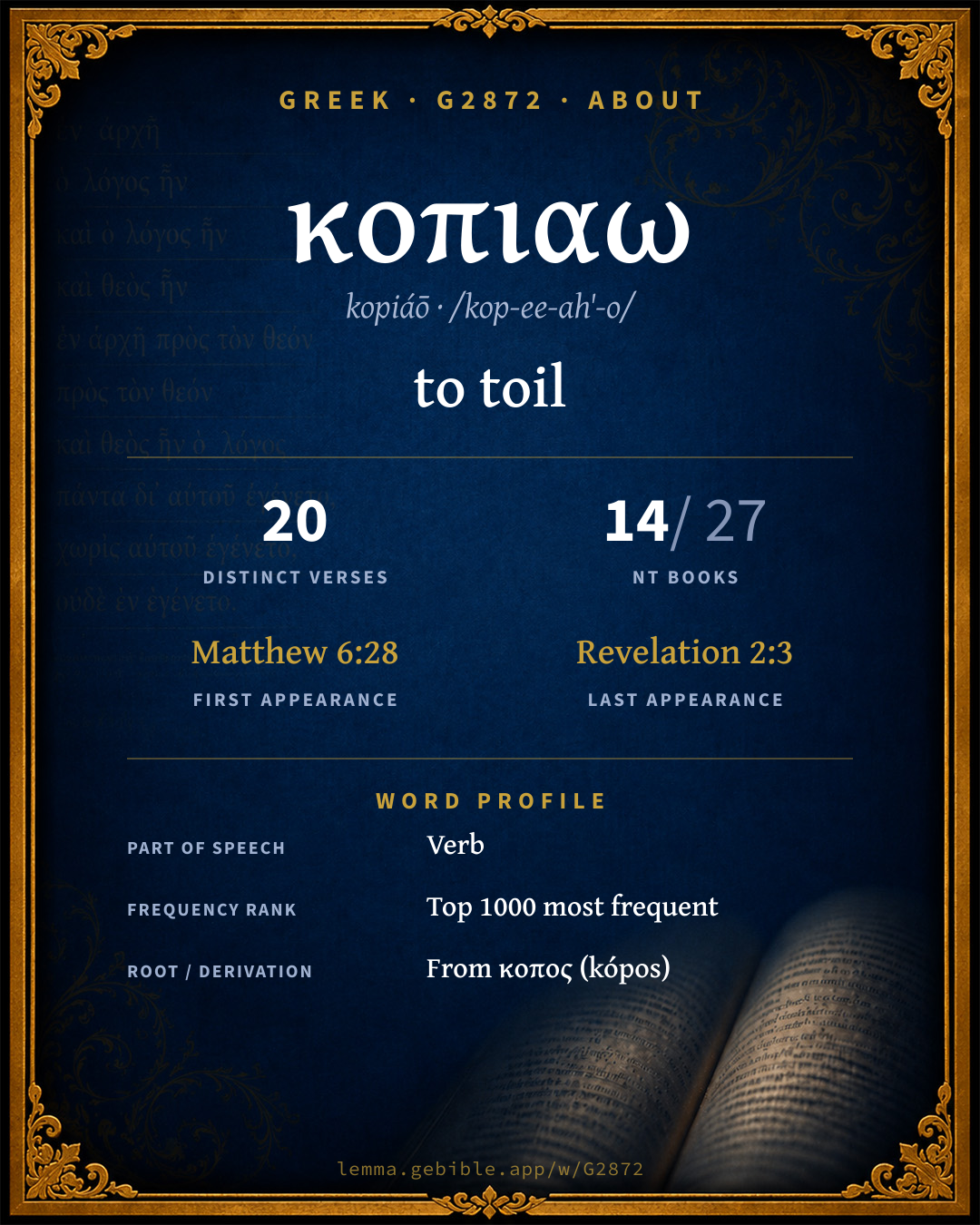
κοπιάω
to toil
‘to toil’ is one of 2 main senses fuller range ↓
Full lexicon entry — Thayer's Greek Lexicon
From Thayer's Greek Lexicon
Where this word appears
Grammar key — what these labels mean
Part of speech
- Verb
- An action or state-of-being word.
Tense
- Aorist
- Action viewed as a simple whole, without regard to duration — often past (perfective aspect).
- Present
- Ongoing or general action in present time (imperfective aspect).
- Perfect
- A completed past action with continuing present results.
Voice
- Active
- The subject performs the action.
Mood
- Indicative
- States a fact or asks a factual question (the mood of reality).
- Participle
- A verbal adjective (“writing,” “having written”).
- Imperative
- Expresses a command or request.
Case
- Accusative
- The case of the direct object and of extent.
- Nominative
- The case of the subject (and the predicate nominative).
- Dative
- The case of the indirect object, means, or location — “to / for / with / in.”
Person
- 1st person
- The speaker (“I / we”).
- 3rd person
- The one spoken about (“he / she / it / they”).
- 2nd person
- The one addressed (“you”).
Gender
- Masculine
- Grammatically masculine.
- Feminine
- Grammatically feminine.
Number
- Singular
- One.
- Plural
- More than one.
Every verse where G2872 appears in the Book of Ephesians — 1 distinct verse. Click any verse to open its interlinear word-by-word view. Verse text shown in the World English Bible for context — . Each verse’s Greek form is shown with its reference; the English is not keyword-highlighted, since the data carries no word-level English alignment. Use “Compare translations” on any verse to read it across multiple English versions. This concordance covers the Greek New Testament; Septuagint (Greek Old Testament) occurrences of this word are not indexed here.
Ephesians
About this entry
At a glance — auto-summarized from this page’s data, not written by a person. Every figure links to its source below. This summary describes the numbers; it doesn’t interpret them.
At its core, κοπιαω (kopiáō) means “to toil.” Scripture first uses it in Matthew 6:28. Spanning 20 verses in 14 books, it ranks among the uncommon words of the Greek New Testament. Catalogued under 2 senses, its meaning is not single-sense. From the same root come κοπος and κοπαζω. Each statement above links to its evidence; the full detail follows below.
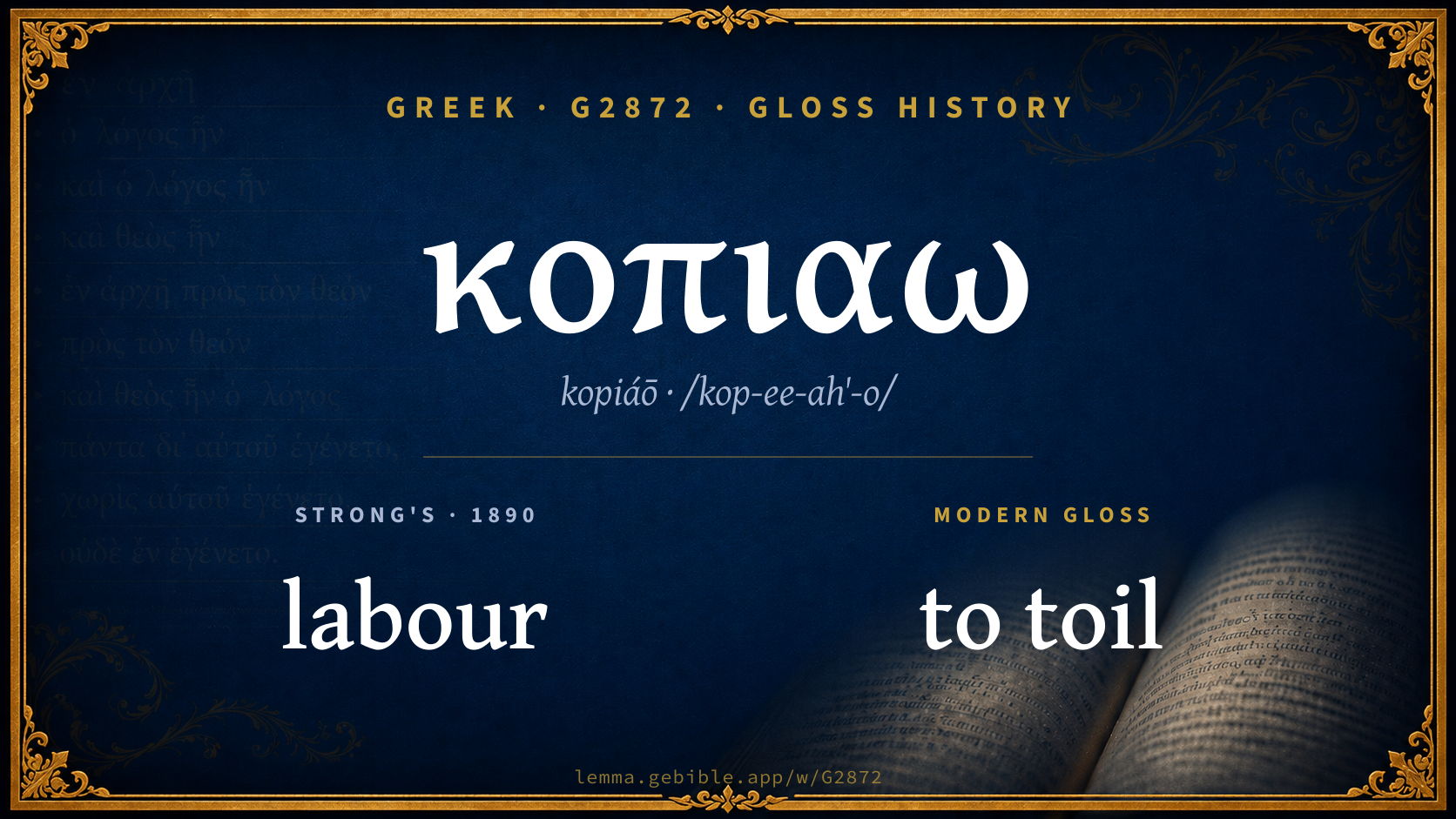
Gloss history
Strong's 1890 vs modern scholarship
About this word
Strong's G2872 catalogs a Greek word from the Greek New Testament.
These counts are not copied from any lexicon or concordance. They are computed here, from the morphology-tagged Greek New Testament. What Lemma adds →
- 20
- distinct verses
- The word appears in 20 distinct verses.
- 14 / 27
- NT books
- The word appears in 14 of 27 New Testament books.
- #586
- by frequency
- Top 1000 most frequent Greek words (rank 586 of 5,347 Greek words by occurrence).
View all 20 occurrences in the concordance →
Most concentrated in
- 1 Corinthians 3 verses 15%
- Matthew 2 verses 10%
- John 2 verses 10%
By section of the New Testament
By traditional corpus
Conventional, traditional groupings — biblical authorship is debated, so this is a traditional corpus grouping, not an authorship claim. Some books belong to more than one corpus (Luke is in both the Gospels and the Lukan corpus, and so on), so these shares overlap and need not total 100%. Each figure is a share of the word’s 20 distinct verses.
- Pauline corpus 13 verses · 65%
- Gospels 5 verses · 25%
- Johannine 3 verses · 15%
- Lukan (Luke–Acts) 2 verses · 10%
- Revelation 1 verse · 5%
How translations render this word
Counts come from each version’s own published word-to-Strong’s tagging or interlinear alignment — an approximate guide to how each version renders this word, not a word-level alignment the data otherwise carries. Because each total is that version’s own tagged count, the per-version totals vary from one another and need not match the appearance or distinct-verse counts above. These counts may also differ from a printed concordance because Lemma counts each distinctly tagged rendering and does not collapse phrase taggings into a single head-word total. This is a fixed set of word-tagged versions (KJV, ASV, BSB, ULT) and does not change with the reading translation you choose elsewhere. Each version’s license is shown beside its name below (and on Sources).
- King James Version: Labour 8×, Laboured 3×, Bestowed 2×
- American Standard Version: Labor 9×, Labored 2×, Laboreth 2×
- Berean Standard Bible: Labor 3×, Has worked 2×
- unfoldingWord Literal Text: Labor 3×, Laboring 3×, Have 2×
King James Version Public Domain
Renders G2872 across 28 tagged occurrences — most commonly:
Plus 11 renderings that appear only once — usually multi-word phrases or single function words the recovered tagging swept in, not distinct renderings.
American Standard Version Public Domain
Renders G2872 across 26 tagged occurrences — most commonly:
Plus 11 renderings that appear only once — usually multi-word phrases or single function words the recovered tagging swept in, not distinct renderings.
Berean Standard Bible Public Domain
Renders G2872 across 23 tagged occurrences — most commonly:
Plus 18 renderings that appear only once — usually multi-word phrases or single function words the recovered tagging swept in, not distinct renderings.
unfoldingWord Literal Text CC BY-SA 4.0
Renders G2872 across 28 tagged occurrences — most commonly:
Plus 16 renderings that appear only once — usually multi-word phrases or single function words the recovered tagging swept in, not distinct renderings.
Senses in Thayer's
The 2 senses Thayer's distinguishes for this word, in lexicon order (not ranked by frequency or importance). The full entry — with sub-senses — is in the Lexicon Entry tab.
- to grow weary, tired, exhausted (with toil or burdens or grief)
- to labour with wearisome effort, to toil
Word origin
Derived from κοπος (kópos) (G2873) — beating.
From a derivative of G2873 ; to feel fatigue ; by implication to work hard : - (bestow) labour toil be wearied.
— Strong’s Exhaustive Concordance (1890), public domain.
Forms in the corpus
The 17 distinct written forms G2872 takes in the Greek New Testament, most frequent first — each parse links to that tense’s occurrences in the concordance.
Same root — word family
Other Thayer's entries built from the same root as G2872, grouped by Strong’s listed origin. These share a root / origin per the lexicon — not necessarily a shared meaning. Each links to that word’s own entry.
Derives from
Shares the same root
Compare all same-root words → They share a root, not necessarily a meaning.
Septuagint usage
The same Greek word κοπιαω appears 37 times in the Greek Old Testament (Septuagint), across 36 verses in 10 books.
- 37
- LXX occurrences
- Tagged occurrences of this Greek word in the Septuagint.
- 36
- verses
- Distinct Septuagint verses containing this word.
- 10 / 39
- OT books
- The word appears in 10 of the 39 Old Testament books.
Sample Septuagint occurrences
- Deuteronomy 25:18 κοπιάω
- Joshua 24:13 κοπιάω
- Judges 5:26 κοπιάω
- 1 Samuel 6:12 κοπιάω
- 2 Samuel 17:2 κοπιάω
- Job 2:9 κοπιάω
- Psalms 6:7 κοπιάω
- Proverbs 4:12 κοπιάω
- Isaiah 5:27 κοπιάω
- Jeremiah 2:24 κοπιάω
Septuagint occurrences (same lexeme)
Every verse where the same Strong’s number (G2872) appears in the Greek Septuagint. Verse text shown in the World English Bible for context; the Greek form is the matched word — the English is not keyword-highlighted.
- Deuteronomy 25:18 κοπιάω how he met you by the way, and struck the hindmost of you, all who were feeble behind you, when you were faint and weary; and he didn't fear God.
- Joshua 24:13 κοπιάω I gave you a land whereon you had not labored, and cities which you didn't build, and you dwell therein; of vineyards and olive groves which you didn't plant do you eat.
- Judges 5:26 κοπιάω She put her hand to the tent-pin, Her right hand to the workmen's hammer; With the hammer she struck Sisera, she struck through his head; Yes, she pierced and struck through his temples.
- 1 Samuel 6:12 κοπιάω The cattle took the straight way by the way to Beth-shemesh; they went along the highway, lowing as they went, and didn't turn aside to the right hand or to the left; and the lords of the Philistines went after them to the border of Beth-shemesh.
- 1 Samuel 14:31 κοπιάω They struck of the Philistines that day from Michmash to Aijalon. The people were very faint;
- 1 Samuel 17:19 κοπιάω Now Saul, and they, and all the men of Israel, were in the valley of Elah, fighting with the Philistines.
- 2 Samuel 17:2 κοπιάω and I will come on him while he is weary and weak-handed, and will make him afraid; and all the people who are with him shall flee; and I will strike the king only;
- 2 Samuel 23:7 κοπιάω But the man who touches them Must be armed with iron and the staff of a spear: They shall be utterly burned with fire in [their] place
- 2 Samuel 23:10 κοπιάω He arose, and struck the Philistines until his hand was weary, and his hand froze to the sword; and Yahweh worked a great victory that day; and the people returned after him only to take spoil.
- Job 2:9 κοπιάω Then his wife said to him, "Do you still maintain your integrity? Renounce God, and die."
- Job 20:18 κοπιάω That for which he labored he shall restore, and shall not swallow it down; According to the substance that he has gotten, he shall not rejoice.
- Job 39:16 κοπιάω She deals harshly with her young ones, as if they were not hers. Though her labor is in vain, she is without fear,
- Psalms 6:7 κοπιάω My eye wastes away because of grief; It grows old because of all my adversaries.
- Psalms 68:4 κοπιάω Sing to God! Sing praises to his name! Extol him who rides on the clouds: To Yah, his name! Rejoice before him!
- Psalms 126:1 κοπιάω When Yahweh brought back those who returned to Zion, We were like those who dream.
- Proverbs 4:12 κοπιάω When you go, your steps will not be hampered. When you run, you will not stumble.
- Isaiah 5:27 κοπιάω None shall be weary nor stumble among them; None shall slumber nor sleep; Neither shall the belt of their loins be untied, Nor the latchet of their shoes be broken:
- Isaiah 16:12 κοπιάω It shall happen, when Moab presents himself, when he wearies himself on the high place, and shall come to his sanctuary to pray, that he shall not prevail.
- Isaiah 30:4 κοπιάω For their princes are at Zoan, and their ambassadors are come to Hanes.
- Isaiah 31:3 κοπιάω Now the Egyptians are men, and not God; and their horses flesh, and not spirit: and when Yahweh shall stretch out his hand, both he who helps shall stumble, and he who is helped shall fall, and they all shall be consumed together.
- Isaiah 33:24 κοπιάω The inhabitant shall not say, I am sick: the people who dwell therein shall be forgiven their iniquity.
- Isaiah 40:28 κοπιάω Have you not known? have you not heard? The everlasting God, Yahweh, the Creator of the ends of the earth, doesn't faint, neither is weary; there is no searching of his understanding.
- Isaiah 40:30 κοπιάω Even the youths shall faint and be weary, and the young men shall utterly fall:
- Isaiah 40:31 κοπιάω but those who wait for Yahweh shall renew their strength; they shall mount up with wings as eagles; they shall run, and not be weary; they shall walk, and not faint.
- Isaiah 43:22 κοπιάω Yet you have not called on me, Jacob; but you have been weary of me, Israel.
- Isaiah 45:14 κοπιάω Thus says Yahweh: "The labor of Egypt, and the merchandise of Ethiopia, and the Sabeans, men of stature, shall come over to you, and they shall be yours. They shall go after you. In chains they shall come over; and they shall fall down to you. They shall make supplication to you: 'Surely God is in you; and there is none else, there is no other god.
- Isaiah 46:1 κοπιάω Bel bows down, Nebo stoops; their idols are on the animals, and on the cattle: the things that you carried about are made a load, a burden to the weary [animal].
- Isaiah 47:13 κοπιάω You are wearied in the multitude of your counsels: let now the astrologers, the star-gazers, the monthly prognosticators, stand up, and save you from the things that shall come on you.
- Isaiah 47:15 κοπιάω Thus shall the things be to you in which you have labored: those who have trafficked with you from your youth shall wander everyone to his quarter; there shall be none to save you.
- Isaiah 49:4 κοπιάω But I said, I have labored in vain, I have spent my strength for nothing and vanity; yet surely the justice [due] to me is with Yahweh, and my recompense with my God.
- Isaiah 57:10 κοπιάω You were wearied with the length of your way; yet you didn't say, It is in vain: you found a reviving of your strength; therefore you weren't faint.
- Isaiah 63:13 κοπιάω who led them through the depths, as a horse in the wilderness, so that they didn't stumble?
- Isaiah 65:23 κοπιάω They shall not labor in vain, nor bring forth for calamity; for they are the seed of the blessed of Yahweh, and their offspring with them.
- Jeremiah 2:24 κοπιάω a wild donkey used to the wilderness, that snuffs up the wind in her desire; in her occasion who can turn her away? all those who seek her will not weary themselves; in her month they shall find her.
- Jeremiah 17:16 κοπιάω As for me, I have not hurried from being a shepherd after you; neither have I desired the woeful day; you know: that which came out of my lips was before your face.
- Jeremiah 28:58 κοπιάω
These are occurrences of the same Greek lexeme (G2872) in the Septuagint — not a translation of any one Hebrew word. The store carries no word-level Hebrew↔Greek alignment, so no Hebrew original is asserted here. Counts come from the recovered LXX Strong's tagging — high-frequency vocabulary is well covered, while rare or late forms may be untagged — so they reflect tagged occurrences and may slightly undercount.