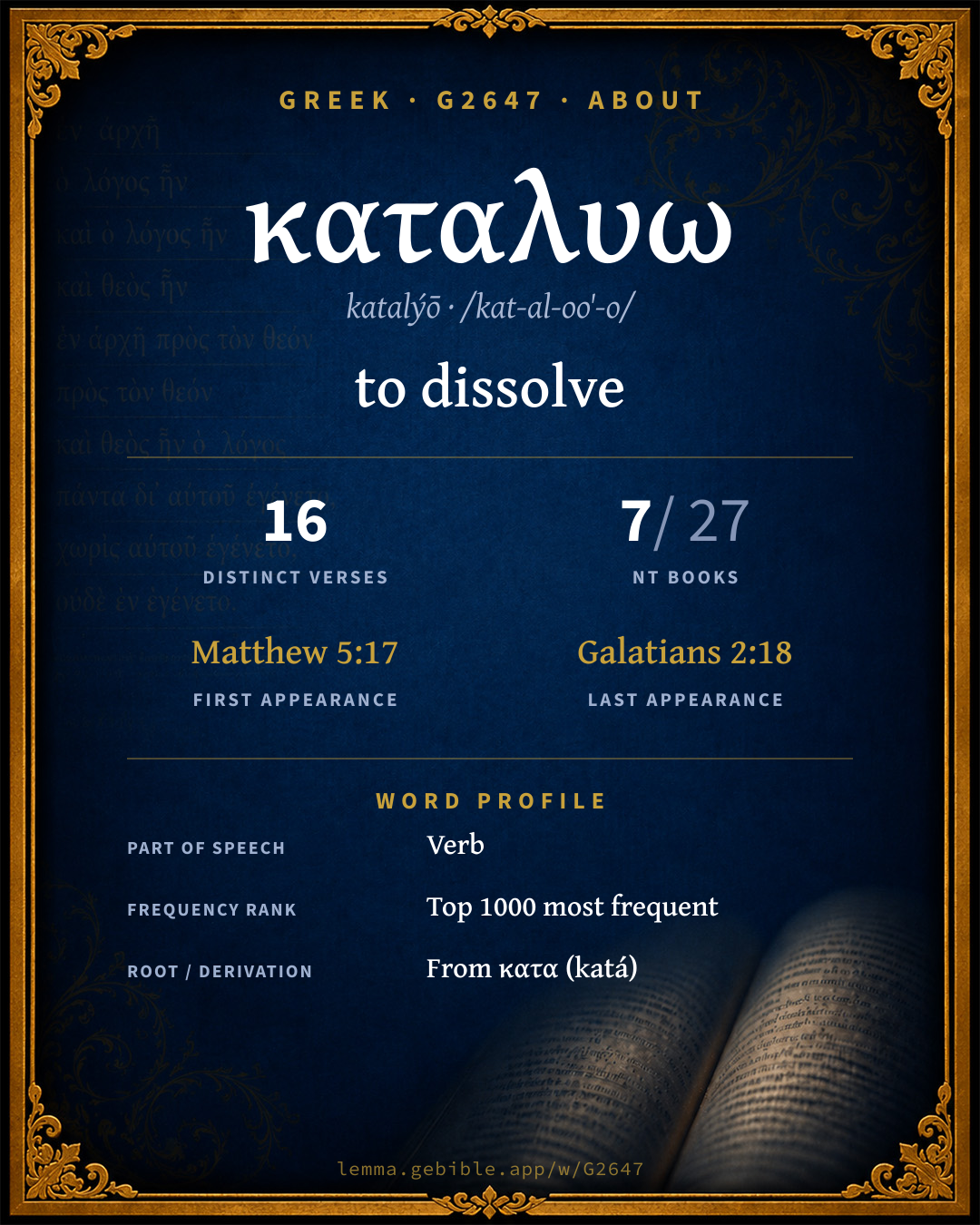
καταλύω
to dissolve
‘to dissolve’ is one of 4 main senses fuller range ↓
Full lexicon entry — Thayer's Greek Lexicon
From Thayer's Greek Lexicon
Where this word appears
See every Aorist-tense verb in the Greek New Testament →
Grammar key — what these labels mean
Part of speech
- Verb
- An action or state-of-being word.
Tense
- Aorist
- Action viewed as a simple whole, without regard to duration — often past (perfective aspect).
- Future
- Action expected in future time.
- Present
- Ongoing or general action in present time (imperfective aspect).
Voice
- Active
- The subject performs the action.
- Passive
- The subject receives the action.
Mood
- Infinitive
- A verbal noun (“to write”), unmarked for person or number.
- Indicative
- States a fact or asks a factual question (the mood of reality).
- Subjunctive
- Expresses probability, purpose, or possibility (the mood of contingency).
- Participle
- A verbal adjective (“writing,” “having written”).
- Imperative
- Expresses a command or request.
Case
- Nominative
- The case of the subject (and the predicate nominative).
Person
- 3rd person
- The one spoken about (“he / she / it / they”).
- 1st person
- The speaker (“I / we”).
- 2nd person
- The one addressed (“you”).
Gender
- Masculine
- Grammatically masculine.
Number
- Singular
- One.
- Plural
- More than one.
Every verse where G2647 appears in the Book of Luke — 3 distinct verses. Click any verse to open its interlinear word-by-word view. Verse text shown in the World English Bible for context — . Each verse’s Greek form is shown with its reference; the English is not keyword-highlighted, since the data carries no word-level English alignment. Use “Compare translations” on any verse to read it across multiple English versions. This concordance covers the Greek New Testament; Septuagint (Greek Old Testament) occurrences of this word are not indexed here.
Luke
- Luke 9:12 καταλύσωσιν aor act subj 3pl The day began to wear away; and the twelve came, and said to him, "Send the multitude away, that they may go into the surrounding villages and farms, and lodge, and get food, for we are here in a deserted place."
- Luke 19:7 καταλῦσαι aor act inf When they saw it, they all murmured, saying, "He has gone in to lodge with a man who is a sinner."
- Luke 21:6 καταλυθήσεται fut pass ind 3sg "As for these things which you see, the days will come, in which there will not be left here one stone on another that will not be thrown down."
About this entry
At a glance — auto-summarized from this page’s data, not written by a person. Every figure links to its source below. This summary describes the numbers; it doesn’t interpret them.
καταλυω — transliterated katalýō — is a Greek verb carrying the sense “to dissolve.” Its lexical range runs to 4 senses. Spanning 16 verses in 7 books, it ranks among the uncommon words of the Greek New Testament. Its uses concentrate in Matthew (25% of all occurrences). Debuting at Matthew 5:17, it then recurs through the corpus. Each statement above links to its evidence; the full detail follows below.
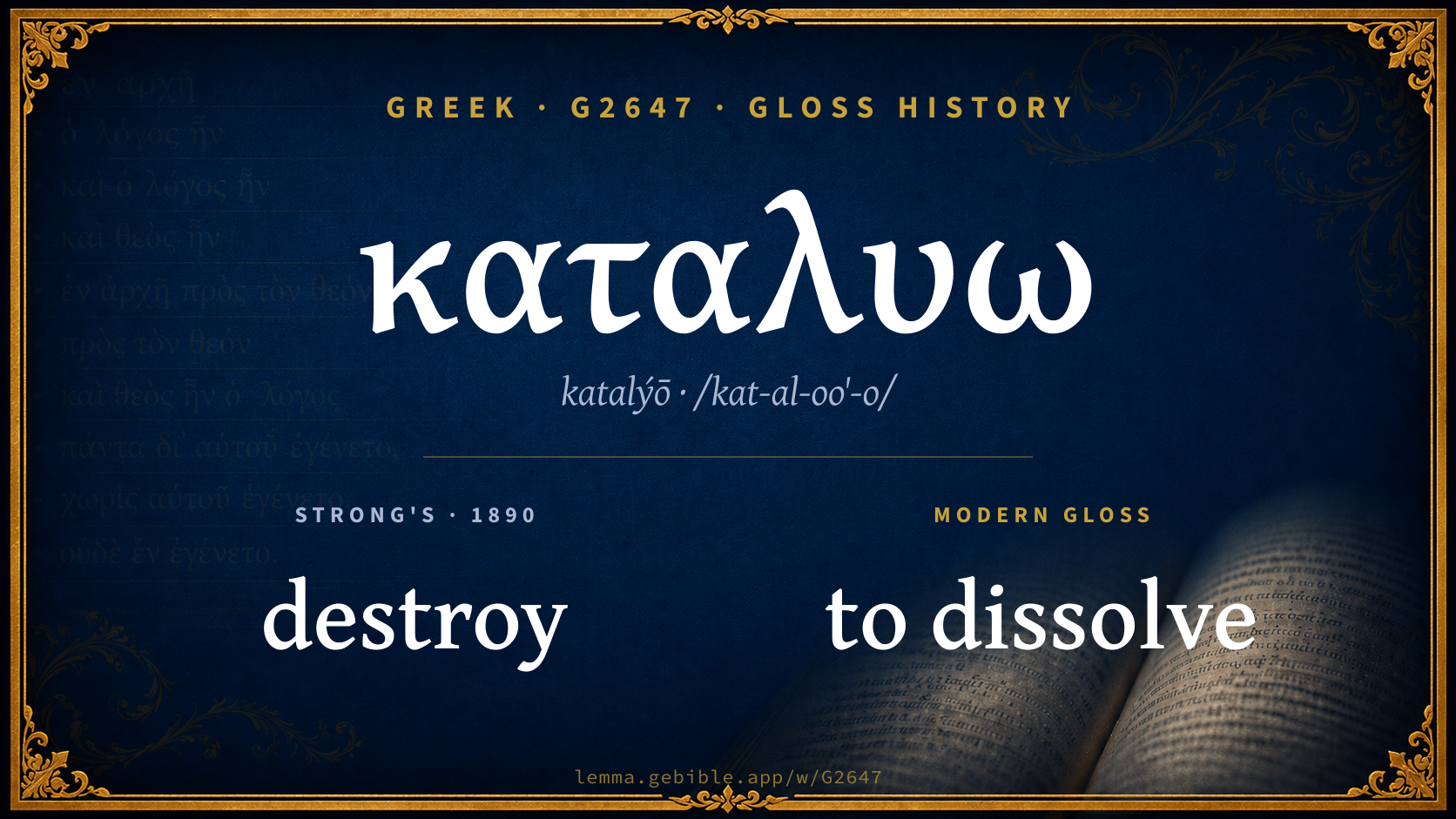
Gloss history
Strong's 1890 vs modern scholarship
About this word
Strong's G2647 catalogs a Greek word from the Greek New Testament.
These counts are not copied from any lexicon or concordance. They are computed here, from the morphology-tagged Greek New Testament. What Lemma adds →
- 16
- distinct verses
- The word appears in 16 distinct verses.
- 7 / 27
- NT books
- The word appears in 7 of 27 New Testament books.
- #697
- by frequency
- Top 1000 most frequent Greek words (rank 697 of 5,347 Greek words by occurrence).
View all 16 occurrences in the concordance →
By section of the New Testament
By traditional corpus
Conventional, traditional groupings — biblical authorship is debated, so this is a traditional corpus grouping, not an authorship claim. Some books belong to more than one corpus (Luke is in both the Gospels and the Lukan corpus, and so on), so these shares overlap and need not total 100%. Each figure is a share of the word’s 16 distinct verses.
- Gospels 10 verses · 63%
- Lukan (Luke–Acts) 6 verses · 38%
- Pauline corpus 3 verses · 19%
How translations render this word
Counts come from each version’s own published word-to-Strong’s tagging or interlinear alignment — an approximate guide to how each version renders this word, not a word-level alignment the data otherwise carries. Because each total is that version’s own tagged count, the per-version totals vary from one another and need not match the appearance or distinct-verse counts above. These counts may also differ from a printed concordance because Lemma counts each distinctly tagged rendering and does not collapse phrase taggings into a single head-word total. This is a fixed set of word-tagged versions (KJV, ASV, BSB, ULT) and does not change with the reading translation you choose elsewhere. Each version’s license is shown beside its name below (and on Sources).
- King James Version: Destroy 4×, Be thrown down 3×, Shall 3×
- American Standard Version: Destroy 3×, Lodge 2×, Shall 2×
- Berean Standard Bible: Will be thrown down 3×, Abolish 2×, Destroy 2×
- unfoldingWord Literal Text: Destroy 4×, Be torn down 3×, Will 3×
King James Version Public Domain
Renders G2647 across 20 tagged occurrences — most commonly:
Plus 8 renderings that appear only once — usually multi-word phrases or single function words the recovered tagging swept in, not distinct renderings.
American Standard Version Public Domain
Renders G2647 across 19 tagged occurrences — most commonly:
Plus 10 renderings that appear only once — usually multi-word phrases or single function words the recovered tagging swept in, not distinct renderings.
Berean Standard Bible Public Domain
Renders G2647 across 17 tagged occurrences — most commonly:
Plus 8 renderings that appear only once — usually multi-word phrases or single function words the recovered tagging swept in, not distinct renderings.
unfoldingWord Literal Text CC BY-SA 4.0
Renders G2647 across 21 tagged occurrences — most commonly:
Plus 7 renderings that appear only once — usually multi-word phrases or single function words the recovered tagging swept in, not distinct renderings.
Senses in Thayer's
The 4 senses Thayer's distinguishes for this word, in lexicon order (not ranked by frequency or importance). The full entry — with sub-senses — is in the Lexicon Entry tab.
- (what has been joined together), to destroy, demolish
- metaph. to overthrow i.e. render vain, deprive of success, bring to naught
- of institutions, forms of government, laws, etc., to deprive of force, annul, abrogate, discard
- of travellers…
Word origin
Derived from κατα (katá) (G2596) — down.
From G2596 and G3089 ; to loosen down ( disintegrate ) that is (by implication) to demolish (literally or figuratively); specifically (compare G2646 ) to halt for the night : - destroy dissolve be guest lodge come to nought overthrow throw down.
— Strong’s Exhaustive Concordance (1890), public domain.
Forms in the corpus
The 9 distinct written forms G2647 takes in the Greek New Testament, most frequent first — each parse links to that tense’s occurrences in the concordance.
| Form | Parsing | Example | Uses |
|---|---|---|---|
| καταλῦσαι katalŷsai | Verb, Aorist, Active, Infinitive | Matthew 5:17 | 5 |
| καταλυθήσεται katalythḗsetai | Verb, Future, Passive, Indicative, 3rd person, Singular | Matthew 24:2 | 3 |
| καταλυθῇ katalythē̂ | Verb, Aorist, Passive, Subjunctive, 3rd person, Singular | Mark 13:2 | 2 |
| καταλύων katalýōn | Verb, Present, Active, Participle, Nominative, Singular, Masculine | Matthew 27:40 | 2 |
| κατάλυε katálye | Verb, Present, Active, Imperative, 2nd person, Singular | Romans 14:20 | 1 |
| κατέλυσα katélysa | Verb, Aorist, Active, Indicative, 1st person, Singular | Galatians 2:18 | 1 |
| καταλύσει katalýsei | Verb, Future, Active, Indicative, 3rd person, Singular | Acts 6:14 | 1 |
| καταλύσω katalýsō | Verb, Future, Active, Indicative, 1st person, Singular | Mark 14:58 | 1 |
| καταλύσωσιν katalýsōsin | Verb, Aorist, Active, Subjunctive, 3rd person, Plural | Luke 9:12 | 1 |
Same root — word family
Other Thayer's entries built from the same root as G2647, grouped by Strong’s listed origin. These share a root / origin per the lexicon — not necessarily a shared meaning. Each links to that word’s own entry.
Derives from
Shares the same root
- καθα kathá G2505 according as
- καθαιρεω kathairéō G2507 to tear down
- καθαπτω katháptō G2510 to fasten down
- καθεδρα kathédra G2515 seat
- καθεζομαι kathézomai G2516 to sit down
- καθεξης kathexēs G2517 in order
- καθευδω katheúdō G2518 to fall asleep
- καθηγητης kathēgētḗs G2519 guide
- καθηκω kathḗkō G2520 to come down
- καθημαι káthēmai G2521 to sit down
- καθημερινος kathēmerinós G2522 daily
- καθιημι kathíēmi G2524 to send down
- καθιστημι kathístēmi G2525 to place
- καθο kathó G2526 according to what
- καθολου kathólou G2527 wholly
- καθοπλιζω kathoplízō G2528 to arm
- καθοραω kathoráō G2529 to see clearly
- καθοτι kathóti G2530 according to what
- καθως kathṓs G2531 according as
- καμμυω kammýō G2576 to close eyes
- καταβαινω katabaínō G2597 to descend
- καταβαλλω katabállō G2598 to cast down
- καταβαρεω katabaréō G2599 to weigh down
- καταβιβαζω katabibázō G2601 to bring down
+103 more words share this root (not shown).
Derived from this word
Compare all same-root words → Showing 4 of 130 — not the complete family. They share a root, not necessarily a meaning.
Septuagint usage
The same Greek word καταλυω appears 36 times in the Greek Old Testament (Septuagint), across 35 verses in 15 books.
- 36
- LXX occurrences
- Tagged occurrences of this Greek word in the Septuagint.
- 35
- verses
- Distinct Septuagint verses containing this word.
- 15 / 39
- OT books
- The word appears in 15 of the 39 Old Testament books.
Sample Septuagint occurrences
- Genesis 19:2 καταλύω
- Numbers 22:8 καταλύω
- Joshua 2:1 καταλύω
- Ruth 4:14 καταλύω
- 2 Samuel 17:8 καταλύω
- 1 Kings 19:9 καταλύω
- 2 Chronicles 23:8 καταλύω
- Ezra 5:12 καταλύω
- Psalms 8:3 καταλύω
- Isaiah 38:12 καταλύω
- Jeremiah 5:7 καταλύω
- Lamentations 5:15 καταλύω
Septuagint occurrences (same lexeme)
Every verse where the same Strong’s number (G2647) appears in the Greek Septuagint. Verse text shown in the World English Bible for context; the Greek form is the matched word — the English is not keyword-highlighted.
- Genesis 19:2 καταλύω and he said, "See now, my lords, please turn aside into your servant's house, stay all night, wash your feet, and you will rise up early, and go on your way." They said, "No, but we will stay in the street all night."
- Genesis 24:23 καταλύω and said, "Whose daughter are you? Please tell me. Is there room in your father's house for us to lodge in?"
- Genesis 24:25 καταλύω She said moreover to him, "We have both straw and provender enough, and room to lodge in."
- Genesis 26:17 καταλύω Isaac departed from there, encamped in the valley of Gerar, and lived there.
- Genesis 42:27 καταλύω As one of them opened his sack to give his donkey food in the lodging-place, he saw his money. Behold, it was in the mouth of his sack.
- Genesis 43:21 καταλύω and it happened, when we came to the lodging-place, that we opened our sacks, and, behold, every man's money was in the mouth of his sack, our money in full weight. We have brought it again in our hand.
- Numbers 22:8 καταλύω He said to them, Lodge here this night, and I will bring you word again, as Yahweh shall speak to me: and the princes of Moab abode with Balaam.
- Numbers 25:1 καταλύω Israel abode in Shittim; and the people began to play the prostitute with the daughters of Moab:
- Joshua 2:1 καταλύω Joshua the son of Nun sent out of Shittim two men as spies secretly, saying, Go, view the land, and Jericho. They went and came into the house of a prostitute whose name was Rahab, and lay there.
- Joshua 3:1 καταλύω Joshua rose up early in the morning; and they removed from Shittim, and came to the Jordan, he and all the children of Israel; and they lodged there before they passed over.
- Ruth 4:14 καταλύω The women said to Naomi, Blessed be Yahweh, who has not left you this day without a near kinsman; and let his name be famous in Israel.
- 2 Samuel 17:8 καταλύω Hushai said moreover, You know your father and his men, that they are mighty men, and they are fierce in their minds, as a bear robbed of her cubs in the field; and your father is a man of war, and will not lodge with the people.
- 1 Kings 19:9 καταλύω He came there to a cave, and lodged there; and, behold, the word of Yahweh came to him, and he said to him, What are you doing here, Elijah?
- 2 Chronicles 23:8 καταλύω So the Levites and all Judah did according to all that Jehoiada the priest commanded: and they took every man his men, those who were to come in on the Sabbath; with those who were to go out on the Sabbath; for Jehoiada the priest didn't dismiss the shift.
- Ezra 5:12 καταλύω But after that our fathers had provoked the God of heaven to wrath, he gave them into the hand of Nebuchadnezzar king of Babylon, the Chaldean, who destroyed this house, and carried the people away into Babylon.
- Psalms 8:3 καταλύω When I consider your heavens, the work of your fingers, The moon and the stars, which you have ordained;
- Psalms 88:45 καταλύω
- Isaiah 38:12 καταλύω My dwelling is removed, and is carried away from me as a shepherd's tent: I have rolled up, like a weaver, my life; he will cut me off from the loom: From day even to night will you make an end of me.
- Jeremiah 5:7 καταλύω How can I pardon you? your children have forsaken me, and sworn by them that are no gods: when I had fed them to the full, they committed adultery, and assembled themselves in troops at the prostitutes' houses.
- Jeremiah 7:34 καταλύω Then will I cause to cease from the cities of Judah, and from the streets of Jerusalem, the voice of mirth and the voice of gladness, the voice of the bridegroom and the voice of the bride; for the land shall become a waste.
- Jeremiah 16:9 καταλύω For thus says Yahweh of Hosts, the God of Israel: Behold, I will cause to cease out of this place, before your eyes and in your days, the voice of mirth and the voice of gladness, the voice of the bridegroom and the voice of the bride.
- Jeremiah 28:43 καταλύω
- Jeremiah 30:10 καταλύω Therefore don't you be afraid, O Jacob my servant, says Yahweh; neither be dismayed, Israel: for, behold, I will save you from afar, and your seed from the land of their captivity; and Jacob shall return, and shall be quiet and at ease, and none shall make him afraid.
- Jeremiah 30:26 καταλύω
- Jeremiah 32:11 καταλύω So I took the deed of the purchase, both that which was sealed, containing the terms and conditions, and that which was open;
- Jeremiah 44:13 καταλύω For I will punish those who dwell in the land of Egypt, as I have punished Jerusalem, by the sword, by the famine, and by the pestilence;
- Jeremiah 45:22 καταλύω
- Lamentations 5:15 καταλύω The joy of our heart is ceased; Our dance is turned into mourning.
- Ezekiel 16:8 καταλύω Now when I passed by you, and looked at you, behold, your time was the time of love; and I spread my skirt over you, and covered your nakedness: yes, I swore to you, and entered into a covenant with you, says the Lord Yahweh, and you became mine.
- Ezekiel 21:35 καταλύω
- Ezekiel 23:17 καταλύω The Babylonians came to her into the bed of love, and they defiled her with their prostitution, and she was polluted with them, and her soul was alienated from them.
- Ezekiel 26:13 καταλύω I will cause the noise of your songs to cease; and the sound of your harps shall be no more heard.
- Ezekiel 26:17 καταλύω They shall take up a lamentation over you, and tell you, How are you destroyed, who were inhabited by seafaring men, the renowned city, who was strong in the sea, she and her inhabitants, who caused their terror to be on all who lived there!
- Zephaniah 2:7 καταλύω The coast will be for the remnant of the house of Judah. They will find pasture. In the houses of Ashkelon, they will lie down in the evening, for Yahweh, their God, will visit them, and restore them.
- Zechariah 5:4 καταλύω I will cause it to go out," says Yahweh of Hosts, "and it will enter into the house of the thief, and into the house of him who swears falsely by my name; and it will remain in the midst of his house, and will destroy it with its timber and its stones."
These are occurrences of the same Greek lexeme (G2647) in the Septuagint — not a translation of any one Hebrew word. The store carries no word-level Hebrew↔Greek alignment, so no Hebrew original is asserted here. Counts come from the recovered LXX Strong's tagging — high-frequency vocabulary is well covered, while rare or late forms may be untagged — so they reflect tagged occurrences and may slightly undercount.