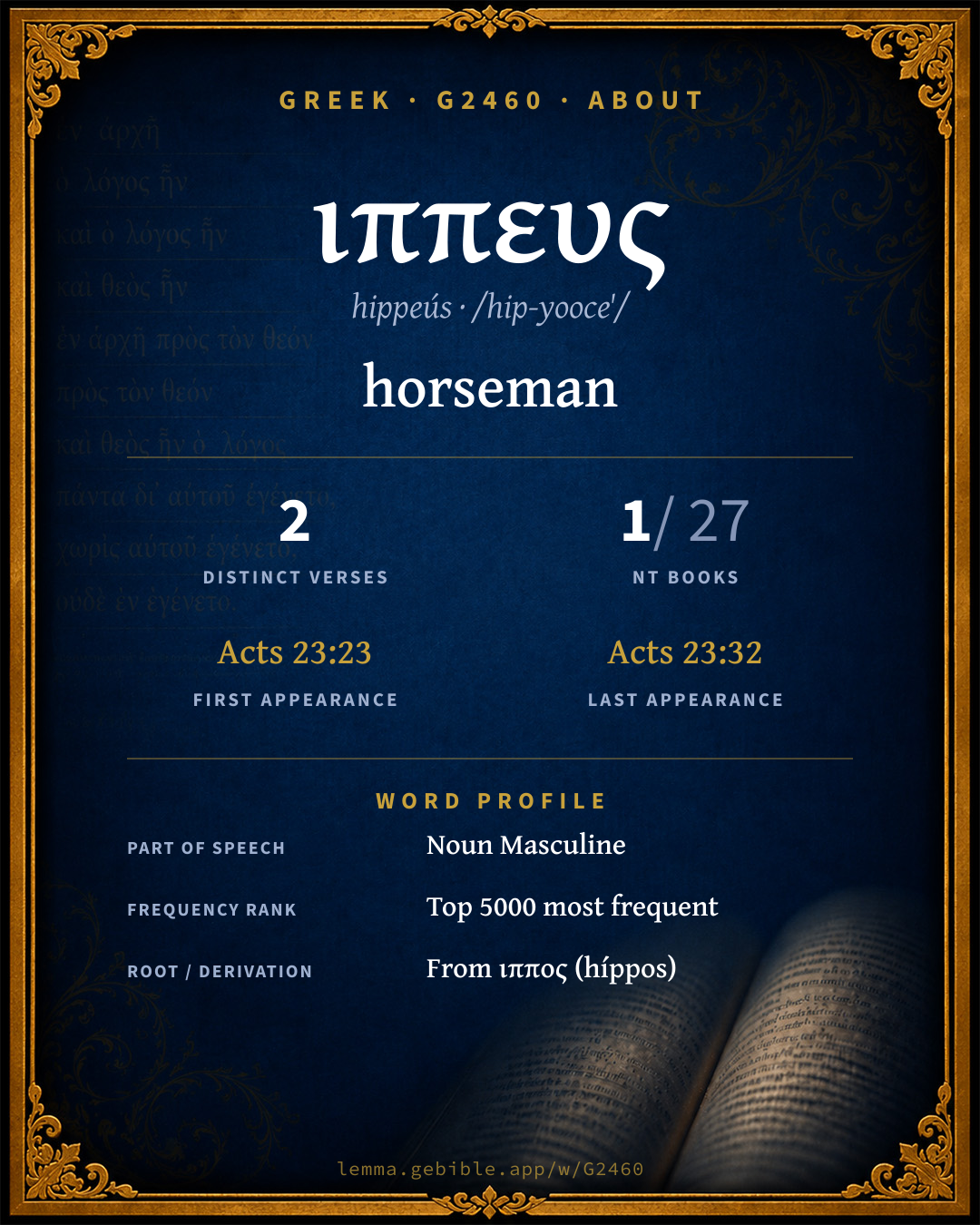
ἱππεύς
horseman
Full lexicon entry — Thayer's Greek Lexicon
From Thayer's Greek Lexicon
Where this word appears
Grammar key — what these labels mean
Part of speech
- Noun
- A naming word — a person, place, thing, or idea.
Case
- Accusative
- The case of the direct object and of extent.
Gender
- Masculine
- Grammatically masculine.
Number
- Plural
- More than one.
Every verse where G2460 appears — 2 distinct verses across 1 book. Click any verse to open its interlinear word-by-word view. Verse text shown in the World English Bible for context — . Each verse’s Greek form is shown with its reference; the English is not keyword-highlighted, since the data carries no word-level English alignment. Use “Compare translations” on any verse to read it across multiple English versions. This concordance covers the Greek New Testament; Septuagint (Greek Old Testament) occurrences of this word are not indexed here.
Acts 2 verses
- Acts 23:23 ἱππεῖς n acc pl masc He called to himself two of the centurions, and said, "Prepare two hundred soldiers to go as far as Caesarea, with seventy horsemen, and two hundred men armed with spears, at the third hour of the night."
- Acts 23:32 ἱππεῖς n acc pl masc But on the next day they left the horsemen to go with him, and returned to the barracks.
About this entry
At a glance — auto-summarized from this page’s data, not written by a person. Every figure links to its source below. This summary describes the numbers; it doesn’t interpret them.
At its core, ιππευς (hippeús) means “horseman.” With only 2 verses it sits in the long tail of Greek New Testament vocabulary. Its uses cluster heavily in Acts (100% of all occurrences). Scripture first uses it in Acts 23:23. Sharing its root, it stands alongside ιππος and ιππικον. Each statement above links to its evidence; the full detail follows below.
Gloss history
Strong's 1890 vs modern scholarship
About this word
Strong's G2460 catalogs a Greek word from the Greek New Testament.
These counts are not copied from any lexicon or concordance. They are computed here, from the morphology-tagged Greek New Testament. What Lemma adds →
- 2
- distinct verses
- The word appears in 2 distinct verses.
- 1 / 27
- NT books
- The word appears in 1 of 27 New Testament books.
- #2,678
- by frequency
- Top 5000 most frequent Greek words (rank 2,678 of 5,347 Greek words by occurrence).
View all 2 occurrences in the concordance →
Most concentrated in
- Acts 2 verses 100%
By section of the New Testament
By traditional corpus
Conventional, traditional groupings — biblical authorship is debated, so this is a traditional corpus grouping, not an authorship claim. Some books belong to more than one corpus (Luke is in both the Gospels and the Lukan corpus, and so on), so these shares overlap and need not total 100%. Each figure is a share of the word’s 2 distinct verses.
- Lukan (Luke–Acts) 2 verses · 100%
How translations render this word
Counts come from each version’s own published word-to-Strong’s tagging or interlinear alignment — an approximate guide to how each version renders this word, not a word-level alignment the data otherwise carries. Because each total is that version’s own tagged count, the per-version totals vary from one another and need not match the appearance or distinct-verse counts above. These counts may also differ from a printed concordance because Lemma counts each distinctly tagged rendering and does not collapse phrase taggings into a single head-word total. This is a fixed set of word-tagged versions (KJV, ASV, BSB, ULT) and does not change with the reading translation you choose elsewhere. Each version’s license is shown beside its name below (and on Sources).
- King James Version: Horsemen 2×
- American Standard Version: Horsemen 2×
- Berean Standard Bible: Horsemen 2×
- unfoldingWord Literal Text: Horsemen 2×
King James Version Public Domain
Renders G2460 across 2 tagged occurrences — most commonly:
American Standard Version Public Domain
Renders G2460 across 2 tagged occurrences — most commonly:
Berean Standard Bible Public Domain
Renders G2460 across 2 tagged occurrences — most commonly:
unfoldingWord Literal Text CC BY-SA 4.0
Renders G2460 across 2 tagged occurrences — most commonly:
Senses in Thayer's
The 1 sense Thayer's distinguishes for this word, in lexicon order (not ranked by frequency or importance). The full entry — with sub-senses — is in the Lexicon Entry tab.
- a horseman
Word origin
Derived from ιππος (híppos) (G2462) — horse.
From G2462 ; an equestrian that is member of a cavalry corps : - horseman.
— Strong’s Exhaustive Concordance (1890), public domain.
Same root — word family
Other Thayer's entries built from the same root as G2460, grouped by Strong’s listed origin. These share a root / origin per the lexicon — not necessarily a shared meaning. Each links to that word’s own entry.
Derives from
Shares the same root
Compare all same-root words → They share a root, not necessarily a meaning.
Septuagint usage
The same Greek word ιππευς appears 45 times in the Greek Old Testament (Septuagint), across 43 verses in 19 books.
- 45
- LXX occurrences
- Tagged occurrences of this Greek word in the Septuagint.
- 43
- verses
- Distinct Septuagint verses containing this word.
- 19 / 39
- OT books
- The word appears in 19 of the 39 Old Testament books.
Sample Septuagint occurrences
- Genesis 49:17 ἱππεύς
- Exodus 14:9 ἱππεύς
- 1 Samuel 8:11 ἱππεύς
- 2 Samuel 8:4 ἱππεύς
- 1 Kings 1:5 ἱππεύς
- 2 Kings 2:12 ἱππεύς
- 1 Chronicles 19:6 ἱππεύς
- 2 Chronicles 1:14 ἱππεύς
- Ezra 8:22 ἱππεύς
- Esther 8:14 ἱππεύς
- Job 1:17 ἱππεύς
- Isaiah 21:7 ἱππεύς
Septuagint occurrences (same lexeme)
Every verse where the same Strong’s number (G2460) appears in the Greek Septuagint. Verse text shown in the World English Bible for context; the Greek form is the matched word — the English is not keyword-highlighted.
- Genesis 49:17 ἱππεύς Dan will be a serpent in the way, An adder in the path, That bites the horse's heels, So that his rider falls backward.
- Genesis 50:9 ἱππεύς There went up with him both chariots and horsemen. It was a very great company.
- Exodus 14:9 ἱππεύς The Egyptians pursued after them: all the horses and chariots of Pharaoh, his horsemen, and his army; and overtook them encamping by the sea, beside Pihahiroth, before Baal Zephon.
- 1 Samuel 8:11 ἱππεύς He said, This will be the manner of the king who shall reign over you: he will take your sons, and appoint them to him, for his chariots, and to be his horsemen; and they shall run before his chariots;
- 1 Samuel 13:5 ἱππεύς The Philistines assembled themselves together to fight with Israel, thirty thousand chariots, and six thousand horsemen, and people as the sand which is on the sea-shore in multitude: and they came up, and encamped in Michmash, eastward of Beth Aven.
- 2 Samuel 8:4 ἱππεύς David took from him one thousand seven hundred horsemen, and twenty thousand footmen: and David hamstrung all the chariot horses, but reserved of them for one hundred chariots.
- 2 Samuel 10:18 ἱππεύς The Syrians fled before Israel; and David killed of the Syrians [the men of] seven hundred chariots, and forty thousand horsemen, and struck Shobach the captain of their host, so that he died there.
- 1 Kings 1:5 ἱππεύς Then Adonijah the son of Haggith exalted himself, saying, I will be king: and he prepared him chariots and horsemen, and fifty men to run before him.
- 1 Kings 2:46 ἱππεύς So the king commanded Benaiah the son of Jehoiada; and he went out, and fell on him, so that he died. The kingdom was established in the hand of Solomon.
- 1 Kings 10:22 ἱππεύς For the king had at sea a navy of Tarshish with the navy of Hiram: once every three years came the navy of Tarshish, bringing gold, and silver, ivory, and apes, and peacocks.
- 1 Kings 10:26 ἱππεύς Solomon gathered together chariots and horsemen: and he had a thousand and four hundred chariots, and twelve thousand horsemen, that he bestowed in the chariot cities, and with the king at Jerusalem.
- 1 Kings 21:20 ἱππεύς Ahab said to Elijah, Have you found me, my enemy? He answered, I have found you, because you have sold yourself to do that which is evil in the sight of Yahweh.
- 2 Kings 2:12 ἱππεύς Elisha saw it, and he cried, My father, my father, the chariots of Israel and the horsemen of it! He saw him no more: and he took hold of his own clothes, and tore them in two pieces.
- 2 Kings 13:7 ἱππεύς For he didn't leave to Jehoahaz of the people save fifty horsemen, and ten chariots, and ten thousand footmen; for the king of Syria destroyed them, and made them like the dust in threshing.
- 2 Kings 13:14 ἱππεύς Now Elisha was fallen sick of his sickness of which he died: and Joash the king of Israel came down to him, and wept over him, and said, My father, my father, the chariots of Israel and the horsemen of it!
- 2 Kings 18:24 ἱππεύς How then can you turn away the face of one captain of the least of my master's servants, and put your trust on Egypt for chariots and for horsemen?
- 1 Chronicles 19:6 ἱππεύς When the children of Ammon saw that they had made themselves odious to David, Hanun and the children of Ammon sent one thousand talents of silver to hire them chariots and horsemen out of Mesopotamia, and out of Arammaacah, and out of Zobah.
- 2 Chronicles 1:14 ἱππεύς Solomon gathered chariots and horsemen: and he had one thousand four hundred chariots, and twelve thousand horsemen, that he placed in the chariot cities, and with the king at Jerusalem.
- 2 Chronicles 8:6 ἱππεύς and Baalath, and all the store-cities that Solomon had, and all the cities for his chariots, and the cities for his horsemen, and all that Solomon desired to build for his pleasure in Jerusalem, and in Lebanon, and in all the land of his dominion.
- 2 Chronicles 8:9 ἱππεύς But of the children of Israel did Solomon make no servants for his work; but they were men of war, and chief of his captains, and rulers of his chariots and of his horsemen.
- 2 Chronicles 9:25 ἱππεύς Solomon had four thousand stalls for horses and chariots, and twelve thousand horsemen, that he bestowed in the chariot cities, and with the king at Jerusalem.
- 2 Chronicles 16:8 ἱππεύς Weren't the Ethiopians and the Lubim a huge host, with chariots and horsemen exceeding many? yet, because you did rely on Yahweh, he delivered them into your hand.
- 2 Chronicles 23:15 ἱππεύς So they made way for her; and she went to the entrance of the horse gate to the king's house: and they killed her there.
- Ezra 8:22 ἱππεύς For I was ashamed to ask of the king a band of soldiers and horsemen to help us against the enemy in the way, because we had spoken to the king, saying, The hand of our God is on all those who seek him, for good; but his power and his wrath is against all those who forsake him.
- Ezra 12:9 ἱππεύς
- Esther 8:14 ἱππεύς So the posts who rode on swift steeds that were used in the king's service went out, being hurried and pressed on by the king's commandment; and the decree was given out in Shushan the palace.
- Job 1:17 ἱππεύς While he was still speaking, there came also another, and said, "The Chaldeans made three bands, and swept down on the camels, and have taken them away, yes, and killed the servants with the edge of the sword; and I alone have escaped to tell you."
- Isaiah 21:7 ἱππεύς and when he sees a troop, horsemen in pairs, a troop of donkeys, a troop of camels, he shall listen diligently with much heed.
- Isaiah 22:7 ἱππεύς It happened that your choicest valleys were full of chariots, and the horsemen set themselves in array at the gate.
- Jeremiah 4:29 ἱππεύς Every city flees for the noise of the horsemen and archers; they go into the thickets, and climb up on the rocks: every city is forsaken, and not a man dwells therein.
- Jeremiah 26:4 ἱππεύς You shall tell them, Thus says Yahweh: If you will not listen to me, to walk in my law, which I have set before you,
- Ezekiel 23:6 ἱππεύς who were clothed with blue, governors and rulers, all of them desirable young men, horsemen riding on horses.
- Ezekiel 23:12 ἱππεύς She doted on the Assyrians, governors and rulers, [her] neighbors, clothed most gorgeously, horsemen riding on horses, all of them desirable young men.
- Ezekiel 26:7 ἱππεύς For thus says the Lord Yahweh: Behold, I will bring on Tyre Nebuchadrezzar king of Babylon, king of kings, from the north, with horses, and with chariots, and with horsemen, and a company, and much people.
- Ezekiel 26:10 ἱππεύς By reason of the abundance of his horses their dust shall cover you: your walls shall shake at the noise of the horsemen, and of the wagons, and of the chariots, when he shall enter into your gates, as men enter into a city in which is made a breach.
- Ezekiel 27:14 ἱππεύς They of the house of Togarmah traded for your wares with horses and war-horses and mules.
- Ezekiel 38:4 ἱππεύς and I will turn you about, and put hooks into your jaws, and I will bring you forth, and all your army, horses and horsemen, all of them clothed in full armor, a great company with buckler and shield, all of them handling swords;
- Hosea 1:7 ἱππεύς But I will have mercy on the house of Judah, and will save them by Yahweh their God, and will not save them by bow, nor by sword, nor by battle, by horses, nor by horsemen."
- Joel 2:4 ἱππεύς The appearance of them is as the appearance of horses, And as horsemen, so do they run.
- Amos 2:15 ἱππεύς Neither shall he stand who handles the bow; And he who is swift of foot won't escape; Neither shall he who rides the horse deliver himself;
- Nahum 2:4 ἱππεύς The chariots rage in the streets. They rush back and forth in the broad ways. Their appearance is like torches. They run like the lightnings.
- Nahum 3:3 ἱππεύς the horseman mounting, and the flashing sword, the glittering spear, and a multitude of slain, and a great heap of corpses, and there is no end of the bodies. They stumble on their bodies,
- Habakkuk 1:8 ἱππεύς Their horses also are swifter than leopards, and are more fierce than the evening wolves. Their horsemen press proudly on. Yes, their horsemen come from afar. They fly as an eagle that hurries to devour.
These are occurrences of the same Greek lexeme (G2460) in the Septuagint — not a translation of any one Hebrew word. The store carries no word-level Hebrew↔Greek alignment, so no Hebrew original is asserted here. Counts come from the recovered LXX Strong's tagging — high-frequency vocabulary is well covered, while rare or late forms may be untagged — so they reflect tagged occurrences and may slightly undercount.