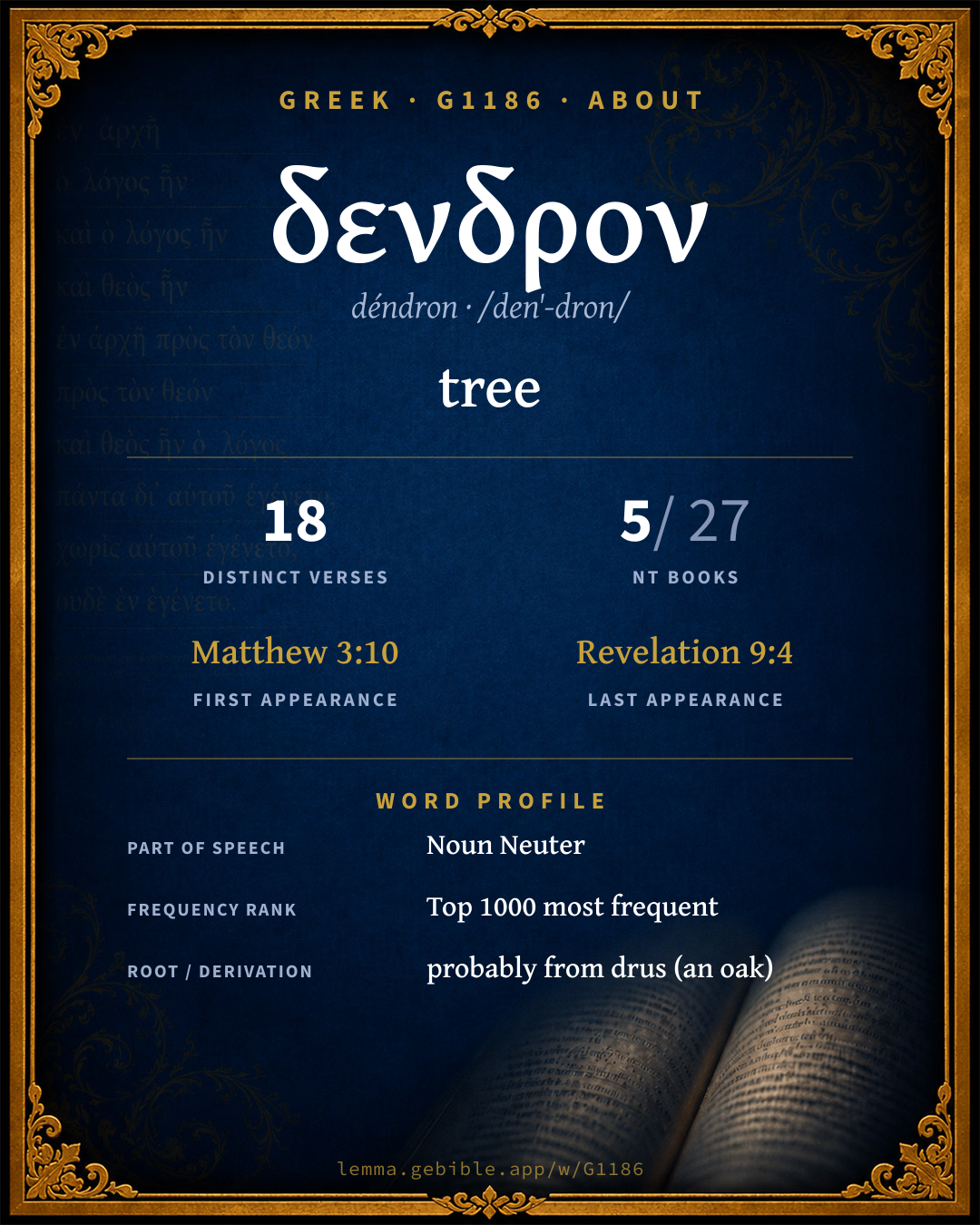
δένδρον
tree
Full lexicon entry — Thayer's Greek Lexicon
From Thayer's Greek Lexicon
Where this word appears
See every Nominative-case word in the Greek New Testament →
Grammar key — what these labels mean
Part of speech
- Noun
- A naming word — a person, place, thing, or idea.
Case
- Nominative
- The case of the subject (and the predicate nominative).
- Accusative
- The case of the direct object and of extent.
- Genitive
- The case of source, possession, or “of” — answers “whose / from what.”
Gender
- Neuter
- Grammatically neuter.
Number
- Singular
- One.
- Plural
- More than one.
6 verses where G1186 appears in the Nominative case in the Book of Matthew. Filtered view — show all forms. Click any verse to open its interlinear word-by-word view. Verse text shown in the World English Bible for context — . Each verse’s Greek form is shown with its reference; the English is not keyword-highlighted, since the data carries no word-level English alignment. Use “Compare translations” on any verse to read it across multiple English versions. This concordance covers the Greek New Testament; Septuagint (Greek Old Testament) occurrences of this word are not indexed here.
Matthew
- Matthew 3:10 δένδρων δένδρον n gen pl neut n nom sg neut "Even now the axe lies at the root of the trees. Therefore, every tree that doesn't bring forth good fruit is cut down, and cast into the fire.
- Matthew 7:17 δένδρον δένδρον n nom sg neut n nom sg neut Even so, every good tree produces good fruit; but the corrupt tree produces evil fruit.
- Matthew 7:18 δένδρον δένδρον n nom sg neut n nom sg neut A good tree can't produce evil fruit, neither can a corrupt tree produce good fruit.
- Matthew 7:19 δένδρον n nom sg neut Every tree that doesn't grow good fruit is cut down, and thrown into the fire.
- Matthew 12:33 δένδρον δένδρον δένδρον n acc sg neut n acc sg neut n nom sg neut "Either make the tree good, and its fruit good, or make the tree corrupt, and its fruit corrupt; for the tree is known by its fruit.
- Matthew 13:32 δένδρον n nom sg neut which indeed is smaller than all seeds. But when it is grown, it is greater than the herbs, and becomes a tree, so that the birds of the air come and lodge in its branches."
About this entry
At a glance — auto-summarized from this page’s data, not written by a person. Every figure links to its source below. This summary describes the numbers; it doesn’t interpret them.
“tree” is the headline sense of the Greek noun δενδρον (déndron). First canonically at Matthew 3:10, it enters the text early. It turns up in 18 verses across 5 books, an uncommon footprint. It concentrates in Matthew, which alone accounts for 39% of its uses. The sections below give every sense, occurrence, and version rendering.
Gloss history
Strong's 1890 vs modern scholarship
About this word
Strong's G1186 catalogs a Greek word from the Greek New Testament.
These counts are not copied from any lexicon or concordance. They are computed here, from the morphology-tagged Greek New Testament. What Lemma adds →
- 18
- distinct verses
- The word appears in 18 distinct verses.
- 5 / 27
- NT books
- The word appears in 5 of 27 New Testament books.
- #530
- by frequency
- Top 1000 most frequent Greek words (rank 530 of 5,347 Greek words by occurrence).
View all 18 occurrences in the concordance →
Most concentrated in
- Matthew 7 verses 39%
- Luke 5 verses 28%
- Revelation 4 verses 22%
By section of the New Testament
By traditional corpus
Conventional, traditional groupings — biblical authorship is debated, so this is a traditional corpus grouping, not an authorship claim. Some books belong to more than one corpus (Luke is in both the Gospels and the Lukan corpus, and so on), so these shares overlap and need not total 100%. Each figure is a share of the word’s 18 distinct verses.
- Gospels 13 verses · 72%
- Lukan (Luke–Acts) 5 verses · 28%
- Johannine 4 verses · 22%
- Revelation 4 verses · 22%
- General (Catholic) Epistles 1 verse · 6%
How translations render this word
Counts come from each version’s own published word-to-Strong’s tagging or interlinear alignment — an approximate guide to how each version renders this word, not a word-level alignment the data otherwise carries. Because each total is that version’s own tagged count, the per-version totals vary from one another and need not match the appearance or distinct-verse counts above. These counts may also differ from a printed concordance because Lemma counts each distinctly tagged rendering and does not collapse phrase taggings into a single head-word total. This is a fixed set of word-tagged versions (KJV, ASV, BSB, ULT) and does not change with the reading translation you choose elsewhere. Each version’s license is shown beside its name below (and on Sources).
- King James Version: Tree 17×, Trees 9×
- American Standard Version: Tree 16×, Trees 6×
- Berean Standard Bible: Tree 17×, Trees 8×
- unfoldingWord Literal Text: Tree 17×, Trees 8×, A 2×
King James Version Public Domain
Renders G1186 across 26 tagged occurrences — most commonly:
American Standard Version Public Domain
Renders G1186 across 26 tagged occurrences — most commonly:
Plus 4 renderings that appear only once — usually multi-word phrases or single function words the recovered tagging swept in, not distinct renderings.
Berean Standard Bible Public Domain
Renders G1186 across 25 tagged occurrences — most commonly:
unfoldingWord Literal Text CC BY-SA 4.0
Renders G1186 across 28 tagged occurrences — most commonly:
Plus 1 rendering that appears only once — usually multi-word phrases or single function words the recovered tagging swept in, not distinct renderings.
Senses in Thayer's
The 1 sense Thayer's distinguishes for this word, in lexicon order (not ranked by frequency or importance). The full entry — with sub-senses — is in the Lexicon Entry tab.
- a tree
Word origin
Origin: probably from drus (an oak)
Probably from δρύς drus (an oak ); a tree : - tree.
— Strong’s Exhaustive Concordance (1890), public domain.
Forms in the corpus
The 3 distinct written forms G1186 takes in the Greek New Testament, most frequent first — each parse links to that case’s occurrences in the concordance.
| Form | Parsing | Example | Uses |
|---|---|---|---|
| δένδρον déndron | Noun, Nominative, Singular, Neuter | Matthew 3:10 | 17 |
| δένδρα déndra | Noun, Accusative, Plural, Neuter | Mark 8:24 | 4 |
| δένδρων déndrōn | Noun, Genitive, Plural, Neuter | Matthew 3:10 | 4 |
Septuagint usage
The same Greek word δενδρον appears 27 times in the Greek Old Testament (Septuagint), across 27 verses in 9 books.
- 27
- LXX occurrences
- Tagged occurrences of this Greek word in the Septuagint.
- 27
- verses
- Distinct Septuagint verses containing this word.
- 9 / 39
- OT books
- The word appears in 9 of the 39 Old Testament books.
Sample Septuagint occurrences
- Genesis 18:4 δένδρον
- Numbers 13:20 δένδρον
- Deuteronomy 12:2 δένδρον
- Job 14:7 δένδρον
- Proverbs 11:30 δένδρον
- Isaiah 2:13 δένδρον
- Ezekiel 6:13 δένδρον
- Daniel 2:40 δένδρον
- Hosea 4:13 δένδρον
Septuagint occurrences (same lexeme)
Every verse where the same Strong’s number (G1186) appears in the Greek Septuagint. Verse text shown in the World English Bible for context; the Greek form is the matched word — the English is not keyword-highlighted.
- Genesis 18:4 δένδρον Now let a little water be fetched, wash your feet, and rest yourselves under the tree.
- Genesis 18:8 δένδρον He took butter, milk, and the calf which he had dressed, and set it before them. He stood by them under the tree, and they ate.
- Genesis 23:17 δένδρον So the field of Ephron, which was in Machpelah, which was before Mamre, the field, the cave which was therein, and all the trees that were in the field, that were in all the border of it round about, were made sure
- Numbers 13:20 δένδρον and what the land is, whether it is fat or lean, whether there is wood therein, or not. Be of good courage, and bring of the fruit of the land. Now the time was the time of the first-ripe grapes.
- Deuteronomy 12:2 δένδρον You shall surely destroy all the places in which the nations that you shall dispossess served their gods, on the high mountains, and on the hills, and under every green tree:
- Deuteronomy 20:19 δένδρον When you shall besiege a city a long time, in making war against it to take it, you shall not destroy the trees of it by wielding an axe against them; for you may eat of them, and you shall not cut them down; for is the tree of the field man, that it should be besieged of you?
- Job 14:7 δένδρον "For there is hope for a tree, If it is cut down, that it will sprout again, That the tender branch of it will not cease.
- Job 19:10 δένδρον He has broken me down on every side, and I am gone. My hope he has plucked up like a tree.
- Job 40:21 δένδρον He lies under the lotus trees, In the covert of the reed, and the marsh.
- Job 40:22 δένδρον The lotuses cover him with their shade. The willows of the brook surround him.
- Proverbs 11:30 δένδρον The fruit of the righteous is a tree of life. He who is wise wins souls.
- Proverbs 13:12 δένδρον Hope deferred makes the heart sick, But when longing is fulfilled, it is a tree of life.
- Proverbs 15:4 δένδρον A gentle tongue is a tree of life, But deceit in it crushes the spirit.
- Isaiah 2:13 δένδρον For all the cedars of Lebanon, that are high and lifted up, For all the oaks of Bashan,
- Isaiah 16:9 δένδρον Therefore I will weep with the weeping of Jazer for the vine of Sibmah; I will water you with my tears, Heshbon, and Elealeh: for on your summer fruits and on your harvest the [battle] shout is fallen.
- Isaiah 17:8 δένδρον They shall not look to the altars, the work of their hands; neither shall they have respect to that which their fingers have made, either the Asherim, or the sun-images.
- Isaiah 27:9 δένδρον Therefore by this shall the iniquity of Jacob be forgiven, and this is all the fruit of taking away his sin: that he makes all the stones of the altar as chalk stones that are beaten in sunder, [so that] the Asherim and the sun-images shall rise no more.
- Isaiah 57:5 δένδρον you who inflame yourselves among the oaks, under every green tree; who kill the children in the valleys, under the clefts of the rocks?
- Ezekiel 6:13 δένδρον You shall know that I am Yahweh, when their slain men shall be among their idols round about their altars, on every high hill, on all the tops of the mountains, and under every green tree, and under every thick oak, the places where they offered sweet savor to all their idols.
- Ezekiel 47:7 δένδρον Now when I had returned, behold, on the bank of the river were very many trees on the one side and on the other.
- Daniel 2:40 δένδρον The fourth kingdom shall be strong as iron, because iron breaks in pieces and subdues all things; and as iron that crushes all these, shall it break in pieces and crush.
- Daniel 4:3 δένδρον How great are his signs! and how mighty are his wonders! his kingdom is an everlasting kingdom, and his dominion is from generation to generation.
- Daniel 4:13 δένδρον I saw in the visions of my head on my bed, and, behold, a watcher and a holy one came down from the sky.
- Daniel 4:15 δένδρον Nevertheless leave the stump of its roots in the earth, even with a band of iron and brass, in the tender grass of the field; and let it be wet with the dew of the sky: and let his portion be with the animals in the grass of the earth:
- Daniel 4:16 δένδρον let his heart be changed from man's, and let a animal's heart be given to him; and let seven times pass over him.
- Daniel 4:19 δένδρον Then Daniel, whose name was Belteshazzar, was stricken mute for a while, and his thoughts troubled him. The king answered, Belteshazzar, don't let the dream, or the interpretation, trouble you. Belteshazzar answered, My lord, the dream be to those who hate you, and the interpretation of it to your adversaries.
- Hosea 4:13 δένδρον They sacrifice on the tops of the mountains, And burn incense on the hills, under oaks and poplars and terebinths, Because its shade is good. Therefore your daughters play the prostitute, And your brides commit adultery.
These are occurrences of the same Greek lexeme (G1186) in the Septuagint — not a translation of any one Hebrew word. The store carries no word-level Hebrew↔Greek alignment, so no Hebrew original is asserted here. Counts come from the recovered LXX Strong's tagging — high-frequency vocabulary is well covered, while rare or late forms may be untagged — so they reflect tagged occurrences and may slightly undercount.