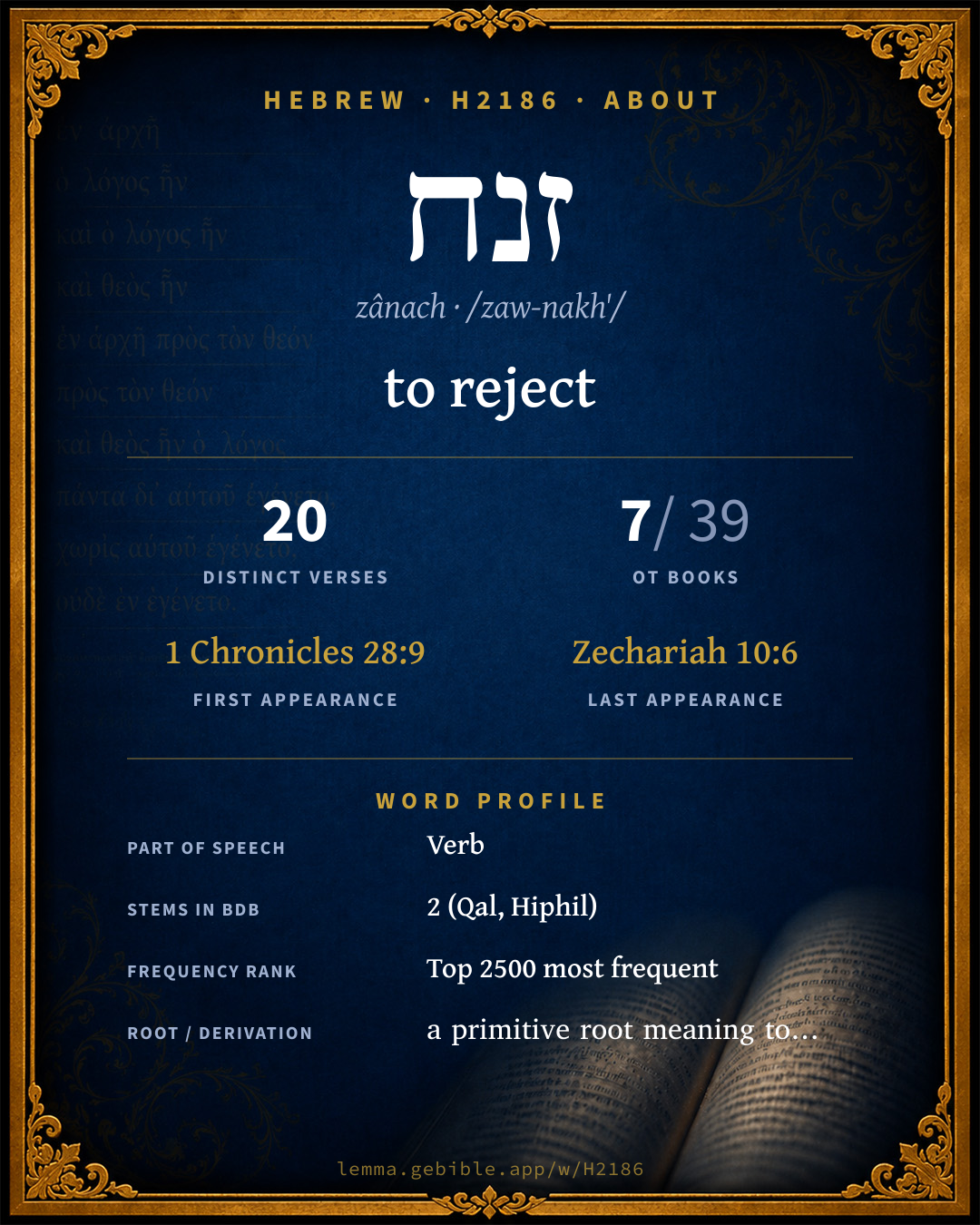
זָנַח
to reject
‘to reject’ is one of 2 main senses fuller range ↓
Full lexicon entry — Brown-Driver-Briggs (BDB)
From Brown-Driver-Briggs (BDB)
Where this word appears
See every Qal verb in the Hebrew Bible →
Grammar key — what these labels mean
Part of speech
- Verb
- An action or state-of-being word.
Stem
- Qal
- The basic, simple active stem — the plain form of the verb (“he wrote”).
- Hiphil
- The causative active stem (“he caused / brought about”).
Form
- Perfect
- A completed action or state — Hebrew marks aspect (completeness) more than strict tense (“he wrote”).
- Imperfect
- An incomplete, ongoing, or future action (“he will / would write”).
- Sequential Perfect
- A perfect with prefixed waw continuing a preceding imperfect or command (waw-consecutive perfect).
- Sequential Imperfect
- An imperfect with prefixed waw — the standard past-narrative form (waw-consecutive imperfect).
- Jussive
- A third- or second-person volitional form expressing wish or command (“let him write”).
Person
- 2nd Person
- The one addressed (“you”).
- 3rd Person
- The one spoken about (“he / she / it / they”).
- 1st Person
- The speaker (“I / we”).
Gender
- Masculine
- Grammatically masculine.
- Common
- Either gender — not distinguished for this form.
- Feminine
- Grammatically feminine.
Number
- Singular
- One.
- Plural
- More than one (in Hebrew, generally three or more).
Grammatical forms 10 distinct
- Verb, Qal, Perfect, 2nd Person, Masculine, Singular 7 times (35%)
- Verb, Qal, Perfect, 3rd Person, Masculine, Singular 3 times (15%)
- Verb, Qal, Imperfect, 3rd Person, Masculine, Singular 2 times (10%)
- Verb, Hiphil, Perfect, 3rd Person, Masculine, Singular 2 times (10%)
- Verb, Hiphil, Sequential Perfect, 3rd Person, Common, Plural 1 time (5%)
- Verb, Qal, Sequential Imperfect, 3rd Person, Feminine, Singular 1 time (5%)
- Verb, Hiphil, Imperfect, 3rd Person, Masculine, Singular 1 time (5%)
- Verb, Qal, Imperfect, 2nd Person, Masculine, Singular 1 time (5%)
+2 more forms (2 occurrences)
Parsed forms decoded from the imported morphology (morphhb / Westminster Leningrad Codex — WLC text public domain, morphhb tagging CC BY 4.0), counted across 20 parsed occurrences — not distinct verses.
Every verse where H2186 appears — 20 distinct verses across 7 books. Click any verse to open its interlinear word-by-word view. Verse text shown in the World English Bible for context — . Each verse’s Hebrew form is shown with its reference; the English is not keyword-highlighted, since the data carries no word-level English alignment. Use “Compare translations” on any verse to read it across multiple English versions. This concordance covers the Hebrew Bible; Septuagint (Greek Old Testament) occurrences are not indexed here.
1 Chronicles 1 verse
2 Chronicles 2 verses
- 2 Chronicles 11:14 הִזְנִיחָ֤/ם Hiphil pf 3ms + sfx pers 3mp For the Levites left their suburbs and their possession, and came to Judah and Jerusalem: for Jeroboam and his sons cast them off, that they should not execute the priest's office to Yahweh;
- 2 Chronicles 29:19 הִזְנִיחַ֩ Hiphil pf 3ms Moreover all the vessels, which king Ahaz in his reign did cast away when he trespassed, have we prepared and sanctified; and, behold, they are before the altar of Yahweh.
Psalms 10 verses
- Psalms 43:2 זְנַ֫חְתָּ֥/נִי Qal pf 2ms + sfx pers 1cs For you are the God of my strength. Why have you rejected me? Why do I go mourning because of the oppression of the enemy?
- Psalms 44:9 זָ֭נַחְתָּ Qal pf 2ms But now you rejected us, and brought us to dishonor, And don't go out with our armies.
- Psalms 44:23 תִּזְנַ֥ח Qal juss 2ms Wake up! Why do you sleep, Lord? Arise! Don't reject us forever.
- Psalms 60:1 זְנַחְתָּ֣/נוּ Qal pf 2ms + sfx pers 1cp God, you have rejected us. You have broken us down. You have been angry. Restore us, again.
- Psalms 60:10 זְנַחְתָּ֑/נוּ Qal pf 2ms + sfx pers 1cp Haven't you, God, rejected us? You don't go out with our armies, God.
- Psalms 74:1 זָנַ֣חְתָּ Qal pf 2ms God, why have you rejected us forever? Why does your anger smolder against the sheep of your pasture?
- Psalms 77:7 יִזְנַ֥ח Qal impf 3ms "Will the Lord reject us forever? Will he be favorable no more?
- Psalms 88:14 תִּזְנַ֣ח Qal impf 2ms Yahweh, why do you reject my soul? Why do you hide your face from me?
- Psalms 89:38 זָ֭נַחְתָּ Qal pf 2ms But you have rejected and spurned. You have been angry with your anointed.
- Psalms 108:11 זְנַחְתָּ֑/נוּ Qal pf 2ms + sfx pers 1cp Haven't you rejected us, God? You don't go forth, God, with our armies.
Isaiah 1 verse
Lamentations 3 verses
- Lamentations 2:7 זָנַ֨ח Qal pf 3ms The Lord has cast off his altar, he has abhorred his sanctuary; He has given up into the hand of the enemy the walls of her palaces: They have made a noise in the house of Yahweh, as in the day of a solemn assembly.
- Lamentations 3:17 וַ/תִּזְנַ֧ח conj + Qal wimpf 3fs You have removed my soul far off from peace; I forgot prosperity.
- Lamentations 3:31 יִזְנַ֛ח Qal impf 3ms For the Lord will not cast off forever.
Hosea 2 verses
Zechariah 1 verse
About this entry
At a glance — auto-summarized from this page’s data, not written by a person. Every figure links to its source below. This summary describes the numbers; it doesn’t interpret them.
זנח (zânach) is a Hebrew verb most often rendered “to reject.” It clusters heavily in Psalms, which alone accounts for 50% of its uses. It turns up in 20 verses across 7 books, an uncommon footprint. It first appears in 1 Chronicles 28:9. Different stems carry different senses — BDB groups them under 2 stems, among them Qal and Hiphil. For the data behind this summary, explore the sense tree and the renderings breakdown below.
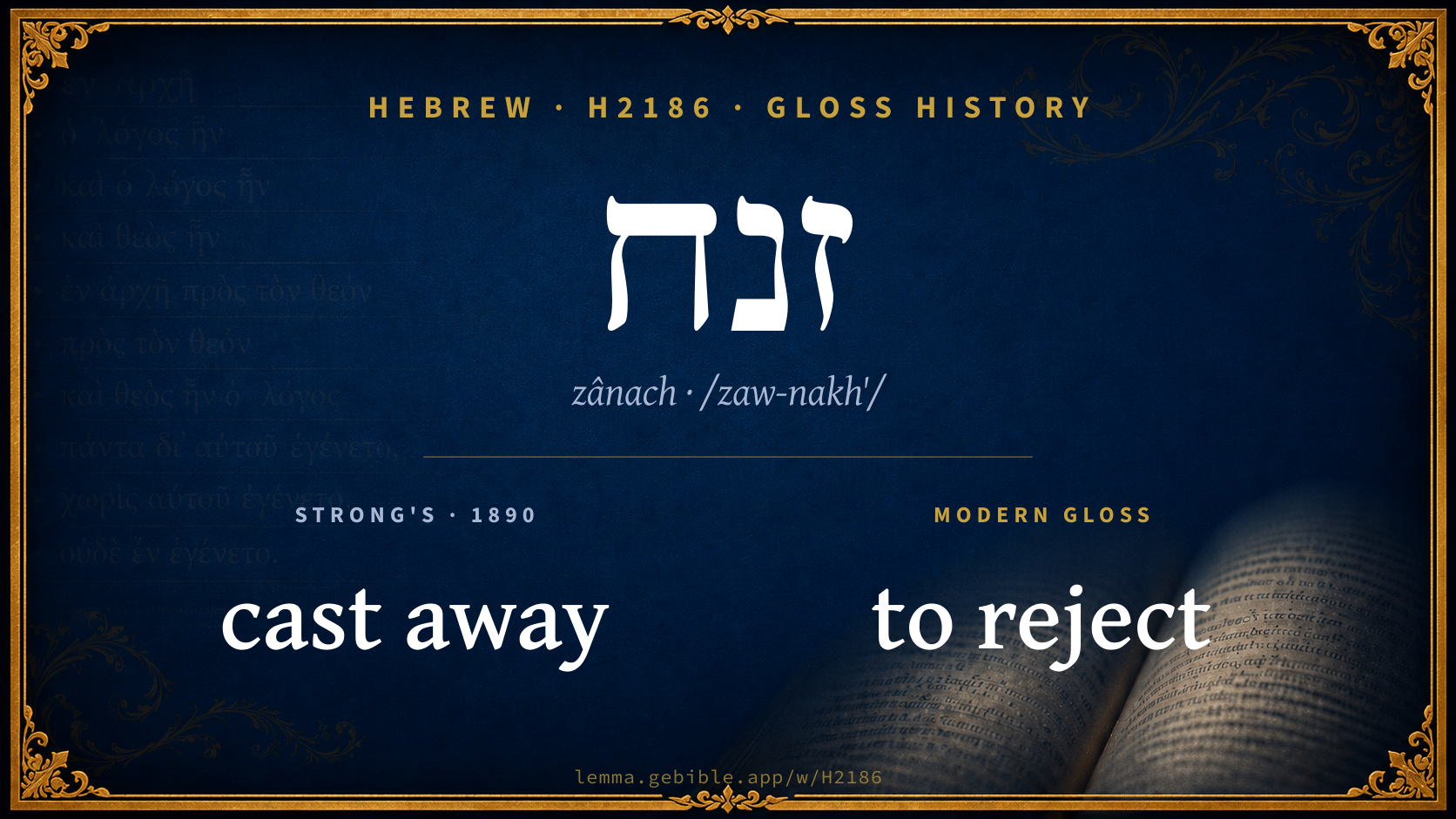
Gloss history
Strong's 1890 vs modern scholarship
About this word
Strong's H2186 catalogs a Hebrew word from the Hebrew Old Testament.
These counts are not copied from any lexicon or concordance. They are computed here, from the morphology-tagged Hebrew Old Testament. What Lemma adds →
- 20
- distinct verses
- The word appears in 20 distinct verses.
- 7 / 39
- OT books
- The word appears in 7 of 39 Old Testament books.
- #1,513
- by frequency
- Top 2500 most frequent Hebrew words (rank 1,513 of 8,640 Hebrew words by occurrence).
View all 20 occurrences in the concordance →
Most concentrated in
- Psalms 10 verses 50%
- Lamentations 3 verses 15%
- 2 Chronicles 2 verses 10%
By section of the Old Testament
By traditional corpus
Conventional, traditional groupings — biblical authorship is debated, so this is a traditional corpus grouping, not an authorship claim. Each share is this word’s portion of its verses in that division of the Hebrew canon. Each figure is a share of the word’s 20 distinct verses.
- Writings (Ketuvim) 16 verses · 80%
- Prophets (Nevi'im) 4 verses · 20%
How translations render this word
Counts come from each version’s own published word-to-Strong’s tagging or interlinear alignment — an approximate guide to how each version renders this word, not a word-level alignment the data otherwise carries. Because each total is that version’s own tagged count, the per-version totals vary from one another and need not match the appearance or distinct-verse counts above. These counts may also differ from a printed concordance because Lemma counts each distinctly tagged rendering and does not collapse phrase taggings into a single head-word total. This is a fixed set of word-tagged versions (KJV, ASV, BSB, ULT) and does not change with the reading translation you choose elsewhere. Each version’s license is shown beside its name below (and on Sources).
BDB lists this Strong’s number as 2 distinct words (homographs). Each count above pools all of them and is not split by sense — see the Senses section below. A low-frequency rendering may belong to a different one of those words, not the primary meaning.
- King James Version†: Hath cast off 2×, Thou hast cast off 2×
- American Standard Version†: Hath cast off 2×
- Berean Standard Bible†: Has rejected 2×, Rejected us 2×
- unfoldingWord Literal Text†: Reject 3×, And 2×, Has rejected 2×
King James Version Public Domain
Renders H2186 across 22† tagged occurrences — most commonly:
Plus 18 renderings that appear only once — usually multi-word phrases or single function words the recovered tagging swept in, not distinct renderings.
American Standard Version Public Domain
Renders H2186 across 22† tagged occurrences — most commonly:
Plus 20 renderings that appear only once — usually multi-word phrases or single function words the recovered tagging swept in, not distinct renderings.
Berean Standard Bible Public Domain
Renders H2186 across 20† tagged occurrences — most commonly:
Plus 16 renderings that appear only once — usually multi-word phrases or single function words the recovered tagging swept in, not distinct renderings.
unfoldingWord Literal Text CC BY-SA 4.0
Renders H2186 across 28† tagged occurrences — most commonly:
Plus 15 renderings that appear only once — usually multi-word phrases or single function words the recovered tagging swept in, not distinct renderings.
Senses in the full BDB
Hebrew verbs can shift meaning by stem (binyan): Qal is the basic action, Niphal is often passive or reflexive, Piel often intensifies or makes it factitive, and Hiphil is typically causative. The senses below are grouped under the stem BDB assigns to each.
What do BDB’s symbols mean?
BDB uses these scholarly abbreviations:
| Symbol | Meaning |
|---|---|
| 𝔊 | the Septuagint (the ancient Greek translation, LXX) |
| 𝔙 | the Vulgate (the Latin translation) |
| 𝔖 | the Syriac version (the Peshitta) |
| 𝔗 | the Targum (the Aramaic translation) |
| ψ | the Psalms |
| √ | root (the underlying root or stem) |
| ‖ | parallel passage (a synonymous or contrasted parallel) |
| † | the dagger: every passage where the word occurs is cited |
The 2 senses and sub-senses the full Brown-Driver-Briggs lexicon distinguishes for this word, in lexicon order (not ranked by frequency), with BDB’s own verbatim wording and sub-sense lettering. Shown in Hebrew script with BDB’s own scholarly abbreviations. The condensed entry is in the Lexicon Entry tab. See also the Forms in the corpus table below.
זנח I reject, spurn (Arabic زَنَحَ repelled
Qal
- Pf. ז׳ Ho 8:3, 5 La 2:7; זָנַחְתָּ ψ 44:10 + 2 times; sf. זְנַחְתָּ֑נִי ψ 43:2; וְנַחְתָּנוּ ψ 60:3, 12; 108:12; זְנַחְתִּים Zc 10:6; Impf. יִזְנַח ψ 77:8 La 3:31; תִּזְנַח ψ 44:24 + 2 times;—reject, Isr. rejects good Ho 8:3; Samaria’s calf rejects her Ho 8:5 (others make י׳ subj.; WeKl. Proph. reads אזנח I reject), elsewhere God rejects people ψ 43:2; 60:3; 77:8; 88:15 Zc 10:6; לָנֶצַח ψ 44:24; 74:1; לעולם La 3:31; ז׳ ולא תצא בצבאתינו ψ 44:10; 60:12; 108:12; נַפְשִׁי מִשָּׁלוֹם La 3:17; king ψ 89:39; altar La 2:7. e.g. Hosea 8:3
Hiphil
- Pf. הִזְנִיחַ 2 Ch 29:19; sf. הִזְנִיחָם 2 Ch 11:14; 3 pl. הֶאֶזְנִיחוּ Is 19:6, v. II. זנח; Impf. יַזְנִיחֲךָ 1 Ch 28:9;—(late) reject (= earlier Qal), Jeroboam rejects the Levites מכהן לי׳ 2 Ch 11:14; Ahaz the sacred vessels 2 Ch 29:19; י׳ rejects Solomon 1 Ch 28:9. e.g. 2 Chronicles 29:19
זנח II stink, emit stench (cf. Arabic زَنَخَ become rancid, of oil, etc., Lane)
Senses from the full Brown-Driver-Briggs lexicon (Brown, Driver, Briggs; Oxford 1906 — public domain), digitized via Sefaria, supplemented by the OpenScriptures HebrewLexicon (CC BY 4.0). Full attribution on Sources.
Word origin
I. vb. reject, spurn (Arabic زَنَحَ repelled; Assyrian zinû, to be angry not connected)—
II. stink, emit stench (cf. Arabic زَنَخَ become rancid, of oil, etc., Lane);—only Hiph. Pf. 3 mpl. הֶאֶזְנִיחוּ נְהָרוֹת rivers stink Is 19:6 (read הִזְנִיחוּ Ges§ 53, 6 Ol§ 255 b Sta§ 420 a Köi 293; but Ew§ 126 b De Di derive from elative אַזְנָח or אֶזְנָח).
— Brown-Driver-Briggs (Oxford 1906, public domain), digitized via Sefaria, supplemented by the OpenScriptures HebrewLexicon (CC BY 4.0). See Sources.
Origin: a primitive root meaning to push aside
Jastrow Dictionary
A second Hebrew/Aramaic lexicon for comparison, covering Aramaic and post-biblical (Talmudic, Targumic, Midrashic) usage that the biblical-Hebrew BDB does not. Matched by lemma rather than by Strong’s number, so a lemma may carry more than one Jastrow headword (shown separately below), and the entries cover usage well beyond the Bible.
זָנַח
- (b. h.) to glisten (cmp. דנח) to be fat; to be greasy, foul (cmp. meanings of זהם, צחן, v. Ges. Thes. s. v. זנח);
- 1. (act. verb) to loathe. Midr. Till. to Ps. LX; Yalk. Ps. 777 אני זָנַחְתִּי אתכם אתם זְנַחְתֶּם אותי did I loathe you? You loathed me.
- 2. to be loth. Pesik. R. s. 41 (ref. to זונה, Ps. LXXIII, 27) שרחקו וזָנְחוּ הימך because they removed themselves from and were loth of Thee. e.g. Psalms 73:27
- 1. to declare rejectable, unclean; (cmp. זהם) to reject; (cmp. סאב, רחק) to remove. Ḥull. 7ᵃ אין מַזְנִיחִין אותו we must not detest him (remove him from college). Pesik. R. l. c. מַזְנִיחִים עצמם הימך they (through their sins) remove themselves from thee.
- 2. to polish, cleanse. Lev. R. s. l, beg. (ref. to אבי זנוח) I Chr. IV, 18) that is Moses שהיה אב למַזְנִיחִים שהִזְנִיחָם מע"ז for he was the father of the cleaners, for he cleansed them from idolatry; Yalk. ib. 428. e.g. 1 Chronicles 4:18
- to make glistening, to stroke, dress. Num. R. s. 20; Tanḥ. Balak 12 באתי … זִנַּחְתִּיהָ I had come to kill her, and now I had to polish her up; (Tanḥ. ed. Bub. ib. 20 זיניתה; Yalk. Num. 768, Matt. K. to Num. R. l. c. quotes in Tanḥ. l. c. דכיתיה).
זנח
- , Targ. Ps. XV, 5 יזנח ed. Lag., read יזוּחַ or יזוּעַ.
A Dictionary of the Targumim, the Talmud Babli and Yerushalmi, and the Midrashic Literature (Marcus Jastrow; London, Luzac, 1903) — Public Domain. Digitized via Sefaria. Digitized via Sefaria. Full attribution on Sources.
Forms in the corpus
The 18 distinct written forms H2186 takes in the Hebrew Bible, most frequent first — each parse links to that stem’s occurrences in the concordance. Hebrew forms include their vowel points and cantillation, so a single lemma takes many written forms.
Same root — word family
Other BDB entries built from the same root as H2186, grouped by Strong’s listed origin. These share a root / origin per the lexicon — not necessarily a shared meaning. Each links to that word’s own entry.
Proper names from this root
People and places named from this root — a name, not an additional meaning of the word.
Compare all same-root words → 1 of the same-root words is a proper name (a person or place). They share a root, not necessarily a meaning.
Septuagint verse parallels
This word appears in 17 verses that also exist in the Greek Old Testament (Septuagint), out of the 20 Hebrew verses it occurs in. You can read those verses in Greek by switching the Old Testament edition to the Septuagint.
Read these verses in the Septuagint
- 1 Chronicles 28:9
- 2 Chronicles 11:14
- Psalms 43:2
- Isaiah 19:6
- Lamentations 2:7
- Hosea 8:3
- Zechariah 10:6
This is a verse-level parallel only — the same verses exist in both the Hebrew and Greek Old Testaments. No word-level Hebrew↔Greek correspondence is claimed: the data carries no such alignment, so no Greek word is shown as this Hebrew word’s translation. Coverage is not total — the Septuagint omits the deuterocanon and renumbers the Psalms, so some Hebrew verses have no direct Greek parallel.