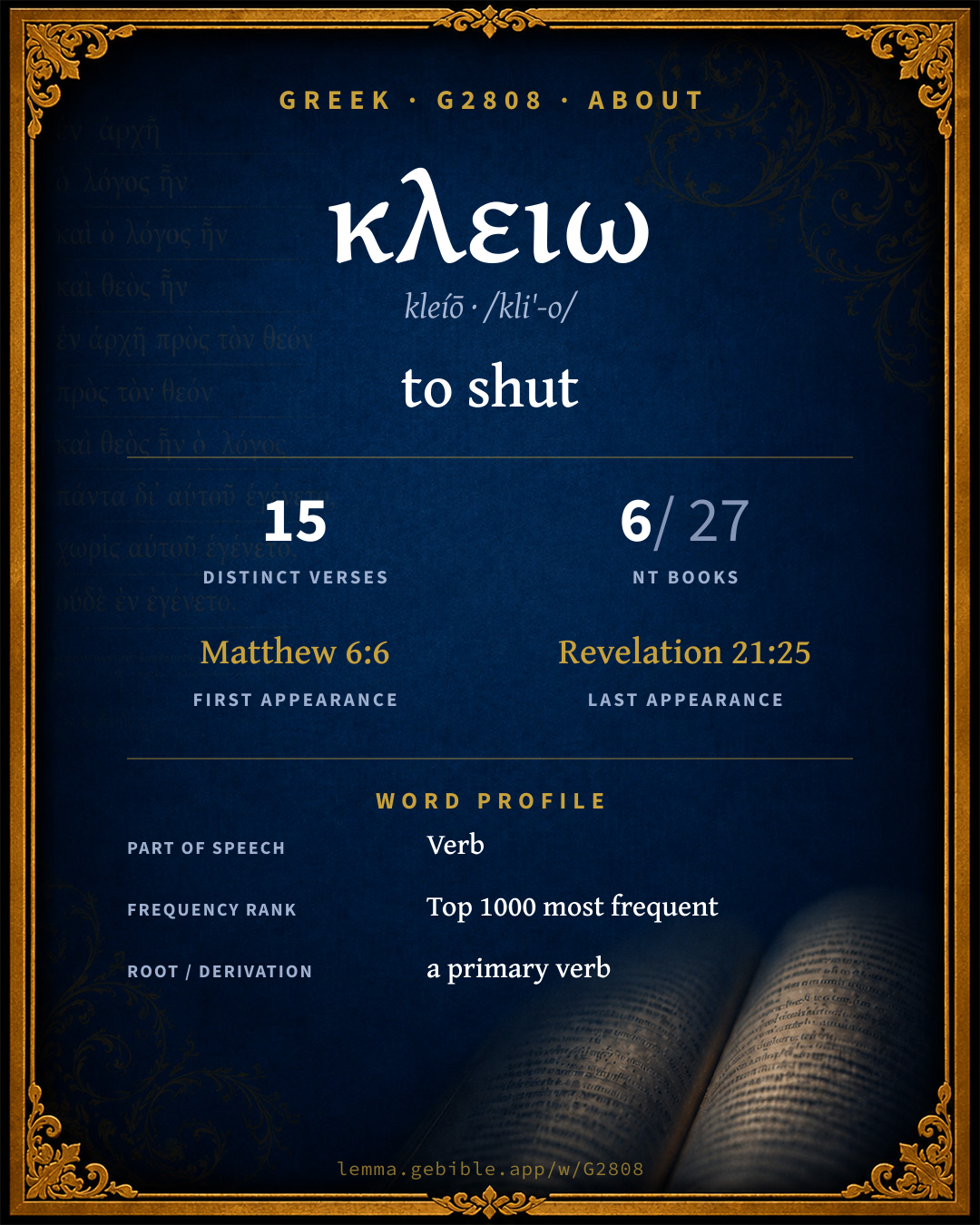
κλείω
to shut
‘to shut’ is one of 2 main senses fuller range ↓
Full lexicon entry — Thayer's Greek Lexicon
From Thayer's Greek Lexicon
Where this word appears
See every Aorist-tense verb in the Greek New Testament →
Grammar key — what these labels mean
Part of speech
- Verb
- An action or state-of-being word.
Tense
- Aorist
- Action viewed as a simple whole, without regard to duration — often past (perfective aspect).
- Perfect
- A completed past action with continuing present results.
- Future
- Action expected in future time.
- Present
- Ongoing or general action in present time (imperfective aspect).
Voice
- Active
- The subject performs the action.
- Passive
- The subject receives the action.
Mood
- Infinitive
- A verbal noun (“to write”), unmarked for person or number.
- Indicative
- States a fact or asks a factual question (the mood of reality).
- Participle
- A verbal adjective (“writing,” “having written”).
- Subjunctive
- Expresses probability, purpose, or possibility (the mood of contingency).
Case
- Genitive
- The case of source, possession, or “of” — answers “whose / from what.”
- Nominative
- The case of the subject (and the predicate nominative).
- Accusative
- The case of the direct object and of extent.
Person
- 3rd person
- The one spoken about (“he / she / it / they”).
- 2nd person
- The one addressed (“you”).
Gender
- Feminine
- Grammatically feminine.
- Masculine
- Grammatically masculine.
- Neuter
- Grammatically neuter.
Number
- Singular
- One.
- Plural
- More than one.
Grammatical forms 13 distinct
- Verb, Aorist, Active, Infinitive 2 times (13%)
- Verb, Aorist, Passive, Indicative, 3rd person, Singular 2 times (13%)
- Verb, Perfect, Passive, Participle, Genitive, Plural, Feminine 2 times (13%)
- Verb, Aorist, Active, Indicative, 3rd person, Singular 1 time (6%)
- Verb, Aorist, Active, Participle, Nominative, Singular, Masculine 1 time (6%)
- Verb, Aorist, Active, Subjunctive, 3rd person, Singular 1 time (6%)
- Verb, Aorist, Passive, Indicative, 3rd person, Plural 1 time (6%)
- Verb, Aorist, Passive, Subjunctive, 3rd person, Plural 1 time (6%)
+5 more forms (5 occurrences)
Parsed forms decoded from the imported morphology (Robinson–Tischendorf, public domain), counted across 16 parsed occurrences — not distinct verses.
Every verse where G2808 appears — 15 distinct verses across 6 books. Click any verse to open its interlinear word-by-word view. Verse text shown in the World English Bible for context — . Each verse’s Greek form is shown with its reference; the English is not keyword-highlighted, since the data carries no word-level English alignment. Use “Compare translations” on any verse to read it across multiple English versions. This concordance covers the Greek New Testament; Septuagint (Greek Old Testament) occurrences of this word are not indexed here.
Matthew 3 verses
- Matthew 6:6 κλείσας aor act ptcp nom sg masc But you, when you pray, enter into your inner chamber, and having shut your door, pray to your Father who is in secret, and your Father who sees in secret will reward you openly.
- Matthew 23:13 κλείετε pres act ind 2pl "Woe to you, scribes and Pharisees, hypocrites! For you devour widows' houses, and as a pretense you make long prayers. Therefore you will receive greater condemnation.
- Matthew 25:10 ἐκλείσθη aor pass ind 3sg While they went away to buy, the bridegroom came, and those who were ready went in with him to the marriage feast, and the door was shut.
Luke 2 verses
- Luke 4:25 ἐκλείσθη aor pass ind 3sg But truly I tell you, there were many widows in Israel in the days of Elijah, when the sky was shut up three years and six months, when a great famine came over all the land.
- Luke 11:7 κέκλεισται perf pass ind 3sg and he from within will answer and say, 'Don't bother me. The door is now shut, and my children are with me in bed. I can't get up and give it to you'?
John 2 verses
- John 20:19 κεκλεισμένων perf pass ptcp gen pl fem When therefore it was evening, on that day, the first day of the week, and when the doors were locked where the disciples were assembled, for fear of the Jews, Jesus came and stood in the midst, and said to them, "Peace be to you."
- John 20:26 κεκλεισμένων perf pass ptcp gen pl fem After eight days again his disciples were inside, and Thomas was with them. Jesus came, the doors being locked, and stood in the midst, and said, "Peace be to you."
Acts 2 verses
- Acts 5:23 κεκλεισμένον perf pass ptcp acc sg neut "We found the prison shut and locked, and the guards standing before the doors, but when we opened them, we found no one inside!"
- Acts 21:30 ἐκλείσθησαν aor pass ind 3pl All the city was moved, and the people ran together. They seized Paul and dragged him out of the temple. Immediately the doors were shut.
1 John 1 verse
Revelation 5 verses
- Revelation 3:7 κλείσει κλείων fut act ind 3sg pres act ptcp nom sg masc "To the angel of the assembly in Philadelphia write: "He who is holy, he who is true, he who has the key of David, he who opens and no one can shut, and who shuts and no one opens, says these things:
- Revelation 3:8 κλεῖσαι aor act inf "I know your works (behold, I have set before you an open door, which no one can shut), that you have a little power, and kept my word, and didn't deny my name.
- Revelation 11:6 κλεῖσαι aor act inf These have the power to shut up the sky, that it may not rain during the days of their prophecy. They have power over the waters, to turn them into blood, and to strike the earth with every plague, as often as they desire.
- Revelation 20:3 ἔκλεισεν aor act ind 3sg and cast him into the abyss, and shut it, and sealed it over him, that he should deceive the nations no more, until the thousand years were finished. After this, he must be freed for a short time.
- Revelation 21:25 κλεισθῶσιν aor pass subj 3pl Its gates will in no way be shut by day (for there will be no night there),
About this entry
At a glance — auto-summarized from this page’s data, not written by a person. Every figure links to its source below. This summary describes the numbers; it doesn’t interpret them.
The Greek verb κλειω centers on the idea of “to shut.” Debuting at Matthew 6:6, it then recurs through the corpus. Spanning 15 verses in 6 books, it ranks among the uncommon words of the Greek New Testament. Revelation dominates its distribution — 5 of 15 verses. Thayer's distinguishes 2 senses for it. Dig into 15-verse concordance and the renderings breakdown below.
Gloss history
Strong's 1890 vs modern scholarship
About this word
Strong's G2808 catalogs a Greek word from the Greek New Testament.
These counts are not copied from any lexicon or concordance. They are computed here, from the morphology-tagged Greek New Testament. What Lemma adds →
- 15
- distinct verses
- The word appears in 15 distinct verses.
- 6 / 27
- NT books
- The word appears in 6 of 27 New Testament books.
- #726
- by frequency
- Top 1000 most frequent Greek words (rank 726 of 5,347 Greek words by occurrence).
View all 15 occurrences in the concordance →
Most concentrated in
- Revelation 5 verses 33%
- Matthew 3 verses 20%
- Luke 2 verses 13%
By section of the New Testament
By traditional corpus
Conventional, traditional groupings — biblical authorship is debated, so this is a traditional corpus grouping, not an authorship claim. Some books belong to more than one corpus (Luke is in both the Gospels and the Lukan corpus, and so on), so these shares overlap and need not total 100%. Each figure is a share of the word’s 15 distinct verses.
- Johannine 8 verses · 53%
- Gospels 7 verses · 47%
- Revelation 5 verses · 33%
- Lukan (Luke–Acts) 4 verses · 27%
- General (Catholic) Epistles 1 verse · 7%
How translations render this word
Counts come from each version’s own published word-to-Strong’s tagging or interlinear alignment — an approximate guide to how each version renders this word, not a word-level alignment the data otherwise carries. Because each total is that version’s own tagged count, the per-version totals vary from one another and need not match the appearance or distinct-verse counts above. These counts may also differ from a printed concordance because Lemma counts each distinctly tagged rendering and does not collapse phrase taggings into a single head-word total. This is a fixed set of word-tagged versions (KJV, ASV, BSB, ULT) and does not change with the reading translation you choose elsewhere. Each version’s license is shown beside its name below (and on Sources).
- King James Version: Shut 5×, Shutteth 2×, Were shut 2×
- American Standard Version: Shut 5×
- Berean Standard Bible: Shut 5×, Locked 3×, Was shut 2×
- unfoldingWord Literal Text: Having been closed 2×, Shut 2×
King James Version Public Domain
Renders G2808 across 19 tagged occurrences — most commonly:
Plus 10 renderings that appear only once — usually multi-word phrases or single function words the recovered tagging swept in, not distinct renderings.
American Standard Version Public Domain
Renders G2808 across 17 tagged occurrences — most commonly:
Plus 12 renderings that appear only once — usually multi-word phrases or single function words the recovered tagging swept in, not distinct renderings. Not rendered by a distinct English word in 1 further occurrence.
Berean Standard Bible Public Domain
Renders G2808 across 16 tagged occurrences — most commonly:
Plus 6 renderings that appear only once — usually multi-word phrases or single function words the recovered tagging swept in, not distinct renderings.
unfoldingWord Literal Text CC BY-SA 4.0
Renders G2808 across 18 tagged occurrences — most commonly:
Plus 14 renderings that appear only once — usually multi-word phrases or single function words the recovered tagging swept in, not distinct renderings.
Senses in Thayer's
The 2 senses Thayer's distinguishes for this word, in lexicon order (not ranked by frequency or importance). The full entry — with sub-senses — is in the Lexicon Entry tab.
- to shut, shut up
- metaph.
Word origin
Origin: a primary verb
A primary verb; to close (literally or figuratively): - shut (up).
— Strong’s Exhaustive Concordance (1890), public domain.
Forms in the corpus
The 13 distinct written forms G2808 takes in the Greek New Testament, most frequent first — each parse links to that tense’s occurrences in the concordance.
Same root — word family
Other Thayer's entries built from the same root as G2808, grouped by Strong’s listed origin. These share a root / origin per the lexicon — not necessarily a shared meaning. Each links to that word’s own entry.
Derived from this word
Compare all same-root words → They share a root, not necessarily a meaning.
Septuagint usage
The same Greek word κλειω appears 21 times in the Greek Old Testament (Septuagint), across 19 verses in 11 books.
- 21
- LXX occurrences
- Tagged occurrences of this Greek word in the Septuagint.
- 19
- verses
- Distinct Septuagint verses containing this word.
- 11 / 39
- OT books
- The word appears in 11 of the 39 Old Testament books.
Sample Septuagint occurrences
- Genesis 7:16 κλείω
- Joshua 2:5 κλείω
- Judges 9:51 κλείω
- 1 Samuel 23:20 κλείω
- 2 Chronicles 28:24 κλείω
- Ezra 16:10 κλείω
- Job 12:14 κλείω
- Ecclesiastes 12:4 κλείω
- Song of Solomon 4:12 κλείω
- Isaiah 24:10 κλείω
- Ezekiel 44:1 κλείω
Septuagint occurrences (same lexeme)
Every verse where the same Strong’s number (G2808) appears in the Greek Septuagint. Verse text shown in the World English Bible for context; the Greek form is the matched word — the English is not keyword-highlighted.
- Genesis 7:16 κλείω Those who went in, went in male and female of all flesh, as God commanded him; and Yahweh shut him in.
- Joshua 2:5 κλείω and it happened about the time of the shutting of the gate, when it was dark, that the men went out; where the men went I don't know: pursue after them quickly; for you will overtake them.
- Joshua 2:7 κλείω The men pursued after them the way to the Jordan to the fords: and as soon as those who pursued after them were gone out, they shut the gate.
- Judges 9:51 κλείω But there was a strong tower within the city, and there fled all the men and women, and all they of the city, and shut themselves in, and got them up to the roof of the tower.
- 1 Samuel 23:20 κλείω Now therefore, O king, come down, according to all the desire of your soul to come down; and our part shall be to deliver him up into the king's hand.
- 2 Chronicles 28:24 κλείω Ahaz gathered together the vessels of the house of God, and cut in pieces the vessels of the house of God, and shut up the doors of the house of Yahweh; and he made him altars in every corner of Jerusalem.
- Ezra 16:10 κλείω
- Ezra 17:3 κλείω
- Ezra 23:19 κλείω
- Job 12:14 κλείω Behold, he breaks down, and it can't be built again; He imprisons a man, and there can be no release.
- Ecclesiastes 12:4 κλείω And the doors shall be shut in the street; When the sound of the grinding is low, And one shall rise up at the voice of a bird, And all the daughters of music shall be brought low;
- Song of Solomon 4:12 κλείω A locked up garden is my sister, my bride; A locked up spring, A sealed fountain.
- Isaiah 24:10 κλείω The waste city is broken down; every house is shut up, that no man may come in.
- Isaiah 60:11 κλείω Your gates also shall be open continually; they shall not be shut day nor night; that men may bring to you the wealth of the nations, and their kings led captive.
- Ezekiel 44:1 κλείω Then he brought me back by the way of the outer gate of the sanctuary, which looks toward the east; and it was shut.
- Ezekiel 44:2 κλείω Yahweh said to me, This gate shall be shut; it shall not be opened, neither shall any man enter in by it; for Yahweh, the God of Israel, has entered in by it; therefore it shall be shut.
- Ezekiel 46:1 κλείω Thus says the Lord Yahweh: The gate of the inner court that looks toward the east shall be shut the six working days; but on the Sabbath day it shall be opened, and on the day of the new moon it shall be opened.
- Ezekiel 46:2 κλείω The prince shall enter by the way of the porch of the gate outside, and shall stand by the post of the gate; and the priests shall prepare his burnt-offering and his peace-offerings, and he shall worship at the threshold of the gate: then he shall go forth; but the gate shall not be shut until the evening.
- Ezekiel 46:12 κλείω When the prince shall prepare a freewill-offering, a burnt offering or peace-offerings as a freewill-offering to Yahweh, one shall open for him the gate that looks toward the east; and he shall prepare his burnt offering and his peace-offerings, as he does on the Sabbath day: then he shall go forth; and after his going forth one shall shut the gate.
These are occurrences of the same Greek lexeme (G2808) in the Septuagint — not a translation of any one Hebrew word. The store carries no word-level Hebrew↔Greek alignment, so no Hebrew original is asserted here. Counts come from the recovered LXX Strong's tagging — high-frequency vocabulary is well covered, while rare or late forms may be untagged — so they reflect tagged occurrences and may slightly undercount.