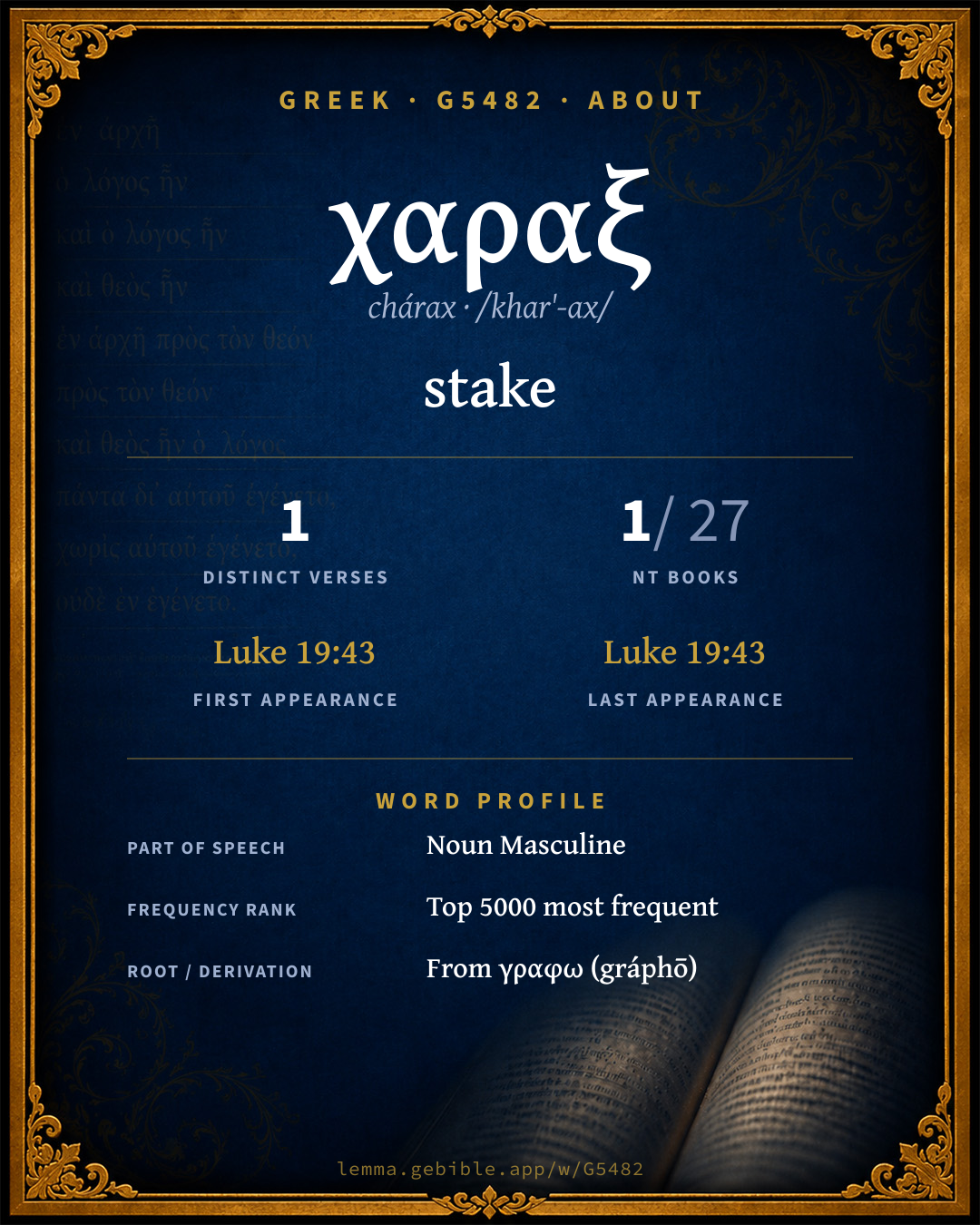
χάραξ
stake
‘stake’ is one of 2 main senses fuller range ↓
Full lexicon entry — Thayer's Greek Lexicon
From Thayer's Greek Lexicon
Where this word appears
Grammar key — what these labels mean
Part of speech
- Noun
- A naming word — a person, place, thing, or idea.
Case
- Accusative
- The case of the direct object and of extent.
Gender
- Masculine
- Grammatically masculine.
Number
- Singular
- One.
Every verse where G5482 appears — 1 distinct verse across 1 book. Click any verse to open its interlinear word-by-word view. Verse text shown in the World English Bible for context — . Each verse’s Greek form is shown with its reference; the English is not keyword-highlighted, since the data carries no word-level English alignment. Use “Compare translations” on any verse to read it across multiple English versions. This concordance covers the Greek New Testament; Septuagint (Greek Old Testament) occurrences of this word are not indexed here.
Luke 1 verse
About this entry
At a glance — auto-summarized from this page’s data, not written by a person. Every figure links to its source below. This summary describes the numbers; it doesn’t interpret them.
At its core, χαραξ (chárax) means “stake.” The Greek New Testament uses it only 1 verse. Its uses cluster heavily in Luke (100% of all occurrences). Found nowhere else but Luke 19:43. Ranging over 2 senses, it is not a single-sense word. Dig into 1-verse concordance and the renderings breakdown below.
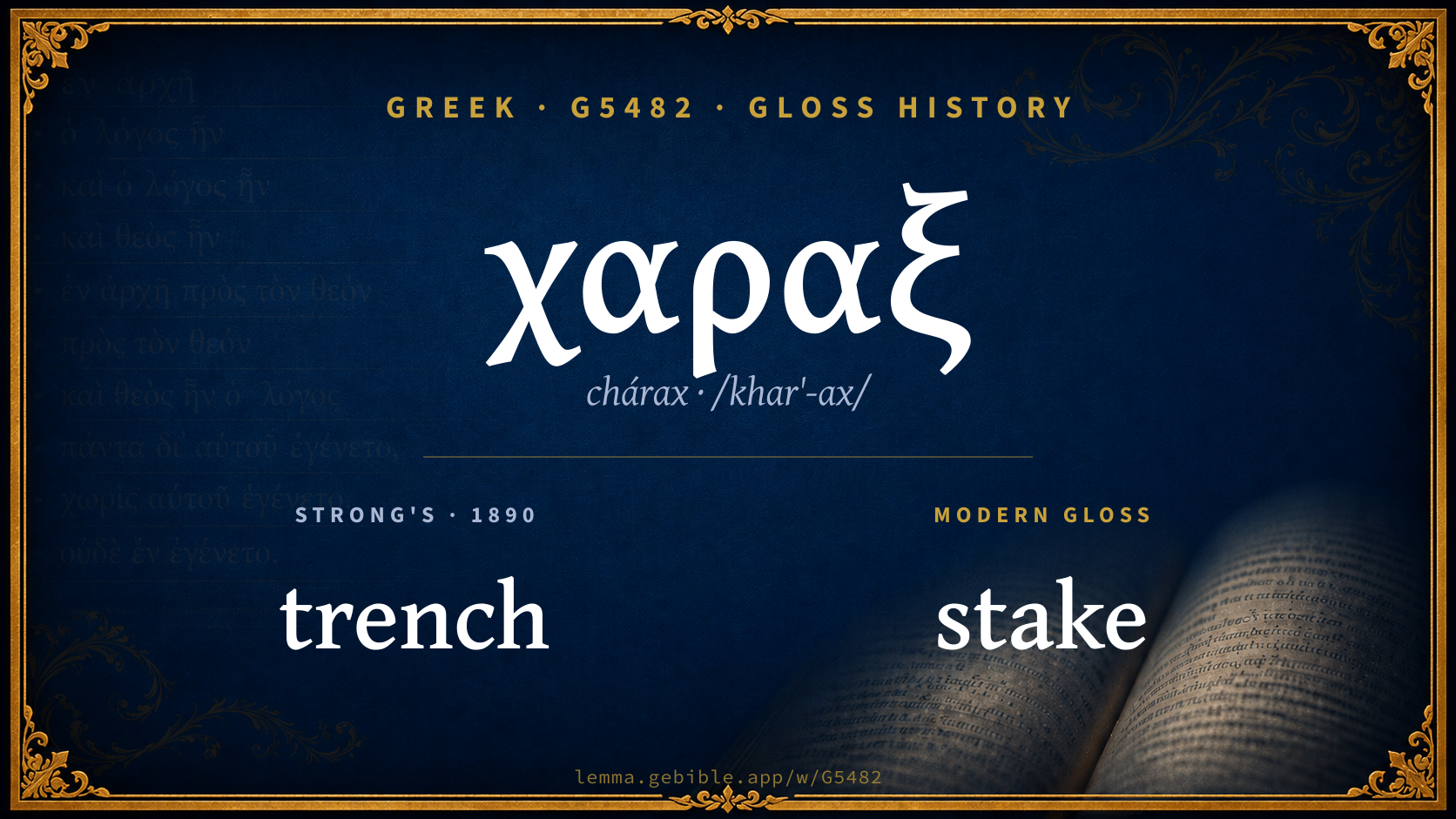
Gloss history
Strong's 1890 vs modern scholarship
About this word
Strong's G5482 catalogs a Greek word from the Greek New Testament.
These counts are not copied from any lexicon or concordance. They are computed here, from the morphology-tagged Greek New Testament. What Lemma adds →
- 1
- distinct verses
- The word appears in 1 distinct verse.
- 1 / 27
- NT books
- The word appears in 1 of 27 New Testament books.
- #3,503
- by frequency
- Top 5000 most frequent Greek words (rank 3,503 of 5,347 Greek words by occurrence).
View all 1 occurrence in the concordance →
Most concentrated in
- Luke 1 verse 100%
By section of the New Testament
By traditional corpus
Conventional, traditional groupings — biblical authorship is debated, so this is a traditional corpus grouping, not an authorship claim. Some books belong to more than one corpus (Luke is in both the Gospels and the Lukan corpus, and so on), so these shares overlap and need not total 100%. Each figure is a share of the word’s 1 distinct verse.
- Gospels 1 verse · 100%
- Lukan (Luke–Acts) 1 verse · 100%
How translations render this word
Counts come from each version’s own published word-to-Strong’s tagging or interlinear alignment — an approximate guide to how each version renders this word, not a word-level alignment the data otherwise carries. Because each total is that version’s own tagged count, the per-version totals vary from one another and need not match the appearance or distinct-verse counts above. These counts may also differ from a printed concordance because Lemma counts each distinctly tagged rendering and does not collapse phrase taggings into a single head-word total. This is a fixed set of word-tagged versions (KJV, ASV, BSB, ULT) and does not change with the reading translation you choose elsewhere. Each version’s license is shown beside its name below (and on Sources).
- King James Version: Trench 1×
- American Standard Version: Up a bank 1×
- Berean Standard Bible: Will barricade 1×
- unfoldingWord Literal Text: Barricade 1×
King James Version Public Domain
Renders G5482 across 1 tagged occurrence — most commonly:
American Standard Version Public Domain
Renders G5482 across 1 tagged occurrence — most commonly:
Berean Standard Bible Public Domain
Renders G5482 across 1 tagged occurrence — most commonly:
unfoldingWord Literal Text CC BY-SA 4.0
Renders G5482 across 1 tagged occurrence — most commonly:
Senses in Thayer's
The 2 senses Thayer's distinguishes for this word, in lexicon order (not ranked by frequency or importance). The full entry — with sub-senses — is in the Lexicon Entry tab.
- a pale or stake, a palisade
- pales between which earth, stones, trees, and timbers are heaped and packed together
Word origin
Derived from γραφω (gráphō) (G1125) — to write.
From charasso (to sharpen to a point; akin to G1125 through the idea of scratching ); a stake that is (by implication) a palisade or rampart (millitary mound for circumvallation in a siege): - trench.
— Strong’s Exhaustive Concordance (1890), public domain.
Same root — word family
Other Thayer's entries built from the same root as G5482, grouped by Strong’s listed origin. These share a root / origin per the lexicon — not necessarily a shared meaning. Each links to that word’s own entry.
Derives from
Shares the same root
Derived from this word
- χαραγμα cháragma G5480 engraved mark
- χαρακτηρ charaktḗr G5481 engraving tool
- χαρτης chártēs G5489 papyrus
Compare all same-root words → Showing 4 of 7 — not the complete family. They share a root, not necessarily a meaning.
Septuagint usage
The same Greek word χαραξ appears 13 times in the Greek Old Testament (Septuagint), across 11 verses in 6 books.
- 13
- LXX occurrences
- Tagged occurrences of this Greek word in the Septuagint.
- 11
- verses
- Distinct Septuagint verses containing this word.
- 6 / 39
- OT books
- The word appears in 6 of the 39 Old Testament books.
Sample Septuagint occurrences
- Deuteronomy 20:19 χάραξ
- 1 Kings 12:24 χάραξ
- Ecclesiastes 9:14 χάραξ
- Isaiah 29:3 χάραξ
- Jeremiah 40:4 χάραξ
- Ezekiel 4:2 χάραξ
Septuagint occurrences (same lexeme)
Every verse where the same Strong’s number (G5482) appears in the Greek Septuagint. Verse text shown in the World English Bible for context; the Greek form is the matched word — the English is not keyword-highlighted.
- Deuteronomy 20:19 χάραξ When you shall besiege a city a long time, in making war against it to take it, you shall not destroy the trees of it by wielding an axe against them; for you may eat of them, and you shall not cut them down; for is the tree of the field man, that it should be besieged of you?
- 1 Kings 12:24 χάραξ Thus says Yahweh, You shall not go up, nor fight against your brothers the children of Israel: return every man to his house; for this thing is of me. So they listened to the word of Yahweh, and returned and went their way, according to the word of Yahweh.
- 1 Kings 21:12 χάραξ They proclaimed a fast, and set Naboth on high among the people.
- Ecclesiastes 9:14 χάραξ There was a little city, and few men within it; and a great king came against it, besieged it, and built great bulwarks against it.
- Isaiah 29:3 χάραξ I will encamp against you round about, and will lay siege against you with posted troops, and I will raise siege works against you.
- Isaiah 31:9 χάραξ His rock shall pass away by reason of terror, and his princes shall be dismayed at the ensign, says Yahweh, whose fire is in Zion, and his furnace in Jerusalem.
- Isaiah 37:33 χάραξ Therefore thus says Yahweh concerning the king of Assyria, He shall not come to this city, nor shoot an arrow there, neither shall he come before it with shield, nor cast up a mound against it.
- Jeremiah 40:4 χάραξ Now, behold, I loose you this day from the chains which are on your hand. If it seem good to you to come with me into Babylon, come, and I will look well to you; but if it seem ill to you to come with me into Babylon, forbear: behold, all the land is before you; where it seems good and right to you to go, there go.
- Ezekiel 4:2 χάραξ and lay siege against it, and build forts against it, and cast up a mound against it; set camps also against it, and plant battering rams against it round about.
- Ezekiel 21:27 χάραξ I will overturn, overturn, overturn it: this also shall be no more, until he come whose right it is; and I will give it [him].
- Ezekiel 26:8 χάραξ He shall kill with the sword your daughters in the field; and he shall make forts against you, and cast up a mound against you, and raise up the buckler against you.
These are occurrences of the same Greek lexeme (G5482) in the Septuagint — not a translation of any one Hebrew word. The store carries no word-level Hebrew↔Greek alignment, so no Hebrew original is asserted here. Counts come from the recovered LXX Strong's tagging — high-frequency vocabulary is well covered, while rare or late forms may be untagged — so they reflect tagged occurrences and may slightly undercount.